Cop
yright
© ABE&M t
odos os dir
eit
os r
eser
vados
.
A case of thyroid hormone
resistance: a rare mutation
Caso de resistência aos hormônios tireóideos: mutação rara
Ana Pires Gonçalves1, José Maria Aragüés1, Ema Nobre1, Ana Paula Barbosa1, Mario Mascarenhas1
SUMMARY
Reduced sensitivity to thyroid hormones (RSTH) is a rare disease that affects about 3,000 indi-viduals, belonging to about 1,000 families. It results from reduced intracellular action of thyroid hormones (TH) genetically determined and manifests as persistent hyperthyroxinemia with non-suppressed thyroid-stimulating hormone (TSH). We describe a 67-years old, Caucasian woman, with past history of subtotal thyroidectomy due to diffuse goiter, who presents with a recurrence of goiter. Although she is clinically euthyroid, laboratory evaluation shows persis-tent hyperthyroxinemia with non-suppressed TSH. Response to thyrotropin releasing hormone (TRH) test was normal and TSH concentrations were not suppressed during oral administration of supraisiologic doses of levothyroxine (L-T4). Peripheral blood DNA was extracted from the patient and a mutation was found localized in cluster one, at codon 346 of the ligand binding do-main of the THRB gene. The patient’s son underwent thyroid function testing (TFT) and genetic study, both negative, suggesting a sporadic mutation. RSTH should be considered in all hyper-thyroxinemic patients who are clinically euthyroid. Mutations interfering with three major steps required for TH action on target tissues have been, so far, identiied (TR-β, TR-α, MCT8, SPB2). Each mutation is associated with a distinctive syndrome. Goal of management is to maintain a normal serum TSH level and a eumetabolic state and offer appropriate genetic counselling and prenatal diagnosis. Inappropriate treatment of eumetabolic patients results in hypothyroidism and need for TH replacement. Arq Bras Endocrinol Metab. 2014;58(9):962-6
SUMÁRIO
A sensibilidade reduzida aos hormônios tiroidianos (RSTH) é uma doença rara que afeta cerca de 3.000 indivíduos em 1.000 famílias. Ela resulta de uma ação intracelular reduzida de hor-mônios tiroidianos (TH), é geneticamente determinada e se manifesta como hipertiroxinemia persistente com hormônio tireoestimulante (TSH) não suprimido. Descrevemos o caso de uma mulher caucasiana de 67 anos de idade com histórico de tiroidectomia subtotal por bócio difu-so e que apresentou recorrência do bócio. Embora ela fosse clinicamente eutiroide, a avaliação laboratorial mostrou hipertiroxinemia persistente com TSH não suprimido. A resposta ao hor-mônio liberador da tireotroina (TRH) foi normal e as concentrações de TSH não foram suprimi-das durante a administração oral de doses supraisiológicas de levotiroxina (L-T4). Foi extraído DNA de sangue periférico da paciente e encontrada uma mutação no cluster um do códon 346 do domínio de ligação do ligante do gene THRB. O ilho da paciente foi submetido a um teste de função da tiroide e a um estudo genético, ambos negativos, o que sugeriu uma mutação espo-rádica. O RSTH deve ser considerado em todos os pacientes hipertiroxinêmicos que sejam clini-camente eutiroides. Foram identiicadas, até hoje, mutações que interferem com os três passos principais necessários para a ação do TH sobre os tecidos-alvo (TR-β, TR-α, MCT8, SPB2). Cada mutação está associada com uma síndrome distinta. O objetivo do manejo é manter o nível sérico normal de TSH e um estado eumetabólico, além de se oferecer aconselhamento genético adequado e diagnóstico pré-natal. O tratamento inadequado de pacientes eumetabólicos leva ao hipotireoidismo e requer reposição de TH. Arq Bras Endocrinol Metab. 2014;58(9):962-6
1 Serviço de Endocrinologia,
Diabetes e Metabolismo do Hospital de Santa Maria, Centro Hospitalar Lisboa Norte, Portugal
Correspondence to:
Ana Pires Gonçalves Rua Sousa Martins, 16 1 C 218-1050 – Lisboa, Portugal [email protected]
Received on Feb/17/2014 Accepted on May/31/2014
Cop
yright
© ABE&M t
odos os dir
eit
os r
eser
vados
.
INTRODUCTION
R
educed sensitivity to thyroid hormones (RSTH) is a rare disease, that affects about 3,000 indivi duals, belonging to about 1,000 families (1).It results from reduced intracellular action of thy roid hormones (TH) genetically determined and mani fests as persistent hyperthyroxinemia with non sup pressed TSH (2,3).
Patients with RTH are usually euthyroid. Occasion ally, they present signs and symptoms of thyrotoxicosis or, rarely, with hypothyroidism.
This condition is found with equal frequency in both genders and has wide geographic distribution hav ing been reported in Caucasians, Africans, and Asians (3,4). The prevalence may vary among different ethnic groups. Familial occurrence of RTH has been docu mented in approximately 75% of cases (3,4).
Eightyive percent of the patients harbour muta tions in the thyroid receptor (TR) beta, and about one hundred of different mutations have been reported so far (3,4). Most patients with RTH present missense mutations located exclusively in ligandbinding domain and hinge domain, most often clustered in three hot spots (exon 810). Investigation failed to demonstrate correlation between the phenotype and location of mu tations in the receptor gene.
The diagnosis requires a high degree of suspicion, and is often delayed or failed, involving inappropriate treatment and morbidity for the patients.
In this article, we present a case of resistance to thy roid hormones, in which genetic testing revealed a rare mutation.
In this context, we review the literature, and high light “pitfalls” in the investigations and treatment of this rare syndrome.
CASE REPORT
We report a case of a 67years old woman, Caucasian, with past history of subtotal thyroidectomy due to dif fuse goiter, who presents with a recurrence of goiter, persistent elevation of serum levels of FT4 and FT3 and nonsuppressed TSH (TSH – 10.1 uU/mL (0.35 – 5.50), FT3 – 6.21 pg/mL (2.3 – 4.2), FT4 – 2.3 ng/dL (0.80 – 2.0). She is clinically euthyroid. There is no family history of goiter or other thyroid abnormali ties. TBG, antiTPO and antiTG were within normal range. Response to TRH test (200 ug) was normal.
During oral administration of supraisiologic doses of L – T4 (50, 100, 200 ug, each given for three days), TSH concentrations were not suppressed.
The goiter is well tolerated and the patient is euthy roid due to compensation of high levels of TSH, so no treatment was initiated.
Genomic DNA was isolated from peripheral blood. Exons 310 and 12 of THRB gene, including the lanking intronic sequences, were ampliied by poly merase chain reaction (PCR) and screened by direct sequencing. Genetic study identiied a heterozygous, missense mutation in exon 10, with c.1293G>A transi tion inducing a replacement of isoleucine for methio nine (p.Ile431Met). The mutation is localized in clus ter one, at codon 346 of the ligand binding domain of the THRB gene.
The patient’s son underwent thyroid function test ing (TFT) and genetic study, both negative, suggesting a sporadic mutation.
DISCUSSION
We described a rare case of RSTH syndrome associated with an infrequent mutation.
The patient has clinical presentation and pattern of thyroid function test (TFT) abnormalities suggestive of RTH syndrome, which was conirmed by genetic test. Reviewing literature, we found a single previous report of a South American women presenting the same muta tion (5).
To our knowledge this is the irst report of this spe ciic mutations in Europe. Although, normally there is no correlation between phenotype and location of mutations in receptor gene, that woman was diagnosed with RTH at the age of 62 years old, and underwent inappropriate subtotal thyroidectomy due to goiter, similarly to our patient.
To avoid missing the diagnosis and inappropriate treatments, RSTH should be considered in all hyper thyroxinemic patients who are clinically euthyroid.
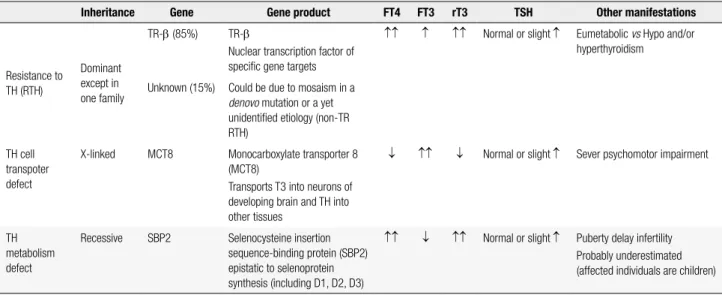
Mutations interfering with three major steps re quired for TH action on target tissues have been iden tiied (TRβ, TRα, MCT8, SPB2) so far (1,69). Each mutation is associated with a distinctive syndrome (Table 1). The TRα gene defect was identiied and re ported only this year in two subjects (1,8,9).
RTH results from mutations of TRβ gene. Twen tyseven percent are de-novo mutations and 73% are
Cop
yright
© ABE&M t
odos os dir
eit
os r
eser
vados
.
In our case report, the patient’s son underwent thy roid function testing (TFT) and genetic study, both negative, and there was no family history of thyroid disease, suggesting a sporadic mutation.
There are two different mutations, as described in igure 1.
The less common, described in only one family, causes RTH by deletion of all coding sequences of the TRβ gene and is inherited as an autosomal recessive trait (3,4). In addition to typical RTH syndrome, these individuals have severe deafness resulting in mutism, and monochromatic vision. Heterozygous individuals for the same mutation have no abnormalities. Although, some TH effects are absolutely isoform speciic, TRβ and TRα are interchangeable to a certain degree. There is no compensatory over expression of the single normal allele of TRβ gene nor that of the TRα gene (3,4).
The most common form of RTH results from mi nor defects, in the ligandbinding domain or hinge domain of the TRβ gene, resulting in impaired T3 binding, attenuated interaction with the coactivator or delay in the corepressor release. Mutant TRβ gene (m TRβ) with impaired T3bindind has a preserved DNAbinding domain and preserved ability to dimer ize with homologous and heterologous partners, so it can interfere with the Wild Type TR (WT TR) function by occupying TH response elements (TRE) on target genes and by engaging WT TRβ in homodimeriza tion, a phenomenon termed dominant negative effect (3,4,10). The reduced amount of wild type TRβ does not produce haploinsuficiency by itself. It requires the dominant negative effect to cause RTH. The dominant negative effect also explains why this trait is inherited in a dominant fashion (3,4,10).
Table 1. Summary of thyroid abnormalities in the known syndromes of reduced sensitivity to thyroid hormone
Inheritance Gene Gene product FT4 FT3 rT3 TSH Other manifestations
Resistance to TH (RTH)
Dominant except in one family
TR-β (85%) TR-β
Nuclear transcription factor of speciic gene targets
↑↑ ↑ ↑↑ Normal or slight ↑ Eumetabolic vs Hypo and/or hyperthyroidism
Unknown (15%) Could be due to mosaism in a
denovo mutation or a yet
unidentiied etiology (non-TR RTH)
TH cell transpoter defect
X-linked MCT8 Monocarboxylate transporter 8 (MCT8)
Transports T3 into neurons of developing brain and TH into other tissues
↓ ↑↑ ↓ Normal or slight ↑ Sever psychomotor impairment
TH metabolism defect
Recessive SBP2 Selenocysteine insertion sequence-binding protein (SBP2) epistatic to selenoprotein synthesis (including D1, D2, D3)
↑↑ ↓ ↑↑ Normal or slight ↑ Puberty delay infertility Probably underestimated (affected individuals are children)
↑: increased; ↓: decreased; TH: thyroid hormone; TR-β: thyroid hormone receptor beta.
Cop
yright
© ABE&M t
odos os dir
eit
os r
eser
vados
.
Most patients with RTH, such as the patient de scribed, present missense mutations located exclusively in ligandbinding domain and hinge domain, most of ten clustered in three hot spots (exon 810) (6).
Failure to identify a TRβ gene mutation in genomic DNA of subjects presenting the RTH phenotype could be due to mosaicism in a de-novo mutation or to a yet un
identiied etiology of the syndrome (nonTR RTH) (4,6). All tissues share reduced sensitivity to TH to variable extent. Differences between tissues are due to absolute and relative levels of TRβ and α expression during dif ferent stages of development. Inter and intrafamilial variation is probably caused by genetically modulated cofactors (3,4,6).
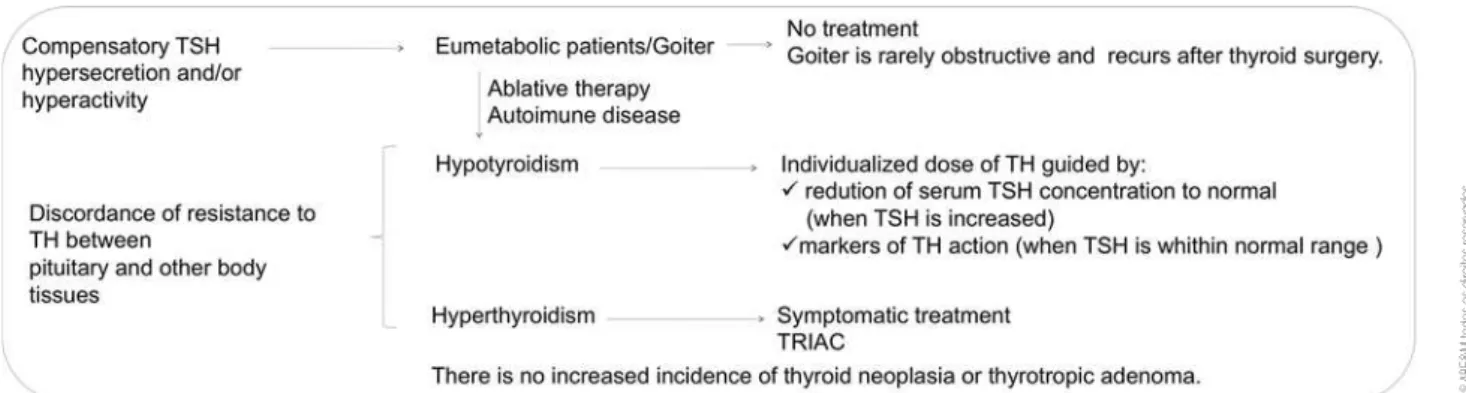
Despite a past history of thyroidectomy, the patient described was euthyroid and presented with recurrence of a small, non obstructive goiter. In this cases, TSH hypersecretion and/or hyperactivity is compensatory, and patients shouldn’t receive treatment (11,12).
When goiter isn’t well tolerated it has been shown that treatment with supraphysiological doses of LT3, given as a single dose every other day, is successful in re ducing goiter size, without causing side effects (11,12). This is the treatment of choice, considering that post operative recurrence of goiter is the rule. The LT3 dose must be adjusted in increments until TSH and TG are suppressed and reduction of goiter size is observed.
Discordance of resistance to TH between pituitary and other body tissues, leads to hypo and/or hyperthy roidism.
Hypothyroidism should be managed with individu alized dose of TH guided by reduction of serum TSH concentration to normal (when TSH is increased) or markers of TH action (when TSH is within normal range) (11).
Parameters representative of peripheral TH action are for example: cholesterol, sex hormonebinding globulin (SHBG), angiotensin converting enzyme (ACE), carboxyterminal crosslinked telopeptide of type I collagen (ICTP), soluble interleukine2 receptor (sIL2r), and osteocalcin (4).
Those who, due to misdiagnosis, have undergone ablative therapy or present concomitant autoimmune disease, and as a consequence have limited thyroid re serve, will be managed as RTH presenting hypothy roidism.
In hyperthyroidism, irst line is symptomatic treat ment (11).
Atenolol is used to manage tachycardia and tremor, antianxiety drugs to alleviate nervousness.
Betablockers noncardio selective should be avoid ed, because they inhibit peripheral T4 to T3 conver sion, thus worsening of the hypothyroidism present in certain tissues.
Among agents with the potential to decrease TH through suppression of TSH, TRIAC, has been suc cessful to reduce goiter size, and alleviate some symp toms, without a thyromimetic effect on peripheral tis sues (compare to LT3, TRIAC is eliminated faster and has high afinity for the β but not α TR) (11).
Goal of management is to maintain a normal serum TSH level and a eumetabolic state and offer appropri ate genetic counseling and prenatal diagnosis. Inappro priate treatment of eumetabolic patients results in hy pothyroidism and need for TH replacement (Figure 2). Although, RTH has been associated to other kind of neoplasia that requires vigilance (thyroid neoplasia, he patocellular carcinoma, renal cell carcinoma…), there is no increased incidence of thyrotropic adenoma. Our pa tient hasn’t present any other neoplasia to the moment.
Cop
yright
© ABE&M t
odos os dir
eit
os r
eser
vados
.
CONCLUSION
Reduced sensitivity to thyroid hormone (RSTH) is more common then formerly suspected (3).
Cellspeciic thyroid hormone (TH) deprivation, suficiency and excess can coexist in syndromes of RSTH.
Goiter and tachycardia are the most common rea sons leading to testing and – ultimately – the diagnosis of RSTH (3).
Laboratory indings are very characteristic, almost pathognomonic, of RSTH (3,4,6).
Genetic analysis of the suspected individuals is a short cut to diagnosis, but absence of a mutation does not rule out the suspected defect, particularly when dealing with mosaicism and nonTR RTH (3,6). In such instances, a biochemical diagnosis should be se cured by measuring the response to incremental doses of LT4 and/or LT3.
Inappropriate treatment in RSTH complicates the follow up and outcome.
Genetic factors, variability of tissue expression of io dothyronine cell membrane transports and intracellular enzymes could explain the lack of phenotype/genotype correlation (6).
Funding: this research did not receive any speciic grant from any funding agency in the public, commercial or notforproit sector.
Disclosure: no potential conlict of interest relevant to this article was reported.
REFERENCES
1. Dumitrescu AM, Refetoff S. The syndromes of reduced sensitivity to thyroid hormone. Biochim Biophys Acta. 2013;1830(7):3987-4003. 2. Dumitrescu AM, Refetoff S. Hot thyroidology. Available at: www.
hotthyroidology.com.
3. Refetoff S, Dumitrescu AM. Syndromes of reduced sensitivity to thyroid hormone: genetic defects in hormone receptors, cell transporters and deiodination. Best Pract Res Clin Endocrinol Metab. 2007;21(2):277-305.
4. Thyroid disease manager. Available at: www.thyroidmanager. org/Chapter16/chapter16d.pdf.
5. Rivolta CM, Olcese MC, Belforte FS, Chiesa A, Gruñeiro-Papend-ieck L, Iorcansky S, et al. Genotyping of resistance to thyroid hormone in South American population. Identiication of seven novel missense mutations in the human thyroid hormone recep-tor beta gene. Mol Cell Probes. 2009;23(3-4):148-53.
6. Weiss RE, Refetoff S. Resistance to thyroid hormone (RTH) in the absence of abnormal thyroid hormone receptor (TR) (non TR- RTH). Hot Thyroidology. Available at: www.hotthyroidology. com.
7. van Mullem A, van Heerebeek R, Chrysis D, Visser E, Medici M, Andrikoula M, et al. Clinical phenotype and mutant TRα1. N Engl J Med. 2012;366(15):1451-3.
8. Bochukova E, Schoenmakers N, Agostini M, Schoenmakers E, Rajanayagam O, Keogh JM, et al. A mutation in the thyroid hor-mone receptor alpha gene. N Engl J Med. 2012;366(3):243-9. 9. Wu SY, Cohen RN, Simsek E, Senses DA, Yar NE, Grasberger H,
et al. A novel thyroid hormone receptor-beta mutation that fails to bind nuclear receptor corepressor in a patient as an appar-ent cause of severe, predominantly pituitary resistance to thyroid hormone. J Clin Endocrinol Metab. 2006;91(5):1887-95.
10. Carvalho GA, Ramos HE. Thyroid hormone resistance syndrome. Arq Bras Endocrinol Metab. 2004;48:83-92.
11. Weiss R, Refetoff S. Editorial: Treatment of resistance to thy-roid hormone – Primum Non Nocere. J Clin Endocrinol Metab. 1999;84(2):401-4.