Cop
yright
© ABE&M t
odos os dir
eit
os r
eser
vados
.
The prevalence of the metabolic
syndrome increases through the
quartiles of thyroid stimulating
hormone in a population-based
sample of euthyroid subjects
Prevalência de síndrome metabólica aumenta em quartis de hormônio tireoestimulante em uma amostra de sujeitos eutiroides baseada na população
Alexander Shinkov1, Anna-Maria Borissova1, Roussanka Kovatcheva1, Iliana Atanassova1, Jordan Vlahov1, Lilia Dakovska1
ABSTRACT
Objective: The aim of the study was to assess the prevalence and characteristics of metabo-lic syndrome (MetS) and its elements in relation to TSH in euthyroid subjects. Materials and metho ds: In the cross-sectional study, 2,153 euthyroid adults, 47.2 ± 14.5 years (20-94) with no current antithyroid or thyroid replacement therapy were enrolled. All participants illed a ques-tionnaire on past and current morbidities, medication and smoking. Body weight, height, waist circumference, serum TSH, glucose and lipids were measured. The subjects were stratiied by quartiles of TSH (QTSH) and the prevalence of the MetS elements was calculated. MetS was de-termined by the IDF 2005 criteria. Results: Overweight prevalence was 37.2% (35.2-39.2), obesi-ty in 25.1% (23.3-26.9), abdominal obesiobesi-ty – 61.4% (59.3-63.5), hypertension – 42.1% (38.9-43.1), diabetes/increased fasting glucose – 13.6% (12.1-15), low HDL-cholesterol – 27.6% (25.7-29.5), hypertriglyceridemia – 24.1% (22.3-25.9), MetS – 32.2% (30.2-34.2). MetS was more prevalent in the highest QTSH (34.9%, 30.9-38.9) than the lowest (27%, 23.3-30.9), p < 0.001, as were low HDL-C (32%, 28-35.9 vs. 25%, 21.3-28.7, p < 0.001) and hypertriglyceridemia (26.8%, 23-30.5 vs. 20.4%, 17-23.8, p = 0.015). Each QTSH increased the risk of MetS by 14%, p < 0.001, of hyper-triglyceridemia by 20%, p = 0.001 and of low LDL-C by 9%, p = 0.042. Other signiicant factors for MetS were age, male gender and obesity. Conclusion: The prevalence of MetS increased with higher QTSH within the euthyroid range, mostly by an increase in the dyslipidemia. Arq Bras Endocrinol Metab. 2014;58(9):926-32
Keywords
Metabolic syndrome; thyroid function; euthyroidism; MetS; elements of the metabolic syndrome
RESUMO
Objetivo: O objetivo deste estudo foi avaliar a prevalência e características da síndrome me-tabólica (MetS) e seus elementos em relação ao TSH em sujeitos eutireoides. Materiais e mé-todos: Foram analisados, em um estudo transversal, 2.153 adultos eutiroides, de 47,2 ± 14,5 anos (20-94) sem terapia antitiroidiana ou de reposição. Todos os participantes preencheram um questionário sobre doenças atuais e passadas, medicações e tabagismo. O peso corpo-ral, altura, circunferência da cintura, TSH, glicose e lipídios séricos foram medidos. Os sujeitos foram estratiicados em quartis de TSH (QTSH) e a prevalência dos elementos da MetS foram calculados. Os critérios da MetS foram determinados pela IDF 2005. Resultados: A prevalência de sobrepeso foi de 37,2% (35,2-39,2), de obesidade – 25,1% (23,3-26,9), obesidade abdomi-nal – 61,4% (59,3-63,5), hipertensão – 42,1% (38,9-43,1), diabetes/aumento da glicose de jejum – 13,6% (12,1-15), baixo colesterol HDL – 27,6% (25,7-29,5), hipertrigliceridemia – 24,1% (22,3-25,9), MetS – 32,2% (30,2-34,2). A MetS foi mais prevalente no QTSH mais alto (34,9%; 30,9-38,9) do que no mais baixo (27%; 23,3-30,9), p < 0,001, assim como o baixo HDL-C (32%, 28-35,9 contra 25%, 21,3-28,7; p < 0,001) e hipertrigliceridemia (26,8%; 23-30,5 contra 20,4%, 17-23,8; p = 0,015). Cada QTSH aumentou o risco MetS em 14%, p < 0,001, de hipertrigliceridemia em 20%, p = 0,001 e de baixo LDL-C em 9%, p = 0,042. Outros fatores signiicativos para a MetS foram idade, sexo masculino e obesidade. Conclusão: A prevalência de MetS aumentou com um maior QTSH dentro da variação eutiroide, principalmente por aumento da dislipidemia. Arq Bras Endocrinol Metab. 2014;58(9):926-32
Descritores
Síndrome metabólica; função tiroidiana; eutiroidismo; MetS; elementos da síndrome metabólica
1 Medical University of
Soia, University Hospital of Endocrinology, Soia, Bulgaria
Correspondence to:
Alexander Shinkov
University Hospital of Endocrinology, Medical University of Soia 2 Zdrave St
1431 – Soia, Bulgaria [email protected]
Received on June/12/2014 Accepted on Oct/3/2014
Cop
yright
© ABE&M t
odos os dir
eit
os r
eser
vados
.
INTRODUCTION
T
he metabolic syndrome (MetS) is a cluster of car-diovascular risk factors that may co-occur in one subject and increase the cardiovascular disease (CVD) and diabetes mellitus type 2 (DM2) morbidity andmor-tality (1). While it is debated whether MetS is a single entity or an aggregate of separate phenomena, there is little doubt as to the detrimental effect of the metabolic syndrome on health. Most of the published data reveal a 1.5 to 3-fold increase in CV and all-cause mortality in the subjects with MetS (2,3). There are however many controversies related to the MetS, one of the primary issues being its deinition. A number of attempts have been made to deine the MetS through the years af-ter it was put forward by Raven in 1988 (4). The ele-ments that are included by most of them are insulin resistance, abdominal obesity, dyslipidemia and arterial hypertension. The separate deinitions have stressed on different parts of the syndrome adding or subtracting elements over time. The irst World Health Organiza-tion deiniOrganiza-tion accentuated the insulin resistance as a key part of the syndrome. In 2001 the National Cho-lesterol Education Program Adult Treatment Panel III (NCEP:ATPIII) proposed a more balanced approach with an equal weight of the different elements (5). Later the International Diabetes Federation (IDF) prioritized the abdominal obesity as an obligatory element of the MetS (6). However it is still not possible to state that any deinition is precise enough (7).
Irrespective of the differences in the diagnostic cri-teria, the prevalence of the MetS increases worldwide and it affects even young adults and children. As the pathogenesis of the syndrome is not entirely clear, there are multiple involved mechanisms such as genetic pre-disposition, adaptation to stress, nutritional and life-style factors and hormonal interactions. Several studies in the recent years have addressed the possible co-exis-tence of multiple disorders and conditions that might affect CVD risk. Hypothyroidism is one of the most common endocrine disorders and numerous studies have found an association with atherosclerotic artery disease. The possible interplay between MetS and thy-roid dysfunction has become a target of research as both conditions increase DVD risk. The existing data is however controversial. Uzunlulu and cols. for example found a 3-fold higher prevalence of subclinical hypo-thyroidism among subjects with the MetS (8). A study among a large group of Taiwanese elderly on the other hand failed to demonstrate such an association (9).
As thyroid function among the population is a contin-uum without a biologically set cut-offs, an interesting question is whether there is a difference in the CVD risk within the laboratory reference range of TSH. Some links between thyroid function tests within the reference range and the metabolic proile have been de-scribed. Roef and cols. observed a positive association of TSH with arterial blood pressure and serum lipids in euthyroid subjects (10). Similar associations of TSH within the normal range have been found with insulin sensitivity and abdominal obesity (11). The direction of the association between TSH and some metabolic parameters such as body mass index (BMI) is not clear, though the existence of an association is beyond doubt (12). Two recent studies found an association of thy-roid function tests in the euthythy-roid range with certain elements of the metabolic syndrome in young and sepa-rately in postmenopausal women (13,14).
The objective of the current study was to assess the prevalence of the metabolic syndrome and its elements in subjects with different TSH levels within the eu-thyroid range and to explore the associations between TSH and the other studied characteristics.
MATERIALS AND METHODS
Cop
yright
© ABE&M t
odos os dir
eit
os r
eser
vados
.
The subjects were categorized according to BMI into normal-weight (BMI < 25 kg/m2), overweight (BMI 25-29.9 kg/m2) or obese (BMI ≥ 30 kg/m2). Arterial hypertension was deined according to the NICE/BHS hypertension guideline (BP cut off is 140/90 mmHg).
Morning fasting blood was collected for serum TSH, lipids and fasting plasma glucose (FPG) measurement. Ultrasensitive TSH determination by a microparticu-late immunoenzyme method (MEIA) at an automated analyzer AxSYM (ABBOTT, USA) was performed. The analytic sensitivity of the method was 0.01 mUI/ml. TSH reference range was 0,39-4,20 mUI/l. The sub-jects were stratiied by quartiles of TSH (QTSH). The irst quartile (Q1) ranged from 0.39 to 0.961 mU/l, the second (Q2) – from 0.962 to 1.356 mU/l, the third (Q3) – from 1,357 to 1.927 mU/l and the fourth – from 1.928 to 4.185 mU/l. Blood glucose was de-termined by an automated glucose-oxidase analyzer (Glucose Analyzer II, Beckman, USA) and all samples were processed by a single laboratory technician. The daily calibration and quality control was performed as per the manufacturer recommendations with a standard Presinorm (Roche) – glucose 4.9 ± 0.3 mmol/l and Presipath (Roche) – glucose 12.6 ± 0.5 mmol/l. To-tal cholesterol, HDL-cholesterol and triglycerides were determined by a direct enzymatic assay at an automated analyzer Cobas Mira Plus (ROCHE, Switzerland).
The metabolic syndrome was deined according to the IDF 2005 criteria as an increased waist circumference (for Caucasians ≥ 80 cm in the females and ≥ 94 cm in the males) plus at least two of the following traits: raised triglycerides ≥ 1.7 mmol/l, reduced HDL cholesterol < 1.03 mmol/l in males and < 1.29 mmol/l in females, raised arterial blood pressure ≥ 130 systolic or ≥ 85 dia-stolic (or antihypertensive treatment) and increased FPG (IFG) ≥ 5.6 mmol/l or diagnosed diabetes mellitus (6).
Diabetes was deined after the WHO 1999 criteria: ei-ther as a previously known diabetes or fasting glucose ≥ 7.0 mmol/l, or a standard oral glucose tolerance test (at 120 minute measurement after a 75 g glucose load) ≥ 11.1 mmol/l, performed if FPG > 6.0 mmol/l.
Subjects with a history of thyroid dysfunction and current thyroid hormone or antithyroid drug therapy, or those with TSH levels above 4.2 mIU/l or below 0.39 mIU/l were excluded from further analysis.
Statistical analysis
The numerical data were presented as means and standard deviations if normally distributed or median
and interquartile range if departing from the normal distribution. The category data were presented as pro-portions and 95% conidence intervals. Normality of distribution was assessed by the Kolmogorov-Smirnoff test. The empirical method was used for generating the TSH percentiles based on equal number of cases in each category. Categorical data and proportions were analyzed by Chi-square and Fisher’s exact test. Nume-ric data were compared by a Student’s t-test, ANOVA or Mann-Whitney rank analysis. Multiple correlations were done between the numerical variables. Univariate and multivariate binary logistic regression was applied to estimate the association of the studied characteristics with the metabolic syndrome, hypertension, dyslipi-demia or diabetes prevalence. All tests were two-tailed and statistical signiicance was accepted at ρ < 0.05. The data were processed by SPSS for Windows v.13 (SPSS Inc, Chicago, Il).
RESULTS
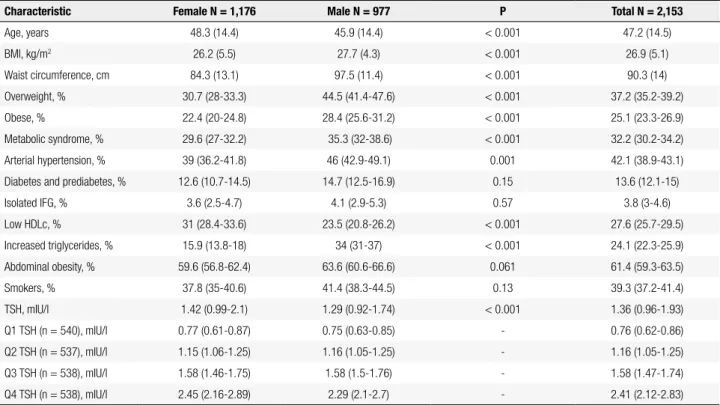
Two thousand one hundred and ifty-three subjects complied with the criteria for inclusion in the study and were analyzed (152 subjects with hypothyroid-ism, 93 of them newly-diagnosed and 96 with hy-perthyroidism, 75 of them newly-diagnosed were excluded). The major characteristics of the studied population and the interquartile range for the quar-tiles of TSH are presented in table 1. The metabolic syndrome and its elements, with the only exception of low HDL cholesterol, were more prevalent in the males (OR for MetS 1.6 (1.3-1.9) for the male gen-der). Overweight and obesity were also more com-mon in the males.
There was no difference in the TSH levels between the subjects with and without metabolic syndrome (p = 0.22), with and without hypertension (p = 0.64) or with and without hypertriglyceridemia (p = 0.34). TSH was marginally higher in the subjects with low HDL-cholesterol than in those with normal HDL-C (1.33 [0.94-1.89] vs. 1.41 [0.99-2.04], p = 0.015).
Cop
yright
© ABE&M t
odos os dir
eit
os r
eser
vados
.
p = 0.05). Triglycerides increased from Q1 to Q4 in the males (1.47, 1.34-1.60 to 1.79, 1.61-1.97, p = 0.061 for the trend).
The prevalence of the elements of the metabolic syndrome through the quartiles of TSH is presented in table 2. By far the most prevalent trait of the MetS throughout the quartiles of TSH was the increased waist circumference. Its prevalence however showed no dependence on the TSH. The prevalence of low HDL cholesterol increased with each quartile and the difference reached signiicance between Q1 (25%) and Q4 (32%). The prevalence of the cases with elevated triglyceride levels was also higher in the Q4 (26.8%) than Q1 (20.4%). The prevalence of the metabolic syn-drome in Q2 (35%) and Q4 (34.9%) was higher than in Q1 (27%).
The unadjusted regression analysis showed that the risk of elevated triglyceride and low HDL levels in-creased through the quartiles of TSH (OR 1.2 (1.08-1.33), 0.001 and 1.12 (1.03-1.22), 0.007 respective-ly). The unadjusted risk was not signiicantly elevated for none of the other studied variables (MetS, arterial hypertension, diabetes, abdominal obesity). The sum-mary of the regression analysis adjusted for age, gen-der and smoking for the metabolic syndrome, arterial hypertension, diabetes mellitus, abdominal obesity, low
HDL and elevated triglycerides as dependent variables and the quartiles of TSH as an independent is present-ed in table 3. The adjustpresent-ed for age, gender and smoking risk of a metabolic syndrome rose by 14% with each increase in the quartiles of TSH. After an additional adjustment for BMI however the association between
Table 1. Characteristics of the studied population. Where appropriate the female and male data are compared
Characteristic Female N = 1,176 Male N = 977 P Total N = 2,153
Age, years 48.3 (14.4) 45.9 (14.4) < 0.001 47.2 (14.5)
BMI, kg/m2 26.2 (5.5) 27.7 (4.3) < 0.001 26.9 (5.1)
Waist circumference, cm 84.3 (13.1) 97.5 (11.4) < 0.001 90.3 (14)
Overweight, % 30.7 (28-33.3) 44.5 (41.4-47.6) < 0.001 37.2 (35.2-39.2)
Obese, % 22.4 (20-24.8) 28.4 (25.6-31.2) < 0.001 25.1 (23.3-26.9)
Metabolic syndrome, % 29.6 (27-32.2) 35.3 (32-38.6) < 0.001 32.2 (30.2-34.2)
Arterial hypertension, % 39 (36.2-41.8) 46 (42.9-49.1) 0.001 42.1 (38.9-43.1)
Diabetes and prediabetes, % 12.6 (10.7-14.5) 14.7 (12.5-16.9) 0.15 13.6 (12.1-15)
Isolated IFG, % 3.6 (2.5-4.7) 4.1 (2.9-5.3) 0.57 3.8 (3-4.6)
Low HDLc, % 31 (28.4-33.6) 23.5 (20.8-26.2) < 0.001 27.6 (25.7-29.5)
Increased triglycerides, % 15.9 (13.8-18) 34 (31-37) < 0.001 24.1 (22.3-25.9)
Abdominal obesity, % 59.6 (56.8-62.4) 63.6 (60.6-66.6) 0.061 61.4 (59.3-63.5)
Smokers, % 37.8 (35-40.6) 41.4 (38.3-44.5) 0.13 39.3 (37.2-41.4)
TSH, mIU/l 1.42 (0.99-2.1) 1.29 (0.92-1.74) < 0.001 1.36 (0.96-1.93)
Q1 TSH (n = 540), mIU/l 0.77 (0.61-0.87) 0.75 (0.63-0.85) - 0.76 (0.62-0.86)
Q2 TSH (n = 537), mIU/l 1.15 (1.06-1.25) 1.16 (1.05-1.25) - 1.16 (1.05-1.25)
Q3 TSH (n = 538), mIU/l 1.58 (1.46-1.75) 1.58 (1.5-1.76) - 1.58 (1.47-1.74)
Q4 TSH (n = 538), mIU/l 2.45 (2.16-2.89) 2.29 (2.1-2.7) - 2.41 (2.12-2.83)
Table 2. Prevalence of the elements of the metabolic syndrome in the studied euthyroid subjects stratiied by quartiles of TSH
Q Abdominal obesity (%) Low HDLc (%) Elevated Tgl (%) Hypertension (%) Diabetes and
pre-diab (%) Met syndrome (%)
1-st 58.5 (54,3-62.7) 25 (21,3-28.7) 20.4 (17-23.8) 43.9 (39.7-48) 13 (10-15.8) 27 (23.3-30.9)
2-nd 63.7 (59.6-67.8) 25.7 (22-29.4) 25.9 (22.1-29.5) 41 (36.8-45.2) 16.4 (13.3-19.5) 35 (31-39)*
3-rd 61.2 (57-65.3) 27.9 (24.1-31.7) 23.4 (19.8-27) 42.2 (38-46.4) 13.9 (11-16.8) 31.6 (27.7-35.5)
4-th 62.5 (58.4-66.6) 32 (28-35.9)* 26.8 (23-30.5)** 41.3 (37.1-45.5) 11 (8.4-13.6) 34.9 (30.9-38.9)*
Total 61.4 (57.3-65.5) 27.6 (25.7-29.5) 24.1 (20.5-27.7) 42.1 (40-44.2) 13.6 (10.7-16.5) 32.2 (28.3-36.1)
Cop
yright
© ABE&M t
odos os dir
eit
os r
eser
vados
.
TSH and MetS was reduced (7%, 95% CI -3 to 18, p = 0.15). The odds ratio for the MetS in overweight was 8.8, 95% CI 6.2-12.4 and in obesity – 23.4, 95% CI 19.9-40.6, as compared to normal-weight subjects.
cant increase in total cholesterol, LDL-cholesterol and triglyceride levels in hypothyroid subjects (20). Despite the unequivocal overall increase in the levels of the lipids however, the latter authors demonstrated that a shift in the lipid particle sizes towards a less atherogenic proile also occurred. Their results puts up the question what the clinical signiicance of the hypothyroidism-induced dyslipidemia is. Furthermore, the cited observation was made in the circumstances of an acute overt hypo-thyroidism and it cannot be extrapolated to subclini-cal hypothyroidism or even less to euthyroid subjects. Though the Colorado study results are convincing, they are applicable throughout a large range of TSH values, but lose sensitivity if the data analysis is conined only within the euthyroid range. Such data from a large euthyroid population sample has been published by As-vold and cols. (21). They found a linear, statistically signiicant increase in the total cholesterol, LDL and triglyceride levels and a decrease in HDL-cholesterol over the normal TSH range. Stratiication of the stud-ied population by BMI however revealed a stronger as-sociation in the overweight and obese subgroup. It may seem that the association between thyroid function and lipid metabolism goes beyond the direct thyroid hor-mone/cell interaction, but is affected by factors that are by themselves related to CVD risk.
It has been hypothesized that in part the association between the MeTS and thyroid dysfunction might be me-diated by an effect on insulin sensitivity. Bakker and cols. studied euthyroid non-diabetic subjects and provided evidence of the insulin sensitivity as an effect-modifying factor in the association between thyroid function and LDL-cholesterol (22). Moreover the effect was stronger in the subjects with insulin resistance than in those wi-thout, suggesting that low-normal thyroid function may be a risk factor in already high-CVD risk populations. In a larger group of type 2 diabetic subjects Chubb and cols. reached similar conclusions for serum cholesterol and triglyceride levels (23). They estimated further that the CVD risk in the diabetics doubles with the increase in the serum TSH levels between 1 and 7 mIU/l.
These data support the concept of a complex yet still not fully clear association between the thyroid and the MetS. We did not study the insulin sensitivity in our group, but found no correlation between the crude indirect markers of insulin resistance (waist circumfer-ence and glucose metabolism abnormalities) and the serum TSH. We did not ind also an association with the BMI. Overweight and obesity though were a major
Table 3. Odds ratios for the metabolic syndrome and its elements with each higher quartile of TSH in a multivariate logistic regression analysis adjusted by age, gender and smoking
Independent variable
– Quartiles of TSH Odds ratios (95% CI) p-value
Metabolic syndrome 1.14 (1.04-1.26) 0.06
Abdominal obesity 1.08 (0.98-1.18) 0.11
Arterial hypertension 1.04 (0.94-1.14) 0.5
Diabetes and IFG 0.93 (0.81-1.06) 0.27
Elevated triglycerides 1.2 (1.08-1.33) 0.001
Low HDL cholesterol 1.09 (1.0-1.19) 0.042
Each increase by one quartile of TSH was associated with an increase in the prevalence of low HDL by 9% (0-19%) and of high triglycerides by 20% (8-33%).
The adjustment for BMI affected mildly the associa-tion of TSH with the hypertriglyceridemia (18%, 95% CI 5-31, p = 0.004).
DISCUSSION
signii-Cop
yright
© ABE&M t
odos os dir
eit
os r
eser
vados
.
contributing factor for the MetS. There are many re-ports of a positive correlation between TSH and body fat – both subcutaneous and visceral. The direction of the association however is not fully understood and the mechanisms underlying it are still debated. On the one hand thyroid hormones and TSH alter the metabolic activity of the fat tissue (24). On the other hand a rela-tive thyroid hormone resistant state in obesity has been proposed by some authors (25). Most probably there is a complex interplay between various mechanisms, as demonstrated by the observations of Muscogiuri and cols. (12). An evidence that the reality might be even more complex provide the recent indings of Lucas and cols. of a possible effect of smoking on the relationship between leptin and TSH (26).
There are several limitations to our study. First, the cross-sectional design does not permit cause-effect con-clusions. To our best knowledge, similar longitudinal studies like the cited one are rare (27). Second, a deter-mination of insulin sensitivity would throw more light on the discussed associations, but it could not be imple-mented in the current population-based study. Third, the study was performed in the winter season and a cer-tain diet-induced bias in the serum lipid measurements cannot be ruled out. Also, the choice of the IDF deini-tion may have introduced an overestimadeini-tion of the MetS prevalence due to the high proportion of subjects with a larger waist circumference. No comparison between the different deinitions has been made among the Bulgarian population to date and any assumption in this direction is speculative since local ethnic features may interfere.
As a conclusion, we observed a positive association between TSH in the euthyroid reference range and the prevalence of the metabolic syndrome. We failed to ind an association of TSH with most of the elements of the MetS except the dyslipidemia, probably due to factors like the complexity of the interrelations or the impact of unaccounted confounders in the studied population. While there is an ample amount of data demonstrating an increased CVD risk in overt thyroid dysfunction, the clinical impact of the described by other authors and by us association of mild thyroid dysfunction or different thyroid hormone levels within the reference range with the MetS remains to be clariied.
Acknowledgements: we would like to thank the following parti-cipants in the study: Kristina Pantcheva, Gergana Antalavitcheva, Tatiana Kornilova, Donka Bogilova, Elena Stavreva. The study was conducted, analyzed and interpreted by the investigators in-dependent of the industry sponsors.
Funding statement: the study was supported by the Bulgarian Society of Endocrinology.
Disclosure: no potential conlict of interest relevant to this article was reported.
REFERENCES
1. Kassi E, Pervanidou P, Kaltsas G, Chrousos G. Metabolic syn-drome: deinitions and controversies. BMC Med. 2011;9:48. 2. Mottillo S, Filion KB, Genest J, Joseph L, Pilote L, Poirier P, et al.
The metabolic syndrome and cardiovascular risk a systematic re-view and meta-analysis. J Am Coll Cardiol. 2010;56:1113-32. 3. Gami AS, Witt BJ, Howard DE, Erwin PJ, Gami LA, Somers VK, et
al. Metabolic syndrome and risk of incident cardiovascular events and death: a systematic review and meta-analysis of longitudinal studies. J Am Coll Cardiol. 2007;49:403-14.
4. Reaven GM. Banting lecture 1988. Role of insulin resistance in human disease. Diabetes. 1988;37:1595-607.
5. Executive Summary of The Third Report of The National Choles-terol Education Program (NCEP) Expert Panel on Detection, Eval-uation, And Treatment of High Blood Cholesterol In Adults (Adult Treatment Panel III). JAMA. 2001;285:2486-97.
6. Alberti KGMM, Zimmet P, Shaw J. The metabolic syndrome – a new worldwide deinition. Lancet. 2005;366:1059-62.
7. Alberti KGMM, Eckel RH, Grundy SM, Zimmet PZ, Cleeman JI, Donato KA, et al. Harmonizing the metabolic syndrome: a joint interim statement of the International Diabetes Federation Task Force on Epidemiology and Prevention; National Heart, Lung, and Blood Institute; American Heart Association; World Heart Federation; International. Circulation. 2009;120:1640-5.
8. Uzunlulu M, Yorulmaz E, Oguz A. Prevalence of subclinical hy-pothyroidism in patients with metabolic syndrome. Endocr J. 2007;54:71-6.
9. Lai C-C, Tang S-H, Pei D, Wang C-Y, Chen Y-L, Wu C-Z, et al. The prevalence of subclinical thyroid dysfunction and its association with metabolic syndrome in Taiwanese elderly. Int J Gerontol. 2011;5:25-9.
10. Roef GL, Rietzschel ER, Van Daele CM, Taes YE, De Buyzere ML, Gillebert TC, et al. Triiodothyronine and free thyroxine levels are differentially associated with metabolic proile and adiposity-re-lated cardiovascular risk markers in euthyroid middle-aged sub-jects. Thyroid. 2014;24:223-31.
11. Ambrosi B, Masserini B, Iorio L, Delnevo A, Malavazos AE, Mor-ricone L, et al. Relationship of thyroid function with body mass index and insulin-resistance in euthyroid obese subjects. J Endo-crinol Invest. 2010;33:640-3.
12. Muscogiuri G, Sorice GP, Mezza T, Prioletta A, Lassandro AP, Pir-ronti T, et al. High-normal TSH values in obesity: is it insulin resis-tance or adipose tissue’s guilt? Obesity. 2012;21:101-6.
13. Park HT, Cho GJ, Ahn KH, Shin JH, Hong SC, Kim T, et al. Thyroid stimulating hormone is associated with metabolic syndrome in euthyroid postmenopausal women. Maturitas. 2009;62:301-5. 14. Roos A, Bakker SJL, Links TP, Gans ROB, Wolffenbuttel BHR. Thyroid
function is associated with components of the metabolic syndrome in euthyroid subjects. J Clin Endocrinol Metab. 2007;92:491-6. 15. Shinkov A, Borissova A-M, Kovatcheva R, Vlahov J, Dakovska L,
Atanassova I, et al. Thyroid dysfunction and cardiovascular risk factors in Bulgarian adults. Cent Eur J Med. 2013;8:742-8. 16. Heima NE, Eekhoff EMW, Oosterwerff MM, Lips PT, van Schoor
Cop
yright
© ABE&M t
odos os dir
eit
os r
eser
vados
.
17. Waring AC, Rodondi N, Harrison S, Kanaya AM, Eleanor M, Miljkovic I, et al. Thyroid function and prevalent and incident metabolic syndrome in older adults: the health, aging, and body composition study. Clin Endocrinol (Oxf). 2013;76:911-8. 18. Oh J-Y, Sung Y-A, Lee HJ. Elevated thyroid stimulating hormone
levels are associated with metabolic syndrome in euthyroid young women. Korean J Intern Med. 2013;28:180-6.
19. Canaris GJ, Manowitz NR, Mayor G, Ridgway EC. The Colorado thy-roid disease prevalence study. Arch Intern Med. 2000;160:526-34. 20. Pearce EN, Wilson PWF, Yang Q, Vasan RS, Braverman LE. Thyroid
function and lipid subparticle sizes in patients with short-term hy-pothyroidism and a population-based cohort. J Clin Endocrinol Metab. 2008;93:888-94.
21. Asvold BO, Vatten LJ, Nilsen TIL, Bjøro T. The association between TSH within the reference range and serum lipid concentrations in a population-based study. The HUNT Study. Eur J Endocrinol. 2007;156:181-6.
22. Bakker SJ, ter Maaten JC, Popp-Snijders C, Slaets JP, Heine RJ, Gans RO. The relationship between thyrotropin and low density
lipoprotein cholesterol is modiied by insulin sensitivity in healthy euthyroid subjects. J Clin Endocrinol Metab. 2001;86:1206-11. 23. Chubb SA, Davis WA, Davis TM. Interactions among thyroid
func-tion, insulin sensitivity, and serum lipid concentrations: the Fre-mantle diabetes study. J Clin Endocrinol Metab. 2005;90:5317-20. 24. Yildiz BO, Aksoy DY, Harmanci A, Unluturk U, Cinar N, Isildak M, et al. Effects of L-thyroxine therapy on circulating leptin and adipo-nectin levels in subclinical hypothyroidism: a prospective study. Arch Med Res. 2013;44:317-20.
25. Nannipieri M, Cecchetti F, Anselmino M, Camastra S, Niccolini P, Lamacchia M, et al. Expression of thyrotropin and thyroid hor-mone receptors in adipose tissue of patients with morbid obesity and/or type 2 diabetes: effects of weight loss. Int J Obes (Lond). 2009;33:1001-6.
26. Lucas A, Granada ML, Olaizola I, Castell C, Julián MT, Pellitero S, et al. Leptin and thyrotropin relationship is modulated by smok-ing status in euthyroid subjects. Thyroid. 2013;23:964-70. 27. Park SB, Choi HC, Joo NS. The relation of thyroid function to