doi: 10.1590/0037-8682-0165-2016
Major Article
Corresponding author: Dr. André Pires Antunes.
e-mail: [email protected]
Received 10 June 2016
Accepted 23 September 2016
Benznidazole therapy for Chagas disease in asymptomatic
Trypanosoma cruzi-seropositive former blood donors:
evaluation of the effi cacy of diff erent treatment regimens
André Pires Antunes
[1],
Antônio Luiz Pinho Ribeiro
[2],
Ester Cerdeira Sabino
[3],
Marise Fagundes Silveira
[1],
Cláudia Di Lorenzo Oliveira
[4]and Ana Cristina de Carvalho
Botelho
[1][1]. Programa de Pós-Graduação em Ciências da Saúde, Departamento de Clínica Médica, Universidade Estadual de Montes Claros, Montes Claros, Minas Gerais, Brasil. [2]. Hospital das Clínicas, Faculdade de Medicina, Universidade Federal de Minas Gerais, Belo Horizonte, Minas Gerais, Brasil.
[3]. Departamento de Doenças Infecciosas, Faculdade de Medicina, Universidade de São Paulo, São Paulo, Brasil. [4]. Departamento de Medicina, Universidade Federal de São João del-Rei, Divinópolis, Minas Gerais, Brasil.
Abstract
Introduction: Chagas disease currently affects 5.7 million people in Latin America and is emerging in non-endemic countries.
There is no consensus concerning the effi cacy of trypanocidal therapy for patients with the chronic form of the disease. We
evaluated cardiac function and sociodemographic, clinical, and serologic characteristics of a group of asymptomatic Trypanosoma
cruzi-seropositive former blood donors, and compared the effects of benznidazole treatment applied for different lengths of time.
Methods: Blood donors who screened positive for T. cruzi between 1998 and 2002 were recruited 10 years later for follow-up (n
= 244); 46 individuals had received treatment. Three subjects had terminated treatment prematurely. The remaining 43 individuals
were divided into two groups: individuals who had received benznidazole therapy for 50-60 days (n = 28; BT ≤60 group) or more than 60 days (n = 15; BT >60). Serologic assays, biochemical tests, electrocardiographic, echocardiographic, and clinical examinations were performed on all participants. Parasite loads were determined by qualitative and quantitative polymerase
chain reaction. Results: Parasitemia was signifi cantly reduced in the BT ≤60 and BT >60 groups compared with the untreated
group. There were no differences in epidemiologic profi les or clinical, biochemical, electrocardiographic, or echocardiographic data between any of the groups. Conclusions: Despite elimination or signifi cant reduction in parasitemia in patients with chronic
Chagas disease who received benznidazole, there was no clinical difference between those who were treated for >60 days and
those treated for a shorter duration. Furthermore, the adverse effects of benznidazole appear to be less severe than previous
reports would suggest.
Keywords: Chagas disease. Blood donors. Benznidazole. Parasitemia. PCR assay.
INTRODUCTION
Chagas disease, also known as American trypanosomiasis, is an infl ammatory disease caused by the fl agellate protozoan Trypanosoma cruzi (Trypanosomatidae). The disease is
endemic in Latin America and is estimated to affect some 5.7 million people(1), a large proportion (20-40%) of whom
will gradually evolve to the chronic phase of the disease and
exhibit myocardiopathy, megaesophagus, megacolon, or other associated conditions in later life(2). Although the incidence of Chagas disease is declining in most Latin American countries
following the establishment of public policies of surveillance,
prevention, and control(3) (4), the number of cases is increasing
in non-endemic regions such as North America, Europe, Asia, and Oceania as a result of the migration of infected individuals.
Despite its detrimental impact on the world economy,
trypanosomiasis is considered a neglected disease(5).
The classical form of transmission of Chagas disease is vectorial via the feces of triatomine bugs, although
non-vectorial modes of transmission (oral, vertical or congenital,
blood transfusion, organ transplantation, and laboratory accidents) have also been reported. In Brazil, for example, the epidemiology of trypanosomiasis has changed substantially
over the years such that it now resembles that of other infectious
diseases that are not vector-borne(1). Indeed, oral transmission through the ingestion of contaminated food is currently the
most frequent mode of infection of Chagas disease in Brazil (68.9%), while congenital transmission and transfusion-related
strengthened in many countries. As a result, donated blood is
screened for known blood-borne infections, including Chagas disease. In the United States (US) for example, the Retrovirus Epidemiology Donor Study-II (REDS-II; 2004 - 2012) was established with the aim of improving blood product safety
and availability(7) (8).
The two antiparasitic drugs that could be employed
in the treatment of T. cruzi infection (i.e. nifurtimox and benznidazole) have not been approved by the US Food and
Drug Administration (FDA) but are available at the request
of a physician for use under investigational protocols(9). It is
important to emphasize, however, that prolonged treatment with benznidazole is contraindicated because of the associated
side-effects and safety risks. The Benznidazole Evaluation for
Interrupting Trypanosomiasis (BENEFIT) project, described
recently by Morillo et al.(10), was a multicenter, double-blinded, randomized, placebo-controlled trial involving the
administration of benznidazole or matching placebo to 2,854 patients presenting with chronic Chagas cardiomyopathy. The results showed that benznidazole therapy did not reduce the clinical decline in cardiac function despite signifi cant reductions in parasite load in the blood over the 5 years of follow-up. The
authors concluded that there is a need to research the effects
of benznidazole in patients with the indeterminate form of Chagas disease without cardiomyopathy and also the effects
of prolonged benznidazole therapy(10).
A retrospective cohort study, conducted in collaboration
with the international component of the REDS-II program,
evaluated a population of supposedly healthy blood donors in the Brazilian cities of São Paulo and Montes Claros, and
showed that 24% of 499 T. cruzi-seropositive individuals
presented with cardiomyopathy within a 10-year follow-up period, while only 5% of the 488 seronegative subjects exhibited this condition within the same time period(11). Interestingly, only 46 seropositive subjects reported prior administration of benznidazole and treatment periods ranged from 6 to 700
days. In the present study we investigated T. cruzi-seropositive
blood donors identifi ed in Montes Claros with the objectives of: I) evaluating the sociodemographic, clinical, serologic, electrocardiographic (ECG) and echocardiographic (ECHO)
characteristics of the individuals, and II) comparing the effects of benznidazole treatment applied for different lengths of
time, namely 50-60 days and >60 days. This is the fi rst report describing treating blood donors with benznidazole; hence,
it contributes to a better evidence-based judgment of the
appropriateness of prolonged treatment with this drug.
METHODS
Study design
This cross-sectional study involved 244 supposedly healthy
volunteers who were registered at a blood donation center in Montes Claros, Brazil, during the period 1998-2002 and had been selected 10 years later for follow-up examinations
in a previous investigation(11). The inclusion criteria were: I) positive serologic test results for Chagas disease based on
enzyme-linked immunosorbent (ELISA) and hemagglutination
assays for T. cruzi antibodies performed at the time of blood donation, II) absence of comorbidities such as diabetes and
renal insuffi ciency, and III) a signed document giving informed consent for participation. Subjects were excluded if their serologic test results were not completed. During the period 2008-2010, potential participants in the follow-up study were recruited by either mail or telephone. New serologic assays were
performed on blood samples of all participants selected. These
tests were repeated in the US REDS-II Central Laboratory at the Blood Systems Research Institute [(BSRI); San Francisco, CA, US] in order to confi rm the diagnosis using methodology and reagent kits (Ortho-Clinical Diagnostics, Raritan, NJ,
US) approved by the FDA. The parasite load in the blood of
each subject was determined by qualitative and quantitative polymerase chain reaction (PCR) assays. Participants also underwent standard biochemical testing, ECG and ECHO investigations, and clinical examination by a physician (non-blinded test), and were subsequently offered counseling if
appropriate.
Collection of data
Selected participants were called for an interview and were asked to complete a standardized questionnaire relating to sociodemographic data (age, sex, skin color, civil status,
educational level, smoking and drinking habits, and physical activity), cardiovascular and digestive symptoms, and use of
medicines. On the day of the interview, blood samples (20mL) for molecular tests were collected from participants and transferred
to vials containing the anticoagulant ethylenediaminetetraacetic
acid (EDTA). Each sample was mixed immediately with an equal
volume of a solution containing 6M guanidine hydrochloride
in 0.2M EDTA and stored at room temperature. Samples were subsequently boiled for 15 min (to shear T. cruzi nuclear and
kinetoplast deoxyribonucleic acid (kDNA), cooled, submitted to vortex mixing and distributed as 1mL aliquots into appropriately labeled cryovials. The vials were maintained in Brazil at -20°C until required for blind analysis by PCR or shipment to BSIR in containers cooled with dry ice (-70°C) for repeat blind testing.
The qualitative and quantitative analysis of blood parasite load was performed by targeted-capture real time polymerase chain reaction (TC-RT-PCR) following the methodology
described by Virreira et al.(12) in which the target was kinetoplast DNA minicircles from T.cruzi. Specifi c DNA extraction was
improved by the TC step employing a T. cruzi-specifi c 20-mer capture oligonucleotide bound to magnetic beads. TC-RT-PCR
analysis was repeated four times for each sample and the result was considered positive when two or more tests detected the specifi c amplicon, or negative when none or only one of the tests
detected the amplicon. According to Sabino et al.(13), this assay is able to detect a single parasite in 20mL of blood. The results
of the PCR assays were sent to the US REDS-II Coordination Center (Westat; Rockville, MD, US) for decoding and analysis. Blood samples (20mL) were also collected for the preparation of serum and plasma required for assessment of high density lipoprotein (HDL) cholesterol, low density lipoprotein (LDL) cholesterol, total cholesterol, triglycerides, glycemia,
(NT-proBNP), creatine kinase fraction MB (CK-MB), and tumor necrosis factor-alpha (TNFα). The levels of troponin, CK-MB and NT-proBNP were determined using the VITROS® System (Ortho Clinical Diagnostics, Raritan, NJ, US), as approved by
the FDA(11).
A resting ECG was performed using a General Electric Healthcare (Waukesha, WI, US) model MAC 1200 ECG instrument. ECG traces were analyzed by a local cardiologist and blind re-evaluations were carried out at the Epidemiological Cardiology Research Center in the Wake Forest University (Winston-Salem, NC, US). The Minnesota Code classifi cation system was employed in the interpretation of ECG
traces(14) (15) considering the following parameters: QRS complex
interval, corrected QT (QTc) interval, heart rate, PR interval, atrioventricular block (AVB), complete right bundle branch block (RBBB), complete left bundle branch block (LBBB), left anterior fascicular block (LAFB), ventricular premature beats (VPBs), Q wave abnormalities, and ST and T waves abnormalities. QRS ≥120ms and QTc >440ms were considered
prolonged.
Echocardiographic assessment was performed using
a General Electric Healthcare Vivid 3 ultrasound unit
following the recommendations of the American Society of
Echocardiography(16). Images were recorded in digital format and analyzed at the Cardiovascular Branch of the Echocardiography Laboratory in the National Heart, Lung, and Blood Institute
(NHLBI; Bethesda, MD, US). The parameters analyzed were: left ventricular ejection fraction (LVEF), left ventricular mass index (LVMI), wall motion score index (WMSI), left ventricular hypertrophy (LVH), Doppler-derived septal E/E’ >15, and left
ventricular diastolic diameter (LVDD). LVEF was calculated using the modifi ed biplane Simpson's method(16). LVEF <50% characterized left ventricular systolic dysfunction.
The results of all of the examinations and assays performed
were sent to the US REDS-II centralized reading centers for
blind evaluation.
Experimental groups
The initial study population (n = 244) was divided into two groups comprising subjects who had received treatment with benznidazole (BT group; n = 46) and non-treated subjects (NT group; n = 198). Subsequently, three members of the BT group were removed from the study because of premature termination of treatment (one after 6 days and two after 30 days). The remaining 43 members of the BT group were subdivided
according to the duration of treatment, namely, 50-60 days
(BT ≤60; n = 28) and more than 60 days (BT >60; n = 15).
Statistical analysis
The Kolmogorov-Smirnov test was used to test the
normality of the distributions. Normally distributed variables
were expressed in terms of the mean ± standard deviation (SD) while continuous variables that were not normally distributed were expressed in terms of the median and interquartile range (IQR). The statistical significance of differences between groups was assessed using the Mann-Whitney or Kruskal-Wallis
tests. Categorical variables were expressed as numbers and percentages, and differences were determined using the χ2
or
Fisher’s exact tests. For all tests, the level of signifi cance was set at p <0.05. The strength of the relationship between parasite load and duration of treatment was evaluated using the Spearman correlation coeffi cient. All statistical analyses were performed with the aid of Statistical Package for the Social Sciences (SPSS) version 18 software (Chicago: SPSS Inc.).
Ethical considerations
The study was submitted to and approved by the National Research Ethics Commission (protocol no. CONEP 3 1312/2006) and all procedures followed the ethical principles
for medical research involving human subjects proposed by the
Declaration of Helsinki. Written informed consent was obtained
from all participants.
RESULTS
The initial study population (n = 244) had an average age of 46.7 years and a male preponderance (56.6%). Most subjects had partners (73.1%), had achieved a basic level of education (75.6%), and were sedentary (77%), non-smokers (62.3%) and non-drinkers (52.2%). The majority of participants declared themselves to be of mixed race (67.5%) or black (9.5%), while 23% stated that they were non-colored (Table 1).
The BT group comprised only 18.9% of the study population (n = 46). There were no differences between the BT and NT groups (Not Treated) with respect to sociodemographic variables. When the duration of treatment was taken into
consideration, the sociodemographic characteristics of the
NT, BT 60, and BT >60 groups were similar, except for a signifi cantly higher frequency of patients who reported having
drunk alcohol in the previous month among individuals in the
BT ≤60 group (Table 1).
The three groups were also similar with respect to the biochemical variables (Table 2) and clinical, ECG, and ECHO
characteristics (Table 3). However, quantitative PCR revealed that
the parasite load of the NT group was signifi cantly higher than that of the BT groups (p <0.05) (Table 4). Qualitative PCR showed that
the parasite load of the NT group was signifi cantly higher (p <0.05) than that of the BT ≤60 group but was not signifi cantly higher than that of the BT >60 group (Table 4). Qualitative and quantitative
PCR demonstrated that there were no signifi cant differences in parasite load between the BT ≤60 and BT >60 groups.
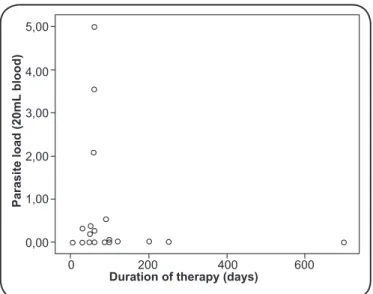
The duration of benznidazole therapy received by the two treatment groups was highly variable as demonstrated by the distribution: 6 days (n = 1), 30 days (n = 2), 50 days (n = 5), 60 days (n = 23), 90 days (n = 4), 100 days (n = 4), 120 days (n = 3), 180 days (n = 1), 200 days (n = 1), 250 days (n =1), and 700 days (n =1). The three participants whose treatment terminated prematurely (i.e. <50 days) were not included in the BT ≤60 group. Figure 1 shows that
TABLE 1
Sociodemographic characteristics of former blood donors registered in Montes Claros, State of Minas Gerais, Brazil.
NT group BT ≤60 group BT >60 group
Variables (n = 198) (n = 28) (n = 15) P value
Age (mean ± SD) 47.2 ± 10.1 45.2 ± 10.9 42.7 ± 7.1 0.202
Sex (n; %) 0.137
female 117 59.1 11 39.3 08 53.3
male 81 40.9 17 60.7 07 46.7
Skin color (n; %) 0.173
male
non-colored 43 21.8 10 35.7 02 13.3
mixed race/black 154 78.2 18 64.3 13 86.7
Civil status (n; %) 0.793
single 53 26.9 08 29.6 03 20.0
married/cohabiting 144 73.1 19 70.4 12 80.0
Educational level (n; %) 0.497
elementary 149 75.6 19 70.4 13 86.7
secondary or higher 48 24.4 08 29.6 02 13.3
Smoking habits (n; %) 0.172
non-smoker 122 61.6 21 75.0 07 46.7
smoker/former smoker 76 38.4 07 25.0 08 53.3
Alcohol last month (n; %) 0.037*
yes 88 46.8a 18 66.7b 04 26.7a
no 100 53.2 09 33.3 11 73.3
Physical activity (n; %) 0.626
Yes 45 22.7 06 21.4 05 33.3
no 153 77.3 22 78.6 10 66.7
NT: non-treated; BT: benznidazole-treated; SD: standard deviation. Data expressed in number and percentage, and used χ2 or Fisher’s exact tests. Values
followed by different lowercase superscript letters ( a, b ) are signifi cantly different. *Statistically signifi cant (χ2 test).Age expressed in mean and SD, and used
Kruskal-Wallis test.
TABLE 2
Biochemical profi le of former blood donors registered in Montes Claros, State of Minas Gerais, Brazil.
NT group BT ≤60 group BT >60 group
Variable (n = 198) (n = 28) (n = 15) P value
HDL cholesterol (mg/dL) 46.5 (40.0–55.0) 44.4 (40.0–57.5) 51.5 (45.3–55.8) 0.521
LDL cholesterol (mg/dL) 119.0 (97.0–147.3) 117.5 (72.7–163.5) 109.0 (95.5–186.5) 0.894
Total cholesterol (mg/dL) 193.5 (165.0–225.3) 201.5 (143.7–247.2) 175.5 (164.0–265.7) 0.986
Triglycerides (mg/dL) 117.5 (85.5–182.0) 145.5 (78.7–197.5) 108.0 (71.0–168.0) 0.435
Glucose (mg/dL) 90.0 (83.8–97.3) 88.5 (78.2–96.5) 90.0 (82.2–107.5) 0.829
Troponin (ng/mL) 0.01 (0.01–0.01) 0.01 (0.01–0.01) 0.01 (0.01–0.01) 0.306
Myoglobin (ng/mL) 36.6 (30.5–44.4) 37.2 (30.9–50.9) 38.9 (34.2–55.9) 0.311
NT-proBNP (pg/mL) 49.4 (27.9–98.4) 39.6 (18.1–55.7) 40.3 (23.3–85.7) 0.271
CKMB (ng/mL) 0.76 (0.50–1.21) 0.63 (0.38–0.96) 0.87 (0.49–1.11) 0.286
TNFα (pg/mL) 3.2 (1.8–4.9) 3.7 (1.9–5.7) 3.7 (2.0–4.6) 0.825
TABLE 3
Clinical, ECG and ECHO alterations of former blood donors registered in Montes Claros, State of Minas Gerais, Brazil.
NT group BT ≤60 group BT >60 group
Variable (n = 198) (n = 28) (n = 15) P value
Clinical
BMI [kg/m2; median (IQR)] 26.2 (23.7–28.6) 26.8 (24.9–29.4) 26.5 (22.0–32.5) 0.925
SBP [mm Hg; median (IQR)] † 120.0 (110–125) 120.0 (110.0–125.0) 110.0 (110.0–125.0) 0.837
DBP [mm Hg; median (IQR)] 65 (60–70) 70.0 (60.0–70.0) 67.5 (60.0–74.3) 0.481
Altered heart sounds [n (%)] 29 15.0 3 11.1 2 13.3 0.856
ECG alterations
QTc interval [>440ms; n (%)] 58 29.3 6 21.4 4 26.7 0.681
Heart rate [bpm; median (IQR)] † 63.0 (57.8–70.0) 62.0 (56.0–69.0) 62.5 (58.0–69.3) 0.974
PR interval [≥200ms; n (%)] 15 7.7 1 3.7 1 6.7 0.747
Third degree AVB [n (%)] 1 0.5 0 0.0 0 0.0 0.897
RBBB [n (%)] 35 17.7 5 (17.9) 1 (6.7) 0.545
LAFB [n (%)] 42 21.5 5 (17.9) 1 (6.7) 0.375
Frequent VPBs [n (%)] 5 2.5 0 0.0 0 0.0 0.574
Major Q wave abnormalities [n (%)] 6 3.0 0 0.0 0 0.0 0.513
Major isolated ST and T waves
abnormalities [n (%)] 6 3.0 2 (7.1) 0 0.0 0.398
ECHO alterations
LVEF [<50%; n (%)] 16 8.1 1 3.6 0 0.0 0.388
LVMI [g/m2; median (IQR)]† 79 (66–93.8) 78.5 (68.5–88.3) 68.5 (63.5–89.5) 0.546
Abnormal WMSI [n (%)] 17 8.7 1 3.6 0 0.0 0.357
LVH [n (%)] 2 1.0 1 3.6 1 6.7 0.174
Doppler-derived septal E/E’ >15 [n (%)] 4 2.1 0 0.0 0 0.0 0.637
LVDD [mm; median (IQR)]† 45.0 (42.0–48.0) 45.0 (43.0–48.0) 44.0 (40.7–48.5) 0.865
ECG: electrocardiographic; ECHO: echocardiographic; NT: non-treated; BT: benznidazole-treated; BMI: body mass index; IQR: interquartile range; SBP: systolic blood pressure; DBP: diastolic blood pressure; QTc: corrected QT interval; PR: PR interval ; AVB: atrioventricular block; RBBB: right bundle branch block; LAFB: left anterior fascicular block; VPBs: ventricular premature beats; ST: ST-segment; T: T wave; LVEF: left ventricular ejection fraction; LVMI: left ventricular mass index to body surface area; WMSI: wall motion score index; LVH: left ventricular hypertrophy; LVDD: left ventricular diastolic diameter.
Data expressed in number and percentage, and used χ2 test used to compare, excepted † data expressed in median and interquartile range, and Kruskal-Wallis test used for comparison, as appropriate.
TABLE 4
Parasite load as determined by quantitative and qualitative PCR.
NT group BT ≤60 group BT >60 group
Variable (n = 198) (n = 28) (n = 15) P values
Quantitative PCR*; 0.08 (0–0.88) 0 (0–0.05) 0 (0–0.03) 0.003*** (NT vs. BT≤60)
median (interquartile range)] 0.005*** (NT vs. BT>60)
0.839 (BT≤60 vs. BT 60)
Qualitative PCR** [n (%)] 112 (57.4) 6 (22.2) 5 (33.3) 0.001*** (NT vs. BT≤60)
0.070 (NT vs. BT>60) 0.433 (BT≤60 vs. BT>60)
PCR: polymerase chain reaction; NT: non-treated; BT: benznidazole-treated. *Kruskal-Wallis test; **χ2 test; ***Statistically signifi cant (for two groups:
5,00
Parasite load (20mL
blood)
4,00
3,00
2,00
1,00
0,00
0 200 400 600
Duration of therapy (days)
FIGURE 1. Correlation between parasite load as estimated by quantitative
PCR and duration of benznidazole treatment. PCR: polymerase chain reaction.
Spearman correlation coeffi cient r = 0.13; p = 0.401.
DISCUSSION
Chagas disease, described more than 100 years ago(17), remains a potentially life-threatening condition that negatively
impacts on the quality of life of millions of people in Latin America, with attendant economic consequences. Infection is mediated mainly by vectors, but the epidemiologic profi le
of the disease has changed markedly in Brazil over recent years such that ingestion of contaminated food is currently the
most important mode of transmission. Moreover, while the disease was originally confi ned to Latin American countries, its prevalence in the US, Canada, Europe, and some Western Pacifi c countries is on the increase owing mainly to population
mobility(3).
Treatment of adults with the indeterminate form of Chagas disease remains controversial chiefl y because of the absence
of appropriate blinded randomized clinical trials. In the past,
parasite persistence was not thought to be relevant to the
physiology of complications in Chagas disease. Many other reasons also motivated the paradigm of not treating Chagas disease(18). Despite the current recommendations, treatment
is not implemented in >99% of infected individuals(2). In the
present study, the proportion of seropositive blood donors who had been treated with benznidazole was also modest (18.9%; 46/244) while the duration of treatment varied markedly and ranged between 6 and 700 days.
Few studies have focused on the efficacy of different
durations of benznidazole therapy in the treatment of Chagas disease. Thirty years ago, Coura et al.(19) compared the effectiveness of 30- and 60-day treatments, but observed no
statistical difference between the two regimens regarding the control of parasitemia, thus suggesting that there was no advantage in opting for a longer therapy. However, in a more
recent report, Coura et al.(20) suggested a treatment regimen
comprising 30 days of therapy repeated every two months over
a 6 to 12 month period. In contrast, the study conducted by Morillo et al.(10) for the BENEFIT project involved benznidazole
treatment administered for a single period of 40 to 80 days. In a systematic review and meta-analysis of benznidazole therapy applied to patients with chronic Chagas disease who were in the indeterminate phase or had visceral involvement,
Pérez-Molina et al.(21) considered 696 reports and selected for detailed analysis three clinical trials and six observational
studies of which six involved adults. In these studies, the duration of treatment varied widely encompassing regimens of
30(22), 45-60(23) and 60(24) days, while the follow-up periods were
also somewhat disparate, ranging from 12 months to 24 years (median 4 years)(21). Regarding the effi cacy of benznidazole administered in the late chronic phase of the disease, the authors
of the meta-analysis concluded that the effi cacy of therapy was doubtful and that the benefi cial effect was marginal(21). Uncertainty appeared to be even greater in asymptomatic
individuals and those older than 50 years; this was largely due
to differences in the study populations, endpoints, and durations
of follow-up. However, the non-randomized and non-blinded
prospective study conducted by Viotti et al. (22) confi rmed clinical improvement and increased seroreversion rates of
benznidazole-treated subjects compared with their non-treated counterparts (n = 283 in each group). Moreover, Fabbro et al.(23)
reported improvement of the ECG profi les of benznidazole-treated patients, while Fragata-Filho et al.(25) found that 79.1%
(263/310) of benznidazole-treated patients and 46.8% (47/310) of those untreated had normal ECG fi ndings after a follow-up
period of around 20 years. The occurrence of ECG abnormalities
and clinical events (heart failure, stroke, mortality, and death) was less prevalent in treated patients. In contrast, Morillo et
al.(10) concluded that therapy with benznidazole in patients with
established Chagas cardiomyopathy reduced signifi cantly serum parasite load but did not signifi cantly reduce clinical cardiac deterioration through fi ve years of follow-up.
In the present study, although the length of treatment
varied considerably, two groups with different benznidazole treatment regimens could be defi ned. While parasite load was signifi cantly reduced in the BT group compared with the NT group, no signifi cant differences were detected between BT ≤60 and BT >60 groups. Quantitative and qualitative PCR revealed a signifi cant reduction in the parasite load of the BT 60 group compared with NT. However, an analogous reduction in the BT >60 group could only be confi rmed by quantitative PCR, probably because this group was small and the statistical power to detect differences by qualitative PCR was not so
strong. Regarding the clinical cardiac conditions, no alterations
were detected in the study population, regardless of group. It is important to emphasize, however, that the frequencies of use
of cardiovascular drugs by the study population at the time of
evaluation were 23.2, 25.0 and 6.7% for the NT, BT ≤60, and BT >60 groups, respectively, although the differences were not statistically signifi cant (p = 0.313).
Chagas cardiomyopathy, the effi cacy of treatment as assessed by conversion to negative PCR results was 66.2% at the end of treatment and 46.7% after 5 years or more of follow-up. This fi nding suggests that the standard regimen of benznidazole may be less effective in patients with cardiomyopathy. In contrast,
the preliminary results of a randomized placebo-controlled evaluation of benznidazole treatment on long-term disease
progression in adults with chronic Chagas disease (the TRAENA
study)(26) (27) showed that rates of negative parasitemia increased
with time after treatment from 55.97% after two months, to 62.59% after 8-16 months, and 72.81% after 9-11 years.
In our study, side effects (allergic reactions) to the drug were detected in 19.5% of individuals, and therapy was discontinued in only 6.5% (3/46) of cases. Morillo et al.(10) reported that
14.4% of patients permanently discontinued treatment with benznidazole because of adverse events, a rate that is lower than
that previously reported in observational and small randomized
trials. These authors recommended that a dose of 300mg/day should not be surpassed since low doses appeared to increase
tolerance to the drug.
New evidence supports the idea that the level of circulating
parasites is relevant to the pathogenesis of chronic Chagas disease(11). Furthermore, the association between parasite load
(as measured by PCR) and the severity of clinical conditions has been confi rmed(12). In addition, various blinded randomized
studies have demonstrated the effi cacy of benznidazole therapy and that earlier treatment is associated with a more successful
outcome(9) (18) (28) (29) (30). Such findings have encouraged
some agencies, including members of the network Nuevas
Herramientas para el Diagnóstico y la Evaluación del Paciente
con Enfermedad de Chagas (NHEPACHA; New Tools for the
Diagnosis and Evaluation of Chagas Disease Patients), the
World Health Organization and the Centers for Disease Control
and Prevention, to recommend antiparasitic treatment for all
T. cruzi-infected individuals in the chronic phase, even though
this remains controversial in current medical practice. The need
for a paradigm shift becomes stronger when one considers that delay in treatment while awaiting further studies leaves most
of the infected population without any treatment.
Limitations of the present study include recall bias and the absence of information in the study population relating to dosage and the length of time after treatment completion. Moreover, employing positive ELISA results in the inclusion criteria may have led to the exclusion from the study of serologically cured patients, thereby reducing the ability to detect differences favoring treatment. In addition, the small sample population
probably reduced the statistical power to detect differences.
A strength of the study is that sampling a population of blood
donors allowed inclusion of asymptomatic individuals, thus
minimizing the effect of referral bias.
In conclusion, our study revealed that parasite load was signifi cantly lower in the benznidazole-treated group than the non-treated group. However, comparison between individuals
treated for 50-60 days and those treated for a more extended
period (>60 days) showed that prolonged treatment conferred no
advantage. Since the majority of blood donors are asymptomatic
they are ideal targets for etiologic treatment in specialized
health facilities. However, treatment regimens are currently inconsistent and this problem needs to be addressed with dosage, duration, and treatment intervals specifi ed according to age and
clinical groups. Although our results indicate that the duration
of treatment does not infl uence the parasite load, the study was not designed to draw conclusions about the most appropriate therapeutic regimen for individuals with chronic asymptomatic
or indeterminate Chagas disease.
Acknowledgments
We wish to thank Fundação de Amparo à Pesquisa do Estado de Minas
Gerais for partial support for this work, and to express our thanks the student Igor Pereira.
Confl ict of Interest
The authors declare that there are no confl icts of interest.
Financial Support
This study did not receive fi nancial support.
REFERENCES
1. World Health Organization. Weekly epidemiological record Relevé
épidémiologique hebdomadaire. Chagas disease in Latin America: an epidemiological update based on 2010 estimates. No. 6. Geneva: WHO; 2015. p. 33-44. Accessed 2016 April. Available at: http:// www.who.int/wer/2015/wer9006.pdf
2. Maguire JH. Treatment of Chagas' disease - time is running out.
N Engl J Med 2015; 373:1369-1370.
3. Angheben A, Boix L, Buonfrate D, Gobbi F, Bisoffi Z, Pupella S,
et al. Chagas disease and transfusion medicine: a perspective from non-endemic countries. Blood Transfus 2015; 13:540-550.
4. Requena-Méndez A, Albajar-Viñas P, Angheben A, Chiodini P,
Gascón J, Muñoz J, et al. Health policies to control Chagas disease transmission in European countries. PLoS Negl Trop Dis 2014;
8:e3245. doi:10.1371/journal.pntd.0003245.
5. Lee BY, Bacon KM, Bottazzi ME, Hotez PJ. Global economic
burden of Chagas disease: a computational simulation model. Lancet Infect Dis 2013; 13:342-348.
6. Ministério da Saúde. Doença de Chagas aguda no Brasil: série
histórica de 2000 a 2013. Boletim Epidemiológico 2015; 46:1-9. Accessed April 2016. Available at: http://portalsaude.saude.gov.br/ images/pdf/2015/agosto/03/2014-020.pdf
7. National Heart, Lung, and Blood Institute (NHLBI). Retrovirus
Epidemiology Donor Study-II (REDS-II). ClinicalTrials.gov Identifi er: NCT00097006. Bethesda: NHLBI; 2009. Accessed April 2016. Available at: https://clinicaltrials.gov/ct2/show/NCT00097006
8. Centers for Disease Control and Prevention. Blood Donor Screening
for Chagas Disease - United States, 2006-2007. Atlanta: CDC; 2007; 56:141-143. Accessed April 2016. Available at: http://www.cdc.gov/ mmwr/preview/mmwrhtml/mm5607a2.htm.
9. Centers for Disease Control and Prevention. Parasites - American
10. Morillo CA, Marin-Neto JA, Avezum A, Sosa-Estani S, Rassi Jr A, Rosas F, et al. Randomized trial of benznidazole for chronic Chagas' cardiomyopathy. N Engl J Med 2015; 373:1295-1306.
11. Sabino EC, Ribeiro AL, Salemi VMC, Di Lorenzo Oliveira C, Antunes AP, Menezes MM, et al. Ten-year incidence of Chagas
cardiomyopathy among asymptomatic Trypanosoma cruzi–
seropositive former blood donors. Circulation 2013; 127:1105-1115. 12. Virreira M, Torrico F, Truyens C, Alonso-Vega C, Solano M,
Carlier Y, et al. Comparison of polymerase chain reaction methods
for reliable and easy detection of congenital Trypanosoma cruzi
infection. Am J Trop Med Hyg 2003; 68:574-582.
13. Sabino EC, Ribeiro AL, Lee TH, Oliveira CL, Carneiro-Proietti
AB, Antunes AP, et al. Detection of Trypanosoma cruzi DNA in
blood by PCR is associated with Chagas cardiomyopathy and disease severity. Eur J Heart Fail 2015; 17:416-423.
14. Ribeiro AL, Sabino EC, Marcolino MS, Salemi VMC, Ianni BM, Fernandes F, et al. Electrocardiographic abnormalities in
Trypanosoma cruzi seropositive and seronegative former blood
donors. PLoS Negl Trop Dis 2013; 7:e2078.
15. Prineas RJ, Crow RS, Zhang ZM. The Minnesota code manual of
electrocardiographic fi ndings. 2nd edition. London: Springer; 2010.
p. 277-284.
16. Lang RM, Badano LP, Mor-Avi V, Afi lalo J, Armstrong A, Ernande
L, et al. Recommendations for cardiac chamber quantifi cation by echocardiography in adults: an update from the American Society of Echocardiography and the European Association of Cardiovascular Imaging. J Am Soc Echocardiogr 2015; 28:1-39 e14.
17. Chagas C. Nouvelle espèce de trypanosomiase humaine. Bull Soc Pathol Exot 1909; 2:304-307.
18. Viotti R, Alarcón de Noya B, Araujo-Jorge T, Grijalva MJ, Guhl F, López MC, et al. Towards a paradigm shift in the treatment of chronic Chagas disease. Antimicrob Agents Chemother 2014; 58:635-639. 19. Coura JR, Brindeiro PJ, Ferreira I. Benznidazole in the treatment
of Chagas disease. Current chemotherapy. Proc 10th Int Congr
Chemotherapy 1978; 1:161-162.
20. Coura JR, Borges-Pereira J. Chronic phase of Chagas disease: why
should it be treated? A comprehensive review. Mem Inst Oswaldo Cruz 2011; 106:641-645.
21. Pérez-Molina JA, Pérez-Ayala A, Moreno S, Fernández-González MC, Zamora J, López-Vélez R. Use of benznidazole to treat
chronic Chagas' disease: a systematic review with a meta-analysis. J Antimicrob Chemother 2009; 64:1139-1147.
22. Viotti R, Vigliano C, Lococo B, Bertocchi G, Petti M, Alvarez MG, et al. Long-term cardiac outcomes of treating chronic Chagas disease with benznidazole versus no treatment: a nonrandomized trial. Ann Intern Med 2006; 144:724-734.
23. Fabbro DL, Streiger ML, Arias ED, Bizai ML, del Barco M, Amicone NA. Trypanocide treatment among adults with chronic Chagas disease living in Santa Fe city (Argentina), over a mean follow-up of 21 years: parasitological, serological and clinical evolution. Rev Soc Bras Med Trop 2007; 40:1-10.
24. de Castro AM, Luquetti AO, Rassi A, Chiari E, Galvão LMC.
Detection of parasitemia profiles by blood culture after treatment
of human chronic Trypanosoma cruzi infection. Parasitol Res
2006; 99:379-383.
25. Fragata-Filho AA, França FF, Fragata CS, Lourenço AM, Faccini CC, Costa CAJ. Evaluation of parasiticide treatment with benznidazol in the electrocardiographic, clinical, and serological evolution of Chagas disease. PLoS Negl Trop Dis 2016; 10:e0004508.
26. Riarte A, Velázquez E, Prado N, Schijman AG, Ramírez JC,
De Rissio AM, et al. TRAENA study: Evaluation of potential biomarkers of therapeutic effi cacy. Rio de Janeiro: Chagas Disease Clinical Reserach Platform, Drug for Neglected Diseases Initiative (DNDi); 2012. p.12-13. Accessed 2016 April. Available at: http:// www.dndi.org/wp-content/uploads/2010/03/NewsletterChagas. Eng.2.pdf
27. Riarte A. TRAENA: Placebo-controlled evaluation of impact
of benznidazole treatment on long-term disease progression in
adults with chronic Chagas disease. In: Proceedings of the 62nd
Ann Meeting Amer Soc Trop Med & Hygiene; Washington, DC: November 13-17, 2013.
28. Mady C, Ianni BM, de Souza Jr JL. Benznidazole and Chagas
disease: can an old drug be the answer to an old problem? Expert Opin Investig Drugs 2008; 17:1427-1433.
29. Issa VS, Bocchi EA. Antitrypanosomal agents: treatment or threat? Lancet 2010; 376:768-769.
30. World Health Organization (WHO). Chagas disease (American