ISSN: 1546-9239
© 2014 N.M. Salameh, This open access article is distributed under a Creative Commons Attribution (CC-BY) 3.0 license
doi:10.3844/ajassp.2014.1157.1163 Published Online 11 (7) 2014 (http://www.thescipub.com/ajas.toc)
GENETIC DIVERSITY OF OKRA (ABELMOSCHUS
ESCULENTUS L.) GENOTYPES FROM DIFFERENT
AGRO-ECOLOGICAL REGIONS REVEALED BY AMPLIFIED
FRAGMENT LENGTH POLYMORPHISM ANALYSIS
Naser M. Salameh
Department of Plant Production, Faculty of Agriculture, Mutah University, Al Karak-Jordan
Received 2014-02-12; Revised 2014-03-31; Accepted 2014-04-29
ABSTRACT
This study was carried out to assess the genetic diversity in 48 genotypes and accessions using eight Amplified Fragment Length Polymorphism (AFLP) primer-pairs. The eight selected AFLP primer-pairs generated a total of 150 polymorphic loci. Using the generated AFLP data, the Un-Weighted Pair Group Method with Arithmetic Average (UPGMA) ordered the genotypes into six groups based on Dice similarity coefficient. The range in taxonomic distance was from 0.23 to 1.0. Each cluster was found to have genotypes and accessions from different regions and climate and sometimes different continents. The size range of the loci ranged from 87-662 bp. Great variation between the genotypes and accessions in the different cluster could be of high value as the genetically diverse okra genotypes represent a potentially valuable source for improved pathogen and pest resistance.
Keywords: Amplified Fragment Length Polymorphism (AFLP), UPGMA, Okra Genotypes, Genetic Variation
1. INTRODUCTION
Okra is a member of the malvaceae family, which includes fiber crops such as cotton (Gossypium spp) and kenaf (Hibiscus cannabianus). The present accepted binomial is Abelmoschus esculentus (L.) Moench (Siemonsa, 1982), formerly Hibiscus esculentus L. (Borssum Waalkes, 1966; Bates, 1968). The genus Abelmoschus comprises nine species (IBPGR, 1990). It is a traditional vegetable crop in many tropical, subtropical and Mediterranean countries. The origin of okra remains unclear but centers of genetic diversity include West Africa, India and Southeast Asia (Charrier, 1984; Hamon and Van Sloten, 1989).
Van Borssum-Waalkes distinguished only six species: three cultivated (A. moschantus, A. manihot and A. esculentus) and three wild (A. ficuleus, A. crinitus and A. angulosus). Kundu and Biswas (1973; Terell and Winters, 1974) distinguished the genus Abelmoschus from Hibiscus. Okra is increasing in popularity and is now commonly available as a boiled or fried vegetable dish at restaurants salad bars and cafeterias. Fresh
tender fruit provide dietary fiber, protein and vitamin C in human nutrition (Candlish et al., 1987). Okra seeds have also gained much interest as a new oil and protein source (Düzyaman, 1997).
However very little information is available about cytogenetics and reproductive biology of this very important vegetable crop. Phenotypic variation has been studied by several studies (Salameh and Kasrawi, 2011; 2007; Bello et al., 2006; Düzyaman, 2006; Ghai et al., 2005; Rawashdeh, 1999; Ariyo, 1987). Nuclear DNA content of okra using Flow Cytometry has been measured to be ranged between 3897-17321 Mpb (Salameh, 2014).
Without a broad base of heterogeneous plant material, it is impossible for plant breeders to produce cultivars that meet the changing needs regarding adaptation to growing conditions, resistance to biotic and a biotic stresses product yield or specific quality requirements (Friedt et al., 2007). Therefore, the most efficient way to farther improve the performance of crop varieties is to access to large diverse pool of genetic diversity.
many areas such as gene mapping and tagging (Kliebenstein et al., 2001) characterization of sex, (Flachowsky et al., 2001), analysis of genetic diversity (Erschadi et al., 2000), or genetic relatedness (Mace et al., 1999). DNA based methodologies are now the method of choice to differentiate closely related organisms (Widen et al., 1994). Rawashdeh (1999) reported significant differences between 19 local landraces of Jordan using RAPD. To overcome the limitation of reproducibility associated with RAPD, AFLP technology (Vos et al., 1995) was developed. A method that has become widely applied in plant population genetics.
Knowledge of genetic diversity of a species has an important impact on the improvement of crop productivity as well as the conservation of genetic resources. In recent years more attention has been given to the genetic analysis of diverse genotype sets, which are particularly attractive for association analysis of qualitative traits such as disease resistance or special quality characteristics (Hasan et al., 2006). To our knowledge, scarcely studies have been focused on studying the genetic diversity at DNA level of okra benefiting from the advantages of AFLP. Therefore this research aims to estimate the genetic relationship between 48 okra genotypes from different agro-ecological regions using the AFLP marker.
2. MATERIALS AND METHODS
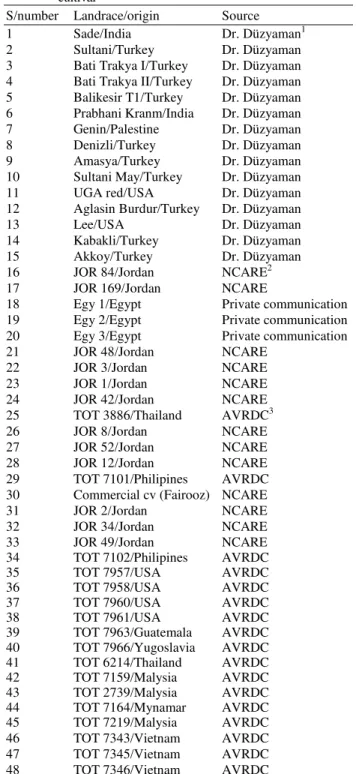
A total of 48 seed samples of okra genotypes and accessions were obtained from National Center for Agricultural Research and Extension (NCARE) Amman-Jordan and The World Vegetables Center/Taiwan, together with a commercial check cultivar (Fairooz) (Table 1). Okra seeds were grown in the greenhouse (Plant Breeding Department, Giessen, Germany). In order to take into account possible genetic variability within each accession, total genomic DNA was extracted from bulked young leaves (100-200 mg per accession) of ten 4-5-week-old plants following the CTAB procedure according to Doyle and Doyle (1990). After RNAse treatment, DNA content was fluorometrically quantified (DynaQuant 200 Hoefer Scientific Instruments) and diluted to 25 ng −1 working solution. AFLP analysis was performed according to Vos et al. (1995) by using the Invitrogen AFLP® Core Reagent Kit following the manufacturer’s instructions. Here, 125 ng of genomic DNA (i.e., 5 L of working solution) were digested using EcoRI and MseI restriction enzymes and generated fragments were ligated with double-stranded site-specific adapters using T4 DNA ligase. Ligation was followed by two pre-amplifications (+0, +1) prior to the final amplification phase performed by using primer combinations having three selective nucleotides.
Table 1. List of 48 okra (Abelmoschus esculentus L.) genotypes and accessions with their region together with the control cultivar
S/number Landrace/origin Source
1 Sade/India Dr. Düzyaman1
2 Sultani/Turkey Dr. Düzyaman 3 Bati Trakya I/Turkey Dr. Düzyaman 4 Bati Trakya II/Turkey Dr. Düzyaman 5 Balikesir T1/Turkey Dr. Düzyaman 6 Prabhani Kranm/India Dr. Düzyaman 7 Genin/Palestine Dr. Düzyaman 8 Denizli/Turkey Dr. Düzyaman 9 Amasya/Turkey Dr. Düzyaman 10 Sultani May/Turkey Dr. Düzyaman
11 UGA red/USA Dr. Düzyaman
12 Aglasin Burdur/Turkey Dr. Düzyaman
13 Lee/USA Dr. Düzyaman
14 Kabakli/Turkey Dr. Düzyaman 15 Akkoy/Turkey Dr. Düzyaman
16 JOR 84/Jordan NCARE2
17 JOR 169/Jordan NCARE
18 Egy 1/Egypt Private communication 19 Egy 2/Egypt Private communication 20 Egy 3/Egypt Private communication
21 JOR 48/Jordan NCARE
22 JOR 3/Jordan NCARE
23 JOR 1/Jordan NCARE
24 JOR 42/Jordan NCARE
25 TOT 3886/Thailand AVRDC3
26 JOR 8/Jordan NCARE
27 JOR 52/Jordan NCARE
28 JOR 12/Jordan NCARE
29 TOT 7101/Philipines AVRDC 30 Commercial cv (Fairooz) NCARE
31 JOR 2/Jordan NCARE
32 JOR 34/Jordan NCARE
33 JOR 49/Jordan NCARE
34 TOT 7102/Philipines AVRDC
35 TOT 7957/USA AVRDC
36 TOT 7958/USA AVRDC
37 TOT 7960/USA AVRDC
38 TOT 7961/USA AVRDC
39 TOT 7963/Guatemala AVRDC 40 TOT 7966/Yugoslavia AVRDC 41 TOT 6214/Thailand AVRDC 42 TOT 7159/Malysia AVRDC 43 TOT 2739/Malysia AVRDC 44 TOT 7164/Mynamar AVRDC 45 TOT 7219/Malysia AVRDC 46 TOT 7343/Vietnam AVRDC 47 TOT 7345/Vietnam AVRDC 48 TOT 7346/Vietnam AVRDC 1
Department of Horticulture, Faculty of Agriculture, Ege University, Turkey
The selective amplification mixture (total volume of 25 L) consisted of 7.5-12.5 ng fluorescent dye-labelled EcoRI primer, 30 ng MseI primer, 0.2 mM of each dNTPs, 2 L PCR buffer, 0.5 U Taq-polymerase (Qiagen, Germany) and 5 L of pre-amplified PCR-product in deionised distilled water.
Selective ampliWcation products were separated on 8% denaturing polyacrylamide gels using a Li-Cor 4200 DNA Analyzer. Fragments size was estimated incomparison to a 50-750 bp labelled DNA-ladder Scoring and analyses of AFLP data AFLP fragments were detected using the RFLPScan 2.1 software package (Scananalytics, Fairfax, USA). Clear and unambiguous fragments were scored as present (1) or absence (0) to generate a binary data matrix. The number of polymorphic fragments was determined for each primer pair used. Only polymorphic fragments were used for further data analysis. Pairwise relatedness based on genetic similarity (Dice, 1945) was estimated between all okra accessions using the SIMQUAL module of NTSYS pc software version 2.20e (Rohlf, 1993). UPGMA (unweighted pair-grouped method using arithmetic averages) cluster analysis was performed following GenDist and NEIGHBOR programs available in the software package PHYLIP 3.6 (Felsenstein, 1985).
3. RESULTS
3.1. AFLP Data Analysis
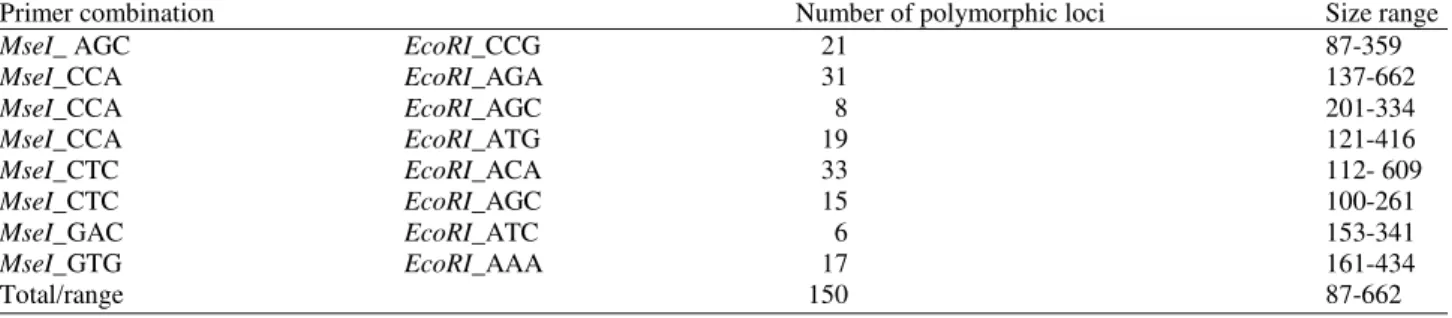
In our study, eight AFLP marker combinations were used to profile the 48 okra (Abelmoschus esculentus L.) genotypes including the control cultivar Fairooz (Fig. 1). As shown in Table 2 a total of 150 polymorphic loci were generated, ranging in size from 6 to33 bp. The number of amplified loci per primer varied from 6 loci (MseI_GAC and EcoRI_ATC) to 33 loci (MseI _CTC and EcoRI_ACA
3.2. Cluster and Principal Coordinate Analyses
Dice similarity coefficient (Dice, 1945) which is a matching coefficient for binary data generated AFLP analysis, was used to cluster the 48 okra (Abelomschus esculentus L.) genotypes together with the control cultivar Fairooz with the Unweighted Pair Group Method with Arithmetic Average (UPGMA). The 48 genotypes felt into 6 groups (Fig. 2). The similarity level between genotypes and accessions in cluster I ranged from 0.56 to 0.83. The highest genetic similarity percentage (0.83) was observed between (Sade) and (TOT 7963/Guatemala), while the lowest level (0.56) was found to be between (Bati Trakya I/Turkey) and the rest of the genotypes and accessions in the same cluster.
Fig.1. AFLP profiles of the 48 okra genotypes and accessions by the primer combination MseI-CTC/EcoRI-AGC. Lanes 1 to 48 presents: (1: Sade; 2: Sultani; 3: Bati Trakya I; 4: Bati Trakya II; 5: Balikesir T1; 6: Prabhani Kranm; 7: Genin; 8: Denizili; 9: Amasya; 10:Sultani May; 11: UGA red; 12: Aglasin Burdur; 13: Lee, 14: Kabakli; 15: Akkoy; 16: JOR 84; 17: JOR169; 18: EGY1; 19: EGY2; 20: EGY3; 21: JOR 48; 22: JOR 3; 23: JOR1; 24: JOR 42; 25: TOT3886; 26: JOR 8; 27: JOR 52; 28: JOR 12; 29: TOT 7101; 30: FAIROOZ CV; 31: JOR 2; 32: JOR 34; 33: JOR 49; 34: TOT 7102; 35: TOT 7957; 36: TOT 7958; 37: TOT 7960; 38: TOT 7961; 39: TOT 7963; 40: TOT 7966; 41: TOT 6214; 42: TOT 7159; 43: TOT 2739; 44: TOT 7164; 45: TOT 7219; 46: TOT 7343; 47: TOT 7345; 48: TOT 7346
Fig. 2. Dendogram generated based on UPGMA clustering method and Dice coefficient using AFLP analysis among 48 okra genotypes and clusters
Table 2. Standard statistics for the AFLP primer combination tested on the 48 okra (Abelmoschus esculentus L.) genotypes and accessions togethe with the control cultivar (Fairooz)
Primer combination Number of polymorphic loci Size range
MseI_ AGC EcoRI_CCG 21 87-359
MseI_CCA EcoRI_AGA 31 137-662
MseI_CCA EcoRI_AGC 8 201-334
MseI_CCA EcoRI_ATG 19 121-416
MseI_CTC EcoRI_ACA 33 112- 609
MseI_CTC EcoRI_AGC 15 100-261
MseI_GAC EcoRI_ATC 6 153-341
MseI_GTG EcoRI_AAA 17 161-434
The last cluster (Cluster VI) has been found to consist of only six landraces including the commercial cultivar Fairooz, The highest similarity (0.30) between (Bati Trakya II/Turkey) and (TOT 7345/Vietnam), while the lowest (0.14) was found between (Balikesir T1/Turkey) and the rest five landraces in the same cluster.
4. DISCUSSION
Forty eight genotypes and accessions of okra has been collected from different regions with the aim to measure genetic distinctiveness using AFLP markers. The result of the study demonstrated the suitability of AFLP data for the analysis of genetic diversity in Abelmoschus esculentus L. genotypes and accessions. Unlike genetic diversity, diversity based on phenotypic and morphological characters, usually varies with environments and evaluation of traits requires growing the plants to full maturity prior to identification, but now the rapid development of biotechnology allows easy analysis of large number of loci distributed throughout the genome of the plants (Chakravarthi and Naravaneni, 2006). Information on the genetic diversity in okra (Abemoschus esculentus L.) collections can give breeders and geneticists important information on the allelic diversity present in genebank materials and may help to identify genetically diverse pools for use in cross combinations to improve important agronomic traits or to better exploit heterosis (Diers and Osborn, 1994).
AFLP is a powerful fingerprinting technique, which detects polymorphism on the level of restriction enzymes sites. It is based on PCR amplification of restriction enzymes and oligonucleotides adaptors of few nucleotide bases. This method generates a large number of restriction fragment bands facilitating the detection of polymorphism. Therefore, AFLP markers combine the advantages of RFLP's and PCR-based markers. This technology has been adopted for fingerprinting and mapping of different plants (Hussein et al., 2005) as well as some pathogens (Meza-Moller et al., 2011).
Omahinmin and Osawaru (2005) reported that high degree of wide morphological variation exist among accession of okra which requires further evidence using molecular markers to clarify. Molecular markers have been successfully used in the genus Abelmoschus to select parents for hybrid production, for intra-specific or inter-intra-specific classification and for the analysis of variation. Akash et al. (2013) indicated a lack of significant correlation between phenotypic and actual AFLP genetic profile inferred by UPGMA
clustering in 21 landraces of Jordanian okra (Abelmoschus esculentus L).
In conservation programs for plant genetic resources, the availability of characterization data and information on available genetic diversity can help germplasm users to identify accessions of interest and also provide plant breeders with initial data regarding materials for use in crop improvement programs (Cruz et al., 2007). The Asian accessions was found to be more diverse than the accessions from African or USA, this could be mainly due to that the accession have be collected from different geographical regions from East to South of the continent, this result agress with Aladele et al. (2008) who indicated more diversity among the Asian genotypes using RAPD markers, this variation could be due to that the genotypes were originally collected from six different countries in the region. From this study, the Jordanian accessions were found to be diverse as they have been located in different clusters, the results agree with Kaur et al., (2013) who found great diversity between okra accession using RAPD. Many studies using Cluster analysis showed that similarity between the okra lines was from 100 to 15.41%. Gulsen et al. (2007) found the relatedness value based on SRAP markers ranging from 100 to 86% among 23 okra genotypes. Aladele et al. (2008) observed relatively more molecular diversity in the Asian genotypes as compared to those of African origin. Genetic distance values ranging from 0.00 to 0.66 were observed among okra accessions (Saifullah et al., 2010). The present investigation has provided a useful insight into the extent of genetic diversity in the okra germplasm and can be exploited in future breeding programs as well as for the development of mapping populations/linkage map.
The result of AFLP indicate a genetic diversity between the different accessions from different regions (cluster I and VI), this could be of high interest for breeders to start a successful breeding programs.
5. ACKNOWLEDGMENT
6. REFERENCES
Aladele, S.E., O.J. Ariyo and R. Lapena, 2008. Genetic relationships among West African okra (Abelmoschus caillei) and Asian genotypes (Abelmoschus esculentus) using RAPD. Afr. J. Biotechnol., 7: 1426-1431.
Ariyo, O.J., 1987. Multivariate analysis and the choice of parents for hybridization in Okra (Abelmoschus esculentus (L.) Moench). Theor. Applied Genet., 74: 361-363. DOI: 10.1007/BF00274718
Akash, M.S., K. Rehman and S. Rehman, 2013. Role of inflammatory mechanisms in pathogenesis of type 2 diabetes mellitus. J. Cell. Biochem., 114: 525-531. PMID: 22991242
Bates, D.M., 1968. Notes on the cultivated Malvaceae. 2, Abelmoschus. Baileya, 16: 99-112.
Bello, D., AA. Sajo, D. Chubado and J.J. Jellason, 2006. Variability and correlation studies in okra (Abelmoschus esculentus (L.) Moench.). J. Sustainable Dev. Agric. Environ.
Borssum Waalkes, J.V., 1966. Malesian malvaceae revised. Blumea, 14: 1-213.
Candlish, J.K., L. Gourley and H. Lee, 1987. Dietary fiber and starch contents of some southeast asian vegetables. J. Agr. Food Chem., 35: 319-321. DOI: 10.1021/jf00075a008
Chakravarthi, B.K. and R. Naravaneni, 2006. SSR marker based DNA fingerprinting and diversity study in rice (Oryza sativa. L). Afr. J. Biotech., 5: 684-688.
Charrier, A., 1984. Genetic resources of the genus Abelmoschus Med. (Okra). IBPGR Secretariat, Rome, pp: 61.
Cruz, V.M.V., R. Luhman, L.F. Marek, C.L. Rife and R.C. Shoemaker et al., 2007. Characterization of flowering time and SSR marker analysis of spring and winter type Brassica napus L. germplasm. Euphyt., 153: 43-57. DOI: 10.1007/s10681-006-9233-1 Dice, L.R., 1945. Measures of the amount of ecologic
association between species. Ecology, 26: 297-302. DOI:10.2307/1932409
Diers, B.W. and T.C. Osborn, 1994. Genetic diversity of oilseed Brassica napus germ plasm based on restriction fragment length polymorphisms. Theor. Applied Genet., 88: 662-668. DOI: 10.1007/BF01253968
Doyle, J.F. and J.L. Doyle, 1990. A rapid DNA isolation procedure for small quantities of fresh leaf tissue. Focus, 12: 13-15.
Düzyaman, E., 1997. Okra: Botany and Horticulture. In: Horticultural Review, Janick, J. (Ed)., John Wiley and Sons, ISBN-10: 1118351800, pp: 41-72. Düzyaman, E., 2006. Cultivar differences in yield
distribution patterns in okra (Abelmoschus esculentus (L.) Moench). Aus. J. Agric. Res., 57: 55-63. DOI: 10.1071/AR04291
Erschadi, S., G. Haberer, M. Schoniger and R.A. TorresRuiz, 2000. Estimating genetic diversity of Arabidopsis thaliana ecotypes with Amplified Fragment Length Polymorphisms (AFLP). Theor. Applid Genet., 100: 633-640. DOI: 10.1007/s001220050084
Felsenstein, J., 1985. Confidence limits on phylogenies: An approach using the bootstrap. Evolution, 39: 159-791. DOI: 10.2307/2408678
Flachowsky, H., E. Schumann, W.E. Weber and A. Peil, 2001. Application of AFLP for the detection of sex-specific markers in hemp. Plant Breed., 120: 305-309. DOI: 10.1046/j.1439-0523.2001.00620.x Friedt, W., R. Snowdon, F. Ordon and J. Ahlemeyer,
2007. Plant breeding: Assessment of genetic diversity in crop plants and its exploitation in breeding. Progress Botany, 168: 152-178. DOI: 10.1007/978-3-540-36832-8_7
Ghai, T.R., D. Arora, S.K. Jindal and P. Singh, 2005. Assessment of genetic divergence based on nutritional quality and agronomic traits in okra (Abelmoschus esculentus (L.) Moench.) J. Genet. Breed., 59: 1-6.
Gulsen, O., S. Karagul and K. Abak, 2007. Diversity and relationships among Turkish okra germplasm by SARP and phenotypic marker polymorphism. Biol. Bratislana, 62: 41-45.
Hamon, S. and D.H. Van Sloten, 1989. Characterization and Evaluation of Okra. In: The Use of Plant Genetic Resources, Brown, A.H.D. (Ed)., Cambridge University Press, Cambridge, ISBN-10: 0521368863, pp: 173-174.
Hasan, M., F. Seyis, A.G. Badani, J. Pons-Kuhnemann and W. Friedt et al., 2006. Analysis of genetic diversity in the Brassica napus L. gene pool using SSR markers. Genet. Resources Crop Evolut., 53: 793-802. DOI: 10.1007/s10722-004-5541-2
IBPGR, 1990. (International Board for Plant Genetic Resurces) Report on International Workshop on Okra Genetic Resources Held at the National Bureau Omonhinmin, C.O. and M.E. Osawaru, 1991. Morphological Characterization of Two Species of Abelmoschus: Abelmoschus esculentus and Abelmoschus caillei. Plant Genetic Resour. Newslett., 144: 51-55.
Kaur, K., M. Pathak, S. Kaur, D. Pathak and N. Chawla, 2013. Assessment of morphological and molecular diversity among okra (Abelmoschus esculentus (L.) Moench.) germplasm. Afr. J. Biotechnol., 12: 3160-3170. DOI: 10.5897/AJB12.2284
Kliebenstein, D.J., J. Gershenzon and T. Mitchell-Olds, 2001. Comparative quantitative trait loci mapping of aliphatic, indolic and benzylic glucosinolate production in arabidopsis thaliana leaves and seeds. Genetics, 159: 359-370.
Kundu, B.C. and C. Biswas, 1973. Anatomical characters for distinguishing Abelmoschus spp. and Hibiscus spp. Proc. Ind. Sci. Cong., 60: 295-298. Mace, E.S., C.G. Gebhardt and R.N. Lester, 1999. AFLP
analysis of genetic relationships in the tribe Datureae (Solanaceae). Theor. Applied Genet., 99: 634-641. DOI: 10.1007/s001220051278
Meza-Moller, A., M. Esqueda, F. Sanchez-Teyer, G. Vargas-Rosales and A.A. Gardea et al., 2011. Genetic variability in Rhizoctonia solani Isolated from Vitis vinifera based on amplified fragment length polymorphism. Am. J. Agric. Biol. Sci., 6: 317-323. DOI: 10.3844/ajabssp.2011.317.323 Omahinmin, A.C. and M.E. Osawaru, 2005.
Morphological characterization of two pecies of Abelmoshus: Abelmoshus esculentus and Abelmoshus caillei. Genet. Resource Newslett. 144: 51-55. Rawashdeh, L.M., 1999. Genetic variation among and
within okra (Abelmoschus esculentus L.) Landraces in Jordan. MSc. Thesis, University of Jordan, Amman, Jordan.
Rohlf, F.J., 1993. NTSYS-pc Numerical Taxonomy and Multivariate Analysis System. 1st Edn., Exeter Softeware, Setauket, N.Y., ISBN-10: 0925031224, pp: 7.
Saifullah, M., M.G. Rabbani and E.J. Garvey, 2010. Estimation of genetic diversity of okra (Abelmoschus esculentus L. Moench) using RAPD markers. SAARC J. Agric., 8: 19-28.
Salameh, N.M., 2014. Flow cytometric analysis Of nuclear DNA between okra Landraces (Abelmoschus esculentus l.) Am. J. Agric. Biol. Sci., 9: 245-250. DOI: 10.3844/ajabssp.2014.245.250
Salameh, N.M. and M.A. Kasrawi, 2007. Inheritance of fruit length, diameter and number of fruit ridges in Okra (Abelmoschus esculentus L.) Landraces of Jordan. Jordan J. Agric. Sci., 3: 439-452.
Salameh, N. and M. Kasrawi, 2011. Inheritance of fruit, petiole and stem color in different crosses in okra (Abelmoschus esculentus L.) landraces of Jordan. Mutah Nat. Applied Sci., 26: 43-62.
Siemonsa, J.S., 1982. West african okra-morphological and cytological indications for the existence of a narural amphidiploid of Abelmoschus esculentus (L.) Moench and A. manihot (L.) Medikus. Euphytica, 31: 241-252. DOI: 10.1007/BF00028327 Terell, E.E. and H.F. Winters, 1974. Change in scientific
names for certain crop plants. Hort. Sci., 9: 324-325. Vos, P., R. Hogers, M. Bleeker, T. van de Lee and M. Hornes et al., 1995. AFLP: A new technique for DNA fingerprinting. Nucleic Acids Res., 23: 4407-4414. DOI: 10.1093/nar/23.21.4407