Syconia of
Ficus benjamina
(
Ficus
: Moraceae)
Chun-Yan Yang1., Jin-Hua Xiao2., Li-Ming Niu2,3
, Guang-Chang Ma , James M. Cook3 4,5, Sheng-Nan Bian1, Yue-Guan Fu3, Da-Wei Huang1,2*
1College of Plant Protection, Shandong Agricultural University, Tai’an, China,2Key Laboratory of Zoological Systematics and Evolution, Institute of Zoology, Chinese Academy of Sciences, Beijing, China,3Environment and Plant Protection Institute, Chinese Academy of Tropical Agricultural Sciences, Danzhou, Hainan, China,4School of Biological Sciences, University of Reading, Reading, Berkshire, United Kingdom,5Hawkesbury Institute for the Environment, University of Western Sydney, Sydney, Australia
Abstract
Figs and fig wasps form a peculiar closed community in which theFicustree provides a compact syconium (inflorescence) habitat for the lives of a complex assemblage of Chalcidoid insects. These diverse fig wasp species have intimate ecological relationships within the closed world of the fig syconia. Previous surveys ofWolbachia, maternally inherited endosymbiotic bacteria that infect vast numbers of arthropod hosts, showed that fig wasps have some of the highest known incidences of Wolbachiaamongst all insects. We ask whether the evolutionary patterns ofWolbachiasequences in this closed syconium community are different from those in the outside world. In the present study, we sampled all 17 fig wasp species living on Ficus benjamina, covering 4 families, 6 subfamilies, and 8 genera of wasps. We made a thorough survey ofWolbachia infection patterns and studied evolutionary patterns inwsp(WolbachiaSurface Protein) sequences. We find evidence for high infection incidences, frequent recombination between Wolbachia strains, and considerable horizontal transfer, suggesting rapid evolution ofWolbachiasequences within the syconium community. Though the fig wasps have relatively limited contact with outside world,Wolbachiamay be introduced to the syconium community via horizontal transmission by fig wasps species that have winged males and visit the syconia earlier.
Citation:Yang C-Y, Xiao J-H, Niu L-M, Ma G-C, Cook JM, et al. (2012) Chaos ofWolbachiaSequences Inside the Compact Fig Syconia ofFicus benjamina(Ficus: Moraceae). PLoS ONE 7(11): e48882. doi:10.1371/journal.pone.0048882
Editor:William Hughes, University of Leeds, United Kingdom
ReceivedJuly 25, 2012;AcceptedOctober 1, 2012;PublishedNovember 8, 2012
Copyright:ß2012 Yang et al. This is an open-access article distributed under the terms of the Creative Commons Attribution License, which permits unrestricted use, distribution, and reproduction in any medium, provided the original author and source are credited.
Funding:This project was supported by the National Natural Science Foundation of China (NSFC grant no. 31090253, 31172072), partially by Major Innovation Program of Chinese Academy of Sciences (KSCX2-EW-Z-2), a grant (No. O529YX5105) from the Key Laboratory of the Zoological Systematics and Evolution of the Chinese Academy of Sciences and National Science Fund for Fostering Talents in Basic Research (Special subjects in animal taxonomy, NSFC- J0930004). The funders had no role in study design, data collection and analysis, decision to publish, or preparation of the manuscript.
Competing Interests:The authors have declared that no competing interests exist.
* E-mail: [email protected]
.These authors contributed equally to this work.
Introduction
Wolbachia(Alphaproteobacteria) are maternally inherited endo-symbiotic bacteria that are found in arthropods and filarial nematodes [1,2]. A meta-analysis estimates that the proportion of
Wolbachia-infected arthropod species is 66% and that there are some 1 million infected species in insects alone [3]. Recently, with a more appropriate data set from both a broad range of species and a sufficient number of individuals per species, this number was reduces to 40%, however confirming thatWolbachiaare the most abundant endosymbionts among arthropod species [4]. Besides the pandemic distribution, host reproductive manipulations are also important features of Wolbachia. The bacteria spread and persist in some host species by manipulating host reproduction via methods including feminization of genetic males [5], partheno-genesis induction [6], killing of male progeny from infected females [7] and cytoplasmic incompatibility [8]. These all provide relative reproductive advantages to infected females, thereby favoring the persistence and spread of theWolbachiastrain in host populations [9].
Vertical transmission from mother to offspring via the egg cytoplasm is thought to be the predominant mode of Wolbachia
transmission within a host species [10]. However, horizontal transfer of Wolbachia has also been detected both within and among different host species in many cases. Various findings suggest the existence of horizontal transfer. For example, closely related bacterial strains can be found in taxonomically unrelated hosts [11,12,13]; the phylogeny of Wolbachia is often strongly incongruent with that of their hosts [12,13,14,15,16,17]. Further, it is possible to transfect Wolbachia from native hosts to other species, although a newly acquired strain often cannot maintain high infection rates over many generations [18,19,20]. A case study in the wasp genusNasonia indicated that the four closely related species were infected with eleven different
In order to investigate the transmission ofWolbachiaor its effects on hosts, many studies have compared samples from different localities, in some cases even among different continents [2,3,25,26]. Other studies have focused on ecological communities or at least interacting host species, such as social hosts [27], insects with host-parasite relationships [19], or otherwise linked through feeding on the same food [17,22]. These species are phylogenet-ically or ecologphylogenet-ically closely related, and even form communities in some cases. However the environment they occupy is open, so they have many opportunities to interact with a wide range of species that is hard to define. This can make it difficult to define the boundaries of a relevant panel of potential hosts from which they may acquireWolbachiainfections. However, the diverse but closed communities of fig wasps (Hymenoptera: Chalcidoidea), living within the syconia of fig trees (Ficus: Moraceae) are different. Fig and fig wasps form a classical model in the study of co-evolution and, increasingly, community ecology [28,29,30,31]. We suggest that they may also provide a good model to study infection patterns and transfer routes of Wolbachia. Figs are plants in the genus Ficus, with around 750 species worldwide, mostly in the tropics. Figs and fig-pollinating wasps are obligate mutualists that have coevolved for over 60 million years [32]. Figs have unique closed inflorescences called syconia, in which the fig wasps (including pollinating and non-pollinating species) reproduce and develop. One fig tree species may host several (and up to 30) different wasp species [33,34]. Most of the wasp species are chalcidoids from the families Agaonidae, Pteromalidae, Euryto-midae, Torymidae and Orymidae. Different wasp species can survive within the same syconium by employing different living strategies, such as using different flower layers [35,36], laying eggs at different phases of fig maturity [30,37] and having diverse larvae diets (e.g. gallers and parasitoids) [30,38,39,40,41,42,43,44]. The syconia provide fig wasps with a compact habitat isolated from the outside world. The female wasps come out from their natal figs to lay eggs into the ovaries of some flowers in receptive figs. Some of the species (all the pollinators and some pollinators) enter the syconia to oviposit, while most of the non-pollinators do not enter syconia but inject eggs through the fig wall. The larvae of the wasps can feed on either fig flowers or parasitize other fig wasps. Upon maturation, the wingless males of most species mate with females inside the syconia, which they do not leave. Meanwhile, other non-pollinator species have fully winged males, which emerge from the syconia and search for females after dispersal.
Previous surveys of fig wasps have proved that the incidence of
Wolbachia infection in fig-associated wasps is significantly higher than for a broad collection of insects [11,25,26]. The compact and closed world of the syconium is one in which intimate physical contact and close ecological association between species are inevitable. Together with the relatively close phylogenetic relationships of these fig wasps species, this suggests that horizontal transmission of Wolbachia is more likely to occur in this species community than other less closed systems. The frequent horizontal transmission of Wolbachiamay also lead to the high evolutionary rates ofWolbachiagenes, for example the recombination events of outer membrane protein genes, due to the immune responses of the hosts. In the present studies, we are very interested in the following questions:
1) What is theWolbachiainfection pattern across all fig wasp species associated withFicus benjamina?
2) Are there more frequent horizontal transfer events of
Wolbachiaamong these wasp species living inFicus benjamina
than other previously researched species with some kind of intimate relationships?
3) DoWolbachiainfections within a closed syconium commu-nity have unique evolutionary characters?
4) Compared to open or semi-open communities, is there a decrease in Wolbachia exchange between the relatively compact world of within syconia (fig wasps) and the outside (other insects)?
In the present study, we focused on the 17 species of chalcidoid wasps living onFicus benjamina, covering 4 families, 6 subfamilies, and 8 genera. We made a thorough survey ofWolbachiainfection patterns by using theWolbachia Surface Protein gene (wsp) as a marker. We also observed and investigated the biological characteristics on these fig wasps, based on which we tried to reconstruct horizontal transfer routes ofwsp.
Materials and Methods
Ethics Statement
The sampling of living material involved in our experiments included figs (Ficus benjamina) and fig wasps (living in Ficus benjamina). All necessary permits were obtained for the field sampling. Collection permits were provided by the Institute of Environment and Plant Protection, Chinese Academy of Tropical Agricultural Sciences and Xishuangbanna Tropical Botanical Garden, Chinese Academy of Science.
Ecological Observations and Fig Wasp Sample Collection and Identification
Ficus benjaminaoccurs naturally throughout Southeast Asia. The oviposition timing of the fig wasp species associated with F. benjaminawas observed and analyzed based on three individual fig trees. Around 1000 fig syconia were chosen on each tree. The visiting time of all the wasp species was noted in relation to the developmental stage of the fig syconia.
All the fig wasps for molecular experiments were collected from differentFicus benjaminatrees in Hainan and Yunnan province in the years of 2006–2011. Before the emergence of fig wasps, mature fig fruits were collected and then dissected in the laboratory for fig wasp specimen’s collection. Female fig wasps species were taxonomically determined by morphological diagnostics by using Nikon SMZ80 microscopes, with most of the species described in a previous study in our lab which have corresponding data for both morphological and molecular characters [45]. We tried to maximize the independence of samples by choosing samples from different batches of syconia so as to avoid sampling with an unusualWolbachiadistribution. The fig wasp species used are listed in table S1.
DNA Extraction
PCR Amplification and Sequencing
The samples were first screened forWolbachiainfection by PCR amplification with the primers wsp81F (59 -TGGTCCAATAAGT-GATGAAGAAAC-39) and wsp691R (59 -AAAAATTAAACGC-TACTCCA-39) that amplified part of the Wolbachia Surface Protein gene (wsp) [46]. Genomic DNA from Ceratosolen solmsi
(Hymenoptera: Chalcidoidea), a pollinator ofFicus hispida, which had high infection titre ofWolbachiawas used as positive control, while ddH2O was used as template for a blank control. Because in
some cases, the amplification of wsp81F and wsp691R could not get a single band, another pair of primers were used, wsp1f (59 -AATAAGTGATGAAGAAACTAG-39) and wsp691R. The lo-cality of wsp1f is on the right of wsp81F by 3 bp, with 18 nucleotides exactly the same as wsp81F. Both of them do not have degenerate sites. A BLAST search on wsp81F of NCBI GenBank, we found subjects with identical wsp81F sequences also have the same inner 3 bps as wsp1f. So we consider them to have almost the same sensitivity. Touchdown PCR programs were used: 5 min at 94uC, followed by 20 cycles of 30 s at 94uC, 45 s at 56uC (with 0.5uC reduction every cycle), 1 min at 72uC, and then 8 cycles of 30 s at 94uC, 45 s at 46uC, and 1 min at 72uC; and a final elongation step of 10 min at 72uC. PCR products were purified by EasyPure PCR purification Kit (TransGen, Beijing, China) and directly sequenced by ABI3730 capillary autosequencer (Biosune, Shanghai, China). If the sequencing results showed multiple peaks, the PCR products were cloned with Peasy-T1 vector (TransGen, Beijing, China), and 3 positive clones were sequenced. In case the clones showed high sequence diversity, more clones were sequenced. On average, 5–6 clones were sequenced in each multiple infected individual. The length ofwspsequences is from 552 to 573 bp with primers of wsp1f and wsp691R and from 555 to 576 bp with primers of wsp81F and wsp691R. In order to acquire accurate infection frequency in each species, negative samples ofwspwere double-checked by amplification of another two genes,ftsZand16S rDNA.
For multilocus sequence typing (MLST), we only selected the samples whosewspsequence was consistent with a singleWolbachia
infection, and a single clear single gel band was obtained. We used a system of MLST primer F3/R3 nested with MLST standard primers, with the primer sequence and PCR conditions as described on the WolbachiaMLST website (http://pubmlst.org/ wolbachia/info/protocols.shtml). We also tried to acquire MLST sequences from lowWolbachiatitre samples, but it was difficult to successfully amplify all the five gene fragments.
Sequence Analysis
Raw sequences treatments, wsp typing and ascertainment of recombinants. If multiple identical se-quences were obtained for each species, we chose only one to represent them. The sequences were then submitted forwsptyping (http://pubmlst.org/wolbachia/wsp/). According to the typing results, the sequences were clustered into different groups of non-recombinant or non-recombinant wsptypes. The suggested recombi-nant evidence of the recombirecombi-nant wsp sequences were further ascertained by using the programs of RDP, GENECONV, MaxChi, BootScan, and SiScan in RDP3 software [47].
Phylogenetic analyses. The non-recombinantwsp sequenc-es were aligned to relevant sequencsequenc-es previously published on NCBI with Clustal W in Bioedit [48]. Neighbor-Joining trees were constructed by using p-distance model in Mega 5 [49]. Gaps and missing data were pairwise deleted. Bootstrap values were calculated from 1000 replications.
Statistic analyses. All of the statistic comparison analyses were based on Chi square test with P values larger than 0.05 indicating insignificant divergences.
Results
Ecological Observations on the Fig Wasps Associated withFicus benjamina
Ficus benjamina is monoecious (subgenus: Urostigma, section: Conosycea). The diameter of syconia is from 12 mm to 25 mm. This tiny space both produces seeds and houses many species of fig wasps. Ficus benjamina can represent a common and classical delegate of the fig fruits, so studies of the Wolbachia infection patterns in this community can give us a broad impression on the system of fig and fig wasps.
We sampled a total of 17 fig wasp species, which belong to 4 families and 8 genera.Eupristina koningsbergeriGrandi is a pollinator, while the others are non-pollinators (table S1) [45]. Wasp number and species composition are very similar among the trees observed. In principle, more wasps are produced in raining season (May to October) than in dry season (November to April). However, the species composition is relatively stable all the year round. Pollinators occupy half of the community population, while the rest are non-pollinators. Many species are easily found whereas some species are rare species, such asSycoscaptersp. 2,Ormyrussp. 1, and Sycophila sp. 3. Up to 12 species co-occurred in individual syconia, while up to 14 species were collected on the same batch of a fig tree.
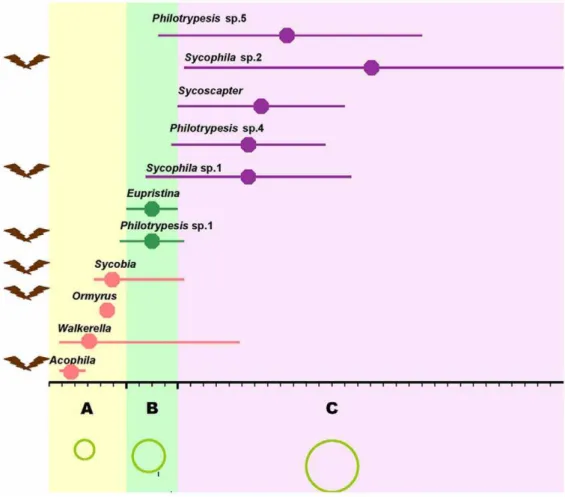
The species assemblage has diverse oviposition behaviors with different species arriving at the figs at different stages of development and using different oviposition sites (Figure 1 and Table S1). Seven species from four genera visit at pre-female stage; 2 species come at female stage, including pollinator Eupristina koningsbergeri; 7 species visit at interfloral stage. The detailed order has been described in Figure 1. ExceptEupristina koningsbergerilay eggs from inside the syconium, all the others oviposite from outside the syconium. Most of the earlier visitors are prone to be gall makers, while the later are mostly inquilines or parasitoids (Table S1). The species assemblage has diverse larval diets of gall-makers, parasitoids or inquilines, which can indicate the parasitic relationships of some of these species within the same syconium (Table S1).
HighWolbachiaInfection Incidence in Ficus benjamina Wasps
We screened 870 wasps of the 17 species associated with F. benjaminaforWolbachiainfection. The detailed results are listed in table 1. Fourteen out of 17 species were found to be infected. This infection incidence (84%) is higher than in wider screenings (from many fig species) of fig wasps in Australia (67%) and Panama (59%), but the differences are not significant (X2= 0.031, P.0.05). Only three species appeared to be uninfected:Sycophila sp. 1,
Wspgenotypes ofWolbachiain this Fig Wasp Community
After removing repeated identical sequences within each species, we obtained 103 effectivewspsequences from the infected species. These were aligned based on the amino acid motifs of the four hypervariable regions (HVRs) and arranged into four groups: group 1, 45 non-recombinant sequences, 7 genotypes; group 2 & group 3: 57 recombinants, 28 genotypes (the detailed comparison of these two groups were described in the following sections); group 4: one unique sequence (data not shown), 1 genotypes. Evidence of recombination for the 57 recombinant sequences was further confirmed by RDP software (data not shown). All of the sequences were submitted to Genbank with accession numbers JQ342186–JQ342231, JQ361490–JQ361513 and JX192925– JX192928.
Detection of Seven non-recombinantWolbachia wsp Genotypes
Based on a Neighbor-Joining analysis of all 45 non-recombinant
wspsequences (group 1) with other related sequences, we detected seven non-recombinant Wolbachia wsp types based on the sequences similarity, which we named wben-1,wben-4, wMors,
wMel, wHaw (Figure 2), in this fig wasp species community.
Within each non-recombinant type, the percentage divergence is from 0 to 0.004, however, between each type, the net percentage divergence is from 0.086 to 0.480. Six belong to Wolbachia
supergroup A, while wben-2 belongs to supergroup B. Previous studies onWolbachia infection of fig wasps found that Wolbachia
strain are region-specific. Strains in Asia and Australia are more similar, while they have more divergence from those in the new world, for example, Panama [25,50]. However in our research, wben-1 is very similar to thewsp type infected several fig wasp species in Panama, in contrast to previous results thatWolbachia
strains infecting fig wasps in Panama and Australia were different and region-specific [25].
Four of thewsptypes were common ones with wide distributions in other insect hosts besides the fig wasps inFicus benjamina. These were wben-1, wMors, wMel and wHaw, which were found respectively in previous studies [23,51,52,53,54,55,56,57]. Wben-2, wben-3, and wben-4 were uniquewsptypes first detected here in ourF. benjaminacommunity. Wben-2 was widely distributed in this community and often co-infects with other types, while wben-3 existed only in some samples from Hainan. Wben-4 was only detected inOrmyrusand this host species had no otherwsptypes (Table 1).
Figure 1. The oviposition timing of fig wasps inFicus benjamina.A, B and C with different ground colors indicate the three different syconia development phases: pre-female phase (Yellow A,,6 days), female phase (Green B,,4 days), and interfloral phase (Lilac C,,30 days). The green circles with different sizes at the bottom indicate the syconia sizes at the different phases. Length of the horizontal line indicates the span of arriving time, and the central point is the hotspot time for the arriving (the arriving individual number is the highest) of each species. Pink, green, and purple lines indicate that the wasps mainly arrive at pre-female, female, and interfloral phase. Brown symbols to the left of the species names mean Species or genus with winged males.
We attempted multilocus sequence typing (MLST) of all non-recombinant wsp strains that occurred as single infections. This involved use of the five housekeeping genes (gatB,coxA,hcpA,ftsZ, and fbpA). However, due to the low titre of Wolbachia, we only obtained full MLST data for wHaw and wben-2, which can now be identified as ST-19 and ST- 274 respectively (table S2).
Abundant Recombinant Sequences Exist in Ficus benjamina
We detected a large number of recombinantwsp types in this study. Of the 57 recombinant sequences, 38 can be assigned to non-recombinant ‘‘parents’’ detected in the F. benjamina commu-nity (group 2). The origins of the other 19 (group 3) are less clear and involve parent sequences not detected in the fig wasp community. Considering the HVRs composition and origin of all recombinants, we classified them into 28 types, named rec-1,
rec-28 (data not shown). By MLST methods, we only obtained full strain information for rec-28 (Table S2). The distribution of recombinant wsp types in the different host species are listed in table 1. All may be functional since they can be translated without frame-shifts or early stop codons.
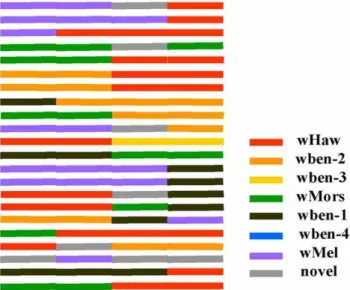
The recombination patterns of the 28 recombinant types according to the origin of the four hypervariable regions are
described in Figure 3. Most recombinants (18 of 28) are composed of sequence blocks from two non-recombinant types; 9 recombi-nants stem from three different non-recombinant genotypes; and rec-24 is composed of sequences from four non-recombinant types. Eight types of the 28 recombinants (rec-1, 4, 10. 15, 20, 21, 26, and 28) are composed of sequences original from not only
Wolbachiastrains of fig wasps onFicus benjamina, but also other host resources we named ‘novel’.
The ubiquitous and Ficus benjamina-specific non-recombinant
wsp types differ in their involvement in recombination. The ubiquitous types with wide range of hosts (wben-1, wMores, wMel and wHaw) are also frequently involved in recombination events. In particular, recombinants involving wHaw sequences were found in all species harboring recombinant sequences. However, the threeF. benjaminaspecific non-recombinantwsptypes are either not involved in any recombination events (wben-4) or involved in few cases (wben-3 and wben-2) (Figure 3).
Infection Patterns ofWolbachiainFicus benjamina Community
Based on a survey of 143 infected wasps, we detected that 63 insects have multiple infections, while 80 were single infected. Superinfected samples were mainly from speciesPhilotrypesissp. 1
Table 1.Wolbachiainfection frequencies of the fig wasp species associated withFicus benjamina.
wasp species Sample locality
Individuals infected (Individuals screened)
Infect
frequency Non-recombinant strains
Recombinant strains
Eupristina koningsbergeri Hainan 64 (96) 0.667 wben-3 rec-3
Eupristina koningsbergeri Yunnan 13 (28) 0.464 wben-2.wHaw.wMors rec-1.4.16.22.25
Walkerella benjamina Hainan 99 (100) 0.99 wben-2.3 /
Walkerella benjamina Yunnan 13 (18) 0.722 wben-2 /
Walkerellasp. 1 Hainan 78 (91) 0.857 wben-2 /
Walkerellasp. 1 Yunnan 2 (6) 0.333 wben-2 /
Sycoscaptersp. 1 Hainan 95 (120) 0.792 wben-1.3.wHaw.wMors rec-1.5.12.16.17.21.25
Sycoscaptersp. 2 Hainan 6 (6) 1 / rec-28
Philotrypesissp. 1 Hainan 21 (36) 0.583 wben-1.2.wHaw.wMors.wMel rec-1.15.16.18.23.25
Philotrypesissp. 1 Yunnan 2 (4) 0.5 wben-2 /
Philotrypesissp. 4 Hainan 10 (59) 0.169 wben-1.2.wHaw.wMors rec-1.5.6.15.16.19.25.27
Philotrypesissp. 4 Yunnan 26 (37) 0.703 wben-2.wHaw.wMors rec-4.8.10.14.16.20.21
Philotrypesissp. 5 Hainan 33 (76) 0.434 wben-1.3 /
Philotrypesissp. 5 Yunnan 1 (1) 1 wHaw /
Sycobiasp. 1 Yunnan 34 (38) 0.893 wben-1.2.wHaw.wMors rec-4.7.9.16.25
Sycobiasp. 2 Hainan 10 (31) 0.323 wben-3 rec-1.15.16.24
Acophilasp. 1 Hainan 17 (37) 0.349 wHaw /
Sycophilasp. 1 Hainan 0 (11) 0 / /
Sycophilasp. 2 Hainan 28 (36) 0.778 wben-1.2.wHaw.wMors rec-1.2.15.16.22.25
Sycophilasp. 2 Yunnan 1(5) 0.2 / rec-13
Sycophilasp. 3X Hainan 2 (4) 0.5 / /
Sycophilasp. 4 Hainan 0 (22) 0 / /
Ormyrussp. 1 Hainan 6 (7) 0.857 wben-4 /
Ormyrussp. 2 Hainan 0 (1) 0 / /
Notes:/indicates nowspsequences were obtained.
in Hainan,Philotrypesissp. 4,Sycoscaptersp. 1 in Hainan,Sycobiasp. 1 in Yunnan, andSycophilasp. 2 in Hainan. Some species had only single-infected specimens, for example Ormyrus sp. 1 in Hainan, andSycoscaptersp. 2 in Hainan. (See table S3).
The species that harbor more recombinant sequences also have more non-recombinants; for example, inPhilotrypesissp. 1,P.sp. 4, andSycophilasp. 2, implying a positive correlation of recombinants and non-recombinants. Species with multiple wsp genotypes mostly harbor both recombinant and non-recombinant types. There is only one exception in Philotrypesis sp. 5, which harbors only non-recombinants (wben-3, wben-1). More wsp sequences from Philotrypesis sp. 5 are required to ascertain this infection appearance. However, there is no indication that the recombi-nants come from the combination of the non-recombinant sequences hosted in the same individual or species. For example,
Eupristina koningsbergeriin Hainan hosts non-recombinant wben-3, while it has recombinant rec-3 which derives from wHaw and wMel, not from wben-3 (Figure 3 and table 1).
The infection patterns are independent of sampling localities (X2
= 0.19, p.0.05) or the phylogenetic relationships of the hosts (X2
= 0.00039, p.0.05). For example, Eupristina koningsbergeri in Hainan and Yunnan provinces have different wsp types. In contrast, Philotrypesis sp. 4 in Hainan and Yunnan has similar infection patterns. Phylogenetically closely related fig wasps may have different infection patterns, e.g.Sycobiasp. 1 andSycobiasp. 2. The former has 4wsptypes, while the latter has only one, different,
wsp type. Overall, there are four species in the genus Sycophila
associated withF. benjamina, but onlySycophilasp. 2 andSycophilasp. 3 are infected withWolbachia(table 1).
Discussion
Our study made a thorough survey on theWolbachiainfection patterns of all the fig wasp species living inside the closed syconium community ofFicus benjamina. We detected high infection incidence in this compact community, as expected. In addition, complicated infection patterns were revealed, including frequent recombination and horizontal transfer, which are signature features of fast evolution of thewspgene [58].
We sequenced 3–6 clones of wsp of each multiple infect individual. This method would underestimate the number of multiple infect hosts and the number of strains that co-infect in the individual. Fortunately, large sample numbers will compensate this drawback to some degree. Despite the underestimate, common existing multiple infections in individuals and species is a peculiar character in this system.
Frequent Recombination Events within the Syconia WSP in Wolbachia is confirmed to be an outer membrane protein [59]. WSP may play a key role in an arms race between arthropod hosts and Wolbachia, by inducing host immune responses [60] in which the WSP protein and its surface domains may have a considerable influence. In the dynamic host-bacterium immune interactions, the bacteria can take advantage of the rapidly evolved outer membrane proteins, e.g. WSP, to produce new phenotypes to avoid the host immunity. Recombination may provide an effective means to create new variants and promote the evolution of novel phenotypes, and so far wsp sequences have shown the most remarkable pattern of recombination among the
Wolbachiaproteins studied so far [58].
In ourF. benjaminawasp community, abundant recombinantwsp
sequences were widely distributed. Recombinants were detected in 53 of the 143 infected fig wasp individuals. At the species level, of the 17 species surveyed, 13 were infected, of which only four lack recombinant infections. Further, all of the recombinant wsp
sequences were novel and first detected in this focal fig wasp community. Additionally, most of the recombinants were descended from other sequences within the same community, which indicated that most of these recombinants were produced in the syconium community, and further suggested that intimate insect species interactions within the Ficus syconia provided a platform for horizontal transfer and recombination ofWolbachia.
Several lines of evidence help us to confirm that the recombinants we detected are real recombinants in the cells and not PCR recombinants. First, we have acquired the same recombinants from different host individuals and even from different host species for many wsp genotypes. Second, we can confirm recombinants with repeated PCR reactions on the same template. Third, All the recombinants sequences can be translated correctly; if these sequences were PCR errors it is unlikely that all of them have right open reading frame without interruption.
In previous studies, Werren and Bartos reported the first example of recombination and they detected one type of recombinants. The parasitoid wasp and the flies it parasitizes may provide ecological context for this recombination [61]. In Reuter and Keller’s studies, all ants co-infected with four or five distinct Wolbachia strains, three of which were arisen by Figure 2. NJ tree constructed with the obtained non-recombinantwspsequences and some related sequences downloaded from GenBank (The accession IDs of the downloaded sequences are annotated on the tree).Two sequences from supergroup C and D are used as outgroups. All of the seven non-recombinantwsptypes are indicated. The strains to which somewsptypes belonged with previously reported names are also indicated. The threewsptypes unique toFicus benjaminaare pointed out withm. Wben-2 belongs to supergroup B while the other wsptypes belong to supergroup A.
doi:10.1371/journal.pone.0048882.g002
Figure 3. Recombination patterns for the recombinant groups according to HVRs.HVRs of the seven original non-recombinants and some HVR resources not associated withFicus benjamina(we named them ‘novel’.) are indicated with different colors. All the 28 recombinant wsp types have different HVRs compositions recombined from the seven non-recombinants or some other HVR resources.
homologous recombination [62]. InSpalangiaspp. (Hymenoptera: Pteromalidae), 24 out of 48 strains were recombinants [53]. Some statistic analyses predicted that the rate of recombination might be approximately equal to the rate of horizontal transmission [63]. In our studies, 28 types of recombinants occupied 80% (28/28+7) of all genotypes detected within theFicus benjaminacommunity. These comparison results indicated that the recombination events ofwsp
happened frequently in the system ofFicus benjamina.
We do not exactly know how recombinants are produced; however, the contact of differentwspDNA sequences is a prerequisite. Studies indicate thatwsp occurs as a single copy in theWolbachia
genome, so the co-existence of differentwspsequences in a host is evidence of co-infections of divergentWolbachiastrains in a host, and the widespread occurrence of co-infections provides a suitable arena for recombination [60].
While the ubiquitous non-recombinant strains were extensively involved in recombination, some non-recombinant strains were involved in no or few recombination events. Why do these strains have different appearances? We suggest that the ubiquitous strains have broad hosts both within the syconium and the outside world, which means that they may be more likely to transfer, so co-infection events are easily formed. However for the unique strains only found within the syconium, they were often present in a host individual with high concentration alone, which may be a function of the host biology so that they do not have chance to recombine.
Prevalent Horizontal Transfer ofwspinFicus benjamina Community
Due to the fast evolution, especially the frequent recombination events, ofwsp, it is misleading to classifyWolbachiastrains based only onwspsequences [58,64]. Aswspcan be horizontally transferred as a single gene, horizontal transfer ofWolbachiastrains can not be inferred solely on the basis ofwspsequences [58,64]. However, the horizontal transfer frequency of wsp gene itself can indicate the transfer frequency ofWolbachiain some degree. Due to the practical difficulty in obtaining the MLST strain information for theWolbachiain these fig wasp species, we only discuss the transfer of thewspgene.
Wolbachia spreads across hosts through both vertical and horizontal transfer. Maternal vertical transmission is crucial for the persistence ofWolbachiawithin a single host species from one generation to the next. In our studies, some fig wasp species stably harbor some types of wspsequences, even though the wasps are sampled from different syconia or different fig trees, which indicates that they are not occasional infection events. Wsp
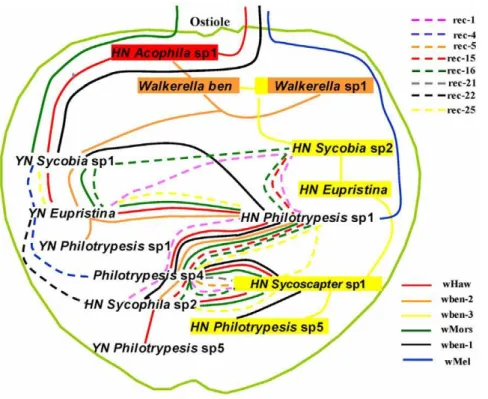
sequence can exist in the species stably via vertical transmission. Horizontal transfer also appears prevalent in the syconia ofFicus benjamina. As shown in Figure 4, we made an assumption on the putative transfer routes of all thewsptypes infecting more than one fig wasp species. Five of the 7 non-recombinants present horizontal transfer events (except wben-4 which is only present inOrmyrusand wMel only inPhilotrypesis sp.1). Eight wsprecombinants are also infecting more than one fig wasp species and representing complicated horizontal transfer patterns within the community.
Though the exact horizontal transfer routes can only be speculated upon, there is plentiful evidence that horizontal transfer is common. First, identicalwspsequences exist in species with long distance in phylogenetic relationship. Considering the fast mutation rate of wspsequences [60], it is unlikely that vertically transmittedWolbachia accumulate no mutation inwsp sequences among species that diverged a long time ago. Second, there is no clue that the recombinants come from the combination of the non-recombinant sequences hosted in the same individual or species, so horizontal transfer of recombinants among different species seems more likely. It is common that some recombinant sequences exist
in different species in the community, but, it is highly unlikely that identical recombinant sequences form independently and repeat-edly in different species. Finally, intimate ecological relationships occur among the different fig wasp species such as host-parasitoid, phytophagous insects-food, co-habitant, or close phylogeny relationship and provide good chances for thewsp sequences to horizontally transfer within the closed system. Previous studies on dipteran insects associated with mushrooms indicate that the mushroom habitat may provide a somewhat comparable (if more open) ecological arena for the exchange of Wolbachia[17]. The wide distribution of ubiquitous wsp sequences in the fig wasp assemblage indicates active exchanges of wsp between the fig syconia inside world (fig wasps) and the outside (other insects).
We summarized previous studies on the Wolbachia infection patterns. These concerned different species, included parasitic insects, social insects, insects within the same community and other phylogenetically closely related insects. The rate of horizontal transfer events of our community was 37.1% (13/37), lower than that in pumpkin community 57% (4/7) and inNasonia
45.4%. If we only consider the non-recombinants in our system, in which 5 out of 7 were involved in horizontal transfer events, the rate was the highest (71.4%).
We also compared the average strain numbers per species harbored in the surveyed insects: the highest one is Nasonia(11/ 4 = 2.75), second parasitoid wasp (48/21 = 2.29), and the third one is our Ficus benjamina community (35/27 = 2.06). The above data indicated that parasitic insects were prone to harbor more strains.
Fig wasps inFicus benjaminahad 9 species with multiple infections, the rate of which was only lower than the four species ofNasonia.
In summary, our species within the syconia of Ficus benjamina
had abundant events of horizontal transmission, a high number of strains and multi-infections. Compared to those species in the outside world, the close relationship of fig wasps within this closed community may accelerate horizontal transfer events (Detailed iformation was listed in supplementary Table S4).
Origin of theWolbachiainFicus Benjamina
Wolbachia as an endosymbiont presents with a pandemic distribution in arthropods. In our study, we detected that they infected many species of fig wasps. Irrespective of the transmission modes are vertical or horizontal, the origin of theWolbachiainFicus benjamina, especially the non-recombinant strains should be outside of the syconia and they have been introduced inside via certain agents at some time.
Most of the recombinant wsps are descended from the non-recombinants existing inFicus benjamina, so we speculate that these recombinants are original within the syconia, considering the high frequency of recombination events occurring betweenwspsequences. How are the non-recombinantWolbachiastrains introduced into the fig/fig wasp system? The fig syconium is a relatively closed world isolated from the outside, and fig wasps have limited contact or communications with the outside world. A combined analysis on the ecological results (Figure 1) and the horizontal transferring routes of
Wolbachia(Figure 4) detect an interesting coincidence: 1) the first stop for the transfer of ubiquitous strains of wHaw, wMors, wben-1 are fig wasp species ofAcophilaorSycobia, which have winged males and visit the syconia very early; 2) ubiquitous strain of wMel is only detected inPhilotrypesissp. 1, which also has winged males and arrive at figs very early. So the ubiquitousWolbachiastrains may have been introduced inside the syconia via these fig wasp species which may have more opportunities to contact with outsideWolbachiasources because of their winged males. The threeWolbachiastrains unique to
(wben-2, 3 may be introduced bySycobia, while wben-4 only infectOrmyrus
which also have winged males). However, these uniqueWolbachia
strains can only temporarily be considered as unique to Ficus benjaminauntil they are detected in other hosts. It is also possible that they are indeed Ficus benjamina unique strains evolved from an anciently introducedWolbachiastrain.
Why are species with winged males more likely the agents helping the transmission ofWolbachiafrom outside into the syconia? In the closed system of fig wasps, most of the males are wingless and they never leave the syconia where they were born. Only very few species have winged males which will emerge from the syconia and mate on the outside of syconium. The mating process is as following: firstly, winged males come out earlier than females. They linger around on the outer surface of the syconia and wait for females. This process can last for about ten minutes (field survey results of our lab). Many other insects such as ants and flies will attack these males and this intimate contact may make them infected byWolbachiafrom other insects. Then during the mating process,Wolbachiacan transfer to the reproductive system of the females, which will finally introduce
Wolbachiainto the syconia through their eggs. Though female may spend more time away from syconium, where they will finish the process of mating, fig searching and oviposition, the introduction route ofWolbachiais more likely to be: other insectsRwinged males R females R syconia, rather than: other insectsR femalesR
syconia. Because the key factor of successful transmission to the offspring is through the reproductive system of females. The mating behavior outside of the syconia can help the introduction of
Wolbachiainto the syconia through the eggs. Many insects attract females when they are searching for figs or laying eggs, but in these
conditions, it may be difficult forWolbachiato infect the eggs in the ovaries and transmit to the next generation.
Current theory favors the idea that females are important factors influencing Wolbachiatransmission, while males are dead ends ofWolbachiavertical transmission. In our studies, only females were included in the PCR screening. However, by combining infection patterns and system ecological data, we suggested that winged males is a proper route to transfer outside strains to the inside world of syconia. Males may also participate in regulating theWolbachiahorizontal transmission within the syconia, by the behavior of fighting within the syconium. We suggest that the closed system ofFicus benjaminasyconia can be used as a model to study the infection ofWolbachiain the fig and fig wasp system.
Conclusions
In conclusion, in the complex fig wasp assemblage sheltered in
Ficus benjamina, the high infection incidence, frequently occurring recombination events and prevailing horizontal transferring of
wsps suggest a rapid evolution of Wolbachia in the fig wasp community, and intimate ecological relationship of these fig wasp species within the compact syconia may be the impetus. Though the syconia provide fig wasps with a relatively compact world, they still have active connections (e.g.Wolbachiagenomes) to the outside world, via few but specific opportunities.
Supporting Information
Table S1 Summarization on the observations of some ecological and biological characters on the fig wasps associated withFicus benjamina.
(DOC)
Figure 4. Putative horizontal transfer routes of all thewsptypes inFicus benjaminacommunity.The outside light-green circle indicates the syconia with the ostiole at the top. The fig wasp species are arranged inside the syconium from the top to the bottom roughly according to their oviposition timing and (or) parasitic relationships. Species with intimate ecological relationships and bear the samewsptype are linked by the same line, with dotted and colored lines indicating the recombinant sequences, while full lines representing non-recombinants. Colorful square impressed on species name corresponding to a specific non-recombinantwsptype indicates that this species mainly bears the specificwsptype. The routes can show that ubiquitous strains 1, 4, 5, and 7 are transmitted from outside world, while the others only exist in this syconium.
Table S2 Multilocus Sequence Typing (MLST) results on wHaw, wben-2, and rec-28.
(DOC)
Table S3 Summarization of superinfection and single-infection specimens.
(DOC)
Table S4 Comparison of theWolbachiainfection patterns of fig wasps inFicus benjaminawith previous studies.
(DOC)
Acknowledgments
Thanks go to Dr. Wen Xin and TransGen Biotech for providing most of the reagents used in the study. We thank the anonymous reviewers for their valuable comments and suggestions.
Author Contributions
Conceived and designed the experiments: CYY JHX DWH. Performed the experiments: CYY. Analyzed the data: CYY JHX. Contributed reagents/ materials/analysis tools: LMN SNB GCM YGF. Wrote the paper: CYY JHX DWH JMC.
References
1. Werren JH (1997) Biology ofWolbachia. Annual Review of Entomology 42: 587– 609.
2. Werren JH, Windsor DM (2000) Wolbachia infection frequencies in insects: evidence of a global equilibrium? Proceedings of the Royal Society B: Biological Sciences 267: 1277–1285.
3. Hilgenboecker K, Hammerstein P, Schlattmann P, Telschow A, Werren JH (2008) How many species are infected withWolbachia? - a statistical analysis of current data. FEMS Microbiology Letters 281: 215–220.
4. Zug R, Hammerstein P (2012) Still a host of hosts forWolbachia: analysis of recent data suggests that 40% of terrestrial arthropod species are infected. PLoS ONE 7: e38544.
5. Rousset F, Bouchon D, Pintureau B, Juchault P, Solignac M (1992)Wolbachia endosymbionts responsible for various alterations of sexuality in arthropods. Proceedings of the Royal Society B: Biological Sciences 250: 91–98. 6. Stouthamer R, Breeuwert JA, Luck RF, Werren JH (1993) Molecular
identification of microorganisms associated with parthenogenesis. Nature 361: 66–68.
7. Hurst GD, Bandi C, Sacchi L, Cochrane AG, Bertrand D, et al. (1999)Adonia variegata(Coleoptera: Coccinellidae) bears maternally inherited flavobacteria that kill males only. Parasitology 118 (Pt 2): 125–134.
8. O’Neill SL, Giordano R, Colbert AME, Karr TL, Robertson HM (1992) 16S rRNA phylogenetic analysis of the bacterial endosymbionts associated with cytoplasmic incompatibility in insects. Proceedings of the National Academy of Sciences 89: 2699–2702.
9. Werren JH, O’Neill SL (1997) The evolution of heritable symbionts In: O’Neill SL, Hoffmann AA, Werren JH, editors. Influential Passengers: Inherited microorganisms and arthropod reproduction. Oxford: Oxford University Press. 3–41.
10. Werren JH, Baldo L, Clark ME (2008) Wolbachia: master manipulators of invertebrate biology. Nature Reviews Microbiology 6: 741–751.
11. Werren JH, Windsor D, Guo L (1995) Distribution of Wolbachia among neotropical arthropods. Proceedings of the Royal Society B: Biological Sciences 262: 197–204.
12. Baldo L, Dunning Hotopp JC, Jolley KA, Bordenstein SR, Biber SA, et al. (2006) Multilocus sequence typing system for the endosymbiont Wolbachia pipientis. Applied and Environmental Microbiology 72: 7098–7110. 13. Werren JH, Zhang W, Guo LR (1995) Evolution and phylogeny ofWolbachia:
reproductive parasites of arthropods. Proceedings of the Royal Society B: Biological Sciences 261: 55–71.
14. Vavre F, Fleury F, Lepetit D, Fouillet P, Bouletreau M (1999) Phylogenetic evidence for horizontal transmission ofWolbachiain host-parasitoid associations. Molecular Biology and Evolution 16: 1711–1723.
15. Baldo L, Ayoub NA, Hayashi CY, Russell JA, Stahlhut JK, et al. (2008) Insight into the routes ofWolbachiainvasion: high levels of horizontal transfer in the spider genusAgelenopsisrevealed byWolbachiastrain and mitochondrial DNA diversity. Molecular Ecology 17: 557–569.
16. Frost CL, FernA´ Ndez-MarI´N H, Smith JE, Hughes WOH (2010) Multiple gains and losses of Wolbachia symbionts across a tribe of fungus-growing ants. Molecular Ecology 19: 4077–4085.
17. Stahlhut JK, Desjardins CA, Clark ME, Baldo L, Russell JA, et al. (2010) The mushroom habitat as an ecological arena for global exchange ofWolbachia. Molecular Ecology 19: 1940–1952.
18. Grenier S, Pintureau B, Heddi A, Lassablie`re F, Jager C, et al. (1998) Successful horizontal transfer of Wolbachia symbionts between Trichogramma wasps. Proceedings of the Royal Society B: Biological Sciences 265: 1441–1445. 19. Huigens ME, de Almeida RP, Boons PAH, Luck RF, Stouthamer R (2004)
Natural interspecific and intraspecific horizontal transfer of parthenogenesis-inducingWolbachiainTrichogrammawasps. Proceedings of the Royal Society B: Biological Sciences 271: 509–515.
20. Huigens ME, Luck RF, Klaassen RH, Maas MF, Timmermans MJ, et al. (2000) Infectious parthenogenesis. Nature 405: 178–179.
21. Raychoudhury R, Baldo L, Oliveira DCSG, Werren JH (2009) Modes of acquisition ofWolbachia: horizontal transfer, hybrid introgression, and codiver-gence in theNasoniaspecies complex. Evolution 63: 165–183.
22. Sintupachee S, Milne J, Poonchaisri S, Baimai V, Kittayapong P (2006) Closely relatedWolbachiastrains within the pumpkin arthropod community and the
potential for horizontal transmission via the plant. Microbial Ecology 51: 294– 301.
23. Kittayapong P, Jamnongluk W, Thipaksorn A, Milne JR, Sindhusake C (2003) Wolbachia infection complexity among insects in the tropical rice-field community. Molecular Ecology 12: 1049–1060.
24. Caspi-Fluger A, Inbar M, Mozes-Daube N, Katzir N, Portnoy V, et al. (2012) Horizontal transmission of the insect symbiont Rickettsia is plant-mediated. Proceedings of the Royal Society B: Biological Sciences 279: 1791–1796. 25. Haine ER, Cook JM (2005) Convergent incidences ofWolbachiainfection in fig
wasp communities from two continents. Proceedings of the Royal Society B: Biological Sciences 272: 421–429.
26. Shoemaker DD, Machado CA, Molbo D, Werren JH, Windsor DM, et al. (2002) The distribution of Wolbachia in fig wasps: correlations with host phylogeny, ecology and population structure. Proceedings of the Royal Society B: Biological Sciences 269: 2257–2267.
27. Viljakainen L, Reuter M, Pamilo P (2008)Wolbachiatransmission dynamics in Formicawood ants. BMC Evolutionary Biology 8: 55.
28. Cook JM, Rasplus J-Y (2003) Mutualists with attitude: coevolving fig wasps and figs. Trends in Ecology & Evolution 18: 241.
29. Machado CA, Robbins N, Gilbert MTP, Herre EA (2005) Critical review of host specificity and its coevolutionary implications in the fig/fig-wasp mutualism. Proceedings of the National Academy of Sciences 102: 6558–6565.
30. Kerdelhue C, Rossi J-P, Rasplus J-Y (2000) Comparative community ecology studies on old world figs and fig wasps. Ecology 81: 2832–2849.
31. Compton SG, Rasplus J-Y, Ware AB (1994) African fig wasp parasitoid communities. In: Hawkins BA, Sheehan W, editors. Parasitoid Community Ecology: Oxford University Press. 343–368.
32. Rønsted N, Weiblen GD, Cook JM, Salamin N, Machado CA, et al. (2005) 60 million years of co-divergence in the fig-wasp symbiosis. Proceedings of the Royal Society B: Biological Sciences 272: 2593–2599
33. Schiffler G (2002) Fig wasps (Hymenoptera: Agaonidae) associated toFicus mexiae Standl (Moraceae) in Lavras, Minas Gerais, Brazil. Neotropical Entomology 31: 653–655.
34. Chen Y-R, Chuang W-C, Wu W-J (1999) Chalcid wasps onFicus microcarpaL. in Taiwan (Hymenoptera: Chalcidoidea). Journal of Taiwan Museum 52: 39–79. 35. Cook JM, Power SA (1996) Effect of within-tree flowering asynchrony on the
dynamics of seed and wasp production in an Australian fig species. Journal of Biogeography 23: 487–493.
36. Kerdelhue C, Rasplus J-Y (1996) The evolution of dioecy among Ficus (Moraceae): an alternative hypothesis involving non-pollinating fig wasp pressure on the fig-pollinator mutualism. Oikos 77: 163–166.
37. Weiblen GD, Bush GL (2002) Speciation in fig pollinators and parasites. Molecular Ecology 11: 1573–1578.
38. Wang Z-J, Zhang F-P, Peng Y-Q, Bai L-F, Yang D-R (2010) Comparison of reproductive strategies in two externally ovipositing non-pollinating fig wasps. Symbiosis 51: 181–186.
39. Joseph KJ (1959) The biology ofPhilotrypesis caricae(L.), parasite ofBlastophaga psenes(L.) (Chalcidoidea: parasitic Hymenoptera). Proceedings XV International Congress of Zoology: 662–664.
40. Tzeng H-Y, Tseng L-J, Ou C-H, Lu K-C, Lu F-Y, et al. (2008) Confirmation of the parasitoid feeding habit in Sycoscapter, and their impact on pollinator abundance inFicus formosana. Symbiosis 45: 129–134.
41. Compton SG (1993) An association between Epichrysomallines and Eurytomids (Hymenoptera: Chalcidoidea) in southern African fig wasp communities. African Entomology 1: 123–125.
42. Melika G (2007) Parasitoids (Hym., Chalcidoidea) reared from oak gall wasps (Hym., Cynipidae) in west of Iran, with five new species records. Journal of the Entomological Research Society 9.
43. Gibernau M (2002) Seed predation inPhilodendron solimoesense (Araceae) by chalcid wasps (Hymenoptera). 163: 1017–1023.
44. Hanson P (1992) The Nearctic species of Ormyrus westwood (Hymenoptera: Chalcidoidea: Ormyridae). Journal of Natural History 26: 1333–1365. 45. Xiao J-H, Wang N-X, Li Y-W, Murphy RW, Wan D-G, et al. (2010) Molecular
46. Zhou W, Rousset F, Neill SO (1998) Phylogeny and PCR-based classification of Wolbachiastrains usingwspgene sequences. Proceedings of the Royal Society B: Biological Sciences 265: 509.
47. Martin DP, Lemey P, Lott M, Moulton V, Posada D, et al. (2010) RDP3: a flexible and fast computer program for analyzing recombination. Bioinformatics 26: 2462–2463.
48. Hall T (1999) BioEdit: a user-friendly biological sequence alignment editor for Windows 95/98/NT. Nucleic Acids Symposium Series 41: 95–98.
49. Tamura K, Peterson D, Peterson N, Stecher G, Nei M, et al. (2011) MEGA5: molecular evolutionary genetics analysis using maximum likelihood, evolution-ary distance, and maximum parsimony methods. Molecular Biology and Evolution.
50. Chen L-L, Cook JM, Xiao H, Hu H-Y, Niu L-M, et al. (2010) High incidences and similar patterns ofWolbachiainfection in fig wasp communities from three different continents. Insect Science 17: 101–111.
51. Mercot H, Charlat S (2004)Wolbachiainfections inDrosophila melanogasterandD. simulans: polymorphism and levels of cytoplasmic incompatibility. Genetica 120: 51–59.
52. Charlat S, Nirgianaki A, Bourtzis K, Mercot H (2002) Evolution of Wolbachia-induced cytoplasmic incompatibility in Drosophila simulans and D. sechellia. Evolution 56: 1735–1742.
53. Floate KD, Coghlin PC, Taylor DB (2008) An update on the diversity of WolbachiainSpalangiaspp. (Hymenoptera : Pteromalidae). Biocontrol Science and Technology 18: 733–739.
54. Kyei-Poku GK, Colwell DD, Coghlin P, Benkel B, Floate KD (2005) On the ubiquity and phylogeny ofWolbachiain lice. Molecular Ecology 14: 285–294.
55. Rokas A, Atkinson RJ, Nieves-Aldrey J-L, West SA, Stone GN (2002) The incidence and diversity ofWolbachiain gallwasps (Hymenoptera; Cynipidae) on oak. Molecular Ecology 11: 1815–1829.
56. Parrish C, Miller WJ, Ehrman L, Schneider D (2010) Infectious speciation revisited: impact of symbiont-depletion on female fitness and mating behavior of Drosophila paulistorum. PLoS Pathogens 6: e1001214.
57. Miller WJ, Riegler M (2006) Evolutionary dynamics ofwAu-like Wolbachia variants in neotropicalDrosophilaspp. Applied and Environmental Microbiology 72: 826–835.
58. Baldo L, Lo N, Werren JH (2005) Mosaic nature of theWolbachia surface protein. Journal of Bacteriology 187: 5406–5418.
59. Braig HR, Zhou W, Dobson SL, O’Neill SL (1998) Cloning and characteriza-tion of a gene encoding the major surface protein of the bacterial endosymbiont Wolbachiapipientis. J Bacteriol 180: 2373–2378.
60. Baldo L, Desjardins CA, Russell JA, Stahlhut JK, Werren JH (2010) Accelerated microevolution in an outer membrane protein (OMP) of the intracellular bacteriaWolbachia. BMC Evolutionary Biology 10: 48.
61. Werren JH, Bartos JD (2001) Recombination inWolbachia. Current Biology 11: 431–435.
62. Reuter M, Keller L (2003) High levels of multipleWolbachiainfection and recombination in the antFormica exsecta. Molecular Biology and Evolution 20: 748–753.
63. Jiggins FM (2002) The rate of recombination inWolbachiabacteria. Molecular Biology and Evolution 19: 1640–1643.