Original Article
Effect of temperature and kinetic modelling of lignosulfonate adsorption
onto powdered eggshell in batch systems
Muhammad Ali Zulfikar*, Henry Setiyanto and Samitha Dewi Djajanti
Analytical Chemistry Research Group, Institut Teknologi Bandung, Jl. Ganesha 10 Bandung, Indonesia 40132.
Received 10 October 2011; Accepted 19 April 2013
Abstract
The sorption of lignosulfonate onto powdered eggshell under the influence of temperature has been studied. The rate of adsorption onto eggshell was investigated under a variety of adsorbent dosages. The kinetic data from these investigations were correlated to a number of adsorption models in an attempt to elucidate the mechanism of the adsorption processes. Thermodynamic parameter data indicated that the lignosulfonate sorption process was non-spontaneous and endothermic under the experimental conditions, with the Gibbs free energy (Go) in the range of 1.83-1.07 kJ mol-1, enthalpy (Ho) and entropy (So) of 5.66 kJ mol-1 and 12.82 J mol-1, respectively and the activation energy of 18.17 kJ mol-1. The adsorption
mechanism was found to follow a pseudo-second-order model, with the kinetic constants in the range of 0.689–1.430 g mg-1
min-1. Both the intra-particle diffusion and Boyd kinetic models indicated that boundary layer/film diffusion was the main rate
determining step in lignosulfonate adsorption process.
Keywords: adsorption, eggshell, kinetic, lignosulfonate
1. Introduction
Effluents from pulp and paper mills are highly toxic and a major source of aquatic pollution. Kraft Mills Process Effluent (KMPE) discharge a large volume of brown colored effluent due to the Kraft process used in the processing of wood and pulp. The brown color of the effluents results primarily from the presence of lignosulfonate and its de-gradation products, which are chemically stable, resistant to biological degradation (very high COD/BOD ratio), and intractable to separation by conventional treatment methods (Mohan and Karthikeyan, 1997). This wastewater causes three kinds of environmental impact i.e. high biological oxygen demand (BOD), toxicity and color (Diez et al., 1999; Ali and Sreekrishnan, 2001).
At present, there are two kinds of method to remove color and toxicity from wastewater i.e. physical and chemical processes. Some of these processes are adsorption, coagu-lation, electro coagucoagu-lation, flotation, oxidation, biosorption, biodegradation, UV photodecomposition and ultrafiltration. Most of these processes are expensive, ineffective and un-favorable economically. Adsorption has been found to be an efficient and economic method to remove dyes, pigments and other colorants and to control of the bio-chemical oxygen demand. The most widely used sorbent for industrial applica-tions is activated carbon (Walker & Weatherley, 1997; Khalil and Girgis, 1998; Porter et al., 1999). However, there are some problems associated with its use, i.e. the material is expen-sive, regeneration and reuse are complex and limited to the removal of non-polar materials (Oke et al., 2008). This has led to a search for low-cost materials as alternative adsorbents in order to remove phenolic and lignin compounds (Bailey
et al., 1999).
Chicken eggs are used in enormous numbers by food manufacturers and restaurants and the shells are discarded
* Corresponding author.
Email address: [email protected]
as waste. Different investigations have been conducted to explore useful applications for eggshells. Such research has shown that eggshells may be used as a fertilizer and a feed additive for livestock and it appears to be able to effectively adsorb certain heavy metals and organic compounds (Kuh & Kim, 2000; Koumanova et al., 2002; Chojnacka, 2005; Zulfikar
et al., 2012). The porous nature of eggshell makes it an attractive material to employ as an adsorbent. Each eggshell has been estimated to contain between 7000 and 17000 pores (William, 1995). In our previous work, we showed that the powdered eggshell could adsorb lignosulfonate compounds, and the percentage of adsorption depended on mixing time, pH and dosage of powdered eggshell (Zulfikar et al., 2012).
The present study was aimed to examine the removal of lignosulfonate compound at various temperatures. In addi-tion, the adsorption mechanism through various adsorption kinetics models was investigated.
2. Kinetic Modelling
2.1 Pseudo-first-order model.
In order to investigate the mechanism of adsorption, the pseudo-first-order adsorption, the pseudo-second-order adsorption and the intra-particle diffusion model were used to test dynamic experimental data. The pseudo-first-order rate expression of Lagergren (1898) is generally described by the following equation (Ho and McKay, 1998a, 1999; Chiou
and Li, 2003; Jain and Sharma, 2002; Tseng et al., 2003;
Ugurlu et al., 2005):
log(qe– qt) = log qe– k/2.303. t (1)
where qeand qtare the amounts of organic compounds, (mg/ g) adsorbed on sorbents at equilibrium and at time t, respec-tively, and k is the rate constant (min–1). The rate k was
obtained from slope of the linear plots of log(qe– qt) against
t.
2.2 Pseudo-second-order model.
The pseudo-second-order model is based on the assumption that the rate-limiting step may be chemical sorp-tion or chemisorpsorp-tion involving valence forces through sharing or exchange of electrons between sorbent and sorbate. It is assumed that the sorption capacity is propor-tional to the number of active sites occupied on the sorbent, then the kinetic rate law can be written as follows: (Ho and McKay, 1998b, 1998c, 2000; Ho, 2003; Ho and Chiang, 2001; Tseng et al., 2003; Ugurlu et al., 2005):
t/qt= 1/k.qe 2+ t/q
e (2)
where qeand qtare the amounts of organic compounds, (mg/ g) adsorbed on sorbents at equilibrium and at time t, respec-tively, and k is the rate constant (g/mg.min–1). If
second-order kinetics are applicable, the plot of t/qtagainst t of Eq. (2) should give a linear relationshipfrom which the constants
qe and k can be determined.
2.3 Intra-particle diffusion model.
Intra-particle diffusion can be described by three consecutive steps (Ugurlu et al., 2005):
(i) The transport of sorbate from bulk solution to outer surface of the sorbent by molecular diffusion, known as external (or) film diffusion.
(ii) Internal diffusion, the transport of sorbate from the particles surface into interior sites.
(iii) The sorption of the solute particles from the active sites into the interior surface of the pores.
The overall rate of the sorption process will be controlled by the slowest, rate-limiting step. The nature of the rate-limiting step in a batch system can be determined from the properties of the solute and sorbent. In adsorption systems where there is a possibility of intra-particle diffusion being the rate-limiting step, the intra-particle diffusion approach described by Weber and Morris (1963) is used. The rate constants, for intra-particle diffusion (ki) are determined using equation given by Weber and Morris (1963). This equation can be written as follow: (Ho and McKay, 1998;
Sivaraj et al., 2001; Jain and Sharma, 2002; Basibuyuk and
Forster, 2003 and Ugurlu et al., 2005):
qt= k.t0
.5 + c (3)
where k and c are intra-particle diffusion rate constant (mg/ g.min0.5) and a constant, respectively. The k is the slope of
straight-line portions of the plot of qt vs. t0
.5. These plots
generally have a dual nature i.e. an initial curved portion and a final linear portion. This is explained by the fact that the initial curved portion represents boundary layer diffusion effects. The final linear portions are a result of intra-particle diffusion effects (Ugurlu et al., 2005). Extrapolating the linear portion of the plot yields the intercept (c) which is propor-tional to the extent of boundary layer thickness (Jain and Sharma, 2002).
2.4 Elovich model
The Elovich equation is one of the most useful models for describing chemisorption, which is given as (Ozacar & Sengil, 2005; Elkady et al., 2011):
qt= a + ln t (4)
2.5 Boyd model
In order to determine the actual slow step involved in the dye sorption process, the kinetic data as obtained by the batch method were further analyzed using the Boyd model given by (Boyd et al., 1947; Elkady et al., 2011):
Bt= - 0.4977- ln (1 – F) (5)
F represents the fraction of solute adsorbed at any time, t (h), which is calculated as follows:
F = qt / q (6)
where, q represents the amount sorbed (mg/g) at infinite
time and Bt is a mathematical function of F. The Bt values at different contact times can be calculated using Eq. 5. The calculated Bt values were plotted against time t (h). The linearity of the plots can be used to identify control of sorp-tion rate process, whether film diffusion or intra-particle diffusion (Ngah & Hanafiah, 2008).
3. Materials and Methods
3.1 Materials
Chicken eggshells collected from Balubur traditional market Bandung, Indonesia were washed with distilled water, air-dried, ground into powder with particle sizes of 150 µm and stored in desiccators. The characteristics of this eggshell were shown in our previous work (Zulfikar et al., 2012). For adsorption studies lignosulfonate obtained from Aldrich was used as adsorbate. Water used was generated from a dis-tillation system. All materials were used without further purification.
3.2 Methods
3.2.1 Sorption studies
Adsorption experiments were carried out in 100 mL flasks immersed in a thermostatic shaker bath at 25°C, 45°C, 65°C and 85°C for 15, 30, 45, 60, 75, 90 and 120 minutes. Chicken eggshell samples of 20 g were mixed with 100 mL lignosulfonate 500 mg/L. At the end of each adsorption period, the suspension was centrifuged. The concentrations of lignosulfonate compounds in the supernatant solutions after and before adsorption were determined spectrophoto-metrically, at the l of 290 nm.
3.2.2 Kinetic study
The kinetic study was investigated by varying the dosage of powdered eggshell (5, 10, 15 and 20 g) while other conditions were held constant at pH 7, particle size of 150 µm, temperature of 25°C and concentration lignosulfonate of 500 mg/L. The experimental data were calculated to determine
the kinetics and mechanism using the pseudo-first-order, pseudo-second-order, intra-particle diffusion, Elovich and Boyd models.
4. Results and Discussion
4.1 Effect of temperature and contact time on lignosulfonate sorption
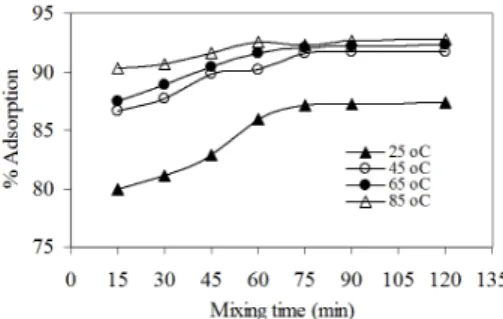
The effect of contact time on lignosulfonate sorption to eggshell at different temperatures is shown in Figure 1. It can be seen that a rapid initial uptake of lignosulfonate takes place at the beginning of the contact time and thereafter the sorption increases gradually with increasing contact time. The sorption of lignosulfonate reaches equilibrium after 75 minutes.
From Figure 1, it is clear that the amount of ligno-sulfonate adsorbed on eggshell is enhanced with increasing temperature. Increasing temperature is known to increase the diffusion rate of the lignosulfonate molecule across the exter-nal boundary layer and the interexter-nal pores of the adsorbent particles. Furthermore, increasing temperature may produce a swelling effect within the internal structure of the eggshell enabling large lignosulfonate to penetrate further (Mckay, 1982; Hiroyuki et al., 1994a; Saker & Podar, 1994). The increasing adsorption of lignosulfonate with increasing tem-perature reported to be was due to more interaction between
adsorbate and adsorbent (Pandey et al., 1988; Hiroyuki et
al., 1994b).
4.2 Mechanism of adsorption
To explain the mechanism of adsorption of ligno-sulfonate compound onto eggshell as an adsorbent, a model of modified double-electric layer proposed by Grahame (1947) has been used. In this model, the Stern layer consists of two layers: an inner layer (IL) in which adsorbed molecules or ions connect with surface of eggshell directly and an outer layer (OL) in which adsorbed molecules or ions have a looser arrangement. When the eggshell powder is mixed with the solution, CaCO3 contained in eggshell may partially dissolve
and release Ca2+, CaHCO
3+, CaOH+, HCO3-, CO32- and OH
ions (Pramanpol and Nitayapat, 2006; Arunlertaree et al., 2007).
These ions may be adsorbed onto the surfaces of the eggshell particles and form a negative charge. Aside from the ions mentioned above, the solution also contains Na+, Mg2+
and K+ ions which originate from the eggshells. These ions
may be adsorbed onto the surfaces of eggshell particles, forming an electrical double layer, with the surface of the eggshell particle acquiring a positive charge. Therefore, its Stern IL consists of positive ions and water dipole.
Lignin or lignosulfonate is a heterogeneous aromatic polymer which consists of many phenolic functional groups. It is known that the phenolic functional group may ionize in basic aqueous medium. Thus, phenolic compounds may acquire a negative charge in aqueous media. When sulfonate participates in competitive adsorption, ligno-sulfonate ion will be attracted to the surface of the adsorbent by electrostatic interaction, form a Stern OL and thus increase the adsorption rate of lignosulfonate.
4.3 Thermodynamic parameters
The thermodynamic parameters (DHo, DSo and DGo)
for lignosulfonate sorption on eggshell are calculated from the temperature dependent sorption isotherms. The value enthalpy (DHo) and entropy (DSo) can be calculated from
slope and intercept of the plot of ln KL vs 1/T (Figure not show here):
ln KL = R
So
-
T R
Ho .
(7) The Gibbs free energy change (Go) is calculated as:
DGo = DHo – T. DSo (8)
Where R (8.314 J/mol K) is the gas constant, T (K) absolute temperature and KL (L/mg) is the Langmuir isotherm constant, which is obtained from Langmuir isotherm data.
The values obtained from Equations 7 and 8 are tabu-lated in Table 1. A positive value of the standard enthalpy change indicates that the sorption is endothermic. One possible explanation of this positive entropy is that adsor-bent and lignosulfonate compound are dissolved well in water, and the hydration sheath of adsorbent and ligno-sulfonate have to be destroyed before the sorption process. This dehydration process needs energy, and it is favored at
high temperature (Xie et al., 2011). The enthalpy change
(DHo) for chemisorption is in the range 40-120 kJ/mol (Alkan
et al., 2004). Since the value of DHo observed in the system is lower than 40 kJ/mol, the adsorption of lignosulfonate onto eggshell by physisorption.
The positive values of Gibbs free energy (DGo) indi-cate the non-spontaneous nature of adsorption. The value of
DGo becomes more negative with the increase of temperature, which indicates that the reaction is more favorable at high temperatures. The positive value of entropy change (DSo) implies some structural changes during the sorption process, which lead to an increase in the randomness at the solid-solution system (Xie et al., 2011; Rahcamani et al., 2011; Namasivayam & Sangeetha, 2006).
4.4 Adsorption kinetics
Kinetics of adsorption are an important parameter to evaluate adsorption dynamics. In order to examine the controlling mechanism of lignosulfonate adsorption process such as mass transfer and chemical reaction, the pseudo-first-order adsorption, the pseudo-second-order adsorption, the intra-particle diffusion, Elovich and Boyd models were used to test the experimental data. The validity of three kinetic models was checked and the models are depicted in Figures 2-6 and by the linear plots of log (qe – qt) against
t, t/qt against t and qt against t0.5, qt against ln t and Bt against
t, respectively. Figure 2 shows plots of log (qe – qt) against t at different adsorbent dosages. It was observed that the first-order kinetic model did not adequately fit the experimen-tal values. Also from Table 2, it is indicated that the values of the correlation coefficients are not high for the different
Figure 2. Pseudo-first-order plots for adsorption of lignosulfonate onto powdered eggshell.
Table 1. Thermodynamic parameters of adsorption process at different temperature.
Temperature (ºC) KL(L/mg) Gº (kJ/mol) Hº (kJ/mol) Sº (kJ/mol) Ea (kJ/mol)
25 0.479 1.83
45 0.543 1.61
65 0.610 1.39
85 0.699 1.07
adsorbent dosages. Furthermore, the estimated values of qe
calculated from the equation qe differ substantially from those measured experimentally. That gives confirmation that the lignosulfonate sorption using eggshell did not obey the pseudo-first-order model.
In contrast, the pseudo-second-order rate equation for sorption of lignosulfonate compound onto eggshell agreed well with the data (Figure 3). The correlation coefficients calculated by using the pseudo-second-order model i.e. R2,
and the pseudo-second-order parameters i.e. k2, qe,exp and
qe,calc, are shown in Table 2.
As seen from Table 2, the calculated equilibrium sorption capacity for the pseudo-second-order model, qe,
calc, is close to the experimental value, qe,exp, and the linear regression analysis of the pseudo-second-order rate equa-tion gave a high R2 value.
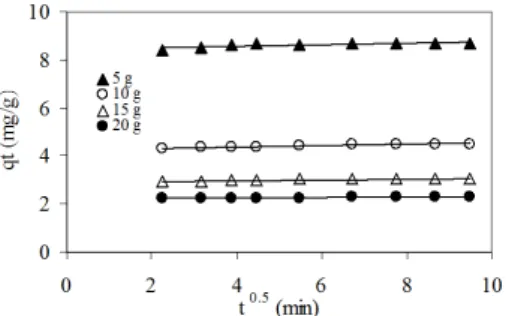
Figure 4 shows intra-particle diffusion plot at different adsorbent dosages. Referring to Figure 4, a linear relation-ship exists after a certain time but they do not pass through the origin. This is due to boundary layer effect. The larger the intercept effects the greater contribution of surface sorption is the rate determining step. Previous studies showed the same features of the plot which characterize different steps of adsorption process (Aksu & Aisoglu, 2005; Kamari
et al., 2009; Patil et al., 2011). The intercepts (C) and kd
values of plots qt against t0.5 decrease with increasing of
adsorbent dosage (Table 3). This was due to an increase in the overall rate of the lignosulfonate adsorption, which resulted in a rapid decrease in the lignosulfonate concentration and, thus, the driving force for intra-particle diffusion (Sun &
Yang, 2003; Qada et al., 2007). Moreover, this can also be
attributed to the significance of the external diffusion and the reduction in the effect of intra-particle diffusion as the
ratio of the adsorbent/adsorbate in the system increased (Mckay et al., 1986; Qada et al., 2007).
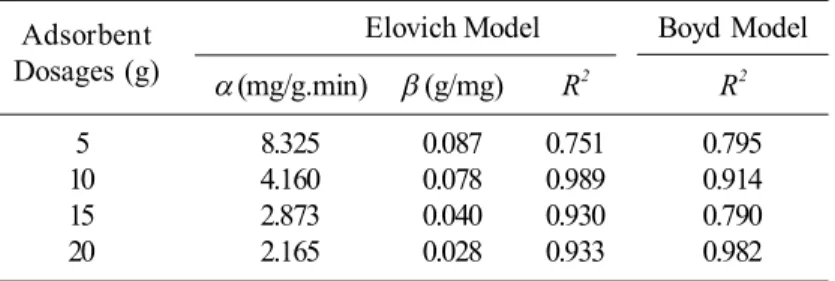
Figure 5 shows plots of the Elovich model at different adsorbent dosages. It is indicated from the estimated Elovich parameters (Table 4) that the R2 values obtained from Elovich
equation were in the range of 0.751-0.933 for the different adsorbent dosage.In order to determine the actual slow step Table 2. The pseudo-first-order and second-order kinetic parameters for lignosulfonate adsorption
using eggshell powder.
Pseudo-first-order Pseudo-second-order
k (min-1) qe, cal R2 k qe, cal R2 qe, exp
(mg/g) (g mg-1 min-1) (mg/g) (mg/g)
5 0.047 0.179 0.795 0.689 8.696 1 8.682
10 0.070 0.390 0.914 0.459 4.523 1 4.498
15 0.030 0.103 0.790 0.971 3.055 1 3.051
20 0.102 0.004 0.982 1.430 2.294 1 2.286
Adsorbent Dosages (g)
Figure 3. Pseudo-second-order plots for adsorption of lignosul-fonate onto powdered eggshell.
Figure 4. Intra-particle diffusion plots for adsorption of lignosul-fonate onto powdered eggshell.
Table 3. Parameters of the intra-particle diffusion model for ligno-sulfonate adsorption using eggshell powder.
Adsorbent Dosages (g) kd(mg/g.min0
.5) C R2
5 0.030 8.441 0.588
10 0.030 4.250 0.941
15 0.015 2.919 0.872
involved in the lignosulfonate adsorption process, the kinetic data as obtained by the batch method were further
analyzed using the Boyd model, and the plot of Bt against
t can be seen in Figure 6. The Boyd linear plots with high correlation coefficients R2 (Table 4) indicate that boundary
layer/ film diffusion mainly governs the lignosulfonate adsorption process.
From Figure 1, we can see that the amount of ligno-sulfonate adsorbed on eggshell is enhanced with increasing temperature. The other thermodynamic parameter, activation energy, Ea, was calculated using Arrhenius equation:
ln k = ln A -
T R
Ea
. (9)
where Ea is the activation energy (kJ/mol), A the Arrhenius factor, R the gas constant (8.314 J/mol K) and T is the
absolute temperature (K). When ln k is plotted versus 1/T,
a straight line with slope –Ea/R is obtained (Figure 7). The magnitude of activation energy gives an idea about the type of diffusion path of sorption process which is mainly film or pore diffusion (Namasivayam & Sangeetha, 2006). Film diffu-sion typically has an activation energy of 17-21 kJ/mol and pore diffusion has an activation energy of 21-42 kJ/mol (Namasivayam & Sangeetha, 2006; Sparks, 1999).
The obtained value of activation energy (18.17 kJ/ mol) in Table 1 confirms that the adsorption of lignosulfonate onto eggshell is film diffusion controlled.
4. Conclusions
The result from this work showed that the tempera-ture has an important role in the adsorption of lignosulfonate compounds onto eggshell. Thermodynamic parameter data indicated that the lignosulfonate sorption process was non-spontaneous and endothermic under the experimental condi-tions, with the Gibbs free energy (Go) in the range of 1.83-1.07 kJ mol-1, enthalpy (Ho) and entropy (So) of 5.66 kJ mol-1 and 12.82 J mol-1, respectively, and the activation
energy of 18.17 kJ mol-1. The kinetic experimental data
properly correlated with the pseudo-second-order kinetic model with a rate constant in the range of 0.689 –1.430 g mg-1
min-1, while both the intra-particle diffusion and Boyd kinetic
models and the value of activation energy indicated that boundary layer or film diffusion was the main rate
determin-ing step in lignosulfonate adsorption process.
Acknowledgment
The authors are very grateful to the Bandung Institute of Technology for their financial support for this research study.
Figure 5. Elovich plots for adsorption of lignosulfonate onto powdered eggshell.
Table 4. The Elovich and Boyd kinetic parameters for lignosulfonate adsorption using eggshell powder.
Elovich Model Boyd Model
(mg/g.min) (g/mg) R2 R2
5 8.325 0.087 0.751 0.795
10 4.160 0.078 0.989 0.914
15 2.873 0.040 0.930 0.790
20 2.165 0.028 0.933 0.982
Adsorbent Dosages (g)
Figure 6. Boyd plots for adsorption of lignosulfonate onto pow-dered eggshell.
References
Alkan, M., Demirbas, O., Celikcapa, S. And Dogan, M. 2004. Sorption of acid red 57 from aqeous solution onto sepiolite. Journal of Hazardous Materials. B116, 135-145.
Arunlertaree, C., Kaewsomboon, W., Kumsopa, A., Pokethiti-yook, P., Panyawathanakit, P. 2007. Removal of lead from battery manufacturing wastewater by eggshell. Songklanakarin Journal of Science and Technology. 29 (3), 857-868.
Aksu, Z. and Aisoglu, I. 2005. Removal of Cu(II) ions from aqueous solution by biosorption onto agricultural waste sugar beet pulp. Process Biochemistry. 40, 3031-3044.
Ali, M. and Sreekrishnan, T.R. 2001. Aquatic toxicity from pulp and paper mill effluents: A review. Advances in Environmental Research. 5, 175–196.
Bailey, S.E., Olin, J.T., Bricka, R.M. and Adrian, D.D. 1999. A review of potentially low cost sorbents for heavy metals. Water Research. 33 (1), 2469–2479.
Basibuyuk, M. and Forster, C.F. 2003. An examination of the adsorption characteristics of a basic dye (Maxilon Red BL-N) onto live activated sludge system. Process Biochemistry. 38 (9), 1–6.
Boyd, G.E., Adamson, A.W. and Meyers, L.S. 1947. The exchange adsorption of ions from aqueous solution by organic zeolites. II. Kinetics. Journal of the Ameri-can Chemical Society. 69, 2836–2848.
Chiou, M.S. and Li, H.Y. 2003. Adsorption behavior of reactive dye in aqueous solution on chemical cross-linked chitosan beads. Chemosphere. 50, 1095–1105. Chojnacka, K. 2005. Biosorption of Cr(III) ions by eggshells,
Journal of Hazardous Materials. 121, 167–173. Diez, M.C. Mora, M.L. and Videala, S. 1999. Adsorption of
phenolic compounds and colour from bleached kraft mill effluent using allophonic compounds. Water Research. 33 (1), 125–130.
Elkady, M.F., Ibrahim, A.M. and Abd El-Latif, M.M. 2011. Assessment of the adsorption kinetics, equilibrium and thermodynamic for the potential removal of re-active red dye using eggshell biocomposite beads. Desalination. 278, 412–423.
Grahame, D.C. 1947. The electrical double layer and the theory of electrocapillarity, Chemical Reviews. 41, 441-501.
Hiroyuki H., Fukudas M., Okamato A. and Kataoka T. 1994. Adsorption of acid dye cross linked chitosan fibers equilibria, Chemical Engineering Science. 48 (12), 2267-2272.
Hiroyuki H., Hideki N. and Kataoka T. 1994. Adsorption of BSA on strongly basic chitosan – eqiulibria, Biotech-nology and Bioengineering. 43, 1087-1093.
Ho, Y.S. and McKay, G. 1998a. Sorption of dye from aqueous solution by peat. Chemical Engineering Journal. 70, 115–124.
Ho, Y.S. and McKay, G. 1998b. The kinetics of sorption of basic dyes from aqueous solution by sphagnum moss peat. The Canadian Journal of Chemical Engineering 76 (4), 822–827.
Ho, Y.S. and McKay, G. 1998c. Kinetic model for lead (II) sorption on to peat. Adsorption Science and Techno-logy. 16 (4), 243–255.
Ho, Y.S. and McKay, G. 1999. The sorption of lead (II) ions on peat. Water Research. 33, 578–584.
Ho, Y.S. and McKay, G. 2000. The kinetics of sorption of divalent metal ions onto sphagnum moss flat. Water Research. 34 (3), 735–742.
Ho, Y.S. and Chiang. C.C. 2001. Sorption studies of acid dye by mixed sorbents. Adsorption. 7, 139–147.
Ho, Y.S. 2003. Removal of copper ions from aqueous solution by tree fern. Water Research. 37, 2323–2330.
Jain, C.K. and Sharma, M.K. 2002. Adsorption of cadmium on bed sediments of river Hindon: Adsorption models and kinetics. Water, Air, and Soil Pollution. 137, 1–19. Kamari, A., Ngah, W.S.W. and Wong, L.W. 2009. Shorea
dasyphylla sawdust for humic acid adsorption. Euro-pean Journal of Wood and Wood Products. 67, 417-426.
Khalil, L.B. and Girgis, B.S. 1998. Column removal of some dyestuffs by activated carbons derived from apricot stone shells. Adsorption Science and Technology. 16, 405-414.
Koumanova, B., Peeva, P., Allen, S.J., Gallagher, K.A. and Healy, M.G. 2002. Biosorption from aqueous solutions by eggshell membranes and Rhizopus oryzae: equili-brium and kinetic studies. Journal of Chemical Tech-nology and BiotechTech-nology. 77, 539–545.
Kuh, S.E. and Kim, D.S. 2000. Removal characteristics of cadmium ion by waste egg shell. Environmental Technology. 21, 883–890.
Mckay G. 1982. Adsorption of dyestuffs from aqueous solu-tion with activated carbon : 1 : Equilibrium and batch contact time studies. Journal of Chemical Technology and Biotechnology. 32, 759-772.
Mckay, G., Bino, M. J. and Altamemi, A. 1986. External mass transfer during the adsorption of various pollutants onto activated carbon. Water Research. 20 (4), 435-445.
Mohan, S.V. and Karthikeyan, J. 1997. Removal of lignin and tannin colour from aqueous solution by adsorption onto activated charcoal. Environmental Pollution. 97 (1–2), 183–187.
Namasivayam, C. and Sangeetha, D. 2006. Removal and
recovery of vanadium (V) by adsorption onto ZnCl2
activated carbon: Kinetics and isotherms. Adsorption. 12, 103-117.
Oke, I.A., Olarinoye, N.O. and Adewusi, S.R.A. 2008. Adsorp-tion kinetics for arsenic removal from aqueous solu-tions by untreated powdered eggshell. Adsorption. 14, 73–83.
Ozacar, M. and Sengil, I.A. 2005. A kinetic study of metal complex dye sorption onto pine sawdust. Process. Biochemistry. 40, 565–572.
Pandey, K.K., Prasad, G. and Singh, V.N. 1989. Use of wallstronite for the treatment of Cu(II) rich effluent. Water Research. 19, 869-872.
Patil, S., Renukdas, S. and Patel, N. 2002. Removal of methyl-ene blue, a basic dye from aqueous solutions by adsorption using teak tree (Tectona grandis) bark powder. International Journal of Environmental Science and Technology. 1 (5), 711-726.
Porter, J.F., McKay, G. and Choy, K.H. 1999. The prediction of sorption from a binary mixture acid dyes using single and mixed isotherm variants of the ideal absorbed solte theory. Chemical Engineering Science. 54, 5863-5885.
Pramanpol, N. and Nitayapat, N. 2006. Adsorption of reactive dye by eggshell and its membrane. Kasetsart Journal (Natural Science) 40, 192-197.
Qada, E.N.E., Allen, S.J. and Gavin, M. 2007. Walker kinetic modeling of the adsorption of basic dyes onto steam -activated bituminous coal. Industrial and Engineering Chemistry Research. 46, 4764-4771.
Rahchamani, J., Moausavi, H.Z. and Behzad, M. 2011. Adsorption of methyl violet from aqueous solution by polyacrylamide as an adsorbent: Isotherm and kinetic studies. Desalination. 267, 256-260.
Saker, M. and Podar, S. 1994. Study of adsorption of methyl violet onto flyash, Proceeding of Industrial Annual Communication. 31, 213-215.
Sivaraj, R., Namasivayam, C. and Kadirvelu, K. 2001. Orange peel as an adsorbent in the removal of acid violet 17 (acid dye) from aqueous solutions. Waste Manage-ment. 21, 105–110.
Sparks, D.L. 1999. Kinetics of sorption/release reactions at the soil mineral/water interface, in D.L. Sparks (ed.), Soil Physical Chemistry, 2nd edition, CRC Press. Boca
Raton, Florida, USA., pp.135-191.
Sun, Q. and Yang, L. 2003. The adsorption of basic dyes from aqueous solution on modified peat-resin particle. Water Research. 37 (7), 535-529.
Tseng R.L., Wu, F.C. and Juang, R.S. 2003. Liquid-phase adsorption of dyes and phenols using pinewood-based activated carbons. Carbon. 41, 487–495. Ugurlu, M. and Dogar, C. 2005. Removal of phenolic and
lignin compounds from bleached kraft mill effluent by fly ash and sepiolite. Adsorption. 11, 87–97.
Walker, G.M. and Weatherly, L.R. 1998. Fixed bed adsorption on acid dyes onto activated carbon. Environmental Pollution. 99, 133-136.
Weber, W.J. and Morris, J.C. 1963. Kinetics of adsorption on carbon from solution. Journal of the Sanitary Engineer-ing Division, American Society Civil Engineers. 89, 31–60.
William, J.S. and Owen, J.C. 1995. Egg Science and Techno-logy, 4th edition, Food Product Press, New York.
Xie, H., Wu, D., Jiao, Z., Li, X., Zhang, S., Lan, Y. and Cheng, C. 2011. Kinetic and thermodynamic sorption study of radiocobalt by magnetic hydroxyapatite nano-particles. Journal of Radioanalytical and Nuclear Chemistry. DOI 10.1007/s10967-011-1458-3.