Maleic Anhydride Grafting on EPDM:
Qualitative and Quantitative Determination
Guilherme M.O. Barra, Janaina S. Crespo, José R. Bertolino,
Valdir Soldi, and Alfredo T. Nunes Pires*
Laboratório de Materiais Poliméricos, Departamento de Química,
Universidade Federal de Santa Catarina, 88040-900 Florianópolis - SC, Brazil
Nos últimos anos tem sido estudada a modificação de polímeros com grupos funcionais específicos, com o objetivo de obter blendas compatíveis com propriedades macroscópicas dese-jáveis. Neste trabalho foi determinado a percentagem do enxerto do EPDM com anidrido maleico (AM), em solução, utilizando peróxido de benzoila como iniciador. As condições de enxerto foram estudadas em função do tempo de reação e da quantidade de anidrido maleico. Para a determinação quantitativa do AM enxertado na cadeia do EPDM foi utilizado o método de espectroscopia de infravermelho, sendo o procedimento discutido em detalhes.
Several attempts have been made to compatibilize immiscible blends by introducing suitably-chosen polymer additives. This work studies the EPDM elastomer, chemically modified with maleic anhydride (MA), through reaction in solution of EPDM and MA, using dibenzoyl peroxide as an initiator. The best conditions for obtaining the maximum grafting were studied at different times and percentage weights of maleic anhydride. The evaluation of MA grafting onto EPDM was determined with multiple internal reflectance infrared spectroscopy as discussed in detail.
Keywords:EPDM, maleic anhydride, grafting
Introduction
The maleic anhydride (MA) modification of different kinds of rubbers is a useful way of compatibilizing immiscible polymer blends as well as improving interfacial adhesion in polymeric composites. Several factors can influence mechani-cal properties, such as the particle size and particle-size distri-bution of the dispersed phase, and the degree of interfacial adhesion between two phases. The adequate chemical struc-ture of the compatibilized agent can reduce the interfacial energy between the phases and a finer dispersion can be obtained1, improving its performance in terms of enhanced impact strength. For example, the modification of EPDM rubber with MA in a twin screw extrusion process has been described by Oostenbrink and Gaymans, in the presence or absence of bis(t-butyl peroxy isopropyl)benzene as an initia-tor2. Xie et al. studied the maleation of EPDM in xylene solution using dibenzoyl peroxide as an initiator of the grafting reaction3. The knowledge of MA content in the rubber by covalent linking is important not only to evaluate its applica-tion but also to choose the best manner of grafting. Different techniques have been reported in the literature, such as
gravimetry, titration of acid group, infrared spectroscopy, and so on. Each technique is limited with regard to its sensitivity and range of application. Infrared spectroscopy permits a series of variations in the form of acquiring data. Multiple reflectance infrared spectroscopy has high sensi-tivity and the ability to analyse insoluble and opaque poly-mers without drastic thermal or physical treatment, in contrast to the usual transmission infrared spectroscopy which is only capable of analysing transparent films. Stud-ies reported in the literature4 using Diffuse Reflectance FTIR discuss the complicated procedures for quantitative analyses, due to nonproportional relationships between concentration and pseudo-absorbance. In the present work, we used Multiple Reflectance FTIR in order to simplify the method of quanti-tative determination of the percentage of maleic anhydride grafting in the EPDM chain.
Experimental
Material
The ethylene-propylene-ethylene-diene monomer (EPDM) can be found as a commercial product with
differ-Article
J. Braz. Chem. Soc., Vol. 10, No. 1, 31-34, 1999. © 1999 Soc. Bras. Química
ent comonomers and resulting terpolymers. In this work, we used EPDM with an ethylidene norbornene content of 1.7%, as shown below, kindly supplied by Nitriflex. A sample of EPDM-g-MA (Uniroyal Chemical) with 0.5% of maleic anhydride indicated by the supplier, was used to ratify the present method.
Maleic anhydride (Merck) and dibenzoyl peroxide (VETEC) were recrystallized from chloroform and ethanol respectively, and were employed according to standard procedures. The EPDM was used as received without any additional purification.
Techniques
Small pieces of EPDM elastomer were added to chlo-robenzeneand heated while stirring. When the temperature reached 80 °C, solutions of maleic anhydride and dibenzoyl peroxide in chlorobenzene were added to the vessel and reacted for different times at this temperature. Then, the graft EPDM-g-MA was precipitated in methanol and it was
washed several times with acetone, maintaining it under vacuum at 40 °C for 24 h.
The physical mixtures (EPDM/MA) were prepared by dissolving undiluted components in chloroform by stirring and maintaining them at room temperature until complete solvent evaporation.
FTIR spectra of EPDM, EPDM-g-MA and EPDM/MA films were carried out in a 16 PC Perkin Elmer spectro-photometer, equipped with a multiple reflectance acces-sory, resolution 4 cm-1, and performing 20 scans. The films were supported on KRS-5 crystal.In the case of the pre-sence of close bands in the analysis, the spectra can be fitted to evaluate the real contribution of each one, using Origin 4.1 software with Gaussian or Lorentzian bases. The same band height relations were obtained for both functions.
Results and Discussion
Initially, we describe the procedure for determining the extent of grafting of maleic anhydride on to the backbone of the EPDM macromolecule by FTIR spectrum.Figure 1 shows the multiple internal reflectance infrared spectrum of EPDM and EPDM-g-MA, where the inside numbers indicate the assignment according to absorption group as described in Table 1. We may observe the C=O stretching band of maleic anhydride at 1856 (low intensity) and 1780 cm-1 (medium intensity)5,6, and a band at 1707 cm-1 due to the C=O stretching group of hydrolised MA in EPDM-g-MA6. The band at 922 cm-1 is due to angular deformation outside the plane of the OH hydrogen bonding, which is indicative of MA incorporated in the EPDM rubber. How-ever, the maleic anhydride is partially converted to the acid
32 Barra et al. J. Braz. Chem. Soc.
p n
m )
C
CH3
CH HC
CH2
HC
CH CH
CH CH2
CH3
CH CH2
) ( ) (
( CH2
Table 1. Characteristic infrared bands of the EPDM and EPDM-g-MA spectrum.
band number band intensity wave number
cm-1 absorption assignment
EPDM
1 and 2 strong 2925, 2850 CH stretching vibration
3 medium 1630 C = C stretching vibration
4 strong 1460 CH2 angular deformation
5 medium 1375 CH3 angular deformation
6 medium 720 CH2 angular deformation
EPDM-g-MA
1 and 2 strong 2925, 2850 CH stretching vibration
3 low 1856 C = O asymmetric stretching
4 medium 1780 C = O symmetric stretching
5 low 1707 C = O symmetric stretching*
6 strong 1460 CH2 angular deformation
7 medium 1375 CH3 angular deformation
8 medium 922 OH angular deformation
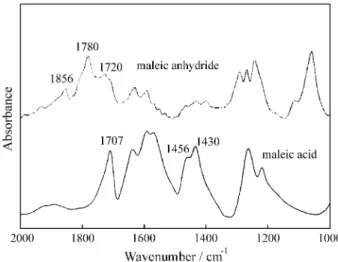
form under room conditions, and the control of probable mixture of the two extreme forms is very difficult because it is a function of many variables. In order to avoid quanti-ties in both forms, maleic anhydride was totally converted to maleic acid, maintaining it above a water vapour for 4 h, as shown in Fig. 2. We may observe the rise of a band at 1707 cm-1 and the disappearance of bands at 1856 and 1780 cm-1. This process is reversible, if this sample is heated at 100 °C under vacuum for 24 h7. Figure 3 shows the infrared spectrum of maleic anhydride and maleic acid, with only one clear band at 1707 cm-1 in the range of 1690 and 1890 cm-1.
No shifts are observed in the characteristic bands of maleic anhydride grafting or in the physical mixture with EPDM, indicating no change in the group vibration accord-ing to whether the components are covalently linked or not. This observation can facilitate the obtention of the calibra-tion curve for the physical mixture. The calibracalibra-tion curve was prepared from the spectrum of physical mixtures of different compositions of maleic acid and EPDM, using the
ratio from band heights at 1707 (maleic acid) and 1460 cm-1 (EPDM). These two characteristic bands of each compo-nent permit the use of infrared as a quantitative method. However, it is necessary to obtain the calibration curve for the same EPDM, due to a possibility of variable content of ethylene and propylene in the main elastomer chain.The fitting of the spectrum bands was necessary in order to evaluate the ability of different mixtures to abolish the contribution of the band at 1430 cm-1 in the total absorbance and also to avoid intrinsic error. The Lorenz and Gauss mathematical functions give comparable band heights which are different, rising when the MA concentration increases without curve fit. This behavior is expected be-cause the rise of maleic acid increases the band overlay. Figure 4 shows a typical spectrum of EPDM/maleic acid physical mixture with and without fit.Figure 5 shows the band ratio, h1707/h1460, as a function of different maleic acid
concentrations. The linear relation is observed when the fit is used, in contrast to results without fit for the upper concentration of 4%. The grafting of maleic acid on EPDM can be estimated by the curve shown in Fig. 5 as 1.9% weight or 1.9 x 10⁻⁴ mol/g.
The determination of grafting maleic anhydride grade was made on a commercial sample of EPDM-g-MA, after being changed into the maleic acid form. The h1707/h1460
ratio was determined in the infrared spectrum (Fig. 6) as equal to 0.07, and the grafting maleic anhydride was ob-tained from the graph in Fig. 5 as equal to 0.6%. This value agrees with that given by the company supplying the prod-uct.
There is no effect of maleic anhydride concentration on the degree of maleic anhydride grafting of EPDM (1.7% of diene) rubber, using 2.0 g of EPDM and 0.15 g of dibenzoyl peroxide, at 80 °C for 3 h. The conversion reached a maximum value at 1.9 % weight for all MA ranges studied. This value corresponds to at least 2.9 x 10⁻³ g or 2.9 x 10⁻⁴ mol of MA, indicating an equimolar relation with the diene
Vol. 10, No. 1, 1999 Maleic Anhydride Grafting on EPDM 33
Figure 1. Infrared multiple internal reflectance spectrum of EPDM and EPDM-g-MA.
Figure 2. Spectrum of maleic anhydride (A) or maleic (B) acid grafting
percentage in EPDM monomeric units. The maleic anhy-dride grafting, at 80 °C and 0.15 g of dibenzoyl peroxide, 2.9 x 10⁻³ g maleic anhydride and 2.0 g of EPDM, rises to a maximum after 3 h of reaction (Fig. 7). The conditions described above were used in all experiments to evaluate the MA grafting content.
Conclusion
The presence of maleic anhydride grafting on EPDM was made evident by infrared analysis, and it was possible to detect the carboxyl group band of maleic anhydride at 1856 and 1780 cm-1. The infrared spectrum with band fit
minimizes the error in determining thecontent of maleic acid and it is a simple and useful method for evaluating the percentage of grafting, using the ratio from band heights of the infrared spectrum at specific wave numbers correspond-ing to each component in the mixture.
References
1. Newman, S. In Rubber modification of plastics, Paul, D.R.; Newman, S., eds., Polymer blend. New York: Academic, 1978, 2, 63.
2. Oostenbrink, A.J.; Gaymans, R.J. Polymer 1992,
33(14), 3086.
3. Xie, H.Q.; Feng, D.S.; Guo, J.S. Journal of Applied Polymer Science1997, 64(2), 329.
4. Coutinho, F.M.B.; Ferreira, M.I.P. Polymer Testing 1994, 13, 25.
5. Wu, C.H.; Su, A.C. Polymer Engineering and Science 1990, 31, 1975.
6. Cimmino, S. et al.Polymer Engineering and Science 1985, 25, 193.
7. Lanzetta, L. et al.Polymer Bolletin1989, 32, 603.
34 Barra et al. J. Braz. Chem. Soc.
Figure 4. EPDM/maleic acid physical mixture spectrum. The dashed line indicates the bands after fitting.
Figure 6. Infrared multiple internal reflectance spectrum of commercial EPDM-g-MA, supplied as 0.5% of maleic anhydride.
Figure 5. Calibration curve of EPDM/ maleic acid physical mixture using ratio height band ( ) with fit and (O) without fit.
Figure 7. Reaction time versus grafting content of MA, at 0.15 g diben-zoyl peroxide, 2.0 g of EPDM and 2.9 x 10⁻³ g maleic anhydride, at 80 °C.