Article
A Theoretical HSAB Study of the Acidity of Carbon Acids CH
3Z
Marcos C. Rezende
Facultad de Química y Biología, Universidad de Santiago, Casilla 40, Correo 33, Santiago, Chile
A acidez em fase gasosa de nove ácidos carbonados do tipo CH3Z (nitrometano, acetofenona, dimetilsulfona, acetaldeído, butanona, acetona, acetato de metila, acetonitrila e dimetilsulfóxido ) foi estudada, em busca de correlações com propriedades locais e globais, calculadas em níveis 3-21G, 6-31G* e 6-31+G(3df,2p), segundo a teoria de ácidos e bases duros e macios (“HSAB”). Uma correlação razoável foi obtida com as energias de deprotonação calculadas, o que permitiu estimar a acidez em fase gasosa do tioacetato de metila (∆Go = 1476 kJ mol-1), próxima da do
nitrometano, o membro mais ácido da série. As funções de Fukui para ataque nucleofílico dos centros aniônicos duros e macios em cada base -CH2Z foram usadas para interpretar as variações
de acidez quando os ácidos são transferidos da fase gasosa para a fase aquosa.
The gas-phase acidity of nine carbon acids of the form CH3Z (nitromethane, acetophenone, dimethylsulfone, acetaldehyde, butanone, acetone, methyl acetate, acetonitrile and dimethylsulfoxide) was investigated, in the search of correlations with global and local HSAB properties, calculated at the 3-21G, 6-31G* and 6-31+G(3df,2p) levels. A reasonable correlation was obtained with the calculated ionization energies. Based on the obtained correlation, the gas-phase acidity of methyl thioacetate was estimated (∆Go = 1476 kJ mol-1) as close to that of the
most acidic member of the series, nitromethane. The nucleophilic Fukui functions of the hard and soft anionic centers in each base - CH
2Z stabilized by direct conjugation were calculated, following
two different approaches, and their ratios utilized to interpret the shifts in acidity when the acids are transferred from gas-phase to aqueous solution.
Keywords: acidity, carbon acids, HSAB theory, Fukui functions
Printed in Brazil 0103 - 5053 $6.00+0.00
Introduction
DFT-based HSAB theory provides the chemist with a variety of descriptors that have been successfully correlated with properties such as acidity / basicity and reactivity of organic molecules.
Since the original definition of these descriptors1-3 the
theory has been tested with a variety of properties. Examples include the gas-phase basicity of amines4,5, the calculation
of electronegativities and hardness values for substituents6,
the acidity of alcohols7, of substituted acetic acids8 and
phenols9. An example of the prediction of the unknown
acidities of a family of compounds is provided by the
calculation of pKa values of hydrofullerenes, based on
correlations with various organic acids10.
This potential use of theoretical tools is particularly interesting in those cases where a direct measurement of a given property poses experimental difficulties, even in the
e-mail:[email protected]
case of simple systems. As an example, measurements of the basicity of ester carbanions in water have been traditionally restricted to those few stable species, capable of appreciable ionization in relatively weak basic solutions. The concomitant basic hydrolysis of simple esters had traditionally made the determination of their pKa values in water a particularly difficult task11. As a result, direct
measurements of the acidity of fairly simple esters like ethyl acetate12 or thioacetate13 have been reported only recently.
data, like their behaviour in gas phase and in solution. The acidity of the studied compounds changes significantly from the gas phase to aqueous solutions. Although the HSAB descriptors obtained theoretically should apply to the gas-phase acid behaviour, an attempt was made to interpret their changes in acidity on being transferred to water, by means of local descriptors like the Fukui function.
Results and Discussion
The global HSAB descriptors employed in this work comprised the electronegativity χ, the chemical potential
µ = - χ, the hardness η and the softness S = 1 / η of the systems. Their calculation utilized Koopman’s approxi-mation, equations (1) and (2)
µ = -χ = (εL + εH) / 2 (1)
η = 1 / S = (εL - εH) / 2 (2)
where εL and εH are the LUMO and the HOMO
eigenvalues, respectively1-3,9.
Local descriptors included the local softness sk- and
the Fukui function for nucleophilic attack fk- of chosen
atoms. The former is simply the product of the global softness S by fk- at a given site k.
sk- = S . fk- (3)
For the calculation of the Fukui function we employed two different approaches. The first of them, proposed by Yang and Mortier4, utilizes the gross Mulliken charge at
site k, qk, for systems with N and N-1 electrons, calculated at the same geometry9.
(fk- )
1 = qk (N) - qk (N-1) (4)
This approach has been recently criticized, as prone to computational convergence troubles, and an equivalent treatment has been put forward, with the advantage that only one single-point calculation is required5. This second method thus avoids the inevitable change of multiplicity of the electronic state of the first method. The Fukui function for nucleophilic attack, (fk-)
2, may be calculated
by the sum of two terms, as defined in (5).
S c c c ) f (
k h h
2 k h 2
k = ∑ + ∑ ∑
∈
µ ν≠µ µ ν µν ∈
µ µ
−
(5)
The first term in (5) is the sum of the squared atomic-orbital coefficients of atom k in the HOMO. The second term involves products of the HOMO coefficients of atom k with all other atoms, and the overlap integrals Sµνbetween the corresponding basis functions. It is seen that this
definition of the Fukui function for nucleophilic attack is simply the overall HOMO density at site k, partitioned into a first term, which is the density at the atom, and a second term, which is the electronic density shared with the rest of the molecule. Unfortunately, the second term, unlike the first one, is not directly obtained from the Gaussian output, but must be calculated by means of a short routine added to the MulPop link 601 of the program5. This limitation may be
partly circumvented by considering the relative weight of the two terms in the sum (5). In a study of seven alkylamines, the contribution of the second term amounted to only 5 -9% of the sum, and was found to be roughly constant 5. As
a result, the same correlation coefficient (r = 0.995) was obtained when the exact Fukui function, calculated by (5), and the approximate function, derived from (6)
c ) f
( 2
k h 2
k ≈ ∑
∈
µ µ
−
(6)
were plotted against the amine gas-phase basicities. These observations led to the utilization in this work of the approximation (6), for the calculation of (fk-)
2.
The two approaches presented above may be summarized in qualitative terms. According to the approach of Yang and Mortier4, the Fukui function for nucleophilic attack, (fC-)
1, is defined as a measure of the tendency, by a
given atom, to give away its share of one electron. In the gas-phase, this is also a measure of the basicity of a given atom. In an alternative, equivalent approach, Contreras et al.5 defined the Fukui function (fC-)
2 as the total HOMO
density of a given atom, partitioned into a sum of two terms, the HOMO density at the atom itself and the density shared by its overlap with other atoms in the molecule. The second term is neglected in the present paper, based on the fact that it amounts to 5-9% of the total density, and is roughly constant for a series of analogous compounds5.
All calculations were performed with a Gaussian 94w program14. Optimizations of the structures of the investigated
carbon acids and their corresponding anions were carried out at an HF/3-21G level, after being initially optimized via the semiempirical AM1 method. This level of calculation had proved successful in the theoretical treatment of the
acidity of substituted acetic acids8, phenols9 and
hydrofullerenes10. Calculations of amine basicities
employing a smaller basis set (HF/ STO-3G) yielded results which were as good, and even superior to those obtained with larger basis sets (6-31G and 6-311G**)5, suggesting
The decision as to the conformations to be considered in the calculations was in most cases straightforward. In the case of methyl acetate and butanone, the structures with the methyl groups syn to the carbonyl oxygen were chosen as the most stable conformations15.
In Table 1 are listed literature values for the acidity of nine carbon acids CH3Z (Z = NO2, COPh, SO2Me, COH,
COEt, COMe, CO2Me, CN and SOMe) in the gas phase
and in solution (DMSO and water). Acidity values in the gas phase are expressed as free-energy values of ionization,
∆Go (kJ mol -1), acidities in solution in pKa values. Most free-energy values of ionization in the gas phase are quoted directly16,, or were obtained by simple manipulation of data
from literature17-19.The reported ∆Go value for butanone
was obtained by interpolation, with the aid of a relationship between ∆Go and ∆Ho, [∆Go = 1328.33 + 0.7866 ∆Ho,
r = 0.999] derived from data for six compounds, and an enthalpy value of 229 kJ mol-1, from the same source16.
The pKa value of methyl acetate in water was assumed equal to the value of the pKa value of ethyl acetate12.
Compounds are listed in order of decreasing acidity in the gas phase. As can be gathered from inspection of Table 1, this order is not followed in solution.
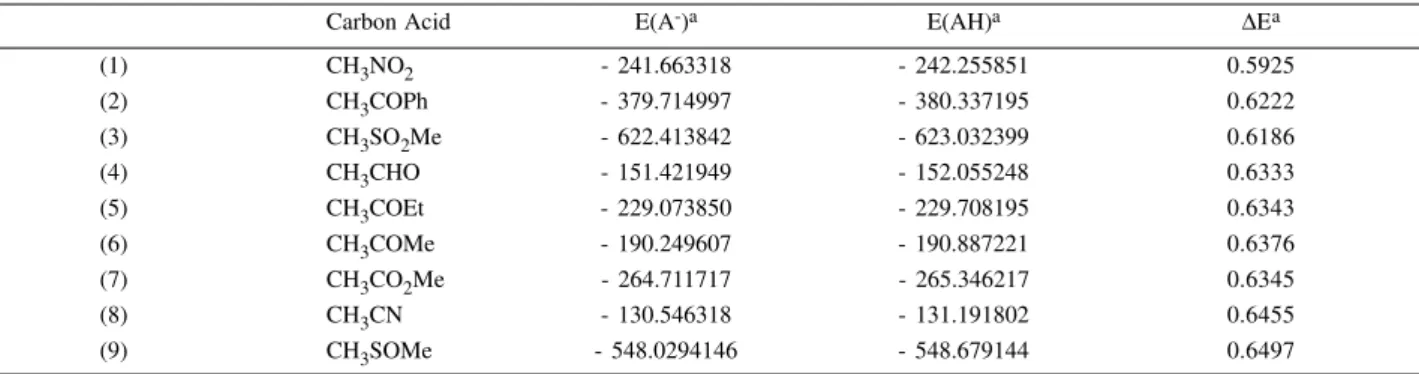
A first test of correlation of theoretical parameters with the experimental data was performed with the deproto-nation energies ∆E of the nine carbon acids. This term is the difference between the total energy of the conjugate base E(A-) and that of its acidic form E(AH)10.
∆E = E(A-) - E(AH) (7)
A very good correlation (r = 0.994) had been obtained for a series of seven carbon acids, with a range of pKa values spanning almost 50 units, when their acidity values in DMSO were plotted against the corresponding deprotonation energies ∆E10.
For the series of compounds (1)-(9), the calculated E(A-),
E(AH) and ∆E values are given in Table 2, and a plot of
∆Govs.∆E is shown in Figure 1. The resulting correlation
coefficient was more modest (r = 0.961) than that obtained by Geerlings et al.10, but still quite reasonable, indicating that the deprotonation energy may be a useful descriptor for estimating the gas-phase acidity of carbon acids
Table 1. Acidity of nine carbon acids CH3Z in the gas phase and in solution.
∆Go/kJ mol -1 pK a Value
Compound Gas Phase DMSO Water
(1) CH3NO2 1473 a 17.2 b 10.2 c
(2) CH3COPh 1491 a 24.7 b 19.5 c, 18.3 d (3) CH3SO2Me 1502 a 31.1 b 28.5 c
(4) CH3CHO 1504 a - 16.7 d
(5) CH3COEt (1508) e 24.4 b
-(6) CH3COMe 1513 f 26.5 b 19.3 d
(7) CH3CO2Me 1513 a - (25.6) g
(8) CH3CN 1524 a 31.3 b 25.0 c
(9) CH3SOMe 1530 a 35.0 b 28.5 c
(a) From ref. 16, p. 227; (b) From ref. 17; (c) From ref. 16, p. 220; (d) From ref. 12; (e) From ref 16, p. 226; obtained by interpolation from the relationship between ∆Ho and ∆Go values for six compounds, ∆Go=1328.33+0.7866 ∆Ho, with a correlation coefficient r = 0.999 and an enthalpy value of 229 kJ mol-1; (f) From ref. 19; (g) Value assumed equal to that of ethyl acetate taken from reference 12.
Table 2. Deprotonation energies of carbon acids (1) – (9), calculated from equation (7) at the 3-21G level.
Carbon Acid E(A-)a E(AH)a ∆Ea
(1) CH3NO2 - 241.663318 - 242.255851 0.5925
(2) CH3COPh - 379.714997 - 380.337195 0.6222
(3) CH3SO2Me - 622.413842 - 623.032399 0.6186
(4) CH3CHO - 151.421949 - 152.055248 0.6333
(5) CH3COEt - 229.073850 - 229.708195 0.6343
(6) CH3COMe - 190.249607 - 190.887221 0.6376
(7) CH3CO2Me - 264.711717 - 265.346217 0.6345
(8) CH3CN - 130.546318 - 131.191802 0.6455
(9) CH3SOMe - 548.0294146 - 548.679144 0.6497
(a) – In atomic units
0,58 0,59 0,60 0,61 0,62 0,63 0,64 0,65 0,66 1460
1470 1480 1490 1500 1510 1520 1530 1540
∆
G
o /
k
J.m
ol
-1
∆ E / a.u.
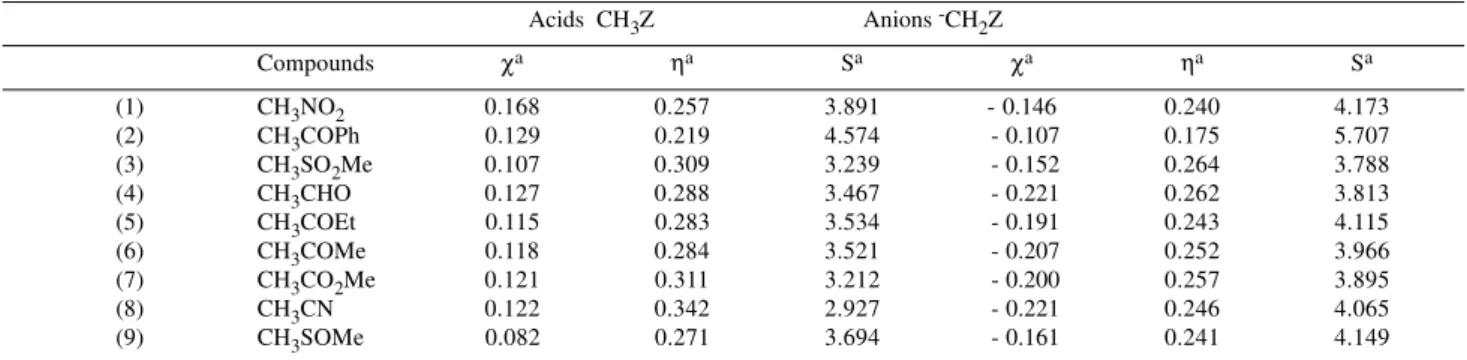
Table 3 lists the values of the global HSAB descriptors
χ, η and S calculated for acids (1)-(9) and their
corresponding anions. Inspection of the Table reveals the absence of correlations between the acidity order in the gas phase of compounds (1)-(9) and the listed global descriptors. This reflects the wide variety of substituents Z attached to the acidic methyl group of CH3Z.
Table 4 lists some local descriptors of the conjugate bases of (1)-(9). They include the charge qC on the anionic carbon atom of - CH
2Z, the corresponding Fukui functions
for nucleophilic attack, calculated by means of equations (4) and (6), and the local softness (sC-)
1 and (sC-)2,
calculated from the corresponding Fukui functions (fC-) 1
and (fC-)
2, respectively.
0.600 to - 0.670. The most acidic compound of the series, nitromethane, where the anionic C atom is conjugated with two oxygen atoms, constitutes by itself a second
category, with a much smaller qC value. Finally, the
dimethylsulfone and dimethylsulfoxide anions constitute the third category of conjugate bases, with the largest qC values (- 0.988 and - 0.882). Their large negative charges reflect the fact that they are in fact sulfonyl and sulfoxyl ylids. Unlike all other carbanions in the series, with a planar sp2 hybridization of the anionic C, optimization
of the conjugate bases of dimethyl-sulfone and -sulfoxide yielded sp3-type C atoms20.
The Fukui functions for nucleophilic attack at the
anionic carbon atoms of the conjugate bases -CH
2Z
exhibited a clear trend, when compared with the gas-phase acidities of the series. Values calculated by both methods [(fC-)
1 and (fC-)2, from equations (4) and (6), respectively]
tended to increase with the decreasing acidity of CH3Z. This tendency is in agreement with the concept that a greater electronic density [equation (6)] or charge availability
[equation (4)] by the anionic carbon atom of -CH
2Z
correspond to less delocalization, and therefore, to a decreased stability of the conjugate base. Although these qualitative trends are discernible from the data of Table 4, the correlation coefficients were not good, yielding a poor linearity in plots of ∆Go against f
C- values. The poor
correlations obtained (r = 0.608 for the (fC-)
1 and 0.684
for the (fC-)
2 values) could be improved (r = 0.882 and
0.933, respectively) with the elimination of the data points corresponding to dimethyl-sulfone and -sulfoxide. This again reflects the essentially different nature of the conjugate bases of these compounds, when compared with the other carbanions. Unlike the latter anions, exhibiting HOMO densities for the anionic carbon originating mainly from pz contributions, the corresponding HOMO densities for -CH
2SOMe and - CH2SO2Me had significant
contributions from s and all patomic orbitals. Such
differences in hybridization of - CH
2Z led to deviations in Table 3. Global values of electronegativity (χ) , hardness (η) and softness (S) of carbon acids (1)-(9) and their corresponding anions, calculated with the 3-21G basis set.
Acids CH3Z Anions -CH 2Z
Compounds χa ηa Sa χa ηa Sa
(1) CH3NO2 0.168 0.257 3.891 - 0.146 0.240 4.173
(2) CH3COPh 0.129 0.219 4.574 - 0.107 0.175 5.707
(3) CH3SO2Me 0.107 0.309 3.239 - 0.152 0.264 3.788
(4) CH3CHO 0.127 0.288 3.467 - 0.221 0.262 3.813
(5) CH3COEt 0.115 0.283 3.534 - 0.191 0.243 4.115
(6) CH3COMe 0.118 0.284 3.521 - 0.207 0.252 3.966
(7) CH3CO2Me 0.121 0.311 3.212 - 0.200 0.257 3.895
(8) CH3CN 0.122 0.342 2.927 - 0.221 0.246 4.065
(9) CH3SOMe 0.082 0.271 3.694 - 0.161 0.241 4.149
(a) – atomic units.
Table 4. Values for the charge (qC), Fukui functions for nucleophilic attack [(fC-)
1 and (fC-)2], and local softness [(sC-)1 and (sc-)2] of the anionic carbon atom of -CH
2Z, calculated at the 3-21G level. Conjugate Base qC (fC-)
1a (fC-)2b (sC-)1c (sc-)2d -CH
2NO2 - 0.212 0.197 0.357 0.822 1.490
-CH
2COPh - 0.605 0.248 0.407 1.415 2.323
-CH
2SO2Me - 0.988 0.276 0.556 1.045 2.106 -CH
2CHO - 0.669 0.256 0.422 0.976 1.609
-CH
2COEt - 0.627 0.255 0.424 1.049 1.745
-CH
2COMe - 0.636 0.260 0.424 1.031 1.682
-CH
2CO2Me - 0.659 0.271 0.454 1.055 1.768 -CH
2CN - 0.632 0.341 0.494 1.386 2.008
-CH
2SOMe - 0.882 0.237 0.544 0.983 2.257
(a) calculated with equation (4); (b) calculated with equation (6); (c) calculated with equations (3) and (4); (d) calculated with equations (3) and (6).
-the series as regards -the qC (N) term of equation (4), and might also invalidate our assumptions of a constant and relatively negligible second term in the sum (5).
Correlations of the gas-phase acidities of compounds (1)-(9) with the values of local softness sC- given in Table 4 were also poor. If the dimethyl-sulfoxide and -sulfone anions are again excluded, a general trend is observed with the sC- values
of Table 4, which tend to increase with the decreasing acidity of the compounds. Acetophenone stands out as an exception in the series, with a large sC- and a relatively small ∆Go value.
This reflects the large global softness of the molecule and of its conjugate base, the highest S value of all compounds (Table 3), due to the polarizable phenyl substituent. As the data of Table 1 seem to indicate, the greater acidity of acetophenone in the gas phase, when compared to that of other enolizable compounds, results from its greater polarizability. In solution, where other mechanisms of carbanion stabilization operate, there are no great differences in the acidity of the three ketones in the series.
Next, the acidity of a new carbon acid was estimated, from the properties and correlations obtained above. Methyl thioacetate (10) was an interesting choice, because of the possibility of comparing its behavior as an acid with other carbonyl compounds, both in the gas phase and in solution. Ab-initio calculations of this molecule are available in the literature21,22, the most stable conformer being the Z, or
syn, form22. In contrast with the lack of data on its behaviour as an acid, comparisons have been made of its basicity with that of acetate esters, in the gas phase23 and in solution24.
Calculations perfomed with the syn conformer of
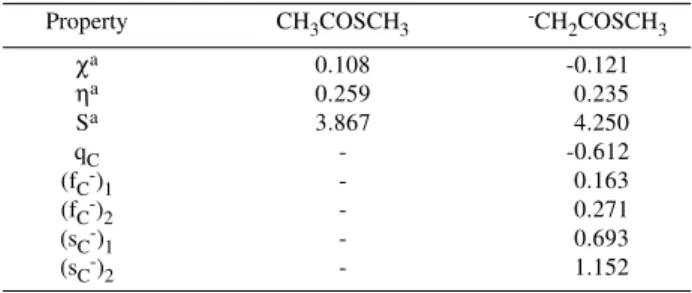
methyl thioacetate, following the same protocol employed for the series (1)-(9), yielded the values for its global and local properties given in Table 5.
utilizing the linear regression of Figure 1, the value of 1476 kJ mol-1 was obtained.
The high acidity of compound (10) in the gas phase is confirmed by the values of the Fukui functions for the anionic carbon of its conjugate base, (fC-) 1 = 0.163 and (fC-)
2 = 0.271. These values are again close to the
corresponding values for nitromethane (0.197 and 0.357, respectively), suggesting for the thioester a similar, and even higher gas-phase acidity than that for CH3NO2. The high acidity of methyl thioacetate, like that of acetophenone, arises from the charge-delocalization by conjugation, coupled with the great polarizability of the molecule, as a result of the presence of the soft sulfur atom. The calculated global softness of MeSOCCH2-, 4.250, was
larger than that for the conjugate bases of methyl acetate (3.895), acetone (3.966) or even butanone (4.115), being second only to that of the acetophenone anion (5.702).
Solvation plays a dominant role in changing the order of acidities of compounds (1)-(10) upon transfer from the gas phase to solution. One cannot expect an exact prediction of solvation effects based on the global and local descriptors listed in Tables 2-5. Nevertheless, one may look for tendencies in the solvation of these molecules by a hard solvent like water. This may provide us with a picture of the relative stability of these species in solution, and, consequently, of their relative acidity in water.
With the exception of the anions from dimethyl-sulfone and -sulfoxide, all other bases in the studied series possess a hard center (O or N) directly conjugated with the soft anionic carbon atom. A comparison of the relative importance of these hard and soft centers in each anion may be obtained by comparing the corresponding Fukui functions fx- of these centers in each species. The ratio
Σ fx- / f
C-, where the sum Σ fx- extends over all hard centers
conjugated with the anionic C, may be utilized as a measure of the tendency of the conjugate base to be solvated by a hard solvent like water. The higher this ratio, the higher should the species be solvated by hydrogen-bonding with this solvent. In consequence, shifts in the gas-phase acidities, when compared with the pKa values in water, could be anticipated by consideration of the above ratios, which may be used as an indication of the relative stability of the carbanions in aqueous solution.
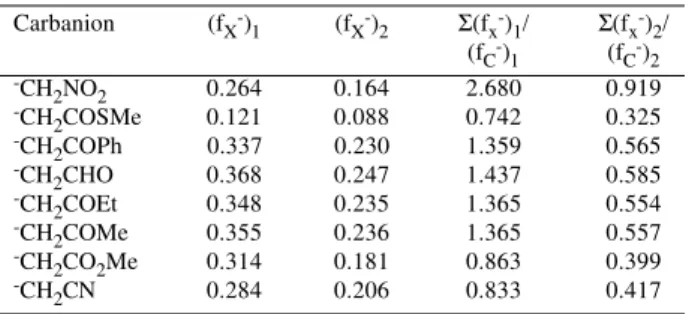
Table 6 gives the Fukui functions (fX-)
1 and (fX-)2
calculated by equations (4) and (6), respectively, for the hard centers (X = O or N) of the anions - CH
2Z, exhibiting
direct conjugation between the soft C and the hard atom(s). The corresponding ratios Σ fx- / f
C- are also given.
Inspection of the calculated values reveals a pattern of shifts of acidity from the gas-phase to aqueous solutions in agreement with the data of Table 1. It is assumed that
Table 5. Global and local properties of methyl thioacetate (10) and its carbanion, calculated at the 3-21G level.
Property CH3COSCH3 -CH
2COSCH3
χa 0.108 -0.121
ηa 0.259 -0.235
Sa 3.867 -4.250
qC - -0.612
(fC-)
1 - -0.163
(fC-)
2 - -0.271
(sC-)
1 - -0.693
(sC-)
2 - -1.152
(a) - In atomic units
The calculated ionization energy ∆E for methyl
thioacetate was equal to 0.5983 a.u. This energy is close to the value of 0.5925 a.u. obtained for nitromethane (Table 2), suggesting an acidity value ∆Go for methyl
the acidity of a carbon acid in water is roughly the result of its intrinsic acidity in the gas-phase, modulated by the aqueous solvation of its anion, and that this latter contribution is measured by the ratio Σ fx- / f
C-.
Methyl thioacetate and nitromethane have about the same acidity in the gas-phase. The anion of the former is, however, much less solvated by water than that of the latter (ratio values of 0.742 vs 2.680, or 0.325 vs. 0.919). As a result, nitromethane is much more acidic in water than methyl thioacetate, with a pKa value (10.2) about 10 units lower than that of methyl thioacetate (estimated pKa of 21.0, assumed equal to the pKa of ethyl thioacetate12).
Besides the usual leveling effect of the solvent, the reduced solvation by water of - CH
2COSMe, compared to
-CH
2CO2Me (0.742 vs. 1.365, or 0.325 vs. 0.399 in their
ratio values), may be held responsible for the fact that the relative differences in acidity strength of the acetate and thioacetate esters are largely reduced from the gas-phase (∆∆Go of ca. 35 kJ mol-1, corresponding to a pKa difference of about 33 units) to aqueous solutions (∆pKa of ca. 4 units). The values in Table 6 also show that the ketone enolates are all similarly solvated in water, and better so than the acetate enolate (ratios of 1.4 vs. 0.86, or 0.56 vs. 0.40). Thus, although methyl acetate and acetone have the same acidity in the gas-phase (Table 1), the latter becomes a stronger acid than the former in water (pKa values of 19.3 and 25.6, respectively).
Finally, the low intrinsic acidity of acetonitrile in the gas-phase, coupled with its poor solvation in water (ratio values of 0.833, or 0.417, comparable to those of the acetate and thioacetate esters), makes this compound one of the least acidic in the series of compounds of Table 6.
The above analysis and the choices made in this paper are open to criticism. Firstly, free-energy values ∆Go were
correlated with the calculated deprotonation energies ∆E, neglecting all entropic contributions to the gas-phase acidity of compounds (1)-(10). This may be justified by the good linear relationship between the experimental ∆Go and ∆Ho
values for the set of studied compounds, with a correlation coefficient of 0.99916. The theoretical deprotonation energies ∆E, which measure enthalpic variations only, may thus be compared with the experimental free-energy values ∆Go,
since the entropic contribution to the gas-phase acidity is practically constant for all compounds in the series.
A second point may be raised, regarding the low level of theory employed in the present work. The choice of the 3-21G basis set was determined by our intention of comparing the set of carbon acids with studies on other compounds reported in the literature under the same conditions. A possible improvement in this approach, with minimum additional cost, might be the use of polarization or diffuse functions for single-point calculations of structures optimized at a lower level of theory. This should be especially convenient when dealing with the anionic conjugate bases of carbon acids CH3Z, since diffuse functions are normally employed for calculations involving anionic species.
We therefore decided to follow this protocol for all
studied compounds, optimizing all CH3Z and -CH
2Z
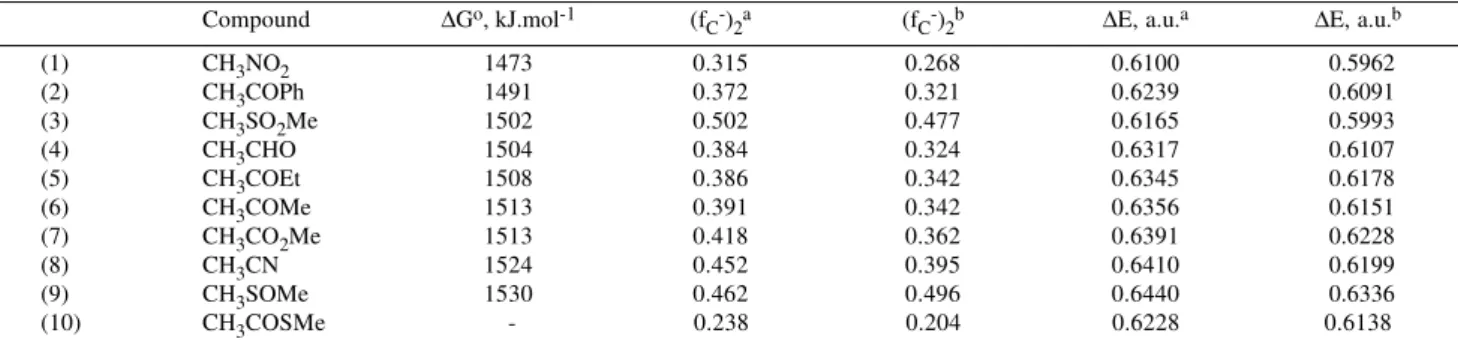
structures at the 3-21G level, and carrying out single-point calculations with the 6-31G* and the 6-31+G (3df,2p) basis sets. These calculations were restricted to the ∆E and (fC-)2 descriptors, which had yielded the best correlations with the experimental gas-phase acidities of compounds (1)-(9). The obtained results are given in Table 7. It can be seen that this supposedly improved approach reproduces the trends obtained with the 3-21G method. Gas-phase acidities increase with the calculated deprotonation energies ∆E, with correlation coefficients of 0.915, for the 6-31G* // 3-21G method, and of 0.870 for the 6-31+G(3df,2p) // 3-21G method. Both values correspond to worse correlations than that of 0.961 obtained with the 3-21G basis set. According to the calculated deprotonation energies of methyl thioacetate, compound (10) should be one of the most acidic member of the series, with an acidity comparable to that of nitromethane. The gas-phase acidity is also seen to increase with the nucleophilic Fukui function values (fC-)
2 of the
anionic carbon atom of - CH2Z, according to both methods. As observed with the calculations at the 3-21G level, the obtained correlations were rather poor (r = 0.689 for the 6-31G*//21G, and r = 0.680 for the 6-31+G(3df,2p) // 3-21G method), and could be improved to r = 0.949 and r = 0.957, respectively, when the data points for dimethyl-sulfoxide and -sulfone were omitted from the plots. Again, the use of polarization or diffuse functions represented little, if any improvement over the 3-21G method, which yielded coefficients r equal to 0.684 and 0.933 respectively. This observation is in line with previous studies which suggested that the use of larger basis sets does not necessarily lead to better correlations with experimental acidities or basicities5.
Table 6. Fukui functions, (fX-)
1 and (fX-)2, of the hard centers (X = O or N) and corresponding ratios Σ(fx-)
1/( fC-)1 and Σ(fx-)2/( fC-)2 for the carbanions -CH
2Z with direct conjugation between the soft C atom and the hard center. Calculations performed at the 3-21G level.
Carbanion (fX-)
1 (fX-)2 Σ(fx-)1/ Σ(fx-)2/ (fC-)
1 (fC-)2 -CH
2NO2 0.264 0.164 2.680 0.919
-CH
2COSMe 0.121 0.088 0.742 0.325
-CH
2COPh 0.337 0.230 1.359 0.565
-CH
2CHO 0.368 0.247 1.437 0.585
-CH
2COEt 0.348 0.235 1.365 0.554
-CH
2COMe 0.355 0.236 1.365 0.557
-CH
2CO2Me 0.314 0.181 0.863 0.399
-CH
In conclusion, the present paper investigated the existence of correlations between the gas-phase acidities of nine carbon acids of the form CH3Z and global and local properties of these molecules, calculated with a 3-21G basis set, based on the HSAB principles. A reasonably good correlation (r = 0.961) was obtained between literature ∆Go values and the
calculated ionization energies of all compounds. No correlations were observed between global HSAB properties of the acids or their anions and the ∆Go values, probably
because of the heterogeneity of the studied series. Local descriptors reflected the nature of the carbanion, establishing a distinction between - CH
2Z which presented direct
conjugation between the carbanionic center and an oxygen or nitrogen atom, and the pair dimethyl-sulfone/-sulfoxide, where this conjugation was absent. The Fukui function for nucleophilic attack of the anionic carbon atom of - CH2Z, calculated following two different approaches, yielded reasonable correlations with the gas-phase acidities of the former compounds. For this series of acids, the strength of the conjugate bases increased with the value of the nucleophilic Fukui function at the carbon atom. The obtained correlation between ∆Go and the calculated ionization energies was used to estimate the acidity of methyl thioacetate in the gas phase. The result indicated that this compound should have nearly the same intrinsic acidity as nitromethane. The shifts from gas-phase to aqueous acidities of the studied compounds, where direct conjugation between a soft carbon atom and hard O or N atoms exist in the anions, were interpreted in terms of the ratios of the nucleophilic Fukui functions between the hard centers and the soft C atom.
The use of larger basis sets and polarization (6-31G*) or diffuse functions (6-31+G(3df,2p)) for single-point calculations of deprotonation energies and nucleophilic Fukui functions for the anionic carbon atoms reproduced the trends observed with the 3-21G method, but did not improve the correlations between the theoretical descriptors with the experimental gas-phase acidities.
Acknowledgements
Financial support from USACH-DICYT is acknowledged.
References
1. Parr, R. G.; Pearson, R. G. J. Am. Chem. Soc. 1983, 105, 7512.
2. Pearson, R. G. J. Am. Chem. Soc.1985, 107, 6801. 3. Pearson, R. G. J. Chem. Educ.1987, 64, 561. 4. Yang, W.; Mortier, W. J. J. Am. Chem. Soc. 1986,
108, 5708.
5. Contreras, R. R.; Fuentealba, P.; Galván, M.; Pérez, P. Chem. Phys. Lett.1999, 304, 405.
6. De Proft, F.; Langenaeker, W.; Geerlings, P. J. Phys. Chem.1993, 97, 1826.
7. De Proft, F.; Langenaeker W.; Geerlings, P. Tetrahedron, 1995, 51, 4021.
8. De Proft, F.; Amira, S.; Choho, K.; Geerlings, P. J. Phys. Chem.1994, 98, 5227.
9. Méndez, F.; Romero, M.L.; De Proft, F.; Geerlings, P. J. Org. Chem. 1998, 63, 5774.
10. Choho, K.; Van Lier, G.; Van de Woude, G.; Geerlings, P. J. Chem. Soc. Perkin 2, 1996, 1723.
11. Hawkinson, D. C.; Feiock, J. M.; Nevy, J. B.; Wu, Y.-Zh. J. Org. Chem.1998, 63, 5345.
12. Amyes, T. L.; Richard, J. P. J. Am. Chem. Soc.1996, 118, 3129.
13. Amyes, T. L.; Richard, J. P. J. Am. Chem. Soc. 1992, 114, 10297.
14.Gaussian 94, Frisch, M. J.; Trucks, G. W.; Schlegel, W. B.; Gill, P. M. W.; Johnson, B. G.; Robb, M. A.; Cheeseman, J. R.; Keith, T. A.; Peterson, G. A.; Montgomery, J. A.; Raghavachari, K.; Al-Laham, M. A.; Zahrzewski, V. G.; Ortiz, J. V.; Foresman, J. B.; Cioslowski, J.; Stefanov, B. B.; Nanayakkara, A.; Challecombe, M.; Peng, C. Y.; Ayala, P. Y.; Chen, W.;
Table 7. Nucleophilic Fukui functions (fC-)
2 and deprotonation energies ∆E, calculated with a 6-31G* // 3-21G and with a 6-31+G(3df,2p) // 3-21G method for compounds (1)-(10) and their conjugate bases.
Compound ∆Go, kJ.mol-1 (f
C-)2a (fC-)2b ∆E, a.u.a ∆E, a.u.b
(1) CH3NO2 1473 0.315 0.268 0.6100 0.5962
(2) CH3COPh 1491 0.372 0.321 0.6239 0.6091
(3) CH3SO2Me 1502 0.502 0.477 0.6165 0.5993
(4) CH3CHO 1504 0.384 0.324 0.6317 0.6107
(5) CH3COEt 1508 0.386 0.342 0.6345 0.6178
(6) CH3COMe 1513 0.391 0.342 0.6356 0.6151
(7) CH3CO2Me 1513 0.418 0.362 0.6391 0.6228
(8) CH3CN 1524 0.452 0.395 0.6410 0.6199
(9) CH3SOMe 1530 0.462 0.496 0.6440 0.6336
(10) CH3COSMe - 0.238 0.204 0.6228 0.6138
Wong, M. W.; Andres, J. L.; Replogle, E. S.; Gomperts, R.; Martin, R. L.; Fox, D. J.; Binkley, J. S.; Defrees, D. J.; Baker, J.; Stewart, J. P.; Head-Gordon, M.; Gonzalez, C.; Pople, J. A.; Gaussian Inc., Pittsburgh, PA, 1995. 15. Houk, K.N.; Wang, X. J. Am. Chem. Soc. 1988, 110,
1870.
16. Isaacs, N. S. Physical Organic Chemistry, Longman, Essex, England, 1992.
17. Bordwell, F. G. Acc. Chem. Res. 1988, 21, 456. 18. Bordwell, F. G.; Taft, R.W. Acc. Chem. Res. 1988, 21,
463.
19. Bordwell, F. G.; Fried, H. E.; Hughes, D. L.; Lynch, T. Y.; Satish, A. V.; Whang, Y. E. J. Org. Chem. 1990, 55, 3330.
20. It is interesting to note that these corresponded to the ab-initio-optimized structures. The preliminarily AM1-optimized structures of dimethyl-sulfoxide and -sulfone
anions yielded planar, sp2-type anionic C atoms. These
simple examples caution against the use of AM1-optimized structures for single-point calculations of HSAB parameters at a higher level of theory. Though justified in terms of computational costs (as, for example, in ref. 10), this procedure may lead to significant distortions. 21. Jones, D.; Modelli, B.; Olivato, P. R.; Dal Colle, M.;
De Palo, M.; Distefano, G. J. Chem. Soc. Perkin Trans. 2, 1994, 1651.
22. Deerfield, D. W. II; Pedersen, L.G., THEOCHEM
1995, 358, 99.
23. Grunwell, J. R.; Foerst, D. L.; Kaplan, F.; Siddigui, J. Tetrahedron, 1977, 33, 2781.
24. (a) Smolders, A.; Maes, G.; Zeegers-Huyskens, T. J. Mol. Struct.1988, 172, 23. (b) Maes, G.; Smolders, A.; Vandevyvere, P.; Vanderheyden, L.; Zeegers-Huyskens, T. J. Mol. Struct.1988, 173, 349.