reação de hidrólise do diacetato de 2,5-dimetil-1,4-naftoidroquinona em condições reacionais brandas, meio básico, e que favorece a hidrólise do grupo 4-acetato, foi investigada utilizando métodos de ab initio e semi-empíricos. Em fase gasosa (sistemas isolados) estes métodos não forneceram resultados consistentes com a seletividade observada. Com a inclusão dos efeitos do solvente (água) através do modelo de solvatação discreta no método semi-empírico AM1, foi possível estabelecer a estabilidade relativa dos intermediários tetraédricos e dos seus respectivos estados de transição como sendo a responsável pela seletividade observada. A origem da estabilidade relativa, e portanto, da seletividade está relacionada com as interação repulsivas entre o grupo substituinte 2-metil no anel do naftaleno e a metila do grupo 4-acetado, assim como o impedimento destes grupos à hidratação do grupamento iônico dos intermediários tetraédricos.
The regioselectivity found in the mild basic hydrolysis of the 2,5-dimethyl-1,4-naphthohydroquinone diacetate (Nunes, R.L.; Bieber, L.W.; Longo, R.L. J. Nat. Prod.1999, 62, 1600) has been studied with ab initio and semiempirical molecular orbital methods. In the gas phase (isolated systems), these methods were not able to provide results that could explain the observed selectivity. However, when the solvent effects were included in the AM1 method using the discrete solvation model it was possible to establish that this selectivity is due to the relative stability of the tetrahedral intermediates and their transitions states. The origin of this relative stability and thus of the observed selectivity is due to the repulsive interactions between the 2-methyl substituent in the naphthalene ring and the 2-methyl group in the 4-acetate substituent, as well as their hindrance towards the hydration of the ionic group in the tetrahedral intermediates.
Keywords: regioselectivity, MO calculations, solvent effects
Introduction
Base-promoted ester hydrolysis (saponification) has been used by the Phoenicians to make soap over 2000 years ago1. Nowadays this reaction is employed in organic synthesis mainly for protecting/deprotecting hydroxyl groups. This reaction is also widely used in introductory organic chemistry laboratories in undergraduate courses. Despite this reaction being so old and useful some of its aspects are still elusive. For instance, during the synthesis of the natural product Mansonone F2 a remarkable regioselectivity has been found for the base-promoted hydrolysis of the 2,5-dimethyl-1,4-naphthohydroquinone diacetate intermediate. As shown in Scheme 1, the hydrolysis of (1) in mild basic aqueous/methanol media yielded the monoacetates in 84% yield in a proportion of 80:20 of the isomers (2):(3), according to an 1H-NMR analysis2.
This selectivity had already been observed in the hydrolysis of other methyl-1,4-naphthohydroquinone diacetates3,4 as well as been applied in the synthesis of
natural products4. However, no attempt has been made to explain this selectivity, despite of its potential application in organic synthesis. Attempts to rationalize this selectivity based upon the relative stability of the products using resonance stabilization of enolate ions were unsuccessful.2 Consequently, quantitative theoretical approaches were used to study this reaction, namely, ab initio and semiempirical molecular orbital (MO) methods. The computational modeling of this reaction is not trivial if the solvent effects have to be considered, because several groups of the reactants or intermediates are polar and/or ionic, and the solvent is highly polar (water/methanol). Thus, the specific interactions, namely, hydrogen bonds have to be described accurately. In addition, apolar methyl groups are present, so that their hydrophobic interactions also have to be considered properly.
The reaction mechanisms for the hydrolysis of carboxylic esters can be classified, according to Ingold5,
as BAC1 and BAC2 for acyl cleavage and BAL1 and BAL2 for alkyl cleavage. In basic aqueous/organic media the BAC2 is the predominant mechanism and involves a tetrahedral intermediate originated from the attack of the carbonyl group by the hydroxyl ion6,7. Spectroscopic
detection, 18O labeling and isolation procedures, as well
as thermodynamic and kinetic data have provided compelling evidence for the existence of this intermediate7,8. In the gas phase, nucleophilic attacks to
carboxylic esters take a different course, with the BAL2 mechanism being the observed one6. However, when the
nucleophile is solvated, even by a single solvent molecule, the BAC2 mechanism is also observed6. Thus, the proper
description of the solvent effects is essential to model this selectivity and to understand its origin.
Theoretical Procedure
All calculations were performed on a Sun UltraSparc1 under Solaris 2.25 workstation. For the ab initio calculations9,10 the GAMESS program11 was used with the
standard basis sets 3-21G12 and its counter part effective core potential (SBK)13 augmented by an s-type diffuse
function14 on the oxygen atoms of the o-naftoquinone ring. For the semiempirical calculations the MOPAC 93 (revision 2) program15 was used with the standard Hamiltonians MNDO16, AM117 and PM318. All geometry optimizations
were performed in Cartesian coordinates without any restriction, except in the reaction coordinate calculations. The convergence threshold for all geometry optimization calculation was 5 x 10⁻³ kJ mol-1 pm-1. All the extreme points
in the potential energy surface have been characterized by the calculation of the Hessian eigenvalues. The ORTEP-III program19 was used for visualization of the molecular
structures. The discrete model20 described the solvent effects;
namely, 18 water molecules surrounded the tetrahedral intermediates. In fact, initially only a few water molecules were placed at hydrogen bond distances from the oxygen atoms and the AM1 method were used to optimize the geometry. Then, the solvent positions were modified at random generating approximately 20 structures which had their geometry fully optimized. Only the structures within 12 kJ mol-1 from the most stable one were used in the
sequence, which involved the inclusion of more water molecules until it reached 18 molecules. At each step of including these water molecules a complete optimization of the molecular structure was performed.
Results and Discussion
Considering the Hammond’s postulate6, the selectivity
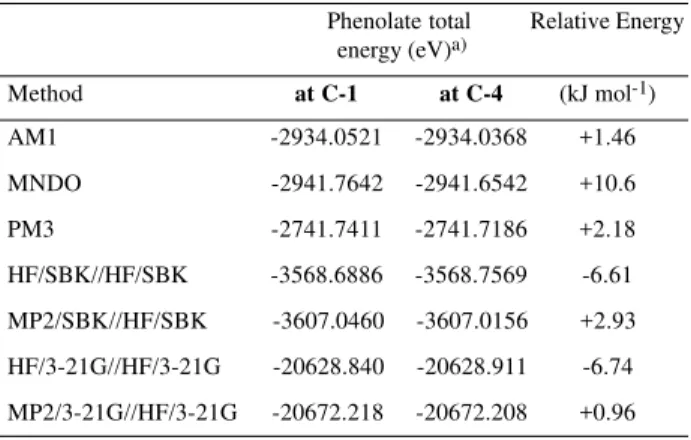
of the diacetate hydrolysis was initially explored by calculating the relative stability of the phenolate formed in C-1 and C-4 using the semiempirical methods MNDO16, AM117 and PM318. From Table 1 it can be seen that these
methods have not provided any corroboration of the relative stability predicted by the inductive effects of the methyl groups. Also, these results are in disagreement with the observed selectivity, despite the relative energy calculated by the AM1 method being very small, but still positive.
As a result, ab initio MO calculations9,10 were also
about 12.5 kJ mol-1 more stable than the one at C-1, in
agreement with the observed selectivity, despite the relative stability in the gas phase being the reverse.
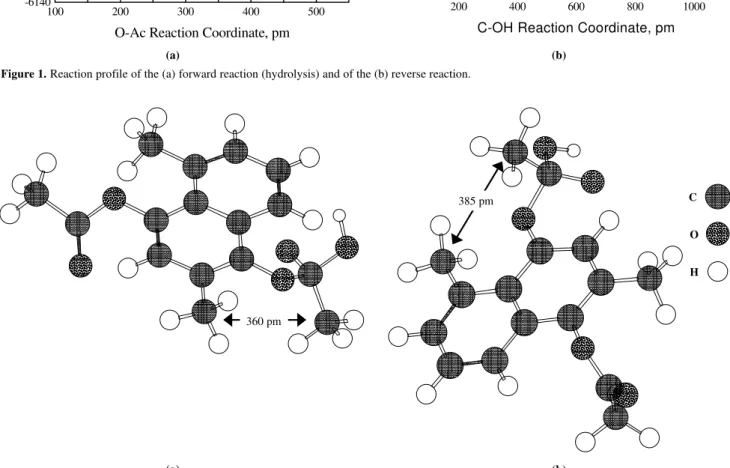
The reaction profiles for the hydrolysis (forward) and for the reverse (diacetate formation) reactions were calculated and are shown in Figures 1a and 1b, respectively. The forward reaction (hydrolysis) has a small activation energy and is highly exothermic, characterizing an irreversible reaction, and also explaining the high yield of this hydrolysis. The Hammond’s principle6 states that the
transition state energy is directly related to tetrahedral intermediate enthalpy of formation. Indeed, from Table 1 it is shown that the transition state of the hydrolysis reaction at C-4 is also about 13 kJ mol-1 lower in energy than that
at C-1 (Figure 1a). Thus, the origin of the regioselectivity for the hydrolysis of the diacetate 1 is related to the relative stability of the tetrahedral intermediates, and to the maintenance of this stabilization in the transition state formed from the nucleophilic addition of the hydroxide to the carbonyl groups.
This relative stability is dependent upon the interaction between the substituents in the naphthalene ring and the acetates, as well as the solvation effects of a polar solvent. The formation of the tetrahedral intermediate at C-1 leads to a conformational change of the acetate group. This causes a large repulsive interaction between the methyl group at the naphthalene at C-2 with the methyl group at the acetate group (241 - 248 pm). This steric hindrance are not significantly present in the tetrahedral intermediate at C-4 because the methyl group at C-5 is quite far from the acetate methyl group (270 - 285 pm), as can be seen in Figures 2a and 2b, respectively. The close proximity of the methyl groups in the intermediate at C-1 also hinders its hydration causing a destabilization relative to the tetrahedral intermediate at C-4. It thus can be concluded that the origin of the observed selectivity is due to the interactions between the substituents in the naphthalene ring and in the ester, as well as their relative hindrance towards the solvation of the ionic group.
AM1 -2934.0521 -2934.0368 +1.46
MNDO -2941.7642 -2941.6542 +10.6
PM3 -2741.7411 -2741.7186 +2.18
HF/SBK//HF/SBK -3568.6886 -3568.7569 -6.61
MP2/SBK//HF/SBK -3607.0460 -3607.0156 +2.93
HF/3-21G//HF/3-21G -20628.840 -20628.911 -6.74
MP2/3-21G//HF/3-21G -20672.218 -20672.208 +0.96
a) 1 eV ≈ 96.487 kJ mol-1
Table 2. AM1 enthalpy of formation and activation enthalpy (kJ mol-1)
Species position Enthalpy of Activation Formation Enthalpy
Tetrahedral intermediate C-1 -1851.42 + 3 H2O
Tetrahedral intermediate C-4 -1854.35 + 3 H2O
Transition State + 3 H2O C-1 -1805.81 45.61
Transition State + 3 H2O C-4 -1809.16 45.19
Tetrahedral intermediate C-1 -6064.29 + 18 H2O
Tetrahedral intermediate C-4 -6077.69 + 18 H2O
Transition State + 18 H2O C-1 -6047.13 17.16
Transition State + 18 H2O C-4 -6059.69 18.00
The structure and energetics of the tetrahedral intermediate at C-1 and C-4 formed from the hydroxide addition to each carbonyl group has been calculated by the AM1 method. It has been found that the tetrahedral intermediates are not minima in the potential energy surfaces. This result is consistent with experimental21 and
100 200 300 400 500 -6140
-6120 -6100 -6080 -6060 -6040
tetrahedral intermediate
Position 4 Position 1
Entha
lpy
of
F
orm
atio
n, k
J m
ol
-1
O-Ac Reaction Coordinate, pm
200 400 600 800 1000
-6080 -6060 -6040 -6020 -6000 -5980 -5960 -5940 -5920 -5900
tetrahedral intermediate
Position 1 Position 4
E
n
th
al
py
of F
o
rm
at
ion,
kJ
m
o
l
-1
C-OH Reaction Coordinate, pm
360 pm
385 pm C
O
H
(a) (b)
Figure 1. Reaction profile of the (a) forward reaction (hydrolysis) and of the (b) reverse reaction.
(a) (b)
Figure 2. Structure of the hydrated tetrahedral intermediates at C-1 (a) and in C-4 (b). The hydration molecules are not shown for simplicity.
Conclusions
The present model (AM1 + discrete solvent molecules) can provide a semi-quantitative account of the observed selectivity of basic hydrolysis of diacetates. The origin of the regioselectivity for the hydrolysis of the diacetate is related to the relative stability of the tetrahedral inter-mediates. Steric interactions between the substituents in the naphthalene ring and the acetate substituent and the solvation effects are responsible for the relative stabili-zation of the tetrahedral intermediates.
Acknowledgments
The authors thank the Brazilian funding agencies: FINEP, FACEPE, CAPES, CNPq and PADCT for financial support. One of the authors (RLN) wishes to acknowledge the fellowship from CNPq.
References
8. Bender, M. L.; Heck, H. d’A. J. Am. Chem. Soc.1967, 69, 1211.
9. Hehre, W. J.; Radom, L.; Schleyer, P. vR.; Pople, J. A. Ab Initio Molecular Orbital Theory; John Wiley & Sons, New York, 1986.
10. Clark, T. A Handbook of Computational Chemistry; John Wiley & Sons, New York, 1985.
11. Schmidt, M. W.; Baldridge, K. K.; Boatz, J. A.; Elbert, S. T.; Gordon, M. S.; Jensen, J. H.; Koseki, S.; Matsunaga, N.; Nguyen, K. A.; Su, S. J.; Windus, T. L.; Dupuis, M.; Montgomery, J. A. J. Comput. Chem.1993, 14, 1347.
18. Stewart, J. J. P. J. Comput. Chem.1989, 10, 210. 19. Burnett, M. N.; Johnson, C. K. ORTEP-III; Oak Ridge
National Laboratory, Oak Ridge, TN, USA, 1996. 20. Freitas, L. C. G.; Longo, R. L.; Simas, A. M. J. Chem.
Soc., Faraday Trans.1992, 189.
21. Wilbur, J. L.; Brauman, J. I. J. Am. Chem. Soc.1994, 116, 5839; 1994, 116, 9216.
22. Madura, J. D.; Jorgensen, W. L. J. Am. Chem. Soc.
1986, 108, 2517.
23. Blake, J. F.; Jorgensen, W. L. J. Am. Chem. Soc.1987, 109, 3856.