A Multiparton Model for
pp
/
pp
Inelastic Scattering
P. C. Beggio∗
Laborat´orio de Ciˆencias Matem´aticas,
Universidade Estadual do Norte Fluminense Darcy Ribeiro - UENF, Av. Alberto Lamego, 2000, Pq. Calif ´ornia, CEP: 28013-602,
Campos dos Goytacazes - RJ, Brazil
(Received on 9 October, 2008)
We have applied a geometrical approach to studypp/ppinelastic scattering over the range of center mass energies from 44.5 to 900 GeV. The multiplicity distributions are described by multiple parton-parton collisions without free parameters. The output seems to be consistent with data and the results are discussed. Exploring the possible connection between impact parameter representation of the multiplicity distribution and that of the eikonal function, the range of impact parameters for multiple collisions of partons are estimated. The energy dependence ofiparton-parton collisions probability is studied and the average multiplicity is related to hadron opacity at each impact parameter.
Keywords: Eikonal approximation; Hadronic multiplicity distribution;pp/pp¯ scattering
1. INTRODUCTION
It is well know that the underlying theory of hadronic in-teractions, the Quantum Chromodynamics (QCD), is not yet able to describe the bulk of experimental data associated with soft processes in hadronic interactions. Phenomenological ap-proaches are used as source of information for adequate theo-retical developments. General principles are very important in the nonperturbative sector, in particular unitarity, which reg-ulates the relative strength of elastic and inelastic processes [1]. Thus, since that an approach based exclusively in QCD is still missing, we hope infer some useful information on mul-tiparticle production in pp/ppcollisions by using a geomet-rical approach involving both elastic and inelastic scattering related by unitarity. The multiplicity distribution is the most general feature of multiparticle production processes. To be successful, any phenomenological model of these processes should, first of all, fit the experimental values for probabili-ties ofnparticle production [2]. Thus, we shall apply an ex-isting generalized phenomenological procedure, referred to as Fused String Model(FSM) [3], which describes well the over-all multiplicity distributions arising from pp/ppcollisions at ISR (52.6 GeV) and Collider (546 GeV) energies once the eikonal function (Ω) is given, which can be inferred from mea-surements of the elastic differential cross section. The success of theFSMencourages us apply them to study pp/pp inter-actions in others collision energies. Their formalism is based on the idea that particles are produced due to the multiparton collisions and the impact parameter formalism is used.
The plan of the paper is as follows. We shall begin by pre-senting the basic formalism of the FSM in the next section. In Sec. 3 we apply the model to study some aspects ofpp/pp collisions, namely, overall multiplicity distributions, the range of impact parameters for multiple collisions of partons and the average multiplicity as a function of impact parameter. Dis-cussions of the results and concluding remarks are given in Sec. 4.
∗Electronic address:[email protected]
2. THE FUSED STRING MODEL FORMALISM
We review in this section the key points of theFSM. The multiplicity distribution is defined [4] by the formula
Pn(s) =
σn(s)
∑∞n=0σn(s)
= σn(s) σin(s)
, (1)
whereσnis the cross section of ann-particle process (the
so-called topological cross section),σinis the inelastic cross
sec-tion and√sthe center-of-mass energy. In theFSMthe inci-dent hadrons are treated as spatially extended objects and their collisions depicted as an ensemble of elementary interaction between quarks and/or gluons (parton-parton collision). It is assumed that in each parton-parton collision there is forma-tion of an string, a object similar to the one ine−e+collisions,
in which probably oneqqpair has triggered the multitude of the final particles. Since the model treats hadrons as extended objects, the impact parameterbis an essential variable in the description of their collisions. Thus, in studies of the colli-sions between compound objects, such as hadrons, we expect that more than one parton-parton collisions tend to occur in smallerb collisions, where the overlap of hadronic matter is larger and hence two or more strings could be produced. Mak-ing the assumption that may occur formation of several strMak-ings (i qqpairs) and since they are formed in a very small region of typical hadron size, it is natural that they are subsequently fused to from just one larger final chain. By using the eikonal approximation the connection between the elastic and the in-elastic channels is established through the unitarity condition andσn, in Eq. (1), is decomposed into contributions from each
bwith weightGin(s,b)[5]
Pn(s) =
σn(s)
σin(s)
=
R
d2b Gin(s,b)
hσ
n(s,b)
σin(s,b) i
R
d2b G in(s,b)
, (2)
whereGin(s,b)is the inelastic overlap function. To
expandingGin(s,b)in following form
Gin(s,b) =
∞
∑
i=1
[2Ω(s,b)]i
i! e
−2Ω(s,b) (3)
≡
∞
∑
i=1
G(i)(s,b), (4) withirepresenting the number of initial strings created in the interaction. G(i) is the overlap function for formation of i strings, introduced in Ref. [3]. We recall that, in Eq. (2), the quantity in brackets can be interpreted as the probability of producingnparticles atband that it should scale in KNO sense due to its elementary structure [3]. Then, with Eq. (4), the overall multiplicity distribution is given by summing con-tributions coming from each set ofistrings, in general
Pn(s) =
∞
∑
i=1 R
d2b G(i)(s,b) <n(s,b)>(i)
h
<n(s,b)>(i) σn(s,b)
σin(s,b) i
R
d2b G in(s,b)
, (5)
<n(s,b)>(i) is the average multiplicity of the final fused
chain atband√s, originated fromiinitial strings. This quan-tity is written as [3]
<n(s,b)>(i)=<N(s)>f(i)(s,b), (6) where <N(s)>is the average multiplicity at √s and call f(i)(s,b)multiplicity function ofistrings [3]. Now, similarly to KNO, let us introduce for eachbthe elementary multiplic-ity distribution
ψ
µ n <n(s,b)>(i)

=<n(s,b)>(i) σn(s,b)
σin(s,b)
. (7) Thus, with Eqs. (6) and (7), Eq. (5) becomes
Φ(s,z) = ∞
∑
i=1 R
d2bG(i)(s,b)
f(i)(s,b)ψ ³
z f(i)(s,b)
´
R
d2b G in(s,b)
, (8)
whereΦ(s,z) =<N(s)>Pn(s)andz=n/ <N(s)>
repre-sents the usual KNO scaling variable. We assume that the i strings formed in the collision are fused to from just one larger final chain and that this final fused chain decays pro-ducing particles and, for each value of b, follows a gamma distribution normalized to 2 [5]
ψ(z) =2 k
k
Γ(k)z
k−1e−kz,
(9) which is characterized by the parameterk. Experimental data fore−e+multiplicity distributions, covering the interval 22.0 GeV ≤√s≤161 GeV, were fitted obtaining k=10.775 ±
0.064(χ2/N
DF=2.61)[5]. The gamma distribution is know
to arise as a limiting form (with certain correction terms which depend on details of the evolution equation) for the parton number variable, when the dynamical theory (as in QCD case) allows each existing parton to act as a source to emit addi-tional partons (parton branching) [6]. Now, to obtain the mul-tiplicity function f(i)(s,b)in terms of the eikonal Ωwe as-sume that the fractional energy√s′, that is deposited for par-ticle production in a collision atb, is equally divided among
inumber of colliding partons pairs and that this quantity is proportional toΩ. Thus, the total energy√s′ of a final fused chain, originated fromiinitial strings, is written
√
s′
i ∝ Ω(s,b)⇒ p
s′ =iβ(s)Ω(s,b), (10) β is a function of the collision energy and their values in-creases as the collision energy also inin-creases. In section 3.3 we have estimated the values ofβat two different energies. Fi-nally, to obtain thef(i)(s,b)as a function of theΩ, we assume that the average multiplicity originated fromistrings depends on the energy√s′ in the same way as ine−e+annihilations, which is approximately represented by a power law in√s
<n(s,b)>(i)=γs′A. (11) Combining the Eqs. (6), (10) and (11) we obtain
f(i)(s,b) =i2Aξ(s)[Ω(s,b)]2A, (12)
withξ(s)determined by the usual normalization conditions onΦ[3] and which also gives ξ(s)as an energy dependent quantity [3]
ξ(s) =
R
d2b Gin(s,b) R
d2b[Ω(s,b)]2A[∑∞
i=1i2AG(i)(s,b) ]
. (13)
The overall multiplicity distribution, Eq. (8), is explicitly given by
Φ(s,z) = ∞
∑
i=1 R
d2b G(i)(s,b)
i2Aξ(s)[Ω(s,b)]2Aψ ³
z i2Aξ(s)[Ω(s,b)]2A
´
R
d2b G in(s,b)
. (14)
We note that, in the last Eq., the weight function is now the overlap function for formation ofistrings,G(i), and that, ac-cording to Eqs. (3) and (14), the model should contain infinite number of strings irrespective of the incident energy. How-ever, the finite effective partons in the incident hadrons and the finite available energy forbid to form indefinitely large number of strings. In this approach, the effective number of strings involved in the interaction is inferred from multiplicity distribution data. In previous studies, the average multiplic-ity data ine−e+ annihilations were fitted by Eq.(11), giving A=0.198±0.004 (χ2/N
DF =1.7) in the interval 10 GeV <√s≤183 GeV [5], andA=0.200±0.006(χ2/N
DF=0.94)
2.1. Remarks on FSM
The formalism ofFSMis based on the idea that, in hadronic interactions, particles are produced due to the parton-parton collisions and with the formation of an object similar to the one in e−e+ annihilations. Ine−e+collisions probably one
qqpair has triggered the multitude of final particles (e−e+
−→
Z/(γ)−→qq¯−→hadron). Thus, neglecting the first phase in e−e+collisions (e−e+−→Z/(γ)), we have considered the ex-perimental data one−e+annihilations as a possible source of information concerning parton-parton interactions in pp/pp collisions. With this procedure we are able to predict the hadronic multiplicity distribution in a wide interval of energy without free parameters, which could be adjusted to achieve agreement with experimental results. Specifically, Ω(s,b) comes from analysis of the elastic scattering,kandAfrom fits toe−e+data. Despite of the fact that there are some doubts
whether such an extremely narrowψ corresponds to reality, similarities betweene−e+and hadronic interactions are often quoted [8]. In addition, Basile et al. [9] found that the av-erage multiplicity inppcollisions is similar to that fore−e+ collisions. It was concluded that the multiparticle production mechanism is the same in both processes, controlled mainly by the amount of energy available for particle production.
3. APPLYING THEFSM
In next subsections we shall apply the FSM formalism to study some quantities associated with the high energy hadronic collisions.
3.1. Multiplicity distributions
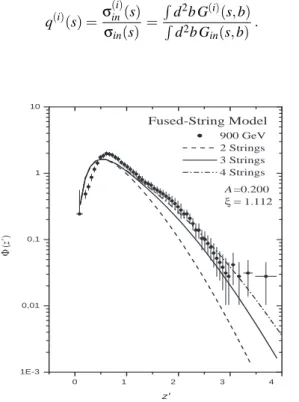
The model has been previously used to study multiplic-ity distributions,Φ, in ppandppcollisions at energies 52.6 and 546 GeV, respectively [3]. Now, we would like to in-vestigate the effects of the multiple string formation during the hadronization process on the charged multiplicity distribu-tions arising frompp/ppcollisions at energies 44.5, 200 and 900 GeV. For this purpose, we have fixed the value ofA=0.2 and adopted the Henzi and Valin parametrization forΩ(s,b). G(i)(s,b)andψ(withk=10.775) are given by Eqs. (4) and (9), respectively. The value ofξ(s)is obtained from Eq. (13). This completes the specification of model and we have com-puted the overall multiplicity distributions at energies above mentioned. We show in Fig. 1 the result of computation of Φat thepp-ISR energy (√s=44.5 GeV). We can see that the curve obtained assuming up to three parton-parton collisions (or equivalently, the formation of up to three initial strings) shows reasonable agreement with the data [10]. This is not surprising since the multiplicity distributions observed at the CERN-ISR obey KNO scaling and the theoretical curve pre-dicted from theFSM at 52.6 GeV, in Ref. [3], also showed good agreement with the data assuming the formation of up to three initial strings. However, at 200 and 900 GeV, Figs. 2 and 3 , a better agreement with data [11] are obtained if we assume
0 1 2 3 4
1E-3 0,01 0,1 1 10
A=0.200
ξ = 1.258
44.5 GeV 2 Strings 3 Strings 4 Strings
Fused-String Model
Φ
(
z'
)
z'
FIG. 1: Overall scaled multiplicity distribution data forppat ISR en-ergy [10], compared to theoretical prediction using the Fused-String Model, Eqs. (14) and (13).
0 1 2 3 4
1E-3 0,01 0,1 1 10
A=0.200
ξ = 1.186
Fused-String Model
200 GeV 2 Strings 3 Strings 4 Strings
Φ
(
z'
)
z'
FIG. 2: Overall scaled multiplicity distribution data for pp at
√
s=200 GeV [11], compared to theoretical prediction using the Fused-String Model, Eqs. (14) and (13).
also have calculated thei-string formation probability (q(i)), as a function of√s, that the model predicts and obtained the results shows in Fig. 4. This quantity is defined in Ref. [3] and for completeness we record here:
q(i)(s) =σ
(i) in(s)
σin(s)
=
R
d2b G(i)(s,b)
R
d2b G in(s,b)
. (15)
0 1 2 3 4
1E-3 0,01 0,1 1 10
A=0.200
ξ = 1.112
900 GeV 2 Strings 3 Strings 4 Strings
Fused-String Model
Φ
(
z'
)
z'
FIG. 3: Overall scaled multiplicity distribution data for pp at
√
s=900 GeV [11], compared to theoretical prediction using the Fused-String Model, Eqs. (14) and (13).
The results demonstrate that the probability of formation of one (q(1)) and two (q(2)) strings are approximately constants in a wide interval of energy (10-5000 GeV). In counterpart, the probability of formation of three (q(3)) and four (q(4)) strings increases as√salso increases. As each initial string created is associated with a parton-parton collision, it may indicate that the gluons and sea quarks are increasingly important in deter-mining the characteristics of the interactions as the energy is increased. This result agrees with the specific result from an analysis of experimental data done in Ref. [8], in which the author showed that the multiple parton-parton collisions be-come increasingly important as the collision energy increases. We have expressedΦin terms of modified the scaling variable z′=n−No/ <n−No>withNo=0.9 representing the average number of leading particles [5].
3.2. Range of impact parameters for multiple collisions of partons
Since our framework is based on the concept of impact pa-rameter, we would like to investigate for which range of im-pact parameters we need to consider the superposition of a
10 100 1000
0,01 0,1 1
q(4)
q(3)
q(2)
q(1)
q
(i)
s1/2 GeV
FIG. 4: Energy dependence ofistring formation probability,q(i), for several values ofi, Eq. (15).
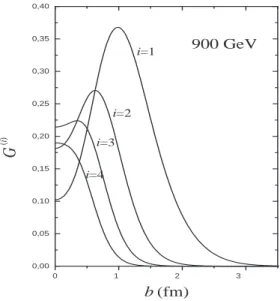
specific number of parton-parton collisions in pp/pp inter-actions. Equations (14) and (13) are the basic equations of model. In the Eq. (14) the weight function is the overlap function for formation ofistrings (G(i)). Thus, to a first ap-proximation, we can expect that the integrals in (14) vanishes whenG(i)→0. It enables us to estimate the range of impact parameters in which may occur the superposition of 2,3,4,... strings, produced by pairs of colliding partons. For this pur-pose we show, in Figs 5, 6 and 7, plots ofG(i) versusb at energies 52.6, 546 and 900 GeV, respectively, as determined from Eq. (4). Based on this results we present, in Table 1, the estimated range of impact parameters in whichiinitial pairs of colliding partons are active and the corresponding energies. The interval of impact parameters are essencially the same at 546 and 900 GeV.
3.3. Average multiplicity as a function of impact parameter
Now we proceed to study the average number of hadrons created in inelastic collisions taking place atband√s, namely the average multiplicity, <n(s,b)>(i). Unfortunately, <
n(s,b)>(i)can not be directly measured. However, being the
impact parameterban essential variable in a geometrical de-scription of hadronic collisions, we apply the model to com-pute this quantity as a function ofbat energies 52.6 and 546 GeV. Let us recall that, in theFSMmodel, the fractional en-ergy that is deposited for particle production is proportional toΩ(s,b), given by Eq. (10), and the average multiplicity is parametrized in a general power law form, Eq. (11). Thus, combining Eqs. (10) and (11) we have
0 1 2 3 0,00
0,05 0,10 0,15 0,20 0,25 0,30 0,35 0,40
52.6 GeV
i=4 i=3
i=2 i=1
G
(
i
)
b (fm)
FIG. 5: Overlap function for formation ofistrings at√s=52.6 GeV and for 4 values ofi, Eq. (4).
0 1 2 3
0,00 0,05 0,10 0,15 0,20 0,25 0,30 0,35 0,40
546 GeV
i=4 i=3
i=2 i=1
G
(
i
)
b (fm)
FIG. 6: Overlap function for formation ofistrings at√s=546 GeV and for 4 values ofi, Eq. (4).
whereΩ(s,b)comes from analysis of the elastic scattering data,A=0.2 andγ=3.36 from fits toe−e+data, as discussed in Section 2,irepresents the number of initial strings created in the collision, being inferred from multiplicity distribution data. However, we can not calculate the<n(s,b)>(i) until
the value ofβ(s)is known. To estimateβ(s)we note that the
0 1 2 3
0,00 0,05 0,10 0,15 0,20 0,25 0,30 0,35 0,40
900 GeV
i=4 i=3
i=2 i=1
G
(
i
)
b (fm)
FIG. 7: Overlap function for formation ofistrings at√s=900 GeV and for 4 values ofi, Eq. (4).
parameterξ(s), introduced in Eq. (12), is related withβ(s)by
ξ(s) = γ[β(s)]
2A
<N(s)>, (17)
where<N(s)>is the average multiplicity at √s. By us-ing the values of <N(s)> imputed from experiments (< N(52.6)>=11.55 [10] and <N(546)>=27.5 [12]) and ob-serving thatξ(s)is obtained from Eq. (13), we have estimated the values ofβ(52.6)=38.27 andβ(546)=263.82. With the results above we have computed the <n(s,b)>(i) that the
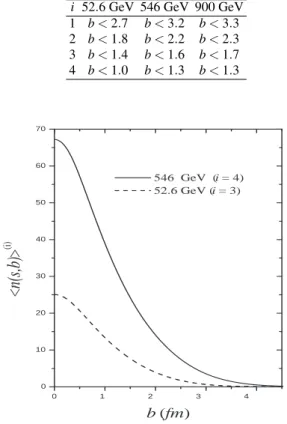
model predicts at ISR and Collider energies. The results are displayed as the curves in Fig. 8. Since<n(s,b)>(i)is
pro-portional to the eikonalΩ(s,b), we can see that<n(s,b)>(i)
is greatest when the hadron is the most black and the least when the hadron is the most transparent. This is a physically realistic description of<n(s,b)>(i)since that more particles
TABLE I: Range of impact parameters (f m) in which may occur the superposition ofistrings, each one produced by a pair of colliding partons, and the corresponding energies.
i 52.6 GeV 546 GeV 900 GeV 1 b<2.7 b<3.2 b<3.3 2 b<1.8 b<2.2 b<2.3 3 b<1.4 b<1.6 b<1.7 4 b<1.0 b<1.3 b<1.3
0 1 2 3 4
0 10 20 30 40 50 60 70
<
n(s,b)
>
(i)
b (fm)
546 GeV (i = 4) 52.6 GeV (i = 3)
FIG. 8: Average multiplicity as function of impact parameter, ob-tained from the model calculation, Eq.(16). Both curves present a change of curvature around 1 f m.
4. DISCUSSION AND CONCLUDING REMARKS
We have studied the effects produced by multiple colli-sions of partons in hadronic interactions at ISR (44.5 - 52.6
GeV) and Collider (200 - 900 GeV) energies by using a phe-nomenological procedure referred to asFSM. It is assumed that in each parton-parton collision an object (string) simi-lar to the one in e−e+ annihilations is created. Based on results from Ref. [9], which are suggestive of a universal mechanism of particle production in strongly-interacting sys-tems, we have considered the experimental data available on e−e+ collisions as possible source of information
concern-ing elementary hadronic interactions. The strconcern-ings originated due multiple parton-parton collisions are fused to from just one larger final chain, ψ, which decays producing particles and follows a gamma distribution at each value of impact pa-rameter. However, the dynamical origin for the strings fusion process remains to be understood at a deeper level. Our re-sults has been analyzed together with those obtained in Ref. [3]. The model predictions for overall multiplicity distribu-tions revealed that three pairs of colliding partons are active at ISR energies and four over the range from 200 to 900 GeV. This result indicates that the increase in the number of par-ton parpar-ton collision leads to the violation of KNO scaling. We also have computed theistrings formation probability (Fig.4). The results obtained demonstrate that the probability for three and four parton-parton collisions increases as the energy is creased. It may indicate that the gluons and sea quarks are in-creasingly important in determining the characteristics of the interactions as the energy is increased. We have presented a criterion and estimated the range of impact parameters, of the incident hadronic system, for multiple collisions of partons at energies 52.2, 546 and 900 GeV. The average number of particles produced depends upon the hadron opacity at each impact parameter. Despite some simplifications made in our description, the results seems to be consistent with the multiplicity distributions data in a wide interval of energy (44.5 -900 GeV) and therefore has a chance of continuing to work at higher energies also.
Acknowledgements
Thanks are due to Dr. Yogiro Hama.
[1] S. M. Troshiin and N. E. Tyurin, J. Phys. G: Nucl. Part. Phys.
29, 1061 (2003).
[2] I. M. Dremin, JETP Letters84no. 5, 235 (2006). [3] P. C. Beggio and Y. Hama, Braz. J. Phys,37, 1164 (2007). [4] I. M. Dremin and J. W. Gary, Phys. Rep.349, 301 (2001). [5] P. C. Beggio, M. J. Menon, and P. Valin, Phys. Rev. D 61,
034015 (2000).
[6] S. Barshay and J. Goldberg, Phys. Lett. B196, 566 (1987). [7] R. Henzi and P. Valin, Phys. Lett. B160, 167 (1985). [8] W. D. Walker, Phys. Rev. D69, 034007 (2004).
[9] M. Basileet al., Phys. Lett. B92, 367 (1980); B. B. Backet al.,
nucl-ex/0301017 v1(2003).
[10] ABCDWH Collaboration; A. Breakstoneet al., Phys. Rev. D
30, 528 (1984).
[11] UA5 Collaboration; R. E. Ansorge et al., Z. Phys. C43, 357 (1989).
[12] UA5 Collaboration, G. J. Alneret al., Phys. Rep.154, 247 (1987).
![FIG. 1: Overall scaled multiplicity distribution data for pp at ISR en- en-ergy [10], compared to theoretical prediction using the Fused-String Model, Eqs](https://thumb-eu.123doks.com/thumbv2/123dok_br/18982937.457728/3.892.501.789.102.404/overall-scaled-multiplicity-distribution-compared-theoretical-prediction-string.webp)