The Ising Model and Real Magneti Materials
W. P.Wolf
YaleUniversity,Departmentof AppliedPhysis,
P.O.Box208284,NewHaven,Connetiut 06520-8284,U.S.A.
Reeivedon3August,2000
Thefators that makeertain magnetimaterialsbehavesimilarlyto orrespondingIsingmodels
are reviewed. Examples of extensively studied materials inlude Dy(C2H5SO4)3.9H2) (DyES),
Dy
3 Al
5 O
12
(DyAlG),DyPO
4 , Dy
2 Ti
2 O
7 , LiTbF
4 ,K
2 CoF
4
,and Rb
2 CoF
4
. Various omparisons
between theoryand experiment for thesematerials are examined. Theagreementis found to be
generallyverygood,evenwhenthereareleardierenesbetweentheidealIsingmodelandthereal
materials. Inanumberofexperimentsbehavior hasbeenobservedthat requiresextensionsofthe
usualIsingmodel. Theseinludetheeetsoflongrangemagnetidipoleinterations,ompeting
interationeetsineld-induedphasetransitions,induedstaggeredeldeetsandfrustration
eets,anddynamieets. TheresultsshowthattheIsingmodelandrealmagnetimaterialshave
providedanunusuallyrihandprodutiveeldfortheinterationbetweentheoryandexperiment
overthepast40years.
I Introdution
FormanyyearstheIsingmodelanditsvariantswere
re-gardedastheoretialsimpliations,designedtomodel
theessentialaspetsof ooperativesystems,but
with-out detailed orrespondene to spei materials. In
theearly1950'spurerareearthelementsbeamemore
readilyavailable and this stimulated thestudy ofnew
magnetimaterials. Someoftheseweresoonreognized
asloseapproximationstotheIsingmodel. Wewill
re-viewthesimilaritiesanddierenesbetweentheoretial
Isingmodelsandanumberofreal magnetimaterials.
The early experiments were aimed at identitying
Ising-like materials and haraterizing the parameters
of the mirosopiHamiltonian. Various approximate
alulationswerethen omparedwith thermodynami
measurements. It was soon reognized that there are
someessentialdierenesbetweenthemodelsandreal
magneti materials, but the overall agreement was
found to be generally very satisfatory. The advent
oftheoretial preditionsofritial pointbehaviorled
to omparisons of ritial exponents and amplitudes,
and againgenerallysatisfatoryagreementwasfound.
The reognition that Ising-like behaviorvery lose to
ritialpointsmayalsobefoundin systemsthat have
large non-Ising interations signiantlyinreased the
numberofmaterialsthatouldbeusedforsuhstudies.
Thematerialsthatorderantiferromagnetiallyoer
additionalopportunitiesforomparingtheorywith
ex-periment. Field-induedphasetransitionsofbothrst
and seond order were found, with rossover regions
near triritialpoints. Experimental studiesof
tririt-ialpoints arediÆult dueto pratialompliations,
but generally good agreement with theory was again
found. Experimentsalsogaveevideneforphenomena
not envisaged by simple Ising models. One of these
wasthe possibility of oupling to the staggered
mag-netizationin antierromagnets,anddierentiating
be-tweenthetwotime-reversedantierromagnetistates.
Most reently systems in whih interations between
thespinsarefrustratedhavebeenstudied.
In all of this work the interation between theory
and experiment has been ruial, and eah has
stim-ulated the other. Indeed, onean speak of \layersof
understanding," as eah has advaned predited and
observedbehaviorin turn. Ifthere is onelessonto be
learneditisthatboththeoryandexperimenthavetobe
treatedwith somehealthyskeptiismif oneisseeking
trueunderstandingofrealmaterials.
II Model materials
Inorderto identify materialswithanIsing-like
miro-sopi Hamiltonian, one needs to understand the
be-haviorofindividualmagnetiionsinarystalline
envi-ronment. Thebasisforthisunderstandingomesfrom
the early work of Van Vlek, as rened with the
ad-vent of paramagneti resonanein the 1950's and the
introdutionofthespinHamiltonian[1℄.
Foramaterial tobeIsing-liketwoonditionsmust
be met. First, the ground state of the ion must be
adoublet wellseparatedfrom exited states (E >>
de-generayorrespondingtoanoddnumberofeletronsin
theion,andmostofthematerialsstudiedhavesatised
this riterion. Ions with an even number of eletrons
analsohavedoublydegeneratestates,ifthesymmetry
is suÆientlyhigh, but anysmall hange in symmetry
willsplitthedoublet. Suhasplittingmaybesmallor
largeonthesaleofothereets,butitisoftensimply
ignored. Inpratie,it ismuhsafertostaywith ions
that are subjet to Kramers time reversal symmetry,
that isionswithanoddnumberofeletrons.
Theseondonditioninvolvesthequantum
mehan-ial desription of the two ioni states. The
impor-tantriterion is that all matrixelementsoupling the
twostatesofeahoftheinteratingionsshouldvanish
for all of the operators involved in the spin-spin
in-terations. Inpratie,themostusual interations
in-volveexhangeanddipolarouplings,bothofwhih
in-volveoperatorsthattransformasvetors,e.g. JS
j :S
j .
Forsuh operators the seletion rule is m =0; 1,
where m is any angular momentum quantum
num-ber. Inprinipleoneanalsohaveinterations
involv-ing higher ranktensors, suh as anisotropi exhange
or quadrupole-quadrupole oupling,[2℄ and to exlude
these aswelloneneedstonddoubletstatesin whih
suhinterationsalsohavenomatrixelementsbetween
thetwostates.
Suitableases havebeenfound in manyrareearth
ompounds. The rst suh material to be identied
as \Ising-like" was Dy(C
2 H 5 SO 4 ) 3 .9H 2 0, dysprosium
ethylsulfate(DyES).[3℄Ananalysisoftherystaleld
by Elliottand Stevens,[4℄using resultsof earlier
mag-netiandoptialrotationmeasurements,[5℄hadshown
that the groundstate is aKramers doublet desribed
primarily as jJ = 15=2;J
z
= 9=2 > with small
ad-mixtures of jJ =15=2; J
z
=3=2 > and jJ = 15=2;
J
z
=15=2>. Forsuh adoublet onlyoperators
in-volvingtensors of rank3,orgreater, will havematrix
elementsbetweenthestates,andnosuhoperatorsare
involved in any of the usual exhange and magneti
dipoleinterations. Thereforeoneouldonludethat
in this material the mirosopi interation
Hamilto-nianouldbeauratelyrepresentedbytheIsingform
H= X i>j K ij zi zj ; (1) where zi and zj
=1, and thesumi>j runs over
all pairs of interating sites i and j. A disussion of
moregeneralsituations anbefoundin Ref. 2.
InthespeiaseofDyEStheloalIsingaxeswere
allparallel, and also parallel to the hexagonalrystal
axis, but it should be pointed out that this need not
alwaysbe thease. The Isingform forthe interation
istheresultoftheloalanisotropy,theaxisofwhihis
determinedby thepointsymmetry at thesiteof eah
ion. Asweshallsee,someofthemostinteresting
situ-ationsarisefrom theveryfat that theloalising axes
arenotalwaysparallel.
TableIshowsaseletionofIsing-likematerialsthat
havebeen studied extensively over the past 40 years.
In this paper we will disuss some of the spei
as-petsthathavemadethesematerialsofinterest. Many
otherIsing-likematerials have,ofourse, beenstudid,
andextensivereferenestotheseandotherompounds
maybefoundinthereviewsbydeJonghandMiedema,
[6℄andbyStryjewskiandGiordano.[7℄
TABLEI.ExtensivelystudiesIsinglikemagnetimaterials
ChemialFormula SpaeGroup MagnetiStruture Ordering T
(K) E=k B T Ref. a Dy(C 2 H 5 SO 4 ) 3 .9H 2
O P6/m Coupledhain Dipolarferromagnet 01 190 11,13,42,75
Dy(C 3 Al 5 SO 12
(DyAlG) Ia3d Cubigarnet 6-sublat.antiferro. 25 27 8,26,28,55
DyPO4 I4I/amd Cubidiamond 2-sublat.antiferro. 34 20 16,17,18,19
LiTbF 4 ,LiHoF 4 I4 I
/a b.t.trigonal Dipolarferromagnet 29 >50 35,40,42,43
Rb2CoF4,K2CoF4 I4I/mmm Coupledplanes 2dantiferromagnet 101 4 6,21,22,23
Dy 2 Ti 2 O 7
Fd3m Cubipyrohlore Frustrated\spinie" <0.05 >100 65,68,70,71
A. Strength of the Interations
There is no quantitative theory for alulating
strength of the various interations from rst
prini-ples,andtheouplingonstantsK
ij
mustthereforebe
determinedexperimentallyforeahmaterial. The
mag-nitudes aregenerally quiteweak in the materialsthat
havebeenstudied,and sineallmagnetiionsinterat
throughmagnetidipole-dipoleouplingweanwrite,
withoutanylossofgenerality,K
ij =D ij (1 + ij ),where D ij
denotes the magneti oupling. This an be
al-ulated from the experimentallydetermined magneti
tions. Onewouldnormallyexpet the
ij
tobe
signif-iantonlyfor nearneighbors,and this generallyturns
outto bethe ase,though in someases therange of
signiant non-dipolar interations an extend out to
thirdnearestneighbors.[8℄Also,bothpositiveand
neg-ativenon-dipolarinterationshavebeenfound, andin
pratieonemustbearefultohekforsuh
possibil-ities.
Itistemptingtoignoresuhompliationsbeause
it is not easy to determine several
ij
in every ase,
Tondtheinterationonstants,onemustt
exper-imental data to theoretial expressions for
thermody-nami quantities (usually thesuseptibility or spei
heat)inregionswherethetheoryisasymptotially
ex-at. InpratiethisusuallymeansT T
C
orT T
C ,
whereT
istheritialtemperature. Forexample,the
suseptibilityfor T T
C
an betted to the
asymp-totiallyexatexpression[9,10℄
=(=T)[1+
1
=T +( 2
1
2 )=T
2
+:::℄ (2)
where
1 =
1
k
B X
i K
ij ;
2 =
1
k 2
B X
j K
2
ij ;
whilethespei heatanbettedto
C=R=
2 =2T
2
+
3 =3T
3
+::: (3)
where
3 =
6
k 3
B X
j>k K
ij K
jk K
ik :
It should be noted that tting data in regions far
fromtheritialpointimplieslookingforverysmall
de-viationsfromidealbehavior. Greataremustbetaken
toavoidsystematierrorsfromextraneouseets suh
as ontributions from exited states, Van Vlek
tem-peratureindependentsuseptibilityorsmallsystemati
errors. Forthespei heatorretionsforlattie
on-tributions and nulearhyperneinteration must also
bemade.
InaverydilutematerialsuhasDyESonemight
ex-petnon-dipolarinterationstobeveryweakandthat
is indeed what was found [11℄. The very rst
Ising-likemagnetwasthusalsotherstpurelydipolar
ferro-magnet,thoughthesignianeofthatdistintiondid
notbeomeapparentuntilmuhlater,[12℄afterritial
pointtheory hadbeendevelopedandafter the
impor-taneofmarginaldimensionalityhadbeenreognized.
B. Approximate Theories
The earliest experiments were ompared against
Ising model theory using various approximations
in-ludingmeaneld,lustermodels,ombinationsof
ex-atlinear hainresults withmeaneld,and series
ex-pansions, both at low and high temperatures. Two
earlyexamples[13℄forquasione-dimensionalDyESare
shown inFigs. 1and 2Theagreementwithevenvery
simpleapproximationsisgood,espeiallyinlightofthe
Figure1. Variationof1=T
(==)against1=T for
dyspro-siumethyl sulfate. The points(o) represent experimental
results. Theurvesrepresenttheresultsofvarious
theoreti-almodels.(a)Moleulareldmodel;(b)VanVlek
expan-sionto seondorder(Eq. 2);()Isingmodelwithnearest
neighborinterationsinamoleulareldduetoother
neigh-bors;(d)Isingmodelwithnearestandnextnearestneighbor
interationinamoleulareld. AfterRef. 11.
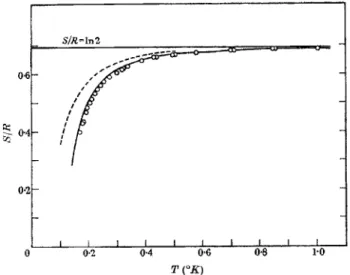
Figure 2. Entropy of dysprosium ethyl sulfate as a
fun-tionoftemperature. Thepoints(o)representexperimental
results. Thebrokenlinerepresentsamodelassuming
non-interatinglinearIsinghainsandthesolidlinestheresults
predited by the Oguhi lusterexpansion method. After
Ref. 11.
The development of long power series expansions
for both lowand high temperaturesduring the1960's
[14,15℄ made it possible to ompare magneti and
thermal measurements over muh wider temperature
ranges, inluding the ritial regions. One material
thatyieldedexellentresultswasDyPO
4
andexamples
[16,17℄are showninFigs. 3,4,and 5.
Itanbeseenthatthe agreementisverygood,
interation. However,thesuessofthese omparisons
depended on some speial fators that are worth
dis-ussing.
Figure 3. Magneti spei heat as afuntionof
temper-ature for DyPO4. The points (o) represent experimental
results,thesolidlinerepresentstheresultsofaalulation
basedonhigh-andlow-temperatureseriesexpansionswith
oneadjustableonstant. After Ref. 17.
First,the hoie of materialturned out to be very
importantbeausethemodelalulationsouldbe
per-formed readilyonlyfor relativelysimplelatties. The
fat that DyPO
4
losely approximates a simple
dia-mond lattie was essential for a detailed omparison
withavailableseries. Ontheotherhand,sinethe
the-oretial series expansionsare extremely time
onsum-ing they were able to onsider only nearest neighbor
interations and thus ignored any eets from
longer-range interations. The exellent agreement between
theory and experiment was, therefore, to some extent
fortuitous, though it an be argued that moredistant
neighborinterations,whilepresent,ananelintheir
eet. However,the overall agreementlearly
demon-strates the lose relation between to Ising model and
thismaterial,eventhoughlaterstudiesrevealed
ompli-ationsthatarestillnotompletelyunderstood[18,19℄.
An extension of these omparisons beame
possi-ble withthedisoveryofmaterialsinwhihthelattie
struture strongly favored interations within a plane
of spins, with almost no interation between planes.
Suh materials would be expeted to behaveas quasi
twodimensionalsystemsand,iftheIsingriteriaould
alsobesatised,wouldprovideanopportunityto
om-pare experimental data with the exat results on the
two dimensional Ising model. No rare earth
materi-metaluoridesinvolvingtransitionmetalswere
identi-ed in the late 1960's. Beause of strong rystaleld
quenhing most transition metal ions show relatively
little anisotropy and behave more as Heisenberg
sys-tems. TheexeptionistheCoion,whihiswellknown
toshowonsiderableanisotropyinmanymaterials.[20℄
Figure4. Magneti suseptibilityas afuntionof
temper-ature for DyPO4. The points (o) represent experimental
results;thesolidlinerepresentstheresultsofaalulation
basedonhigh-andlow-temperatureseriesexpansionswith
oneadjustableonstant. AfterRef. 17.
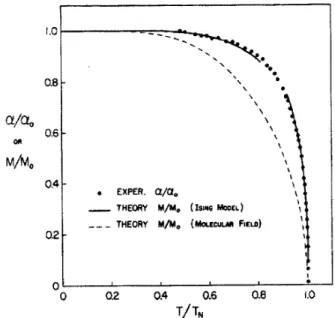
Figure5. Spontaneoussublattie magnetizationasa
fun-tionof temperature for DyPO4. The points(o) represent
experimentalresultsofmagneto-eletrimeasurements;the
two solidlinesrepresent the results ofa alulation based
onalow-temperatureseriesexpansionwithoneadjustable
onstant, andattoapower-lawwithattedritial
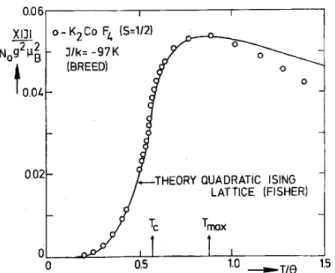
Figure 6. Magneti suseptibility parallel tothe axis as a
funtionoftemperatureforK2CoF4. Thepoints(o)
repre-sentexperimentalresults(Ret: 21)orretedfora
temper-atureindependentVanVlek ontribution to make =0
at T =OK :The solidlinerepresentsthe series expansion
of Sykesand Fisher for the quadrati S =1=2 Ising
anti-ferromagnetttedwithoneadjustableonstant. AfterRef.
6.
Twoverysimilar materials identied as both
two-dimensionalandIsing-likewereK
2 CoF
4
andRb
2 CoF
4 ,
[21℄andin Figs. 6and7weshowthesuseptibility[6℄
and the spei heat, [22℄ ompared with the two
di-mensionalIsingmodelwithoneadjustableonstant. It
anbeseenthattheagreementisverygood. However,
a number of ompliations must be noted that show
againthataremustbeexerisedinomparingtheory
withexperimentintheseases.
Figure7. Variationofthemagnetispeiheat,asa
fun-tionoftemperatureforRb2CoF4. Thesolidpoints()are
experimentalresults ofoptialbirefringenemeasurements
shownpreviously to be proportionalto the magneti
spe-iheat. The solidline isthe exatOnsager solutionfor
thetwo-dimensionalIsingmodelwithamplitudeandritial
temperatureadjustedtotthe data,and asmallonstant
Figure8. Magneti suseptibility as afuntionof
temper-ature for K2CoF4, withoutany orretions. Notethe
dif-ferenesfromFig. 6andthelargesuseptibility
perpendi-ular tothe axis reeting the inuene of low-lying states
andorrespondingdeviationsfromthesimpleIsing
Hamil-tonian. AfterRef. 21.
For the suseptibility, we see in Fig. 8 that the
measured value[14℄ is, in fat, muh largerthan that
shownin Fig. 6,whihhasbeenorretedempirially
bysubtratingaontributionfromVanVlek
tempera-tureindependentparamagnetismtoallowforthe
pres-eneoflow-lyingexitedstates. Itanbeseenthatthe
orretionisverylarge,and itislearthatthe
orre-tionforthepreseneofexitedstateswillnotreallybe
isotropiandindependentoftemperature,asassumed.
This probablyaountsfor theobserveddierenesat
thehighesttemperatures. [6℄
ForthespeiheatomparisonwithOnsager's
ex-at two-dimensional solution another fator must be
noted. Neutronsatteringexperiments[23℄hadshown
that the non-Ising interationsin this material are, in
fat, quite signiant, amounting to some 55%of the
Ising terms,but itwouldappearfrom thelose
agree-mentthatthismakesverylittledierene.
Theonlusiontobedrawnfromtheseomparisons
isthatevenratherlargedierenesbetweenthemodel
Hamiltonian and the real Hamiltonian an leave the
agreement between theory and experiment relatively
unaeted. The dominane of the Ising terms in the
immediate viinity of the ritial point in these, and
in evenmoreisotropimaterials,anbeunderstoodin
termsofrossovereets.
Overall the agreement found between the
approx-imate theories and experiment was very satistatory,
and itenouraged boththeorists andexperimentalists
tointensifythestudyofritialpointproperties.
C. Critial Points
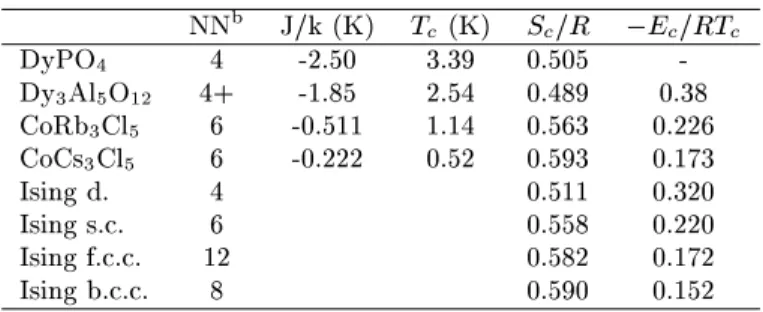
lated toloatetheritialpoint,andestimatethe
val-uesofthermodynamipropertiesattheritial
temper-ature. TableII,adaptedfrom Ref. 6,showsaseleted
omparison. Itanbeseenthat thegeneralagreement
is again very satisfatory, and one an ertainly
on-ludethatsuitablyseletedmagnetimaterialsarewell
explainedbyIsingmodelalulations.
TABLEII.Critialentropyandenergyparameters a
NN b
J/k(K) T (K) S=R E=R T
DyPO4 4 -2.50 3.39 0.505
-Dy
3 Al
5 O
12
4+ -1.85 2.54 0.489 0.38
CoRb3Cl5 6 -0.511 1.14 0.563 0.226
CoCs3Cl5 6 -0.222 0.52 0.593 0.173
Isingd. 4 0.511 0.320
Isings.. 6 0.558 0.220
Isingf... 12 0.582 0.172
Isingb... 8 0.590 0.152
a
afterRef. 6andreerenesontainedtherein.
b
numberofnearestneighbors.
D. Critial Exponents
The great strides in theoretial understanding of
ritialphenomenainthe1960'sand1970'sledto
pre-ditionsofmanyritialexponentsandsalingrelations
betweenthem. Manyofthesehavebeentestedby
mea-surements on Ising-like magnets. We will review the
story of just one of these exponents, thespei heat
exponentfortheantiferromagnetDy
3 Al
5 )
12
,
dyspro-sium aluminum garnet (DyAG), whih will illustrate
thedeliateinterationbetweentheoryandexperiment
in these studies. It will emphasizethe areand
skep-tiism that must be exerised in studies of this kind
beforeanydenite \proof"anbelaimed.
Therstspeitiheatmeasurements[24℄areshown
in Fig.9. They illustrated dramatially the failure of
mean eld theory, even though mean eld theory is
asymptotiallyexatatlowtemperaturesforan
Ising-like system suh as DyAG. They also provided lear
evidene that ritialpointbehavioris quite singular,
reminisentofOnsager'sresultforthetwo-dimensional
Ising model.
To study the ritial point behavior more losely
a series of high resolution measurements were
made,[25,26℄andoneset isshowninFig. 10.
Inspired by the 2D Ising model, an attempt was
made tot thespei heatto alogarithmi
singular-ityoftheform
C =AlnjT T
j+B (4)
and for T < T
C
an apparent t wasfound. However,
for T >T
C
a logarithmit was learly ruled out by
thedata,soattothe(nowommonlyaepted)form
C=A (T T )
+B (5)
wastried,withamplitudesA
+ andB
+
,theritial
tem-perature T
, and the exponent a all allowed to vary
treely. Thetwasquitegood, but thevalueobtained
for=0:310:02waswelloutsidethepreditionsof
theory, whih were onverging on = 0:125, and the
valuesobtainedfor theamplitudes did notagree with
theory. Moreover, the logarithmi form for T < T
wasalsoin onit with theory, whih predited
simi-larformsaboveandbelowT
.
It was pointed out by Gaunt and Domb [27℄ that
theasymptotisingularitypreditedbythetheory for
T <T
was,in fat, valid only extremely loseto T
,
and would not be observable even with the relatively
high resolutionof data suh as in Fig. 10. They
on-strutedaninterpolationexpressionthatombinedthe
asymptotiform with thelow temperature series, and
showedthatforT <T
theapparentvariationisindeed
similartoalogarithmisingularity.
Figure 9. Spei heat as a funtion of temperature for
Dy3Al5O12. Thepoints(o)represent experimentalresults.
Curves (a) and (b) were alulated using the mean eld
approximation,with theonstantfor (a)estimatedonthe
basisofpuremagnetidipole-dipoleinteration,andfor(b)
by ttingthe low-temperature experimentalpoints. After
Ref. 24.
Are-examinationoftheregionT >T
nextrevealed
[26℄ the striking fat that a very small hange in the
hoieofT
resultedinverylargehangesinthevalues
of the other tted parameters. Table III shows some
oftheresults. It beamelearthat simplyttingdata
toatheoretial expressionould leadtovery
mislead-ingresults. Moreover,thereisaverystrongorrelation
betweenthevariousttedonstants,sothatitwasnot
Amoreareful tof thedata, using
least-squares-ubi splines with knots, [29℄ resulted in a value for
= 0:120:03; now in exellent agreementwith the
theoretialvalue.
One problem with all ts to ritial point
predi-tionsisthefatthat theasymptotirangeisgenerally
verynarrow,and islimitedby \roundingeets" that
inevitablybroadenanysingularity. Toextendtherange
overwhih the asymptoti form anbe tted one an
inludeso-alled\orretionstosaling,"whoseleading
termwill modifytheexpressionforthespeiheatto
theform
C=A
t
(1+Dt
)+B
(6)
where t = j(T T
)=T
j. It is learly impossible to
talltheelevenparametersinthis expressionwithout
someonstraints,and Rivesand Landau [30℄ hose to
set
+
= =0:125;B
+
=B , andx
+
=x ,as
pre-dited by theory. With these onstraints it was then
possible to t the data over relatively wide ranges of
temperaturebothaboveandbelowT
.
Figure10. SpeiheatofDy3Al5O12asafuntionof
tem-peraturenearT
N
,underfourdeadesoftemperature
reso-lution. Temperaturesaremeasuredrelativetoanarbitrarily
hosenT
max
=2:544K.AfterRef. 26.
Critial exponents and amplitudes desribing the
besomewhateasiertodetermine,sinetheyare
gener-allystrongerthanthatforthespeiheat. Manysuh
exponentsandamplitudeshavenowbeenmeasuredfor
bothIsing-likeand Heisenberg-likematerials, and one
anertainlyonludethat theoryandexperimentare
in agreement.
However,thehistoryofthedierentattemptstot
data to the theory illustrates some general priniples
that aresometimesignored. It islearthat both
theo-retialunderstandingandthemeasurementand
analy-sisofexperimentaldatatendtoimproveovertime. One
must be very areful, therefore before one an laim
that an experimenthas \proved" thetheory, and itis
muhsatertosaythattheexperimentisonsistentwith
thetheorywithinspeiedphysialassumptions,aswell
asameasureofthequalityofthestatistialt. Suha
onlusionisnotlimitedtotheanalysisofritialpoint
data, ofourse, butin this eld thereis apartiularly
rihhistoryofsuessiveattemptsto verifytheory.
III Extensions of the simple
Ising models
Sofarwehavedisussedobservationsthatwere
onsis-tent withthe Isingmodelasusually disussedand, as
we have seen, materials havebeen found that losely
reprodue many theoretial preditions. However, on
oasionobservationsaremadethatdierqualitatively
from thestandardtheoryanddemand thatextensions
of the simplemodels. Several of these have led to
in-terestingnewphysis.
A. Magneti dipole interation
Magnetidipoleinterationsare,ofourse,present
in all magneti materials but it is diÆult to inlude
them in most model alulations beause they are of
longrange. ManyoftheIsing-likematerialsthat have
beenstudiedinfathaverelativelyweaknon-dipolar
in-terations, sothat onsideringonlythenear neighbors
might notturn outto be averygood approximation.
In some situations the interations with more distant
neighbors tend to anel, but in someases they
an-notbeignored.
1. ShapeDependene
The most obvious situation in whih dipole
inter-ations are evident is in the shape dependene of the
magneti suseptibility. Shape dependene is usually
disussed in termsof a lassialdemagnetizingfator,
N,that relatesthesuseptibilityforagivenshape
N
tothatofalongneedle-shapedsample
N=0
tothrough
theexpression
1=
N =1=
N=0
TABLEIII.CritialexponentsandamplitudesforDy3Al5O12forT >TN,showingtheeetofhoosingdierentvaluesfor
T
N
,togetherwiththeoretialestimatesforthreeubiIsingmodels.
T
N T
max (mK)
a
A
+ B
+
Fitto
0.31 -0.15 0 Eq. 5
b
1.3 0.09 1.58 -1.64 Eq. 5
0.6 0.14 0.91 -0.95 Eq. 5
0.3 0.22 0.42 -0.37 Eq. 5
-0.7 0.33 0.19 -0.08 Eq. 5
0.7 0:120:03 1:00:3 1:00:3 Eq. 5 d
- 0.125 1:10:08 1:150:10 Eq. 6
theorys.. 0.125 1.136 -1.244
theoryb... 0.125 1.106 -1.247
lheoryf... 0.125 1.136 -1.244
a
TemperaturesmeasuredrelativetoTmax=2:5430:10K.
b
TN estimatedtrommeasurementsbelow+Tmax andEq.4.
AfterRef. 28andreerenesontainedtherein.
d
UsingmethodsdesribedinRef. 29.
e
AfterRef. 30,withTN ttedandaxedatthetheoretialvalue.
Thisrelationdependsonly ontheassumptionthat
thesampleismagnetizeduniformly,whihisgenerally
the asefor ellipsoidalsample shapedsamples. An
il-lustration ofthiseetisshowninFig. 11.[31℄
Intheparamagnetiphasetheshapedependeneis
not a serious problem, though the quantitative eet
an bequite large. The question then arises whether
there is onepartiular shape that is more \intrinsi,"
in that itorrespondsmostloselyto thesimple
near-neighbormodel. Unfortunately the most obvious
an-swer,thelongthin needle-shapewithN=0;forwhih
the internaleld isthesameastheapplied eld,does
notapproximatetothatase. Forthatshapethe
umu-lativeeetsofthelong-rangedipolarinterationsare,
in fat, maximized and provide a signiant non-zero
internal eld. An alternative possibility is to orret
to ashape for whih thelong-rangedipolar eld
van-ishes,[32℄butthisisonlyamean-eld orretion.
Belowtheritialtemperaturetheeetofthe
dipo-lar interations an be even more signiant. If the
orderingisferromagneti,
N=0
divergesatT
andthe
measuredsuseptibilityisthengovernedentirelybythe
demagnetizingfator. Thisistheaseforthe
measure-ments shown in Fig. 11. Theeetivevalueof N an
thenbeestimatedfromthemeasuredvalueof1=,but
errors an be very large if the sample is not shaped
aurately into an ellipsoid. In the ordered state the
dipolar interations will ause a ferromagnetto break
upintodomainssoastolowerthemagnetostatienergy
[33℄. Theformationofdomainsisantiipatedby
orre-sponding utuationsin theparamagneti regionthat
havebeenstudiedextensivelyusingneutronsattering
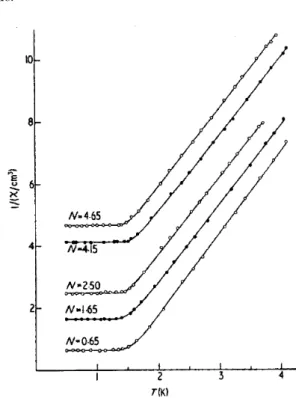
Figure11. Thereiproalsuseptibilityparalleltothe
rys-tal-axisasafuntionoftemperatureforLiHoF4. The
ex-perimentalpointsorrespond tomeasurementsfor ve
dif-ferent sampleshapes, haraterized by demagnetizing
fa-tors,N. TheonstantvaluesforT <1:5Korrespondtoa
transitiontotheferromagnetistate,forwhih1=N=0=0.
AfterRef.31.
For antiferromagnets the eet of dipolar
intera-tionsislesssigniantbeausesuseptibilitiesarenite
but,asweshallseebelow(seeSe. IIIB),domainsan
alsobeformedatrstorderphasetransitions.
2. Critialproperties
dra-ferromagnets. Theoretial models based noton a
mi-rosopimodelbut onperturbationand
renormaliza-tion groupideaspredited[36,37℄ that adipolar Ising
(n=1)ferromagnetwillhaveamarginal
dimensional-ityd
=3, and heneexhibit ritial point properties
desribedbyLandau(meaneld)theorywith
logarith-mi orretions. Thus, for example,the suseptibility,
, spontaneous magnetization, M
s
, and spei heat,
C,arepreditedto varyas
= t 1
[ln (t
0 =t)℄
1=3
(8)
M
s
=B( t) 1=2
jln ( t)j 1=3
(9)
C=Alnjt
0 =tj
1=3
(10)
where t=T T
=T
as before, andt x
o andt
0
are
on-stants. Extensive experiments on LiTbF
4
,[38-47℄ and
on DyES [42℄ have shown that these preditions are
onsistentwiththedata,andhaveprovidedelegant
in-sightinto the unique ritial properties of these Ising
systems. Asdisussedbefore,itisverydiÆulttoprove
that ertain ritial point exponents have the values
preditedby the theory, but arefulexperiments have
providedonviningevidenethatthesesystemsdo
in-deed behave quite dierently from Ising systemswith
predominantlyshort-rangeinterations.
B. Field-indued phase transitions
Ising-likeantiferromagnetshaveprovidedadditional
phenomena not antiipated by the usual simple Ising
models. Theappliation of amagneti eld would be
expetedtodestroytheantiferromagnetiorderbutthe
detailsofthetransitionhaveshownsomesurprises.
1. First order transitions
Conventionalwisdom hadpredited thatthe eet
ofamagnetieldwouldbeasimpleshiftoftheseond
orderphasetransitiontolowertemperaturesastheeld
isinreased. Thephasediagramwouldbeasshownin
Fig. 12a. AtT=0Kthetransitionwouldbeomerst
order, orresponding to asimple reversal of the spins
opposed to the magneti eld. Detailed support for
suh a predition was provided by a two-dimensional
superexhange IsingmodeldevisedbyFisher[48℄ that
ouldbesolvedexatlyintermsot thezeroeld Ising
model. Theresultsforthemagnetizationofthemodel
areshownin Fig. 13.
TherstexperimentsontheIsing-like
antiferromag-netDyAG gaveresultsin sharpontrast to these
pre-ditions[49℄. Magnetizationisothermsforeldsapplied
along a [111℄diretion are shown in Fig. 14a. It an
beseenthatthereappeartobenosingularitiesatany
eld, but therearelargeregionsat thelowest
temper-aturesin whihthemagnetizationappearstovary
lin-A part of the puzzle was resolved when the data
werere-plotted asafuntion of theinternal eld,
or-respondingtoameasurementonalongthinneedle
sam-pleshape. Theseresultsareshownin Fig. 14b. Itan
nowbe seenthat the low temperature transitions are
essentially disontinuous in the magnetization,
orre-spondingto arst ordertransition. Thenatureof the
transition as a funtion of applied eld wasdisussed
by Wyatt[50℄ in terms of domainssimilar to those in
Ising-like ferromagnets. The domains were later
ob-servedoptiallybyDillonet al. [51℄
Figure12. Possiblephasediagramsintheeld-temperature
plane for antiferromagnets. (a) usualphase diagramwith
nearest neighbor interations, in whih the
antiferromag-neti phase(A) isseparated fromthe paramagnetiphase
(P)byalineofseondordertransitions. (b)phasediagram
with ompeting interations, inwhihthere are bothrst
order and seond ordertransitions, and a triritial point
wheretheymeet. ()showsthephasediagramwhenthere
isaouplingbetweentheappliedeldandthe
antiferromag-netiorderparameter. Inthisasethereisonlyarstorder
transition ending ina ritial point. (d)same as () but
showingbothpositiveandnegativeappliedelds.The
pos-itive eld induesoneof thetwoantiferromagnetistates,
A +
,whiletheoppositeeldinduesthetime-reversedstate
A . Thephases A +
andA areseparatedbyarstorder
Figure13. Themagnetizationasafuntionofmagnetield
atxedtemperatureforatwo-dimensionalsuper-exhange
antiferromagnet. The dashedurve is the lous of
transi-tionpoints. Theurvesarelabeledbyappropriatevaluesof
the reduedtemperature. Notetheontinuityofall urves
exept for zero temperature, andthe innite derivativeat
thetransitionpoints. AfterRef. 48.
Theoriginof therst ordertransition at low
tem-peratures ould be explained by the fat that the
in-terations in DyAG are not limited to nearest
neigh-bors,asommonlyassumed insimplemodels. Infat,
there are ompeting ferromagneti and
antiferromag-netiinterationsinvolvingrst,seondandthird
near-est neighbors. [8℄Therelativestrengthsofthese
inter-ations areshownin TableIV. With ompeting
inter-ations, rst order transitions are notunexpeted, as
preditedbysimplemeaneld models[52℄.
TABLE IV. Spin-spin interations inDy3Al5O a
12
,showing
the relative importane ofseveralshells of nearneighbors.
Similar ompeting terms may be expetedin many other
materials,butareoftennotonsidered.
Neighborshell(n) Spins/shell K
n =K
l
1 4 1:000
b
2 8 0:206
b
3 2 -0.522
4 4 -0.137
a
AfterRef. 8.
b
Theourreneofbothpositiveandnegativeinterations
is aresult ofthe garnet symmetry(see text), butitould
alsobefoundinotherstrutures.
2. Indued staggered elds
With therstorder transitionatlowtemperatures
nowunderstood, we are still left with the unexpeted
behavior at higher temperatures, whih ertainly did
not appear to orrespond toa seond ordertransition
with a singularity in the derivative of the
magnetiza-of a phase diagram as in Fig. 12b, it appeared that
therewasonlya\higherorder"transition,orasitlater
turnedout,notransitionatall,betweentheendofthe
rst order phase boundary and the Neel point. The
orrespondingphasediagramis showninFig. 12.
Figure 14. The magnetization of a spherial sample of
DyAlG as a funtionof eld along [111℄ at temperatures
aboveand belowthe Neeltemperature. In(a)the
magne-tization is plotted as a funtion of the externally applied
eld. In(b) themagnetization is plotted as afuntion of
the internal eld, alulated by Hint = Hext NM, with
N=4=3forasphere. AfterRef. 49.
The reason for this puzzling situation was not
re-solveduntil1974whenBlumeetal. [53,54℄notedthat
DyAG happens to have a somewhat unusual lattie
struture, whose symmetry allowsaoupling between
pa-notallowed,beausetheantiferromagnetiordermust
usuallybeindexedonaunitellbiggerthanthe
hem-ialunit ell,andis thus nottranslationallyinvariant,
inontrasttothemagnetieldwhoseomponentsare,
ofourse,translationallyinvariant.
In the garnet struture the oupling between the
magnetieldand theantiferromagnetiorder
param-eter,,takestheformofanadditionalterminthefree
energyF H
x H
y H
z
,whereH
x ,H
y ,andH
z arethe
omponentsoftheappliedeldalongtheubiaxes. In
thepreseneofsuhatermanappliedeldwillouple
totheantiferromagnetiorder anddestroyany
ontin-uous phasetransition. Evidene for this was found in
a neutron sattering experiment, results of whih are
shownin Fig. 15a.
Thesymmetryargumentthusexplainedtheabsene
ofaseond order phasetransition,but itdidnot
sug-gestaphysialmehanismthatwouldresultinsuhan
extraterm in theenergy. The answerwasfound,
sur-prisingly, to lie in aombination of two quitenormal
teaturesof DyAG: thesymmetry of thegarnetlattie
strutureandIsingharateroftheloal spins.
Figure15. Resultsforthestaggeredmagnetization,M
s ,for
DyAlGas a funtionof the internal eldwith Hi k [111℄.
(a)Experimentalresults ofBlume etal. [Ref. 53℄; (b)
re-sultsofthelusteralulationforthesamevalue ofT=TN.
AfterRef. 55.
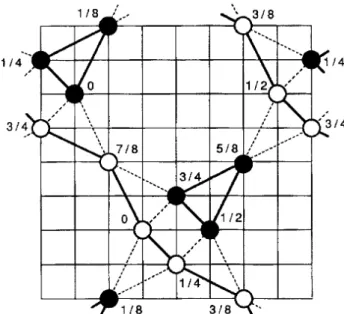
Fig. 16 shows, for simpliity, half the sites in one
estneighborinterationsduetothedominantmagneti
dipole fores. (The remainingsites arerelatedby
sim-ple translations and share no nearest neighbor bonds
with the others.) It anbeseen that half the nearest
neighbor interations are shown as ferromagnetiand
half areantiferromagneti,but inanunusualpattern.
Figure16. Lattie andbondstrutureofthestaggered
in-terationmodelshownina[001℄projetion. Thestruture
is body entered ubi, with 6 sites in the primitive unit
ell. Thegureshowstheonventionalunitell. The
num-bersgivetheheightsabovethez=0planeintermsofthe
unit-ell edge length. Ferromagneti bonds are shown as
solid linesand antiferromagneti bondsare shown as
bro-kenlines. Notethatonlyhalfthesites,markedas(),form
triangleswiththreeferromagneti bonds,whereasthesites
marked(o)haveonlytwoferromagnetibonds. The
stru-tureshownorrespondsto onehalfof thesites inDyAlG.
The omittedsites form a similar lattie related by simple
translations and donotshare any nearest neighbor bonds
withthesitesshown. AfterRef.55.
Thisomesaboutfrom thefat thattheloal Ising
axespointin dierent diretions, asdemanded by the
garnetsymmetry,and itisthen neessaryto speifya
ommonsetofrystalaxestodesribetheinterations
betweenneighbors.Twospinsanbesaidtobe
\ferro-magnetiallyaligned"relativetoanappliedeldifthey
bothpointalong apositive(or bothalong anegative)
rystal axis, and antiferromagnetially aligned if one
pointsalongapositiverystalaxisandtheotheralong
anegativerystal axis. Physially this simply reets
theresultofprojetingtheusualmagnetidipole-dipole
interation
H
dd =
i
j
r 3
ij
3(
i ~
j )(
j ~
j )
r 5
ij
(11)
alongorthogonalaxes. Forexample,if
i
isonstrained
tothex-axisand
j
H= 3x ij y ij r 5 ij i j ; (12) where x ij , y ij and r ij
are the relative positions of
i
and
j
. It is lear that this will hange sign between
twoneighborsoneat+yandoneat-y,forthesamex.
GiventhearrangementofinterationsshowninFig.
16 one anthen use allthe usual tehniquesto study
thepropertiesofsuhanIsingmodel. Sofarverylittle
seemstohavebeendoneinthisdiretion,andtheonly
onsiderationofthepropertiesofsuhamodelseemsto
havebeengivenbyGiordanoandWolf,[55℄ who
stud-ied theleadingtermsinthelowtemperatureseriesfor
theenergy.
Theyshowedthatinthepreseneofamagnetield
with omponents along all three axes, the energy of
exitation of three spins will not be the same for the
\positive"and\negative"sublatties,sothatthe
mag-netield doesindeed oupleto theantiferromagneti
order parameter. The eet on the order parameter
is shown in Fig. ISb. It anbeseen that there is no
visibleboundarybetweenthe\ordered"andthe
\para-magneti" phases, and the usual seond order phase
transition thereforedisappears.
It would seem to beof someinterest to study the
\staggered interation" model shown in Fig. 16 with
moresophistiatedtehniques,sineithasaphase
di-agramsimilar tothat ofaliquid-gassystem. Therst
orderlineseparatingtheantiferromagnetiand
param-agnetiphasesendsinasimpleritialpoint,asshown
inFig. 12. Asomewhatsimilarphasediagramhas
re-entlybeen proposed in onnetionfrustratedspinie
systems. (SeeSe. IIIC.)
If positive and negative elds are inluded, the
phase diagram of the staggeredinteration model
be-omesevenriher,inthatthetwotime-reversed
antifer-romagnetistatesA +
andA areseparatedbyanother
rstorderline, asshowninFig. 12d. Evenmore
om-pliated phasediagrams are possibleifthe stritIsing
onditionsarerelaxed[55℄.
Theability to ouplediretly to the
antiferromag-netiorderparameterleadstothepossibilityof
observ-ing and manipulating thetwotime reversed
antiferro-magnetistatesA +
andA ,andanumberof
interest-ing optial andmagnetoelasti experimentshavebeen
reported. Beauseoflakofspae,weshallnotdisuss
thedetailshere,whihanbefoundin Refs. [51-61℄.
3. Triritialpoints
Materialswithamoreonventionalphasediagram,
suhasin Fig. 12b,haveatriritialpoint,where the
rst and seond orderphase boundariesmeet.
Exten-siveeortshavebeenmadetostudysuhpoints,butit
turns outthat there are experimental diÆulties that
makeitevenharderto extratexponentsthanat
rit-ial points. We shallnot disuss thedetails here,but
Theabilitytoapplystaggeredeldsinsuitableases
makes it possible to study the so-alled \wings"near
triritial points [63,64℄ and, subjet to some
exper-imental limitations, good agreement with theoretial
preditions was found. This is a eld in whih
addi-tionalexperimentswouldbewelome.
C. Frustration eets
The eet of non-ollinear Ising axes has reently
reeivedmuhattentionin onnetionwithanomalous
propertiesobserved forsomerareearth titanates with
the pyrohlore struture. The struture of the rare
earth ions is shown in Fig. 17a. Eah spin has six
nearestneighbors,threebelongingtoeahoftwolinked
tetrahedra. The loalsymmetry axisat eah spinsite
pointstowardsthe enter ofitstetrahedron, asshown
inFig. 17b.
It wasrst notedby Harris et al. [65℄ that a
fer-romagnetiouplingbetweennearestneighbors in this
struture(asonstrainedbytheIsingaxisateahsite)
would lead to frustration. The relation between the
pyrohlorestrutureandtheIsingmodelhasalsobeen
disussedbyMoessner[66℄andbyBramwellandHarris
[67℄. Itturnsoutthatitisnotpossibletosatisfymore
thanhalf of thenearestneighborbonds in eah
tetra-hedron,andthestatewiththelowestenergyanbe
de-sribedas \twoin"and \twoout." That is, twospins
point towards the enter while two point away from
the enter. There are many ways to ahieve suh an
arrangement,andthegroundstateis,therefore,highly
degenerate.
It was pointed out by Harris et al.[65℄ that suh
aground state is diretly omparable with the model
proposedbyPauling[68℄toaountfortheanomalous
entropyofie,andtheyoinedtheexpression`spinie'
formaterialsofthis kind. InPauling'smodelthe
pro-tons belonging to the H
2
0 moleules are displaed so
thattheyareeitherloserorfurtherfromtheiroxygen
atom. Giventhetetrahedralstrutureofie,itisonly
possibletodisplaetwoofthefourprotonsinthesame
senseforeahtetrahedron,leadingtotheierule\two
in,twoout," asillustratedin Fig. 17.
Speially, Harris et al. had suggested that
Ho 2 Ti 2 0 7
should beaspinie,butthis onlusionhas
beensubjetto somedisussion. It turnsoutthat the
speiheatofHo
2 Ti
2 0
7
isquiteanomalous,in thatit
suddenly beomes impossible to measure beause the
equilibriumtimebeomesverylong[69℄.Itisnotlear
ifthissigniesatransitiontosomesortofpartially
or-deredstateorifitisaresultofspiniefrustrations. At
thesametime some,but notall,MonteCarlo
simula-tionshavesuggestedthat Ho
2 Ti
2 0
7
wasindeed aspin
ie[70℄. Furtherworkisneededtoresolvethequestion.
Ontheotherhand,thereseemstobenodoubtthat
theisostruturalDy
2 Ti
2 O
7
have been able to reprodue the experimental results
overawiderangeof temperatures. Theresultsof one
oftheseisshowninFig. 18a.
Figure17. (a)Ashematirepresentationofthepyrohlore
lattie,showingthepositionsofthemagnetiions. (b)The
groundstateofasingletetrahedronofspinsoupled
ferro-magnetially withloal Isinganisotropy. () Loalproton
arrangement inie,showingthe oxygen atoms()and
hy-drogenatoms(-),andwiththe displaement ofthe
hydro-genatomstromthemid-pointsoftheoxygen-oxygenbonds
markedbyarrows. Thesimilarityto(b)hasledtothe
on-eptof`spin-ie.' AfterRefs. 67and73.
Thestrikingfeatureofthisbehavioristhefatthat
thetotal entropy assoiatedwith theordering proess
islessthanRln2;asis otherwiseobservedinallother
systems with two-fold degenerate ground states. The
entropy asa funtion of temperature is shown in Fig
18b. It an be seen that it extrapolates lose to the
valueR (ln 2 1=2ln 3=2)preditedforiebyPauling
[68℄.
It is interesting to note that the anomalously low
valuefortheentropywasrstnotedsome30yearsago
[72℄but,atthetime,itwasasribedtoinomplete
mea-surements,andnofurtherstudywasmade. Itis
tempt-ingtospeulatehowtheeldoffrustrationmighthave
advaned if the anomaly had been onrmed
experi-mentally.
Toprovidefurtherinsight,andtoverifythatthe
re-duedentropyisnotsimplytheresultofexperimental
error, orpossible lakof stoihiometry, Ramirezet al.
Theappliationofaeldwouldbeexpetedtoredue
thedegreeoffrustrationandtherebyinreasethetotal
entropy. The results for a eld of 0.5T are shown in
Fig. 18b. It an be seen that the entropy is indeed
inreased andthatitnowtendstowardsavalueloser
to theusualRln2forasystemwithadoubletground
state.
However,theappliationofevenstrongermagneti
elds produed some unexpeted eets in addition,
and theseare shownin Fig. 19. Three sharppeaksin
thespeiheatarenowobservedontopofthebroader
peak and, quite surprisingly, they are found to be
in-dependent of the strength of the eld. The entropy
assoiatedwiththesepeaksisquitesmall,sothat only
afrationofthespinsappeartobeinvolved.
Figure18. SpeiheatandentropyofDy2Ti2O7and
Paul-ing'spreditionforie. (a)Speiheatdividedby
temper-ature for H=0 (o)and H=0.5T (). The dashedline is a
MonteCarlo simulation of the zero-eldC(T)/T. (b)
En-tropy of Dy2Ti2O7 found byintegrating C/T trom 0.2 to
14K.ThevalueofR (ln2 1=2ln3=2)isthat foundforie
(Ih),andln2istheusualfullspinentropy. AfterRef. 71.
Thereisnodetailed understandingofthese eets,
but a possible explanation may involve the ordering
of spins with axes perpendiular to the magneti eld
madepossiblebytheorderingoftheremainingspinsby
theeld[65,73℄. Asomewhatsimilarphenomenonhad
that the measurementswere made on powdered
sam-ples and experiments on single rystals would learly
bedesirable.
One interesting feature of the study of the
py-rohloresis thefat that mostof the\theory,"so far,
has involved omputer simulations. Suh simulations
arenoteasybeauselong-rangedipole interationsare
important in these systems, and there has been some
disagreementovertheapproximations.[70,71℄It would
behelpfulto supplementthesimulationsbyanalytial
results. This islearlyahallengingnewextension for
Ising modelstudies.
Figure 19. Spei heat as a funtion of temperature for
Dy2Ti2O7 invariousappliedelds. ThebroadH=0
fea-ture is suppressed oninreasing H and replaed by three
sharpfeatures at0.34,0.47and 1.12K.Inset(a)showsthe
onstanyofthesetransitiontemperatureswitheld. Inset
(b)shows theresultofnite-eldMonteCarlosimulations
ofC/T. AfterRef. 71.
D. Dynami eets
Boththetheoryand experimentsonerning
Ising-like systems have onentrated on stati equilibnum
properties,andverylittlehasbeensaidaboutdynami
eets. Insomesensethisisnotsurprisingsineallthe
terms in the Ising model Hamiltonian ommute, and
nothustimedependenewouldbeexpeted. However,
inasmuh asthe Ising model aims to approximate the
behaviorofrealphysialsystems,andthesearenot
al-waysin equilibrium, thedynamis are offundamental
In pratial terms, dynami eets an manifest
themselves when measurements are made with a..
tehniques, whih are generally more onvenient than
statimeasurements. Sometimesitisobservedthatthe
frequeny used to make measurements aets the
re-sults,andthisprovidesalearindiationthatdynami
eets areimportant. In prinipleonemightthen try
toextrapolatethe resultsto \zero"frequenybut this
an result in misleading onlusions, sine more than
oneproessmaybeoperating. Suhasituationis
illus-tratedbythe resultsin Fig. 20whih showsaplot of
theout-of-phaseomponent 00
asafuntionofthe
in-phaseomponent 0
of the suseptibility of DyES for
various frequenies [75℄. It is lear that the values of
0
extrapolatedto 00
= 0are verydierent from the
measuredd.. value,
d:
. Evideneforaseond
relax-ation proess at even lowerfrequenies is provided by
thepointsmarked`5', orrespondingto measurements
at5Hz.
Figure20. Aplotottheout-of-phasesuseptibility 00
asa
funtionofthein-phase 0
forDyESforvariousfrequenies
atfour dierent temperatures. Thefrequenyof
measure-ment,inHz,iswrittenbesideeahsymbol. Theurvesare
irleswhihpassthroughtheoriginandbesttthedata.
Theextrapolatedvaluesof 0
for 00
=0arelearlydierent
fromthemeasuredd.. value,d::. AfterRef. 75.
Dynami eets are learly important are asesin
whihthesamplebreaksintodomainswhihmustgrow
and shrink in response to anapplied eld. Suh
situ-ations inlude ferromagnetsbelowthe Curie
tempera-ture,and also antiferromagnetsundergoingrst order
phasetransitions.
Observations of dynami eets involving domain
motionwere,in fat,made[75℄ontheveryrst
Ising-like ferromagnet studied, DyES, and possible
meha-nismswere disussed by Rihards [76℄. However, this
materialhas aninonvenientlylowCurie temperature
( 0.1 K), and more detailed experiments were later
madebyKotzlerandhisassoiatesonLiTbF
4
,andon
GdCI
3
whose Curie points are at 2.9K and 2.2K
re-spetively. A number of interesting relaxationeets
assoiatedwithdomainwallmotionwerefoundovera
de-Theothersituationinwhihdynamieetsanbe
observedistheresponsetoana.. eldwhenthesystem
isinahomogeneousphase. Theeetsthatanbe
ob-servedarenotsmall,andinFig. 21weshowresultsfor
one relaxationproess as a funtion of magneti eld
for DyAG at temperatures well below the Neel point
[83℄. Here boththe d.. and thea.. measuringelds
were appliedalonga[110℄diretion,forwhih no
ou-pling to theantierromagnetiorder parameterwould
beexpeted.
Figure21. Fieldandtemperaturedependeneofoneofthe
relaxation times, IHF,of DyAlG.The arrowindiates the
loation of thephase boundaryH
at 1.8 K; at the other
temperaturesshownHisnotverydierent. Alltheresults
thereforeorrespondtomeasurementsinthe
antiferromag-neti phase. The brokenline at 10 5
indiates the lower
limitofthemeasurements. AfterRef. 83.
Itan be seenthat there arehanges in the
relax-ation time of more than two orders of magnitude for
applied elds assmall as0.1T, muh weakerthanthe
eld 0.6Trequiredto indueatransition fromthe
an-tiferromagnetito theparamagneti phase. No
expla-nationfortheseandsimilarphenomenahasbeenfound
[83℄.
Toaount fordynami eets in detail, there are
twoproblemsonfrontingthetheory. Oneistoidentify
thenon-Isingmehanisms,andtheirstrengths,
respon-sibleforrelaxationeetsintherstplae. Theseond
is to alulate their observable eets in terms of the
mirosopiinterations. These arenoteasyproblems
eets in Ising-like systemswill ontinue to provide a
hallengetoboththeoryandexperimentforsometime.
IV Conlusions
TheworkonIsing-likemagnetimaterialsoverthepast
40 years has led to several onlusions. First, it has
shownthat thetheoretialpreditionsof thestandard
nearneighborIsingmodelaregenerallyonrmed,both
with respetto thermodynamipropertiesoverawide
range of temperatures, and the asymptoti behavior
nearritialpointsTheexperimentsarenotalwayseasy
toanalyzeunambiguously,but ahealthyiterative
pro-ess-theoryguidingexperiment,andexperiment
look-ing forappropriatetestsof thetheory- hasbeen very
suessful.
Otheronlusions relateto situations in whih the
experimentsgaveresultsthat, at rst,appearedto be
in onit with the theory. Closerinspetion then
re-vealedthattherewerefeaturesintherealmaterialthat
were not inluded in the usual kind of Ising model.
These haveinludedompeting near neighbor
intera-tions,longrangemagnetidipoleinterations,and
lat-tie strutures that leadto new physial eets, suh
asrstordertransitions,ouplingtoantiferromagneti
order by anappliedmagneti eld, andsuppressionof
orderbyfrustration. SofarsomeoftheseunusualIsing
models have been studied only with a limited range
of tehniques, and further work in these areas would
learlybeofinterest.
Anotherareathat has reeived relatively sant
at-tentiononernsdynamieetsAnysuheetsmust,
ofneessity,involveinterationsthatarenotompletely
Ising like, sinesimple Ising models haveno time
de-pendene. However, in real Ising-like materials time
dependent eets are observed, and further study of
thesewill beofinterest.
Theprinipal onlusion from all thepast work in
thiseldmaybethefatthattheIsingmodelhas
pro-videdanunusuallyrihopportunityforboththeoryand
experiment to interat, to themutual benetof both.
Thereseemsnoreasonwhysuhinterationshouldnot
ontinuetoourish inthiseld.
ThispaperisdediatedtoErnstIsingandtheeld
he reated,and tothe manytheoristsand
experimen-talist whohavebuilton hisverysimpleoriginal ideas.
I would alsoliketothankM.E. FisherandM.Blume
who have led me through muh of the theory, and to
my students and olleagues who,overthe years, have
unraveledmanyofthepropertiesofIsing-likematerials,
expetedand unexpeted.
Referenes
Ele-(OxfordUniversityPress,New York,1970).
[2℄ See,for example, W.P.Wolf, J.Phys.(Paris)C-1, 26
(1971),andreterenestherein.
[3℄ A.H.Cooke,D.T.Edmonds,C.B.P.FinnandW.PWolf,
Pro.Phys.So.,London74,791(1959).
[4℄ R.J.ElliottandK.W.H.Stevens,Pro.Roy.So.,
Lon-donSer.A219,387(1953).
[5℄ W.J.deHaas,J.vandenHandelandC.J.Gorter,Phys.
Rev.43, 81(1933); W.J. deHaas, J. vandenHandel,
C.J.Gorter,J.Bequerel,W.J.deHaasandJ.vanden
Handel,Physia3,1133(1936).
[6℄ L.J. de Jongh and A.R. Miedema, Adv. Phys. 23, 1
(1973).
[7℄ E. Stryjewski and N. Giordano, Adv. Phys 26, 487
(1977).
[8℄ B.Shneider, D.P.Landau, B.E.KeenandW.P.Wolf,
Phys.Lett.23,210(1966).
[9℄ J.H.VanVlek,J.Chem.Phys.5,320(1937).
[10℄ J.M.Daniels,Pro.Phys.So.,London,Se.A66,673
(1953).
[11℄ A H. Cooke, D.T Edmonds, F.R. MKim and W P
Wolf,Pro.Soy.So.,London, Ser.A252,246(1959);
A.H.Cookeetal.,Pro.VIIInt.Conf.LowTemp.Phys.,
187,(1960)
[12℄ R.FroweinandJ.Kotzler,Z.Phys.B25,279(1976);
R.FroweinandJ.Kotzler,Phys.Rev.B25,3292(1982).
[13℄ A.H. Cooke, D.T. Edmonds, C.B.P. Finn and W.P.
Wolf,Pro.Roy.So.(London)Ser.A306,313(1968).
[14℄ C.Domb,Adv.Phys,9,149(1960).
[15℄ M.E.Fisher,Rep.Prog.Phys.30,615(1967).
[16℄ G.T. Rado, Solid State Commun. 8, 1349 (1969); 9,
vii(E)(1971).
[17℄ J.C. Wrightetal.,Phys.Rev.B3,843(1971).
[18℄ I.R.Jahn,J.Ferre,M.RegisandY.Farge,SolidState
Commun.28,421(1978).
[19℄ J.Homann,Phys.StatusSolidiB165,517(1991).
[20℄ See,forexample,A.AbragamandB.Bleaney,in
Ele-tron Paramagneti Resonane of Transition Ions
(Ox-fordUniversityPress,NewYork,1970).
[21℄ D.J.Breed,K.GilijamseandA.R.Miedema,Physia,
45,205(1969).
[22℄ P.Nordblad, D.P.Belanger, A.R. King, V.Jaarino
andH.Ikeda.,Phys.Rev.B28.278(1983).
[23℄ M.T. Huthings, H. Ikeda and E. Janke, Phys. Rev.
Lett.49,386(1982).
[24℄ M.Ball,M.J.M.Leask,W.P.WolfandA.F.G.Wyatt,
J.Appl.Phys.34,1104(1963)
[25℄ B.E.Keen,D.P.LandauandWP.Wolf,J.Appl.Phys.
38,967(1967).
[26℄ D.P.Landau,B.E.Keen,B.ShneiderandW.P.Wolf,
Phys.Rev.B3,2310 (1971).
[28℄ W.P.Wolf,B.Shneider,D.P.LandauandB.E.Keen,
Phvs.Rev.B5,4472 (1972).
[29℄ A.J.Guttmann,J.Phys.C8,4037(1975).
[30℄ J.E. Rivesand D.P. Landau, Phys. Rev.B 17, 4426
(1978).
[31℄ A.H.Cooke,D.A.Jones,J.F.A.SilvaandM.R. Wells,
J.Phys.C8,4083(1975).
[32℄ W. P. Wolf and A.F.G. Wyatt, Phys. Rev.13, 368
(1964).
[33℄ C.Kittel,Phys.Rev.82,965(1951).
[34℄ J. Als-Nielsen, L.M. Holmes and H.J. Guggenheim,
Phys.Rev.Lett.32,610(1974).
[35℄ L.M. Holmes, J. Als-Nielsen and H.J. Guggenheim,
Phys.Rev.B12,180(1975).
[36℄ A.L.LarkinandD.E.Khmel'nitskii,Zh.EksTeor.Fiz.
56,2087(1969)[Sov.Phys.JETP29,1123(1969)℄.
[37℄ A.Aharony,Phys.Rev.B8,3363 (1973); F.Wegner
andE.Riedel,ibid.7,248(1973).
[38℄ N.J.Als-Nielsen,L.M.HolmesandH.J.Guggenheim,
Phys.Rev.Lett.32,610(1974).
[39℄ L.M.Holmes,H.J.GuggenheimandJ.P.Maita, Phys.
Lett.A50,163(1974).
[40℄ G. Ahlers, A. Kornblit and H.J. Guggenheim, Phys.
Rev.Lett.34,1227(1975).
[41℄ J.Als-Nielsen,Phys.Rev.Lett.37,1161(1976).
[42℄ R.FroweinandJ.Kotzler,Z.Phys.B25,279(1976).
[43℄ J.A.GriÆn,J.D.LitsterandA.Linz,PhysRev.Lett.
38,251(1977);J.A.GriÆnandJ.D.LitsterPhys.Rev.
B19,3676 (1979).
[44℄ O.G.Mouritsen and S.J. KnakJensen, Phys.Rev.B
19,3663(1979).
[45℄ R. Frowein, J. Kdtzler and W. Assmus, Phys. Rev.
Lett.42,739(1979).
[46℄ P.Bauvillain,C.ChappertandI.Laursen,J.Phys.C
13,1481(1980).
[47℄ R.Frowein,J.Kotzler.Phys.Rev.B25,3292 (1982);
R. Frowein, J. Kotzler, B. Shaub and H.G. Shuster,
ibid 4905(1982).
[48℄ M.E. Fisher, Pro. Roy. So. London Ser A 254, 66
(1960).
[49℄ M.Ball,W.P.WolfandA.F.G.Wyatt,Phys.Lett.10,
7(1964).
[50℄ A.F.G.Wyatt,J.Phys.C1,684(1968).
[51℄ J.F. Dillon, Jr., E. Yi Chen, N. Giordano and W.P.
Wolf,Phys.Rev.Lett.33,98(1974).
[52℄ See,forexample,K.Motizuki,J.Phys.So.Japan14,
759(1959),andreferenesontainedtherein.
[53℄ M.Blume,L.M.Corliss,J.M.HastingsandE.Shiller,
Phys.Rev.Lett.32,544(1974).
[54℄ R.Alben,M. Blume,L.M.Corlissand J.M.Hastings,
Phys.Rev.B11,295(1975).
[56℄ E.YiChen, J.F.DillonJr.,E.l.BlountandL.G.Van
Uitert,J.Appl.Phys.50,1841(1979).
[57℄ J.F.DillonJr., E.l.Blount,E. YiChen,E.M.Gyorgy
andL.G.VanUitert,J.Appl.Phys.50,1844(1979).
[58℄ J.F.DillonJr.,E.M.Gyorgy,E.l.Blount,E.Yi Chen
andL.G.VanUitert,J.Appl.Phys.49,1371(1978).
[59℄ J.F.Gregg,L.D.Morris,M.R.WellsandW.P.Wolf,J.
Phys.(Paris)49,C-82027 (1988).
[60℄ J.F.Greggetal.,J.Appl. Phys.67,5430(1990).
[61℄ S.J. Dawson,et al.,J.Magn. Magn.Mater. 90& 91,
184(1990);ibid.,104-107(1992).
[62℄ W.P. Wolf, inMultiritial Phenomena, edited by R.
PynnandA.Skjeltorp(PlenumPublishingCor,1984),
13.
[63℄ N.GiordanoandW.P.Wolf,Phys.Rev.Lett.39,342
(1977)
[64℄ C.A.Ramos,A.R.KingandV. Jaarino,Phys.Rev.
B40,7124(1989).
[65℄ M.J.Harrisetal.,Phys.Rev.Lett.79,2554(1997).
[66℄ R.Moessner,Phys.Rev.B57,R5587(1998).
[67℄ S.T.BramwellandM.J.Harris,J.Phys.Condes.
Mat-ter10,L215(1998).
[68℄ L.Pauling,TheNatureoftheChemialBond(Cornell,
Ithaa,NY,1960),3rd.ed.,465-468.
[69℄ R.Siddharthanetal.,Phys.Rev.Lett.83,1854(1999).
[70℄ B.C.denHertogandM.J.P.Gingras,Phys.Rev.Lett.
84,3430 (2000).
[71℄ A.P.Ramirezetal.,Nature(London)399,333(1999).
[72℄ H.W.J. Blote, R.F. Wielinga and W.J. Huiskamp,
Physia43,549(1969).
[73℄ M.J. Harris, S.T. Bramwell, P.C.W. Holdsworth and
J.D.M.Champion,Phys.Rev.Lett.81,4496(1998).
[74℄ B.E. Keen, D.P. Landauand W.P. Wolf, Phys.Lett.
23,202(1966).
[75℄ A.H. Cooke, D.T. Edmonds, C.B.P. Finn and W.P.
Wolf,Pro.Roy.So.(London)Ser.A306,335(1968).
[76℄ P.M.Rihards,Phys.Rev.187,690(1969).
[77℄ J.Kotzler,M.Grahl,I.SesslerandJ.Ferre,Phys.Rev.
Lett.64,2446(1990).
[78℄ M.Grahletal.,J.Appl.Phys.69,6179(1991).
[79℄ M. GrahlandJ.Kotzler, J.Magn.MagnMater. 104,
219(1992).
[80℄ J.Kotzleretal.,Phys.Rev.Lett.71,177(1996).
[81℄ C.Marx,D.GorlitzandJ.Kotzler,Phys.LettA210,
141(1996).
[82℄ M. GrahlandJ. Kotzler,J. Phys.(Paris)49,C8-915
(1988); M. Grahl, and J. Kotzler, Z. Phys.B 75, 527
(1989).
[83℄ M. Ritter and W.P. Wolf, J. Magn. Magn. Mater.
54-57, 1329(1986); M. Ritter, thesis(YaleUniversity,
1986)(un-published).
[84℄ E. Frey, F.Shwabl andS.Thoma,Phys.Rev.B40,