From the Department of Pediatrics, Hospital das Clínicas, Faculty of Medicine, University of São Paulo.
ORIGINAL ARTICLES
NUTRITIONAL FOLLOW-UP OF CRITICALLY ILL
INFANTS RECEIVING SHORT TERM PARENTERAL
NUTRITION
Artur Figueiredo Delgado, Helio Massaharo Kimura, Ary Lopes Cardoso, Dina Uehara and Francisco Roque Carrazza
RHCFAP/2996 DELGADO AF et al. - Nutritional follow-up of critically ill infants receiving short term parenteral nutrition. Rev. Hosp. Clín. Fac. Med.
S. Paulo 55 (1):3-8, 2000.
SUMMARY: Few studies have tried to characterize the efficacy of parenteral support of critically ill infants during short period of intensive care. We studied seventeen infants during five days of total parenteral hyperalimentation. Subsequently, according to the clinical conditions, the patients received nutritional support by parenteral, enteral route or both up to the 10th day. Evaluations were performed on the 1st, 5th, and 10th days. These
included: clinical data (food intake and anthropometric measurements), haematological data (lymphocyte count), biochemical tests (albumin, transferrin, fibronectin, prealbumin, retinol-binding protein) and hormone assays (cortisol, insulin, glucagon).
Anthropometric measurements revealed no significant difference between the first and second evaluations. Serum albumin and transferrin did not change significantly, but mean values of fibronectin (8.9 to 16 mg/dL), prealbumin (7.7 to 18 mg/dL), and retinol-binding protein (2.4 to 3.7 mg/dL) increased significantly (p < 0.05) from the 1st to the 10th day. The hormonal study showed no difference for insulin, glucagon, and cortisol when the three
evaluations were compared. The mean value of the glucose/insulin ratio was of 25.7 in the 1st day and 15.5 in the 5th day, revealing a transitory supression
of this hormone. Cortisol showed values above normal in the beginning of the study.
We conclude that the anthropometric parameters were not useful due to the short time of the study; serum proteins, fibronectin, prealbumin, and retinol-binding protein were very sensitive indicators of nutritional status, and an elevated glucose/insulin ratio, associated with a slight tendency for increased cortisol levels suggest hypercatabolic state. The critically ill patient can benefit from an early metabolic support.
DESCRIPTORS: Hyperglycemia. Nutritional status. Nutritional profile.
Cuthbertson in 1932 was the first to describe the metabolic events occur-ring in response to trauma, consisting of wasting of body nitrogen (N)1,2.
Only after many years was the meta-bolic response better understood. Trauma and sepsis cause a hypermeta-bolic state, resulting in an increasingly negative N balance. This negative N balance is generally proportional to the intensity of the injury. There is hyper-glycemia and resistance to insulin3,4,5.
Cortisol, catecholamines, and glucagon are invariably high. The basic substrate to cope with the increased nutritional needs comes from Acetyl coenzyme A
(acetyl-CoA) in the Krebs cycle. Acetyl-CoA is produced by carbohy-drates, fats, and amino acids. Alanine and glutamate are the principal sources of amino acids for gluconeogenesis. Exogenous amino acid administration can minimize the large amount of ca-tabolism that occurs after trauma, in-creasing N retention6–10. The early
di-agnosis of acute protein deficiency is important for prescribing adequate
metabolic support11–13.
Nutritional status can be assessed by clinical and laboratory procedures. Feeding evaluation and anthropometric measurements are fundamental to the diagnosis. Laboratory tests are indi-cated according to the clinical situation of the patient; serum proteins (transfer-rin, retinol binding protein, prealbumin, and fibronectin), serum amino acids, and number of lympho-cytes have special importance14–19.
those serum proteins that can be con-sidered as good markers of body pro-tein depletion. We also present data concerning the hormonal profile during recovery from the hypermetabolic phase.
PATIENTS AND METHOD
Seventeen infants (11 males and 6 females) aged between 2 and 6 months, with a median age of 3 months 20 days, were studied during recovery from acute respiratory distress caused by bronchopneumonia. They were ad-mitted to the Intensive Care Unit of Instituto da Criança, Hospital das Clínicas, São Paulo University Medi-cal School, between October of 1992 and October of 1993.
All patients were evaluated at ad-mission, but the data were incomplete for three patients who died after a few days.
The severity of the patient’s condi-tion was assessed by the PRISM Score (Pediatric Risk of Mortality)20.
After initial stabilization, clinical and laboratory evaluation were per-formed, and total parenteral hyperalimentation was prescribed within one week.
The nutritional evaluation comprised a complete 24-hour feeding inquiry questionairre (anamneses, neonatal data, recent diet) and physical examination with anthropometric measures (body weight, height, mid-arm circumference, and some skin folds). Z scores were cal-culated for body weight/age, height/age, and weight/height.
The laboratory workup included prealbumin, transferrin, retinol-binding protein, and fibronectin, which were analyzed by radial immunodiffusion.
The following hormones were mea-sured by radioimmunoassay: glucagon, insulin, and cortisol21.
The evaluations above described were repeated in the 5th and 10th day
after initial stabilization and initiation of nutritional support. Parenteral hyperalimentation consisted of 100 ml/ 100 kcal/kg day of a 10% dextrose so-lution containing 2 g/kg/day amino
ac-ids and 2 to 3 g/kg of fat emulsion. The ratio of N/calories varied between 1/ 150 and 1/200. Trace elements, miner-als, and vitamins were administered in basal amounts daily to critically ill pa-tients.
The data were tabulated and ana-lyzed (mean + SD). Means were com-pared using the Student’s t paired test. The non-parametric tests of Friedman and Wilcoxon were calculated, using the 5% significance level.
RESULTS
The mean of the PRISM score was less than 10 (8.4 + 7.1) at the begin-ning of the study and did not change signifcantly by the second evaluation (4.5 + 3.8).
Table 1 shows the z score for weight for age, height for age, and weight for height at admission, as well as for the subsequent evaluations. The majority of the patients were nutrition-ally normal or slightly malnourished. The intake of food was adapted for the
Table 1 - Mean “Z”scores at admission, 5th and 10th day (N = 14).
Parameters Admission 5thday 10thday
Weight/Age -0.94±0.89 -1.00±0.98 -0.92±0.97
Height/Age -1.02±0.79 -1.02±0.79 -1.02±0.79
Weight/Height -0.14±0.60 -0.23±0.79 -0.12±0.80
Weight = Kilogram Height = centimeter
Table 2 - Mean serum Retinol-Binding-Protein, Fibronectin, Prealbumin, Albumin
at admission, 5thday and 10thday.
Serum Proteins Admission 5thday 10thday
RBP (3-6 mg/dL) 2.40±1.79 3.45±2.32 3.75±1.31*
Fibronectin (25-40 mg/dL) 8.9±6.62 11.6±6.58 16.0±5.57*
Prealbumin (20-50 mg/dL) 7.7±5.59 18.0±17.7 20.7±11.9*
Albumin (g/dL) 3.2±0.46 3.34±0.53 3.30±0.50
age of patients. Energy intake calcu-lated was estimated until a deficit of 10% of the recommended intake.
Table 2 shows the values for serum proteins at admission and at the 10th
day of follow-up. Prealbumin, retinol-binding protein, and fibronectin were significantly higher at the end of the study (p< 0.05) compared with first day.
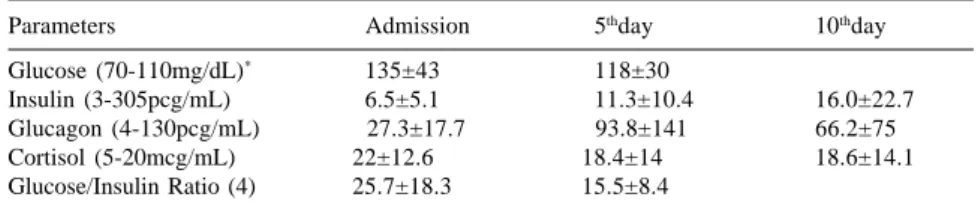
Table 3 shows the values for gluca-gon, cortisol, and insulin at the begin-ning and end of the study. Mean insu-lin and glucagon were maintained in the normal range in all periods. But the ratio of serum glucose/insulin was el-evated, with a mean of 25.7 at admis-sion and 15.5 on the 5th day (p< 0.06).
Serum cortisol levels were slightly in-creased on the first day and were nor-mal on the 5th and 10th day of the
study.
There was positive linear correla-tion between retinol-binding protein and insulin, prealbumin and cortisol, and retinol-binding protein and prealbumin.
The lymphocyte count was less than 1800/cm3 in two patients in the
first day and in three patients at the 5th
day with no statistical difference found using the Student’s t paired test.
DISCUSSION
Few studies have emphasized the efficacy of parenteral nutritional
sup-port of critically ill infants after the ad-mission to the ICU13,22. In this study we
evaluated the role of early metabolic support in stressed infants. In the last decade several investigators have tried to establish a correlation between clini-cal and laboratory parameters and the prognosis of critically ill patients9,13,23.
The ideal parameter should have sen-sitivity, specificity, and predictive value capable of identifying groups with a difference in the rate of morbidity-mor-tality.
In this study, nutritional status was evaluated and associated with a specific and standardized metabolic support. As was expected by the short term of the study, there was no important body gain weight. In spite of the severity of the infection in these patients, they maintained body weight. However, fac-tors such as edema and vascular per-meability disturbances could influence the sequential analysis of the anthropo-metric parameters. Other anthopo-metric indexes as triceps and biceps skin thickness, as well as arm muscle circumference and arm muscle area were similar at admission and at the end of the study.
The muscle evaluation is more sig-nificant when one considers the impor-tant muscle atrophy described in the severely infected infant8,24.
Serum albumin and lymphocyte count are not good nutritional indica-tors when the nutritional depletion is assessed for a short period of time. The
correlation between serum albumin and body protein mass is more accurate in large numbers of people, with a low individual sensitivity and specifity3,17.
Thus, the greater half-life of albumin (15 to 20 days) is not correlated with acute nutritional alterations. A lympho-cyte count less than 1500 to 1800/cm3
seems to be related to a high mortality rate. Relating these findings to nutri-tional status is of doubtful value, since the method has low sensitivity and specificity. Sequential counts are more reliable for detection of slight nutritional alterations25,26 .
Retinol-binding protein, fibro-nectin, and prealbumin have a shorter half-life17,27. Our data suggest that these
serum proteins were significantly higher at the 10th day, compared with admission. Yoder et al. and Bondestam et al. have described the reliability of these proteins in the nutritional evalu-ation of children with chronic infection of the respiratory airways or during re-covery from protein-energy
malnutri-tion27,28. Yoder et al. called attention to
the better specificity of changes in prealbumin and fibronectin occurring with malnutrition or nutritional recov-ery, independent of the presence of in-flammatory response. The positive lin-ear correlation in our study supports this idea. Schlichtig and Ayres pointed out the better sensitivity of fibronectin in acute nutritional disturbances in critically ill adults3. There have been
only few studies in pediatrics in which
Table 3 - Mean serum glucose, insulin, glucagon, cortisol, and glucose/insulin
ratio at admission, 5thday, and 10th day.
Parameters Admission 5thday 10thday
Glucose (70-110mg/dL)* 135±43 118±30
Insulin (3-305pcg/mL) 6.5±5.1 11.3±10.4 16.0±22.7
Glucagon (4-130pcg/mL) 27.3±17.7 93.8±141 66.2±75
Cortisol (5-20mcg/mL) 22±12.6 18.4±14 18.6±14.1
retinol-binding protein has been evalu-ated. But, the superior value of retinol-binding protein over albumin or tranferrin during nutritional recovery has been emphasized18,27.
Several hormones function as me-diators of intermediary metabolic alter-ations in patients with severe infec-tions. The hyperglycemic hormones, which are related to the protein catabo-lism, show systematically elevated se-rum concentrations, although the fac-tors responsible for these actions re-main to be clarified. Insulin, the prin-cipal anabolic hormone, has extremely variable concentrations in different phases of acute disease. The more con-stant finding for this hormone is a blunted response, secondary to dimin-ished pancreatic perfusion and counter-action by catecholamines2,3,24,29. We
ob-served a tendency for our patients to be
hyperglycemic. After observing the be-havior of the insulin concentrations during the follow-up, we note the pos-sibility that the decreased insulin val-ues at the end of the study (elevated glucose concentration/insulin concen-tration) might be a factor in the hyper-glycemia in view of the normal gluca-gon and cortisol concentrations. Corti-sol decreased during the study, but the values were not statistically different. The clinical stability of the patients at the beginning could explain the hor-monal findings. Recently, a study has shown that the serum concentrations of thyroid hormones and cortisol are sen-sitive indices in critically ill patients.30
Accordingly, the positive linear corre-lation (p<0.05) in our study between retinol-binding protein and insulin, which was similar to prealbumin and
cortisol, indicates a high specificity of these indices.
Metabolic support administered until the 10th day was sufficient to
pre-vent deterioration of the nutritional sta-tus of these patients. The early admin-istration of the nutritional support is important for prevention of acute pro-tein-energy depletion in hospitalized infants treated in intensive care units.
CONCLUSION
Serum proteins (fibronectin, prealbumin and retinol-binding pro-tein) and an increased glucose/insulin ratio were useful in evaluating nutri-tional recovery in infants with respira-tory distress during intensive care. Early metabolic support results in clini-cal benefit in those conditions.
RESUMO RHCFAP/2996
DELGADO AF e col. - Avaliação nutricional seqüencial de lactentes gravemente doentes recebendo terapia nutricional parenteral por curto período. Rev. Hosp. Clín.
Fac. Med. S. Paulo 55 (1):3-8,
2000.
A avaliação nutricional seqüencial é muito importante para a adequação e monitoramento da terapia nutricional. Raros estudos caracterizaram a eficácia da terapia nutricional parenteral em lactentes gravemente doentes.
Foram estudados 17 lactentes
submetidos à terapia nutricional parenteral total por cinco dias. Posteriormente, de acordo com as condições clínicas, os pacientes recebiam terapia nutricional parenteral, enteral ou mista até o décimo dia de internação. As avaliações nutricionais eram realizadas no primeiro, quinto e décimo dias e constavam de: dados clínicos ( história alimentar e medidas antropométricas), dado hematológico (contagem de linfócitos), testes bioquímicos (albumina, transferrina, fibronectina, pré-albumina e proteína ligada ao retinol) e dosagens
hormonais (cortisol, relação glicemia/ insulina, glucagon).
comparações. O valor médio da relação glicemia/insulina foi de 25.7 no primeiro dia e 15.5 no quinto dia, revelando supressão transitória deste hormônio. O cortisol mostrou valores acima do normal no início do estudo.
Neste estudo concluiu-se que os parâmetros antropométricos não foram
úteis no curto período de avaliação. As proteínas viscerais foram de boa sensibilidade e a relação glicemia/ insulina aumentada, associada com uma tendência de elevação do cortisol, sugerem estado hipercatabólico. Os lactentes gravemente doentes podem se
beneficiar de uma terapia nutricional precoce.
DESCRITORES: Glicemia. Terapia nutricional parenteral. Lactente gravemente doente. Avaliação nutricional.
RERERENCES
1. CUTHBERSON D & TILSTONE W - Metabolism during the post-injury period. Adv Clin Chem 1977;12:1-55.
2. DEUTSCHMAN CS - Nutrition and metabolism in the critically ill child. In: ROGER MC. - Textbook of Pediatric Intensive Care. Baltimore, Williams & Wilkins 1992. p. 1109-1131.
3. SCHLICHTIG R & AYRES SM - Nutritional support of the critically
ill. Illinois, Yr Bk Med Pub. 1988.
4. IAPICHINO G - Nutrition in respiratory failure. Intensive Care Med 1989;15:483-485.
5. KEMPER M, WEISSMAN C & HYMAN AI - Caloric requirements and supply in critically ill surgical patients. Crit Care Med 1992;20:344-348.
6. BRASEL JÁ - Endocrine adaptation to malnutrition. Pediatr Res. 1980;14:1299-1302.
7. NORDENSTROM J, CARPENTER YA & ASKANAZI J et al. - Free fatty acid mobilization and oxidation during total parenteral nutrition in trauma and infection. Ann Surg 1983;198:725-735. 8. CERRA FB - Metabolic manifestations of multiple systems organ
failure. Crit Care Clin 1989;5:119-131.
9. RADRIZZANI D, IAPICHINO G, CAMBISANO M et al. - Peripheral, visceral and body nitrogen balance of catabolic patients, without and with parenteral nutrition. Intensive Care Med 1988;14:212-216.
10. BAUE AE - Nutrition and metabolism in sepsis and multisystem organ failure. Surg Clin North Am 1991;71:549-565.
11. POLLACK MM, WILEY JS & HOLDBROOK PR - Early nutritional depetion in critically ill children. Crit Care Med 1981;9:580-583. 12. BROWN RO, BADLEY JE & BEKERMEYER WB - Effect of albumin supplementation during parenteral nutrition on hospital morbidity.
Crit Care Med 1988;16:1177-1182.
13. BROWN RO, BUOMPANE EA, VEHE KA et al. - Comparison of modified amino acids and standard amino acids in parenteral nutrition support of thermally injured patients. Crit Care Med 1990;18:1096-1101.
14. DANCEY MJ, GANDY G & GAIRDNER D - Assessment of total body fat in infancy from skinfold thickness measurements. Arch
Dis Child 1977;52:223-227.
15. FRISANCHO AR - New norms of upper limb fat and muscle areas for assessment of nutritional status. Am J Clin Nutr 1981;34:2540-2545.
16. YOUNG GA & HILL GL - Evaluation of protein-energy malnutrition in surgical patients from plasma valine and other amino acids, proteins, and anthropometric measurements. Am J Clin Nutr 1981;34:166-172.
17. BENJAMIN DR - Laboratory tests and nutrition assessment: Protein-energy status. Ped Clin North Am 1989;36:139-161.
18. BOOSALIS MG, OTT L, LEVINE AS et al. Relationship of visceral proteins to nutritional status in chronic and acute stress. Crit Care
Med 1989;17:741-747
19. MALDONADO J, GIL A, FAUS MJ et al. - Differences in the serum amino acid pattern of injured and infected children promoted by two parenteral nutrition solutions. JPEN 1989;13:41-46. 20. POLLACK MM, RUTTIMANN EU & GETSON PR - Pediatric Risk
of Mortality (PRISM) score. Crit Care Med 1988;16:1110-1116. 21. MANCINI G, CARBONARA AO & HEREMANS JF -Immunochemical quantification of antigens by single radial immunodiffusion. Immunochemistry 1965;3:235-254. 22. BAGLEY JS, WAN JMF & GEORGIEFF M - Celular nutrition in support
of early multiple organ failure. Chest. 1991;100(Supp.):182-187. 23. DRIVER AG, MCALEVY MT & SMITH JL - Nutritional assessment
of patients with chronic obstructive pulmonary disease and acute respiratory failure. Chest 1982;82:568-571.
24. CERRA FB - Hypermetabolism - organ failure syndrome: a metabolic response to injury. Crit Care Clin 1989;5: 289-302.
25. SELTZER MH, FLECHER S, SLOCUM BA et al. - Instant nutritional assessment in the intensive care unit. JPEN 1981;5:70-72. 26. UNTERMAN TG, VAZQUEZ RM, SLAS AJ et al. - Usefulness of
somatomedin-V in nutritional assessment. Am J Med 1985;78:228-234.
28. YODER MC, ANDERSON DC, GOPALAKRISNA GS et al. -Comparison of serum fibronectin, prealbumin, and albumin concentrations during nutritional repletion in protein-calorie malnourished infants. J Pediatr Gastroenterol Nutr 1987;6:84-88.
29. DAHN MS, JACOBS LA, SMITH S et al. - The relationship of insulin production to glucose metabolism in severe sepsis. Arch Surg 1985;120:166-172.
30. ROTHWELL PM & LAWLER PG - Prediction of outcome in intensive care patients using endocrine parameters. Crit Care Med 1995;22:78-83.