ORIGINAL ARTICLE
einstein. 2011; 9(1 Pt 1):52-5
Procalcitonin in patients with influenza A (H1N1) infection
and acute respiratory failure
Pró-calcitonina em pacientes com infecção por influenza A (H1N1) e insuficiência
respiratória aguda
Péricles Almeida Delfino Duarte1, Carla Sakuma de Oliveira Bredt2, Gerson Luís Bredt Jr2, Amaury César Jorge2,
Alisson Venazzi2, Leônidas Gustavo Tondo2, Luciana Schmidt Cardon de Oliveira2, Marcela Maria Jorge2,
Roberta Marchiori2, Thiago Simões Giancursi2, Marcelo Coradin2, Anderson Gustavo Alexandrino2
ABSTRACT
Objective: To verify serum procalcitonin levels of patients with acute respiratory failure secondary to influenza A (H1N1) upon their admission to the Intensive Care Unit and to compare these results to values found in patients with sepsis and trauma admitted to the same unit. Methods: Analysis of records of patients infected with influenza A (H1N1) and respiratory failure admitted to the General Intensive Care Unit during in a period of 60 days. The values of serum procalcitonin and clinical and laboratory data were compared to those of all patients admitted with sepsis or trauma in the previous year. Results: Among patients with influenza A (H1N1) (n = 16), the median serum procalcitonin level upon admission was 0.11 ng/ mL, lower than in the sepsis group (p < 0.001) and slightly lower than in trauma patients. Although the mean values were low, serum procalcitonin was a strong predictor of hospital mortality in patients with influenza A (H1N1). Conclusion: Patients with influenza A (H1N1) with severe acute respiratory failure presented with low serum procalcitonin values upon admission, although their serum levels are predictors of hospital mortality. The kinetics study of this biomarker may be a useful tool in the management of this group of patients.
Keywords: Pneumonia, viral; Sepsis; Intensive care units; Biomarkers, pharmacological; Calcitonin; Infection
RESUMO
Objetivo: Verificar os níveis de pró-calcitonina sérica em pacientes com insuficiência respiratória aguda secundária à influenza A (H1N1) admitidos à Unidade de Terapia Intensiva, e comparar esses resultados com valores encontrados em pacientes com sepse e trauma admitidos na mesma unidade. Métodos: Análise de prontuários de pacientes infectados com influenza A (H1N1) e insuficiência respiratória aguda
admitidos na Unidade de Terapia Intensiva Geral em um período de 60 dias. Os valores de pró-calcitonina sérica e os dados clínicos e laboratoriais foram comparados com todos pacientes admitidos com sepse ou trauma no ano anterior. Resultados: Entre os pacientes com influenza A (H1N1) (n = 16), a mediana de pró-calcitonina sérica na admissão foi 0,11 ng/mL, menor do que o grupo de sepse (p < 0,01) e levemente menor do que os com trauma. Embora os valores médios tenham sido baixos, o nível sérico de pró-calcitonina foi um poderoso preditor de mortalidade hospitalar em pacientes com influenza A (H1N1). Conclusão: Pacientes com influenza A (H1N1) com insuficiência respiratória aguda grave tiveram baixos níveis de pró-calcitonina à admissão, embora seu nível sérico seja preditor de mortalidade hospitalar. A cinética desse biomarcador poderia ser uma ferramenta útil para o manejo desses pacientes.
Descritores: Pneumonia viral; Sepse; Unidades de terapia intensiva; Biomarcadores farmacológicos; Calcitonina; Infecção
INTRODUCTION
A major challenge in clinical practice of intensive care and emergency medicine is early detection and prognosis of severe community respiratory infections, as well as the differentiation between viral and bacterial infections, with a consequent impact on the inappropriate use of antibiotics, bacterial resistance, mortality, and costs(1).
The recent pandemic by influenza A (H1N1) virus(2)
has reinforced the importance of biomarkers that might assist the clinician in diagnosis and management of patients with severe community-acquired pneumonia and acute respiratory failure. Procalcitonin (PCT) has been studied and has shown itself to be useful in the
Study carried out at Hospital Universitário do Oeste do Paraná – HUOP, Cascavel (PR), Brazil.
1 Departament of Emergency and Intensive Medicine, Universidade Estadual do Oeste do Paraná – UNIOESTE, Cascavel (PR), Brazil. 2 Department of Internal Medicine, Universidade Estadual do Oeste do Paraná – UNIOESTE, Cascavel (PR), Brazil.
Corresponding author: Péricles Almeida Delfino Duarte – Rua Castro Alves, 2.283, apto. 72 – Centro – CEP 85810-100 – Cascavel (PR), Brasil – Tel.: 45 3219-6400 – e-mail: [email protected] Received: Sep 8, 2010 – Accepted: Jan 31, 2011
einstein. 2011; 9(1 Pt 1):52-5
Procalcitonin in patients with influenza A (H1N1) infection and acute respiratory failure 53
differential diagnosis(3), prognosis(4), and antimicrobial
management(5) of both community and
hospital-acquired infections, proving to be an exclusion marker of viral infections exclusion, particularly in patients with
severe community-acquired infections(6,7).
OBJECTIVE
To analyze the profile of serum PCT collected upon admission at the Intensive Care Unit (ICU) from patients with severe acute infection with influenza A (H1N1), comparing it to patients with sepsis and trauma.
METHODS
This was a retrospective cohort study. A total of 16 patients admitted to a special unit installed in July/2009, at the Hospital Universitário do Oeste do Paraná (HUOP), in Cascavel, (PR, Brazil), with respiratory failure secondary to influenza A (H1N1) infection, between July 1 and August 31, 2009, were studied. All of them were included in the study. The medical charts, clinical and epidemiological data, and laboratory tests upon ICU admission were analyzed, as well as oxygen and mechanical ventilation parameters and ICU outcomes. The study data were compared to the ICU database by analyzing all the patients admitted due to trauma or sepsis, during one year before this study. The diagnostic test for influenza A (H1N1) was performed through with the real-time polymerase chain reaction (RT-PCR) method of nasopharynx or tracheal aspirates secretion with Kit Superscript III Platinum One-Step
Quantitative RT-PCR System® (Invitrogen, Carlsbad,
USA). The diagnosis of influenza A (H1N1) was defined as clinical symptoms plus a positive RT-PCR test. The diagnostic test for PCT used a quantitative immunoassay method (Brahms MiniVidas, Roche/BioMérieux). Sepsis was defined according to criteria of the ACCP/
SCCM Consensus Conference(8). Obesity was defined as
body mass index (BMC) > 30. Previous comorbidities were defined according to clinical diagnosis, by medical charts. Descriptive statistics were prepared with calculations of percentage, mean, median, and standard deviation. The comparison between the percentages
was performed using the χ2 test. Quantitative variables
were compared by the means with Student’s t test
for independent samples and the median with the Mann-Whitney’s test. Any p-value lower than 0.05 was recognized as significant. All statistical analyses were performed with Statistical Package for the Social Sciences (SPSS), version 15.0. The study was approved by the Research Ethics Committee of the Universidade Estadual do Oeste do Paraná (UNIOESTE).
RESULTS
The epidemiological and clinical data of the 16 patients are presented in table 1. In general, patients were young, predominantly female, and with few comorbidities – except obesity.
The respiratory involvement was significant; one third of the patients had a very severe oxygen exchange disorder (PaO2/FiO2 < 100), with a high use of the
Variable Descriptive Statistics
Male gender, n (%) 03 (18.7%)
Age 34.4 ± 14.82
Time between onset of symptoms and ICU admission, days 5.6 ± 4.73
APACHE II in the first 24 hours 9.2 ± 6.29
Obesity (BMI ≥30), n (%) 04 (25.0%)
Chronic diseases*, n (%) 02 (12.5%)
COPD, n (%) 01 (6.2%)
AIDS, n (%) 01 (6.2%)
Cancer or immune suppression 0
Pregnancy, n (%) 04 (25.0%)
1st trimester 01 (6.2%)
2nd trimester 01 (6.2%)
3rd trimester 02 (12.5%)
WBC, cells/mm3 8,452.5 ± 3,023.71
Hematocrit, % 36.3 ± 3.68
Platelets, cells/mm3 196,000 ± 83,700.0
Platelets <100.000 cells/mm3, n (%) 02 (12.5%)
Lactate, mOsm/L 2.39 ± 1.86
Creatinine, mg/dL 1.02 ± 0.38
Creatinine > 1.5 mg/dL, n (%) 01 (6.2%)
Total bilirubin > 2.0 mg/dL, n (%) 0
LDH, UI/mL 875.8 ± 772.7
CPK, UI/mL 416.7 ± 300.0
Vasopressor use in the first 4 h, n (%) 06 (37.5%)
Lowest PaO2/FiO2, in the first 24 h 137.9 ± 101.5
PaO2/FiO2 < 100, n (%) 05 (31.2%)
PaCO2, mm Hg 43.3 ± 10.1
Need of IMV, n (%) 08 (50.0%)
Length of IMV, days 8.6 ± 7.93
Prone position, n (%) 03 (37.5%)
Highest PEEP in the first 12 h, cm H2O 17.1 ± 5.33
NIMV use for > 2 h, n (%) 02 (12.5%)
Oseltamivir use, n (%) 16 (100.0%)
PCT, ng/mL 1.79 ± 3.27
PCT ≤ 0.05, ng/mL, n (%) 07 (43.7%)
Table 1. Clinical and epidemiological profile and laboratory data upon admission of patients with influenza A(H1N1) (n=16)
All variables are described as mean ± SD (standard deviation), unless when indicated. * Except obesity. Vasopressor: norepinephrine (any dose) or dopamine (> 5 µg/kg/min). APACHE: acute physiology and chronic health evaluation; BMI: body mass index; COPD: chronic obstructive pulmonary disease; AIDS: acquired immunodeficiency syndrome; WBC: white blood cell; LDH: lactate dehydrogenase; CPK: creatine phosphokinase; PaO2: arterial oxygen pressure; FiO2: inspired oxygen fraction; IMV: invasive mechanical ventilation; PEEP: positive end-expiratory pressure; NIMV: noninvasive mechanical ventilation; PCT: procalcitonin.
Outcome Descriptive Statistics
Hospital LOS, average ± SD 7.31 ± 4.43
Hospital mortality, n (%) 07 (43.7%)
Table 2. Clinical outcome (n=16)
einstein. 2011; 9(1 Pt 1):52-5
54 Duarte PAD, Bredt CSO, Bredt Jr GL, Jorge AC, Venazzi A, Tondo LG, Oliveira LSC, Jorge MM, Marchiori R, Giancursi TS, Coradin M, Alexandrino AG
prone position. On the other hand, renal and circulatory systems were not as intensely impaired, at least during the initial phase.
Mortality was high (Table 2); mortality predictors (Table 3) were mainly related to clinical severity (such as APACHE II) or respiratory involvement (e.g., PaO2/ FiO2). All patients required invasive mechanical ventilation.
Serum LDH and CPK values were very high, and there was a great incidence of obesity.
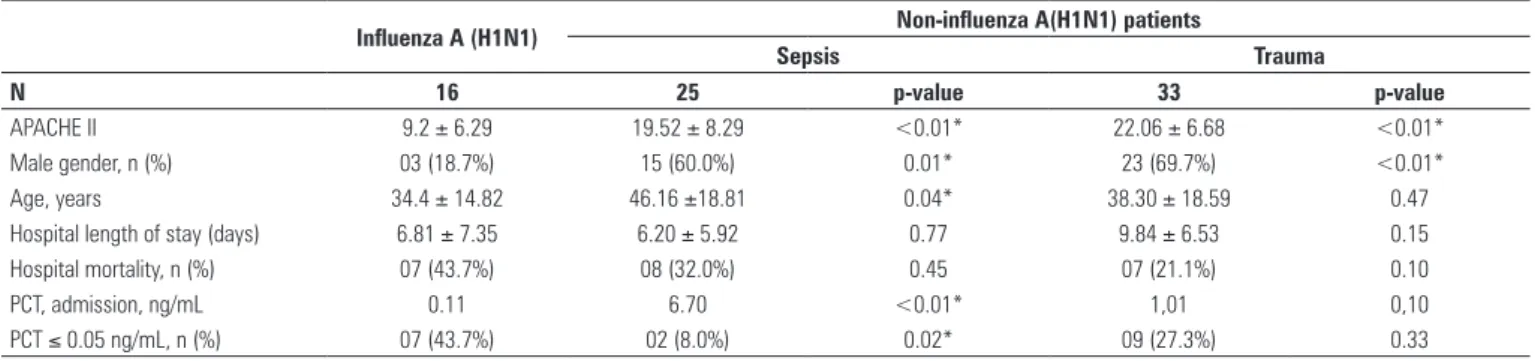
Admission serum PCT levels were strongly predictive of hospital mortality in H1N1 patients (Table 3); however, these values were lower than non-H1N1 patients (with sepsis or trauma), according to table 4.
DISCUSSION
The use of biomarkers has given support to the management of sepsis and respiratory failure patients, including the decision to use antibiotics(9-11). In the
present study, serum PCT levels upon ICU admission were markedly different between the groups with infection by influenza A (H1N1) and the patients with presumed bacterial sepsis. The difference in trauma patients was less pronounced, and did not reaching statistical difference. Billeter et al.(3) studied 1,032
Predictors of hospital mortality Result Alive Dead p-value
APACHE II 9.2 ± 6.29 6.22 ± 4.55 13.13 ± 6.31 0.02*
LDH, UI/mL 875.80 ±
772.70
458.57±
306.13
1362.6 ±
890.19
0.03*
Vasopressor use, in the first 4 h, n (%) 06 (37.5%) 0 (0.0%) 06 (85.6%) <0.01*
Lowest PaO2/FiO2, in the first 24 h 137.97 ± 101.50 206.67 ± 112.29 79.09 ± 36.50 0.02*
PaCO2, mmHg 43.31 ± 10.09 36.33 ± 5.16 49.29 ± 9.55 0.01*
Need of IMV, n (%) 08 (50.0%) 01 (11.1%) 07 (100.0%) <0.01*
Highest PEEP in the first 12 h, cmH2O 15.0 ± 6.50 8.0 ± 2.83 16.8 ± 5.97 0.085*
PCT, ng/mL 0.11 0.02 2.89 0.02*
PCT ≤ 0.05 ng/mL, n (%) 07 (43.7%) 07 (77.8%) 0 (0.00%) <0.01*
Table 3. Predictors of hospital mortality (n=16)
All variables are described as mean ± SD (standard deviation), unless when indicated. Vasopressor: norepinephrine (any dose) or dopamine (> 5 µg/kg/min). APACHE: acute physiology and chronic health evaluation; LDH: lactate dehydrogenase; PaO2: arterial oxygen pressure; FiO2: inspired oxygen fraction; IMV: invasive mechanical ventilation; PEEP: positive end-expiratory pressure; PCT: procalcitonin.
Influenza A (H1N1) Non-influenza A(H1N1) patients
Sepsis Trauma
N 16 25 p-value 33 p-value
APACHE II 9.2 ± 6.29 19.52 ± 8.29 <0.01* 22.06 ± 6.68 <0.01*
Male gender, n (%) 03 (18.7%) 15 (60.0%) 0.01* 23 (69.7%) <0.01*
Age, years 34.4 ± 14.82 46.16 ±18.81 0.04* 38.30 ± 18.59 0.47
Hospital length of stay (days) 6.81 ± 7.35 6.20 ± 5.92 0.77 9.84 ± 6.53 0.15
Hospital mortality, n (%) 07 (43.7%) 08 (32.0%) 0.45 07 (21.1%) 0.10
PCT, admission, ng/mL 0.11 6.70 <0.01* 1,01 0,10
PCT ≤ 0.05 ng/mL, n (%) 07 (43.7%) 02 (8.0%) 0.02* 09 (27.3%) 0.33
Table 4. Comparison between influenza A (H1N1) group and patients with other diagnoses
All variable are described as mean ± SD (standard deviation), unless when indicated. * Significant at level of 5%. PCT: procalcitonin.
patients with moderate and severe trauma, and serum PCT in the first days of the patients with no associated infection was 0.81 ng/mL, showing higher values in patients with sepsis and infection. Similar results were obtained by other researchers(12). Castelli et al.(13) also
found that PCT values correlated with the severity and outcome of trauma. Moreover, in sepsis patients, particularly bacterial, initial PCT values proved to be far higher. The mean values ranged from 4.3 (non-severe sepsis) to 21.3 ng/mL (septic shock)(5,14,15).
In the present study, the median PCT values in patients with sepsis and trauma were similar to those found by Castelli et al.(13) and Billeter et al.(3), respectively.
Although the initial values of PCT in patients with sepsis are usually higher in more severe patients, the
correlation with mortality is not as clear(5,14). However,
specifically in patients with pneumonia, apparently its
efficiency as a marker of adverse outcome is greater(4,16).
einstein. 2011; 9(1 Pt 1):52-5
Procalcitonin in patients with influenza A (H1N1) infection and acute respiratory failure 55
it is not surprising that initial serum PCT levels in patients with severe influenza A (H1N1) infection were predictive of mortality, although they were much lower than in patients with sepsis and even than in those with
trauma. The majority of patients with PCT ≥ 0.1 µg/l L
died at the hospital, whereas none of the patients with PCT <0.1 µg/L progressed to death.
This study has several limitations. The number of patients studied is small and may lead to difficulty in interpreting collected data. Only the initial value (upon ICU admission) of serum PCT was analyzed.
The dynamics of PCT in patients with sepsis(5), in
postoperative care(15), with ventilator-associated
pneumonia(4), and with trauma(3,13) prove to be more
useful than the initial dosage. Heterogeneity among the non-H1N1 patients hinders comparisons between the groups. It must be emphasized that the “sepsis” group included patients with presumed bacterial sepsis, although they did not necessarily had microbiological identification. Patients included in the group with influenza A (H1N1) were very seriously ill, particularly with severe respiratory failure(2,9). Analysis of patients
with milder cases (without severe respiratory failure) could further emphasize the importance of this biomarker in the management of these patients in the emergency room.
CONCLUSIONS
In an observational study, it was found that initial serum levels of PCT in patients with severe respiratory infection for influenza A (H1N1) were strongly predictors of a poor outcome and mortality, although they are significantly lower than those of patients with sepsis or trauma. The study of PCT kinetics of PCT may better define better its usefulness in managing patients with severe respiratory infection with influenza A (H1N1).
REFERENCES
1. Brown SM, Dean NC. Defining and predicting severe community-acquired pneumonia. Curr Opin Infect Dis. 2010;23(2):158-64.
2. Duarte PAD, Venazzi A, Youssef NCM, Oliveira MC, Tannous LA, Duarte CB, et al. Outcome of influenza A (H1N1) patients admitted to intensive care units in the Paraná state, Brazil. Rev Bras Ter Intensiva. 2009;21(3):231-6.
3. Billeter A, Turina M, Seifert B, Mica L, Stocker R, Keel M. Early serum procalcitonin, interleukin-6, and 24-hour lactate clearance: useful indicators of septic infections in severely traumatized patients. World J Surg. 2009;33(3):558-66.
4. Seligman R, Meisner M, Lisboa TC, Hertz FT, Filippin TB, Fachel JMG, et al. Decreases in procalcitonin and C-reactive protein are strong predictors
of survival in ventilator-associated pneumonia. Crit Care. 2006;10(5): R125.
5. Charles PE, Tinel C, Barbar S, Aho S, Prin S, Doise JM, et al. Procalcitonin kinetics within the first days of sepsis: relationship with the appropriateness of antibiotic therapy and the outcome. Crit Care. 2009;13(2):R38.
6. Daubin C, Parienti JJ, Vabret A, Ramakers M, Fradin S, Terzi N, et al. Procalcitonin levels in acute exacerbation of COPD admitted in ICU: a prospective cohort study. BMC Infect Dis. 2008;8:145.
7. Kristoffersen KB, Søgaard OS,, Wejse C, Black FT, Greve T, Tarp B, et al. Antibiotic treatment interruption of suspected lower respiratory tract infections based on a single procalcitonin measurement at hospital admission--a randomized trial. Clin Microbiol Infect. 2009;15:481-7.
8. Bone RC, Balk RA, Cerra FB, Dellinger RP, Fein AM, Knaus WA, et al. Definitions for sepsis and organ failure and guidelines for the use of innovative therapies in sepsis. The ACCP/SCCM Consensus Conference Committee. American College of Chest Physicians/Society of Critical Care Medicine. Chest. 1992;101(6):1644-55.
9. Rello J, Rodríguez A, Ibañez P, Socias L, Cebrian J, Marques A, Guerrero J, Ruiz-Santana S, Marquez E, Del Nogal-Saez F, Alvarez-Lerma F, Martínez S, Ferrer M, Avellanas M, Granada R, Maraví-Poma E, Albert P, Sierra R, Vidaur L, Ortiz P, Prieto del Portillo I, Galván B, León-Gil C; H1N1 SEMICYUC Working Group. Intensive care adult patients with severe respiratory failure caused by Influenza A (H1N1) virus in Spain. Crit Care. 2009;13(5):R148.
10. Shapiro NI, Trzeciak S, Hollander JE, Birkhahn R, Otero R, Osborn TM, et al. A prospective, multicenter derivation of a biomarker panel to assess risk of organ dysfunction, shock, and death in emergency department patients with suspected sepsis. Crit Care Med. 2009;37(1):96-04.
11. Hausfater P, Juillien G, Madonna-Py B, Haroche J, Bernard M, Riou B. Serum procalcitonin measurement as diagnostic and prognostic marker in febrile adult patients presenting to the emergency department. Crit Care. 2007;11(3):R60.
12. Maier M, Wutzler S, Lehnert M, Szermutzky M, Wyen H, Bingold T, et al. Serum procalcitonin levels in patients with multiple injuries including visceral trauma. J Trauma. 2009;66(1):243-9.
13. Castelli GP, Pognani C, Cita M, Paladini R. Procalcitonin as a prognostic and diagnostic tool for septic complications after major trauma. Crit Care Med. 2009;37(6):1845-9.
14. Harbarth S, Holeckova K, Froidevaux C, Pittet D, Ricou B, Grau GE, Vadas L, Pugin J; Geneva Sepsis Network. Diagnostic value of Procalcitonin, Interleukin-6, and Interleukin-8 in critically ill patients admitted with suspected Sepsis. Am J Respir Crit Care Med. 2001;164(3):396-402.
15. Hochreiter M, Köhler T, Schweiger AM, Keck FS, Bein B, von Spiegel T, et al. Procalcitonin to guide duration of antibiotic therapy in intensive care patients: a randomized prospective controlled trial. Crit Care. 2009;13(3):R83. 16. Haeuptle J, Zaborsky R, Fiumefreddo R, Trampuz A, Steffen I, Frei R, et al.
Prognostic value of procalcitonin in Legionella pneumonia. Eur J Clin Microbiol Infect Dis. 2009:28(1):55-60.
17. Prat C, Ricart P, Ruyra X, Domínguez J, Morillas J, Blanco S, et al. Serum concentrations of procalcitonin after cardiac surgery. J Card Surg. 2008;23(6):627-32.
18. Madershahian N, Wittwer T, Strauch J, Wippermann J, Rahmanian P, Franke UF, et al. Kinetic of procalcitonin in the early postoperative course following heart transplantation. J Card Surg. 2008;23(5):468-73.