Licenciado sob uma Licença Creative Commons DO): http://dx.doi.org. . / - . . .AO
[T]
Evaluation of the best environment for the
six-minute walk test
[)]
Avaliação do melhor ambiente para o teste
de caminhada de seis minutos
[A]
Newton Santos de Faria Júnior[a], Cláudio Hiroshi Nakata[b], Luís Vicente Franco de Oliveira[c], Gaspar Rogério Chiappa[d], Gerson Cipriano Júnior[b]*
[a] Universidade do Estado de Minas Gerais UEMG , campus Divinópolis; Divinópolis, MG, Brazil [b] Universidade de Brasília UnB , Brasília, DF, Brazil
[c] Universidade Nove de Julho Uninove , São Paulo, SP, Brazil [d] Faculdades da Serra Gaúcha FSG , Porto Alegre, RS, Brazil
[R]
Abstract
Introduction: The purpose of the six-minute walk test MWT is to evaluate cardiopulmonary capacity
using a low-cost test that is easy to administer, generally well tolerated by different populations and reflects one’s performance on activities of daily living. (owever, few studies have been conducted to determine the difference between performing the MWT indoors and outdoors. Objective: The aim of the present
study was to compare the distance covered on the MWT performed indoors and outdoors and evaluate the following physiological variables: heart rate, blood pressure and the subjective sensation of shortness of breath, using the Borg perceived exertion scale. Materials and methods: A prospective, randomized,
clinical trial was conducted involving eight healthy females not engaged in regular physical activity, with
mean age . ± . years. Each subject performed the MWT indoors and outdoors with a -minute interval between tests. The order of the tests was determined randomly. Results: The mean distance
trav-eled was ± . m on the outdoor trial and . ± . m on the indoor trial p = . . The mean physiological variables were . ± . bpm indoors versus . ± . bpm outdoors for heart rate,
. ± . mm(g indoors versus . ± . mm(g outdoors for systolic blood pressure, .
± . mm(g indoors versus . ± . mm(g outdoors for diastolic blood pressure and a mean score
of on the perceived exertion score in both environments. Conclusions: The present data demonstrate
no differences in the distance walked on the MWT or the physiologic variables of participants between the indoor and outdoor trials.
[P]
Keywords: Exercise test. Walking. Physical exertion. Exercise tolerance.
[B] Resumo
Introdução: O objetivo do teste de caminhada de seis minutos (TC6) é avaliar a capacidade cardiorrespiratória por meio de um teste de baixo custo e de fácil administração, sendo bem tolerado por diferentes populações, e que
reflita a realização das atividades da vida diária. Entretanto, poucos estudos têm sido realizados para determinar
a diferença entre a realização do TC6 em ambientes fechados e ao ar livre. Objetivo: O presente estudo teve como
objetivo comparar a distância percorrida no TC6 realizado em ambientes fechado e ao ar livre e avaliar as
seguin-tes variáveis fisiológicas: frequência cardíaca, pressão arterial e a sensação subjetiva de falta de ar, utilizando a
escala de percepção de esforço de Borg. Materiais e métodos: Um ensaio clínico randomizado prospectivo foi
conduzido envolvendo oito mulheres saudáveis não praticantes de atividade física regular, com média de idade de
23,75 ± 1,67 anos. As participantes realizaram o TC6 nos dois ambientes com um intervalo de 30 minutos entre os
testes. A ordem dos testes foi determinada aleatoriamente. Resultados: A distância média percorrida foi de 578
± 50,07 m ao ar livre e 579,95 ± 45,35 m no ambiente fechado (p = 0,932). As variáveis fisiológicas médias foram
82,25 ± 11,02 bpm (fechado) versus 84,38 ± 9,42 bpm (ar livre) para a frequência cardíaca, 121,88 ± 10,28 mmHg
(fechado) versus 118,75 ± 19,40 mmHg (ar livre) para a pressão arterial sistólica, 81,88 ± 9,74 mmHg (fechado)
versus 80,50 ± 7,89 mmHg (ar livre) para a pressão arterial diastólica e uma pontuação média de 12 pontos na
escala de esforço percebido em ambos os ambientes. Conclusão: Os dados demonstraram que não há diferenças
nas distâncias percorridas ou entre as variáveis fisiológicas dos participantes durante o TC6 nos ambientes
fecha-do e ao ar livre. [K]
Palavras-chave: Teste de esforço. Caminhada. Esforço físico. Tolerância ao exercício.
Introduction
The first walk tests were described by Cooper in , in which the distance travelled was correlated to oxygen consumption after conducting a -minute walk. The six-minute walk test MWT is a valid mea-sure of functional status commonly used for evaluat-ing individuals with chronic obstructive pulmonary disease , . This test is typically administered in an enclosed indoor corridor free of distractions and patients are instructed to travel as far as possible in six minutes . (owever, this environment is some-what artificial and may not adequately reflect one’s performance on activities of daily living.
The MWT has also been used as a predictor for heart and lung transplantation, the assessment of functional status in elderly individuals as well as pa-tients with chronic obstructive pulmonary disease and chronic heart failure to determine responses to therapeutic interventions. Moreover, this test seems to have a good correlation with maximum oxygen uptake peak VO , , - .
Several studies have shown that the MWT can be applied on a treadmill, in a hallway or in an open environment. According to the American Thoracic Society ATS , the MWT should be performed in an indoor environment hallway to avoid the influence of climate . (owever, some studies have found significant differences with a normal pace between open and closed environments, with individuals reaching a greater distance in the former . While an indoor environment is most often employed for the performance of the MWT, few studies have demonstrated the existence of differences between open and closed environments or when the test is performed on a treadmill , , .
Considering the costs involved in obtaining a spe-cific space for the indoor administration of the MWT indoors and the existence of regions that prevent out-door activities for climatic reasons, it is essential to determine the influence of these two environments on the MWT so that this test can be administered in accordance with the convenience of the location.
As it is well known that the physiological respons-es to exercise differ between men and women, the decision was made to evaluate healthy females in the present study to gain a better understanding of their physiological responses. Thus, the aim of the present study was to compare the performance of healthy females on the MWT in open and closed environments based on the distance travelled and physiological variables to determine the possible influence of these environments on the results and provide flexibility in the choice of where the test is to be applied, which may exert an impact on the cost of administering this test.
Materials and methods
Subjects
This study was conducted at a renowned private hospital in the city of Sao Paulo, Brazil. The sample
consisted of eight females selected by convenience. All volunteers read and signed a statement of in-formed consent. This study received approval from the (uman Research Ethics Committee under proto-col number / .
The inclusion criteria were age to years, adequate health status and a sedentary lifestyle, as determined using the )nternational Physical Activity Questionnaire . The exclusion criteria were musculoskeletal or neuromuscular problem that significantly limited the ability to walk, cog-nitive or behavioral disorders, unstable angina, uncontrolled hypertension, severe pulmonary hy-pertension, a recent history of cardiac arrhythmia or myocardial infarction and any clinical condition that could be exacerbated by physical exertion. )n the present study, there were no cases of exclusion of the volunteers.
Procedures and design
The MWT was performed in accordance with the guidelines established by the ATS . The equipment required for the test were a chronometer Technos Skydiver Professional™, Brazil , measuring tape, pulse oximeter Tuffsat™, Sao Paulo, Brazil , heart rate
monitor Polar Frequency Model S ™, Finland , sphygmomanometer BD™, Germany , stethoscope Littmann™ Classic )) SE, USA and scale Bismark™, Sao Paulo, Brazil .
The volunteers performed the MWT once in a closed environment and once in an open environ-ment. The order of the tests was determined random-ly. The outdoor test was performed on a -meter track between and am in the morning to avoid exposure to high temperature and the indoor test was performed along a -meter track in a closed corridor following the recommendations of the ATS. The same previously trained examiners monitored all tests. (eart rate and shortness of breath Borg scale were determined before at rest , during in the rd
and th minute of the test and after the test each
The volunteers were instructed to stop the test if they felt symptoms, such as pain in the lower limbs, tachycardia or other symptoms of discomfort. The pulse oximeter remained on the volunteer to moni-tor oxygen saturation. The test was interrupted if the desaturation level was lower than % or if % of maximum heart rate was reached. The MWT was well tolerated by all volunteers, with no complica-tions during or after the test.
Statistical analysis
The results were analyzed using the Statistical Package for Social Sciences SPSS . for Mac OS, Chicago, USA . The data were expressed as mean and standard deviation ± . Either the paired Student’s t-test, ANOVA one-way and Blant-Altman was used for the comparisons between tests, with statistical significance defined as p < . .
Results
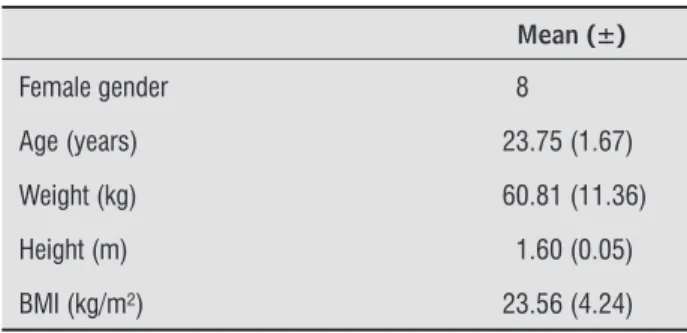
Eight healthy women who did not exercise regular-ly participated in the present study. Table displays the anthropometric characteristics of the sample.
. ± . mm(g in the closed environment. No significant differences between environments were found regarding this variable at any evaluation time
Figure .
Table 1 - Characteristics of volunteers (n = 8)
Mean (±)
Female gender 8
Age (years) 23.75 (1.67)
Weight (kg) 60.81 (11.36)
Height (m) 1.60 (0.05)
BMI (kg/m²) 23.56 (4.24)
Note: ± = standard deviation; BMI = body mass index.
Mean systolic blood pressure SBP at rest was . ± . mm(g in the open environment and . ± . mm(g in the closed environment. At the end of the MWT, mean SBP had increased to . ± . mm(g in the open environment and . ± . mm(g in the closed environment. Mean SBP decreased in the th minute of recovery to
. ± . mm(g in the open environment and
Outdoor Indoor
Systolic arterial blood pressure (mmHg)
Diastolic arterial blood pressure (mmHg)
Heart rate (bpm)
Borg
140
130
120
110
100
90 95
90
85
80
75
70
65
60
55 150 140 130 120 110 100 90 80 70 60 50
15 14 13 12 11 10 9 8 7 6 5 4
6MWT Recovery
Rest
6th minute 5th minute 3rd minute 2nd minute 1st minute
6 MWT 3rd minute6 MWT 6th minute
A
B
C
D
Mean diastolic blood pressure DBP at rest was . ± . mm(g in the open environment and . ± . mm(g in the closed environment. At the end of the MWT, mean DBP had increased to . ± . mm(g in the open environment and . ± . mm(g in the closed environment. Mean DBP decreased in the th minute of recovery to . ±
. mm(g in the open environment and . ± . mm(g lower than baseline value in the closed environment. No significant differences between en-vironments were found regarding this variable at any evaluation time Figure .
Mean heart rate (R at rest was . ± . bpm in the open environment and . ± . bpm in the closed environment. Peak (R was achieved in the rd minute of the test in the open environment
. ± . and closed environment . ± . . (R did not return to baseline values in the
th minute of recovery . ± . bpm in the open
environment and . ± . bpm in the closed environment . No significant differences between environments were found regarding this variable at any evaluation time Figure .
)n both environments, the mean Borg perceived exertion score was range: to at rest, reaching a peak of range: to in the th minute of the
test and dropping to range: to in the th minute
of recovery. No significant differences were found re-garding this variable at any evaluation time Figure . The mean distance traveled was ± . m in the open environment and . ± . m in the closed environment. No significant difference was found regarding this variable Figure .
Figure 2 - Distance travelled in both environments
distance walked (m)
Outdoor Indoor 800
800
800
800
800
6MWT outdoor - 6MWT indoor
150
+1.96 SD 116.6
Mean
-136.6 -10.01
-1.96 SD BIAS = -10.01; SD = 64.50
100
50
0
-50
-100
-150
Figure 3 - Bland-Altman plots showing the walking distance difference on 6-min walk test between outdoor and indoor
Statistical analysis Bland-Altman visualize three participants with relevant differences in distances traveled in closed and open environment.
Discussion
The present study compared the distance covered by healthy females on the MWT in closed and open environments as well as the behavior of physiological variables: heart rate, blood pressure and the subjec-tive sensation of shortness of breath using the Borg scale of perceived exertion. The main finding was the lack of differences between environments for all variables analyzed.
The MWT has gained importance in the assess-ment of functional exercise capacity in patients with chronic respiratory disease , . Exercise capacity varies with age, sex and health status . )mportant differences in the distance travelled have been ob-served in studies performed with healthy subjects
in (R immediately after the test is considered to be due to the reactivation of parasympathetic function. This increase in vagal activity has been associated with reduced risk of death, which makes (R recovery at the end of a test as an important prognostic marker, according to Cole et al. . The Borg scale of per-ceived exertion also demonstrated an increase during the test, as expected, with the return to baseline val-ues within the first minute of recovery. Although the differences were non-significant, (R and SBP were higher during and after the test in the closed envi-ronment, despite the wide range of environmental factors that could influence the test results in the open environment.
Cruz et al. report that the subjects walked farther in an open environment than a closed en-vironment. (owever, the study cited divided the
MWT into normal walking and fast walking. This goes against the guidelines of the ATS, which stipu-late instructing the individual to walk as quickly as possible in six minutes. Pires et al. found that younger people with a body mass index < kg/m² walked farther. Likewise, the young volunteers in the present study had a mean body mass index . kg/m². Troosters et al. attributed the variability in the distance travelled to height, weight, gender and age, suggesting that these variables should be considered when comparing the results obtained by different individuals.
No significant difference was found regarding the distance traveled in the closed and open environ-ments but the Bland-Altman statistical analysis points to a potential difference in the distances between closed and open environment, as three of the eight participants showed significant clinical differences in the distances.
The MWT demonstrates moderate correlation with peak VO levels, and ability to predict VO func-tional capacity dependent on distance walked. )n previous studies, the MWD ≤ m was signifi-cantly able to predict likelihood of death or poorer outcomes in months and worse prognostic out-comes . Other studies determined that distances ≤ m and ≤ m, respectively also correlated with VO max .
The small sample size was a limitation of this study and therefore further studies with a larger number of individuals are needed to confirm the similar results when performing the MWT in an open or closed environment.
the eighth decades of life and was significantly higher in men than women.
Few studies are found in the literature com-paring the MWT in a closed environment to the test performed on a treadmill. Swerts et al. concluded that a corridor is more appropriate and efficient than a treadmill, whereas Stevens et al. found no significant differences between the two methods. Cruz et al. found significant differences in distance travelled at a normal pace between open and closed environments, with in-dividuals reaching greater distances in the former. Brooks et al. concluded that the test in an open environment reflects the same indexes as those found in a closed environment provided that the climatic variables are stable.
The differences among the female volunteers regarding age, height and body mass index were non-significant, which is in agreement with data described in a study by Enright et al. . To avoid the influence of the learning effect, motivation and environmental factors, the tests were performed fol-lowing the ATS guidelines, without accompanying the volunteer along the track, only using standardized encouraging phrases, randomizing the order of the tests and always holding the tests in the morning to avoid high temperatures.
Changes occurred in SBP and DBP during the tests, which lead to important physical exercise and hemodynamic autonomic adaptations that influence the cardiovascular system in order to maintain cel-lular homeostasis in the face of increased metabolic demands. There is an increase in cardiac output, a redistribution of blood flow and increased circulatory perfusion to the exercising muscles. SBP increases di-rectly in proportion to the increase in cardiac output. DBP reflects the efficiency of the local mechanism of vasodilator activity in muscles, which is higher when local capillary density is greater. Vasodilatation in skeletal muscle decreases peripheral resistance to blood flow. Concomitant vasoconstriction, which oc-curs in tissues not exercised sympathetically, compen-sates for the induced vasodilatation. Consequently, the overall resistance to blood flow drops drastically at the onset of exercise.
. Brooks D, Solway S, Weinacht K, Wang D, Thomas S. Comparison between an indoor and an outdoor -minute walk test among individuals with chronic obstructive pulmonary disease. Arch Phys Med
Re-habil. ; : - .
. Cipriano Junior G, Yuri D, Bernardelli GF, Mair V, Buf-folo, White JNR. Safety assessment of the walk test six minutes in patients undergoing cardiac transplanta-tion. Arq Bras Cardiol. ; : - .
. Pires SR, Oliveira AC, Parreira VF, Britto RR. Test six-minute walk at different ages and body mass indices. Rev Bras Fisioter. ; : - .
. Toledo A, Ribeiro K, Silva AB, Costa D. Comparaçao en-tre o teste de caminhada de seis minutos no corredor e na esteira rolante. Fisioter Bras. , : - . . Enright PL. The six minute walk test. Respir Care.
; : - .
. Baughman RP, Sparkman BK, Lower EE. Six-minute walk test and health status assessment in sarcoidosis.
Chest. ; : - .
. Ross RM, Murthy JN, Wollak )D, Jackson AS. The six minute walk test accurately estimates mean peak oxy-gen uptake. BMC Pulm Med. ; : .
. Passantino A, Lagioia R, Mastropasqua F, Scrutinio D. Short-term change in distance walked in min is an indicator of outcome in patients with chronic heart failure in clinical practice. J Am Coll Cardiol. ;
: - .
. Ganagaram V. Six minute walk distance is a useful predictor of survival in lung transplant recipients.
Thorax. ; : - .
. Cote CG, Casanova C, Marín JM, Lopez MV, Pinto-Plata V, de Oca MM, et al. Validation and comparison of refer-ence equations for the -min walk distance test. Eur
Respir J. ; : - .
. Wise RA, Brown CD. Minimal clinically important differences in the six-minute walk test and the incre-mental shuttle-walking test. COPD. ; : - . . Guyatt G(, Sullivan MJ, Thompson PJ, Fallen EL, Pug-sley SO, Taylor DW, et al. The six-minute walk: a new measure of exercise capacity in patients with chronic heart failure. Can Med Assoc J. ; : - . Conclusion
The present data demonstrate no differences in the distance walked on the MWT or the physiologic variables heart rate, blood pressure and subjective sensation of shortness of breath of participants when performed in an indoor or outdoor environ-ment. (owever, this research needs to be conducted with a larger number of participants to confirm or not the trend indicated by the Bland-Altman statisti-cal test. These findings suggest flexibility in choosing the environment for the test, considering cost and the availability of space at each hospital or reha-bilitation center. The open environment allows the administration of the test in locations outside a hos-pital, whereas a closed environment is more feasible in locations where climatic factors may impede the administration of the test outdoors.
References
. Solway S, Brooks D, Lacasse Y, Thomas S. A qualitative systematic overview of the measurement properties of functional walk tests used in the cardiorespiratory
domain. Chest. ; : - .
. ATS Committee on Proficiency Standards for Clinical Pulmonary Function Laboratories. ATS Statement: guidelines for the six-minute walk test. Am J Respir
Crit Care Med. ; : - .
. Guyatt G(, Thompson PJ, Berman LB, Sullivan MJ, Townsend M, Jones NL, et al. (ow should we mea-sure function in patients with chronic heart and lung disease? J Chronic Dis. ; : - .
. Araújo CO, Makdisse MRP, Peres PAT, Tebexreni AS, Ramos LR, Matsushita AM, et al. Different patterns of the test and six-minute walk test to measure exercise capacity of elderly patients with and without clinically evident C(D. Arq Bras Cardiol. ; : - . . Cruz MNP, Flores MED, Pérez AR, (ernández JG. Dife-rencia de la prueba de caminada de minutos entre un espacio abierto y uno cerrado. Rev )nt Nal Enf Resp
. Stevens D, Elpern E, Sharma K, Szidon P, Ankin M, Kes-ten S. Comparison of hallway and treadmill six-minute walk tests. Am J Respir Crit Care Med. ; Pt
: - .
. Cole CR, Blackstone E(, Pashkow FJ, Snader CE, Lau-er MS. (eart-rate recovLau-ery immediately aftLau-er exLau-er- exer-cise as a predictor of mortality. N Engl J Med. ;
: - .
. Pollentier B, )rons SL, Benedetto CM, Dibenedetto AM, Loton D, Seyler RD, et al. Examination of the six minute walk test to determine functional capacity in people with chronic heart failure: a systematic review. Cardiopulm Phys Ther J. ; : - .
. Pulz C, Diniz RV, Alves AN, Tebexreni AS, Carvalho AC, de Paola AA, et al. )ncremental shuttle and six-minute walking tests in the assessment of functional capacity in chronic heart failure. Can J Cardiol. ;
: - .
Received: / /
Recebido: / /
Approved: / /
Aprovado: / / . Matsudo SM, Araújo T, Matsudo V, Andrade D,
An-drade E, Oliveira LC, et al. Questionário )nternacio-nal de Atividade Física )PAQ : estudo de validade e reprodutibilidade no Brasil. Rev Bras Ativ Fis Saúde.
; : - .
. Gulati M, Black (R, Shaw LJ, Arnsdorf MF, Merz CN, Lauer MS, et al. The prognostic value of a nomo-gram for exercise capacity in women. N Engl J Med.
; : - .
. Casanova C, Celli BR, Barria P, Casas A, Cote C, de Torres JP, et al. The -min walk distance in healthy subjects: reference standards from seven countries.
Eur Respir J. ; : - .
. Kavanagh T, Mertens DJ, (amm LF, Beyene J, Kennedy J, Corey P, et al. Peak oxygen intake and cardiac mortality in women referred for cardiac rehabilitation. J Am Coll
Cardiol. ; : - .
. Ades PA, Savage PD, Brawner CA, Lyon CE, Eh-rman JK, Bunn JY, et al. Aerobic capacity in pa-tients entering cardiac rehabilitation. Circulation.
; : - .
. Swerts PM, Mostert R, Wouters EF. Comparison of cor-ridor and treadmill walking in patients with severe chronic obstructive pulmonary disease. Phys Ther.