GUILLAIN BARRÉ SYNDROME IN A POPULATION
LESS THAN 15 YEARS OLD IN BRAZIL
Elza Dias-Tosta
1, Carlos Santos Kückelhaus
2ABSTRACT - To know the impact of the Guillain Barré syndrome (GBS) in the population less than 15 years old, after the eradication of poliomyelitis. Data bank from the program of epidemiological surveillance of acute flaccid palsies (AFP) from the Fundação Nacional de Saúde were analyzed between 1990 – 1996. From 3619 notifications of AFP there were 1678 GBS. GBS yearly incidence rates is 0.39-0.63 cases/100,000. No consistent seasonal variation existed or relationship to vaccines. Weakness at inclusion were, moderate 52.1%, severe in 47.9%, sixty days after 57.1% normal, 7.4% mild, 15.7% moderate, 10.4% with severe deficits, death in 5.4%. 67 (4.0%) cases unknown. Death rates varies from 2.8% in southeast to 7.9% in the northeast. GBS was the most frequent cause of AFP. In spite of the severity of this disease being similar in the different regions, the outcome varies according to origin of the cases, possibly reflecting the economical conditions in those places. KEY WORDS: Guillain Barré syndrome, epidemiology, vaccines, follow up.
Síndrome de Guillain-Barré na população menor de quinze anos no Brasil Síndrome de Guillain-Barré na população menor de quinze anos no BrasilSíndrome de Guillain-Barré na população menor de quinze anos no Brasil Síndrome de Guillain-Barré na população menor de quinze anos no BrasilSíndrome de Guillain-Barré na população menor de quinze anos no Brasil
RESUMO - Com o objetivo de conhecer a importância da síndrome de Guillain Barré (SGB) na população menor de quinze anos, após a erradicação da poliomielite, foi analizado o banco de dados do programa da vigilância epidemiológica das paralisias agudas e flácidas (PAF) da Fundação Nacional de Saúde, entre 1990 e 1996. De 3619 notificações de PAF encontraram-se 1678 com SGB, com incidência anual de 0,39-0,63 casos/ 100.000. Não se comprovou variação sazonal nem relação com a vacina. Os casos eram de acometimento: moderado em 52,1%, grave em 47,9%, 60 dias após 57,1% eram normais, 7,4% leves, 15,7% moderados, 10,4% graves, morte em 5,4%, 67 (4,0%) casos perdidos para o acompanhamento. Mortes ocorreram em 2,8% no sudeste, e 7,9% no nordeste. SGB é a causa mais frequente de PAF. Embora a gravidade da doença seja semelhante nas diferentes regiões, a evolução varia conforme o local de origem, possivelmente refletindo diferentes condições econômicas.
PALAVRAS-CHAVE: síndrome de Guillain Barré, epidemiologia, vacina, evolução.
The acute flaccid palsies (AFP) are a group of dis-eases, with many etiologies, variable incidences and variable prognoses, that affect population around the year in the world. Until mid 80’s the acute polio-myelitis was the main cause of acute flaccid palsies but with the program of eradication of poliomyeli-tis had emerged the Guillain-Barré syndrome (GBS) as the major etiology, such statement is already pro-ved in the developed countries, but still unknown in many communities. The epidemiological data has been shown valuable in evaluating the frequency of GBS in various populations, studying changes in incidence over time, detecting outbreaks or cluster of unusual preceding illnesses, and possible illuminating under-lying causes1,2. Epidemiological surveillance of GBS
is considerable relevant since large and small epide-mics due to vaccines, water pollution, drugs, as well
unexpected statistically significant variations in an-nual incidence in age sub-groups have been repor-ted3.
The Brazilian national program of immunization against poliomyelitis since 1980, has afforded two important goals: the eradication of this disease in 1989, and a better understanding of the incidence and clinical expression of acute flaccid paralysis in children less than 15 years old, due to the epidemio-logical surveillance which has been carried out since then.
Our goal was to know the impact of the GBS in the population less than 15 years old, after the eradi-cation of poliomyelitis, with analysis of the incidence of this syndrome in that particular age group in the Brazil as a whole, and in the five macro geographic regions in the country. The epidemiological studies
1MD, PhD, Head of Neurology Unit, Hospital de Base do Distrito Federal, Brasilia DF, Brazil; 2MD, Neurologist of Hospital Regional do
Guará, Brasília DF, Brazil.
368 Arq Neuropsiquiatr 2002;60(2-B)
were done to understand if there were peak of inci-dence along the years analyzed, its relationship with vaccination campaigns, the sex preponderance and the possible influence, as a predictive factor, of the patient’s ages, as age at onset may be relevant in differentiating clinicoepidemiological subgroups3
and the length of prodromal period and the severity of the clinical patterns at the first examination and sixty days later.
METHOD
A total of 3619 cases of acute flaccid paralysis were notified during the poliomyelitis surveillance program car-ried out by the Brazilian health authorities, during the period of 1990 to 1996, in a population under 15 years old, as recorded by the Fundação Nacional de Saúde of the Brazilian Ministry of Health.
The Guillain-Barré syndrome was diagnosed accord-ing to the clinical criteria defined by Asbury & Cornblath4:
presence of roughly symmetrical motor weakness over a period ranging from days to 4 weeks, and decrease or disappearance of deep tendon reflexes.
We separated two subgroups of patients according to the deficit found at the first examination in order to know if there were a form of predicting their evolution. The se-verity of the motor deficit was characterized as moderate when two limbs were weak at the first examination and severe when more than two limbs were involved or respi-ratory insufficiency was present. Sixty days later all the patients had a second examination, and was reported if there was any persistent motor weakness as mild, moder-ated or severe. The presence and severity of the sequels were classified as absent (those with no motor deficits), mildly (minimal motor deficit in one limb or reflex loss), moderated (motor deficits of more magnitude in more than one limb), or severe (severe motor deficits). Those
ca-ses that could not be followed were classified as unknown. Patients were also studied according to length of the time of disease installation defined as onset of weakness after the prodromal signs or preceding events in three groups: 0 to 7 days, 8 to 14 days and more than 15 days. The cases were also analyzed according their gender, ages and region of origin.
To gain a better understanding about the geographi-cal distribution of the disease, the observations were re-ferred to the five Brazilian macro-regions (north, northeast, middle west, southeast and south) and the incidence rates were calculated as the total number of cases /population less than 15 years old in that year x 100000. The mean coefficient of incidence were calculated as mean of the total number of cases in 7 years / mean of the population less than 15 years old from that region in 7 years x 100000.
RESULTS
Within the 3619 cases of AFP, were found 78 cases (2%) of polio post-vaccination, 33 cases (1%) of trau-ma, 32 ( 1%) of tumor, 126 cases (3%) of myelitis, 1153 (32%) others (such as encephalitis, cerebro-vas-cular events and cerebellar ataxia which are impor-tant differential diagnosis of gait disturbance), 506 (14%) without diagnostic definition. There were ini-tially 1742 cases of GBS reported; from these 51 could not afford a critical analysis and we could not agree with the diagnosis, so remained 1691 cases in the study. It was also not considered another 13 cases that although had evolution compatible with GBS, in the first examination it was not reported a symme-trical weakness of the limbs4. It remained 1678 cases
(46%) as Guillain-Barré syndrome.
From the total cases of Guillain-Barré recorded, 33.7% were notified in Brazilian southeast region,
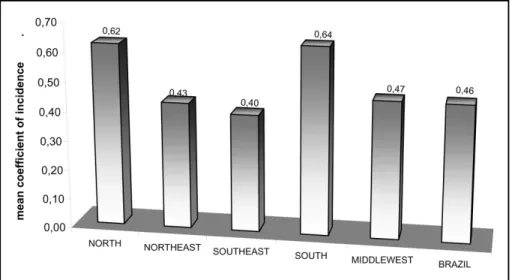
29.6% in northeast, 19.2% in south, 10.6% in north and 6.9% in the middle west. When analyzed accord-ing to the demographic data the mean incidence rates show as a rather uniform distribution throughout the different macro-regions of Brazil such as southeast with 17%, northeast 18%, middle-west 19%, north 26%, south 27%. The mean coefficient of incidence for the whole country was 0.46, the same coefficient for the south region 0.64, north 0.62, middle-west 0.47, northeast 0.43, southeast 0.40 (Fig 1).
When the data from the whole country were stud-ied along the 7 years (1990-1996), there was no clear peak distribution amongst the months, but there is only a variation in January and May, without much discrepancy in the visual analysis of the graphic. The cumulative data from 1990 to 1996 from the
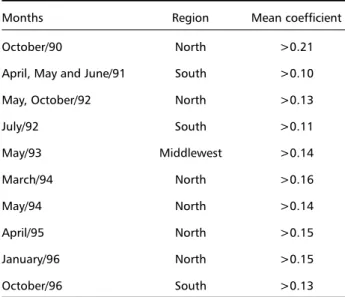
macro-regions distribution by months showed a mean co-efficient above 0.07 in the north region during the months March, May and June (Fig 2). The same is seen in the south region in July. To be sure that these peaks were not due to small cumulative differences but to a very well defined peak, the more accurate analysis were processed by regions by months from each year. There were peaks >0.21 in the north re-gion in October 1990, and middle west in May 1993 and greater than 0.1 in other regions and months during the years of study (Table 1).
The month analyses showed repeated peaks of incidence in May (once in the south, twice in north and middle west regions), April (south and north regions) and October (in the north region twice and once in the south region). The data were compared with the anti-poliomyelitis vaccination calendar in order to test if the peaks could be temporally rela-ted to cases of GBS recorded. There was no clear increment temporally related with the vaccine cam-paign, considering either 3 or 6 weeks after the vacci-nation when Brazil was studied as a whole, each year, during the 7 years analyzed (Fig 3). We also tested if there was any increase in a specific region that could be diluted in the data from the whole country, spe-cifically the north region, the south region and the middle west region. We found indeed in the north region the increment after the third vaccination cam-paign in 1990, after the first one in 1992 and after the first, the second and the third campaigns in 1993 and also after the first vaccination campaign in 1994. In the south region there were an increase incidence in 1994 after the third campaign. However there was no regularity in the behavior in those increments to
Table 1. Analyses of mean coefficient of incidence by regions.
Months Region Mean coefficient
October/90 North >0.21
April, May and June/91 South >0.10 May, October/92 North >0.13
July/92 South >0.11
May/93 Middlewest >0.14
March/94 North >0.16
May/94 North >0.14
April/95 North >0.15
January/96 North >0.15
October/96 South >0.13
370 Arq Neuropsiquiatr 2002;60(2-B)
Fig 3. The Graphic analysis show that there is no correlation between the means of incidence and the vaccination campaing considering either three or six weeks after the vacination. +, Sabin vaccination campaign.
suggest events temporally related. Some of those peaks after vaccination campaign could be explained as greater awareness from the authorities and the population with increase in notification. Other in-crements were not related to the vaccination cam-paign, as those in the south region (1991), in the north region in 1990 and 1992, in the middle west region in 1993 and in October in the north region in 1990 and 1992 and in the south region in 1996. Those regions are very different in the climate and social-economic conditions, so it is at present diffi-cult to make any correlation with the increasing
in-cidence of GBS in those regions mainly if they have not occurred at the same time.
The cases of Guillain-Barré syndrome were more frequently related among children aging 0-4 years (n=671), peaking 2 years old, followed by the group of 5-9 years old (n=560), and those older than nine (n=447) (Fig 4).
A slight preponderance of boys (55%) was ob-served throughout the years of the study.
At the entry of the study from 1678 cases, 52% were characterized as moderately affected and 48% as severely affected. At the follow-up sixty days
Fig 5. Follow up of 1678 cases of GBS from 1990 to1996 grouped by regions. Examination after 60 days of entry.
ter 57.1 of the patient were free from symptoms or signs of Guillain-Barré syndrome, 7.4% had mild signs, 15.7% still had moderate deficits, 10.4% had weakness in more than two limbs and 5.4% were dead. The remaining 67 cases were lost for follow-up.
A 5.4% death was recorded in the whole coun-try: 2.7% in the southeast, 4.3% in the middle west, 5.9% in the south, 7.3% in the north and 7.6% in the northeast (Fig 5).
The age of the patients was related to the persis-tence of motor deficit at the second examination 60 days later: the older was the child, the worst the prognosis as shown by the 29% from the group of 0-4 years, 31% from 5-9 years, and 35% from 10-15
years, that remained with moderated or severe mo-tor deficit or were dead (Table 2).
The severity of the cases at the first examination represented a bad prognostic factor related both to the death rate and the persistence of moderated or severe motor deficit at the second examination. From those cases presenting at the first examination with moderated motor deficit at the follow up, 20% will present with moderated or severe motor deficit and 3.2% will be dead at 60 days later. From the severe cases at entrance, up to 33% will present at 60 days later with moderate or severe deficit and 8.2% will be dead. Those cases presenting with mild or moderate motor deficit at the first examination more frequently
Table 2. Follow up: comparison on the severity of cases at 60 days and severity at first examination, ages at entry and prodromal times. Examination at 60 days
Examination at 60 daysExamination at 60 days Examination at 60 daysExamination at 60 days
n Absence % Mild % Moderate % Severe % Death % Unknown % Severity
Severity Severity Severity
Severity Moderate 874 566(64,8%) 72 (8,2%) 121 (13,8%) 54 (6,2%) 27 (3,1%) 34 (3,9%) at first
at first at first at first
at first Severe 804 393(48,9%) 52 (6,5%) 142 (17,7%) 121(15,0%) 63 (7,8%) 33 (4,1%) examination
examination examination examination
examination 1678
0 - 4 years 671 392 (58,4%) 52(7,7%) 112 (16,7%) 50 (7,5%) 36 (5,4%) 29 (4,3%) Age
Age Age Age
Age 5-9 years 560 330(58,9%) 38 (6,8%) 78 (13,9%) 62 (11,1%) 36(6,4%) 16 (2,9%) 10-15 years 447 237(53,0%) 33 (7,4%) 74 (16,6%) 63 (14,1%) 18(4,0%) 22(4,9%)
1678 Prodromal
Prodromal Prodromal Prodromal
Prodromal O to 7 days 1471 840(57,1%) 106 (7,2%) 233(15,8%) 153 (10,4%) 81(5,5%) 58 (3,9%) time
time time time
time 8 to 14 days 109 58 (53,2%) 8 (7,3%) 19 (17,4%) 13(11,9%) 5 (4,6%) 6 (5,5%) > 15 days 98 61 (62,2%) 10 (10,2%) 11 (11,2%) 9 (9,2%) 4 ( 4,1%) 3 (3,1%)
372 Arq Neuropsiquiatr 2002;60(2-B)
had a favorable outcome with absence of motor deficit at the second examination, sixty days later (Table 2).
An association was looked for between the length of time for installation of Guillain-Barré syndrome and its prognosis at the second examination. The group of patients with a prodromal period greater than 15 days (6%) had a better outcome with 62% without sequelae, 10% of mild weakness, 11% with moderate deficit and 9% of severe weakness. From the group that developed the motor deficit between 8 to 14 days (6.5%) there were 53% without seque-lae, 7% mildly affected, 17% with moderate weak-ness and 12% of severe deficit at 60 days later. From the third group (88%) that took 0 to 7 days to start the weakness 57% had no motor signs at sixty days after the first examination, 7% had mildly weakness, 16% moderate weakness and 10% severe deficit. The death rates for the first group cited above was 4% for the second 5% and 6% for the last one. There were 3%, 6% and 4% of lost cases in the follow-up respectively (Table 2).
DISCUSSION
This study was based on data gathered during the Brazilian program of poliomyelitis surveillance. Therefore, the strength of the result is based on the numbers of observations, typical of epidemiological surveys, and not in the accuracy of individual data. The diagnosis of GBS was mostly based on clinical grounds as applied by other epidemiological stud-ies4,5 and sometimes need to be confirmed on the
follow up. Indeed, it has been recognized that labo-ratory tests are not necessary to establish the diag-nosis of GBS, but rather to exclude other conditions6.
In the present study, laboratory tests were used to exclude the diagnosis of poliomyelitis and other vi-rus diseases, according to the recommendations of the World Health Organization.
Incidence - The GBS incidence rate of 0.46 per 100,000 children we found is somewhat different from that obtained in China4, where a much wider
band of rates was observed, 0.13 to 1.26 per 100,000 children. Also it is different from that cited for the Latin America as a whole 0.91 to 1.1 cases per 100,000 children younger than 15 years old7,8 and
0.95/100,000 children less than 12 years of age at risk in Kuwait9. It is worthwhile to emphasize that
the epidemiological studies are influenced by the epidemiological criteria adopted and that the Guil-lain-Barré variants cases can be missed when only the typical cases are allowed to enter in the analysis. Our data on incidence rates in the whole country
(0.46 per 100,000) and for the different macro re-gions (0.4 to 0.6 per 100,000) are similar of those derived from the studies in USA that is calculated as 0.2 to 0.5 per 100,000 children less than 15 years old10 being important to remark that this was a
popu-lation-based study with a largest number of children included. Also our data are similar to those from Finland (0.38 per 100,000) in children younger than 15 years of age11 and is not different of 0.6 per
100,000 recorded in California5. The incidence should
be actually a little higher if one consider the clinical variants of GBS which has not been included in our data, as the Miller-Fisher cases could be under the term ataxia disregard in “others” at the begin of our study. In other studies the variants other than Miller-Fisher are responsible for 0.14/100,000/year and 0.09/100,000/year for the typical Miller Fisher syn-drome, as has been shown previously.12,13 On the
other hand the variants accounted for about 7% to
8.2% of the GBS14 and would be less common in
children than in adults15.
Seasonal distribution - It was not demonstrated a clear seasonal distribution of the cases of GBS, al-though a tendency for clustering was observed in some areas (Fig 2). This observation is rather differ-ent from the observed in northern China with a clear correlation with the summer months for the Acute Motor Axonal Neuropathy (AMAN) type of Guillain-Barré,16 and in other regions such as in Argentina with
two peaks for both forms of the disease Acute De-myelinating Peripheral Neuropathy (AIDP) and AMAN at the summer and at the winter months7.
Age distribution - The peak incidence in 2 years-old children, and the frequency of persistence of motor deficit 2 months after the diagnosis was es-tablished, were comparable in both studies, 20-30% in China and 33% in Brazil. The higher incidence in children at two years of age had been shown, and found also that these taxes remained high at 3 and 4 years old5. The variation of incidence by age could
suggest different susceptibility to the triggering fac-tors. Our results are different from those of the adult groups where usually is shown that the incidence in-creases with age, and ours seems to decrease until 15 years of age, suggesting two peaks of incidence. Sex distribution - Our results showed a slight, not significant, male preponderance of GBS, as has been found in some series15,17 but not in others9. We also
It is reported that it is not possible to predict fu-ture motor deficit at an early examination18, but our
results suggested that moderate cases at the first examination had a better prognosis at sixty days (64.8% without sequalae), compared to the severe cases (48%). Also the length of time to develop the first motor signs were related to the outcome, the slowly the better (Table 2).
The death rate of 5.4% we found is comparable to that of other series of pediatric GBS17, and its regional
variation probably reflects the quality of available local health services. Nonetheless in Southeast England a recent survey had showed that the mortality rate is still high as 8% in spite of being a region of a high standard medical care quality,without much change from previous data of 5 to 10% 19 but not for others
that reported a fall in 2% to 3% over the past 40 years mainly through improvements in nursing and critical care measures, and early use of plasmapheresis or high dose intravenous immunoglobulin20.
There were data from Finland in children21 and
adults22 and from Kuwait9 that explored the
relation-ship between the Guillain-Barré syndrome and the oral polio vaccine and we though in exploring also this possibility. Our data do not confirm the correla-tion between oral polio vaccine administracorrela-tion and the Guillain-Barré syndrome during the years stud-ied. The same conclusion as shown by the others data23 that showed the rise of numbers of GB cases
have started before the immunization campaign, so without a temporal relationship. Also the same con-clusion was arrived in Kuwait9, andin Latin America24.
Sallisbury25 says that to reconcile the data from
Fin-land and those from Americas it will blame the pre-vious Intramuscular (IPV) plus oral (OPV) to trigger the GBS, but this is not proved. Others vaccine were linked to GBS but this had being merely on tempo-ral association, only the link with rabies vaccines are not controversial. For the epidemics followed the swine flue influenza vaccine, there is a consensus of expert concluding that a small risk of developing GBS exist for up to 6 weeks after immunization26.
Acknowledgments Acknowledgments Acknowledgments Acknowledgments
Acknowledgments – We thank Dr. Carlos Eduardo Tosta and Dr. Pedro Tauil for thoughtful discussions and criticism. We also thank Ms Sara Jane Medeiros and Mr Paulo Cesar Teixeira from Fundação Nacional de Saúde for making available the data from surveillance of AFP program, and Mrs Selma S. Kuckelhaus for her precious collaboration.
REFERENCES
1. Lasky T. Methodologic issues in clinical research: the example of Guillain-Barré syndrome. Neuroepidemiology 1996;15:57-61. 2. Ho TW, Mishu B, Li CY, et al. Guillain-Barré syndrome in northern
China: relationship to Campilobacter jejuni infection and anti-glycolipid antibodies. Brain 1995;118:597-605.
3. Pedro-Cuesta J, Abraira V, Jiang G-X, Solders G, Fredrikson S. Guillain-Barré syndrome in south-west Stockholm, 1973-91,3. Clinicoepidemio-logical subgroups. Acta Neurol Scand 1996;93:175-83.
4. Chiba Y, Xu A, Li L, et al. Poliomyelitis surveillance in Shandong Province, China, 1990-92; WHO Bull 1994;72:915-920.
5. Rantala H, Cherry J D, Shields W D, Uuhari M. Epidemiology of Guillain-Barré syndrome in children: relationship of oral polio vaccine administration to occurrence. J Pediatr 1994;124:220-223
6. Van der Meché FG. The Guillain-Barré syndrome: pathogenesis and treatment. Rev Neurol 1996;152:355-358.
7. Paradiso G, Tripoli J, Galicchio S, Fejerman N. Epidemiological, clini-cal, and electrodiagnostic findings in childhood Guillain-Barré syn-drome: a reapraisal. Ann Neurol 1999;46:701-707.
8. WHO-AIREN. Acute onset flaccid paralysis. Geneva: WHO, 1993:993.3 9. Ismail EAR, Shabani IS, Badawi M. et al. An epidemiologic, clinical, and therapeutic study of childhood Guillain-Barré syndrome in Kuwait: it is related to the oral polio vaccine? J Child Neurol 1998;13:488-492. 10. Hurwitz E S, Holman RC, Nelson DB, Schonberger LB. National
sur-veillance for Guillain-Barré syndrome: January 1978 to March 1979. Neurology 1983; 33:150-157.
11. Rantala H, Uhari M, Niemela M. Occurrence, clinical manifestation, and prognosis of Guillain-Barré syndrome. Arch Dis Child 1991; 66:706-708. 12. Emilia-Romagna Study Group on Clinical and Epidemiological
Prob-lems in Neurology. Guillain-Barré syndrome in Emilia-Romagna, Italy,1992-3: incidence, clinical features, and prognosis. J Neurol Neurosurg Psychiatry, 1998;65:218-224.
13. Ropper AH. Unusual clinical variants and signs in Guillain-Barré syndromne. Arch Neurol 1986;43: 1150-1152.
14. Shuaib A, Becker WJ. Variants of Guillain-Barré syndrome? Miller Fisher syndrome, facial diplegia, and multiple cranial nerve palsies. Can J Neurol Sci 1987;14:611-616.
15. Evans OB, Vedanarayanan V. Guillain-Barré syndrome. Pediatr Re-view 1997;18:1-13.
16. McKhann GM, Cornblath DR, Griffin JW, et al. Acute motor axonal neuropathy: a frequent cause of acute flaccid paralysis in China. Ann Neurol 1993; 33:333-342.
17. Ropper AH, Wijdicks EFM, Truax BT. Guillain-Barré syndrome. Phila-delphia: FA Davis,1991.
18. Sedano M J, Calleja J, Canga E, Berciano J. Guillain-Barré syndrome in Cantabria, Spain. epidemiological and clinical study. Acta Neurol Scand 1994;89:287-292.
19. Rees JH, Thompson RD, Smeeton NC, et al. Epidemiological study of Guillain Barré Syndrome in South East England (UMDS Guy’s Hosp, London). J Neurol Neurosurg Psychiatry 1999:64:74-77.
20. Asbury AK. Guillain-Barré syndrome. In Stern MB, Brown MJ, Galetta SL, Asbury AK (eds). Penn neurology 2000: management of common neurologic problems. Irvington: Alpha Medica Press, 200:99-114. 21. Uhari M, Rantala H, Niemela M. Cluster of childhood Guillain-Barré
cases after na oral polio vaccine campaign. Lancet 1989;2:440-441 22. Kinnunen E, Farkkila M, Hovi T, et al. Incidence of Guillain-Barré
syn-drome during a nationwide oral poliovirus vaccine campaign. Neurol-ogy 1989:39:1034-1036.
23. Kinnunen E, Junttila O, Haukka J, Hovi T. Nationwide oral poliovirus vaccination campaign and the incidence of Guillain-Barré syndrome. Am J Epidemiol 1998;147:69-73.
24. Olive J-M, Castillo C, Castro RG, Quadros CA. Epidemiologic study of Guillain-Barré syndrome in children <15 years of age in Latin America. J Infect Dis 1997:175 (Suppl): S160-164
25. Sallisbury DM. Association between oral poliovaccine and Guillain-Barré syndrome? Lancet 1998;351:79-80.