Braz Dent J 14(3) 2003
Tensile strength of metallic crowns 193
Braz Dent J (2003) 14(3): 193-196
Effect of Cement Types on the Tensile Strength of
Metallic Crowns Submitted to Thermocycling
Simonides CONSANI1
Julie Guzela dos SANTOS1
Lourenço CORRER SOBRINHO1
Mário Alexandre Coelho SINHORETI1
Manoel Damião SOUSA-NETO2
1Department of Dental Materials, Dental School of Piracicaba, UNICAMP, Piracicaba, SP, Brazil 2Department of Endodontics, Faculty of Dentistry, UNAERP, Ribeirão Preto, SP, Brazil
The relationship between metallic cast crowns and tensile strength according to cement types submitted to thermocycling was studied. Seventy-two metallic crowns were cast with Verabond II Ni-Cr alloy and cemented in standardized preparations with 10o tapering.
Three types of finishing line (45-degree chamfered, 20-degree bevel shoulder and right shoulder) were made with diamond burs on bovine teeth. Twenty-four metallic crowns in each group were randomly subdivided into three subgroups of 8 samples each according to the cement used: SS White zinc phosphate cement, Vitremer resin-modified glass ionomer cement, and Rely X resin cement and were submitted to thermocycling. Retention was evaluated according to tensile load required to displace the metallic cast crowns from tooth preparations with an Instron testing machine. ANOVA and Tukey’s test showed a statistically significant difference among luting materials, with greater results for Rely X resin cement (24.9 kgf) followed by SS White zinc phosphate cement (13.3 kgf) and Vitremer resin-modified glass ionomer cement (10.1 kgf). The finishing line types did not influence the tensile resistance of the crowns fixed with the three cements. Increased tensile resistance of metallic crowns fixed on bovine teeth was obtained with resin cement, independent of the finishing line types.
Key Words: metallic crown, cervical finishing line, cement type.
Correspondence: Dr. Simonides Consani, Faculdade de Odontologia de Piracicaba, UNICAMP, Av. Limeira 901, 13414-903 Piracicaba, SP, Brasil. e-mail: [email protected]
ISSN 0103-6440
INTRODUCTION
The success of metallic crowns retained on a cavity preparation has been attributed not only to me-chanical properties of the cement but also to the design of the cavity (1). Previous studies have shown a signifi-cant relationship between the cavity area available for bonding and the retention of the casting, as well as the importance of the roughness of the cavity wall for improv-ing the mechanical retention (2-4). Thus, these factors can influence the retention values required to dislodge the crown cast filling from cavity preparations (5).
Mechanical interlocking and chemical bonding are desirable factors in the fixation mechanisms of luting cements, and are critical for achieving suitable retention for metallic cast crowns. Zinc phosphate is a successful nonadhesive luting cement that only adheres to casting and tooth irregularities by mechanical
reten-tion (6,7). Conversely, the glass-ionomer cement ad-heres by chemical bonding. The chemical reaction is ionic and occurs between carboxyl ions of polyacrylic acid and the calcium of the tooth structures (8). This material was first introduced as a restorative cement for classes III and V cavity preparations, lesions of recur-rent caries, marginal defects in amalgam fillings and cavity base. Currently, it is used as a luting agent with relative success (9-11).
Braz Dent J 14(3) 2003
194 S. Consani et al.
release, and thermal isolation, were preserved (13). The glass-ionomer cements attained their total resistance with mechanical interlocking and chemical bonding. Conversely, the adhesion of these luting ce-ments increased by the bonding of dentin and enamel to metallic ions, which can be beneficial mainly for short complete crowns, excessively conical preparations, minimally prepared surfaces, and other non-suitable geometric configurations(14-16).
In spite of this, the literature has not shown whether the adhesion of these cements would be depen-dent on the preparation type in order to obtain higher physical-chemical retention values. The resin cements adhere to the tooth structure by the presence of the hybrid layer, an intermediate zone obtained by impreg-nation, diffusion, and monomer polymerization into dentin previously etched by acid conditioners (17). Thus, the resin cement promotes bonding to dentin differently when compared with other cements, and the literature had demonstrated the superiority of these luting agents in tensile bond resistance (18-20).
The purpose of this study was to verify the reten-tion of metallic crowns fitted with resin-modified glass-ionomer cement, zinc phosphate cement, and resin ce-ment in standardized preparations made with different types of finishing lines, submitted to thermal cycling.
MATERIAL AND METHODS
Seventy-two recently extracted sound bovine incisive teeth were used in this study. After cleaning, each root was aligned vertically in an individual poly-meric tube and embedded with cold-cured acrylic resin (Jet Set; Clássico Dental Products, São Paulo, SP, Brazil). After embedding, the teeth were prepared to receive complete crowns using a 4103-diamond bur (KG Sorensen, Rio de Janeiro, RJ, Brazil) under water cooling. All tooth preparations were made with the polymeric tube fixed to an optic microscope modified to produce replicas guided by a high-speed turbine (Dabi-Atlante, Ribeirão Preto, SP, Brazil) fixed to a movable X-Y axis table. The dimensions of the com-plete crown preparations were: 7.0 mm in cervical diameter; 5.0 mm in occlusal diameter; 4.0 mm in length; 1.0 mm in finishing cervical shoulder; 10o taper on each outside axial wall.
Twenty-four teeth of each group were prepared with 45-degree chamfered, 20-degree bevel shoulder
and right shoulder finishing line types. The teeth of each group were randomly assigned to three subgroups of 8 samples each according to the cement used for the metallic crown luting: zinc phosphate cement (SS White Dental Products, Rio de Janeiro, Brazil), resin-modified glass-ionomer cement (Vitremer; 3M Dental Products Division, St. Paul, MN), and resin cement (Rely X; 3M). A cold-cured acrylic resin (Duralay; Reliance Dental Co., Worth, IL) was used for the manufacturing of the copings, which were later recovered with casting blue wax (Kerr/Sybron; Romulus, MI). The patterns were invested with phosphate-bonded investment (Pre-cise; Caulk/Dentsply, Milford, DE), and casted with Ni-Cr alloy (Verabond II; Aalba Dent, Cordelia, CA) in a spring-wound centrifuge (Citty Máquinas; São Paulo, SP, Brazil). The metallic cast crowns were removed from the investment, cleaned, and air-abraded with 50 mm aluminum oxide for 10 s in an Oxy Dry unit (Manfredi, Torino, Italy)
The luting cements were mixed according to manufacturer instructions at room temperature (23 ± 1oC) and 50% relative humidity. The mixed cement was placed in both metallic cast and tooth preparation with a brush. Each casting was first placed with finger pressure and then with a pressure unit with 98 N static load applied on the occlusal cast surface for 10 min.
Cement excess was removed, and the specimens were stored in 100% humidity at 37oC for 24 hours. The specimens were subsequently thermocycled at 1,000 cycles in 5oC and 55oC baths for 30 s each, in a cycling machine (MCT 2; MM Co., São Carlos, SP, Brazil). After thermocycling, the specimens were returned to the original storage conditions for 24 h.
The cast crown tensile resistance test was carried out with an Instron 441 testing machine (Cambridge, UK) at 0.5 mm/min crosshead speed. The data were submitted to ANOVA and Tukey’s test at 5% level of significance.
RESULTS
resin-Braz Dent J 14(3) 2003
Tensile strength of metallic crowns 195
modified glass-ionomer cement, both with no signifi-cant difference in the 45-degree chamfered and 20-degree bevel shoulders (Table 3).
DISCUSSION
Several factors can affect the long-term success of dental cast cementation and this study has shown that the luting cements are also an important factor for achieving desirable retention of the metallic cast crown. Table 1 shows the necessary load (kgf) for crown failure fixed with the cements, independent of the finishing lines. With significant statistical difference, the resin cement showed the greater tensile strength values, followed by zinc phosphate and resin-modified glass-ionomer materials. Previous studies have also shown the superiority of the resin cement when com-pared with zinc phosphate (2,14,16,18) and glass ionomer cements (4). It is evident that the factor respon-sible for the greater crown retention shown by resin cement in this work was the hybrid layer produced during impregnation, diffusion, and monomer poly-merization into dentin previously etched by acid condi-tioners (17).
Zinc phosphate showed better results than the glass-ionomer cement modified by resin. The retentive superiority of zinc phosphate in relation to resin-modi-fied glass-ionomer cement was also reported in a previ-ous study (8).According to these authors, zinc phos-phate has good capability for wetting the surface due to its properties of lower surface tension, low viscosity and good fluidity. Also, the phosphoric acid should improve the retention increasing the surface tension of the etched dentin. The zinc phosphate cement may be more retentive on rough surfaces (3) due to this fact, confirming that this material promotes mechanical bond-ing (2,4). Conversely, earlier studies showed the supe-riority of the glass-ionomer cements when compared to zinc phosphate cements(2,4,20) or similarity between these materials (2).
The values of the tension resistance, dependent on the cement factor, were not statistically significant when the 45-degree chamfered, 20-degree bevel shoul-der and right shoulshoul-der finishings were compared (Table 2). This fact probably occurred because the influence of finishing was least during the crown retention test, due to the mechanical properties of the cements that pro-moted smaller interaction among the different cervical finishings.
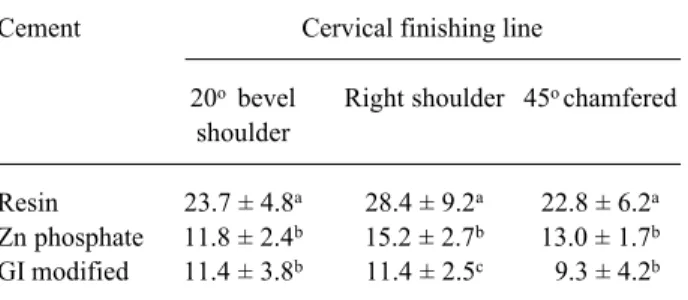
When the factors 45-degree chamfered and 20-degree bevel shoulder were evaluated, the resin cement showed the greater means differing from the zinc phos-phate and resin-modified glass ionomer cements, both with similar values. All cements were statistically dif-ferent in relation to the right shoulder, in which the greatest value was obtained with the resin cement and the smallest by the resin-modified glass ionomer ce-ment (Table 3).
Table 2. Means (± SD) of the tensile strength (kgf) of the metallic crowns in relation to cervical finishing lines and cement type interactions.
Cervical finishing Cements
Resin Zn phosphate GI modified
Bevel shoulder 23.7 ± 4.8 11.8 ± 2.4 11.4 ± 3.8 Right shoulder 28.4 ± 9.2 15.2 ± 2.7 9.7 ± 2.5 Chamfered shoulder 22.8 ± 6.2 13.0 ± 1.7 9.3 ± 4.2
There were no statistical differences of cervical finishing between cements (p>0.05).
Table 1. Means (± SD) of the tensile strength of the metallic crowns, independent of the cervical finishing lines.
Cements Tensile strength (kgf)
Resin 24.7 ± 7.2a
Zn phosphate 13.3 ± 2.7b
GI modified 10.1 ± 3.5c
Means followed by different letters were significantly different (p<0.05).
Table 3. Means (± SD) of the tensile strength (kgf) of the metallic crowns in relation to cervical finishing lines.
Cement Cervical finishing line
20o bevel Right shoulder 45o chamfered
shoulder
Resin 23.7 ± 4.8a 28.4 ± 9.2a 22.8 ± 6.2a
Zn phosphate 11.8 ± 2.4b 15.2 ± 2.7b 13.0 ± 1.7b
GI modified 11.4 ± 3.8b 11.4 ± 2.5c 9.3 ± 4.2b
Braz Dent J 14(3) 2003
196 S. Consani et al.
Previous investigations (13,19) have reported that resin-modified materials show better mechanical properties when compared to conventional cements. The adhesion of resin-modified glass-ionomer cement to bovine dentin was also far superior to that of self-cured glass-ionomer cement (8), and the better adhe-sion properties of the resin-modified cement is respon-sible for improving the retention of the complete cast crowns (10). In addition to the improved handling properties, such as no crazing when desiccated and cure control with visible light-cure, the mechanical proper-ties of the VLC glass-ionomer materials are notably superior (9) because the mechanical properties of the glass-ionomer cement composed by 2-HEMA resin monomer are significantly superior to those of conven-tional glass-ionomer cement (11). This should be attrib-uted to the ability of 2-HEMA to quickly balance the network flexibility after curing of methacrylate groups bonded to polycarboxylate chains. Thus, the rapidly formed polymer network between 2-HEMA and the methacrylate groups of ionized and unionized fractions of polyacrylic acid decreased the rate of the acid-base reaction. According to these authors, apparently it is due to steric hindrance phenomena.
Thus, the resin cement showed the greater ten-sile strength values, followed by zinc phosphate and resin-modified glass-ionomer materials, independent of cervical finishing. When the cervical finishing was considered, there were no differences in the tensile strength values among cements, and the resin cement showed the greater means differing from the zinc phos-phate and resin-modified glass ionomer cements in the 45-degree chamfered and 20-degree bevel shoulder, both with similar values. All cements were statistically different in relation to the right shoulder, in which the greatest value was obtained with the resin cement.
RESUMO
O objetivo deste estudo foi verificar a resistência à tração de coroas metálicas fixadas com diferentes cimentos e submetidas à termociclagem. Setenta e duas coroas foram fundidas com liga de Ni-Cr Verabond II e cimentadas em preparos padronizados com 8o de paredes laterais e acabamento cervical com ombro reto,
ombro biseldo 20o e ombro chanfrado 45o. As coroas foram
separadas em três grupos de oito elementos de acordo com os cimentos: fosfato de zinco (SS White), ionômero de vidro modificado por resina Vitremer (3M ) e resinoso Rely X (3M), e submetidas a 500 ciclos térmicos em banhos de 5oC e 55oC. A
retenção foi avaliada de acordo com a carga de tração (kgf) necessária para separar a coroa do preparo, numa máquina
Instron com velocidade de 0,5 mm/minuto. Os resultados submetidos à análise de variância e ao teste de Tukey (5%) mostraram que a retenção mais eficiente foi obtida com o cimento resinoso, independentemente do tipo de acabamento cervical.
REFERENCES
1. Wang C, Millstein PL, Nathanson D. Effects of cement, cement space, marginal design, seating aid materials, and seating force on crown cementation. J Prosthet Dent 1992;67:786-790. 2. Ayad MF, Rosenstiel SF, Salama M. Influence of tooth surface
roughness and type of cement on retention of complete cast crowns. J Prosthet Dent 1997;77:116-121.
3. Juntavee N, Millstein PL. The effect of surface roughness and cement space on crown retention. J Prosthet Dent 1992;68:482-486.
4. Tuntiprawon M. Effect of tooth surface roughness on marginal seating and retention of complete metal crowns. J Prosthet Dent 1999;81:142-147.
5. Dahl BL, Oilo G. Retentive properties of luting cements: an in vitro investigation. Dent Mater 1996;2:17-21.
6. Berkson R. Dental cement: a study of its property of adhesion. Am J Orthod 1950;36:701-710.
7. Karipides A, Pearson GJ. The effect of seating pressure and powder/liquid ratio of zinc phosphate cement on the retention of crowns. J Oral Rehabil 1992;14:333-337.
8. Mitra SB. Adhesion to dentin and physical properties of a light-cured glass-ionomer liner/base. J Dent Res 1991;70:72-74. 9. Burgess JO, Barghi N, Chan DCN, Hummert T. A comparative
study of three glass ionomer base materials. Am J Dent 1993;6:137-141.
10. Vallittu PK, Forss H. Adhesion of glass ionomer cement to a ceramometal alloy. J Prosthet Dent 1997;77:12-16.
11. Eliades G, Palaghias G. In vitro characterization of visible light-cured glass ionomer liners. Dent Mater 1993;9:198-203. 12. Mathis RS, Ferracane JL. Properties of a glass-ionomer
resin-composite hybrid material. Dent Mater 1998;5:355-358. 13. Mitchell CA, Orr JF, Connor KN, Magill JPG, Maguire GR.
Comparative study of four glass ionomer luting cements during post pull-out tests. Dent Mater 1994;10:88-91.
14. El Mowafy OM, Fenton AH, Forrester N, Milenkovic M. Reten-tion of metal ceramic crowns cemented with glass ionomer ce-ments: Effects of preparation taper and height. J Prosthet Dent 1996;76:524-529.
15. Ernst CP, Wenzl N, Stender E, Willershansen B. Retentive strengths of cast gold crowns using glass ionomer, compomer, or resin cement. J Prosthet Dent 1998;79:472-473.
16. Tjan AHL, Li T. Seating and retention of complete crowns with a new adhesive resin cement. J Prosthet Dent 1992;67:478-483. 17. Nakabayashi N. Adhesive bonding with 4-META. Operat Dent
1992;5:125-130.
18. Brukl CE, Nicholson JW, Norling BK. Crown retention and seating on natural teeth with a resin cement. J Prosthet Dent 1992;53:618-622.
19. Momoi Y, Hirosaki K, Kohno A, McCabe JF. Flexural properties of resin-modified hybrid glass-ionomer in comparison with con-ventional acid-base glass-ionomer. Dent Mater 1995;14:109-119. 20. Zidan O, Ferguson GC. The retention of complete crowns pre-pared with three different tapers and luted with four different cements. J Prosthet Dent 2003;89:565-571.