2011 May-Jun;19(3):451-7 www.eerp.usp.br/rlae
Corresponding Author: Viviane Martinelli Pelegrino
Universidade de Sao Paulo. Escola de Enfermagem de Ribeirao Preto Departamento de Enfermagem Geral e Especializada. Sala 69 Av. dos Bandeirantes, 3900
Bairro: Monte Alegre
CEP: 14040-902 Ribeirao Preto, SP, Brasil E-mail: [email protected]
Health-related Quality of Life Determinants in Outpatients
With Heart Failure
1Viviane Martinelli Pelegrino
2Rosana Aparecida Spadoti Dantas
3Alexander Michael Clark
4This descriptive and exploratory study analyzed variables associated with health-related
quality of life among 130 outpatients. Health-related quality of life was measured through
the Minnesota Living with Heart Failure Questionnaire. Significant associations were found
between patients’ health-related quality of life and their age (r=-0.177; p=0.044), vitality
(r=-0.625; p=<0.001) as well as mental health (r=-0.672; p=<0.001), which are both
SF-36 domains. The linear regression showed that heart failure symptom severity, vitality and
mental health explained 54% of HRQOL measurement variation. To control symptoms and
preserve good mental well-being are important to maintain health-related quality of life and
to deliver effective heart failure care.
Descriptors: Heart Failure; Quality of Life; Mental Health; Symptoms.
1 Paper extracted from Master’s Dissertation “Avaliação do estado de saúde percebido e do impacto da insuficiência cardíaca por
pacientes em seguimento ambulatorial”, presented to Escola de Enfermagem de Ribeirão Preto, Universidade de São Paulo, WHO Collaborating Centre for Nursing Research Development, SP, Brazil.
2 RN, Hospital das Clínicas, Faculdade de Medicina de Ribeirão Preto, Universidade de São Paulo, Brasil. Master’s Student, Escola de
Enfermagem de Ribeirão Preto, Universidade de São Paulo, WHO Collaborating Centre for Nursing Research Development, SP, Brazil. E-mail: [email protected].
3 RN, Ph.D. in Nursing, Associate Professor, Escola de Enfermagem de Ribeirão Preto, Universidade de São Paulo, WHO Collaborating
Centre for Nursing Research Development, SP, Brazil. E-mail: [email protected].
Determinantes da qualidade de vida relacionada à saúde em pacientes ambulatoriais com insuiciência cardíaca
Trata-se de estudo descritivo e exploratório que analisou as variáveis associadas à qualidade de vida relacionada à saúde (QVRS), de 130 pacientes com insuiciência cardíaca, em seguimento ambulatorial. A QVRS foi avaliada pelo Minnesota Living with
Heart Failure e realizada análise de regressão linear. A média da QVRS foi de 34,9 (dp=24,8; intervalo de 0 a 99). Foram encontradas associações signiicantes entre a medida da QVRS e idade (r=-0,177; p=0,044), vitalidade (r=-0,625; p=<0,001) e saúde
mental (r=-0,672; p=<0,001), domínios do SF-36. A regressão linear mostrou que a gravidade dos sintomas da insuiciência cardíaca, e dois domínios do SF-36, vitalidade e saúde mental, explicaram 54% da variação da medida da QVRS. Controlar os sintomas e
manter bem-estar mental é essencial para a manutenção da QVRS e são essenciais para o cuidado eicaz da insuiciência cardíaca.
Descritores: Insuiciência Cardíaca; Qualidade de Vida; Saúde Mental; Sintomas.
Determinantes de la calidad de vida relacionada a la salud en pacientes atendidos en ambulatorios con insuiciencia cardíaca
Se trata de un estudio descriptivo y exploratorio que analizó las variables asociadas a la calidad de vida relacionada a la salud (CVRS) de 130 pacientes con insuiciencia cardíaca en seguimiento en ambulatorio. La CVRS fue evaluada por el Minnesota Living with
Heart Failure y realizado análisis de regresión linear. El promedio de la CVRS fue de 34,9 (DE = 24,8; intervalo de 0 a 99). Fueron encontradas asociaciones signiicantes entre la medida de la CVRS y edad (r=-0,177; p=0,044), vitalidad (r=-0,625; p=<0,001) y
salud mental (r=-0,672; p=<0,001), dominios del SF-36. La regresión linear mostró que la gravedad de los síntomas de la Insuiciencia Cardíaca, y dos dominios del SF-36, vitalidad y salud mental, explicaron 54% de la variación de la medida de la CVRS.
Controlar los síntomas y mantener el bienestar mental es esencial en la manutención de la CVRS y son esenciales para el cuidado eicaz de la Insuiciencia Cardíaca.
Descriptores: Insuiciencia Cardíaca; Calidad de Vida; Salud Mental; Síntomas.
Introduction
Heart Failure (HF) has been an increasing public
health problem in developed countries. Its increase
is usually associated with population age, the wide
prevalence of cardiovascular risk factors and other
diseases. HF is associated with complications like
obesity and diabetes, and improved survival rates from
myocardial infarction(1).
HF is also a growing concern in developing countries.
In Brazil, HF affects over two million people, with 240,000
new diagnoses per year(2). HF is present in one third of
patients who are treated by the public health system
in Brazil,which mostly attends the country’s oldest and
poorest people. HF is the main cause of heart-related
hospitalizations in the public health system (293,759
admissions in 2007), with an annual mortality rate
of about 8% and approximately 23,442 deaths each
year(2).
Heart failure patients face a wide variety of
symptoms that can adversely impact their quality of life.
Physical and psychological symptoms are widely reported. Patients with heart failure face signiicant decreases in functional status, multiple hospital admissions, high
mortality, multiple physical and psychological symptoms
and a diminished quality of life(3).
functional capacity and ability to perform activities of
daily living. HRQOL encompasses various aspects of
self-perceived well-being, which are related to or affected by
the presence of a disease and/or treatment(3).
The effects on HRQOL size are inluenced by many factors, including patient age, gender, left ventricular
dysfunction, New York Heart Association (NYHA)
functional class, HF severity, mortality risk and mental
health(3-4). Heart failure patients face a wide variety of
physical (dyspnea, fatigue, pain, edema, loss of appetite)
and psychological (anxiety and depression) symptoms
that can adversely impact their quality of life(3). Female
patients tend to report more physical limitations and
depressive symptoms compared with male patients(5).
In combination, these factors place severe
limitations on their daily living activities and have
adverse effects on physical and mental health and
perceived quality of life. For example, fatigue reduces
autonomy and independence for daily activities(6).
However, though quality of life is measureable, it is also
a complex and multi-faceted construct that is prone to
cultural and social differences. To date, HRQOL during
HF has been studied mostly in the United States(7-10),
Canada(11) Europe(12-14) and Asia(15). Due to a lack of
studies, little is known about how HF inluences HRQOL in South American populations(16-17).
This study was guided by the question: “What
are the associations among health-related quality of
life, demographic and clinical variables in heart failure
outpatients followed at a public hospital in Brazil?”
To address this knowledge gap, this study sought
to identify the predictors of Health-related quality of life
in heart failure patients followed at a public hospital in
Brazil.
Method
Design, setting and subjects
A larger study that used an observational
cross-sectional design was based at the University Hospital,
Hospital das Clínicas in Ribeirão Preto, São Paulo state,
which attends a mixed rural and urban population all over
the Southeastern region of Brazil. Approval for the study
was obtained from the Institutional Review Board at the
School of Medicine. Participants were recruited from the
Cardiology Division of the University Hospital. Eligible
participants were recruited from a single specialty HF
clinic in the hospital. Inclusion criteria included people
aged 18 years or older, HF diagnosis based on clinical signs, radiological, and echocardiography indings,
and a medical visit at the Cardiomyopathy Specialized
Clinic of the University Hospital during the study period.
Exclusion criteria included the presence of neurological
disorder, major psychiatric condition (such as dementia
or schizophrenia), or cognitive impairment.
The enrollment period ranged from February 2005
to August 2006, 138 patients were invited to participate
in the study. Two patients declined to participate and
6 patients could not participate due to their physical,
psychological or cognitive conditions. Overall, a
convenience sample of 130 patients was analyzed in the
study.
Data collection and instruments
Data were collected immediately after the
individual’s medical visit. Other clinical data were
obtained through a review of patients’ medical records.
To test comprehension and relevance of data collection
instruments, a pilot test was performed on ten subjects.
As no changes were necessary, those patients were included in the inal sample.
The instruments used to measure the variables
were the following:
- Health-related quality of life: it was measured using
the total score of the Minnesota Living with Heart Failure
Questionnaire (MLHFQ)(8). The MLHFQ total scale ranged
from zero to 105, with lower scores meaning better
HRQOL. This measurement tool is reliable and valid(3).
The Portuguese version of the MLHFQ(17) was used and
the internal consistency for the total scale was 0.93 in
the present study.
- Perceived mental health status: it was measured using
the two domains from the Medical Outcomes Study
SF-36: mental health (psychological distress and well-being)
and vitality (energy and fatigue)(18). In a possible range
from zero to 100, higher scores relect better health perception in both domains. The SF-36(19) Portuguese
translation was culturally adapted to Brazil and it was
found reliable and valid in HF patients(16). Hence, it was
also used.
- Other Variables: Demographic data collected during
the interview included age, gender, educational level
(in years), marital status (married/have a partner
versus not), and work status (having a paid job versus
not). Clinical data were: HF etiology, length of
follow-up for HF disease (in years). Left Ventricular Ejection
Fraction (LVEF) echocardiography test was analyzed to
measure left ventricular dysfunction, New York Heart
Rev. Latino-Am. Enfermagem 2011 May-Jun;19(3):451-7.
to measure HF symptoms, number of co-morbidities, number of medications prescribed, and artiicial pacemaker presence or resynchronization therapy.
Clinical variables were also grouped: LVEF (less than
30% and between 30% and 44%); and the
NYHA-Functional Class (class I for asymptomatic HF and
classes II to IV for symptomatic HF).
Data analysis
The data were analyzed using the statistical
software SPSS (Statistical Package for Social Science
version 15.0). Descriptive analysis was performed for all
variables. To assess the association of demographic and
clinical variables to HRQOL, univariate analyses based
on Pearson’s correlation was calculated for numerical
variables. For categorical explanatory variables,
Student’s t test was performed to assess differences in
mean MLHFQ total score among the categories. Pearson’s
correlations were calculated between the continuous
variables (age, educational background, follow-up HF
disease length of time, and Left Ventricular Ejection
Fraction) and HRQOL (measured by MLHFQ total score).
Linear regression analysis using a stepwise regression
model was performed for multivariate investigation
of the association between the HRQOL measure and
demographic, clinical, and perceived mental health
variables. Age and gender were considered factors that
were a prior presence in HF and were controlled before clinical variables. The signiicance level was 0.05.
Results
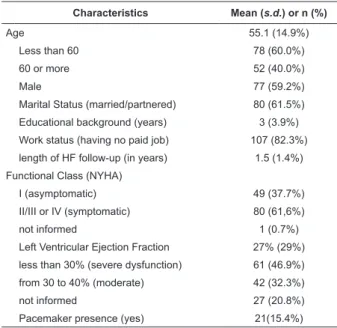
One hundred and thirty patients were included.
Their average age was 55.1 (s.d. = 14.9) and most
of them were less than 60 years old (78; 60%). The
majority was male (n=77, 59.2%), married or living
with a partner (80, 61.5%), they had a low education
level (four years of formal study on average), and no
paid employment (107, 82.3%) (Table 1).
The patients’ length of inclusion into the specialty
HF clinic was 1.5 years on average, ranging from zero
(i.e. patients who were beginning the follow-up on the
day of the interview) to 4.8 years. Most of the patients
(80; 61.6%) were symptomatic in NYHA-Functional
Class II-IV. The mean LVEF was 27% (s.d. = 29;
range from 10% to 43%); 46.9% had severe LVEF and
32.3% had moderate LVEF dysfunction. Twenty-one patients (15.4%) had an artiicial pacemaker due to
bradycardia and none of them had resynchronization
therapy (Table 1).
Fifty-nine participants (44.3%) reported at least
one comorbidity, and 86 (47%) participants showed
associated diseases, such as: systemic arterial hypertension, chronic atrial ibrillation, arrhythmias, and hyperthyroidism. Among the participants, there was a
large variation regarding medication uses, with subjects
using from one to ten different classes of medication
(mean=5.8 e s.d. =1.8). The most common medications
used by the patients and reported in the medical records
were diuretics, Angiotensin-converting enzyme,
Beta-blockers and digitalis.
Table 1 - Characteristics of sample (n=130)
Characteristics Mean (s.d.) or n (%)
Age 55.1 (14.9%)
Less than 60 78 (60.0%)
60 or more 52 (40.0%)
Male 77 (59.2%)
Marital Status (married/partnered) 80 (61.5%)
Educational background (years) 3 (3.9%)
Work status (having no paid job) 107 (82.3%)
length of HF follow-up (in years) 1.5 (1.4%)
Functional Class (NYHA)
I (asymptomatic) 49 (37.7%)
II/III or IV (symptomatic) 80 (61,6%)
not informed 1 (0.7%)
Left Ventricular Ejection Fraction 27% (29%)
less than 30% (severe dysfunction) 61 (46.9%)
from 30 to 40% (moderate) 42 (32.3%)
not informed 27 (20.8%)
Pacemaker presence (yes) 21(15.4%)
Regarding HRQOL, the mean MLHFQ was: 34.9
(s.d. = 24.8; range from 0 to 99). The association
between HRQOL and age was negative and weak
(r=-0.177; p=0.044), although statistically signiicant. Weak
associations were found between HRQOL and length of
HF follow-up (r=-0.233; p=0.015), as well as HRQOL and
left ventricular ejection fraction (r=-0.236; p=0.017)
(Table 2). No association was found between HRQOL and
educational background (r=0.004; p=0.960). However,
Perceived Mental Health, the exploratory variable of
interest, measured by the vitality (r=-.625, p<0.001)
Table 2 - Zero order correlation between HRQOL (MLHFQ
total score) and explanatory variables
Explanatory variables r* p-value†
Age (years) -0.177 .044
Educational background (years) 0.004 .960
Length of HF follow-up (years) -.0213 .015
Left Ventricular Ejection Fraction -0.236 .017
Vitality (SF-36 domain) -0.625 <.001
Mental Health (SF-36 domain) -0.672 <.001
* Pearson’s correlation; † p-value
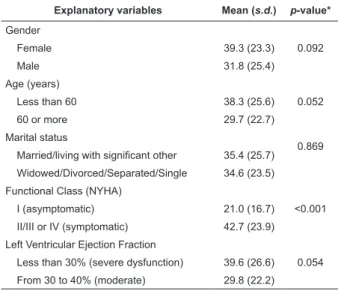
No association was found between HRQOL and
demographic variables. Although younger and female
patients had higher MLHFQ Total scores (indicating
perception of more negative HF effects on quality of
life) than older and male patients, differences were not signiicant (p=0.092 and p=0.052, respectively). Nor did HRQOL vary based on marital status (Table 3). Health-related quality of life was signiicantly lower in patients with worse symptoms (NYHA Class II, III
and IV; p<0.001) but non-signiicant differences were
associated with severe left ventricular dysfunction (less
than 30%; p=0.054) (Table 3).
The multivariate analysis was performed using a two-stepwise regression model, constructed irst by entering NYHA Classiication and then Mental Health and Vitality into the model. After entering the irst step,
Table 3 - Mean of MLHFQ total scale by Categorical
Explanatory Variables
Explanatory variables Mean (s.d.) p-value*
Gender
0.092
Female 39.3 (23.3)
Male 31.8 (25.4)
Age (years)
0.052
Less than 60 38.3 (25.6)
60 or more 29.7 (22.7)
Marital status
0.869
Married/living with significant other 35.4 (25.7)
Widowed/Divorced/Separated/Single 34.6 (23.5)
Functional Class (NYHA)
<0.001
I (asymptomatic) 21.0 (16.7)
II/III or IV (symptomatic) 42.7 (23.9)
Left Ventricular Ejection Fraction
0.054
Less than 30% (severe dysfunction) 39.6 (26.6)
From 30 to 40% (moderate) 29.8 (22.2)
* p-value from Student’s t test
Table 4 - Regression Analysis MLHFQ total score as the Outcome
Explanatory Variable Coefficient St. Error p-value* r2 † p-value‡
STEP 1
NYHA Functional Class (ref.: Class I)
Classes II, III, IV 0.460 4.537 0.00 0.204 0.00
STEP 2:
NYHA Functional Class 0.300 3.764 0.00
Mental Health -0.566 .78 0.00 0.496 0.00
STEP 3:
NYHA Functional Class 0.208 3.725 0.00
Mental Health -0.477 .096 0.00
Vitality -0.195 .104 0.33 0.541 0.00
the adjusted r2 was 0.204. Hence, the presence of HF
symptoms explained, by itself, about 20% of variance
in the HRQOL measure. When adding Mental Health and
Vitality scales, R2 increased to 0.496 (49% of the HRQOL
variance) and this increase was statistically signiicant (p-values <0.001). The inal model explained 54% of
total MLHF scale variation and, also, vitality and mental
health together with NYHA Functional Class explained
34% of variance (Table 4).
* p-value from Student’s t test; † Pearson’s correlation; ‡ p-value
Discussion
The contribution of perceived mental health
(measured by Vitality and Mental Health SF-36
subscales) to explain the variance in HRQOL was high
(31%) after adjusting for demographic and clinical
variables. This is consistent with results usually obtained
from observational studies in clinical research(14). These
results support the hypothesis that symptom severity
and psychological factors (such as mood, depression
and anxiety) signiicantly contribute to HRQOL in HF patients(9-10,20). The levels of HRQOL in our study were
similar to those found in other patients with HF in
Brazil(16,19,21) and in the USA(5,10,14).
The participants in this study were predominantly
less than 60 years old, male, married, with low
Rev. Latino-Am. Enfermagem 2011 May-Jun;19(3):451-7.
www.eerp.usp.br/rlae
as having severe LVEF or moderate LVEF dysfunction.
Among the participants, lower HRQOL was associated
with severity of HF symptoms (NYHA functional Classes
II, III e IV), and severe left ventricular dysfunction. These indings are consistent with studies undertaken in the United Kingdom(14) and the United States(4,7-8). In
line with other studies, younger patients and women
had lower HRQOL(3-4), but there was no association with
marital status. Physical symptom status was the most
powerful predictor of HRQOL in patients with heart
failure(22).
The patients in this study primarily had a lower
socio-economic status and showed high levels of low
literacy, but this is typical for patients treated in Brazilian
public hospitals(16,19,21-23). The HF sample was also similar
to populations from other studies in Brazil(16,21,24).
Although samples used in other studies from the USA(8,25)
and Spain(20) showedsimilar characteristics, most of the
samples have considerably higher socio-economic and
educational levels. In the future, we propose including
this kind of population in a new study in order to improve
our knowledge about that population’s health.
The impact of HF symptoms is both physical and
psychosocial and how to manage these symptoms
effectively is a cornerstone of HF management success
and self-care(3,10). Given the importance of HRQOL
to patients, the adaptation of disease management
interventions to support effective self-care of HF in Brazil
is a priority(16-17,24). Programs to support self-care should
include both patients and partners and examine ways to
ensure that the many facets of these interventions are accessible and beneicial to patients with very low socio-economic and educational levels(9,24-25).
These results suggest that the development and
provision of interventions to improve psychological status
may improve physical symptom status and HRQOL in HF
patients(22). Those most at risk for diminished quality of
life are those of younger age, worse functional status,
increased symptom prevalence and increased symptom
burden(3). Though provision of these therapies to the larger
population with depressive symptoms will be costly, this
may be offset via reduced re-hospitalization rates, which
are also common in HF patients from Brazil.
Conclusion
Regarding the effects of HF on HRQoL, there was
a weak association between HRQoL and the length of
HF follow-up, as well as between HRQoL and the left
ventricular ejection fraction. However, Perceived Mental
Health, the exploratory variable of interest, measured by
the vitality and mental health domains of the SF-36, was signiicantly associated with HRQoL. The contribution of perceived mental health to explain the variance in
HRQoL was higher after adjusting for demographic and
clinical variables. These results support the hypothesis
that symptom severity and psychological factors signiicantly contribute to improve HRQoL in HF patients. Our indings indicated the importance of keeping control of HF symptoms and mental health improvement.
The study is limited by its cross-sectional design and
limitations regarding the number of variables that could
be measured. Further, longitudinal studies are needed to examine the inluence of clinical and psychosocial dimensions on HRQoL across the HF trajectory. Our
results suggest that interventions tailored to improve
self-perceived vitality and mental health may be worth
it to maintain a high level of HRQoL in chronic HF
conditions.
References
1. Rosamond W, Flegal K, Furie K, Go A, Greenlund
K, Haase N, et al. Heart disease and stroke
statistics-2008 update: a report from the American Heart
Association Statistics Committee and Stroke Statistics
Subcommittee. Circulation. 2008;117(4):e25-146.
2. Datasus - Departamento de Informática do SUS.
[homepage na Internet] Brasília: Ministério da saúde
c2008-2009 [acesso 1 dez 2009]. Disponível em: http://
tabnet.datasus.gov.br/cgi/idb2008/matriz.htm.
3. Zambroski CH, Moser DK, Bhat G, Ziegler C. Impact
of symptom prevalence and symptom burden on quality
of life in patients with heart failure. Eur J Cardiovasc
Nurs. 2005; 4(3):198-206.
4. Clark DO, Tu W, Weiner M, Murray MD. Correlates
of health-related quality of life among lower-income,
urban adults with congestive heart failure. Heart Lung.
2003;32(6):391-401.
5. Littik ML, Lesman-Leegte I, Jaarsma T. Quality of life
and depressive symptoms in heart failure patients and
their partners: the impact of role and gender. J Card Fail.
2009;15(7):580-5.
6. Fini A, Cruz DALM. Characteristics of fatigue in heart
failure patients: a literature review. Rev. Latino-Am.
Enfermagem. 2009;17(4):557-65.
7. Carels RA. The association between disease severity,
functional status, depression and daily quality of life
in congestive heart failure patients. Qual Life Res.
www.eerp.usp.br/rlae
8. Rector TS, Kubo SH. Patients’ self-assessment of their
congestive heart failure. Heart Fail. 1987;(3):198-209.
9. Heo S, Lennie TA, Okoli C, Moser DK. Quality of life in
patients with heart failure: ask the patients. Heart Lung.
2009;38(2):100-8.10.
10. Artinian NT, Harden JK, Kronenberg MW, Vander JS,
Daher E, Stephens Q, et al. Pilot study of a Web-based
compliance monitoring device for patients with congestive
heart failure. Heart Lung. 2003;32(4):226-33.
11. Ducharme A, Doyon O, White M, Rouleau JL,
Brophy JM. Impact of care at a multidisciplinary
congestive heart failure clinic: a randomized trial. CMAJ.
2005;173(1):40-5.
12. Ekmam I, Fagerberg B, Lundman B. Health-related
quality of life and sense of coherence among elderly
patients with severe chronic failure in comparison with
healthy controls. Heart Lung. 2002;31(2):94-101.
13. Middel B, Bouma J, Jongste M, van Sonderem E,
Niemeijer MG, van den Heuvel W. Psychometric properties
of the Minnesota Living with Heart Failure Questionnaire
(MLHF-Q). Clin Rehabil. 2001;15(5):489-500.
14. Hobbs FD, Kenkre JE, Roalfe AK, Davis RC, Hare R,
Davies MK. Impact of heart failure and left ventricular
systolic dysfunction on quality of life: a cross-sectional
study comparing common chronic cardiac and medical
disorders and a representative adult population. Eur
Heart J. 2002;23(23):1867-76.
15. Jeng C, Yang MH, Chen PL, Ho CH. The influence of
exercise tolerance on quality of life among patients with
heart failure. Qual Life Res. 2004;13:925-32.
16. Scattolin FAA, Diogo MJD, Colombo RCR. Correlation
between instruments for measuring health-related
quality of life and functional independence on elderly
with heart failure. Public Health. 2007;23(11):2705-15.
17. Carrara D. Avaliação prospectiva da qualidade de vida
em pacientes com miocardiopatia dilatada submetidos
à ventriculectomia parcial esquerda. [dissertação de
mestrado]. São Paulo (SP): Faculdade de Medicina da
Universidade de São Paulo; 2001. 77 p.
18. Ware JE, Sherbourne CD. The MOS 36-item
short-form health survey (SF-36). I. Conceptual framework
and item selection. Med Care. 1992;30(6):473-83.
19. Ciconelli RM, Ferraz MF, Santos W, Meinão I,
Quaresma MR. Brazilian-Portuguese version of the
SF-36. A reliable and valid quality of life outcome measure.
Rev Bras Reumatol. 1999;39(3):143-50.
20. Rodríguez-Artalejo F, Guallar-Castillon P, Pascual CR,
Otero CM, Montes AO, Garcia AN, et al. Health-related
quality of life as a predictor of hospital readmission and
death among patients with heart failure. Arch Intern
Med. 2005;165(11):1274-9.
21. Saccomann IC, Cintra FA, Gallani MCBJ. Psychometric
properties of the Minnesota Living with Heart
Failure-Brazilian version--in the elderly. Qual Life Res.
2007;16(6):997-1005.
22. Heo S, Doering LV, Widener J, Debra K. Moser
DK. Predictors and effect of physical symptom status
on health-related quality of life in patients with heart
failure. Am J Crit Care. 2008;17(2):124-32.21.
23. Dantas RAS, Ciol MA. Quality of life after
coronary artery bypass surgery. West J Nurs Res
2008;30(4):477-90.
24. Rabelo ER, Aliti GB, Domingues FB, Ruschel KB, Brun
AO. What to teach to patients with heart failure and why:
the role of nurses in heart failure clinics. Rev Latino-Am.
Enfermagem. 2007;15(1):165-70.
25. Clark AM, Thompson DR. The future of heart
failure disease management programs. Lancet.
2008;372(9641):784-6.
Received: May 5th 2010