Revista Gaúcha
de Enfermagem
How to cite this article:
Ferreira T, Paula CC, Kleinubing RE, Kinalski DDF, Anversa ETR, Padoin SMM. Evalua-tion of the quality of primary health care for children and adolescents with HIV: PCATool-Brasil. Rev Gaúcha Enferm. 2016 Sep;37(3):e61132. doi: http://dx.doi. org/10.1590/1983-1447.2016.03.61132.
doi: http://dx.doi.org/10.1590/1983-1447.2016.03.61132
Evaluation of the quality of primary
health care for children and
adolescents with HIV: PCATool-Brasil
Avaliação da qualidade da atenção primária à saúde de crianças e adolescentes com HIV: PCATool-Brasi
Evaluación de la calidad de la atención primaria a la salud de niños y adolecentes con VIH: PCATool-Brasil
a Universidade Federal de Santa Maria (UFSM),
Departamento de Enfermagem, Programa de Pós-Graduação em Enfermagem. Santa Maria, Rio Grande do Sul, Brasil.
b Universidade Federal de Santa Maria (UFSM),
Cen-tro de Ciências da Saúde, Programa de Residência Multiprofissional e em Área Profissional da Saúde. Santa Maria, Rio Grande do Sul, Brasil.
c Secretaria Municipal de Saúde de Santa Maria,
Nú-cleo de Educação Permanente em Saúde. Santa Maria, Rio Grande do Sul, Brasil.
Tamiris Ferreiraa
Cristiane Cardoso de Paulaa
Raquel Einloft Kleinubinga
Daniela Dal Forno Kinalskib
Elenir Terezinha Rizzetti Anversac
Stela Maris de Mello Padoina
ABSTRACT
Objective: Assess the overall score of the Primary Health Care in municipalities where children and adolescents living with HIV reside, according to the PCATool-Brazil instrument, professional version.
Methods: Quantitative study with 527 professionals in 25 municipalities where children and adolescents living with HIV reside. Data collection took place between March and August 2014, by applying PCATool-Brazil instrument, professional version. In the data analysis, we used Pearson’s chi-square test, the Mann Whitney test and Poisson regression. All ethical aspects were respected.
Results: The overall assessment of the Basic Health Unit (BHU) and the Family Health Strategy’s (FHS) service quality was satisfactory (6.80). When BHU and FHS were compared, only the latter showed a high score (7.06).
Conclusions: Despite the satisfactory overall score, the need to expand the FSH coverage, and encourage the promotion of compet-itive public service examinations and the qualification of these professionals.
Keywords: Primary health care. Health services evaluation. Child health. Adolescent health. HIV. Nursing.
RESUMO
Objetivo: Avaliar o escore geral da Atenção Primária à Saúde nos municípios de residência de crianças e adolescentes com HIV, segundo o instrumento PCATool-Brasil, versão profissional.
Métodos: Estudo quantitativo, com 527 profissionais, em 25 municípios de residência de crianças e adolescentes com HIV. A coleta de dados realizou-se entre março e agosto de 2014, mediante aplicação do instrumento PCATool-Brasil, versão profissional. Na análise dos dados, utilizou--se o Teste Qui-quadrado de Pearson, Teste de Mann Whitney e Regressão de Poisson. Todos os aspectos éticos foram respeitados.
Resultados: A avaliação geral da qualidade dos serviços de Unidade Básica de Saúde (UBS) e Estratégia de Saúde da Família (ESF) foi satisfatória (6,80). Quando comparados UBS e ESF, somente este último apresentou um alto escore (7,06).
Conclusões: Apesar do escore geral satisfatório, confirma-se a necessidade de ampliar a cobertura de ESF, incentivar a promoção de concursos públicos e a qualificação destes profissionais.
Palavras-chave: Atenção primária à saúde. Avaliação de serviços de saúde. Saúde da criança. Saúde do adolescente. HIV. Enfermagem.
RESUMEN
Objetivo: Evaluar la calificación general de la Atención Primaria a la Salud en los municipios de residencia de los niños y adolecentes viviendo con VIH, según el instrumento PCATool-Brasil, versión profesionales.
Métodos: Estudio cuantitativo, con 527 profesionales, en 25 municipios de residencia de los niños y adolecentes viviendo con VIH. La recolección de datos se realizó entre marzo y agosto de 2014, mediante aplicación del instrumento PCATool-Brasil versión pro-fesionales. En el análisis de los datos se utilizó el Test Qui-cuadrado de Pearson, el Test de Mann Whitney y Regresión de Poisson. Se respetaron los aspectos éticos.
Resultados: La evaluación general de la calidad de los servicios Unidad Básica de Salud (UBS) y Estrategia de Salud de la Familia (ESF) se presentó satisfactoria (6,80). Cuando se compara UBS y ESF, solamente este último presentó alta calificación (7,06).
Conclusiones: A pesar de la calificación general satisfactoria, se confirma la necesidad de ampliar la cobertura de ESF, incentivar la promoción de concursos públicos y la calificación de estos profesionales.
INTRODUCTION
The Acquired Immune Deficiency Syndrome (AIDS), caused by the Human Immunodeficiency Virus (HIV) is a disease that sill has no cure, but with scientific advances such as the introduction of antiretroviral therapy (ART), it is now considered a chronic condition(1-2).
The use of ART secured a higher quality of life and significant improvement in survival(2), contributing to the epidemic affecting people of increasingly younger ages, due to virus infection in children and adolescents, with 201 AIDS cases reported in children aged 0 to 9 years of age, and 405 cases in adolescents 10-19 years of age, in Brazil, until June 2015(3). Considering the recent years, 2012-2014, in the age groups of 0-9 years of age (597, 556 and 510) and 10-19 years of age (964, 1053 and 1057), a reduction in the number of cases in children was shown, but progressive increase in adolescents was also made evident(3).
The monitoring of these children and adolescents permeates aspects related to social vulnerability, depen-dency on the care performed by professionals and family. This is the result of clinical weakness(4), which indicates the need for continuous monitoring in the health ser-vices(5), and, in turn, implies the programmatic vulnerabil-ity(6), such as the need for health care, which should hap-pen seamlessly between specialized services and Primary Health Care (PHC)(7).
The PHC is the preferred service user input in the health system for all new needs and problems, and has strategic importance in structuring actions. It is charac-terized by its essential attributes (first contact access, lon-gitudinality, comprehensiveness, care coordination) and derivatives (cultural competence, family counseling and community)(8).
In Brazil, the PHC consists of the Family Health Strate-gy Services (FHS) and Basic Health Unit (BHU). The FHS is a proposal of the Ministry of Health for the reorganization of PHC, considered an alternative action to achieve the universalization goals, fairness and comprehensiveness(9). Through attention focused on the family, with their phys-ical and social context, it allows professionals a broader view of the needs and interventions that go beyond heal-ing practices(9).
However, the absence of formal or informal commu-nication between services signals the fragmentation of care(10). Thus, the daily care routine is restricted to special-ized services, mainly due to its organization and the experi-ence of their professionals(7).
Fragmentation, in turn, intensifies the culture of search-ing for higher density technology services, encouragsearch-ing
the perception that hospitals solve all problems related to health. Thus, PHC is not recognized as a source of first contact, which prevents the promotion of full and expand-ed attention. Thus, lack of bond generates dissatisfaction and distrust of the service(11). Thus, the PHC care routine involves the practice of the multi-professional team that has, at least, a doctor, nurse, nursing technicians and com-munity health workers, and may include oral health pro-fessionals. It is noteworthy that the nurse plays a leading role in the team, in addition to the care and management activities, which contributes to the quality of care provided and, consequently, the health condition of the people and their community.
In this sense, the evaluation of PHC services through the presence and extent of its attributes is essential, allow-ing the identification of needs related to the entire popu-lation, including those living with HIV, as well as the reor-ganization of actions for health care quality(8). One way to identify whether the services and PHC are oriented accord-ing to their attributes through the instrument Primary Care Assessment Tool (PCATool-Brazil), available in child version, adults and professionals(12).
The productions include the population of children and adolescents, however, although there is research applied to the specificity of infectious diseases (like tu-berculosis and leprosy), this study is unique in relation to HIV infection.
Given the above, the research question was defined as: what is the general score of PHC in municipalities where children and adolescents living with HIV reside, from the experience of professionals? The objective of the study was to evaluate the overall score of PHC in municipalities where children and adolescents living with HIV reside, according to the PCATool Brazil instrument, professional version.
METHODOLOGY
This was a survey with quantitative approach of cross--sectional design, which used the database of the matrix project “Evaluation of primary health care of children and adolescents with HIV.”
Therefore, the research took place in 25 municipalities in the state of Rio Grande do Sul, Brazil, from March to Au-gust 2015, with professionals from 168 services, comprising 60 BHS services and 108 FHS services.
Inclusion criteria were: doctor, nurse and dentist who acted in PHC. professionals on vacation, or away during the collection period were excluded. The population totaled 596 professionals of which 42 (7%) did not meet the inclu-sion criteria. There were 27 losses (4.9%), for 12 professio-nals refused to participate and 15 were not found. Thus, the population surveyed was comprised of 527 professionals, among which, paediatricians, gynecologists and general practitioners, nurses and dentists. Therefore, sample size was not calculated.
During data collection, we used a tool for characteri-zation of professionals, composed of sociodemographic variables (sex and age), academic training (training, time since graduation, graduate programs, graduate program completion and further training) and occupational situa-tion (link to the service, length of service, posisitua-tion in service and having another job). The Primary Care Assessment Tool (PCATool-Brazil), Professional version was also used(12) for the evaluation of health care quality through the presence and extent of the attributes of PHC(8).
The PCATool instrument consists of 77 items, divided into eight components in relation to the attributes of PHC. The answers are in Likert scale, as follows: “definitely” (value = 4), “probably” (value = 3), “probably not” (value = 2), “cer-tainly not” (value = 1) and “I do not know/do not remem-ber” (value = 9). The answers marked “I do not know/do not remember” were considered “probably not” (12).
Data were entered into THE Epi-Info® program, version 7.0, with independent double typing, after checking for errors and inconsistencies. Data analysis was performed using the Statistical Analysis System (SAS) version 9.3.
The scores, essential and derivative, were calculated by the arithmetic mean of their respective attributes and the overall score, the arithmetic mean of the scores of the es-sential attributes and derivatives(12). The values that originally vary in scale of 1 to 4 were processed on a continuous scale from 0 to 10, according to the formula: score from 0 to 10 of attribute X = (score 1 to 4 of attribute X – 1) x 10/ (4 – 1). A high score is considered as one with value> 6.6, which cor-responds in the scale from 1 to 4 to score 3 (“probably”)(12).
The reliability of the PCATool instrument was carried through Cronbach’s alpha (consistency indicators were considered values >0.7). Categorical variables were pre-sented as absolute, and relative frequency and continuous variables, average, standard deviation, median, minimum and maximum.
The Chi-square test was used to compare the propor-tions of dichotomized scores (high score and low score) of the PHC attributes in the variables of socio-demographic profile, training and employment situation of the professio-nal, and the Mann Whitney test was applied to perform the comparison of the scores regarding PHC attributes assig-ned by professionals, according to the type of service (FHS or BHS). For all statistical analyzes, the significance level of 5% was adopted.
Poisson regression with robust variance was applied for verification of variables associated with high scores. Therefore, the prevalence ratios (PR) and their respective confidence intervals (95% CI) were estimated. In the crude and adjusted analysis, the independent variables were as-sociated with a high score of p value <0.25.
The research was approved by the Research Ethics Committee of the Federal University of Santa Maria, CAAE No. 12223312.3.0000.5346/2013, Opinion No. 533126 of Ja-nuary 30, 2014. All participants signed a Free and Informed Consent Form and a Confidentiality Agreement, respec-ting the ethical aspects contained in Resolution No. 466, of December 12, 2012, by the National Health Council of the Ministry of Health of Brazil, which provides for research involving human beings.
RESULTS
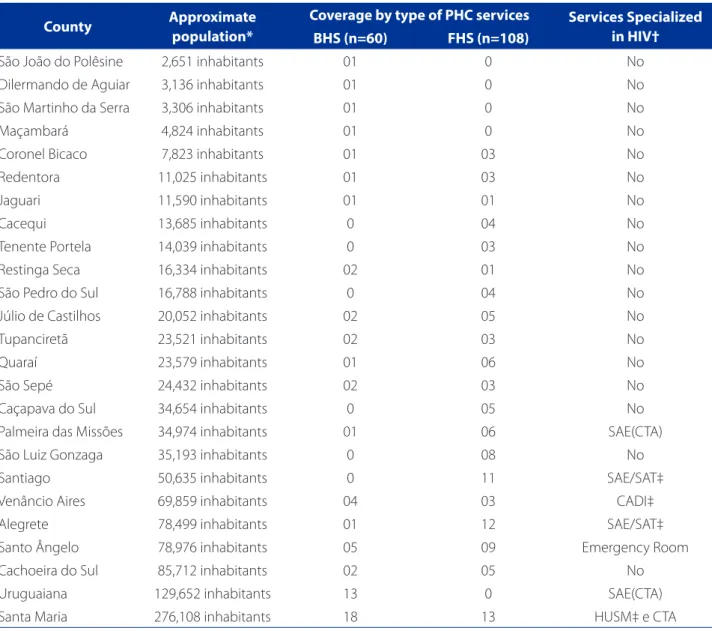
The characterization of the population, the types of ser-vices and existence of specialized HIV serser-vices in 25 muni-cipalities where of children and adolescents living with HIV reside is found in Table 1.
In the assessment of the PHC’s quality by health pro-fessionals from 25 municipalities participating in the study, the overall score of PHC, estimated by PCATool-Brazil, pro-fessional version, presented a high guidance score for PHC (Table 2).
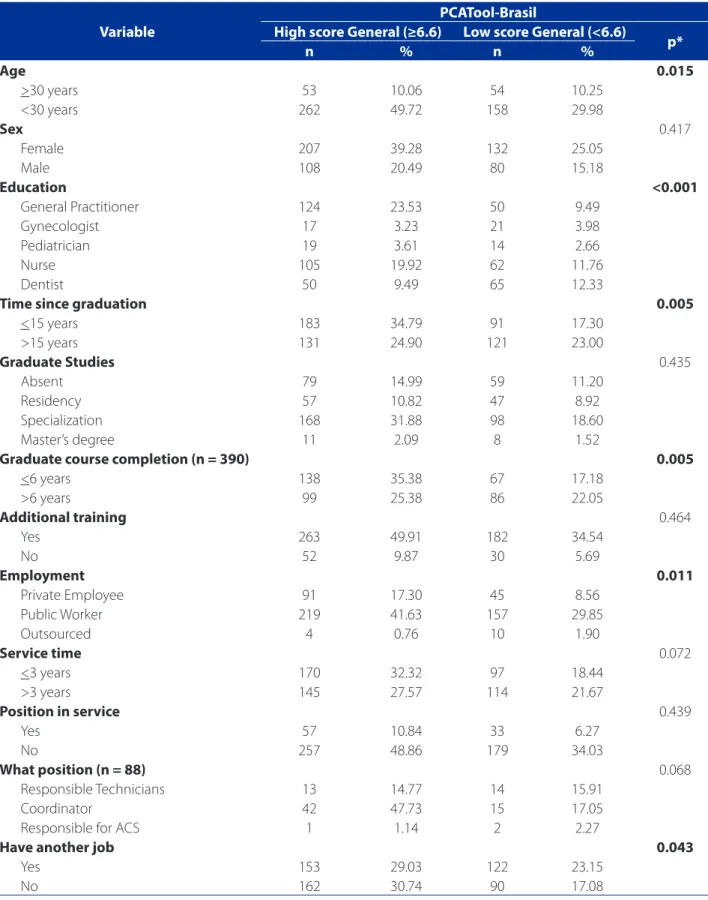
Table 3 contains the sociodemographic characteristics, training and occupational status of professionals, accor-ding to the high and low overall score for PHC. There was significance in the following variables to the high score: age less than 30 years old, professional training as general practitioner and nurses, less training time than or equal to 15 years, conclusion of graduate program equal to or less than six years, a public worker in service and does not have another job.
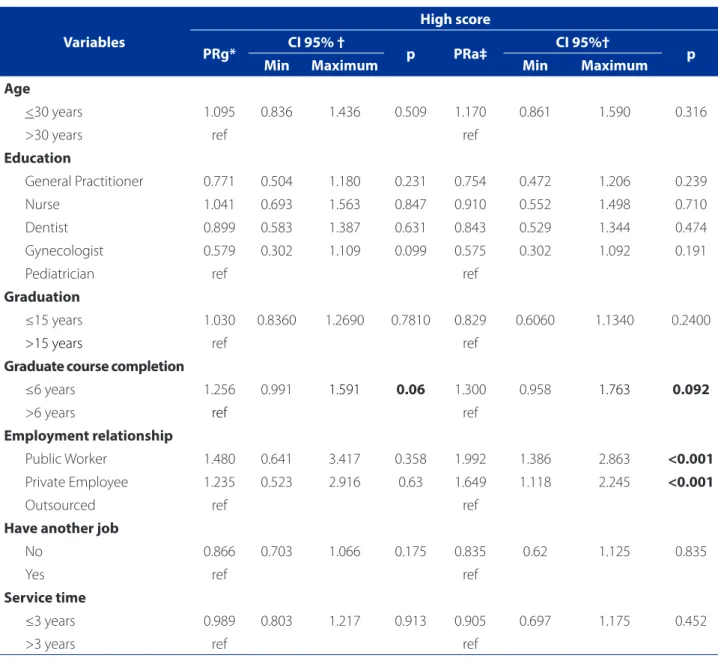
Table 5 shows the gross and adjusted Poisson regres-sion adjusted for independent variables associated with the high score of PHC in relation to health care for
chil-dren and adolescents with HIV in the experience of health professionals of 25 municipalities of Rio Grande do Sul. After adjustments, they were shown to be associated to
County Approximate
population*
Coverage by type of PHC services Services Specialized in HIV† BHS (n=60) FHS (n=108)
São João do Polêsine 2,651 inhabitants 01 0 No
Dilermando de Aguiar 3,136 inhabitants 01 0 No
São Martinho da Serra 3,306 inhabitants 01 0 No
Maçambará 4,824 inhabitants 01 0 No
Coronel Bicaco 7,823 inhabitants 01 03 No
Redentora 11,025 inhabitants 01 03 No
Jaguari 11,590 inhabitants 01 01 No
Cacequi 13,685 inhabitants 0 04 No
Tenente Portela 14,039 inhabitants 0 03 No
Restinga Seca 16,334 inhabitants 02 01 No
São Pedro do Sul 16,788 inhabitants 0 04 No
Júlio de Castilhos 20,052 inhabitants 02 05 No
Tupanciretã 23,521 inhabitants 02 03 No
Quaraí 23,579 inhabitants 01 06 No
São Sepé 24,432 inhabitants 02 03 No
Caçapava do Sul 34,654 inhabitants 0 05 No
Palmeira das Missões 34,974 inhabitants 01 06 SAE(CTA)
São Luiz Gonzaga 35,193 inhabitants 0 08 No
Santiago 50,635 inhabitants 0 11 SAE/SAT‡
Venâncio Aires 69,859 inhabitants 04 03 CADI‡
Alegrete 78,499 inhabitants 01 12 SAE/SAT‡
Santo Ângelo 78,976 inhabitants 05 09 Emergency Room
Cachoeira do Sul 85,712 inhabitants 02 05 No
Uruguaiana 129,652 inhabitants 13 0 SAE(CTA)
Santa Maria 276,108 inhabitants 18 13 HUSM‡ e CTA
Table 1 – Characterization of the 25 municipalities where children and adolescents living with HIV reside in Rio Grande do Sul / Brazil, 2015. (N=168)
Source: *Brazilian Institute of Geography and Statistics (IBGE). Available at: http://www.cidades.ibge.gov.br/xtras/uf.php?lang=&coduf=43&search=rio-grande-do-sul
† List of Specialized Care Services (SAE) and Testing and Counseling Centers (CTA) of Rio Grande do Sul State, Brazil, in 2015. Available at: http://www.saude.rs.gov.br/upload/1416941626_lista%20SAE%20CTA.pdf ‡SAT- Attention Therapy Service; CADI- Center for Infectious Diseases and HUSM- University Hospital of Santa Maria.
Score (0-10)
PHC Feature Mean Standard deviation Median Min Maximum Cronbach Alpha
Overall score 6.80 1.05 6.85 2.63 9.18 0.86
Table 2 – Descriptive statistics of the PHC’s overall score, in experience of health professionals of 25 municipalities of Rio Grande do Sul / Brazil, 2015. (N=527)
Variable
PCATool-Brasil
High score General (≥6.6) Low score General (<6.6)
p*
n % n %
Age 0.015
>30 years 53 10.06 54 10.25
<30 years 262 49.72 158 29.98
Sex 0.417
Female 207 39.28 132 25.05
Male 108 20.49 80 15.18
Education <0.001
General Practitioner 124 23.53 50 9.49
Gynecologist 17 3.23 21 3.98
Pediatrician 19 3.61 14 2.66
Nurse 105 19.92 62 11.76
Dentist 50 9.49 65 12.33
Time since graduation 0.005
<15 years 183 34.79 91 17.30
>15 years 131 24.90 121 23.00
Graduate Studies 0.435
Absent 79 14.99 59 11.20
Residency 57 10.82 47 8.92
Specialization 168 31.88 98 18.60
Master’s degree 11 2.09 8 1.52
Graduate course completion (n = 390) 0.005
<6 years 138 35.38 67 17.18
>6 years 99 25.38 86 22.05
Additional training 0.464
Yes 263 49.91 182 34.54
No 52 9.87 30 5.69
Employment 0.011
Private Employee 91 17.30 45 8.56
Public Worker 219 41.63 157 29.85
Outsourced 4 0.76 10 1.90
Service time 0.072
<3 years 170 32.32 97 18.44
>3 years 145 27.57 114 21.67
Position in service 0.439
Yes 57 10.84 33 6.27
No 257 48.86 179 34.03
What position (n = 88) 0.068
Responsible Technicians 13 14.77 14 15.91
Coordinator 42 47.73 15 17.05
Responsible for ACS 1 1.14 2 2.27
Have another job 0.043
Yes 153 29.03 122 23.15
No 162 30.74 90 17.08
Table 3 – Socio-demographic profile of the training and occupational status of health professionals from 25 municipalities of Rio Grande do Sul / Brazil, according to the evaluation of high and low scores for the overall score of the PHC, 2015. (N=527)
Scores (0-10)
BHS (n=270) FHS (n = 257)
p* Mean Standard
deviation Min Maximum Mean
Standard
deviation Min Maximum
Overall score 6.55 1.12 2.63 8.94 7.06 0.88 4.70 9.18 <0.001
Table 4 – Comparison of PHC of overall scores in relation to health care for children and adolescents with HIV in the expe-rience of health professionals of 25 municipalities of Rio Grande do Sul / Brazil, 2015. (N=527)
Source: Research data, 2015. * Mann Whitney test
Variables
High score
PRg* CI 95% † p PRa‡ CI 95%† p
Min Maximum Min Maximum
Age
<30 years 1.095 0.836 1.436 0.509 1.170 0.861 1.590 0.316
>30 years ref ref
Education
General Practitioner 0.771 0.504 1.180 0.231 0.754 0.472 1.206 0.239
Nurse 1.041 0.693 1.563 0.847 0.910 0.552 1.498 0.710
Dentist 0.899 0.583 1.387 0.631 0.843 0.529 1.344 0.474
Gynecologist 0.579 0.302 1.109 0.099 0.575 0.302 1.092 0.191
Pediatrician ref ref
Graduation
≤15 years 1.030 0.8360 1.2690 0.7810 0.829 0.6060 1.1340 0.2400
>15 years ref ref
Graduate course completion
≤6 years 1.256 0.991 1.591 0.06 1.300 0.958 1.763 0.092
>6 years ref ref
Employment relationship
Public Worker 1.480 0.641 3.417 0.358 1.992 1.386 2.863 <0.001
Private Employee 1.235 0.523 2.916 0.63 1.649 1.118 2.245 <0.001
Outsourced ref ref
Have another job
No 0.866 0.703 1.066 0.175 0.835 0.62 1.125 0.835
Yes ref ref
Service time
≤3 years 0.989 0.803 1.217 0.913 0.905 0.697 1.175 0.452
>3 years ref ref
Table 5 – Gross Poisson regression adjusted for independent variables associated with the high score of PHC in relation to health care for children and adolescents with HIV in the experience of health professionals of 25 municipalities of Rio Grande do Sul / Brazil, 2015. (N=527)
Source: Research data, 2015.
the high score: completion of graduate course ≤6 years; and public employment.
DISCUSSION
The instrument PCATool-Brazil, professional version that was used pointed out that the services were satisfac-tory in providing attention to the health of children and adolescents living with HIV, according to the overall score (6.80). In a study conducted in small and mid-sized mu-nicipalities of the Alfenas micro region, Minas Gerais, with extensive coverage of the FHS and actions for the training of these professionals, the evaluation also showed a high score (7.40)(13).
The results were similar to another study with PHC pro-fessionals involved in PHC services in Chapecó, Santa Cata-rina, which, during the study period, had a network of re-cent expansion of PHC services and 86% of FHS coverage, which also obtained, a high overall score (7.09)(14).
Likewise, there was an overall high score (7.00) in a sur-vey conducted in Montes Claros, Minas Gerais, which evalu-ated PHC services, from the perspective of residents and reg-istered users in the coverage areas of FHS teams(15), diverging from the results found in another study, conducted in the same city with caregivers of children from birth to two years, in which users rated the PHC services as unsatisfactory(16).
This result indicated that the professionals from the original municipalities of children and adolescents with HIV, assessed the PHC services demonstrate quality care to this population. However, the daily care routine indi-cates that attention to this population also focuses on specialized service. It reveals the model of care for acute health conditions, which indicates the need for reorga-nization to care for chronic conditions. This may require users to access and develop ties with the PHC service, close to his home, without their transfer to a specialized center being determined due to their health condition. Thus, there is potential for coordination of care by PHC, and communication between the services for longitudi-nality and comprehensive care(1).
Regarding the score correlation (high/low), with the characteristics of professionals, the variable age (<30 years), showed a significant upward overall score, opposing the average age found in one study in Porto Alegre (> 40 years) (17), and another study in Curitiba (> 35 years)(18).
As for vocational training, the following stood out: gen-eral practitioner and nurse, with a prevailing training time equal to or less than 5 years, and completion of graduate courses or equal to or less than six years. Compared to oth-er studies, the professional profile appeared similar(17-18).
The professionals’ time of training diverged when the medical professional with a training time over 15 years was considered(18), and converged, when considering the nurse, whose training ranged from 9.4 to 13 years in PHC health services(18). As for the time of completion of gradu-ate school, it was not possible to make comparisons, since other studies are turned only to the fact that the profes-sional has such diploma (13-14,17-18), or even if it was focused on PHC(13 to 14,17).
The employment situation that prevailed was that of public workers, without another job, similar to data found in a survey wheret the only employment of profession-als was the PHC service. In these places, make up weekly workload of 40 hours of work(13).
The results, which indicated a significant relationship between the quality of PHC and the employment situation (public worker) of the professional and time since graduate course completion, pointed to the need for investment in training and continuing education, enabling the streng-thening of the professional practice.
In the compared score (high / low) between the types of service (FHS / BHS), a low score (6.55) was achieved for the BHS service, and a high score (7.06) for the FHS, pre-senting greater presence and extent of the PHC attributes. These findings corroborate the study in Porto Alegre, where BHS services were also considered unsatisfactory (6.58), with higher scores for services with FHS (7.08)(17), as in the comparison performed by users of Colombo, metro-politan region of Curitiba, in which the FHS services were considered satisfactory (6.6) and BHS, unsatisfactory (3.9), with a value below the cut(19).
However, another survey of professionals pointed out that both services have obtained satisfactory assessments of the overall score (BHS = 6.70 vs FHS = 7.40), but signifi-cantly higher value was given for the FHT services(18).
The high score in the FHS indicated the need to expand the coverage of this type of service, since the evaluation verified by PCATool demonstrated a statistically significant quality in this type of service. Among the challenges for Brazilian PHC consolidation, an increased family health coverage was shown as key(20).
These findings showed the importance of evaluation, from different experiences, in view of the different wei-ghtings between users and professionals. In addition, the evaluation of PHC services in different locations may help to understand the real picture of the Brazilian primary care, in order to collaborate with the intensification of actions for the qualification of these services.
of peculiarities. Therefore, the generalization of data should be made with caution. However, the implementation of the unprecedented nature of this instrument in the con-text of infectious diseases denotes the relevance of similar assessments that can serve as a basis for improvement of actions and public policies.
CONCLUSION
It is concluded that the instrument used, PCATool--Brazil, professional version, although not specific to the population living with HIV, obtained a satisfactory score, indicating that the PHC services have the potential to serve children and adolescents living with HIV. This is a recommendation from Brazilian public policy, evidenced through research. However, the culture of specialty over-laps even in their everyday life, reflecting the transfer of users with HIV to specialized service. It is suggested that children and adolescents with HIV are referred to specia-lists to meet the specifics of their chronic condition and continue attending the PHC services for other health de-mands such as, for example, monitoring of their growth and development.
Comparing the services, only those with FHS were sho-wn to focus on the defining attributes of the PHC, which highlights the need to expand the coverage of these ser-vices. The identification of variables associated with high overall score of PHC pointed to the importance of attrac-ting human resources through public procurement. The variable graduate school time of completion indicated the need for investments in the qualification of these profes-sionals, through the fostering of postgraduate courses and continuing education activities, providing a more qualified assistance to users.
Finally, there are the contributions of this study for tea-ching, considering the possibility of expanding the discus-sions related to the care of children and adolescents with HIV, under the care model perspective to chronic condi-tions, advocating the integration between the different points of the health care network, under the coordination of PHC. For assistance, the possibility of investments in communication between the services was envisioned. It is also urgent that services determine the tasks to meet the health needs of this population and when referral is indica-ted. This integration between services can be established by means of a flow of users in the health system.
Considering the leading role played by nurses, the pos-sibility of investments to: identify children and adolescents with HIV in the territory of PHC services can be signaled; establish communication with the specialized service in
which monitoring is maintained; actively search for this population; propose monitoring of child care, and the promotion of adherence to treatment. These can be some possibilities of contribution for the practice of nursing care, in order to enhance the access of this population in BHS/ FHS, the completeness and longitudinality in care, under the coordination of PHC.
And finally, this study points to the need for investment in new research aimed at adaptation and validation of an assessment tool that is specific to people living with HIV.
REFERENCES
1. Mendes, EV. As redes de atenção à saúde. 2. ed. Brasília: Organização Pan-Ame-ricana da Saúde, 2011. 549 p.
2. Bazin GR, Gaspar MCS, Silva NCXM, Mendes CC, Oliveira CP, Bastos LS, et al. Tera-pia antirretroviral em crianças e adolescentes infectados pelo HIV: o que sabe-mos após 30 anos de epidemia. Cad Saúde Pública. 2014 abr;30(4):687-70. doi: http://dx.doi.org/10.1590/0102-311X00075413.
3. Ministério da Saúde (BR), Secretaria de Vigilância Sanitária, Departamento de DST, AIDS e Hepatites Virais. Boletim Epidemiológico – AIDS/DST. Brasília (DF); 2015.
4. Silveira A, Neves ET. Vulnerabilidade das crianças com necessidades es-peciais de saúde: implicações para a enfermagem. Rev Gaúcha Enferm. 2012;33(4):172-80.
5. Ribeiro AC, Padoin SMM, Paula CC, Terra MG. O cotidiano do adolescente que tem HIV/AIDS: impessoalidade e disposição ao temor. Texto Contexto Enferm. 2013 jul-set;22(3):680-6.
6. Ayres JRCM, Paiva V, França Jr I. From natural history of disease to vulnerability: changing concepts and practices in contemporary public health. In: Parker R, Sommer M, editors. Routledge handbook of global public health. Abingdon: Taylor and Francis; 2011. p. 98-107.
7. Palácio MB, Figueiredo MAC, Souza LB. O cuidado em HIV/AIDS e a Aten-ção Primária em Saúde: possibilidades de integraAten-ção da assistência. Psico. 2012;43(3):350-67.
8. Starfield B. Atenção primária: equilíbrio entre necessidades de saúde, serviços e tecnologia. Brasília: Unesco, Ministério da Saúde; 2002 [citado 02 nov. 2015]. 725p. Available at: http://bvsms.saude.gov.br/bvs/publicacoes/atencao_pri-maria_p1.pdf.
9. Oliveira MAC, Pereira IC. Atributos essenciais da Atenção Primária e a Estratégia Saúde da Família. Rev Bras Enferm. 2013 set;66(no esp.):158-64. doi: http:// dx.doi.org/10.1590/S0034-71672013000700020.
10. Zambenedetti G, Both NS. Problematizando a atenção em HIV-aids na Estratégia Saúde da Família. Polis Psique. 2012;2(1):99-119.
11. Nobrega VM, Damasceno SS, Rodrigues PF, Reichert PHC, Collet N. Atenção à criança com doença crônica na Estratégia Saúde da Família. Cogitare Enferm. 2013 jan-mar;18(1):57-63. doi: http://dx.doi.org/10.5380/ce.v18i1.28517. 12. Ministério da Saúde (BR), Secretaria de Atenção em Saúde. Departamento de
Atenção Básica. Manual do instrumento de avaliação da atenção primária à saúde: Primary Care Assessment Tool PCATool-Brasil. Brasília (DF); 2010. 13. Silva SA, Nogueira DA, Paraizo CMS, Fracolli LA. Avaliação da Atenção Primária
14. Vitoria AM, Harzheim E, Takeda SP, Hauser L. Avaliação dos atributos da atenção primária à saúde em Chapecó, Brasil. Rev Bras Med Fam Comunidade. 2013 out-dez;8(29):285-93. doi: http://dx.doi.org/10.5712/rbmfc8(29)832.
15. Oliva ACD, Moura CMR, Lima CA, Costa FM, Rocha JFD. Avaliação dos atributos do cuidado primário de saúde na perspectiva do usuário. Rev UNIABEU. 2015 jan-abr;8(18):196-208.
16. Leão CDA, Caldeira AP, Oliveira MMC. Atributos da atenção primária na as-sistência à saúde da criança: avaliação dos cuidadores. Rev Bras Saúde Matern Infant. 2011 jul-set;11(3):323-34. doi: http://dx.doi.org/10.1590/S1519-38292011000300013.
17. Castro RCL, Knauth DR, Harzheim E, Hauser L, Duncan BB. Avaliação da qualida-de da atenção primária pelos profissionais qualida-de saúqualida-de: comparação entre
diferen-tes tipos de serviços. Cad Saúde Pública. 2012 set;28(9):1772-84. doi: http:// dx.doi.org/10.1590/S0102-311X2012000900015.
18. Chomatas E, Vigo A, Marty I, Hauser L, Harzheim E. Avaliação da presença e ex-tensão dos atributos da atenção primária em Curitiba. Rev Bras Med Fam Comu-nidade. 2013;8(29):294-303. doi: http://dx.doi.org/10.5712/rbmfc8(29)828. 19. Oliveira VBCA, Veríssimo MLOR. Assistência à saúde da criança segundo suas
famílias: comparação entre modelos de atenção primária. Rev Esc Enferm USP. 2015;49(1):30-6. doi: http://dx.doi.org.10.1590/S0080-623420150000100004. 20. Malta DC, Santos MAS, Stopa SR, Vieira JEB, Melo EA, Reis C, et al. A cobertura
da Estratégia de Saúde da Família (FHS) no Brasil, segundo a Pesquisa Nacional de Saúde, 2013. Ciênc Saúde Coletiva 2016;21(2):327-38. doi: http://dx.doi. org/10.1590/1413-81232015212.23602015.
Corresponding author:
Cristiane Cardoso de Paula
E-mail: [email protected]