RESEARCH
Health care for children and adolescents with HIV: a comparison of services
Atenção à saúde de criança e adolescente com HIV: comparação entre serviços
Atención de salud del niño y el adolescente con HIV: comparación entre servicios
Clarissa Bohrer da Silva
I, Cristiane Cardoso de Paula
I, Luis Felipe Dias Lopes
II, Erno Harzheim
III,
Tânia Solange Bosi de Souza Magnago
I, Maria Denise Schimith
II Universidade Federal de Santa Maria, Postgraduate Program in Nursing. Santa Maria, Rio Grande do Sul, Brazil. II Universidade Federal de Santa Maria, Postgraduate Program in Administration. Santa Maria, Rio Grande do Sul, Brazil. III Universidade Federal do Rio Grande do Sul, Postgraduate Program in Epidemiology. Porto Alegre, Rio Grande do Sul, Brazil.
How to cite this article:
Silva CB, Paula CC, Lopes LFD, Harzheim E, Magnago TSBS, Schimith MD. Health care for
children and adolescents with HIV: a comparison of services. Rev Bras Enferm [Internet]. 2016;69(3):489-97. DOI: http://dx.doi.org/10.1590/0034-7167.2016690315i
Submission: 03-25-2015 Approval: 04-11-2015
ABSTRACT
Objective: compare the quality of different types of health care for children and adolescents with HIV, in the experience of family members and caregivers. Method: a cross-sectional study was conducted with 71 family members and caregivers, using the children’s version of the Primary Care Assessment Tool (PCATool-Brazil). The Mann-Whitney or Student’s t-test and Pearson’s chi-square or Fisher’s exact test were used for the analysis. Results: primary care services and, predominantly, specialized HIV services, were identifi ed as the regular health care sources. There were no signifi cant differences in quality, since their scores were close to the ideal level. Conclusion: the attributes of these services need to be improved, which would entail reformulating their structural and performance aspects. In addition, it is imperative to recognize primary health care as an integral place for promoting the health of children and adolescents with HIV.
Descriptors: Child Health; Adolescent Health; Primary Health Care; Health Services Assessment; HIV.
RESUMO
Objetivo: comparar a qualidade da atenção à saúde das crianças e dos adolescentes com HIV entre os tipos de serviços, na experiência dos familiares/cuidadores. Método: estudo transversal desenvolvido com 71 familiares/cuidadores utilizando-se o Instrumento de Avaliação da Atenção Primária (PCATool-Brasil) versão criança. Para análise utilizou-se o Teste de Mann-Whitney ou T student e Qui-quadrado de Pearson ou Exato de Fisher. Resultados: foram apontados como fonte regular de atenção os serviços de Atenção Primária à Saúde e, majoritariamente, o serviço especializado ao HIV. Não houve diferenças signifi cativas na qualidade de ambos, visto que seus escores atingiram valor próximo ao ideal. Conclusão: evidencia-se a necessidade de aprimorar os seus atributos, o que implica em reformulações de seus aspectos de estrutura e desempenho. Além disso, é imperativo o reconhecimento da Atenção Primária à Saúde como espaço integrante da promoção à saúde das crianças e adolescentes com HIV.
Descritores: Saúde da Criança; Saúde do Adolescente; Atenção Primária à Saúde; Avaliação de Serviços de Saúde; HIV.
RESUMEN
Objetivo: comparar la calidad de atención de salud de niños y adolescentes con HIV entre los tipos de servicio, según experiencia de familiares/cuidadores. Método: estudio transversal desarrollado con 71 familiares/cuidadores, utilizándose el Instrumento de Evaluación de la Atención Primaria (PCATool-Brasil), versión niños. Para el análisis, se aplicó Test de Mann-Whitney o T Student, y Chi-cuadrado de Pearson o Exacto de Fisher. Resultados: fueron considerados como fuente regular de atención los servicios de Atención Primaria de Salud y, mayoritariamente, el servicio especializado en HIV. No existieron diferencias signifi cativas entre la calidad de ambos, alcanzando ellos puntajes cercanos al ideal. Conclusión: se evidencia la necesidad de mejorar sus atributos, lo cual implica reformulaciones de sus aspectos de estructura y desempeño. Además, el imperativo el reconocimiento de la Atención Primaria de Salud como espacio integrante de la promoción de salud de los niños y adolescentes con HIV.
Descriptores: Salud del Niño; Salud del Adolescente; Atención Primaria de Salud; Evaluación de Servicios de Salud; HIV.
Clarissa Bohrer da Silva E-mail: [email protected]
INTRODUCTION
Infection by human immunodeficiency virus (HIV) in chil-dren and adolescents is categorized as infection by vertical and horizontal transmission. Vertical transmission characterizes new-borns infected due to the HIV-positive serological status of their mothers. Horizontal transmission involves infection through ex-posure through sexual activity or blood. In Brazil, from 1980 to 2013, 18,807 cases of acquired immunodeficiency syndrome (AIDS) were reported in the age group of 0 to 9 years old (chil-dren) and 15,480 in the age group of 10 to 19 years old (adoles-cents). Taking recent years into account, there has been a reduc-tion in the number of cases reported among children (640 in 2011 and 584 in 2012). However, there has been an increase in relation to adolescents (887 in 2011 and 923 in 2012)(1).
Early diagnosis and treatment of children and adolescents with HIV are a health care priority. Although domestic public policies to counter the AIDS epidemic have received interna-tional recognition, there are still barriers to achieving quality health care in this area, whether due to regional diversity or lack of communication in governmental spheres(2). Strength-ening of the health care system occurs through investments in accessible services, which provide a continuum of care, in addition to coordinating the flow of users through shared responsibility among professionals(3).
The affiliation of children and adolescents with HIV seeks to identify the health care services that act as a reference for the continuity of their care, regardless of the existence of an established health care network, and may be any type of health care service or professional(4). However, health care for this population often centers on the need for a team of profession-als with experience, and structured services and technology for clinical and laboratory follow-up(3). These are overloaded in terms of demand, because of lack of human resources and adequate infrastructure(5).
Therefore, activities related to specialized HIV/AIDS services need to be decentralized and expanded into the area of primary health care (PHC), as a way to recognize it as a care coordina-tor and to qualify this care(6-7). Primary health care constitutes a key component of the health care system due to its strategic role in the structuring of actions. It is primarily characterized by its essential attributes (first contact access, longitudinality, com-prehensiveness and care coordination) and derivative attributes (cultural competence and family and community orientation). On the basis of these attributes, it is possible to determine the quality of services and promote better health care indicators, greater patient satisfaction and lower costs(8).
It is important to assess the quality of health care received by this population in an effort to identify care gaps and pro-mote improvement in the structure and performance of the care provided(9). This assessment involves the relationship be-tween the needs of the population and the services provided, in order to produce reliable data and enhance decision-mak-ing and the reorganization of care actions(10). The objective of this study was to compare the quality of different kinds of health care services for children and adolescents with HIV, in the experience of family members and caregivers.
METHOD
This was a cross-sectional study that was conducted in a spe-cialized outpatient service for children and adolescents with HIV in the city of Santa Maria, Rio Grande do Sul, Brazil. This service was chosen for data collection because it provided ac-cess to the population through their regular follow-up visits.
The population of family members and caregivers of chil-dren and adolescents with HIV (N=80) was used, but a sam-ple size calculation was not performed. The inclusion crite-ria were: family members and caregivers of children (0 to 9 years old) and adolescents (10 to 19 years old)(1) with HIV receiving follow-up care in a specialized health care service. The following were excluded: family members and caregiv-ers with limitations that hindered verbal communication and those who reported private services as the regular health care source. There was a total of 80 potential participants. Three people refused to participate, four family members and care-givers were excluded because they reported private services as the regular health care source, and two were no longer re-ceiving follow-up care. That left a final total of 71 participants. The data collection was carried out from January to Sep-tember 2013. The family members and caregivers were ap-proached in the health care service when they accompanied the children and adolescents on the day of their appointment. The data collectors used a research protocol containing: Part 1 – questionnaire to characterize the population, including so-ciodemographic, clinical and health care service use data; and Part 2 – Primary Care Assessment Tool (PCATool-Brazil) - chil-dren’s version (applied to family members and caregivers)(8,11).
This instrument measures the presence and extent of PHC attributes, which each include a component related to struc-ture and performance, forming an assessment of how much the health care services are guided by the defining PHC attributes, i.e., their quality. The instrument is composed of a Likert scale with the following possible responses for each item: “definitely” (value=4), “probably” (value=3), “probably not” (value=2), “definitely not” (value=1) and “I don’t know/I can’t remember” (value=9). The score can range from 1 to 4 for each attribute(9).
The preferred type of health care service for the children and adolescents was defined by the family members and care-givers based on the three initial questions from the PCATool-Brazil establishing the strength of affiliation: 1) in relation to the health care services that were sought in light of the needs of the children and adolescents; 2) who knew the children and adolescents best; and 3) who was more responsible for the health care of the children and adolescents(8). The rest of the instrument was answered based on the services reported in the strength of affiliation. For the data analysis, the responses were characterized into “specialized HIV services” and “PHC services”. The following were considered to be PHC services: Primary Health Units and the Family Health Strategy.
closest to the home, type of service and if the child or adoles-cent was taken to this service. To characterize the quantitative variables (age, years of education, diagnosis time and income), a median was used as a cut-off point, given the asymmetrical distribution of the data.
The data was organized in the program Epi info® 6.04, entered in separately two times, followed by correction of any errors or inconsistencies. The data analysis was performed with the soft-wareStatistical Analysis System (SAS), Version 9.3. The normal-ity distribution of the variables was assessed by the Shapiro-Wilk test. The internal consistency of the PCATool-Brazil, children’s version, was assessed by Cronbach’s alpha (α = 0.874). The attributes and their components were analyzed by calculation of the scores: the essential attributes, derivative attributes and overall score for each attribute, according to the guidelines from the PCATool-Brazil Manual(8). The scores were transformed into a continuous scale ranging from 0 to 10, where ≥ 6.6 was con-sidered a high score. This score is equivalent, on a scale from 1 to 4, to a score of 3 (“probably”), which corresponds to an ap-propriate extent of the attribute(8).
For the association analysis of the variables (sociodemo-graphic, clinical and use of the service) for the service that regularly cared for the child or adolescent, the Chi-square test or Fisher’s exact test was used. To compare the means of each attribute between the types of service, the Mann-Whitney or Student’s t-test was used. For the proportions analysis, the Pearson’s chi-square or Fisher’s exact test was used, in an ef-fort to identify the variables (sociodemographic, clinical and use of health services) that could be associated with the qual-ity of the service cited as the regular health care source. Thus, the group was dichotomized in relation to the assigned score, into high or satisfactory (≥ 6.6) or low (< 6.6) scores. The assumed level of significance for the tests was 5%.
The ethical aspects were based on the guidelines of Reso-lution 196/96, in force at the time of the study(12). The objec-tives of the study were explained to the family members and caregivers, who were asked to sign two copies of the Free and Informed Consent Form. The study was approved by the Re-search Ethics Committee of the Federal University of Santa Maria in January 2013.
RESULTS
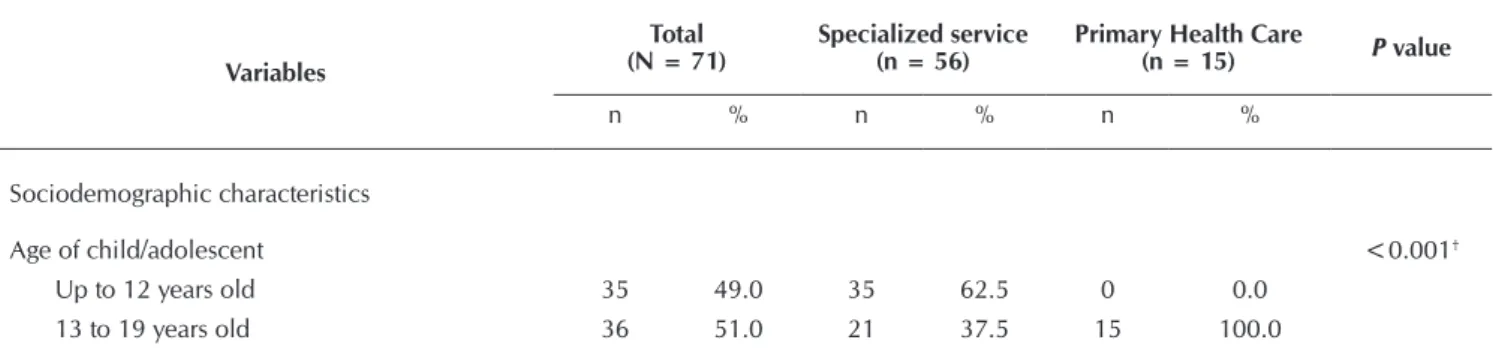
Of the 71 participants, 56 reported the specialized HIV service as the regular health care source. The specialized service was indi-cated as the service generally sought when there was a new health problem (43); as the one that best knew the child or adolescent (45); and as the service most responsible for the health of the child or adolescent with HIV (60). Table 1 presents the sociodemograph-ic, clinical and health service use characteristics, according to the regular care source reported by the family members and caregivers. Among the sociodemographic, clinical and health service use variables, the following were statistically associated with the service that regularly cared for the child or adolescent: age of the child or adolescent, years of education of the family member or caregiver, time since diagnosis, child or adoles-cent receives treatment, and family member or caregiver takes the child or adolescent to the service closest to home.
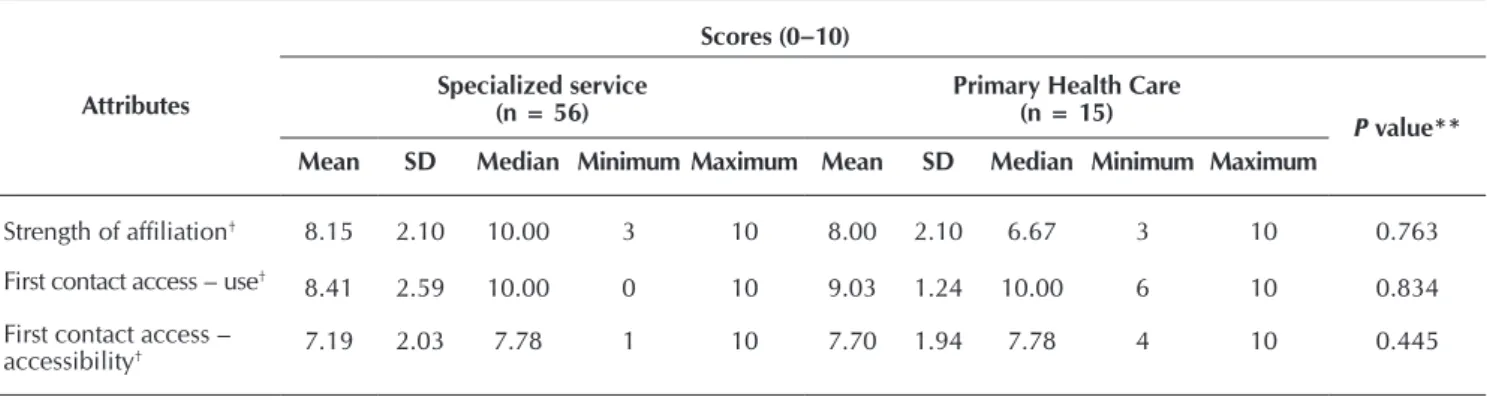
Table 2 presents the scores for the attributes in relation to the health care of children and adolescents with HIV, estab-lishing a comparison between the types of service.
In the assessment of attributes according to type of service, both had satisfactory scores (≥ 6.6) for the attributes: strength of affiliation; first contact access – use; first contact access – accessibility; longitudinality; coordination – care integration; coordination – information system; comprehensiveness – ser-vices available. There were no statistically significant differ-ences between the two. In the combined analysis of the attri-butes, neither service had a satisfactory overall score.
An analysis was performed of the association between the characteristics (sociodemographic, clinical and health service use) and best care assessment (high overall score), according to the type of service (specialized or PHC) established by the strength of affiliation (Table 3).
In the assessment of the population characteristics associated with the overall score of the specialized service, no statistical difference was noted that could be associated with the high score. The same occurred with the PHC service. In other words, no characteristic was associated with the high score of either PHC or the specialized service, indicating that the population characteristics did not affect the care assessment of the services.
Table 1 – Sociodemographic, clinical and health service use characteristics of children and adolescents with HIV, according to the type of service reported by the family members and caregivers as the regular care source, Santa Maria, Rio Grande do Sul, Brazil, 2013
Variables
Total (N = 71)
Specialized service (n = 56)
Primary Health Care
(n = 15) P value
n % n % n %
Sociodemographic characteristics
Age of child/adolescent <0.001†
Up to 12 years old 35 49.0 35 62.5 0 0.0
13 to 19 years old 36 51.0 21 37.5 15 100.0
Table 1 (concluded)
Variables
Total (N = 71)
Specialized service (n = 56)
Primary Health Care
(n = 15) P value
n % n % n %
City of origin 0.079†
Santa Maria 35 49.0 31 55.0 4 27.0
Other 36 51.0 25 45.0 11 73.0
Main caregiver 0.549*
Mother 38 54.0 31 55.0 7 47.0
Other 33 46.0 25 45.0 8 53.0
Income (n = 69) 0.575*
Up to 1,000 BRL 37 54.0 28 52.0 9 60.0
Over 1,000 BRL 32 46.0 26 48.0 6 40.0
Years of education of family member/caregiver 0.008†
Up to 6 years 41 58.0 37 66.0 4 27.0
Over 6 years 30 42.0 19 34.0 11 73.0
Clinical characteristics
How the child/adolescent contracted HIV 1.000†
Vertical transmission 64 90.0 50 89.0 14 93.0
Other 7 10.0 6 11.0 1 7.0
Time since diagnosis 0.009†
Up to 8.5 years 36 51.0 33 59.0 3 20.0
Over 8.5 years 35 49.0 23 41.0 12 80.0
Child/adolescent undergoing drug treatment 0.006†
No 5 7.0 1 2.0 4 27.0
Yes 66 93.0 55 98.0 11 73.0
Health service use characteristics
Knows health service closest to home 1.000†
No 4 6.0 3 5.0 1 7.0
Yes 67 94.0 53 95.0 14 93.0
Type of service closest to home (N = 66) 1.000†
PHC 63 95.0 48 94.0 15 100.0
Other 3 5.0 3 6.0 0 0.0
Goes to the service closest to home 0.002†
No 40 56.0 37 66.0 3 20.0
Yes 31 44.0 19 34.0 12 70.0
Notes: *Pearson’s Chi-square test; †Fisher’s exact test.
Table 2 – Comparison between the means of the attribute scores among the services reported as the regular care source, 2013 (N=71)
Attributes
Scores (0–10)
Specialized service (n = 56)
Primary Health Care
(n = 15) P
value**
Mean SD Median Minimum Maximum Mean SD Median Minimum Maximum
Strength of affiliation† 8.15 2.10 10.00 3 10 8.00 2.10 6.67 3 10 0.763
First contact access – use† 8.41 2.59 10.00 0 10 9.03 1.24 10.00 6 10 0.834
First contact access –
Table 2 (concluded)
Attributes
Scores (0–10)
Specialized service (n = 56)
Primary Health Care
(n = 15) P
value**
Mean SD Median Minimum Maximum Mean SD Median Minimum Maximum
Longitudinality* 8.02 1.12 8.18 5 10 7.67 1.93 7.88 2 10 0.750
Coordination – care
integration † 8.09 2.43 9.33 0 10 8.16 2.32 9.33 4 10 0.978
Coordination –
information system† 7.71 2.17 7.78 2 10 7.18 2.48 7.78 2 10 0.476
Comprehensiveness –
services available* 7.14 1.63 7.41 3 10 6.94 1.67 6.85 3 10 0.872
Comprehensiveness –
services provided† 6.57 3.49 7.67 0 10 6.42 4.04 8.33 0 10 0.958
Family centeredness†
5.21 2.93 5.28 0 10 4.48 3.54 4.44 0 10 0.449
Community orientation†
2.53 3.18 1.67 0 10 1.92 3.33 0.00 0 10 0.310
Essential score* 7.02 1.43 7.22 4 9 6.93 1.63 6.45 4 9 0.459
Derivative score† 3.67 2.37 3.33 0 10 3.07 3.04 2.22 0 10 0.178
Overall score* 6.43 1.34 6.49 3 8 6.13 1.61 5.53 3 8 0.341
Notes: * Normal distribution; † Asymmetric distribution; **Mann-Whitney test or Student’s t-test; SD= Standard deviation.
Table 3 – Association of the sociodemographic, clinical and health service use characteristics with low/high scores, according to the regular care source for children and adolescents with HIV, 2013 (N=71)
PCATool-Brazil
Variables
Specialized service (n = 56) Primary Health Care Service (n = 15)
High overall score (≥ 6.6)
Low overall score (< 6.6)
P value
High overall score (≥ 6.6)
Low overall score (< 6.6)
P value
n % n % n % n %
Age of child/adolescent 0.094*
-Up to 12 years old 12 50.0 23 72.0 - - -
-13 to 19 years old 12 50.0 9 28.0 5 100.0 10 100.0
City of origin 0.351* 0.230†
Santa Maria 15 62.5 16 50.0 0 0.0 4 40.0
Other 9 37.5 16 50.0 5 100.0 6 60.0
How HIV was contracted 1.000† 0.333†
Vertical transmission 21 87.5 29 91.0 4 80.0 10 100.0
Other 3 12.5 3 9.0 1 20.0 0 0.0
Time since diagnosis 0.084* 0.505†
Up to 8.5 years 11 46.0 22 69.0 0 0.0 3 30.0
Over 8.5 years 13 54.0 10 31.0 5 100.0 7 70.0
Child/adolescent receives treatment 1.000† 0.560†
No 0 0.0 1 3.0 2 40.0 2 20.0
Yes 24 100.0 31 97.0 3 60.0 8 80.0
DISCUSSION
For most of the interviewees, the specialized service was identified as the regular health care source. Another study corroborates this result and attributes it to the organization of the health care system and the experience of the professionals from this service(13).
The findings related to the sociodemographic characteris-tics indicate greater vulnerability of the population that uses the specialized service as the regular care source. This vulner-ability lies in the prevalence of the age group up to 12 years old and the low educational level of their family members and caregivers. This result is similar to that of another study, which reinforces the pauperization trend of the epidemic, due to the increased number of cases in individuals with a low educa-tional level, which is also a socioeconomic status marker(14). With regard to the clinical characteristics, the length of time since the original diagnosis was longer among those who in-dicated the PHC as the regular care source than among those who reported the specialized service and were undergoing drug treatment. This confirms the importance of care being shared with the PHC service, regardless of whether treatment is being carried out. This coincides with a study conducted
in Africa, where users at a less advanced and clinically stable stage of the disease were cared for by PHC teams, and the rest by specialized services(15).
As for use of the services, those who reported the special-ized service did not use the service closest to home for the provision of health care for children and adolescents with HIV, corroborating the findings of another study, which affirms that the closest health service is generally not used to promote health among this population(16). On the other hand, in the case of other infectious diseases, such as tuberculosis, there have been proposals to control them at the PHC level through the incorporation of diagnostic, treatment and prevention ac-tions. Primary health care services are also responsible for the diagnosis and control of other chronic conditions, such as high blood pressure(18). What makes it difficult to implement actions to affiliate HIV patients with PHC services is the lack of professional preparedness to care for this population and the stigma attached to the disease(19).
In relation to the scores for the attributes of the services iden-tified as the regular care source by family members and caregiv-ers, most of the attributes obtained high scores. For the attri-bute first contact access, the scores were satisfactory and similar between the services, indicating that this population is able to
PCATool-Brazil
Variables
Specialized service (n = 56) Primary Health Care Service (n = 15)
High overall score (≥ 6.6)
Low overall score (< 6.6)
P value
High overall score (≥ 6.6)
Low overall score (< 6.6)
P value
n % n % n % n %
Main caregiver 0.698* 0.282†
Mother 14 58.0 17 53.0 1 20.0 6 60.0
Other 10 42.0 15 47.0 4 80.0 4 40.0
Years of education of family member/caregiver 0.221* 0.230†
Up to 6 years 18 75.0 19 59.0 0 0.0 4 40.0
Over 6 years 6 25.0 13 41.0 5 100.0 6 60.0
Income 0.967* 1.000†
Up to 1,000 BRL 12 52.0 16 52.0 3 60.0 6 60.0
Over 1,000 BRL 11 48.0 15 48.0 2 40.0 4 40.0
Knows health service closest to home 1.000† 1.000†
No 1 4.00 2 6.0 0 0.00 1 10.0
Yes 23 96.0 30 94.0 5 100.0 9 90.0
Type of service closest to home 0.258†
-PHC 21 100.0 27 90.0 5 100.0 10 100.0
Other 0 0.0 3 10.0 - - -
-Goes to the service closest to home 0.103* 0.241*
No 13 54.0 24 75.0 2 40.0 1 10.0
Yes 11 46.0 8 25.0 3 60.0 9 90.0
access health services. The components accessibility and access obtained higher scores at the PHC level, unlike the findings of other studies that assessed PHC in relation to the general popu-lation, where the scores were lower(20-21). This may be because PHC services are often closer to users’ homes than specialized services and, therefore, are the first services sought(21).
The satisfactory score for the longitudinality attribute for both services shows that it is essential for the health care of children and adolescents with HIV, since it seeks to have a care source, maintain regular use and constitute a link that reflects mutual cooperation between users and health profes-sionals(9). It is important to note that the difficulty of providing continuity of health care results in high proportions of HIV tests not being performed and people with HIV not taking an-tiretroviral treatment(22). The higher score for the specialized service may be due to the continuous follow-up that occurs there because of the chronic nature of the disease.
The care coordination attribute also obtained a satisfactory score for both services. The fact that the care integration com-ponent received a higher score in the PHC service suggests that this service focuses on referral and communication with oth-er health soth-ervices. The high score for the information system component in the specialized service indicates that this service is much better organized and informational in relation to the documents and medical records of its patients. It is worth noting that referral to specialized services often results in disconnect-ing users from PHC services and transferrdisconnect-ing the responsibility for their follow-up(13). Therefore, for users, specialized services may represent the place where care is provided for their health condition, suggesting that they have no need to disclose their diagnosis to PHC teams(6). This is a mistaken notion, since spe-cialists may provide more appropriate care for the disease itself, but PHC professionals can integrate the care with the range of other health problems affecting individuals(10).
In the analysis of the comprehensiveness attribute, the avail-able services component obtained a satisfactory score for both services, demonstrating that family members and caregivers believe that the services care for the basic needs of the pop-ulation, including supplies such as vaccines and medicine. However, the services provided component yielded a score below that considered ideal, indicating the need to invest in promotion and prevention activities, so that they can be effec-tively executed by health services. One study points out that PHC professionals report obstacles in caring for people with HIV, such as work overload, lack of privacy for providing care, and the stigma attached to the disease(13,19,23). Professionals need to be trained in terms of early diagnosis, clinical aspects, diseases associated with HIV, treatment, and the need to refer users to specialized services(13).
The family centeredness attribute did not achieve a satisfac-tory score for either of the services assessed, despite high lon-gitudinality scores. However, the specialized service, which obtained a higher score than PHC, tends to enhance the life context of children and adolescents and their insertion into their families and communities (24).
The family members and caregivers also assigned low scores to the community orientation attribute for both services. It is
important to note that PHC services should address commu-nity health needs through direct contact with the population and knowledge of its epidemiological profile(10). The difficulty of promoting health is due to the limitations of public policies related to HIV prevention and control, which need planning and investment. Specialized services meet growing demand by individuals suffering from the disease; however, they are not designed to provide community orientation. This popu-lation also needs to receive care in PHC services, in order to balance the demand and enable more concrete actions in specialized services(25). To achieve this attribute in PHC servic-es, household visits can be carried out by health profession-als and community agents, resulting in health surveillance, strengthening of ties, educational activities and identification of risk situations(26).
In the essential score analysis, it was found that both ser-vices were providing care that was aligned with PHC attri-butes. As for the derivative score, it indicated that health ser-vices still need to improve actions that focus on families and communities. The combined analysis of the attributes (overall score) indicated that the services were below the level consid-ered as ideal, although they were close. This result coincides with other studies that have assessed PHC(27)and reinforces the importance of the role of health care services in boosting the quality of life of this population(28). There was no statisti-cally significant difference in the assessment of the services, indicating that family members and caregivers may consider them as having similarities. In addition, no characteristic was associated with a high score for either the PHC or specialized service, demonstrating that the characteristics of the popula-tion did not affect the care assessments for the services.
Through the results analysis, it can be inferred that the fam-ily members and caregivers noted positive aspects in the care provided in the specialized service as the regular care source, primarily in terms of more contact with the professionals from this service. This result indicates that specialized services are striving to serve this population. On the other hand, users should place more trust in PHC and view the integration of the services as a care continuum. One study indicates that care is often disconnected from PHC services, either due to the unpreparedness of professionals or the organization of the operation of the services(13). It must be borne in mind that, in some cases, PHC professionals are unfamiliar with the ac-tions performed by specialized HIV services, and also do not identify infected users as being within their scope of work(13). In fact, primary health care should play an important role in receiving and counseling this population on how to handle their chronic condition, mainly in reference to social and fam-ily interactions, health care routines and famfam-ily planning(6).
CONCLUSION
be promoted. The results of this study also emphasize the need to improve certain attributes of PHC and specialized services, which would entail reformulating some aspects of their struc-ture and performance, in order to provide the intended quality. Although children and adolescents with HIV are often re-ferred to specialists, they should continue using PHC services for their chronic condition and other health needs related to longitudinality and care coordination. The services should de-fine the responsibilities for meeting the health needs of this population and decide when referral is indicated. Specialized services are dedicated to specific care for the disease, includ-ing clinical and therapeutic needs, but it is the role of PHC to coordinate care and follow-up of users in their communities, in order to promote their health. In this regard, it is imperative to integrate the services, which can be established through a flow of users in the health care system.
It is recommended that PHC carry out the following ac-tivities: engaging in needed information campaigns to change behavior regarding prevention of infection and reinfection; diagnosing new cases of HIV; serving as a point of reference for specialized services so as to maintain an ongoing flow of care; monitoring childcare and pubertal changes in children and adolescents with HIV; complying with the immunization calendar; promoting health based on the family and social context; helping people sign up for treatment and resolve non-specific complaints and comorbidities; actively seeking users; and sharing information systems between services.
To integrate services, PHC professionals could be required to receive training (through short courses and continuing edu-cation) aimed at a collaborative care model to provide ongo-ing trainongo-ing and support. Integration also requires strengthen-ing communication between services, clear definition and distribution of their activities, collaboration with other non-health-related government sectors, commitment from the government to a formal policy and legislation to legitimize actions that integrate services, and commitment to infection care in the long term.
It is worth noting that, in this study, the attributes were as-sessed through the experience of users (family members and caregivers), who tend to have a more critical view of health care services, which illustrates the need to include other so-cial actors. A limitation was the population size of the study. Because it was conducted with a population that was linked to the specialized service, the study ended up excluding other children and adolescents with HIV who were receiv-ing follow-up in other services, which statistically affected the chances of association in comparing the services. It should be emphasized that the results are restricted to a single city, so any generalization of the data must be done with caution. However, the lack of national studies on the subject suggests that similar assessments would be relevant and could serve as input to improve actions and public policies through discus-sions with users, professionals and managers, acting as a tool to guide implementation in the health care system.
REFERENCES
1. Brasil. Ministério da Saúde. Secretaria de Vigilância Sanitária, Departamento de DST, AIDS e Hepatites Virais. Boletim Epi-demiológico AIDS/DST. Brasília: Ministério da Saúde; 2013. 2. Villarinho MV, Padilha MI, Berardinelli LMM, Borenstein
MS, Meirelles BHS, Andrade SR. [Public health policies fac-ing the epidemic of AIDS and the assistance for people with the disease]. Rev Bras Enferm [Internet]. 2013[cited 2014 Jun 20];6(2):271-7. Available from: http://www.scielo.br/ pdf/reben/v66n2/18.pdf Portuguese.
3. Palácio MB, Figueiredo MAC, Souza LB. O cuidado em HIV/ AIDS e a atenção primária em saúde. Psico (Porto Alegre) [Internet]. Porto Alegre, 2012[cited 2014 Jun 20];43(3):350-67. Available from: http://revistaseletronicas.pucrs.br/teo/ojs/ index.php/revistapsico/article/view/9816/8237
4. Cunha EM, Giovanella L. [Longitudinality/continuity of care: identifying dimensions and variables to the evalu-ation of Primary Health Care in the context of the Brazil-ian public health system]. Ciênc Saúde Colet [Internet]. 2011[cited 2014 Jun 20];16(Supl1):1029-42. Available from: http://www.scielo.br/pdf/csc/v16s1/a36v16s1.pdf Portuguese.
5. Brasil. Ministério da Saúde. Secretaria de Vigilância em Saúde. Departamento de DST, AIDS e Hepatites Virais. Caderno de boas práticas em HIV/AIDS na atenção bási-ca. Brasília: 2014.
6. Ferreira FC, Nichiata LYI. Women living with aids and the family health program professionals: disclosing the diag-nosis. Rev Esc Enferm USP [Internet]. São Paulo, 2008[cit-ed 2014 Jun 12];42(3):483-9. Available from: http://www. scielo.br/pdf/reeusp/v42n3/en_v42n3a09.pdf
7. Mendes EV. As redes de atenção à saúde. Brasília: Orga-nização Pan-Americana da Saúde; 2011. 549 p.
8. Brasil. Ministério da Saúde. Secretaria de Atenção em Saúde. Departamento de Atenção Básica. Manual do instru-mento de avaliação da atenção primária à saúde: primary care assessment tool pcatool – Brasil. Brasília: Ministério da Saúde; 2010. 80 p.
9. Furtado MCC, Braz JC, Pina JC, Mello DF, Lima RAG. As-sessing the care of children under one year old in Primary Health Care. Rev Latino-Am Enferm [Internet]. 2013[cited 2014 May 12];21(2):554-61. Available from: http://www. scielo.br/pdf/rlae/v21n2/0104-1169-rlae-21-02-0554.pdf 10. Starfield B. Atenção Primária: equilíbrio entre necessi-dades de saúde, serviços e tecnologia. Brasília: UNESCO-Ministério da Saúde; 2002. 726p.
pdf/csp/v22n8/13.pdf Portuguese.
12. Brasil. Ministério da Saúde. Conselho Nacional de Saúde. Comissão Nacional de ética em Pesquisa. Diretrizes e normas regulamentadoras de pesquisa em seres huma-nos. Resolução Nº196, de 10 de outubro de 1996. 2. ed. Brasília, 2003. 64p.
13. Silva LMS, Guimarães TA, Pereira MLD, Miranda KCL, Oliveira EN. [Integration in Health: Evaluating Articulation and Co-Responsibility between the Family Health Program and Specialized Assistence Service]. Epidemiol Serv Saúde [Internet]. 2005[cited 2014 Jun 20];14(2):97-104. Available from: http://scielo.iec.pa.gov.br/pdf/ess/v14n2/v14n2a05.pdf Portuguese.
14. Souza CC, Mata LRF, Azevedo C, Gomes CRG, Cruz GECP, Toffano SEM. Interiorização do HIV/AIDS no Brasil: um estudo epidemiológico. Rev Bras Ciênc Saúde [Internet]. 2013[cited 2014 Jun 20];11(35):25-30. Available from: http://seer.uscs.edu.br/index.php/revista_ciencias_saude/ article/view/1798/1380
15. Brennan AT, Long L, Maskew M, Sanne I, Jaffray I, MacPhail P, et al. Outcomes of stable HIV-positive patients down-referred from a doctor-managed antiretroviral therapy clinic to a nurse-managed primary health clinic for moni-toring and treatment. AIDS [Internet]. 2011[cited 2014 Apr 12];25(16):2027-36. Available from: http://www.ncbi.nlm. nih.gov/pmc/articles/PMC3669640/pdf/nihms-446164.pdf 16. Barbosa SM, Costa PNP, Vieira NFC. Comportamento dos
pais em relação à comunicação com os filhos adolescentes sobre prevenção de HIV/AIDS. Rev RENE [Internet]. Fortale-za, 2008[cited 2014 May 20];9(1):96-102. Available from: http://www.revistarene.ufc.br/revista/index.php/revista/ article/view/527/pdf
17. Figueiredo TMRM, Villa TCS, Scatena LM, Gonzales RIC, Netto AR, et al. Performance of primary healthcare ser-vices in tuberculosis control. Rev Saúde Públ [Internet]. 2009[cited 2014 Jun 12];43(5):825-31. Available from: http://www.scielo.br/pdf/rsp/v43n5/en_265.pdf
18. Rabetti AC, Freitas SFT. Evaluation of actions concerning systemic arterial hypertension in primary healthcare. Rev Saúde Públ [Internet]. 2011[cited 2014 Jun 12];45(2):258-68. Available from: http://www.scielo.br/pdf/rsp/v45n2/ en_2141.pdf
19. Mugala N, Mutale W, Kalesha P, Sinyinza E. Barriers to implementation of the HIV guidelines in the IMCI algo-rithm among IMCI trained health workers in Zambia. BMC Pediatrics [Internet]. 2010[cited 2014 Jun 12];10(93):[7 pages]. Available from: http://www.biomedcentral.com/
content/pdf/1471-2431-10-93.pdf
20. Almeida PF, Fausto MCR, Giovanella L. Fortalecimento da atenção primária à saúde: estratégia para potencializar a co-ordenação dos cuidados. Rev Panam Salud Pública [Inter-net]. 2011[cited 2014 Jun 20];29(2):84-95. Available from: http://www.scielosp.org/pdf/rpsp/v29n2/a03v29n2.pdf 21. Oliveira IBN. Acesso universal? Obstáculos ao acesso,
continuidade do uso e gênero em um serviço especial-izado em HIV/AIDS em Salvador, Bahia, Brasil. Cad Saúde Pública [Internet]. 2009[cited 2014 Jun 20];25(Sup 2):S259-68. Available from: http://www.scielo.br/pdf/csp/ v25s2/08.pdf
22. Guimarães MDC. [Vulnerability and HIV]. Rev Méd Minas Gerais [Internet]. 2013[cited 2014 Jun 12];23(4):409-11. Available from: http://rmmg.org/artigo/detalhes/402 Portuguese.
23. Acioli S, Heringer A, Oliveira DC, Gomes AMT, Costa TL, Formozo GA. Produção científica sobre a prática do enfer-meiro frente à AIDS na atenção básica de saúde. Rev Enferm UERJ [Internet]. 2007[cited 2014 Jun 20];15(3):400-5. Avail-able from: http://www.facenf.uerj.br/v15n3/v15n3a13.pdf 24. Potrich T, Paula CC, Padoin SMM, Silva CB. Cuidado
fa-miliar na adesão à terapia antirretroviral em crianças com HIV/AIDS. Cogitare Enferm [Internet]. 2013[cited 2014 Jun 20];18(2):379-86. Available from: http://ojs.c3sl.ufpr. br/ojs/index.php/cogitare/article/view/32589/20705 25. Lima ICV, Galvão MTG, Paiva SS, Brito DMS. Ações de
promoção da saúde em serviço de assistência ambulatorial especializada em HIV/AIDS. Ciênc Cuid Saúde [Internet]. 2011[cited 2014 Jun 20]; 10(3):556-63. Available from: http://periodicos.uem.br/ojs/index.php/CiencCuidSaude/ article/view/13193/pdf
26. Lopes WO, Saupe R, Massaroli A. Visita domiciliar: tec-nologia para o cuidado, o ensino e a pesquisa. Ciênc Cuid Saúde [Internet]. 2008[cited 2014 Jun 20];7(2):241-7. Available from: http://periodicos.uem.br/ojs/index.php/ CiencCuidSaude/article/viewFile/5012/3247
27. Leão CDA, Caldeira AP, Oliveira MMC. Atributos da aten-ção primária na assistência à saúde da criança: avaliaaten-ção dos cuidadores. Rev Bras Saúde Matern Infant [Internet]. 2011[cited 2014 Jun 20];11(3):323-34. Available from: http://www.scielo.br/pdf/rbsmi/v11n3/a13v11n3.pdf 28. Meirelles BHS, Silva DMGV, Vieira FMA, Souza SS,