SUMMARY
Objective: To evaluate the impact of the fortiication of rolls with microencapsulated iron sulfate with sodium alginate on the hemoglobin levels in preschoolers as compared to controls. Meth-ods: Double-blind randomized controlled trial comprised of children aged 2 to 6 years with initial hemoglobin exceeding 9 g/dL from four not-for-proit daycares randomly selected in the city of São Paulo – Brazil. Children of 2 daycares (n = 88) received rolls with fortiied wheat lour as the exposed group (EC) and children of 2 daycares (n = 85) received rolls without fortiication as the control group (CG) over a 24-week period. Rolls with 4 mg iron each were ofered once a day, ive days a week. Hemoglobin concentrations were determined in capillary blood by HemoCue® at three moments of trial: baseline (M1), ater 12 and 24 weeks of intervention (M2, M3). Results:
Hemoglobin concentration presented signiicant increase up to M3 in EG (11.7-12.5-12.6 g/dL) and in CG (11.1-12.4-12.3 g/dL) with higher elevations in children initially with anemia. here was signiicant reduction in the occurrence of anemia from 22% to 9% in EG and from 47% to 8.2% in CG at M3. Conclusion: Rolls fortiied with microencapsulated iron sulfate were well tolerated, in-creased hemoglobin levels and reduced the occurrence of anemia, but with no diference compared to the control group.
Keywords: Food, fortiied; iron; child; anemia; lour.
©2012 Elsevier Editora Ltda. All rights reserved.
RESUMO
Estudo duplo-cego randomizado controlado com pães fortiicados com ferro microencapsulado
Objetivo: A deiciência de ferro é a carência nutricional mais frequente no Brasil, tendo como principal etiologia a baixa ingestão do mineral. A fortiicação alimentar é medida sustentável e de melhor custo-benefício para a prevenção e controle. O objetivo foi avaliar o impacto da fortiicação de pães com sulfato ferroso microencapsulado com alginato de sódio sobre os níveis de hemo-globina em pré-escolares, comparados com controles. Métodos: Estudo duplo-cego randomizado controlado incluindo crianças de 2 a 6 anos com hemoglobina inicial maior que 9 g/dL procedentes de 4 creches ilantrópicas selecionadas aleatoriamente, São Paulo – Brasil. Crianças de 2 creches (n = 88) receberam pães com farinha de trigo fortiicada, constituindo o grupo exposto (EC), e de outras 2 creches (n = 85) receberam pães não fortiicados, compondo o grupo-controle (CG), du-rante 24 semanas. Pães contendo 4 mg de ferro foram oferecidos uma vez ao dia, cinco dias por se-mana. As concentrações de hemoglobina foram determinadas no sangue capilar por HemoCue® em três momentos do estudo: momento inicial (M1), após 12 e 24 semanas da intervenção (M2, M3).
Resultados: A concentração de hemoglobina apresentou aumento signiicativo até M3 no EG (11,7-12,5-12,6 g/dL) e no CG (11,1-12,4-12,3 g/dL) com maiores elevações nas crianças inicial-mente anêmicas. Houve redução signiicativa na ocorrência de anemia de 22% a 9% no EG e de 47% a 8,2% no CG em M3. Conclusão: Os pães fortiicados com sulfato ferroso microencapsulado foram bem tolerados, elevando os níveis de hemoglobina e reduzindo a ocorrência de anemia, porém sem diferenças em relação ao grupo-controle.
Unitermos: Alimentos fortiicados; ferro; criança; anemia; farinha.
©2012 Elsevier Editora Ltda. Todos os direitos reservados.
Study conducted at Universidade Federal de São Paulo, São Paulo, SP, Brazil
Submitted on: 07/05/2011 Approved on: 10/16/2011
Financial Support:
Secretaria da Ciência, Tecnologia e Desenvolvimento Econômico do Estado de São Paulo
Correspondence to:
Teresa Negreira Navarro Barbosa Rua Loefgreen, 1647 CEP: 04040-032 São Paulo, SP, Brazil [email protected]
Conlitct of interest: None.
Double-blind randomized controlled trial of rolls fortified with
microencapsulated iron
TERESA NEGREIRA NAVARRO BARBOSA1, JOSÉ AUGUSTODE AGUIAR CARRAZEDO TADDEI2, DOMINGOS PALMA3, FÁBIO ANCONA-LOPEZ4,
JOSEFINA APARECIDA PELLEGRINI BRAGA5
1 PhD in Sciences; Professor,Department of Pediatrics, Universidade de Santo Amaro (UNISA), São Paulo, SP, Brazil
2 PhD; Associate Professor of Nutrology, Department of Pediatrics, Universidade Federal de São Paulo/Escola Paulista de Medicina (UNIFESP/EPM), São Paulo, SP, Brazil 3 PhD in Pediatrics, Associate Professor of Nutrology, Department of Pediatrics, UNIFESP/EPM, São Paulo, SP, Brazil
4 PhD; Professor, Department of Pediatrics, UNIFESP/EPM, São Paulo, SP, Brazil
INTRODUCTION
Presently, iron deiciency anemia is considered as the ma-jor nutrition deiciency inserting infants and preschoolers as groups of major risk, especially in the developing coun-tries. Improper diet due to low iron bioavailability is its main etiology1.
he development of eicient strategies for prevention and control of iron deiciency anemia is still a great chal-lenge in several regions of the world. Such strategies in-clude nutrition education, medicine supplementation for age groups at major risk, and food fortiication that should be combined and associated to public health strategies. Individually, fortiication is considered to be the most fea-sible and best cost-efective strategy1,2 .
In several countries and in Brazil, studies on children’s feeding with a wide variety of fortiied foods such as milk and dairy products, cookies, spices, sugar, fruit beverages and juices, cereals and instant noodles, in addition to bak-ery products, have indicated good results for a wide seg-ment of this population in short term3-9.Cereal lours have been used traditionally as vehicles for iron fortiication. In Brazil, studies indicate that foods made from wheat lour are an important contribution as nutrition resource for general population, and when fortiied they become an important alternative to cover iron deiciency, mainly among the low-income population10.
Among the compounds used for food fortiication, the group including the so-called protective compounds has the advantage of being more resistant to the environment inluence, (b) reducing interactions with other nutrients or ingredients of diets, and (c) improving the mineral reten-tion in the inal product, thus enabling improvements in bioavailability1,11. According to the available literature, the major advantage of fortiication with microencapsulated iron regards to the possibility of adding compounds with relatively high bioavailability to food vehicles of diicult fortiication such as cereal lours, without causing the usu-al usu-alterations of color and taste. Preliminary studies have demonstrated good iron absorption originating from mi-croencapsulation and signiicant increase in hemoglobin levels ater its utilization12-14.
Considering the high national prevalence of iron de-iciency anemia and the diiculties to assess the existing control measures, the present trial aimed at using the wheat lour fortiication and the rolls baking with this in-novative introduction of microencapsulated iron sulfate, as well as the evaluation of the impact of consumption on the hemoglobin levels and the occurrence of anemia in preschoolers of daycare centers in São Paulo, SP, Brazil, as compared to controls.
METHODS
STUDY POPULATION AND DESIGN
he study was conducted in four not-for-proit daycares associated to the Municipal Secretary for Education of
São Paulo – SP, Brazil, selected by similarity criteria. A ith daycare was eligible for the pilot trial that lasted two weeks. he studied population consisted of children aged 2 to 6 years who attended daycares from 7 a.m. to 5 p.m. dur-ing workdur-ing days and received ive meals per day.
he study was a 24-week (100 working days) double-blind institutional randomized controlled trial resulting in prevalent cases of anemia and variation of hemoglobin lev-els. he trial population was stratiied so that the children of the two daycares receiving fortiied rolls with ferrous sulphate microencapsulated with sodium alginate formed the Exposed Group (EG) and the children of the other two daycares receiving the rolls without fortiied wheat lour formed the Control Group (CG). he head of the Depart-ment of Nutrition and responsible for the preparation of ITAL and delivery of bread participated in the randomiza-tion of the subjects and had knowledge of the groups until the end of the study.
For sample size calculation it was used the Epi-Info version 6.04, whereas ater the institutional trial, double-blind randomization by cluster (two nurseries were ran-domly assigned to receive enriched bread and two to re-ceive non-enriched bread), the prevalence of anemia in the intervention group was 10% and in the control group 25%, we would have with a = b = 0.05 and 0.20, the sample size for each group would be 112. To restore any losses and cor-recting for the fact that randomization was not a sampling unit, but cluster, we adopted 20% larger sample size of 134 in each group.
he individual consumption of rolls was properly reg-istered on a card everyday by a member of the ield team of each daycare center. Consumption was measured in half-roll servings with a maximum of three half-rolls per day.
Ater the intervention, children who had ingested less than one roll per day on average were excluded.
he children from the daycares had similar baseline socioeconomic characteristics and EG and CG presented no statistical diferences for the means of age, gender and iron content in diets. Children were evaluated for hemo-globin levels at three moments of the trial: baseline (M1), ater 12 weeks (M2) and ater 24 weeks (M3).
No other programmed intervention took place during the trial period.
his study was approved by the Universidade Federal de São Paulo, Ethics Committee for Research, number 0173/03, and was initiated only ater the informed written consent was obtained from the adults responsible for each child and from the board of directors of the not-for-proit entities.
EXCLUSION CRITERIA
FORTIFICATION AND CHARACTERISTICS OF THE FORTIFIED FOOD
he small rolls used in this trial weighed 20 g and were programmed for a 4 mg basic iron content per unit as mi-croencapsulated iron sulfate equal to approximately 30% of Dietary Reference Intake (DRI). he microcapsules with iron sulfate microparticles covered with sodium alginate (natural polysaccharide extracted from seaweed) were de-veloped and prepared by the Laboratório de Tecnologia de Partículas do Instituto de Pesquisas Tecnológicas do Estado de São Paulo (IPT) (Particle Technology Laboratory of the São Paulo Institute for Technologic Research) using spray drying technique15. No other iron fortiied food product was served at daycares during the trial and all preschool chil-dren received the regular daycare diet. Rolls were baked and packed weekly at the Instituto de Tecnologia de Alimentos do Governo do Estado de São Paulo (ITAL) (State of São Paulo Government Institute for Food Technology) and labeled with each daycare’s name in order to be ofered at breakfast. A maximum of 3 rolls/day per child was allowed. Bread ofered to children in the control group were prepared identically, except for the non-addition of ferrous sulphate.
A pilot project trained ield team comprised of four graduate students stayed at each daycare every morning for registering the roll consumption, morbidity, absences and intercurrences.
QUALITY CONTROL OF ROLLS AND FOOD ANALYSIS PROPERTIES
A package of 12 rolls was collected from each daycare ev-ery week in order to determine the iron content by atomic absorption and threefold reading. Food analysis was made using one sample of roll received on the same day from all daycares by an independent laboratory (not the one that produced the rolls). Microbiologic analysis showed proper patterns for consumption of rolls with and without forti-ication. A taste panel with trained adults was utilized for sensory analysis to verify for texture, appearance, taste and lavor which have shown no modiications.
DETERMINATION OF IRON CONCENTRATION
A package of rolls from each daycare center was collected weekly as sample to be analyzed at the Research Labora-tory of the Discipline of Pediatric Gastroenterology, Uni-versidade Federal de São Paulo (UNIFESP).
Rolls were crushed inside their own wrappings. hree 1 g samples from each wrapping were weighed. hen, 1 g of roll sufered HNO3/HClO4 digestion and the volume was completed up to 50 L with Milli-Q water. he iron dosage was determined using Perkin-Elmer 5.100 atomic absorption spectrophotometer; hollow-cathode lamp; wave-length: 248,3 nm; slit: 0,2 nm; energy: 60; air/acety-lene oxidizing lame: 10:3; nonlinear calibration; integra-tion time: 3 seconds; standard Fe Tritisol – Merck diluted in Milli-Q water in concentrations 0,1; 0,2; 0,3; 0,5 and 1,0 µg/mL. Readings were made three times.
DIETARY IRON CONTENT IN MEALS
he dietary iron content ofered at daycares was calcu-lated using Monsen’s16 method based on the mean analy-sis for the 5-meal menu served everyday during 5-week days17. An estimate intake of 1 small roll per day for dren aged 2 to 4 years and 1-1/2 small roll for older chil-dren was considered.
HEMOGLOBIN EVALUATION
A portable Hemocue photometer (Hemocue, Angelholm, Sweden) was used to measure hemoglobin using electric power. Capillary blood samples were obtained using dis-posable lancets EZ-Lets II Red (Palco Labs Incorporated, USA) and collected in disposable HemoCue® microcu-vettes by a unique trained member, always in the morning period. Hemoglobin < 11.0 g/dL was considered as ane-mia18.Equipment calibration was checked using the equip-ment cuvette control in the beginning of all collection days and at every 10 readings.
he capillary blood samples were obtained by digital puncture of right hand’s ring ingertip previously cleaned with alcohol 70%, followed by gently milking and collect-ing a drop of blood, and always in the morncollect-ing period.
he result expressed in g/dL was digitally read in 30 seconds and immediately noted on a proper card. Every equipment were admeasured at IPEM/INMETRO – Insti-tuto de Pesos e Medidas/InstiInsti-tuto Nacional de Metrologia (Institute of Weights and Measures/National Institute for Metrology).
STATISTICAL ANALYSIS
Data were double entered in database using Epi Info 6.04 sotware with subsequent validation. For the analysis of results StataCorp 2003 and Epi-Info 6.04 sotwares were used. he following statistic tests were used: G-Cochran test was used to compare the occurrence of anemia in the three study moments in the two groups; Student’s t-test
was used to assess the hemoglobin mean diferences for the EG and CG; p < 0.05 was adopted for signiicance level.
RESULTS
he studied population was comprised of 324 children whose initial prevalence of anemia was 39.2% and at the end of trial 11.7%.
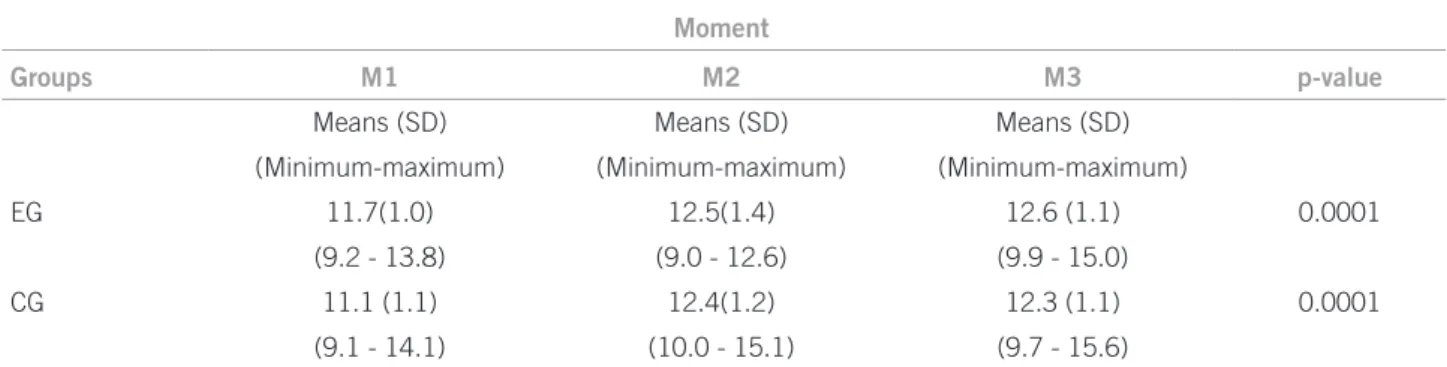
Signiicant increase on the average hemoglobin levels for both groups, EG e CG, was observed at the end of the 24 weeks in children who had ingested an equal or higher amount of one roll per day in average (Table 1).
Due to the fact that approximately half of studied chil-dren had no anemia when they were irst evaluated, the evolution of hemoglobin was measured separately either in children with anemia and without anemia. Hemoglo-bin increase was higher in children with initial anemia (p < 0.0001) for both groups (Table 2).
By the time of the evaluation of the estimate ofer of iron in diets at daycares, all children in CG were already in borderline situations. Nevertheless, with the inclusion of fortiied rolls in EG, the mineral contribution met the recommended daily intake (Table 3).
DISCUSSION
he initial 39.2% prevalence of anemia was considered to be high. Although the existing researches on prevalence of iron deiciency anemia are regional or restrict to certain population groups in part due to the size of the national territory, the studies published indicated anemia in pre-schoolers ranging from 30% to 50%, thus conirming that the anemia in this age group is an important public health issue to be prevented and fought against19,20.
It is likely that the characteristics of the daycares stud-ied that receive children of low socioeconomic conditions coming from the northern outskirts and southern slums of the city have inluenced the results. It is well known that the decrease in the hemoglobin levels does not relect an iron deiciency anemia condition only; however, it is also known that in population where iron deiciency presents a high prevalence, this parameter is considered as an es-timate for prevalence of iron deiciency anemia in this
population. Parents’ low education degree and the limited access to health care services are, in general, risk factors for the development of anemia19.
he present trial assessed a new technology for wheat lour fortiication in which the protection of iron sulfate in microcapsules might provide better stability of salt in the food. he option for small rolls was based on the accep-tance of the product by preschoolers, as well as the tech-nical and economic feasibility for baking and distributing them1,15. he iron content added (4 mg per unit) was agreed upon likewise other studies6,17,21. However, a wide range of iron amounts used for fortiication has been observed in the literature7,22,23.
Regarding the acceptance, children under 36 months old ingested minor amounts in relation to older children, both in EG and CG, conirming that this food as a fortii-cation vehicle shows better results in older children1.
here was no clinical intolerance as already reported in the literature that states no adverse efects were found
Table 1 – Means, standard deviations, lower and higher values of hemoglobin (g/dL) at M1, M2 and M3 for children of exposed and control daycare centers, São Paulo, SP, Brazil, 2007
Moment
Groups M1 M2 M3 p-value
Means (SD) Means (SD) Means (SD)
(Minimum-maximum) (Minimum-maximum) (Minimum-maximum)
EG 11.7(1.0) 12.5(1.4) 12.6 (1.1) 0.0001
(9.2 - 13.8) (9.0 - 12.6) (9.9 - 15.0)
CG 11.1 (1.1) 12.4(1.2) 12.3 (1.1) 0.0001
(9.1 - 14.1) (10.0 - 15.1) (9.7 - 15.6)
EG, exposed group; CG, control group; M1, baseline moment of study; M2, after 12 weeks; M3, after 24 weeks; SD, standard deviation; p, descriptive level of Student’s t-test.
Table 2 – Hemoglobin means (g/dL) at baseline and 24 weeks after for anemic (Hb < 11.0) and non-anemic (Hb ≥ 11.0) children at baseline by exposed group and control group, São Paulo, SP, Brazil, 2007
Hemoglobin baseline EG CG
(g/dL) M1 M3 p-value M1 M3 p-value
< 11.0 10.2 12.2 0.0001 10.1 12.2 0.0001
≥ 11.0 12.1 12.7 NS 12.0 12.5 NS
Hb, hemoglobin; EG, exposed group; CG, control group; Student’s t-test; EG x CG n.s.
Iron (mg/day)
Age (years) EG CG
2-4 12.6 7.4
4-6 18.4 10.6
DRI (Dietary Reference Intake)1997-2002 for 2 to 6 years = 10 mg(25).
EG, exposed group; CG, control group.
for food fortiication with iron in healthy people, once the amount of mineral addition is lower to those levels used for therapeutic supplementation or to the highest daily limit established by the current recommendations24,25.
Average hemoglobin values rose signiicantly by the end of the 24-week trial period. As demonstrated in Table 1 the present trial began with average hemoglobin val-ues within the limits of normality as required for a study aiming basically at prevention. Concerning hemoglobin behavior the population responded rapidly to the inter-vention elevating signiicantly the average hemoglobin values ater 12 weeks, demonstrating the eiciency of the fortiication. Even when starting from values considered adequate, the hemoglobin status could be improved, con-irming the existence of children at borderline condition.
Our results are similar to those obtained by Giorgini et al.8 when using fortiied sweet rolls for preschoolers ob-taining a hemoglobin average increase of 1.1 g/dL ater 6 months of supplementation. he results are also similar to the study of Sazawal et al.2 using fortiied milk, which im-proved hemoglobin by 1.3 g/dL, and Sari et al.26, in which hemoglobin had an average increase of 1.0 g/dL ater 12 weeks of fortiied candies with elemental iron. However, the elevation in hemoglobin levels exceeded those obtained by Paula et al.4 using sugar fortiied with iron amino acid che-late for children between 10 to 48 months of age, in a popu-lation with characteristics similar to ours,or by Moretti et al.22 using fortiication of extruded rice in a primary school in Bangalore, India. In the latter, the average hemoglobin levels remained unchanged at the end of seven months.
Previous studies on iron fortiication without a control group presented similar increase of average values for he-moglobin by the end of the intervention3,8. Such improve-ment could be further justiied by the fact that the shortage scenario was more frequent in CG in the beginning of inter-vention (Table 1), thus enabling children to become more receptive to iron absorption.
By the time we selected children according to the pres-ence of initial anemia, the best response to fortiication oc-curred in those initially diagnosed with anemia (Table 2), same as in other studies as expected, thus conirming the regulatory role of iron absorption mechanism in the in-testinal mucosa26. When organic needs are intensiied a higher proportion of mineral is absorbed27,28. he elevation of 2 g/dL in the hemoglobin levels of children initially anemic in the present study was similar to the study conducted by Miglioranza et al.26, which found an increase in the hemoglo-bin levels of 2.2 g/dL in anemic students who received whey drink fortiied with ferrous bisglycinate.
CG also presented signiicant increase in hemoglobin during the period of observation. he reason for this in-crease is not clear and there are several factors that may contribute for the inal results. he present study tried not to perform any health actions at daycares during the
pe-riod of intervention except for those strictly necessary as required by Ethics, however the absence of communication with relatives, employees and children proved to be impos-sible, once they were involved with and aware of our ield team observations. hus, it is impossible to fully disregard this factor on the results obtained in relation to controls (in-tervention bias)29. We emphasize that the destination of the fortiied bread was unknown by all which could lead to un-desirable individual initiatives encouraging a greater con-sumption. We believe that some previous studies on food fortiication with iron might have presented a sample bias due to the lack of control group, and then, not discussing the possibility that mothers and daycare employees might have modiied their behavior and improved their attention to the meals. A greater stimulus to feed may have led to increased consumption of dietary sources of iron enough for children to stay in balance, once part of the children already had initially normal levels of hemoglobin.
Although there were no signiicant diferences between the fortiied and control groups in the hemoglobin levels, it is suggested that ferritin, in a dosage unanticipated in the methodology, would have allowed a better assessment of iron status and could have indicated the diference be-tween the two groups, because we think iron reserves were higher in CG as a result of the additional consumption of iron. his condition was observed by Chen et al.6 in a 18-month study with supply of iron-fortiied soy sauce to Chinese children older than three years old. he authors obtained a signiicant increase in hemoglobin levels in both exposed and control groups, but serum levels of fer-ritin showed an increase only in the fortiied group. Like-wise, in the double-blind controlled study conducted by Moretti et al.22, body iron stores were greater in the iron-fortiied group at the end of seven months compared with the unfortiied group, while hemoglobin levels showed no signiicant diference.
Other possible reasons might have been taken into consideration as factors that contributed for the present results. We know that prevalence of anemia reduces with age diminishing ater the 24 months of life. Older children diversify their diets and increase their intake quantita-tively while the speed of their growth reduces. It should be pointed out that a great number of studies on fortii-cation that obtained positive response were carried out in closed communities taking several types of programmed simultaneous actions such as educational work, meetings with parents and caregivers, nutrition guidance, vitamin supplementation (vitamin A and C) among others3,18,20.
In addition, a marginal adjustment of iron content in diets ofered at daycares most likely made the action of additional iron supplied with rolls disappear (Table 3). A previous study evaluated the diets ofered at daycares of the same institution for children aged 13 to 24 months and revealed that the total iron content, as well as bioavailable iron has not reached the recommendations33. It is well known how diicult it is to evaluate the iron content actu-ally absorbed; however the diets in our country have a high content of inhibiting factors for iron absorption that might contribute for the high prevalence of anemia observed34.
he present study enhances our knowledge mainly re-garding the design of investigations on the impact of food fortiication, and highlights the need to compare the efects of the fortiication with those of control group carefully matched. Several studies are deprived of control group considering their positive results as representative of the direct action of intervention. Without the control group the elevation in hemoglobin and reduction in occurrence of anemia leaded us to conclude, by the exclusive efect of fortiied rolls without pointing to the actual multiplicity of factors, that perform synergic role when the impact of a fortiied food product is assessed. Further researches are needed to provide direct evidence for this assertion.
As previously mentioned, studies have indicating the positive action of ield teams in motivating employees of health care services or daycares, as well as increasing the attention to children, thereby helping to improve their hemoglobin levels in this kind of interventions28,29. Iron fortiication, however, is also recognized as a measure of medium term action easy and efective to perform in the control of iron deiciency, especially in childhood.
REFERENCES
1. Allen L, de Benoist B, Dary O, Hurrell R. (eds). Guidelines on food fortiica-tion with micronutrients. Geneva: Switzerland. World Health Organizafortiica-tion/ Food and Agriculture Organization of the United Nations; 2006. 2. Sazawal S, Dhingra U, Dhingra P, Hiremath G, Sarkar A, Dutta A, et al.
Mi-cronutrient fortiied milk improves iron status, anemia and growth among children 1-4 years: A double masked, randomized, controlled trial. PLoS ONE. 2010;5(8):e12167.
3. Van Stuijvenberg ME, Dhansay MA, Smuts CM, Lombard CJ, Jogessar VB, Benade AJ. Long-term evaluation of a micronutrient-fortiied biscuit used for addressing micronutrient deiciencies in primary school children. Public Health Nutr. 2001;4:1201-9.
4. de Paula RC, Fisberg M. he use of sugar fortiied with iron tris-glycinate chelate in the prevention of iron deiciency anemia in preschool children. Arch Latinoam Nutr. 2001;51:54-9.
5. Solon FS, Sarol Jr JN, Bernardo ABI, Solon JAA, Mehansho H, Sanchez-Fermin LE, et al. Efect of a multiple-micronutrient-fortiied fruit powder beverage on the nutrition status, physical itness, and cognitive performance of schoolchildren in the Philippines. Food Nutr Bull. 2003;24:S129-41. 6. Chen J, Zhao X, Zhang X, Yin S, Piao J, Huo J. Studies on the efectiveness of
NaFeEDTA-fortiied soy sauce in controlling iron deiciency: a population-based intervention trial. Food Nutr Bull. 2005;26:177-9.
7. hi LH, Brouwer ID, Burema J, Nguyen KC, Kok FJ. Eicacy of iron fortiica-tion compared to iron supplementafortiica-tion among Vietnamese schoolchildren. Nutr J. 2006;5:32-40.
8. Giorgini E, Fisberg M, de Paula RC, Ferreira AMA, Valle J, Braga JAP. he use of sweet rolls fortiied with iron bis-glycinate chelate in the preven-tion of iron deiciency anemia in preschool children. Arch Latinoam Nutr. 2001;51:48-53.
9. Zimmermann MB, Winichagoon P, Gowachirapant S, Hess SY, Harrington M, Chavasit V, et al. Comparison of the eicacy of wheat-based snacks forti-ied with ferrous sulfate, electrolytic iron, or hydrogen-reduced elemental iron: randomized, double-blind, controlled trial in hai women. Am J Clin Nutr. 2005;82:1276-82.
10. Levy-Costa RB, Sichieri R, Pontes NS, Monteiro CA. Disponibilidade domi-ciliar de alimentos no Brasil: distribuição e evolução (1974-2003). Rev Saúde Pública. 2005;39:530-40.
11. Kwak HS, Yang KM, Ahn J. Microencapsulated iron for milk fortiication. J Agric Food Chem. 2003;51:7770-4.
12. Lundeen E, Schueth T, Toktobaev N, Zlotkin S, Houser R. Daily use of sprin-kles micronutrient poeder for 2 months reduces anemia among children 6 to 36 months of age in the Kyrgyz Republic; a cluster-randomized trial. Food Nutr Bull. 2010;31:446-60.
13. Hurrell RF, Lynch S, Bothwell T, Cori H, Glahn R, Hertrampf E, et al. TAIN Task Force: Enhancing the absorption of fortiication iron. A SUS-TAIN Task Force Report. Int J Vitamin Nutr Res. 2004;74:387-401. 14. Tondeur MC, Schauer CS, Christoides AL, Asante KP, Newton S, Serfass
RE, et al. Determination of iron absorption from intrinsically labeled mi-croencapsulated ferrous fumarate (sprinkles) in infants with diferent iron and hematologic status by using a dual-stable-isotope. Am J Clin Nutr. 2004;80:1436-44.
15. IPT-Instituto de Pesquisas Tecnológicas: Desenvolvimento de microcápsu-las de sulfato ferroso modiicadas para uso em estudo clínico de combate à anemia ferropriva em pré-escolares. Relatório Técnico no 70276. São Paulo:
Agrupamento de Processos Químicos, Divisão de Química; 2004. 16. Monsen ER. Iron nutrition and absorption: dietary factors which impact
iron bioavailability. J Am Diet Assoc. 1988;88:786-90.
17. Schümann K, Romero-Abal ME, Mäuer A, Luck T, Beard J, Murray-Kolb L, et al. Haematological response to haem iron fortiication or ferrous sulfate mixed with refried black beans in moderately anaemic Guatemalan pre-school children. Public Health Nutr. 2005;8:572-81.
18. World Health Organization. Iron deiciency anaemia assessment, prevention and control. A guide for programme managers. Geneva: WHO/UNICEF/ UNU; 2001.
19. Matta IEA, Veiga GV, Baião MR, Santos MMAS, Luiz RR. Anemia em crian-ças menores de cinco anos que freqüentam creches públicas do município do Rio de Janeiro, Brasil. Rev Bras Saúde Matern Infant. 2005;5:349-57. 20. Arcanjo FP, Amancio OM, Braga JA, de Paula VTP. Randomized controlled
trail of iron-fortiied drinking water in preschool children. J Am Coll Nutr. 2010;29:122-9.
21. Arcanjo FP, Pinto VP, Coelho MR, Amâncio OM, Magalhães SM. Anemia reduction in preschool children with adiction of low doses of iron to school meals. J Trop Pediatr. 2007;54:243-7.
22. Moretti D, Zimmermann MB, Muthayya S, hankachan P, hung-Ching Lee, Kurpad AV, et al. Extruded rice fortiied with micronized ground ferric pyro-phosphate reduces iron deiciency in Indian schoolchildren: a double-blind randomized controlled trial. Am J Clin Nutr. 2006;84:822-9.
23. Menon P, Ruel MT, Loechl CU, Arimond M, Habicht JP, Pelto G, et al. Mi-cronutrient sprinkles reduce anemia among 9- to 24-mo-old children when delivered through an integrated health and nutrition program in rural Haiti. J Nutr. 2007;137:1023-30.
24. WHO, FAO, UNICEF, GAIN, MI, FFI. Recommendations on wheat and maize lour fortiication. Meeting Report: Interim Consensus Statement. Ge-neva: World Health Organization; 2009.
25. IOM – Institute of Medicine. Food and Nutrition Board: Dietary Reference Intake for vitamin A, vitamin K, arsenic, boron, chromium, copper, iodine, iron, manganese, molybdenum, nickel, silicon, vanadium, and zinc. Wash-ington (DC): he National Academies Press; 2001.
26. Miglioranza LHS, Matsuo T, Caballero-Córdoba GM, Dichi JB, Cyrino ES, Oliveira IBN, et al. Efect of long-term fortiication of whey drink with fer-rous bisglycinate on anemia prevalence in children and adolescents from deprived areas in Londrina, Paraná, Brazil. Nutrition. 2003;19:419-21. 27. MacKenzie EL, Iwasaki K, Tsuji Y. Intracellular iron transport and storage:
from molecular mechanisms to health implications. Antioxid Redox Signal. 2008;10:997-1030.
29. Haynes RB, Sackett DL, Guyatt GH, Tugwell P. Clinical epidemiology: how to do clinical practice research. 3rd ed. Philadelphia: Lippincott Williams &
Wilkins; 2006.
30. Sari M, Bloem MW, Pee S, Schultink J, Sastroamidjojo S. Efect of iron-fortiied candies on the iron status on children aged 4-6 y on east Jakarta, Indonesia. Am J Clin Nutr. 2001;73:1034-9.
31. Bagni UV, Baião MR, Santos MMAS, Luiz RR, Veiga GV. Efect of weekly rice fortiication with iron on anemia prevalence and hemoglobin concentration among children attending public daycare centers in Rio de Janeiro, Brazil. Cad Saúde Pública. 2009;25:291-302.
32. Almeida CAN, Dutra-de-Oliveira JE, Crott GC, Cantolini A, Ricco RG, Del Ciampo LA, et al. Efect of fortiication of drinking water with iron plus ascorbic acid or with ascorbic acid alone on hemoglobin values and anthro-pometric indicators in preschool children in day-care centers in Southeast Brazil. Food Nutr Bull. 2005;26:259-65.
33. Machado EHS, Brasil ALD, Palma D, Taddei JAAC. Condição nutricional e prevalência de anemia em crianças matriculadas em creches beneicentes. Rev Paul Pediatr. 2005;23:21-6.