Individual and contextual effects on mental health status
in São Paulo, Brazil*
Efeitos isolados e contextuais sobre a saúde mental da população de
São Paulo
Ilona Blue
Faculty of the Built Environment, South Bank University
Submitted on 14/5/2000. Approved on 5/6/2000.
Paper partly supported by the Urban Health Programme of the London School of Hygiene and Tropical Medicine, funded by the UK Department for International Development. Work also supported by Departamento de Psiquiatria da Unifep/EPM, São Paulo, Brazil.
Objectives: There is evidence that mental health status is partly determined by socioeconomic status. Recent
research in the U.K. has highlighted the importance of place or context as a health determinant. This study aimed to analyze both individual socioeconomic variables and area of residence as potential risk factors for mental ill health. The objectives were to determine whether the effects of key explanatory variables on mental health status varies by area of residence and whether area of residence has an independent effect on mental health status once other key variables have been controlled for.
Methods: The study used data collected as part of the Brazilian Multicentric Study of Psychiatric Morbidity.
Data from a cross-sectional survey carried out in three socioeconomically contrasting sub-districts in São Paulo, Brazil, was used. The main outcome measure was mental health status as measured by the Questionário de Morbidade Psiquiátrica de Adultos (QMPA).
Results: The results demonstrate that, even after key individual socioeconomic variables were controlled for,
area of residence had a statistically significant effect on mental health status.
Discussion: A possible explanation for the effect of area of residence relates to the social and physical features
of places and their subsequent impact on health.
Conclusions: It is important for mental health research to acknowledge the potential importance of the effect of
area of residence on health, particularly in relation to developing new mental health promotion initiatives.
Mental health. Socioeconomic status. Area of residence, São Paulo, Brazil.
Objetivos: Existem evidências de que a saúde mental de uma população é em parte determinada pelo nível
socioeconômico. Em pesquisa recentemente realizada no Reino Unido verificou-se a importância do local de residência e do contexto como um determinante de saúde. O objetivo do estudo foi analisar as variáveis socioeconômicas e o local de residência como possíveis fatores de risco para a doença mental e determinar se os efeitos sobre a saúde mental das principais variáveis explicativas variam segundo o local de residência e se este exerce um efeito independente, uma vez controladas outras variáveis importantes.
Método: No estudo foram usados dados coletados para o Estudo Multicêntrico Brasileiro de Morbidade
Psi-quiátrica. Dados obtidos a partir de um estudo transversal realizado em três regiões de São Paulo com diferentes níveis socioeconômicos foram incluídos. A principal medida de evolução foi o estado mental, medido por meio do Questionário de Morbidade Psiquiátrica de Adultos (QMPA).
Resultados: Os resultados demonstram que, mesmo depois de controladas as principais variáveis
socioeconômicas, o local de residência revelou ter um efeito estatisticamente significativo sobre a saúde mental.
Discussão: Um explicação possível para o efeito do local de residência está associada a aspectos físicos e
sociais dos lugares de moradia e seu subseqüente impacto sobre a saúde.
Conclusões: É importante para a pesquisa na área de saúde mental reconhecer a importância do efeito do local
de residência sobre a saúde, em especial no que se refere ao desenvolvimento de novas iniciativas para promo-ção da saúde mental.
Saúde mental. Status socioeconômico. Área de residência, São Paulo, Brasil. Abstract
Keywords
Resumo
Introduction
International public health debates have highlighted the need to consider different levels of influence on health outcomes (e.g. individual, household, community, city). However, it is the indi-vidual level that has been the gold standard in epidemiological research. The individual risk factors and their relationship with individual health outcomes were combined for large samples of individuals so that conclusions about populations could be drawn. The use of data related to the community, city or national level was seen as methodologically flawed due to the potential for “ecological fallacies” (a logical fallacy inherent in making causal
inferences from group data to individual behaviors1). Recent
methodological studies have questioned the oft-cited ecological fallacy and the supremacy of individual level data in health re-search. In fact, Wallace et alsuggest that similar to the ecologi-cal fallacy there is a “mediecologi-cal fallacy” (also referred to as an atomistic fallacy) that comes about when individual level data are used to make inferences about group processes.2
Schwartz, in explaining “the fallacy of the ecological lacy”, stated that the use of the term has encouraged three fal-lacious notions:
1. those individual-level models are more perfectly specified than ecological-level models;
2. that ecological correlations are always substitutes for indi-vidual-level correlations;
3. those group-level variables do not cause disease.1
The author went on to describe how a group-level variable (ecological) may be measuring entirely different constructs than an individual-level variable: “... poverty, as an individual-level characteristic and poverty as a contextual characteristic, may exert different, independent effects on health”.1 Causal factors can exist
at a variety of levels and their effects can take place at a variety of levels. Schwartz suggested that the past focus on individual-level data at the expense of ecological-individual-level data had lead to a dismissal of complex social variables as causes of ill health. The focus on individual-level factors has also suited the reductionist nature of much epidemiology, something that has recently been challenged by a number of authors3-8. For example:
“Conceptual problems with the object of inquiry in modern epidemiology suggest the field should adopt a less reductionist approach; the dominant epidemiology begins with the assump-tion that things work separately and independently, that expo-sures can be separated from the practices which produce them. An epidemiology oriented towards massive and equitable public health improvements requires reconstructing the connections between disease agents and their contexts”.8
Many authors3,5-7,9 have acknowledged that the concern for
con-textual effects on health is nothing new. It was common in the 19th
century and it has remained evident in various disciplines. Even in the field of epidemiology, a few publications have served to main-tain a minor interest in such effects.10-12 At the dawn of the 21st
century, the importance of contextual influences on health has gained renewed attention in mainstream epidemiology.
Although within the field of epidemiology the potential of con-textual factors analyses has only been highlighted in the second
half of the 90s, health geographers have been concerned about such factors and they have been considered as a legitimate focus for research for some time. The geographical work on the rela-tionship between context and health explores the idea that health is not solely created or destroyed by processes that operate at the individual level or remain under the control of those individuals. Macintyre et al. with their work on area of residence, social class and health in Glasgow have provided a strong argument for tak-ing the wider environment, and its complexity, into consideration: “Lack of amenities and opportunities to lead healthy or health promoting lives may be as important for assessing the population’s health needs as the knowledge of their personal characteristics, and policies designed to improve local environments may be as effective as individually targeted health promotion activities. There-fore, research should be focused directly on health promoting or health threatening features of local social and physical environ-ments, and on local and national health promotion policies that take into account features of places as well as of people”.13
Jones et al reinforced the perception that neither the ecological/ aggregate nor the atomistic/individual level alone can provide information on the relationship between individual and contextual factors.14 What is required is a multi-level approach that can
contend with the fact that “the impact of the environment may vary from person to person, or the impact of individual variables may vary from place to place”.15 In fact, “no single correct scale
of investigation (...) pattern exists at all levels and on all scales, and recognition of this multiplicity of scales is fundamental to
describing and understanding ecosystems”.16
Popay et al17 referred to the work of Dahlgren & Whitehead18
who described different levels of effect on health: age, gender and hereditary factors; individual lifestyle factors; social and commu-nity influences; living and working conditions; and general socio-economic, cultural and environmental conditions. This model pro-vides a useful starting point, but in relation to cities in developing countries, it is useful to introduce other individual factors (not necessarily related to “lifestyle”) such as education, income, and history of life events. In addition, household factors are important health determinants, for example unequal gender relations at home, domestic violence, cooking practices, water-storage practices, health seeking behavior, and the level of home overcrowding in the home. The types of contextual influences likely to be impor-tant in cities in developing countries include water supply, sanita-tion facilities, refuse disposal, availability of green areas, level of violence and crime, availability of jobs, schools and health facili-ties. It is also helpful to distinguish between those “general socio-economic, cultural and environmental conditions” operating at a city level (e.g. social inequality, city government, and air pollu-tion), national level (e.g. health and policies) and global level (e.g. problems addressed in the “green” agendas, such as global warm-ing, but also global inequalities and global economic forces). There is a need not just of a more detailed understanding of the key elements at each level that influence population health,19 but also
the links between these levels.
sta-tus, income, and education). A series of publications using data from the Brazilian Multicentric Study of Psychiatric Morbid-ity20-23 reported on a nested case-control study (261 cases of
minor psychiatric morbidity and 276 controls) that investigated the effects of gender, marital status, migration, income, educa-tion, age and number of children on mental health status. They concluded that social factors played an important role in the occurrence of minor psychiatric morbidity. In particular they found evidence that the association between gender and men-tal ill health and between migration and menmen-tal health were mediated by social factors. However, the case-control studies focused on individual level data and did not include any con-textual factors (such as area of residence).
However, an interest in multilevel health determinants has not been confined to research focusing on physical ill health. In a review of the effects of an urban environment on stress, Ekblad24
emphasized the importance of group characteristics by stating that: “Deprivation should be understood not only in terms of material poverty, but also in terms of cultural and social depriva-tion arising from a breakdown of family and community struc-tures that provide individuals with a sense of security, belonging and participation”.24 Satterthwaite takes a community
perspec-tive when considering the impact housing has on stress: “Within the wider neighborhood in which the house is lo-cated, a sense of security, good quality physical infrastruc-ture (roads, pavements, drains, street lights) and services (e.g. street cleaning), the availability of emergency services and easy access to educational, health and social services as well as cultural and other amenities all reduce stress and contrib-ute to good mental health”.25
Ekblad24 referred to Selye’s work26,27 on the subject of stress.
Selye defined stress as incongruence between individuals and their environments. He used the term environment in a broad sense to include both physical aspects (e.g. overcrowding, pol-lution) and social aspects (e.g. lifestyle factors). Ekblad em-phasized the way in which urbanization produced social and environmental changes that impact on stress levels and there-fore mental health.24
Recent empirical work that has specifically explored the links between mental health and the urban social and physical
envi-ronment comes from three sources: Aneshensel & Sucoff,28
Dalgard & Tambs29 and Driessen et al.30
Aneshensel & Sucoff28 in their study on neighborhood
con-text and adolescent mental health in Los Angeles, U.S., made a distinction between two sub-components of neighborhood: its structural properties and the individual’s subjective experi-ence of living in that neighborhood. They also considered the presence of threatening conditions in the environment (e.g. crime, violence) and social cohesion. They argued that these context-level factors were equivalent to the individual-level concepts of social stress and resources. Using a community-based sample of 877 adolescents, they investigated at the indi-vidual level, factors such as socioeconomic condition, degrees of depression, anxiety and conduct disorder; and perceptions of the neighborhood (ambient hazards and social cohesion).
They related these findings to data on the neighborhoods in which the sampled adolescents lived in: socioeconomic status (median household income, percent population below the pov-erty line, percent of labor force in professional occupations) and racial/ethnic composition. Their main findings were that youths living in low socioeconomic neighborhoods perceived more and greater ambient hazards and had a worse mental health status than their counterparts living in less deprived areas. They concluded that, “the impact of neighborhood is contingent upon attributes of the individual and vice-versa”.28
Dalgard & Tambs29 in a rare longitudinal study of the effects of
urban environment on mental health interviewed 503 residents of Oslo, Norway, using the same questionnaire on two occasions 10 years apart. The sample was drawn from five neighborhoods, only one of which experienced any significant change during the study period – at the start of the study it was a relatively deprived area, but by the end of the study it had improved social conditions (e.g. a new public school, extended playgrounds for children, subway line extended, a new park). Parallel to the improvements in the area’s social environment there was an improvement in the sampled residents’ mental health status. The study design was able to rule out any effect of selective migration thus lending support to the notion that poor social environments are detrimental to mental health status, regardless of individual characteristics. They there-fore concluded that a better social environment could promote better mental health status.
Driessen et al30 referred to previous research that had found
spatial variations in treated incidence of psychiatric disorders and put it down to different levels of need in the populations in question.31,32 Their aim, however, was to investigate the
possi-bility of an ecological effect of neighborhood and treated inci-dence of mental disorders in Maastricht, Netherlands. Using quantitative data and a multilevel modeling approach, they found evidence for an ecological effect on the treated incidence of non-psychotic disorders even after controlling for individual-level factors. They advocated further research into the elements of the shared social environment to determine how it affects mental health in populations.
It is clear that there is evidence for contextual effects on men-tal health. However, the research documented above focused on developed countries and community-based research on this topic remains limited. There is clearly a need for similar studies in developing country settings. In addition Verheij15 has highlighted
the need to consider interaction effects between factors operat-ing at an individual level and those operatoperat-ing at a contextual level and their links to mental health status. He reviewed litera-ture related to developed countries and found evidence that the effects of age, gender and unemployment (measured at the indi-vidual level) on mental health status varied according to whether respondents were living in urban or rural areas.
Objectives
The study had the following objectives:
·
To determine whether the effects of key individual andvaries by area of residence;
·
To determine whether area of residence has an independenteffect on mental health status once other key variables have been controlled for.
Methods
To achieve these objectives a comparison of mental health status and its relationship to the demographic and nomic factors listed above was undertaken in three socioeco-nomically contrasting sub-districts of São Paulo. Data from the Brazilian Multicentric Study of Psychiatric Morbidity (BMSPM) was available. Details of the BMSPM have been
published elsewhere.33-35 In summary, the main aim of the
BMSPM was to estimate the overall prevalence of psychiatric disorders in the community. Data on psychiatric morbidity were gathered in three cities: Brasília, São Paulo and Porto Alegre. The current study used data collected in the city of São Paulo (n=1,739). In São Paulo, because of its vast population (esti-mated to be 13 million in the municipality), it was decided to limit the cluster sampling to three representative sub-districts rather than attempt to cover the city as a whole. The sub-dis-tricts were chosen based on work carried out by Ramos & Goihman in 1989. They ranked sub-districts according to fam-ily income, percentage of households with sewers and propor-tion of the populapropor-tion over 65 years old and then selected three sub-districts to form a representative sample of the city’s
popu-lation: Aclimação, Vila Guilherme and Brasilândia.36
Aclimação (population of 52,112 in 1991) is located in a southern area of São Paulo. Aclimação was planned around a private park that was later expropriated by the government and became a public park. The park remains an important feature of the sub-district and is visited by the residents. People who were economically successful in Cambuci (a neighboring, highly commercial district) moved up hill to Aclimação to avoid the flooding. Aclimação was therefore considered a wealthy residential sub-district from the start. However, despite the general acceptance of Aclimação as a high-income sub-dis-trict, there are pockets of poverty. Such heterogeneity is a com-mon feature in many central São Paulo sub-districts.
Vila Guilherme (population of 74,315 in 1991) lies just north of the River Tietê and has several main roads passing through it, is easily accessible by subway system and is the home of one of São Paulo’s largest malls. It is also adjacent to one of the largest motorways that leads into the city and harbors one of the city’s two main bus stations with national services. It is therefore a bustling sub-district with considerable traffic. Ba-sic facilities (water, sanitation, paved roads, and electricity) are now adequate throughout the sub-district except in a few small slums where services are still lacking. Vila Guilherme is renowned for its vulnerability to flooding.
Brasilândia (population of 210,145 in 1991) is situated in the northwest peripheral area of São Paulo. It is one of the poorest areas of the city and it has changed from a zone of wasteland to a highly populated sub-district with many slums in approximately fifty years. Such rapid change has had a
se-vere impact on the sub-district’s characteristics. Many basic facilities were lacking or had only recently been provided in certain areas. Again, heterogeneity was a feature of Brasilândia with the term “the periphery of the periphery” being coined to describe the dynamic nature of the continued expansion of the periphery and city as whole. The older areas of Brasilândia are considered to be much better served than the newer, more pe-ripheral areas that are considered to be lacking in order, ser-vices and safety.
The random household survey was carried out in São Paulo between September and December 1990. In each household visited, all adults over the age of 15 were asked to partici-pate in the study. The final samples sizes for each sub-dis-trict in São Paulo were: Brasilândia, 969 (56%); Vila Guilherme, 474 (27%); Aclimação, 296 (17%); total for São Paulo, 1,739 (100%).
The different proportions of the total sample drawn from the three sub-districts reflected the proportion of São Paulo’s popu-lation residing in the three areas from which the sub-districts were selected.36
The screening tool used in the study was the Questionário de Morbidade Psiquiátrica de Adultos (QMPA) (Questionnaire for
Adult Psychiatric Morbidity) developed by Santana37 which has
been widely used in Brazil. The aim of the QMPA is to identify probable cases of mental ill health. Thus it encompasses both psychotic and neurotic conditions although research has consis-tently demonstrated that it is the neurotic or common mental disorders that predominate at the community level.38
The QMPA consists of 43 questions requiring yes/no answers and refers to the past year of the respondent’s life. In the BMSPM, a cut-off point of 7/8 was established through psy-chiatric interviews using the DSM-III classification system administered to 30% of those screened as probable cases and 10% of those screened as probable non-cases.
Information on demographic and socioeconomic variables was collected for all respondents using a questionnaire. The following variables were selected for use in the study: age, gender, education, occupation, marital status, monthly family income per capita (calculated by dividing the monthly family income by the number of people living in the household), mi-gration and number of people per room. The data was ana-lyzed using SPSS (Statistical Package for Social Scientists) for Windows and Stata.
Results
like Brasilândia account for over half of the population (56%). Assuming a total population of 10 million for the city of São Paulo, the results show that, at any one point in time, over one million inhabitants of low-income sub-districts will be experi-encing some form of psychiatric morbidity while under 200,000 inhabitants of high-income sub-districts will suffer from simi-lar conditions. This five-fold difference demonstrates the ab-solute public health impact of the intra-urban variations in mental health status. The remainder of this paper attempts to explain this variation through analyzing the relationship be-tween mental health status and certain explanatory variables (gender, migration status, civil status, occupation, age, educa-tion, number of people per room, and family income).
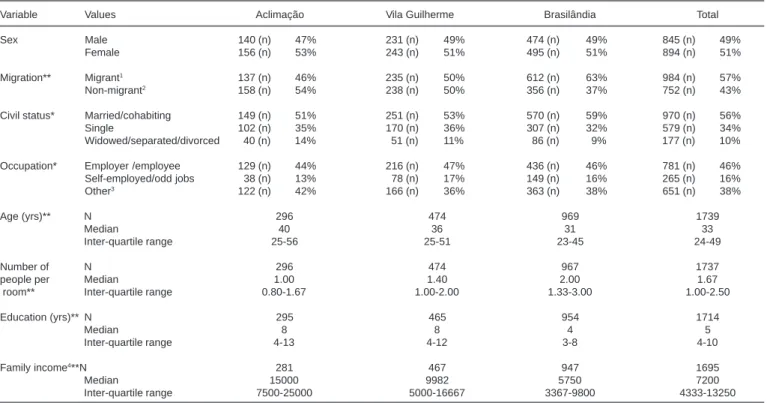
Summary statistics for the explanatory variables are pre-sented in Table 1. It can be seen that Brasilândia had the highest proportion of migrants, the highest median number of people per room, the lowest median number of years of education and the lowest median of monthly family income. Results for Aclimação were at the other extreme, with this sub-district having the lowest proportion of probable cases of mental ill health, the lowest proportion of migrants, the lowest median number of people per room, the highest me-dian number of years of education (similar to Vila Guilherme) and the highest median monthly family income. Data for Vila Guilherme fell between the two extremes of Brasilândia and Aclimação, except in the case of years of education. These findings are as would be expected given the rationale behind the choice of these sub-districts for sampling purposes. The age distributions in each sub-district followed predictable
patterns with Brasilândia revealing the youngest age distri-bution and Aclimação the oldest, and again, with Vila Guilherme lying between the two extremes. There was no significant difference between the proportion of males/females in each sub-district and somewhat unexpectedly the same can be said for the information collected on occupation. Data on civil status demonstrated a significant difference between the sub-districts although there were similar trends. Brasilândia had the highest proportion of married or cohabiting respondents, Vila Guilherme had the highest proportion of single respondents and Aclimação had the highest proportion of widowed, separated or divorced respondents.
Crude odds ratios were calculated for each explanatory vari-able and mental health status. Then logistic regression was used to test for interaction between sub-district and each explana-tory variable’s effect on mental health status. The results were statistically non-significant suggesting no interaction effects. A final logistic regression model, including sub-district (area of residence) and all other explanatory variables, was there-fore constructed. Table 2 presents the adjusted and crude odds ratios. For each variable the category of expected least risk was used as a reference category.
Considering Table 2, it can be seen that by sub-district, the two-fold association of living in Brasilândia with men-tal ill health as compared to Aclimação remains, in a slightly reduced form, after adjustment. The adjusted odds ratio is 1.88 (1.18<OR<3.00, p<0.01). Vila Guilherme, when com-pared to Aclimação, no significant association was found in either the crude or adjusted calculations. From this finding
Table 1 - Summary statistics for explanatory variables.
Variable Values Aclimação Vila Guilherme Brasilândia Total
Sex Male 140 (n) 47% 231 (n) 49% 474 (n) 49% 845 (n) 49%
Female 156 (n) 53% 243 (n) 51% 495 (n) 51% 894 (n) 51%
Migration** Migrant1 137 (n) 46% 235 (n) 50% 612 (n) 63% 984 (n) 57%
Non-migrant2 158 (n) 54% 238 (n) 50% 356 (n) 37% 752 (n) 43%
Civil status* Married/cohabiting 149 (n) 51% 251 (n) 53% 570 (n) 59% 970 (n) 56%
Single 102 (n) 35% 170 (n) 36% 307 (n) 32% 579 (n) 34%
Widowed/separated/divorced 40 (n) 14% 51 (n) 11% 86 (n) 9% 177 (n) 10%
Occupation* Employer /employee 129 (n) 44% 216 (n) 47% 436 (n) 46% 781 (n) 46%
Self-employed/odd jobs 38 (n) 13% 78 (n) 17% 149 (n) 16% 265 (n) 16%
Other3 122 (n) 42% 166 (n) 36% 363 (n) 38% 651 (n) 38%
Age (yrs)** N 296 474 969 1739
Median 40 36 31 33
Inter-quartile range 25-56 25-51 23-45 24-49
Number of N 296 474 967 1737
people per Median 1.00 1.40 2.00 1.67
room** Inter-quartile range 0.80-1.67 1.00-2.00 1.33-3.00 1.00-2.50
Education (yrs)** N 295 465 954 1714
Median 8 8 4 5
Inter-quartile range 4-13 4-12 3-8 4-10
Family income4**N 281 467 947 1695
Median 15000 9982 5750 7200
Inter-quartile range 7500-25000 5000-16667 3367-9800 4333-13250
Notes: * p < 0.05; ** p < 0.01
it can be concluded that the effect of sub-district in Vila Guilherme is not significant and is little different in terms of association with mental health from that found in Aclimação. However, the fact that a strong and significant effect between Brasilândia and Aclimação remains after adjusting for the effect of all other variables suggests that an effect of area of residence exists in Brasilândia that con-tributes to the difference in mental health status revealed in the descriptive statistics. This area of residence effect works independently of all the other factors included in the logis-tic regression model.
Discussion
This study used logistic regression to investigate two con-cerns. First, the possibility of interaction effects between sub-district and the other explanatory variables in their re-lationships to mental health. And second, the association of area of residence with mental health status once the effects of all other variables had been controlled for (i.e. an inde-pendent effect). The results related to the first concern re-vealed no evidence to support the notion that the effects of the selected explanatory variables on mental health status varied according to sub-district. In other words, there was no evidence of any interaction effect. This is in
disagree-ment with the findings described by Verheij15 in which
in-teraction effects on mental health status were found between
age, gender, unemployment and area of residence (urban or rural). The difference between these findings and those of the studies reviewed by Verheij could be due to two rea-sons. First, the statistical test used to identify interaction effects is not particularly sensitive and it may be the case that “real” interaction effects were simply overlooked by the methods used. Second, Verheij was only interested in studies making urban-rural comparisons. He was not con-cerned about intra-urban comparisons and it could be that in fact no interaction effect on mental health status of area of urban residence and the other explanatory variables con-sidered exists. For example, these findings imply that the effect of being female on mental health status is similar across São Paulo, irrespective of the socioeconomic char-acteristics of the areas of residence.
The results related to the second concern revealed that, compared to Aclimação, living in Brasilândia had a nega-tive effect on mental health status that remained after con-trolling for gender, age, migration status, civil status, occu-pation, education, number of people per room and income. Compared to Aclimação, living in Vila Guilherme did not reveal any significant differences in mental health status either before or after adjustment, although the trend sug-gested a worse mental health outcome for those residents in Vila Guilherme.
Thus sub-district was found to have an independent effect on mental health status when comparing Brasilândia with Aclimação, but not when comparing Vila Guilherme with Aclimação. Thus the main health benefits would be gained by moving from the lowest category (Brasilândia) into the middle category (Vila Guilherme), while moving from the middle category to the highest (from Vila Guilherme to Aclimação) would translate only into a little improvement in mental health outcome.
These findings complement the work undertaken as part of
the U.K. Whitehall study.6 Civil servants (all of whom could
be considered as belonging to high socioeconomic strata) were found to have a steady gradient of mental health status that was closely associated with their position in the civil service hierarchy. Those in more powerful positions enjoyed progres-sively better mental health status. The Whitehall findings therefore suggested that health improvements could be made all the way along the socioeconomic scale, irrespective of
one’s position on the scale.6 However, the findings of
Wilkinson39 and Soares et al40 have indicated that the
magni-tude of health improvements that can be made by improving one’s position on the socioeconomic scale will decrease the further along the scale one progresses: the law of diminish-ing health returns. Thus Wilkinson made it clear that a unit increase in income will have a much more beneficial effect on health when the increase takes place at the lower end of the socioeconomic scale than when it takes place at the higher end.39 Equally, Soares et al found similar results for the
asso-ciation between homicide and sub-district in São Paulo for young males, i.e. risk did not decrease evenly as one moved
Table 2 - Crude and adjusted odds ratios for mental ill-health and all explanatory variables. (n=1620)
Variable Crude OR 95% CI Adjusted OR1 95% CI
Sub-district
Aclimação 1.00 1.00
Vila Guilherme 1.52 0.99<OR<2.34 1.56 0.96<OR<2.52 Brasilândia 2.12 1.44<OR<3.13*** 1.88 1.18<OR<3.00** Sex
Male 1.00 1.00
Female 2.49 1.92<OR<3.22*** 2.16 1.60<OR<2.92*** Age (unit increase) 1.02 1.01<OR<1.03*** 1.00 0.99<OR<1.02 Migration status
Non-migrant2 1.00 1.00
Migrant3 2.20 1.69<OR<2.87*** 1.32 0.96<OR<1.80
Civil status
Single 1.00 1.00
Married/Cohabiting 2.61 1.91<OR<3.58*** 1.72 1.20<OR<2.47** Widowed/Separated/
Divorced 4.00 2.61<OR<6.10*** 1.68 0.97<OR<2.89 Occupation
Employer, employee 1.00 1.00 Self-employed/
odd jobs 2.31 1.62<OR<3.29*** 1.87 1.27<OR<2.76*** Others4 2.37 1.79<OR<3.14*** 1.48 1.06<OR<2.07*
Education (years)
10-14 years 1.00 1.00
4-9 years 2.01 1.39<OR<2.89*** 1.44 0.95<OR<2.20 0-3 years 3.84 2.60<OR<5.67*** 1.78 1.08<OR<2.95* People per room
0-1.00 1.00 1.00
1.01-2.00 0.72 0.53<OR<0.98* 0.57 0.41<OR<0.81** 2.01-13.00 1.19 0.88<OR<1.62 0.76 0.51<OR<1.13 Income per month per capita (cruzados)
10751-160000 1.00 1.00
5001-10750 1.66 1.20<OR<2.30* 1.43 0.98<OR<2.08 400-5000 2.34 1.71<OR<3.20*** 1.49 0.99<OR<2.23
* = p<0.05; ** = p<0.01; *** = p<0.001
from the lowest income districts to the middle-income and then higher income ones. Instead, those young males living in the lowest income districts were at considerably higher risk of homicide when compared to those living in middle-income districts (OR=4.78, 4.60<OR<4.96) and those living in high-income districts (OR=5.74, 5.52<OR<5.96), whereas the risk of homicide for males resident in the middle-income districts as compared to the high-income districts was much reduced (OR=1.20, 1.10<OR<1.30).40 The findings described
for Brasilândia, Vila Guilherme and Aclimação support both the Whitehall study results and those related to the law of diminishing health returns.
There are two possible explanations for the association be-tween area of residence and mental health status that remained after controlling for other key explanatory factors. First, there could be additional individual factors that were not included in the model but that have statistically significant effects on mental health status and tend to be distributed differently ac-cording to socioeconomic status. Second, there could be a real effect of area of residence on mental health status. Re-garding the first possibility, no information on the quality and quantity of social support or life events was collected as part of the BMSPM. Such information could have helped to ex-plain the intra-urban differentials in mental health observed and should be incorporated into future studies. In relation to the second possibility, as outlined earlier in this paper, previ-ous research supports the notion of an effect of area of resi-dence on mental health status.28-30 The potential link between
social factors and mental health in a Latin American context
was explored by Almeida-Filho.33
Further qualitative research conducted by the author in the three sub-districts revealed evidence of differences in the range and intensity of community level factors related to the
physi-cal and social environment.41,42 Considering potential
posi-tive influences on mental health status across the three sub-districts, the importance of good social interaction with fel-low residents was a recurring sub-theme. Although all par-ticipants did not express the advantages of friendly, reliable neighbors, the majority mentioned them. Additional positive aspects related to the physical infrastructure and participants in Aclimação and Vila Guilherme discussed the services of-fered. This suggests that in Brasilândia, where the physical infrastructure was worse than in the other two sub-districts, the main positive force was related to social cohesion within the community. Thus in the absence of good physical facili-ties and infrastructure, social cohesion within a community becomes particularly important. This point links in with a growing interest in the association between mental health and social capital (“features of social life – networks, norms and trust – that enable participants to act together more effec-tively to pursue shared objectives”).43
Considering potential negative influences on mental health status, across the three sub-districts, aspects related to the physi-cal infrastructure and services were discussed. The range and intensity of such problems was relatively low in Aclimação,
higher in Vila Guilherme and higher still in Brasilândia. A par-ticular concern in all sub-districts was violence and crime with a similar gradient for the severity of problems as that found for physical infrastructure and services.
Conclusions
Conclusions to this study are necessarily tentative, but can be related to methodological, conceptual and policy implications.
Methodological implications
It is important to investigate multiple levels of effect on mental health status. Despite the emphasis in the literature on quantitative methods of researching multiple levels of effect, a variety of methods can be used: qualitative, quanti-tative or a combination of the two. Without considering the different levels of influence, only a partial understanding of health events and their distribution in time and space will be achieved.
Methods for the evaluation of process-oriented, commu-nity-based, inter-sectoral interventions need to be refined and their validity needs to be established and publicized. This will enable interventions that involve changes in pro-cesses and function at a group-level to be more widely advocated.
Conceptual implications
Having established the range of influences on mental health status, it is important to investigate the processes and mechanisms involved in the links between the multilevel factors identified and mental health status, so that a greater understanding of the wider influences on mental health sta-tus can be achieved.
In addition to the need to understand the processes involved in linking each level to mental health status, there is a need for increased knowledge about the relations between the different types of contextual and structural factors. Thus, the links be-tween individual factors and local and citywide contextual fac-tors, should be explored.
Policy implications
Mental health promotion and the prevention of mental ill health should be viewed as key elements in urban develop-ment rather than separate issues that are only of relevance to health professionals. This will enable inter-sectoral col-laboration (particularly between health and social sectors) which is vital if the complexity of urban ill health is to be addressed. The ways in which inter-sectoral collaboration can be achieved need to be investigated.
References
1. Schwartz S. The fallacy of the ecological fallacy: the potential misuse of a concept and the consequences. Am J Public Health 1994;84(5):819-24. 2. Wallace R, Wallace D, Andrews H. AIDS, tuberculosis, violent crime,
and low brithweight in eight US metropolitan areas: public policy, stochastic resonance, and the regional diffusion of inner-city markers. Environ Plann A 1997;29:525-55.
3. Pearce N. Traditional epidemiology, modern epidemiology and public health. Am J Public Health 1996;86:678-83.
4. Syme SL. Rethinking disease: where do we go from here. Ann Epidemiol 1996;6:463-8.
5. Shy CM. The failure of academic epidemiology: witness for the prosecution. Am J Epidemiol 1997;145:479-84.
6. Marmot MG. Improvement in social environment to improve health. Lancet 1998;351:57-60.
7. Lomas J. Social capital and health: implications for public health and epidemiology. Sociol Sci Med 1998;47(9):1181-8.
8. Wing S. Limits of epidemiology. Med Global Surviva 1995;1(2):74-86. 9. Diez-Roux AV. Bringing context back into epidemiology: variables and
fallacies in multilevel analysis. Am J Public Health 1998;88(2):216-22. 10. Casterline JB. The collection and analysis of community data. In: Cleland
J, Scott C, eds. The World Fertility Survey: an assessment. Oxford (UK): Clarendon Press; 1987.
11. Casterline JB. The collection and analysis of community data. International Statistical Institute. Oxford (UK): World Fertility Survey; 1995. 12. Rose G. The strategy of preventive medicine. Oxford Medical Publications.
Oxford (UK): Oxford University Press; 1992.
13. Macintyre S, Maciver S, Sooman A. Area, class and health: should we be focusing on places or people? J Sociol Policy 1993;22(2):213-34. 14. Jones K, Duncan C, Moon G. Individuals and their ecologies: analysing
the geography of chronic illness within a multilevel modelling framework. Paper presented at the 6th International Medical Geography Conference, University of British Columbia, Vancouver, July 1994.
15. Verheij R. Explaining urban-rural variations in health: a review of interactions between individual and environment. Social Sci Med 1996;42(6):923-35.
16. Levin S. Ecology in theory and application. In: Hallam T, Gross L, Levin S eds. Applied mathematical ecology. New York: Springer; 1989.
17. Popay J, Williams G, Thomas C, Gatrell T. Theorising inequalities in health: the place of lay knowledge. Sociol Health Illness 1998;20(5):619-44. 18. Dahlgren D, Whitehead M. Policies and strategies to promote social equity
in health. Stockholm: Institute for Futures Studies; 1991.
19. Hawe P. Making sense of context-level influences on health. Health Educ Res 1998;13(4):i-iv.
20. Coutinho ES, Almeida-Filho N, Mari JJ, Rodrigues L. Minor psychiatric morbidity and internal migration in Brazil. Soc Psychiatry Psychiatr Epidemiol 1996;31:173-9.
21. Coutinho ES, Almeida-Filho N, Mari JJ, Rodrigues L. Gender and minor psychiatric morbidity: results from a case-control study in a developing country. Int J Psychiatry Med 1999;29:197-208.
22. Coutinho ES, Almeida-Filho N, Mari JJ. Fatores de risco para morbidade psiquiátrica menor: resultados de um estudo transversal em três áreas ur-banas no Brasil. Rev Psiq Clín 1999;26(5):246-56.
23. Almeida-Filho N, Mari JJ, Coutinho E. Rural-urban migration and mental health in Latin America: the debate continues. Chapter in Harpham T, Blue I, eds. Urbanization and mental health in developing countries. Avebury (UK); 1995.
24. Ekblad S. Stressful environments and their effects on quality of life in third world cities. Environ Urbanization 1993;5(2):125-34.
25. Satterthwaite D. The impact on health of urban environments. Environ Urbanization 1993;5(2):87-111.
26. Selye H. The stress of life. New York: McGraw Hill; 1956. 27. Selye H. Stress without distress. Philadelphia: Lippincott; 1974. 28. Aneshensel CS, Sucoff CA. The neighbourhood context of adolescent
mental health. J Health Social Behavior 1996;37(12):293-310. 29. Dalgard OS, Tambs K. Urban environment and mental health. Br J
Psychiatry 1997;171:530-6.
30. Driessen G, Gunther N, Van Os J. Shared social environment and psychiatric disorder: a multi-level analysis of individual and ecological effects. Social Psychiatry Psychiatric Epidemiol 1998;33:606-12. 31. Thornicroft G, Bisoffi G, De Salvia D, Tansella M. Urban-rural differences
in the associations between social deprivation and psychiatric service utilization in schizophrenia and all diagnoses: a case register study in Northern Italy. Psychological Med 1993;23:487-96.
32. Harrison J, Barrow S, Creed F. Social deprivation and psychiatric admission rates among different diagnostic groups. Br J Psychiatry 1995;167:456-62.
33. Almeida-Filho N. Becoming modern after all these years: social change and mental health in Latin America. Cult Med Psychiatry 1998;22:285-316. 34. Almeida-Filho N, Mari JJ, Coutinho E, Faria França J, Fernandes J, Baxter
Andreoli S, Busnello ED’A. Brazilian multicentric study of psychiatric morbidity. Br J Psychiatry 1997;171:524-9.
35. Baxter Andreoli S, Almeida-Filho N, Coutinho E, Mari JJ. Identificação de casos psiquiátricos em estudos multifásicos: métodos, problemas e apli-cabilidade. Rev Psiq Clin 1998;25.
36. Ramos LR, Goihman S. Geographical stratification by socioeconomic status: methodology from a household survey with elderly people in S. Paulo, Brazil. Rev Saúde Pública 1989;23:478-92.
37. Santana V. Estudo epidemiológico das doenças mentais em um bairro de Salvador. Série de Estudos em Saúde (Secretaria de Saúde de Bahia) 1982;3(suppl):1-122.
38. Goldberg D, Huxley P. Common mental disorders. London: Routledge; 1992. 39. Wilkinson R. Unhealthy socieities: the afflictions of inequality. London
(UK): Routledge; 1996.
40. Soares KVS, Blue I, Cano E, Mari JJ. Violent death in young people in the city of São Paulo, 1991-1993. Health Place 1998;4(2):195-8.
41. Blue I. Urban health inequalities in mental health: the case of São Paulo, Brazil. Environ Urbanization 1996;8(2):91-9.
42. Blue I. Intra-urban differentials in mental health status in São Paulo, Brazil [thesis]. UK: South Bank University; 1999.
43. Putnam RD. Tuning in, tuning out: the strange disappearance of social capital in America. Political Sci Politics 1995;12:664-83.
Correspondence
Ilona Blue
Faculty of the Built Environment South Bank University
202 Wandsworth Road London SW9 2JZ, UK E-mail: [email protected]
Acknowledgements
Jair Mari (Unifesp/EPM) and Naomar Almeida-Filho (Universidade Federal da Bahia), provided access to the Bra-zilian Multicentric Study of Psychiatric Morbidity. Evandro Coutinho, Ana Ludermir (Universidade Federal de Pernambuco), Sérgio Baxter Andreoli (Unifesp/EPM) and