GROUP THERAPY W I TH NURSI NG STUDENTS DURI NG THE
THEORY- PRACTI CE TRANSI TI ON
1Z ey n e Alv es Pir es Sch er er2 Edson Ar t hur Scher er3 Ana Mar ia Pim ent a Car v alho2
Scherer ZAP, Scherer EA, Carvalho AMP. Group t herapy w it h nursing st udent s during t he t heory- pract ice t ransit ion.
Rev Lat in o- am En fer m agem 2 0 0 7 m ar ço- abr il; 1 5 ( 2 ) : 2 1 4 - 2 3 .
This st udy aim ed t o ver ify w het her t he int er vent ion of shor t t er m gr oups could pr ovide nur sing st udent s m ean s t o cop e w it h st r ess, t y p ical of t h e t r an sit ion p r ocess f r om t h e t h eor et ical t o t h e p r act ical lear n in g . Par t icip an t ob ser v at ion w as u sed , allow in g 1 2 st u d en t s in t h e d iscip lin e Fu n d am en t als I I , t o ex p r ess t h eir anxiet ies and anguish t ow ar ds t he new and fut ur e r ole of t aking car e of ot her people’s healt h. Result s suggest t hat higher nur sing educat ion inst it ut ions should consider t he gr oup t echnique not only as a suppor t r esour ce, b u t also as a d id act ical r esou r ce in t h eir cu r r icu la. At a t im e w h en ed u cat ion al r ef or m s ar e d iscu ssed , is im por t ant t o bear in m ind t hat any planned changes w ill have an effect not only in t echnical t er m s but w ill also affect t he hum an being.
DESCRI PTORS: psy chot her apy , gr oup; educat ion, nur sing; t eaching; st udent s, nur sing
TERAPI A DE GRUPO CON ESTUDI ANTES DE ENFERMERÍ A DURANTE LA
TRANSI CI ÓN TEÓRI CO- PRÁCTI CA
La finalidad del est udio fue ver ificar si la int er vención de gr upo a cor t o plazo puede pr opor cionar a las est udiant es de enfer m er ía r ecur sos par a enfr ent ar el st r ess, pr opio del paso, del apr endizaj e t eór ico al pr áct ico. Se ut ilizó la obser v ación par t icipant e com o m ét odo, lo que per m it ió que 12 alum nas m at r iculadas en el cur so de Fundam ent os I I , pudier an expr esar sus ansiedades y angust ias ant e el nuevo y fut ur o r ol de cuidador as de la salud. La t écnica gr upal apar ece com o un inst r um ent o a ser consider ado por las inst it uciones de enseñanza su per ior en en fer m er ía n o solo com o u n r ecu r so de apoy o, sin o t am bién didáct ico den t r o de los pr ogr am as cur r icular es. Consider ando las act uales discusiones sobr e las r efor m as en la enseñanza, cualquier planificación de cam bio no solo se dar á niv el t écnico, sino t am bién t r aer á efect os en el ser hum ano.
DESCRI PTORES: psicot er apia de gr u po; edu cación en en fer m er ía; en señ an za; est u dian t es de en fer m er ía
GRUPOTERAPI A COM ESTUDANTES DE ENFERMAGEM DURANTE A
TRANSI ÇÃO TEÓRI CO- PRÁTI CA
O ob j et iv o d o est u d o f oi v er if icar se a in t er v en ção d e g r u p o d e cu r t o p r azo p od e p r op or cion ar às est u d an t es d e en f er m agem m eios d e lid ar em com o est r esse, p r óp r io d a t r an sição d o ap r en d izad o t eór ico par a o pr át ico. Ut ilizou- se a obser v ação par t icipant e com o m ét odo, possibilit ando que 12 alunas que cur sar am a disciplina de Fundam ent os I I ex pr essassem suas ansiedades e angúst ias fr ent e ao nov o e fut ur o papel de cu id ad or as d a saú d e d e ou t r os. A t écn ica g r u p al ap ar ece com o u m in st r u m en t o a ser con sid er ad o p elas inst it uições de ensino super ior de enfer m agem com o r ecur so não apenas de apoio, m as t am bém didát ico, em seus cur r ículos. No m om ent o em que são discut idas r efor m as do ensino, é im por t ant e lem br ar que qualquer m udança planej ada não ser á som ent e t écnica, m as t er á efeit os no ser hum ano.
DESCRI TORES: psicot er apia de gr u po; edu cação em en fer m agem ; en sin o; est u dan t es de en fer m agem
1
St udy ext r act ed fr om Doct or al Disser t at ion; 2 PhD, Pr ofessor at t he Univer sit y of São Paulo at Ribeir ão Pr et o College of Nur sing Psychiat r ic and Hum an Sciences Depar t m ent , WHO Collaborat ing Cent r e for Nur sing Resear ch Developm ent , e- m ail: scher er @eer p.usp.br, anacar @eer p.usp.br; 3 Psychiat r ist ,
Doct or al St udent , Assist ant at Hospit al das Clínicas Univer sit y of São Paulo at Ribeir ão Pr et o Medical School
I NTRODUCTI ON
U
n d e r g r a d u a t e c o u r s e s i n h e a l t h h a v e a cco m p a n i e d t h e ch a n g e s o ccu r r e d i n e d u ca t i o n ,w hich underlie higher educat ion inst it ut ions’ curricular
g u i d e l i n e s. Ed u ca t i o n a n d h e a l t h a r e k n o w l e d g e
p r o d u ct i o n a n d u sa g e a r e a s d e st i n e d f o r h u m a n
dev elopm ent . Mor eov er, k now ledge accum ulat ion and
t he consequent need for updat ing r equir e pr ofessional
t r aining t o t urn int o a cont inuous pr ocess, not only t o
acquire t echnical skills, but also t o develop pot ent ials
in t he labor w or ld and in t he social envir onm ent( 1).
Som e ex per t s int er est ed in nur sing st udent s’
academ ic an d pr ofession al t r ain in g su ggest t h at t h e
sch ool sh ou ld u n d er st an d t h e m ean in g of t h e f ir st
clinical experiences for st udent s, as w ell as t he relat ion
est ablished w it h t he t eacher, m ainly w hen t he lat t er
does not m ake room for j oint reflect ion in a sit uat ion
of pain or deat h f or ex am ple. On t h e opposit e, t h e
t ea ch er f r eq u en t l y cl o ses h i m sel f o f f, cr ea t i n g a n
im age of in sen sit iv it y an d coldn ess t h at im pair s t h e
st udent s’ hum an and pr ofessional gr ow t h( 2).
I t w as obser ved t hat , w hen st udent s ar e put
in con t act w it h pr act ical lear n in g t o dev elop cer t ain
pr ocedu r es t h ey lear n ed in t h eor et ical classes, t h ey
d isp lay in secu r it y an d f ear, an d can ev en m an if est
signs of st ress. Anxious react ions occur, also because
t hey are accust om ed neit her t o t he specific procedur es
clinical pr act ice r equir es nor t o t he speed needed t o
execut e t echniques. Mor eov er, t hey ar e not pr epar ed
t o deal w it h t he em ot ions ar oused by pot ent ial r isk s
t he client is exposed t o( 3).
Gr ou p s h av e b een u sed f or a lon g t im e t o
r elieve and t r eat som at ic and m ent al disor der s ( going
b ack t o An t iq u it y ) an d em er g ed b ef or e t h e k n ow n
gr oup dynam ics t heor ies. The gr oup can be under st ood
as “ a set of people in an int eract ive act ion w it h shared
o b j ect i v es”( 4 ). Th er ef o r e, i n o r d er t o co n st i t u t e a
g r ou p , it s m em b er s n eed t o d ev elop an in t er act iv e
a ct i o n , t h a t i s, t h e r el a t i o n a l a sp ect n eed s t o b e
p r esen t . As a r esu lt , t h e p er son can b ecom e m or e
spont aneous, obj ect iv e and r ealist ic, r ev ealing t o be
less dependent on t he ot her( 5).
Gr o u p p s y c h o t h e r a p y p r a c t i c e i t s e l f w a s
developed in t he first half of t he 20t h cent ury and has
gr ow n in Br azilian r ealit y as a t r eat m ent r esour ce in
d if f er en t car e con t ex t s( 4 , 6 - 7 ). Th e t h er ap eu t ic g r ou p
fav or s t he ex plor at ion of subj ect iv it y by act ing as a
“ social laborat ory”, in w hich t he part icipant s reproduce
t h e r oles t h ey play in t h eir daily liv es( 6 ). Wh en t h e
gr ou p con sist s of a specif ic popu lat ion , w it h sim ilar
char act er ist ics, t his facilit at es “ t he ident ificat ion, t he
revelat ion of part icularit ies and int im acies, t he offering
of su ppor t t o peer s, t h e dev elopm en t of a com m on
g o a l a n d t h e s o l u t i o n o f s i m i l a r d i f f i c u l t i e s a n d
ch allen ges”( 7 ).
Go a l s a r e o f co n si d e r a b l e i m p o r t a n ce t o
classify groups( 8- 9). One group act ivit y t hat is based on
i t s g o a l i s co n si d e r e d w i t h i n t h e cl a ssi f i ca t i o n o f
psychot herapies as “ short groups” or “ short - t erm group
psy ch ot h er apy ” or sim ply “ sh or t psy ch ot h er apy ”( 1 0 ).
Researchers in t his area consider short psychot herapies
as t hose charact erized by a lim it ed t im e, in funct ion of
a specific focus( 8, 10). Hence, w hat defines a gr oup as
short is neit her a m inim um quant it y of hours nor t he
t ask in it self, nor t he t heoret ical fram ework t hat is used,
but t he proposal t o respect t he pre- est ablished lim it in
funct ion of t he focus( 4).
Th er ap ist s w h o u se sh or t - t er m ap p r oach es
sh ou ld t h er efor e dev elop a plan n in g, in clu din g clear
ob j ect iv es, an d d et er m in e a w or k f ocu s an d clar it y
about t he t em poral lim it s of t he gr oup( 8,10). Mor eover,
st r u ct u r al an d g r ou p d ev elop m en t asp ect s n eed t o
be t aken int o account w hen est ablishing an appr oach,
so as n o t t o b e su b j ect t o er r o r s o r f ai l u r e w h i l e
per for m ing t he t ask .
Just like individuals, gr oups ar e able t o gr ow
an d d ev el o p . Wi t h i n t h i s l o g i c, t h r ee st ag es w er e
descr ibed: or ient at ion, conflict and cohesion( 11). These
st ag es cor r esp on d t o t h e so- called in it ial p h ase of
gr oup developm ent( 12). This phase is char act er ized by
par t icipant s’ feelings of anx iet y about being accept ed
by t h e gr ou p, abou t t h e est ablish m en t of st an dar ds
and about t he adopt ion of differ ent r oles. Besides t he
in it ial p h ase, t w o ot h er g r ou p d ev elop m en t p h ases
ar e consider ed: t he oper at ional and t he end phase( 12).
I n t he oper at ional phase, t he gr oup assum es
it self as a t eam , in w hich part icipant s w ork quit e a lot
and r esponsibilit y for t he gr oup is div ided in a m or e
equal w ay. Anx iet y becom es m or e int ense, alt hough
m em b er s co n t r o l a n d t o l er a t e i t b et t er. Pr o b l em s
appear, such as t he for m at ion of subgr oups, conflict ,
level of self- revelat ion and resist ance. The end phase
is addressed since t he st art of t he group, but lit erat ure
r ar ely discusses it as a defined phase( 12).
Th ese ph ases can be im agin ed as a cou r se
t h e g r o u p f o l l o w s t o e s t a b l i s h a n d c o n q u e r i t s
obj ect iv es. I t should be em phasized t hat t he gr oup’s
dev elopm en t , in t u r n , does n ot h appen in isolat ion ,
I n t h i s st u d y, sh o r t - t er m ( sh o r t d u r at i o n )
g r o u p i n t e r v e n t i o n w a s u se d t o p r o v i d e n u r si n g
s t u d e n t s w i t h w a y s o f c o p i n g w i t h t h e s t r e s s
ch a r a ct e r i st i c o f t h e p a ssa g e f r o m t h e o r e t i ca l t o
pr act ical lear n in g.
OBJECTI VE
To verify if short - t erm group int ervent ion can
pr ovide nur sing st udent s w it h w ays of coping w it h t he
st r ess char act er ist ic of t he t r ansit ion fr om t heor et ical
t o pr act ical lear ning.
METHOD
Th i s st u d y w a s b a sed o n t h e p r em i ses o f
q u a l i t a t i v e r e s e a r c h m e t h o d s , u s i n g p a r t i c i p a n t
obser v at ion( 1 3 ).
Subj ect s and st udy sit e
The r esear ch w as car r ied out w it h a gr oup of
12 st udent s fr om t he Nur sing cour se at t he Ribeir ão
Pr et o College of Nur sing ( EERP- USP) , w ho w er e t aking
t he subj ect Nursing Fundam ent als I I , in w hich st udent s
hav e t heir fir st cont act w it h pr ofessional pr act ice.
Pr o ced u r es
Aft er obt aining a fav or able opinion fr om t he
Resear ch Et hics Com m it t ee at EERP- USP, t he r esear ch
o b j e ct i v e s w e r e p r e se n t e d t o t h e u n i v e r se o f 7 6
st udent s during a class in Nursing Fundam ent als I I in
t h e f i r st w eek o f t h e cu r r i cu l u m . Si x t een o f t h em
v o l u n t a r i l y d e c i d e d t o p a r t i c i p a t e i n t h i s g r o u p
pr oposal and t he fir st gr oup m eet ing w as scheduled.
Tw el v e st u d en t s a t t en d ed t h e m eet i n g , w h en t h e
Ther apeut ic Cont r act w as pr esent ed, t he funct ioning
o f g r o u p m e e t i n g s w a s e x p l a i n e d a n d t h e Po st
-I n f or m ed Con sen t Ter m w as sign ed.
I t w as also agr eed upon t hat no new st udent s
w o u l d b e a d m i t t e d a s f r o m t h e t h i r d m e e t i n g ,
ch a r a ct e r i zi n g t h e g r o u p a s cl o se d . Th i s h a s t h e
ad v an t ag e of con sist en t lead er sh ip , st an d ar d s an d
ex pect at ions, w it hout ignor ing gr oup affiliat ion( 12). I t
w as explained ver bally and in w r it ing t hat , aft er t hr ee
c o n s e c u t i v e a b s e n c e s , t h e p a r t i c i p a n t w o u l d b e
disconnect ed fr om t he gr oup.
Group m eet ings were held on a weekly basis
during the first school sem ester of 2002 (March to June),
taking 60 m inutes each. I n total, 16 m eetings took place.
Pe r m i s s i o n w a s a s k e d t o u s e a c a m e r a .
Par t icipant s’ st at em ent s w er e audio- t aped, as t his w as
t he inst r um ent t hat best r ecor ded t heir voices( 14). The
dialogues fr om t he v ideot apes w er e t r anscr ibed and
explored during supervision sessions, w hich w ere held
w eek ly aft er each gr oup m eet ing and coor dinat ed by
a psychiat r ist graduat ed in gr oup psychot herapy. This
t r a n s c r i b e d m a t e r i a l w a s s u b m i t t e d t o c o n t e n t
an aly sis( 1 3 ) f or id en t if icat ion an d g r ou p ex p lor at ion ,
based on t he gr oup dev elopm ent phases( 11- 12).
At t h e en d of t h e 1 6 g r ou p s, an in d iv id u al
int er v iew w as held w it h t he par t icipant s, w hen t hey
answ er ed t w o open quest ions about w hat exper iences
t h ey con sider ed posit iv e an d n egat iv e in t h e gr ou p
con t ex t . Wit h t h eir con sen t , in t er v iew s w er e t ap
e-r ecoe-r ded an d lat ee-r t e-r an sce-r ibed.
The t r anscr ibed m at er ial fr om t he indiv idual
int er view s w as subm it t ed t o cont ent analysis in or der
t o capt ur e t hem at ic phr ases( 13) t hat char act er ized t he
st udent s’ per cept ion of t he gr oup ex per ience.
RESULTS AND DI SCUSSI ON
Gr ou p par t icipan t s w er e f em ale an d sin gle.
Their ages ranged from 18 t o 27 years, wit h an average
age of 21 years. Fict ional nam es are used here.
Table 1 pr esen t s t h e st u den t s’ par t icipat ion
i n t e r m s o f f r e q u e n c y a n d a b a n d o n m e n t o r
disconnect ion dur ing t he 16 m eet ings.
Table 1 – Charact er izat ion of 16 m eet ings
s g n i t e e
M Present Absent Delay DisconnectedAbandonmentParticipants
1 10 2 1 - - 12
2 10 2 1 - - 12
3 11 1 - - - 12
4 7 4 - - 1 11
5 11 - - - - 11
6 6 5 - - - 11
7 11 - - - - 11
8 11 - - - - 11
9 9 2 - - - 11
0
1 10 1 - - - 11
1
1 11 - - - - 11
2
1 8 2 - 1 - 10
3
1 8 1 - 1 - 9
4
1 7 2 - - - 9
5
1 9 - - - - 9
6
The gr oup st ar t ed w it h 12 par t icipant s. At t he
st ar t of t he sem est er, one of t he st udent s t em porar ily
block ed h er r egist r at ion an d ceased par t icipat in g in
t h e fou r t h m eet in g. I n t w o gr ou ps ( 4 an d 6 ) , m or e
t h an 3 0 % of par t icipan t s w as absen t . For t h e six t h
m eet ing, t his w as j ust ified by a change in t he m eet ing
dat e, r equ est ed by t h r ee st u den t s. Tw o par t icipan t s
w er e d iscon n ect ed f r om t h e g r ou p act iv it y b ecau se
t hey w er e absent for t hr ee t im es ( gr oups 9 and 12,
r esp ect iv ely ) , in accor d an ce w it h t h e ab sen ce lim it
e st a b l i sh e d f o r d i sco n n e ct i o n i n t h e t h e r a p e u t i c
cont r act . Hence, t he st udy ended w it h 9 par t icipant s
( 7 5 % ) .
I n g e n e r a l , g r o u p f r e q u e n c y w a s g o o d ,
dem onst r at ing int er est and gr oup cohesion fr om t he
b e g i n n i n g . W h a t a b a n d o n m e n t i s co n ce r n e d , o u r
findings are in line w it h lit erat ure, according t o w hich
a n a b a n d o n m e n t r a t e o f a b o u t 1 0 % t o 3 0 % i s
ex pect ed in gr oup t her apy pr ocesses( 15). Despit e t he
loss of t hr ee ( 25% ) par t icipant s due t o abandonm ent
or disconnect ion, t he gr oup w or k could t ak e place.
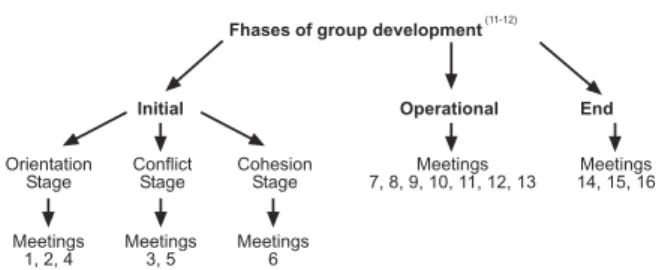
Figu r e 1 pr esen t s t h e st u dy r esu lt s f or t h e
ch ar act er izat ion of each ph ase.
Figur e 1 – Phases of gr oup dev elopm ent
I nit ial phase
Th e i n i t i a l p h a se i s ch a r a ct e r i ze d b y t h e
par t icipant s’ feelings of anx iet y about being accept ed
by t h e gr ou p, abou t t h e est ablish m en t of st an dar ds
and t he adopt ion of r oles( 12). I n t his st udy, m eet ings
1, 2, 3, 4, 5 and 6 cor r esponded t o t his phase.
Diana: I don’t have t im e for anyt hing. When I not ice,
I ’ve already assum ed several of ot her people’s com m it m ent s ( ...)
I t hink I ’m silly.
Talit a: I don’t t hink t hat . I t hink you’r e ver y im por t ant
in t he gr oup ( ...)
Diana: When I ’m anxious I t alk, t alk, t alk.
Coordinator: There are also people who work the opposite
w ay, in view of new sit uat ions, pr oblem s, t hey ar e m or e silent ,
ret ract ed.
Elza: I do t hat a lot , I close off, I ’m like t hat , passive,
I have difficult ies t o t alk.
( Meet ing 1 – Or ient at ion St age)
I n e x p e r i e n c i n g t h e i r i n i t i a t i o n i n g r o u p
m eet in g s as w ell as in t r ain in g act iv it ies ( u n k n ow n
en v ir on m en t s an d people) , t h e st u den t s est ablish ed
t h e i r f i r s t o b s e r v a t i o n s a b o u t “ b e i n g a n u r s i n g
st u den t ”.
Bianca: The cour se is ver y har d, ver y fast ( ...) you’d
like t o give up. ( ...) All t eachers ask som et hing of you. The t eacher
m akes dem ands dur ing t r aining. They ask: haven’t you lear ned
t hat yet ?
Diana: The nur sing cour se is like t hat ... you go on, you
st udy ver y har d for one subj ect , w hile you leave ot her s aside.
( ...) you t ake t he cour se a bit for w ar d as it com es.
Talit a: You know w hat I ‘m afr aid of. Som et im es I t hink
w e’r e gonna gr aduat e w it hout know ing anyt hing.
Diana: But w e w ill. Just like ever ybody.
Bianca: Did you know t hat t he nur se has t o be able t o
do everyt hing? You have t o be able t o do everyt hing. You have t o
know w hat t he nur sing aid does, w hat t he doct or does, w hat t he
phar m acist does...
Vit ór ia: Yeah, if t he aid m akes a m ist ake she “ pays t he
bill” , and if she’s doesn’t , she equally “ pays t he bill” . ( Laughs) .
Bianca: Man, it ’s alw ays her ( nur se) r unning aft er t he
doct or ( ...)
Diana: That ’s w hy w e have t o know w hat t he nur se’s
funct ion act ually is. ( Laughs) .
( Meet ing 5 – Conflict St age)
Th is sit u at ion f acilit at ed t h eir r epor t s abou t
h ow t h ey f elt t h e im p act of t h eir ow n id ealizat ion s
( desir ed) of t eacher s, t he subj ect , t r aining sit es and
a b o u t h o w t h e y g o t f r u s t r a t e d w h e n t h e y w e r e
con f r on t ed w it h t h e r eal ( som et h in g d if f er en t f r om
t h e desir ed) .
Mar ina: They have t he pow er , t hey ar e t he t eacher s.
They’ve w ar ned us t hat t eacher X flunks you on t r aining. You
have t o suck up t o t he t eacher s if you w ant t o get appr oved.
Coordinat or: ( ...) we have t o t hink, work on how t o face
t his m om ent , w it h t he t eacher , w it h t he pat ient , at t hat specific
m om ent . Think about w hat is provoking fears, fright ens us. What
we are doing here is t alking, crying, so t hat we won’t cry when we
are wit h t he pat ient , wit h t he t eacher. There are different ways of
t al k i n g . Cal l i n g t h e t each er an d say i n g t h at y o u h av en ’ t
under st ood. Have you alr eady t hought t hat t his t eacher can also
experience fears, anxieties, fear of m aking a m istake while teaching
you?
Juliana: But t hey’r e t he t eacher s, t hey t hink t hey don’t
m ake m ist akes, t hey pr ot ect t hem selves. ( ...)
( Meet ing 2 – Or ient at ion St age)
Fhases of group development
Initial Operational End
Meetings 1, 2, 4
Meetings 3, 5
Meetings 6 Orientation
Stage
Conflict Stage
Cohesion Stage
Meetings 7, 8, 9, 10, 11, 12, 13
Meetings 14, 15, 16
Diana: I asked a quest ion and t he t eacher didn’t pay
at t ent ion t o m e, she said she didn’t know .
Car ol: Yeah, it ’s like t hat , it ’s no use, last year I asked
t o r evise a quest ion, I t r ied t o dialogue, but not hing, it ’s a w ast e
of t im e... Today I saw som ebody at t he hospit al per for m ing a
w r ong t echnique, I w as shocked.
Juliana: I w as disappoint ed, I hear d people say so
m uch t hat hospit al X was t his, was t hat , a reference point . Hospit al
Y is m uch m or e or ganized.
Mar ina: I feel happy. Oh dear , you ar e seeing w r ong
t hings. That m eans t hat you know , t hat you can ident ify w hat ’s
r ight and w r ong.
Coor dinat or : I per ceive t hat you ar e disenchant ed.
Elza: ( ...) I don’t know , it ’s all ver y st r ange... I w as
obser ving... I t hink I bot her ed m or e...
( Meet ing 3 – Conflict St age)
At t h e sam e t im e, d u r in g g r ou p m eet in g s,
t hey had t heir first cont act w it h group funct ioning rules.
This w ay, t hey show ed feelings of anx iet y about t he
i n st i t u t i o n s ( u n i v er si t y, h eal t h ser v i ces an d g r o u p
act iv it y ) , t h eir st an dar ds, pr in ciples an d f u n ct ion in g
st r u ct u r e.
The coor dinat or ended t he gr oup on t im e and
cut off som e st at em ent s.
Coordinat or: I n t he group it ’s like t hat , when t he subj ect
get s heat ed w e have t o finish because of t he schedule w e have t o
com ply w it h. We can com e back t o t his subj ect dur ing our next
m eet ing.
( Meet ing 2 – Or ient at ion St age)
Carol: After the Pathology test we’ll have an I m m unology
t est . Except t hat I don’t know w hat it w ill deal w it h. I didn’t go t o
class anym or e, I don’t have t he subj ect . Now I have t o pick up
t he pieces.
Coordinat or: I can see t hat you st udy for Pat hology and
t ake t he t est . Then you concent rat e on I m m unology t o do t he t est ,
and so on. That m eans t hat you’re always picking up t he pieces.
Juliana: That is w hat it ’s like, t her e’s no w ay of doing
ev er y t hing.
Vit ór ia: When w e’r e at t he hospit al, for Fundam ent als
I I , w e see how im por t ant Phar m acology and I m m unology ar e.
What is hard is t o underst and t hat , in pract ice, we’ll use everyt hing
w e’ve lear ned in t heor y.
( Meet ing 6 – Cohesion St age)
Rules are inherent t o any inst it ut ion, but are
not alw ays w elcom e. They can be quest ioned, pr ovided
t h at t h is is don e r espect f u lly an d u sin g appr opr iat e
ar gum ent s. I n t he gr oup ex per ience pr esent ed her e,
on e sit u at ion cr eat ed con f lict an d clear ly br ok e t h e
gr oup st r uct ur e. A change in one act ivit y dat e ( m eet ing
6 ) , decided by som e par t icipan t s, cu lm in at ed in an
absent ee r at e of m or e t han 30 % . This sit uat ion w as
d i scu sse d d u r i n g m e e t i n g 7 , r e a d d r e ssi n g i n i t i a l
a p p o i n t m e n t s . Th e p a r t i c i p a n t s c o n s i d e r e d t h i s
m o m e n t a s a l a n d m a r k , a t w h i ch t h e y p o si t i v e l y
learned how t o live bet t er w it h est ablished principles.
Th i s l ea r n i n g w a s n o t r est r i ct ed t o t h o se sp eci f i c
m e e t i n g s, b u t , a cco r d i n g t o t h e st u d e n t s, i t w a s
ex t ended t o any ot her sit uat ion in w hich t hey w ould
be confr ont ed w it h st andar ds in any ot her inst it ut ion.
Coordinator: .( ...) We are part of an institution, this group
is inser t ed in an inst it ut ion, t her e ar e r ules for it s funct ioning.
Does anyone w ant t o r em ind us w hich?
Vit ór ia: Ar r ive on t im e, not ar r ive lat e.
Mar ina: I f you’r e absent t hr ee t im es you’r e out .
Coordinator: As students you also have to obey som e rules.
Juliana: I w ant ed t o leave aft er t he gr oup. But I can’t
because I have t o m ar k m y pr esence in I m m unology class.
Coordinat or: When you are nurses you’ll have t o com ply
w it h t im es, assum e r esponsibilit y for t he aids, people w ho w ill
w or k w it h you.
( Meet ing 4 – Or ient at ion St age)
Marina: So, at that tim e, when we went to ask to postpone
t he gr oup, it w as high t im e, I had alr eady asked t he I m m unology
t eacher and she really scorned us. Then I rem em bered t hat I had
t o w ar n you, t hat t he gir ls and I could not com e t o t he gr oup,
because w e w er e going t o dist r ibut e pam phlet s and sell ent r y
t icket s t o our par t y at t he univer sit y r est aur ant .
Juliana: I was at t he universit y rest aurant , I at e quickly,
t hen I w as t old t hat t her e w ouldn’t be any gr oup t oday. I didn’t
m iss it at t hat m om ent , but lat er it seem ed t hat som et hing w as
m i ssi n g .
Coor dinat or : Can y ou per ceiv e w hat happens w hen
w e change t he t im e, t he day, w it hout any pr evision? The gr oup
alr eady has it s ow n day. ( At t hat m om ent t hey w er e t alking
about t he par t y) .
( Meet ing 6 – Cohesion St age)
The st r uct ur ing of t he set t ing is t he sear ch t o
or ganize t hem selves as people living in a gr oup, w ho
can p r od u ce som et h in g or allow som et h in g t o “ b e”
w it h in a cer t ain t im e f r am e. Th e f act t h at a g r ou p
get s st r uct ur ed, or ganized, est ablishes it s obj ect iv es,
inevit ably gives r ise t o aut hor it y( 16). Ther efor e, as soon
a s a g r o u p ’ s sp o n t a n e o u s st r u ct u r i n g p r o ce ss i s
st art ed, a collect ive funct ion appears, w hich is a pow er
t o r egulat e and cont r ol conduct s.
Car ol: We m iss it w hen t her e’s no gr oup.
Marina: I think it’s com plicated here in the group (...). The
group subject is not always what you want to blow off steam about...
Bianca: I t hink you have t he r ight t o put for w ar d a
Marina: We have a proj ect : beginning, m iddle and end.
Today, Sim one’s subj ect fit , a per son w ho needed it a lot and w e
didn’t let her t alk. But if t he subj ect hadn’t been t his one she
w ouldn’t have blow n off st eam . I w e w er e t o t alk about t im e, like
in t he past m eet ing, t he subj ect w ouldn’t be appr opr iat e. I don’t
know about your view ( ...) I t hink it w on’t be appropriat e. I t ’s not
com m on t her apy, it ’s a dir ect ed t her apy.
Sim one: I t ’s not t hat I w ant ed t o t alk. No w ay. I t w as
t he coor dinat or w ho st im ulat ed m e. Then I felt m obilized ( ...) . I
m ir r or ed m yself, t hat ’s w hy I t alked.
Coor dinat or : Can you see how t he gr oup w or ks?
Talit a: I t ’s an exchange. I n t his gr oup, you have t he
oppor t unit y t o t alk w it h st udent s w ho ar e not fr om your t r aining
group.
( Meet ing 5 – Conflict St age)
Op er at ion al p h ase
I n t h e s e c o n d p h a s e , a c c o r d i n g t o
lit erat ure( 12), t he gr oup is com par ed t o a t eam , in w hich
par t icipan t s w or k a lot an d r espon sibilit y is div ided
m o r e eq u al l y. An x i et y b eco m es m o r e i n t en se, b u t
m em b er s co n t r o l a n d t o l er a t e i t b et t er. Pr o b l em s
appear, such as t he for m at ion of subgr oups, conflict s,
lev el of self- r ev elat ion an d r esist an ce.
I n t his r esear ch, t he st udent s per ceiv ed t hat
in group m eet ings as w ell as in t he course, t here w ere
sin g u lar it ies, d if f er en ces am on g t each er s, st u d en t s
an d t h e coor d in at or. Th is g av e r ise t o t h e n eed t o
adapt t o t he new m om ent t hey exper ienced, including
changes and t r ansfor m at ions in t heir at t it udes t ow ar ds
t h e cou r se an d t h e gr ou p. Th is m ov em en t in clu des
t h e k n o w n a n d t h e u n k n o w n , p r o g r e s s i o n a n d
r egr ession, success and failur e. The need t o adapt t o
“ n ew t h in gs” t h e st u den t s com m en t ed on seem s t o
be t he m anifest at ion t hat t hey per ceived t he changes
t h ey w er e g o i n g t h r o u g h i n t h e i n t er a ct i o n s t h ey
est ablish w it h t he universit y and w it h pract ical learning.
Change or t r ansfor m at ion supposes t hat people w ant
t o face t he new and int end t o develop innovat ive skills
t o get involved w it h realit y ( 17).
Sim one: There’s no dialogue out t here. You’re not heard,
her e you ar e list ening. ( Meet ing 7)
Vit ór ia: You know w hat t he pr oblem is? We ar e in a
phase in our lives, t he phase of univer sit y and t he pr ofession,
w e ar e adapt ing t o new t hings. ( Meet ing 8)
Nina: They keep on t alking about t he difficult ies and I
obser ve m y difficult ies ( ...) I t ’s t his t hing of each per son t alking
a bit t hat is im port ant for who is here list ening, t hat ’s t herapeut ic.
I t ’s har d for you t o deal w it h 80 w om en, it ’s har d for you t o
expose your self in t his space, w it h so m any differ ent people ( ...)
( Meet ing 8 )
Carol: Going t o college is m ore or less like m oving t o
another city. Starting everything all over (...). You acquire a different
at t it ude, learn t o be different from now on. ( Meet ing 8)
Th e st u den t or an y ot h er per son “ can on ly
d ed icat e h im - / h er self t o an act iv it y if ( s) h e h as a
p o s i t i v e o r i e n t a t i o n t o w a r d s i t ”( 1 8 ). Th e r e f o r e ,
know ledge acquisit ion, part icipat ion in group act ivit ies,
a m o n g o t h er s, r eq u i r e p o si t i v e a f f ect i v e su p p o r t .
For m al cu r r icu lar act iv it y does n ot n ecessar ily h av e
t o be coer cive in or der t o achieve it s m ain obj ect ive,
w hich is learning. The lat t er, in t urn, can occur t hrough
t he pleasur e and j oy it pr oduces.
Sim one: ( ...) I got int o t he gr oup and t hought : how
nice, I ’m going t o com e ( ...) . But w hy t alk?
Juliana: Why t alk? Because you’r e par t of t he gr oup.
Sim one: I know how t o be part of t he group by list ening
( ...) I lear ned t o adapt . ( ...) Maybe her e, at t his univer sit y, in
cert ain groups people do not want t o list en t o m e, but I ’m list ened
t o in ot her places, so I ’m useful ( ...) Ther e’s no w ay of m e being
useful her e.
Car ol: You said t hat y our ut ilit y w as t o list en her e
wit hin t he group. ( ...) One day, you kept your hand raised for half
an hour , w e could per ceive t hat you w er e kind of bot her ed about
w ant ing t o t alk, unt il you m anaged t o. So t he ut ilit y of t he gr oup
is not j ust list ening!
( Meet ing 8)
Th r o u g h t h ese st a t em en t s, st u d en t s w er e
r evealing t hem selves, in or der t o show t hat t hey w er e
ex per ien cin g a par t icu lar m om en t . Each per son w as
look ing at her self as a per son, per ceiv ing t he ot her,
q u est i o n i n g h er o w n r eal i t y an d t h e r el at i o n s sh e
e s t a b l i s h e s w i t h h e r ( n a t u r a l , s o c i a l , c u l t u r a l )
e n v i r o n m e n t . Th i s w a s p o s s i b l e b a s e d o n t h e
ex p er ien ce ex ch an g e est ab lish ed in t h e con t ex t of
t h e social p r act ice t h ey w er e in ser t ed in , in clu d in g
t he gr oup t her apy ex per ience t hey passed t hr ough.
The per cept ion w as evidenced t hat t heir fear s,
anguish and solit ude, deriving fr om t he t r ansit ion fr om
t h e o r y t o p r a c t i c e , w e r e f e e l i n g s t h e o t h e r s
ex per ien ced an d, t h er efor e, n ot u n iqu e. Th ey w ou ld
h av e t h e o p p o r t u n i t y t o sh ar e t h em i n t h e g r o u p
cont ex t and feel r eliev ed.
Mar ina: I t hink w e have t o j oin. Som e st udent s w er e
assessed dur ing anot her class and w e w er en’t supposed t o be
absent fr om t hat class. ( ...) so, t hinking about our pr ofession,
our selves as nur ses... Ar e w e going t o “ fix one t hing and cause
pr oblem s in t he ot her ?” You ar e w or king, am I going t o leave t his
Bianca: I got it all w r ong. I w as doing ever yt hing r ight .
Then she ( t eacher) said: you have one hour. I can’t do anyt hing in
a hur r y.
Vit ór ia: But she said t hat you w er e m aking m ist akes
( ...) put you under pr essur e. But you’r e not like t hat !
Bianca: I w on’t be able t o do it again.
Vit ór ia: Yes you w ill.
Bianca: She said: “ You’re not skilled but you’re going t o
t he hospit al” . How am I going t o t he hospit al if I don’t know ? And
w hat if I for get ?
( Meet ing 9)
Th e coor d in at or id en t if ied t h e con f lict t h at
e m e r g e d a n d l e t t h e g r o u p d i scu ss t h e p o ssi b l e
r easons involved, in an at t em pt t o m anage t he conflict ,
believing t hat t his could lead t o each m em ber ’s gr ow t h
an d t o t h e gr ou p’s gr ow t h as a sin gle body. As t h e
st u d en t s w er e act iv ely p ar t icip at in g in g r ou p w or k ,
t he coordinat or now act s as a consult ant , helping t he
gr oup t o keep it s focus on it s obj ect ive and t r ying t o
decr ease t he im pact of anyt hing t hat could t ur n back
or delay t he gr oup’s ex ecut ion of t he t ask .
Coordinat or: You are going t hrough a m om ent of right s
and w r ongs. Thr ough an exper ience in school, w hich w ill gr ant
you secur it y out t her e in t he pr ofession, in hospit al, t o do t hings
r ight or w r ong ( ...) school is a place for lear ning, w her e t her e ar e
r ight s and w r ongs. Even people w ho ar e t ot ally secur e about a
cer t ain issue can m ake m ist akes, because of pr act ical t hings or
because t hey had a busy day. I t hink t hat w hat you should be
t hinking now is t hat t his is a m om ent of lear ning. You ar e t r ying
out a t echnique. I f you’r e going t o do it w ell or badly, t her e’s t he
supervisor t o advise you, t o give you securit y. Does t he laborat ory
cause st r ess? Maybe yes. We feel under pr essur e, not only her e
in school or in t he pr ofession. Ther e ar e sever al t hings in your
lives t hat have alr eady caused pr essur e... ( Meet ing 9)
Wh en t h e g r o u p f l o w s, t h i s ev i d en ces t h e
elaborat ion, revealing ent husiasm am ong par t icipant s.
Th e y e s t a b l i s h e x c h a n g e s , d u r i n g w h i c h t h o s e
p r esen t in g sim ilar ex p er ien ces w it h t h e ad d r essed
t hem e feed ot her s, t hat is, based on t his ex per ience
ex ch an g e, d iscu ssion s m ak e it p ossib le t o p er ceiv e
t hat t hings can change or be differ ent . Ther e is gr eat er
in t egr at ion am on g gr ou p m em ber s.
Vitória: We are looking at things differently. (Meeting 10)
Car ol: We ar e m or e aw ar e ( ...) The st r ess sit uat ion
does not exer t such an im pact on us now because w e ar e com ing
her e. We w ould not know how t o act . So w e ar e her e w or king on
how t o act . We know how t o deal w it h sever al sit uat ions. I have
alr eady been t hr ough sit uat ions in w hich I w as afr aid, because
I ’m a fr agile per son, because I cr y a lot and, t oday, it ’s not so
heavy as I t hought it w ould be. ( Meet ing 10)
Vit ória: We are learning t o work in group, t o respect t he
group, but put t ing our knowledge in pract ice, what we have already
lear ned. ( Meet ing 13)
En d ph ase
Th e t h i r d p h a s e , i . e . t h e e n d p h a s e i s
addr essed since t he st ar t of t he gr oup, but lit er at ur e
rarely discusses it as a defined period ( 12). During t he
l a s t t h r e e m e e t i n g s , t h e s t u d e n t s a s s e s s e d t h e
ch an g es t h at occu r r ed in t h eir b eh av ior s as p eop le
“ inside” and “ out side” t he gr oup. They dr ew a par allel
bet w een t he t her apeut ic gr oup and t he t r aining gr oup,
concluding t hat t hey ar e com plem ent ar y. The st udent s
r ev ealed t hat t hey st ar t ed t he cour se and t he gr oup
w it h pr ej udices and t hat t hey finished w it h a feeling
of st ar t ing t o w alk alone.
Nina: I see it like t his, st ar t ing fr om t his gr oup, w it h
t he t r aining gr oup, one com plem ent ed t he ot her a lot . Dur ing
t r aining, it ’s not j ust because t he t eacher w as st r ict er or calm er .
( ...) The first im pact was t he hospit al, cont act wit h t he hospit alized
pat ient ( ...) fear, insecurit y, uncert aint y “ what am I going t o do?”
And t his gr oup is a com plem ent , because you ar r ive her e and
expose yourself, t here are your colleagues who are passing t hrough
t he sam e t hings, you cry and see t he ot her person crying and see
t hat you ar e suffer ing t he sam e pr oblem s, you see t hat you ar e
no differ ent fr om anyone else, you end up finding com for t ( ...)
because it ’s a gr oup, one is helping t he ot her , per haps because
we are very different from one anot her, we find each ot her, discuss,
list en t o one anot her . I t ’s in t his phase of t he fir st cont act w it h
t he pat ient , fr om t heor y t o pr act ice, t hat it is ver y har d, w e help
each ot her her e in t he gr oup. ( Meet ing 15)
The st udent s becom e m ore able t o reflect on
w h a t t h ey g o t h r o u g h i n a co n t ex t o f si g n i f i ca n t
ex p er i en ces. W h en p er cei v i n g t h ei r i n t er n a l
transform ation, they becom e m ore secure and aware of
their actions as trainees and future professionals (19).
Nina: ( ...) The gr oup w as fundam ent al for us, like, t o
m it igat e our suffer ing dur ing t r aining, dur ing t he fir st cont act .
That hist or y, w hat luggage w e t ake t o t he t r aining in or der t o
suffer less, w hat w e leave in t he closet . I t hink t hat w as ver y
im por t ant . The gr oup feeling w e lear ned t o t ake in t he t eam ,
w hich w e st ar t ed t o deal w it h t his t er m . So, t her e w er e m any
im por t ant t hings in t his gr oup and w e shouldn’t see t his gr oup
as dependence, but as som et hing t hat helped us t o t ake off.
( Meet ing 16)
Th i s st a t e m e n t r e v e a l s t h e f r e e d o m t h e y
acquir ed t o explor e t hem selves in t he “ her e and now ”.
Wh en st u den t s go t h r ou gh t h e t each in g ex per ien ce,
t eacher s and t he healt h t eam , r eceiving t heir r espect
a n d u n d e r st a n d i n g , t h e y w i l l ce r t a i n l y h a v e t h e
possibilit y t o r epeat t h is beh av ior in car e f or ot h er
people an d for t h em selv es.
PARTI CI PAN TS’ PERCEPTI ON OF GROUP
MEETI NGS
Mem ber s’ im pr essions of t he gr oup
Wh en assessin g t h e m eet in g s, p ar t icip an t s
r ev ea l ed t h a t t h ey f el t m o t i v a t ed , a s t h ei r n eed s
becam e m or e com m on and t hey m ut ually ar t iculat ed
in or der t o put t heir obj ect iv es in pr act ice. Sev en of
t h e n in e p ar t icip an t s h ig h lig h t ed t h e f act t h at t h ey
per ceived during t he m eet ings t hat t heir fear s, anguish
and solit ude, der iving fr om t he t r ansit ion fr om t heor y
t o p r a ct i ce, w er e f eel i n g s t h e o t h er s ex p er i en ced
( ident ificat ion) and, t her efor e, not unique.
Flávia: Anot her good t hing t hat helped t o relieve anxiet y,
in t his process we’ve been t hrough, in t his care t erm , was because
w e w er e all in t he sam e boat , w e w ent t hr ough t he sam e t hings
and t his helped t o r elieve m e a lot . ( ...) I have t o go ahead. I n
college, I felt gr eat fear and insecur it y, I t hink ever yone felt it
and know ing t his relieved m e a lot . I loved group t herapy, I loved
it because I didn’t feel alone.
Dur ing t heir educat ion, st udent s w ill need a
super visor or t r ained pr ofessional t o give suppor t and
adv ice, w ho can also assess t his st udent ’s r esour ces
and lim it at ions. I t is recom m ended t hat t his exper ience
be shar ed w it h a gr oup of colleagues, giv ing r ise t o
f eelin g s of em p at h y, in w h ich t h ey w ill b e ab le t o
crit icize and support one anot her, w hile lear ning m or e
about t hem selv es( 2 0 ).
Nina: I t hought it w as posit ive, w hen t he colleague
blew off st eam and “ t ouched” t he ent ir e gr oup because ever yone
was going t hrough t he sam e sit uat ion. ( ...) . We were experiencing
som et hing sim ilar , so t hen you ident ify w it h t he per son. Then
she w as let t ing off st eam it ’s as if you had also under st ood your
own problem .
Th e y p e r ce i v e d t h e g r o u p a s a sp a ce t o
id en t if y w it h on e an ot h er an d in w h ich t h ey f ou n d
suppor t t o deal w it h t he cour se dem ands.
Vit ór ia: We ar r iv ed, pr act ically t he m aj or it y , t ir ed,
st r essed about som et hing t hat happened dur ing t r aining, and t o
the extent that we got to know one another we could say everything,
blow off st eam . Nobody w as t her e t o cr it icize you, ever ybody
helped everybody. I t was a place where you could t alk about what
happened, expr ess your “ ner ves” , your exper iences, bot h t he
good and t he bad ones and t her e w as alw ays som eone t o t alk. I t
w as a ver y good t hing, t he exper ience exchange, besides t he
aspect of fr iendship w e had in t he gr oup and w hich cont inues
out side t he gr oup as w ell. I n t he gr oup, ev er y one accept ed
ever yone as t hey ar e and not as t hey could pr esent t hem selves.
The w ay of being, one t r ying t o help t he ot her in difficult ies ( ...)
I also felt m or e secur it y in t he pr act ical pr ocedur es I ’m going t o
do now. I n t he group, we becam e a lot m ore m at ure. We perceived
t hat ever yt hing w e go t hr ough, it ’s a phase and t hat w e have t o
face it w it h our heads high, w it h m at ur it y.
Th e p ar t i ci p an t s’ sel f - r ev el at i o n f aci l i t at ed
t h eir m u t u al at t r act ion an d b et w een t h em an d t h e
g r o u p . Th i s p r o g r e ssi v e co n t a ct i s k n o w n a s t h e
t her apeut ic fact or of cohesion( 11). I t is know n t hat t he
g r o u p ’ s c o h e s i o n i n c r e a s e s w h e n m e m b e r s
a ck n o w l e d g e i t a s a r i ch so u r ce o f i n t e r p e r so n a l
in f or m at ion an d su p p or t . Th ey lear n ed t o liv e w it h
o t h e r s, t o l i st e n , e st a b l i sh e x ch a n g e s a n d v a l u e
t h e m se l v e s. Th e y a l so m a n i f e st e d t h e d e si r e t o
cont inue t he gr oup, alt hough t hey knew about it s end,
a s d e t e r m i n e d i n t h e Th e r a p e u t i c Co n t r a ct . Th e y
co m p l i m e n t e d t h e co o r d i n a t i o n , i t s a t t i t u d e a n d
m ediat ing r ole. Som e par t icipant s even suggest ed t he
offer ing of a sim ilar act iv it y as an opt ional subj ect .
Diana: When you are working in a team you have to learn
how t o list en, t alk, st op a bit t o t hink. I learned t hat in t he group.
Flávia: The gr oup had t he goal, r eached it and it w as
t im e t o end, ( ...) it helped m e t o grow and t o accept , but it ended.
Vit ór ia: I n t he gr oup w e had r ules, discipline, because
w e didn’t m ove on w it hout t hat . That w as som et hing w e lear ned:
ev er y t hing has r ules, discipline, if not , it becom es a m ess. I
t hink it is sad t hat t he gr oup has t o end ( ...) , but t he subj ect
finished, LI GI E finished ( labor at or y w her e t he m eet ings w er e
held) . We assum ed a com m it m ent , w e closed fr iendships, w e
liked t o be in LI GI E, t his m om ent w as our s only.
Mar ina: I t hink t hat t his pr oj ect , even w hen you finish
your doct or al pr ogr am , I t hink t hat , as t her e is int egr at ion in t he
fir st year , I t hink t hat t his gr oup should be par t of t he opt ional
subj ect s, because it ’s very good. And we already cont inue college
differ ent ly, it seem s t hat w e gr ow up in few sessions.
Bianca: I loved and I would like it if there was m ore, it’s
som ething that helped m e a lot. I would like to have it in the second
term . I need to im prove m y insecurity... I t’s also im portant that what
happened stayed here in the group. I think that you knew how to work
with the group very well, you knew how to direct it very well. I think
that we would keep on hitting the sam e key if you hadn’t directed the
group. I really want to continue in other groups.
Aspect s per ceiv ed as n egat iv e
I n t his group, abandonm ent and disconnect ion
p ar t i cu l ar l y m ar k ed t h e g r o u p as a n eg at i v e f act .
Par t icipan t s felt dem or alized w h en a colleagu e gav e
up, despit e t heir repeat ed effort s t o m ake her cont inue.
Bot h abandonm ent and disconnect ion t hr eat en gr oup
st ability, because t hey consum e t he t herapist ’s and t he
par t icipant s’ t im e and ener gy t o t he ext ent t hat t hey
t ry t o prevent t he person from leaving t he group; t hey
can im pede t he developm ent of cohesion, t hreat ening
t he st abilit y of t he affiliat ion. Moreover, t hey can im plicit ly
and som et im es explicit ly devalue t he group( 11, 15).
Vitória: I t was negative that the colleague gave up. (...) We
knew that she had problem s, but she did not com ply with group
hours, she was absent, we were concerned, but she was not concerned
about us. I saw her departure as neglect, irresponsibility.
Juliana: What I didn’t like in t he gr oup ( ...) one per son
w ho w as not flexible, she only knew how t o fight ( ...) , but she
didn’t accept anyone’s opinion ( ...) she left ( ...) I even want ed her
t o cont inue t o see if she opened her m ind, but it didn’t w or k.
Th e t h e r a p i st sh o u l d h e l p p a r t i ci p a n t s t o
int erpret t he event in a m ore realist ic and const ruct ive
way. I n t he cases of abandonm ent and disconnect ion
t hat occur r ed in t his gr oup, t he coor dinat or, act ing as
a facilit at or, st im ulat ed t he st udent s t o r eflect on t he
f act . Th u s, t h ey en d ed u p con clu d in g t h at p er h ap s
her int er est s and t he gr oup’s w er e not being at t ended
t o, and t hat t he people w ho left could pr obably obt ain
benefit s som e ot her t im e.
Diana: I m et her aft er w ar ds and she t old m e t hat she
gave up t he t erm , but not t he course. She’ll com e back next t erm ,
less t ense, she said she had t o t ake car e of her self. Now I see
t hat t her e w as a r esult , she’s t aking car e of her self, she’s going
t o get m ar r ied an d said t h at sh e didn ’t for get abou t u s. I t
sur pr ised m e a lot . Dur ing t he gr oup, w e didn’t see any r esult .
I t was only on the occasion of the assessm ent
t hat one part icipant m anaged t o perceive how healt hy
t he colleague’s disconnect ion from t he group had been,
because it allowed her to follow new courses in her search
for well being, new horizons, allowing her a healthy return
to academ ic life. The group probably contributed in som e
way to that participant’s decision to give up, which was
interesting for who stayed as well as for who left.
A r eason ab le lev el of con f r on t at ion , an g er
an d con f lict solv in g can of f er in t er per son al lear n in g
am on g gr ou p m em ber s( 9 ).
Carol: When you said t o a colleague t o wait a bit because
anot her per son w as going t o t alk, you “ cut ” her e off ( ...) t his
cr eat ed an unpleasant at m ospher e at t hat t im e, but anot her
colleague put up t he subj ect dur ing t he next session and it w as
solved. ( ...) ever yone got educat ed and t her e w er e no fur t her
int er r upt ions... it w as clear ed up.
Vit ór ia: I didn’t like it , one day, w hen I w as cr ying a lot
( ...) and I found t he door closed ( ...) I couldn’t get in, t hen I
under st ood t hat t her e w as a schedule. We had t o r espect it .
Mar ina: I t hink t hat not having pr eviously agr eed on
t he change in t he t im e and dat e of t hat m eet ing ended up being a
posit ive point for t he gr oup because, fr om t hat day onw ar ds, w e
st ar t ed t o t alk as a gr oup.
Co h e si o n i s a n e sse n t i a l p r e r e q u i si t e f o r
successful conflict m anagem ent . I n t his st udy, t his was
possible because t he par t icipant s dev eloped a feeling
of respect and m ut ual confidence, besides valuing t he
g r ou p , Th is m ad e t h em cap ab le of t oler at in g som e
u n com f or t ab le sit u at ion s. I t w as v er y im p or t an t t o
m aint ain honest com m unicat ion, no m at t er t he ext ent
t o which t he m em bers got irrit at ed about t his.
FI NAL CONSI DERATI ONS
Accor d in g t o t h e st u d y f in d in g s, t h e g r ou p
t echnique can be used as a suppor t and adapt abilit y
fact or for under gr aduat e nur sing st udent s w hen t hey
m o v e f r o m t h e o r e t i ca l t o p r a ct i ca l l e a r n i n g . Th e
par t icipant s at t r ibut ed t he gr oup w it h a gr adual change
i n t h e i r b e h a v i o r a n d p e r f o r m a n c e i n p r a c t i c a l
a ct i v i t i es, i n t h ei r r el a t i o n w i t h f a cu l t y m em b er s,
colleagu es an d par t icu lar ly in pat ien t con t act . Th ey
per ceiv ed t hat , as opposed t o t heir colleagues, t hey
st ar t ed t o r ef lect bef or e act in g or r eact in g t ow ar ds
new sit uat ions t hey w er e faced w it h.
Ther efor e, gr oup psy chot her apy seem s t o be
a n i n s t r u m e n t w h i c h n u r s i n g h i g h e r e d u c a t i o n
inst it ut ions need t o t ak e int o account as a r esour ce
n o t o n l y f o r p sy ch o l o g i ca l , b u t a l so f o r d i d a ct i ca l
suppor t in t heir cur r icula. Not only in sit uat ions lik e
t he one st udied her e, i.e. t he t ransit ion bet w een t heor y
and pr act ice. Not only as a st rat egy, but also as an
o b j e ct i v e . At a t i m e w h e n t e a ch i n g r e f o r m s a r e
d iscu ssed , it sh ou ld b e r em in d ed t h at an y p lan n ed
change w ill not only be t echnical, but w ill also ex er t
effect s on t he hum an being.
REFERENCES
1 . Pe r e i r a ALF. As t e n d ê n c i a s p e d a g ó g i c a s e a p r á t i c a
ed u cat iv a n as ciên cias d a saú d e. Cad Saú d e Pú b lica 2 0 0 3
set em b r o - o u t u b r o; 1 9 ( 5 ) : 1 5 2 7 - 3 4 .
2 . Valsecch i EASS, Nog u eir a, MS. Com u n icação p r of essor
-aluno: aspect os r elacionados ao est ágio super v isionado. I n:
Me n d e s I AC, Ca r v a l h o EC, co o r d e n a d o r e s. Co m u n i ca çã o
com o m eio d e p r om ov er saú d e. 7 º Sim p ósio Br asileir o d e
Com u n icação em en f er m ag em ; 2 0 0 0 . j u n h o 5 - 6 ; Rib eir ão
Recebido em : 7.12.2005 Apr ovado em : 14.2.2006
3. Far ah OGD. A ansiedade e a pr át ica no pr ocesso
ensino-a p r e n d i zensino-a g e m d e h ensino-a b i l i d ensino-a d e s p si co m o t o r ensino-a s: t é cn i censino-a s d e
pr epar o de m edicação par en t er al. [ disser t ação] . São Pau lo
( SP) : Escola de En f er m agem / USP; 1 9 9 6 .
4. Osór io LC. Gr upos: t eor ias e pr át icas - acessando a er a da
gr upalidade. Por t o Alegr e ( RS) : Ar t m ed; 2000.
5 . Bech elli LPC, San t os MA. O pacien t e n a psicot er apia de
gr u po. Rev Lat in o- am En f er m agem 2 0 0 5 j an eir o- f ev er eir o;
1 3 ( 1 ) : 1 1 8 - 2 5 .
6 . Gu an aes C, Japu r M. Fat or es t er apêu t icos em gr u po de
apoio. Rev Br as Psiquiat r ia 2 0 0 1 set em br o; 2 3 ( 3 ) : 1 3 4 - 1 4 0 .
7 . Bech elli LPC, San t os MA. Psicot er ap ia d e g r u p o: com o
su r giu e ev olu iu . Rev Lat in o- am En f er m agem 2 0 0 4 m ar
ço-ab r il; 1 2 ( 2 ) : 2 4 2 - 9 .
8 . Mack en zie KR. Tim e- lim it ed g r ou p p sy ch ot h er ap y. I n t J
Gr ou p Psy ch ot h er 1 9 9 6 ; 4 6 ( 1 ) : 4 1 - 6 0 .
9 . Z im er m an DE. Fu n d am en t os b ásicos d as g r u p ot er ap ias.
Por t o Alegr e ( RS) : Ar t m ed; 2 0 0 0 .
10. Guilliér on E. As psicot er apias br eves. Rio de Janeir o ( RJ) :
Jor ge Zahar Edit or ; 1 9 8 6 .
11. Yalom I D. The t heor y and pract ice of gr oup psychot her apy.
New Yor k : Basic Book s; 1 9 9 5 .
1 2 . Lasalle PC, Lasalle AJ. Gr u pos t er apêu t icos. I n : St u ar t
GW, Lar aia MT. Enfer m agem psiquiát r ica: pr incípios e pr át ica.
Por t o Alegr e ( RS) : Ar t m ed; 2 0 0 1 . p. 6 9 5 - 7 0 9 .
1 3 . Mi n a y o MCS. O d e sa f i o d o co n h e ci m e n t o : p e sq u i sa
q u al i t at i v a em saú d e. São Pau l o - Ri o d e Jan ei r o ( SP- RJ) :
Hu ci t e c- Ab r a sco ; 1 9 9 9 .
14. Scher er EA. Est udo de r euniões de equipe ger al em um
h ospit al- dia psiqu iát r ico. [ disser t ação] . Ribeir ão Pr et o ( SP) :
Facu ldade de Medicin a de Ribeir ão Pr et o/ USP; 1 9 9 9 .
1 5 . Sa l v e n d y JT. Se l e çã o e p r e p a r a çã o d o s p a ci e n t e s e
o r g a n i z a ç ã o d o g r u p o . I n : K a p l a n H I , S a d o c k B J,
or gan izador es. Com pên dio de psicot er apia de gr u po. Por t o
Alegr e ( RS) : Ar t es Médicas; 1 9 9 6 . p. 6 3 - 7 2 .
1 6 . Mu cch ielli R. Psicolog ia d a r elação d e au t or id ad e. São
Pau lo ( SP) : Mar t in s Fon t es; 1 9 7 9 .
17. Gay ot t o MLC, Dom ingues I . Lider ança: apr enda a m udar
em gr upo. Pet r ópolis ( RJ) : Vozes; 1996.
1 8 . Lu ck e si CC. Fi l o so f i a d a e d u ca çã o . Sã o Pa u l o ( SP) :
Cor t ez; 1 9 9 4 .
1 9 . Pet t en g ill MAM, Nu n es CB, Bar b osa MAM. Pr of essor e
a l u n o c o m p a r t i l h a n d o d a e x p e r i ê n c i a d e e n s i n o
-apr endizagem : um a disciplina de enfer m agem pediát r ica da
Univ er sidade Feder al de Mat o Gr osso do Sul. Rev Lat ino- am
En f er m ag em 2 0 0 3 j u lh o- ag ost o; 1 1 ( 4 ) : 4 5 3 - 6 0 .
20. St uart GW. Relacionam ent o t erapêut ico ent re enferm eiro e
pacient e. I n: St uart GW, Laraia MT. Enferm agem psiquiát rica: