AACL BI OFLUX
Aqu a cu lt u r e , Aqu a r iu m , Con se r va t ion & Le gisla t ion
I n t e r n a t ion a l Jou r n a l of t h e Bioflu x Socie t y
Pr a ct ice s, a w a r e n e ss a n d a t t it u de s of M a r a n a o
fa r m e r s in t hr e e w a t e r she d ba r a nga y s in M a siu ,
La n a o De l Su r , Ph ilippin e s t ow a r ds t he pr ot e ct ion
a n d con se r v a t ion of t he La k e La na o W a t e rsh e d
1
Gat ocod M. Rascal,
2Rodolfo C. Aranico,
3Nim fa L. Bracam ont e,
and
2Ruben F. Am parado Jr.
1
Depart m ent of Env ironm ent and Nat ural Resources- Aut onom ous Region in Muslim Mindanao ( DENR- ARMM) , Cot abat o Cit y, Philippines; 2 Depart m ent of Biological Sciences,
College of Science and Mat hem at ics, Mindanao St at e Univ ersit y – I ligan I nst it ut e of Technology , I ligan Cit y , Lanao del Nort e, Philippines; 3 College of Art and Science, Mindanao St at e Universit y- I ligan I nst it ut e of Technology , 9200 I ligan Cit y , Lanao del Nort e, Philippines. Corresponding aut hor: R. F. Am parado, ruben_am parado@y ahoo. com
Abst r a ct. The st udy det er m ined t he pr act ices, awar eness and at t it udes of Mar anao far m er s in t he Lake Lanao Wat er shed in t hr ee wat ershed bar angays nam ely: Gabar Sawer , Lanco Dim apat oy and Lacadun in Masiu, Lanao Del Sur , Philippines and t heir im plicat ions t o t he pr ot ect ion and conser vat ion of Lake Lanao Wat er shed. The awar eness and at t it udes of t he far m ers ar e gear ed t owar ds t he conser vat ion and pr ot ect ion of t he said wat er shed t o ser ve t he needs of t he people living wit hin t he wat er shed. The socio-dem ogr aphic and econom ic char act er ist ics of t he r espondent s have no significant r elat ionship wit h t heir far m ing and for est pr oduct s ext r act ion pr act ices. Most of t he Mar anao far m er s have an idea on t he im plicat ions of t heir far m ing and for est pr oduct s ext r act ion pr act ices t owar d t he pr ot ect ion and conser vat ion of t he Lake Lan ao Wat er shed in Masiu, Lan ao Del Sur . The findings of t he st udy also im plied t hat t he Mar anao far m er s of t he Lake Lanao Wat er shed should be consider ed par t ner s in pr ogr am developm ent . Par t icipat or y appr oach in pr ogr am planning, developm ent and im plem ent at ion is deem ed m ost appr opr iat e for t he st akeholder s who lived in and depended on t he nat ur al r esour ces in t he ar ea for t heir subsist ence.
Ke y W or ds: for est pr oduct ext r act ion and far m ing pr act ices, awar eness, at t it ude and conser vat ion.
I n t r odu ct ion. The basic cause of w at ershed degradat ion is a com binat ion of ignorance and econom ic back w ardness of people, out dat ed social sy st em , ov erpopulat ion and ov ergrazing. These fact ors lead t o cult iv at ion of land wit hout adequat e soil and w at er conserv at ion and of land basically unsuit able for sust ained agricult ure. They lead t o spreading shift ing cult iv at ion, inv olving perm anent forest land, reduct ion of forest fallow period, wit h soil ex haust ion and inefficient conserv at ion of forest s ( Saplaco 1998; Sosm eña 1991) .
Lak e Lanao has an area of 35, 660 hect ares and it is t he second largest lak e in t he Philippines. I t serves as a cat aly st in t he indust rial dev elopm ent of Mindanao. I t is t he w at er reserv oir in w hich st eady supply of w at er com es t he Lak e Lanao Wat ershed. I t is t he m ain source of w at er from w hich t he series of hy droelect ric pow er generat ion plant s along t he grid of t he Agus Riv er depends. I t is highly reliable source t o m eet t he m uch needed pow er requirem ent s of Mindanao I sland. I t also serv es ot her purposes such as irrigat ion, navigation, dom est ic, religious, fish, farm ing and recreat ional purposes ( Gallardo 2009) .
degrees of degradat ion and will be in great risk of being perm anent ly im paired t o deliv er m any goods and serv ices vit al t o societ y. How ev er, recent gov ernm ent proj ect s inv olving com m unit y part icipat ion lik e Com m unit y Based Forest Managem ent proj ect ( CBFM) hav e helped m uch in t he rehabilit at ion of t he degraded w at ershed areas in v arious part s of t he count ry . How ev er, t he im plem ent at ion of t he gov ernm ent program s and proj ect s has been adv ersely affect ed by v arious forest product s ex t ract ion pract ices am ong t he Maranao farm ers and com m ercial logging com panies w ho hav e less regard for t he conserv at ion of residual t rees and t ree plant ing program s.
I t has been ack now ledged t hat t here has been lim it ed inform at ion on t he pract ices, aw areness and at t it udes of t he Maranao farm ers in Masiu, Lanao del Sur, Philippines t ow ards t he prot ect ion and conservat ion of t he Lak e Lanao Wat ershed. Moreov er, t his st udy w ould reinforce and fill-in t he gap in t he deart h of k nowledge about t he farm ing and forest ex t ract ion pract ices of t he respondent s.
The m unicipalit y of Masiu is locat ed in t he east ern port ion of t he Lanao del Sur, Philippines w here t he area of st udy, t he t hree ( 3) barangay s, nam ely : Gubar Saw er, Lanco Dim apat oy and Lacadun are locat ed. These barangay s cov er about 40 percent of t he t ot al area of t he m unicipalit y of Masiu, Lanao Del Sur. They com prise m ore t han 1, 000 hect ares of paddy / lowland farm s, about 3, 000 hect ares of upland and 900 hect ares of forest ed areas. About 30 percent of t he f or est ed areas hav e econom ic v alue for logging and for ex t ract ion of m inor forest product s.
Masiu has v ast lands for agricult ure in it s t ot al land area. The com m unit ies of t he t hree barangay ’s land area hav e been plant ed w it h annual crops and perennial t rees. Giant bam boo (Dendrocalam us asper) predom inat e t he landscape. Minor agricult ural crops grow n are bananas, v eget ables, fruit t rees and root crops. Rice, t he prim ary seasonal crop grow n, is plant ed m ost ly in low -lying areas t o include corn w hich rank s second.
This st udy w as conduct ed t o highlight t he farm ing and forest ex t ract ion pract ices, aw areness and at t it udes of t he Maranao farm er s in Masiu, Lanao del Sur, Philippines t ow ards t he prot ect ion and conserv at ion of Lak e Lanao Wat ershed. This w as conduct ed considering t hat t here is deart h of inform at ion on t he farm ing and forest ex t ract ion pract ices, aw areness and at t it udes part icularly t heir im plicat ions on t he prot ect ion and conserv at ion of t he Lak e Lanao Wat ershed. This st udy w ould fill-in t hat gap of k now ledge. A great deal could be learned from t he pract ices, aw areness and at t it udes of t he Maranao’s com m unit ies in Masiu, Lanao Del Sur.
M e t h odology. The t arget populat ion of t he st udy are t he Maranao farm ers residing in t he Lak e Lanao Wat ershed in t he t hree barangays of Masiu, Lanao Del Sur. The sam ple w as det erm ined based on com binat ion of conv enience and quot a sam pling. The st udy w as conduct ed t reat ing one hundred ( 100) respondent s t ak en from 40% of Maranao farm ers in t he t hree barangay s, nam ely : Gubar, Saw er w it h 100, Lanco, Dim apat oy wit h 88 and Lacadun w it h 62 forest occupant s w it hin t he m unicipalit y of Masiu, Lanao Del Sur. The crit erion used in choosing t he respondent s was t hat t hey should be Maranao farm ers w ho are residing one of t he t hree barangay s ( Figure 1) .
D a t a colle ct ion. The quest ionnaire used w as subj ect ed t o cont ent v alidat ion t hrough t he
help of one forest er and an ex pert in t he social science. These persons w ere also request ed t o st udy t he first draft of t he research inst rum ent and w ho gav e t heir com m ent s on gram m ar, appropriat eness of t erm s used, and clarit y of sent ences and relev ance of each it em t o t he v ariables under st udy . The final revised inst rum ent w as pilot - t est ed t o det erm ine it s reliabilit y .
Perm ission and approv al for t he conduct and adm inist rat ion of t he quest ionnaires in t his st udy w as t ak en from t he Local Gov ernm ent Unit - Municipal Planning and Dev elopm ent Officer ( LGU- MPDO) of Masiu, Lanao Del Sur. The researcher w it h t he help of t w o research assist ant s adm inist ered t he quest ionnaires t o t he Maranao farm ers. Unst ruct ured int erview w as also undert ak en t o subst ant iat e t he dat a collect ed.
This research ut ilized bot h qualit at iv e and quant it at iv e approaches in m eet ing t he obj ect iv es of t he st udy. Frequency count s and percent ages w ere used t o describe t he socio- dem ographic and t he socio- econom ic charact erist ics of t he respondent s. Lik ewise, t he responses t o t he quest ionnaires w ere sum m arized using t he abov e m et hods. The st udy assessed t he respondent ’s farm ing and forest ext ract ion pract ices. The aw areness and at t it udes of t he respondent s on t he prot ect ion of Lak e Lanao Wat ershed w ere likewise det erm ined. The Chi- square t est w as used t o det erm ine t he relat ionships bet w een t he socio- dem ographic and econom ic charact erist ics and t he farm ing and forest ex t ract ion pract ices of t he respondent s.
Figure 1. DENR- ARMM, FMB com pilat ion m ap. Showing t he locat ion of st udy in t he Municipalit y of Masiu w it h t he t hree wat ershed barangays nam ely: Gubar Sawer,
Lanco Dim apat oy, Lacadun, Lanao del Sur.
Re su lt s an d D iscu ssion. One hundred percent ( 100) of t he respondent s are m ale. They are all m ales because in t he Maranao t radit ion w om en are not allow ed t o w ork in t he field. The wiv es st ay in t he house t o t ak e care of t he children and k eep t he house clean. Maj orit y ( 81% ) of t he respondent s are m arried. Tw ent y - four percent ( 24) of t he respondent s hav e a fam ily size of t hree ( 3) and below, 50 percent hav e a fam ily size of four t o sev en ( 4- 7) and 26 percent hav e a fam ily size of eight ( 8) and abov e.
Wit h regards t o educat ional at t ainm ent , 29 percent finished elem ent ary school, w hile 20 percent reached college level. Maj orit y of t he respondent s ( 51% ) are high school graduat es since, according t o t hem , pov ert y has been t he prim ary reason w hy t hey cannot cont inue t o pursue furt her educat ion ( Table 1, w here N represent s t he num ber of respondent s w hile percent age represent s t he different frequency of t he figure - w hich is av ailable for all t he Tables).
A k ey inform ant said t hat t he respondent s’ children hav e t he “ Madaris” Arabic educat ion on Sat urday s and Sunday s and elem ent ary school or Philippine secular educat ion from Monday s t o Friday s. Crossing and Soldian, a sit io of Gubar Saw er, has est ablished secondary schools since 2009, nam ely t he Lacot o High School and The Sult an Alim oden High School. Lanco Dim apat oy , has a prim ary school but no secondary school, and barangay Lacadun has only an elem ent ary school.
below / m ont h) . I t can be gleaned from t he t able t hat 72% of t he respondent s hav e 2 t o 3. 49 hect ares of farm w hich m ay be considered adequat e for t hem t o earn a living. Fort y eight percent occupy 2- 3 hect ares of forest land and fift y percent of t he respondent s hav e 2 t o 3 hect ares of t it led land.
Table 1 Socio- dem ographic charact erist ics of t he respondents
Charact erist ics N %
Age ( years)
37 and below 32 32.0 38- 49 36 36.0 50 and above 32 32.0
Sex
Male 100 100.0 Fem ale 0 0.0
Civil st at us
Single 10 10.0 Marr ied 81 81.0 Widow ed 9 9.0
Fam ily size
3 and below 24 24.0 4- 7 50 50.0 8 and above 26 26.0
Educat ional at t ainm ent
Elem ent ary 29 29.0 High School 51 51.0 College 20 20.0
Table 2 Socio- econom ic charact erist ics of t he respondent s
Charact erist ics N %
Annual incom e ( in Peso)
56,000.00 and below 29 29.0 57,252 – 128,783 65 65.0 129,000 and above 6 6.0
Area of farm ( has)
1.9 and below 19 19.0 2.0 – 3.49 72 72.0 3.5 and above 9 9.0
Type of farm land area - forest land ( has)
1 and below 43 43.0 2 – 3 48 48.0 4 and above 9 9.0
Type of farm land area - t it led land ( has)
1 and below 42 42.0 2 – 3 50 50.0 4 and above 8 8.0
A k ey inform ant said t hat a w ife of one farm er w ho had a st ore w it h t he business of buy ing and selling of rice and corn as w ell as chick en feeds hav e an incom e of P 6, 000. 00 t o P 7, 000. 00 per m ont h ( P 72, 000. 00- 84, 000. 00/ annum ) including her husband’s farm ing incom e. Som e of t he farm ers are in living in subsist ence since t hey hav e no ot her incom e aside from farm ing because of t heir lim it ed area of farm . Som et im es crop pest s and diseases at t ack ed t heir farm s w hich would affect , if not reduce, t heir incom e.
y ield t o be harv est ed w ould be divided int o t w o, one half for t he farm er w ork er and t he ot her half for t he landow ner. When t he ow ner of t he farm lot does not spend/ supply carabao/ t ract or used for farm ing, t he y ield w ould be divided as follow s: one t hird w ould go t o t he farm lot ow ner and t w o t hirds t o t he farm er/ tenant .
Maranao farm ers’ econom y in Masiu, Lanao Del Sur, Philippines, is based on rice and corn agricult ure, fishing, governm ent em ploym ent and businesses. I n fact , Lanao Del Sur w as virt ually self- sufficient unt il a decade ago, w hen som e of t he farm ers t urned t o business or t o indust rial and public em ploy m ent , leav ing behind t heir paddies and upland t o fallow . Those w ho st ayed on t he land cont inued t o farm in t he t radit ional m anner, ut ilizing a carabao or a cow t o plow and harrow t he fields. The t radit ional Maranao farm ers in t he t hree barangay s in Masiu produced only enough rice t o feed t heir fam ily due t o t heir lim it ed farm land.
I n Lanco Dim apat oy a k ey inform ant said t hat due t o unst able peace and order condit ion in t he area caused by fam ily feuds, som e areas of land could not be ut ilized for farm ing for fear of being hit in t he cross fire bet w een opposing fam ilies. Fam ily feud ( RI DO) is a prev alent and cont inuing Maranao t radit ion.
A k ey inform ant m ent ioned t hat in Gubar Saw er, grow ing v eget ables had provided t he farm ers’ fam ily regular fresh and nut rit ious food ev ery day of t he y ear. The v eget ables t hat w ould not be consum ed are sold t o giv e addit ional incom e for ot her fam ily needs. Som e of t he farm ers follow t he bio- int ensiv e w ay of gardening in order t o im prov e t he qualit y and quant it y of veget ables produced in t heir hom es. This m et hod of gardening helped im prov e fam ily healt h and food securit y. Many nut rit ious foods could be t ak en from t he garden. Fishing is t he secondary source of t heir incom e, eit her from Lak e Lanao or in Malaig Riv er.
Som e farm ers raise fish in t he fam ily backy ard in fishponds w hich ensure a supply of fish for t he fam ily. I t also helps bring dow n fam ily ex pendit ure for food. Fish and v eget ables are part of t heir daily m eals, but are fast becom ing scarce in t he m ark et and are becom ing cost ly t oo ( DOH et al 2000) .
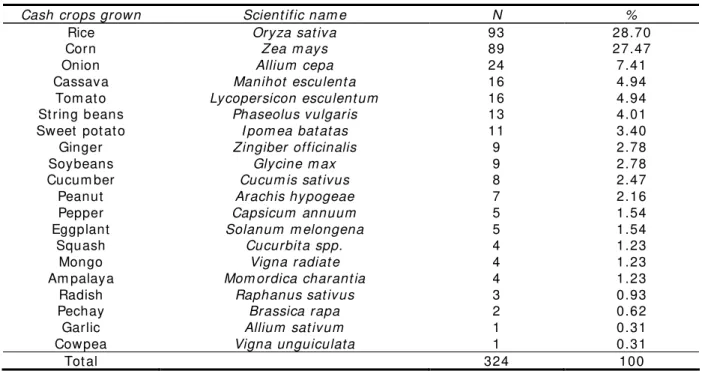
Table 3 show s t he cash crops grow n by t he farm ers in t he t hree barangay s. The farm ers cult iv at e at least t w ent y ( 20) k inds of cash crops such as rice, corn, abaca, onion, t om at o, st ring beans, sw eet pot at o, ginger, soy beans, cucum ber, peanut , chili, eggplant , cassav a, am ong ot hers. These result s indicat e t hat t he farm ers’ plant ed rice and corn as t heir m ain crops. Plant ing of rice is usually undert ak en during t he rainy season in t he m ont hs from May t o Oct ober in t he hint erland farm s, w hile during t he dry season t he farm ers dev ot e t o corn farm ing. How ev er, in t he lowland irrigat ed farm s, rice is alw ay s t he agricult ural m ainst ay .
The farm ers raise a v ariet y of cash crops and plant at ion crops consist ent wit h t he Com m unit y Based Forest ry Managem ent Program ( CBFM) of t he Depart m ent of Env ironm ent and Nat ural Resources ( DENR) t o prov ide liv elihood in t he upland com m unit ies in order t o enhance t heir econom ic condit ion.
Table 4 show s fourt een ( 14) k inds of plant at ion crops and t w o ( 2) ot her m aj or crops ( cacao and bam boo) . A k ey inform ant said t hat farm ers also cult iv at e a v ariet y of plant at ion crops as support crops in addit ion t o t heir m ainst ay crops. These are fruit t rees like coconut , banana, m ango, m arang, calam ansi and ot hers t o augm ent t heir incom e. They also use t he plant part s as v eget ables, lik e j ack fruit , core of t he banana’s pseudo-st em and coffee leav es as alt ernat iv e food sources.
Table 3 Frequency and percent dist ribut ion of cash crops grown by t he respondent s*
Cash crops grown Scient ific nam e N %
Rice Oryza sat iva 93 28.70 Corn Zea m ays 89 27.47 Onion Allium cepa 24 7.41 Cassava Manihot esculent a 16 4.94 Tom at o Lycopersicon esculent um 16 4.94 St ring beans Phaseolus vulgaris 13 4.01 Sweet pot at o I pom ea bat at as 11 3.40 Ginger Zingiber officinalis 9 2.78 Soybeans Glycine m ax 9 2.78 Cucum ber Cucum is sat ivus 8 2.47 Peanut Arachis hypogeae 7 2.16 Pepper Capsicum annuum 5 1.54 Eggplant Solanum m elongena 5 1.54 Squash Cucurbit a spp. 4 1.23 Mongo Vigna radiat e 4 1.23 Am palaya Mom ordica charant ia 4 1.23 Radish Raphanus sat ivus 3 0.93 Pechay Brassica rapa 2 0.62 Garlic Allium sat ivum 1 0.31 Cowpea Vigna unguiculata 1 0.31 Tot al 324 100
* m ult iple r esponses
Table 4 Frequency and percent dist ribut ion of plant at ion crops grown by t he respondent s*
Crops grown Scient ific nam e N %
Coconut Cocos nucifera 29 21.64 Banana Musa sapient um 28 20.90 Mango Mangifera indica 12 8.96 Marang Art ocarpus odorat issim us 12 8.96 Calam ansi Cit rus spp. 10 7.46 Durian Durio zibet hinus 9 6.72 Ram but an Nephelium lappaceum 9 6.72 Guava Calypt ropsidium sart orianum 7 5.22 Avocado (Persea am ericana) 5 3.73 Lanzones Lansium dom est icum 4 2.99 I pil- ipil Leucaena glauca 1 0.75 Coffee Coffea spp. 1 0.75 Jackfruit Art ocarpus het erophylus 1 0.75 St ar- apple Chrysophyllum cainit 1 0.75 Cacao Theobrom a cacao 3 2.24 Bam boo Bam busa vulgaris 2 1.49 Tot al 134 100
* m ult iple r esponses
Table 5 Tradit ional farm ing pract ices*
Pract ices N %
Slash and burn 15 3.59 Zero cult ivat ion 9 2.15 Plow ing only once w it h farm anim al 100 23.92
Plow ing and harrowin g 100 23.92 Monocult ure croppin g 22 5.26
Zero farm chem icals 79 18.90 Rot at ion cropping 93 22.25 Tot al 418 100
Plowing only once wit h t he farm anim al and plowing and harrow ing are t he m ost com m on pract ices applied since t he soils in t heir farm are fert ile. According t o a k ey inform ant , plowing and harrow ing is t he t radit ional farm ing oft en used since it is t he best m et hod for m aint aining soil fert ilit y . Monocult ure cropping is also adopt ed by t he t radit ional farm ers; t hey repeat edly plant rice t hrough t he y ears w it hout applying chem icals. The respondent s also believ ed in com post t reat m ent s lik e rice st raw com post and anim al m anure applicat ion in t heir farm s. How ev er, t hey hav e lim it ed inform at ion on t he long- t erm effect s of t hese applicat ions on soil propert ies and on paddy rice yields.
Table 6 rev eals t he m odern farm ing pract ices of t he respondent s. I t show s t hat t he respondent s conserv ed and prot ect ed t rees on- farm and off- farm t ree plant at ions. They pract iced zero burning and use t ract or for full soil cult iv at ion and in plowing and harrow ing.
Table 6 Modern farm ing pract ices*
Pract ices N %
Trees are conserv ed and prot ect ed on farm plant at ion 96 16.44 Trees are conserv ed and prot ect ed off- farm plant at ion 96 16.44 Zero burning 100 17.12 Full soil cult ivat ion 98 16.78 Tract or cult ivat ion 99 16.95 Plow ing and harrowin g 95 16.27 Tot al 584 100
* m ult iple r esponses
Table 7 show s t he t op t hree m aj or forest product s ex t ract ion pract ices of t he respondent s nam ely ; sm all t im ber gat hering ( 33. 79% ) , round w ood gat hering ( 32. 42% ) and lum ber gat hering ( 31. 05% ) .
Table 7 Maj or forest product ext ract ion pract ices*
Pract ices N %
Round wood gat herin g 71 32.42 Lum ber gat herin g 68 31.05 Sm all t im ber gat her in g 74 33.79 Large t im ber gat her ing 6 2.74
Tot al 219 100
* m ult iple r esponses
One of t he respondent s said t hat t he farm ers do not frequent ly ex t ract forest product s, ex cept w hen t hey w ould m ak e t heir shant ies/ houses. They cut dow n residual t rees ( 10 t o 30 cm in diam et er) w hich is against t he w at ershed conserv at ion and prot ect ion of President ial Decree 705 ot herw ise k now n as t he Revised Forest ry Code of t he Philippines, series of 1975 as am ended. The ex t ent of ex ploit at ion of t hese m aj or forest product s and it s effect s on Lak e Lanao Wat ershed has not been st udied and is bey ond t he scope of t his st udy .
Wit h regards t o round w ood gat hering, a k ey inform ant said t hat t he lum ber dealers are t he ones w ho finance t he chainsaw operat ors w ho cut dow n t he t rees and t ow t he logs t o t he slicers in t he saw m ill y ard ( bandsaw ) . There are t w o sm all saw m ills locat ed in Gubar Saw er and t he t hird one in Lacadun.
bam boo, rat t an and firew ood. Som e forest s are t oo deep in t he int erior t hat it is not econom ically product iv e t o do logging t here.
Table 8 show s t he t op fiv e m inor forest product s ex t ract ion pract ices of t he Maranao farm ers nam ely : bam boo gat hering ( 43% ) , charcoal m aking ( 40% ) , firew ood gat hering ( 10% ) , w ild plant gat hering ( 4% ) and bees and w ax gat hering ( 2% ) .
Table 8 Minor forest product ex t ract ion pract ices*
Pract ices N %
Fire wood gat her ing 20 10.0 Charcoal m aking 81 40.0 Bam boo gat hering 85 43.0 Rat t an gat hering 2 1.5 Bees honey and wax gat hering 3 2.0 Wild plant gat her ing 8 4.0 Wild anim al gat her ing 1 0.5 Tot al 200 100
* m ult iple r esponses
One of t he respondent s said t hat t hey only cut bam boos and rat t ans wit hin t heir area of t he farm , if av ailable. Gat hering of m inor forest pr oduct s is t olerat ed by all t he farm ers of t he t hree barangay s, as long as it is not for com m ercial purposes and is lim it ed for personal use and for food. Lik ewise, t hey adm it t ed t hat t hey do not do t hese frequent ly since t hey are aw are t hat t hese pract ices w ould lead t o degradat ion of t he wat ershed.
A k ey inform ant adm it t ed t hat erosion and flash floods are t he result s of deforest at ion, non- plant ing of t rees in t he hint erland and t he cult iv at ion of m arginal hilly lands. They also believe in t he rehabilit at ion and sust ainable m anagem ent of t he count ry ’s forest resources and t rees, w hich are t he habit at for birds, bees, m onk ey s and ot her w ildlife.
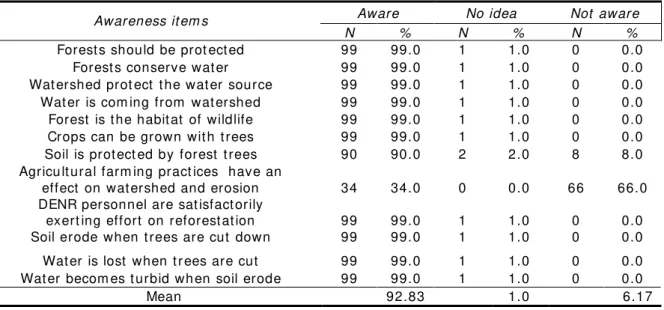
Table 9 show s t hat m aj orit y of t he respondent s wit h a m ean response of 92. 83% t o all aw areness it em s ex cept for t he effect s of agricult ural farm ing pract ices on t he w at ershed and erosion ( 66% are not aw are) are aw are of t he need t o prot ect and conserv e Lak e Lanao Wat ershed for t he sust ainabilit y of w at er resources in Lak e Lanao. Alm ost all of t he respondent s are aw are of t he need t o prot ect forest s w hich will redound t o conserv at ion and av ailabilit y of w at er, served as im port ant habit at for w ildlife and prot ect soil from erosion.
Table 9 Frequency dist ribut ion of t he awareness of Maranao farm ers
on wat ershed prot ect ion and conservat ion
Aware No idea Not aware
Awareness it em s
N % N % N %
Forest s should be prot ect ed 99 99.0 1 1.0 0 0.0 Forest s conserve wat er 99 99.0 1 1.0 0 0.0 Wat ershed prot ect t he wat er source 99 99.0 1 1.0 0 0.0 Wat er is com ing from wat ershed 99 99.0 1 1.0 0 0.0 Forest is t he habit at of wildlife 99 99.0 1 1.0 0 0.0 Crops can be grown wit h t rees 99 99.0 1 1.0 0 0.0 Soil is prot ect ed by forest t rees 90 90.0 2 2.0 8 8.0 Agricu lt ural farm ing pract ices have an
effect on wat ershed and erosion 34 34.0 0 0.0 66 66.0 DENR personnel are sat isfact orily
Table 10 ind icat es t he respondents’ at t it ude t owards t he prot ect ion and conservat ion of Lake Lanao Wat ershed. They recognize t he im port ance of t he wat ershed areas which cont inuously supply wat er t o Lake Lanao which is used, am ong ot hers, for t he generat ion of hydroelect ric power by t he Nat ional Power Corporat ion ( NPC) . This supplies 75 percent of t he power needs in Mindanao ( DENR- MANCOM, 2005) .
Table 10 Frequency dist ribut ion of t he at t it udes of Maranao farm ers
on wat ershed prot ect ion and conservat ion
Agree No idea Disagree
At t it ude it em s
N % N % N %
I pay m uch at t ent ion t o t he prot ect ion of t he wat ershed
99 99.0 0 0.0 1 1.0 I list en t o t he advices of t he DENR personnel
on t he prot ect ion of t he wat ershed
99 99.0 0 0.0 1 1.0 I recognize t he im port ance of wat er 100 100.0 0 0.0 0 0.0 I part icipat e in forest conservat ion 100 100.0 0 0.0 0 0.0 I observe discipline in wat er conservat ion 100 100.0 0 0.0 0 0.0 I underst and what wat ershed is 99 99.0 0 0.0 1 1.0 I observe an at t it ude of forest prot ect ion
and conservat ion
100 100.0 0 0.0 0 0.0 I believ e t hat wat er in Lake Lanao com es
from t he wat ershed
100 100.0 0 0.0 0 0.0 I agree t hat wat er becom es t urbid wh en soil
is eroded from t he uplands
97 97.0 3 3.0 0 0.0 I plant t rees in m y farm 100 100.0 0 0.0 0 0.0 I help prot ect w ildlife in t he forest 95 95.0 2 2.0 3 3.0 I follow soil and wat er conservat ion pract ices 100 100.0 0 0.0 0 0.0 I follow prescr ibed procedur es in farm input s 100 100.0 0 0.0 0 0.0 Mean 99.15 0.39 0.46
Table 11 shows t he result s of t he Chi- square analyses t o det erm ine t he relat ionship bet ween select ed socio- dem ographic characterist ics of t he respondent s and t heir farm ing pract ices. I t indicat es t hat no significant relat ionships were found bet ween t he socio- dem ographic charact erist ics and t heir farm ing pract ices ( p > 0.05) . This im plies t hat t he difference bet ween observed and t he expected responses of each cat egory are due t o chance alone. The df represent s t he deference frequency while X2 represent s t he denom inat or of t he probable-value ( p- probable-value) .
Table 11 Chi- square analyses of relat ionsh ip bet ween socio- dem ographic charact erist ics
and farm ing pract ices of respondent s
Socio- dem ographic charact erist ics df χ2 value p- value Rem ark
Age 2 0.883 0.643 Not signif icant Civ il st at us 2 0.066 0.968 Not signif icant Fam ily size 2 0.006 0.997 Not signif icant Educat ional at t ainm ent 3 2.040 0.564 Not signif icant
Table 12 indicat es no significant relat ionships were found bet ween t he socio- econom ic charact erist ics of t he respondent s and t heir forest product s ext ract ion pract ices ( p > 0.05) . This im plies t hat t he differences bet ween t he observed and expected responses for each cat egory are due t o chance alone.
Table 12 Chi- square analyses of t he relat ionsh ips bet ween socio- econom ic charact erist ics
and m aj or forest product ext ract ion pract ices of t he r espondents
Socio- econom ic charact erist ics Df χ2 value p- value Rem ark
I n t his st udy , t he farm ing and forest ex t ract ion pract ices, aw areness and at t it ude hav e been highlight ed. All of t he respondent s are m ale. I n t erm s of t heir civil st at us 81 percent are m arried, fift y- one percent are high school graduat es show ing t hat t he respondent s are generally educat ed and lit erat e. Sixt y fiv e percent ( 65% ) of t hem had 57, 252. 00 t o 128, 783. 00 annual incom e ( P 4, 771. 00 t o P 10, 732. 00/ m ont h) indicat ing low econom ic condit ion of t he respondent s. Sev ent y- t w o percent had 2 t o 3. 49 hect ares of farm land. Generally, t hey plant rice and corn and ot her cash crops.
Their farm ing pract ices are done eit her t hrough cult ural/ t radit ional and m odern farm ing m et hods. Wit h regards t o t radit ional farm ing pract ices, t he respondent s adm it t ed t hat t hey pract iced a) plowing only once w it h farm anim al, and b) plowing and harrow ing. They also pract iced rot at ion and m onocult ure cropping. Modern farm ing pract ices include zero burning, t ract or cult iv at ion, full soil cult iv at ion, and plowing and harrow ing. They also conserv e and prot ect t rees bot h on and off- farm plant at ions.
The respondent s ex t ract m aj or forest s bot h for com m ercial and for personal uses. The lum ber dealers are t he ones financing t he chainsaw operat ors t o cut dow n t rees. The logs are t ow ed t o t he saw m ill operat ors in barangay s Gubar Saw er and Lacadun, respect iv ely . Allegedly , t hese operat ions are “ illegal” and som e of t he flit ches ( “ t ablon” ) are t ransport ed and br ought t o t he lum ber dist ribut ors in Maraw i Cit y. Personal uses of lum ber are for m ak ing houses and/ or shant ies. Gat hering of m inor forest product s are at t ribut ed m ainly t o charcoal m aking and bam boo gat hering.
Result s of t he Chi- square t est s show ed no significant relat ionships bet w een select ed socio- dem ographic and socio- econom ic charact erist ics of t he respondent s and t heir farm ing and forest ex t ract ion pract ices. These result s indicat e t hat t he differences bet w een t he observ ed and expect ed responses due t o t hese charact erist ics are m ainly due t o chance alone.
Con clusion. The st udy at t em pt ed t o det erm ine t he pract ices, aw areness and at t it udes of Maranao farm ers in Lak e Lanao Wat ershed in Masiu, Lanao Del Sur.
Farm ing is t he m ain occupat ion of t he respondent s. They plant rice and corn as t he m ain crops t oget her w it h ot her cash crops. Since not all of t hem ow n t he land. They deriv e addit ional incom e by gat hering m aj or and m inor forest product s. I t has been highlight ed in t his st udy t hat “illegal logging” has been sporadically pract iced by som e respondent s. How ev er, t he ex t ent of t his ex ploit at ion and it s effect s on t he Lak e Lanao Wat ershed conserv at ion and prot ect ion are beyond t he scope of t his st udy . All t he respondent s are fully aw are and t heir at t it udes rev eal t hat t hey are conscious about t he need t o conserv e and prot ect t he Lak e Lanao Wat ershed. How ev er, t here is a need t o address t he “ illegal logging” and “ slash and burn” pract ices w hich are done out of necessit y t o eke- out addit ional incom e since t hese will cert ainly result t o t he degradat ion of t he Lak e Lanao Wat ershed if left unabat ed.
Re com m e n da t ion s. Based on t he result s of t he st udy , t he following are recom m ended: 1. The nat ional gov ernm ent , t hrough t he regional and local offices/ line agencies, m ust ex ert collaborat iv e effort s in ground im plem ent at ion of adv ocacy program s for t he reforest at ion of deforest ed areas in t he t hree Wat ershed barangay s.
2. The program planners m ust giv e due considerat ion t o include in som e aspect of t he planning process t he rehabilit at ion of Lak e Lanao Wat ershed. The act iv e inv olvem ent of sev eral st ak eholders in t he area of st udy in considerat ion of t heir socio- econom ic st at us and possible cont ribut ion t o program im plem ent at ion.
3. The program im plem ent ers should j oint ly ex ert m ore effort t o undert ak e serious aw areness adv ocacy program for t he prot ect ion and conserv at ion as w ell as in t he dev elopm ent and rehabilit at ion of t he Lak e Lanao Wat ershed. They should encourage t he act ivit ies and inv olvem ent of t he Maranao farm ers and v arious st ak eholders in t he area geared t ow ards t he dev elopm ent and rehabilit at ion of t he Lak e Lanao Wat ershed.
5. To prov ide t enure securit y and organize Maranao farm ers int o forest com m unit ies especially t hose dependent and part ially dependent on forest lands in t he cont ex t of a Com m unit y Based Forest Managem ent Agreem ent . This program prom ot es sust ainable forest ry and upland farm ing pract ices t hat offer bot h im m ediat e and long- t erm benefit s t o t hese com m unit ies, in part icular and t he Lak e Lanao Wat ershed in general.
Re fe r en ce s
DENR- MANCOM, 2005 Managem ent Com m it t ee Meet ing ( MANCOM) . Environm ent al Prot ect ion in t he Lake Lanao t o Support in Sust ainable Liv elihood. January 25, 2005, ARRM, Liaison Office, Rada St . Legaspi Village Mak at i Cit y , pp. 1- 2.
DOH, DI LG, DECS, 2000 An Approach t o School Com m unit y Healt h Educat ion and Prom ot ion, A Joint Proj ect of t he Depart m ent of Healt h and t he Philippine Healt h Dev elopm ent Program and World Bank, 45 pp.
Gallardo O. C., 2009 Reliabilit y of Lak e Lanao as a Reserv oir t o Agus 1 Hy dro- elect ric Plant RST Model. ht t p: / / lak elanao. com / m ain/ ?p= 40. Post ed by Anisha on Sept em ber 2, 2009.
President ial Decree 705 ot herw ise k now n as t he Revised Forest ry Code of t he Philippines, series of 1975.
Saplaco S. R., 1998 Wat ershed Managem ent Techniques. Depart m ent of Forest Resources Managem ent , College of Forest ry, U. P. Los Baños Laguna, Philippines. Sosm eña Jr. G. C. , 1991 Decent ralizat ion and Em pow erm ent . Bureau of Local
Gov ernm ent Superv ision, Depart m ent of t he I nt erior and Local Gov ernm ent . Manila, Philippines, pp 1.
Tam ises F. , 1938 Philippine Forest s and Forest ry . DENR, Dilim an, Cent ral Office, Manila, Philippines, v olum e 1.
Received: 25 June 2 012. Accept ed: 23 July 201 2. Published on line: 15 August 201 2. Aut hor s:
Gat ocod Rascal, Depar t m ent of Envir onm ent and Nat ur al Resour ces - Aut onom ous Region in Muslim Mindan ao ( DENR- ARMM) , 9600 Cot abat o Cit y, Philippines, e- m ail: r ascalgat ocod@yahoo. com
Rodolfo C. Ar anico, Depar t m ent of Biological Sciences, College of Science and Mat hem at ics, Mindanao St at e Univer sit y – I ligan I nst it ut e of Techn ology, 92 00 I ligan Cit y, Lanao del Nor t e, Philippines, e- m ail:
Ecar dbs_csm m suiit @yahoo. com
Nim fa L. Br acam ont e, College of Ar t and Science, Mindanao St at e Univer sit y - I ligan I nst it ut e of Technology, 9200 I ligan Cit y, Lanao del Nor t e, Philippines
Ruben F. Am par ad o Jr . , Depar t m ent of Biological Sciences, College of Science and Mat hem at ics, Mindanao St at e Univer sit y – I ligan I nst it ut e of Techn ology, 92 00 I ligan Cit y, Lanao del Nor t e, Philippines, e- m ail:
r uben_am par ado@yahoo. com How t o cit e t his ar t icle:
Annex 1
Su r ve y Que st ionn a ir e
Pa r t I . Ba sic I n for m a t ion Abou t th e Re spon de n t s
Direct ion: Please giv e t he needed inform at ion on t he it em s t hat best correspond t o y our answ ers.
A. Socio- dem ographic charact erist ics of t he respondent s Age ____
Sex ____
Civil St at us ____ Fam ily size _____
Highest Educat ional At t ainm ent ____
B. Socio econom ic charact erist ics of t he respondent s Annual I ncom e _____
Area of Farm ______ Ow nership of Farm
a. Forest land ( y es) ____ How m any hect ares? _____ b. Tit led land ( y es) ___ How m any hect ares? _______
Pa r t I I . Som e Fa r m in g an d Resou r ce Ex t r act ive Pr a ct ices of t he M a ra n a os in t he La k e La n a o W a te r she d in Ma siu , La n a o de l Su r
Please check t he Farm ing and Forest Pr oduct Ex t r act ion Pract ices y ou are engaged inside t he w at ershed
1. Agree ( A) , 2. No idea ( NI ) , 3. Disagree ( D) .
A. Fa r m in g Pr a ct ice s 1 2 3
1. Cash crops com m only grow n
a. rice _ _ _
b. corn _ _ _
c. vines/ creeping v eget ables _ _ _
d. erect food crop _ _ _
e. legum inous crops _ _ _
f. ot hers ( please specify ) __________________
2. Plant at ion crops grow n
a. coconut _ _ _
b. banana _ _ _
c. m arang _ _ _
d. calam ansi _ _ _
e. ot hers ( please specify ) _______________
3. Tradit ional farm ing pract ices
a. slash and burn _ _ _
b. zero cult iv at ion _ _ _
c. plowing only once wit h farm anim al _ _ _
d. plowing and harrow ing _ _ _
e. m onocult ure cropping _ _ _
f. zero farm chem icals _ _ _
4. Modern farm ing pract ices
a. t rees are conserv ed and prot ect ed
- on farm t ree plant at ion _ _ _ - off- f arm t ree plant at ion _ _ _
b. zero burning _ _ _
c. full soil cult iv at ion _ _ _
d. t ract or cult iv at ion _ _ _
e. plowing and harrow ing _ _ _
B. For e st Ex t r a ct ion Pr a ct ice 1 2 3
1. Maj or forest product s
a. round w ood gat hering _ _ _
b. lum ber gat hering _ _ _
c. sm all t im ber gat hering _ _ _
d. large t im ber gat hering _ _ _
2. Minor forest product s
a. firew ood gat hering _ _ _
b. charcoal m aking _ _ _
c. bam boo gat hering _ _ _
d. rat t an gat hering _ _ _
e. bees honey and w ax gat hering _ _ _
f. wild plant gat hering _ _ _
g. wild anim al gat hering _ _ _
Pa r t I I I . Aw a r en ess a n d At t itu de of Ma r an a o Fa r m e r s t ow a r d Con se r va t ion an d Pr ot e ct ion of t h e La k e Lan a o W a t e r sh e d
A. Aw a r e n e ss
Please check in t he colum n below t he ext ent of y ou aw areness on t he it em below : 1. Agree ( A) ,
2. No idea ( NI ) , 3. Not aw are ( NA) .
I t em s 1 2 3
1. Forest should be prot ect ed _ _ _
2. Forest conserv e w at er _ _ _
3. Wat ershed prot ect w at er source _ _ _ 4. Wat er is com ing from w at ershed _ _ _ 5. Forest is t he habit at of w ildlife _ _ _ 6. Crops can be grow n w it h t rees _ _ _ 7. Soil is prot ect ed by forest t rees _ _ _ 8. Agricult ural farm ing pract ices hav e
effect on w at ershed and erosion _ _ _ 9. DENR Personnel are sat isfact orily ex ert ing
effort on reforest at ion _ _ _
10. Soil erodes w hen t rees are cut dow n _ _ _
11. Wat er is lost w hen t rees are lost _ _ _ 12. Wat er becom e t urbid w hen soil erode _ _ _
B. At t it u de
Please check in t he colum n below t he ext ent of y ou aw areness on t he it em below.
1. Agree ( A) , 2. No idea ( NI ) , 3. Disagree ( D) .
1. I pay as m uch at t ent ion t o t he prot ect ion
of t he w at ershed _ _ _
2. I list en t o t he advices of t he DENR
personnel on prot ect ion of w at ershed _ _ _ 3. I recognize t he im port ance of w at er _ _ _ 4. I part icipat e in forest conserv at ion _ _ _ 5. I observ e discipline on w at er conserv at ion _ _ _ 6. I underst and w hat is a w at ershed _ _ _ 7. I observ e t he at t it ude of forest prot ect ion and
conserv at ion _ _ _
8. I believ e t hat w at er in Lak e Lanao
com es from t he Wat ershed _ _ _ 9. I agree t hat w at er becom es t urbid
w hen soil erode from t he uplands _ _ _ 10. I plant t rees in m y farm _ _ _ 11. I help prot ect t he wildlife in t he forest _ _ _ 12. I f ollow soil and w at er conserv at ion pract ices _ _ _
13. I f ollow prescribed procedures in farm input s _ _ _