B R I E F R E P O R T
Genetic diversity of human papillomavirus types 35, 45 and 58
in cervical cancer in Brazil
Diogo Lisboˆa Basto1,2•Joa˜o Paulo Vidal2•Vale´ria Barbosa Pontes3• Shayany Pinto Felix2•Laine Celestino Pinto3• Bruno Moreira Soares3•
Luis Felipe Martins4•Fla´via Miranda Correa4•Raquel Carvalho Montenegro5• Cla´udia Bessa Pereira Chaves6•Liz Maria Almeida4•
Miguel Aˆ ngelo Martins Moreira2
Received: 6 March 2017 / Accepted: 31 May 2017 / Published online: 9 June 2017
Springer-Verlag GmbH Austria 2017
Abstract In Brazil, most studies of intra-type variants of human papillomavirus (HPV) have focused on HPV16 and HPV18, but other high-risk HPV types have not been studied. Here, we report the prevalence of lineages and variants of HPV35, HPV45 and HPV58 in cervical cancers from the Amazonian and Southeast Brazilian regions. The most frequent sublineages were A1 for HPV35, B2 for HPV45, and A2 for HPV58. The Southeast region had a higher frequency of the B2 sublineage of HPV45, and for HPV35, the genetic and nucleotide sequence diversity were higher in the Southeast region, suggesting that regional factors are influencing the diversity and lineage prevalence.
Keywords Cervical cancerPapillomavirusHPV35 HPV45HPV58HPV diversity
Cervical cancer is the fourth most common cancer in women, with 527,000 cases and 265,000 deaths in 2012 [1]. In Brazil, this cancer accounted for 5,430 deaths in 2013 (https://mortalidade.inca.gov.br/MortalidadeWeb/) and approximately 16,300 new cases in 2016 [2]. Human papillomavirus (HPV) infection is considered an indis-pensable factor, albeit not sufficient, for the development of cervical cancer [3]. Fifteen HPV types have been asso-ciated with a high risk for development of cervical cancer (HR-HPV) [4], and among them, HPV16 and HPV18 are associated with approximately 75% of cervical cancer cases worldwide. Two commercially available vaccines for cervical cancer prevention have been developed against these two types. Recently, a new vaccine was approved, protecting against seven high-risk HPV types and two low-risk HPV types [5].
HPV taxonomy is based on the sequence variation of the L1gene, with differences greater than 10% defining HPV types [6]. Burk et al. [7] proposed a criterion for classifying intra-type HPV diversity based on overall genomic diver-gence, ranging from 1% to 10%, for defining different lineages within HPV types and differences between 0.5% to 1% for defining sublineages. They suggested an alphanumeric nomenclature for all HPVs lineages and sublineages, which we have used in this study, where lin-eages are identified by letters (A, B, C, D,…) and
sublin-eages by letters and numbers (A1, A2, A3, B1, B2, B3,…).
HPV lineages have been associated with different risks for cervical cancer. This is the case for specific HPV16 lin-eages and variants [8–11] as well as for HPV45 lineages [12]. Moreover, specific sequence variants of HPV58 are associated with the risk of developing CIN3 (cervical intraepithelial neoplasia grade 3) and invasive cancer [13]. In Brazil, most studies of intra-type variants of HPV have focused on HPV16 and HPV18 [9,14–18], but other
Electronic supplementary material The online version of this
article (doi:10.1007/s00705-017-3439-5) contains supplementary material, which is available to authorized users.
& Miguel Aˆ ngelo Martins Moreira [email protected]
1 Genetics Department, Universidade Federal do Rio de Janeiro, Rio de Janeiro, Brazil
2 Present Address: Genetics Program, Instituto Nacional de
Caˆncer, Rio de Janeiro, Brazil
3 Department of Woman Health, Faculty of Medicine, Universidade Federal do Para´, Bele´m do Para´, Brazil
4 Population Research Department, Instituto Nacional de
Caˆncer (INCA), Rio de Janeiro, Brazil
5 Department of Physiology and Pharmacology, Universidade
Federal do Ceara´, Fortaleza, Brazil
6 Gynecologic Section and Molecular Carcinogenesis Program,
relevant, high-risk types with different prevalence in dif-ferent countries and continents have not been studied. Brazil has an admixed population, with Amerindian, African and European ethnic components with regional disparities, and Amazonian populations show a higher Amerindian genetic contribution than is observed in the southern regions [19]. This scenario makes the intra-type genetic diversity of high-risk HPV types relevant for ana-lyzing the prevalence of HPV lineages and variants in different Brazilian regions. In this study, our objective was to describe and to compare the prevalence and the genetic diversity of lineages and variants,sensuBurk et al. [7], of the high-risk viruses HPV35, HPV45 and HPV58 in cer-vical cancer in women diagnosed in the Amazonian Region (Bele´m do Para´, Para´ State, Brazil) and the Southeast Region (City of Rio de Janeiro, Rio de Janeiro State, Brazil). The genetic diversity of these HPV types was assessed by sequencing a contiguous HPV genomic region encompassing the LCR (long control region),E6andE7, which have been considered adequate for lineage and sublineage identification in previous work [20–22].
The study was carried out with a cohort of 1,275 women with cervical cancer, 634 from Instituto Nacional de Caˆn-cer (Rio de Janeiro, Southeast region) and 641 from Hospital Ophir Loyola in Bele´m (State of Para´, Amazonian region) following approval by the Ethics Committee of each institution. The identification and frequency of HPV types present in these tumor biopsies were carried out by PCR amplification of the L1 gene using the primers PGMY09/11 and GP05?/06? [23, 24]. Samples from patients (n=96) infected with HPV35 (n=26), HPV45 (n=53) and HPV58 (n=17) in single infections were selected for this study (Supplementary Table 1).
The LCR and E6/E7 regions of HPV35, HPV45 and HPV58 were amplified using type-specific primers (Supple-mentary Table 2). PCR reactions were carried out with 1X PCR buffer, 2.5 mM MgCl2, 0.25 mM each DNTP, 10 pmol of forward and reverse primers per reaction, 50–100 ng of genomic DNA and 2.5 U of Platinum Taq DNA Polymerase (Life Technologies) in a final volume of 50ll. The PCR conditions were 94C for initial DNA denaturation (5 min)
followed by 35 cycles of 94C (1 min), 58C (1 min), and
72C (1 min), with final extension at 72C (15 min). PCR
products were purified and sequenced as described above. A contig encompassing the LCR,E6, and E7genomic regions was built for each sample (GenBank accession numbers KY565580 to KY565668). Sequences of each HPV type were aligned with reference sequences according to Burk et al. [7], and sequence variants (haplotypes) were identified with DNASP [25]. Maximum-likelihood (ML) phylogenetic reconstructions were carried out for each haplotype set with a reference sequence for each HPV type according to the GTR?I?G evolutionary model [26,27].
ML was carried out with PHYML v.3.0 [28] with node support based on 1,000 bootstrap pseudoreplicates. Phy-logenetic trees were rooted by the mid-point method. Median-joining analysis was carried out using Network v.4.6.1.1 [29]. Genetic and nucleotide diversity indices were estimated with Arlequin v.3.5.2.2 [30].
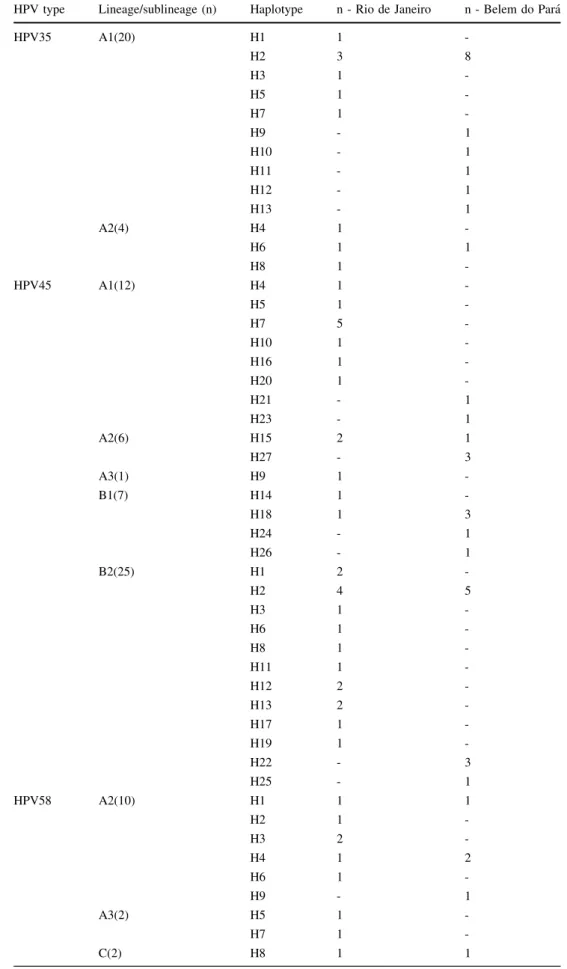
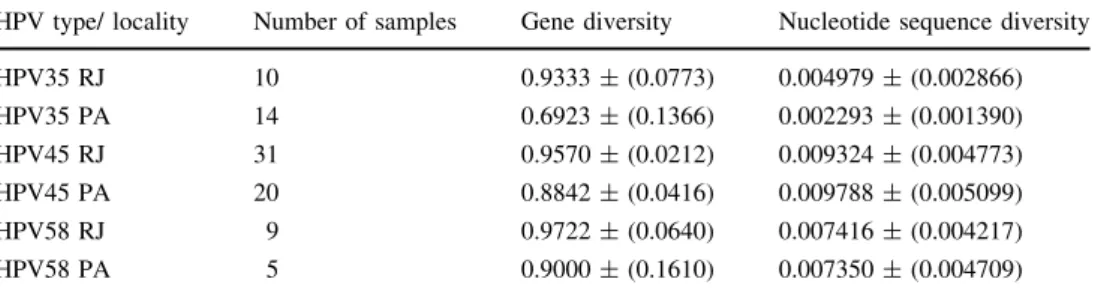
Analysis of HPV35, encompassing 1,587 nucleotides, showed 13 haplotypes in 24 samples (Table1 and Sup-plementary Table 3A and B), two samples were excluded because the PCR for the LCR did not work. ML analysis (Fig.1A) grouped reference sequence A1 with eight hap-lotypes (H2, H3, H5, H7, H9, H11, H12 and H13) in one group and with two others (H1 and H10) in a sister group. The eight haplotypes showed an exclusive insertion of 16 bp between positions 229 and 244. Three other haplotypes (H4, H6 and H8) grouped with sublineage reference sequence A2. The network arrangement (Supplementary Figure 1) was coincident with the ML topology. All hap-lotypes with frequency[1 were present in both localities. Haplotypes grouped with sublineage A1 were more fre-quent (in 20 women), with haplotype H2 in 11 patients, eight from Bele´m do Para´ and three from Rio de Janeiro (Table1). HPV35 from Bele´m do Para´ showed less genetic and nucleotide sequence diversity with respect to samples from Rio de Janeiro. HPV35 showed the least genetic and nucleotide sequence diversity when compared with HPV45 and HPV58 (Table2).
Although some nucleotide substitutions could have resulted from mutations that occurred during cancer pro-gression, the phylogenetic analysis supported haplotype identification at the sublineage level with bootstrap values [80%. HPV35 analysis showed less intra-type genetic diversity than the other types, in agreement with previous evidence that this type shows less intra-type genetic diversity than other HR-HPV types [7]. In this study, A1 was the most frequent HPV35 sublineage, in 20 of 24 isolates, as has been seen in different regions of the world [21, 31–33]. This sublineage was reported to have a higher persistence and oncogenicity than sublineage A2 [21, 34]. The ML topology showed a distinct group of eight haplotypes (H2, H3, H5, H7, H9, H11, H12 and H13) of sublineage A1 comprising the largest number of HPV35 isolates reported herein (18/24). These haplotypes, associated with invasive cancer, are common in other regions of the world, sharing a characteristic 16 bp insertion in their LCR [29,33,35]. The high frequency of these haplotypes, however, must be evaluated in women with normal cervix and pre-neoplastic lesions to deter-mine whether this group is associated with higher oncogenicity.
Table 1 Number of samples (n) with respect to lineages, sublineages and haplotypes per locality for each HPV type
HPV type Lineage/sublineage (n) Haplotype n - Rio de Janeiro n - Belem do Para´
HPV35 A1(20) H1 1
-H2 3 8
H3 1
-H5 1
-H7 1
-H9 - 1
H10 - 1
H11 - 1
H12 - 1
H13 - 1
A2(4) H4 1
-H6 1 1
H8 1
-HPV45 A1(12) H4 1
-H5 1
-H7 5
-H10 1
-H16 1
-H20 1
-H21 - 1
H23 - 1
A2(6) H15 2 1
H27 - 3
A3(1) H9 1
-B1(7) H14 1
-H18 1 3
H24 - 1
H26 - 1
B2(25) H1 2
-H2 4 5
H3 1
-H6 1
-H8 1
-H11 1
-H12 2
-H13 2
-H17 1
-H19 1
-H22 - 3
H25 - 1
HPV58 A2(10) H1 1 1
H2 1
-H3 2
-H4 1 2
H6 1
-H9 - 1
A3(2) H5 1
-H7 1
Fig. 1 Maximum-likelihood topologies for the haplotypes of each HPV type analyzed. The topologies were generated using the concatenated nucleotide sequences of the LCR,E6and E7regions for each haplotype. Numbers at the nodes are bootstrap valuesC70%,
based on 1000 replicates. (A) HPV35. (B) HPV45. (C) HPV58. *Reference sequences [7] for each HPV lineage/sublineage are identified with the respective GenBank accession number
Table 2 Genetic and
nucleotide sequence diversity for each HPV type per locality
HPV type/ locality Number of samples Gene diversity Nucleotide sequence diversity
HPV35 RJ 10 0.9333±(0.0773) 0.004979±(0.002866)
HPV35 PA 14 0.6923±(0.1366) 0.002293±(0.001390)
HPV45 RJ 31 0.9570±(0.0212) 0.009324±(0.004773)
HPV45 PA 20 0.8842±(0.0416) 0.009788±(0.005099)
HPV58 RJ 9 0.9722±(0.0640) 0.007416±(0.004217)
(encompassing the LCR, E6, and a portion of the E7 region), identified 27 haplotypes (Table1 and Supple-mentary Table 3C and D), two samples were excluded because PCR for the LCR did not work. The ML topology (Fig.1B) showed haplotypes grouping with one reference sequence of each sublineage: A1 with eight haplotypes, A2 with two, A3 with one, B1 with four, and B2 with 12. In this last group, a larger number of haplotypes was present in samples from Rio de Janeiro than in those from Bele´m do Para´ (10vs.3). The results of median-joining network analysis (Supplementary Figure 2) coincided with the ML topology. Sublineages were present in both localities except for A3 (H9), which occurred in Rio de Janeiro. A large number of haplotypes (20 in 31 samples) was found in samples from Rio de Janeiro. HPV45 showed the highest nucleotide sequence diversity with respective to the other HPV types analyzed (Table2). Previous reports showed that the HPV45 B2 sublineage was associated with a larger risk for cervical cancer than other sublineages [12,21]. Our findings showed that B2 was the most frequent HPV45 sublineage, with a higher number of haplotypes in Rio de Janeiro than in Bele´m do Para´ (Table1).
HPV58 was detected in 17 patients. Analysis of 14 samples (nine from Rio de Janeiro and five from Bele´m do Para´), covering 1,567 nucleotide positions encompassing the LCR,E6, andE7showed nine haplotypes (Table1and Supplementary Table 3E and F), three samples were excluded because the PCR for the LCR,E6andE7did not work. ML topology (Fig.1C) showed six haplotypes grouping with the reference sequence of sublineage A2, two with A3, and one with C. None of these haplotypes grouped with representative sequences of sublineages A1, B1, B2, D1, and D2. The results of median joining network analysis (Supplementary Figure 3) showed was coincident with the ML topology, with three groups respective to sublineages A2 and A3 and lineage C. A larger number of haplotypes was found in Rio de Janeiro than in Bele´m do Para´ (Table1), but these localities showed similar genetic and nucleotide sequence diversity (Table2).
HPV58 is the third most frequent papillomavirus infecting women with cervical cancer in Eastern Asia [36]. The frequency of HPV58 varies around the globe and is more frequent in East Asia, where lineage A is the most frequent one, followed by lineage C [37]. Our findings showed the presence of two sublineages (A2 and A3) and one lineage (C), with A2 showing the highest frequent in both regions (58.8%). These findings are in agreement with those of Chan et al. [13, 37], who reported the highest frequency of A2 in cervical samples worldwide.
Our findings show differences in the frequency and presence of specific HPV variants between the Southeast and Amazonian regions, and this may be associated with
differences in ethnic genetic background of the patients, as reported by Lopera et al. [38] for the Colombian population and HPV16 lineages. The higher proportion of Amerindian ethnic component in the Brazilian Amazonian population in comparison to the Southeast population has been reported by many authors [19,39,40]. However, to access the possible association between the ethnic component with specific lineages/sublineages of HPV35, HPV45, or HPV58 a larger sample size will be required, taking into account the prevalence of these three HPV types in the populations studied: only in 96 of the 1275 patients included (8.1%), was the presence of HPV35 or HPV45 or HPV58 detected.
Acknowledgements We want to thank the physicians who collected
the tumor biopsies. This work was supported by the National Institute for Cancer Control (INCT do Cancer:http://www.inct-cancer-control. com.br/); Conselho Nacional de Desenvolvimento Cientı´fico e Tec-nolo´gico (CNPq) Grants 573806/2008-0, 484005/2013-8 and 305873/2014-8; Fundac¸a˜o Carlos Chagas Filho de Amparo a` Pesquisa do Estado do Rio de Janeiro (FAPERJ) Grant E26/170.026/2008; Ministry of Health – Brazil; and Pan-American Health Organization (PAHO).
Compliance with ethical standards
Ethical approval All procedures were approved by the Research
Ethics Committees of the Instituto Nacional de Caˆncer (CAAE 53398416.0.0000.5274) and the Hospital Ophir Loyola (CAAE 03288212.0.1001.0018).
Informed consent All patients signed an informed consent form.
Animal rights This article does not contain any studies with animals.
Conflict of interest The authors declare no conflict of interest.
References
1. Ferlay J, Soerjomataram I, Dikshit R et al (2015) Cancer inci-dence and mortality worldwide: sources, methods and major patterns in GLOBOCAN 2012. Int J Cancer 136:E359–E386. doi:10.1002/ijc.29210
2. INCA-Instituto Nacional de Caˆncer Jose´ Alencar Gomes da Silva (2015) Coordenac¸a˜o de prevenc¸a˜o e vigilaˆncia. Estimativa 2016: Incideˆncia de caˆncer no Brasil. Instituto Nacional de Caˆncer Jose´ Alencar Gomes da Silva, Rio de Janeiro, pp 1–126
3. Walboomers JMM, Jacobs MV, Manos MM et al (1999) Human papillomavirus is a necessary cause of invasive cervical cancer worldwide. J. Pathol. 189:12–19. doi: 10.1002/(SICI)1096-9896(199909)189:1\12:AID-PATH431[3.0.CO;2-F
4. Mun˜oz N, Bosch FX, de Sanjose S et al (2003) Epidemiologic classification of human papillomavirus types associated with cervical cancer. N Engl J Med 348:518–527. doi:10.1056/ NEJMoa021641
6. Bernard HU, Burk RD, Chen Z et al (2010) Classification of papillomaviruses (PVs) based on 189 PV types and proposal of taxonomic amendments. Virology 401:70–79. doi:10.1016/j. virol.2010.02.002
7. Burk RD, Harari A, Chen Z (2013) Human papillomavirus gen-ome variants. Virology 445:232–243. doi:10.1016/j.virol.2013. 07.018
8. Berumen J, Ordon˜ez RM, Lazcano E et al (2001) Asian-Ameri-can variants of Human Papillomavirus 16 and risk for cervical cancer: a case–control study. J Natl Cancer Inst 93:1325–1330 9. Sichero L, Ferreira S, Trottier H et al (2007) High grade cervical
lesions are caused preferentially by non-European variants of HPVs 16 and 18. Int J Cancer 120:1763–1768. doi:10.1002/ijc. 22481
10. Zuna RE, Moore WE, Shanesmith RP et al (2009) Association of HPV16 E6 variants with diagnostic severity in cervical cytology samples of 354 women in a US population. Int J Cancer 125:2609–2613. doi:10.1002/ijc.24706
11. Cornet I, Gheit T, Iannacone MR et al (2013) HPV16 genetic variation and the development of cervical cancer worldwide. Br J Cancer 108:240–244. doi:10.1038/bjc.2012.508
12. Chen AA, Heideman DAM, Boon D et al (2014) Human papil-lomavirus 45 genetic variation and cervical cancer risk world-wide. J Virol 88:4514–4521. doi:10.1128/JVI.03534-13 13. Chan PKS, Zhang C, Park J et al (2013) Geographical distribution
and oncogenic risk association of human papillomavirus type 58 E6 and E7 sequence variations. Int J Cancer 132:2528–2536. doi:10.1002/ijc.27932
14. Junes-Gill K, Sichero L, Maciag PC et al (2008) Human papil-lomavirus type 16 variants in cervical cancer from an admixtured population in Brazil. J Med Virol 80:1639–1645. doi:10.1002/ jmv.21238
15. Cerqueira DM, Raio T, Ve´ras NM et al (2008) New variants of human papillomavirus type 18 identified in central Brazil. Virus Genes 37:282–287. doi:10.1007/s11262-008-0263-8
16. Cruz RM, Cerqueira MD, Cruz WB et al (2004) Prevalence of human papillomavirus type 16 variants in the Federal District, Central Brazil. Mem Inst Oswaldo Cruz 99:281–282. doi:10. 1590/S0074-02762004000300007
17. Freitas LB, Chen Z, Muqui EF et al (2014) Human papillo-mavirus 16 non-European variants are preferentially associated with high-grade cervical lesions. PloS One 9:e10074. doi:10. 1371/journal.pone.0100746
18. Vidal JPCB, Felix SF, Chaves CBP et al (2016) Genetic diversity of HPV16 and HPV18 in Brazilian patients with invasive cervical cancer. J Med Virol 88:1279–1287. doi:10.1002/jmv.24458 19. Alves-Silva J, da Silva Santos M, Guimara˜es PE et al (2000) The
ancestry of Brazilian mtDNA lineages. Am J Hum Genet 67:444–461. doi:10.1086/303004
20. Cornet I, Gheit T, Franceschi S et al (2012) Human papillo-mavirus type 16 genetic variants: phylogeny and classification based onE6and LCR. J Virol 86:6855–6861. doi:10.1128/JVI. 00483-12
21. Xi FL, Schiffman M, Koutsky LA et al (2014) Lineages of oncogenic Human Papillomavirus types other than type 16 and 18 and risk for cervical intraepithelial neoplasia. J Natl Cancer Inst 106:dju270. doi:10.1093/jnci/dju270
22. Pe´rez S, Cid A, In˜arrea A et al (2014) Prevalence of HPV 16 and HPV 18 lineages in Galicia, Spain. PLoS One 9:e104678. doi:10. 1371/journal.pone.0104678
23. Fuessel Haws AL, He Q, Rady PL et al (2004) Nested PCR with the PGMY09/11 and GP5(?)/6(?) primer sets improves detec-tion of HPV DNA in cervical samples. J Virol Methods 122:87–93. doi:10.1016/j.jviromet.2004.08.007
24. Almeida LM, Martins LF, Pontes V et al (2017) Human Papi-lomaVirus (HPV) genotype distribution among cervical cancer
patients prior to Brazilian National HPV Immunization Program. J Environ Public Health 2017:1645074. doi:10.1155/2017/ 1645074
25. Librado P, Rozas J (2009) DnaSP v5: a software for compre-hensive analysis of DNA polymorphism data. Bioinformatics 25:1451–1452. doi:10.1093/bioinformatics/btp187
26. Tavare´ S (1986) Some probabilistic and statistical aspects of the primary structure of nucleotide sequences. In: Miura RM (ed) Lectures on mathematics in the life sciences, vol 17. American Mathematical Society, Providence, pp 57–86
27. Lanave C, Preparata G, Saccone C, Serio G (1984) A new method for calculating evolutionary substitution rates. J Mol Evol 20:86–93
28. Guindon S, Dufayard JF, Lefort V et al (2010) New algorithms and methods to estimate maximum-likelihood phylogenies: assessing the performance of PhyMV 3.0. Syst Biol 59:307–321 29. Bandelt HJ, Forster P, Ro¨hl A (1999) Median-Joining networks for inferring intraspecific phylogenies. Mol Biol Evol 16:37–48 30. Excoffier L, Lischer H (2010) Arlequin suite ver 3.5: a new series
of programs to perform population genetics analyses under Linux and Windows. Mol Ecol Res 10:564–567. doi: 10.1111/j.1755-0998.2010.02847.x
31. Calleja-Macias IE, Villa LL, Prado JC et al (2005) Worldwide genomic diversity of the high-risk human papillomavirus types 31, 35, 52, and 58, four close relatives of human papillomavirus type 16. J Virol 79:13630–13640. doi:10.1128/JVI.79.21 32. Gauthier B, Coutle´e F, Franco EL, Brassard P (2015) Human
papillomavirus variants among Inuit women northern Quebec, Canada. Int J Circumpolar Health 74:1–7. doi:10.3402/ijch.v74. 29482
33. Calleja-Macias IE, Kalantari M, Huh J et al (2004) Genomic diversity of human papillomavirus-16, 18, 31, and 35 isolates in a Mexican population and relationship to European, African, and Native American variants. Virology 319:315–323. doi:10.1016/j. virol.2003.11.009
34. Schiffman M, Rodriguez AC, Chen Z et al (2010) A population-based prospective study of carcinogenic human papillomavirus (HPV) variant lineages, viral persistence, and cervical neoplasia. Cancer Res 70:3159–3169. doi: 10.1158/0008-5472.CAN-09-4179
35. Marincevic-Zuniga Y, Gustavsson I, Gyllensten U (2012) Mul-tiply-primed rolling circle amplification of human papillomavirus using sequence-specific primers. Virology 432:57–62. doi:10. 1016/j.virol.2012.05.030
36. Li N, Franceschi S, Howell-Jones MR et al (2011) Human papillomavirus type distribution in 30,848 invasive cervical cancers worldwide: variationby geographical region, histological type and year of publication. Int J Cancer 128:927–935. doi:10. 1002/ijc.25396
37. Chan PKS, Luk AC, Park JS et al (2011) Identification of Human Papillomavirus Type 58 lineages and the distribution worldwide. J Infect Dis 203:1565–1573. doi:10.1093/infdis/jir157
38. Lopera EA, Baena A, Florez V et al (2014) Unexpected inverse correlation between Native American ancestry and Asian American variants of HPV16 in admixed Colombian cervical cancer cases. Infect Genet Evol 28:339–348. doi:10.1016/j.mee gid.2014.10.014
39. Manta FSN, Pereira R, Vianna R et al (2013) Revisiting the genetic ancestry of Brazilians using autosomal AIM-Indels. PloS One 8:e75145. doi:10.1371/journal.pone.0075145