Local hemostatic measures in anticoagulated patients undergoing oral surgery.
A systematized literature review
1Fábio Wildson Gurgel CostaI, Rodrigo Rodrigues RodriguesII, Luzia Hermínia Teixeira de SousaII, Francisco Samuel Rodrigues CarvalhoIII, Filipe Nobre ChavesIV, Clarisse Pessoa FernandesIV, Karuza Maria Alves PereiraV, Eduardo Costa Studart SoaresVI
IPhD, Assistant Professor, Division of Stomatology and Oral Surgery, UFC, Campus Sobral, Fortaleza-CE, Brazil. Conception, design, intellectual and scientiic content of the study, manuscript writing, critical revision.
IIGraduate student, Division of Stomatology and Oral Surgery, UFC, Campus Sobral, Fortaleza-CE, Brazil. Acquisition of data, scientiic content of the study, manuscript writing.
IIIDDS, Collaborative Professor, Division of Stomatology and Oral Surgery, UFC, Campus Sobral, Fortaleza-CE, Brazil. Conception, design, intellectual and scientiic content of the study, manuscript writing, critical revision.
IVFellow Master degree, Postgraduate Program in Dentistry, Dental Clinic Area, Division of Stomatology, UFC, Fortaleza-CE, Brazil. Acquisition of data, scientiic content of the study, manuscript writing.
VPhD, Associate Professor, Division of Oral Pathology, UFC, Campus Sobral, Fortaleza-CE, Brazil. Conception, design, intellectual and scientiic content of the study, manuscript writing, critical revision
VIPhD, Full Professor, Division of Oral Surgery, UFC, Fortaleza-CE, Brazil. Conception, design, intellectual and scientiic content of the study, manuscript writing, critical revision.
ABSTRACT
PURPOSE:To conduct a systematized review of the literature about the main local hemostatic measures to control postoperative bleeding in anticoagulated patients.
METHODS: A systematized review of literature was performed in the electronic database Medline (PubMed) without restriction
of the publication date. The eligibility criteria were studies involving maintenance of the anticoagulant therapy, prospective studies,
retrospective studies, randomized clinical trials, controlled clinical studies, comparative studies, multicentric studies or case-control
studies. Studies discontinuing anticoagulant therapy, case reports, literature reviews, in vitro studies, animal experiments and articles
written in language not compatible with the search strategy adopted in this work were excluded.
RESULTS:Twenty-four articles that met the adopted eligibility criteria were selected, enrolling 3891 subjects under anticoagulant
therapy. A total of 171 cases of hemorrhage was observed. Tranexamic acid was the main local hemostatic measure used to controlling
of postoperative bleeding.
CONCLUSION:The local hemostatic measures proved to be effective according to previously published studies. Nevertheless, further
clinical studies should be conducted to conirm this effectiveness.
Introduction
In oral surgery, a number of risk factors have been associated with increased risk of bleeding, such as excessive
trauma to soft tissues, non-adherence to postoperative instructions,
uncontrolled hypertension, as well as anticoagulant therapy1.
Oral anticoagulants (OA) are drugs commonly prescribed to prevent thromboembolic events associated with important
medical conditions, including deep vein thrombosis, pulmonary embolism, valvular disorders, prosthetic heart valves, dilated
cardiomyopathy, coronary artery bypass graft, atrial ibrillation,
cerebrovascular accident and procoagulation disorder2. However,
these anticoagulant drugs may predispose patients to developing hemorrhage during or even after minor oral surgery, such as a simple extraction2.
In the past few years, altering anticoagulant therapy prior
to dental surgery has been an issue of great discussion. Studies have
suggested the maintenance of anticoagulant therapy associated with
the use of local measures to control bleeding as a safe procedure for performing tooth extractions in anticoagulated patients. Thus,
the aim of this study was to perform a systematized literature review regarding the effectiveness of local hemostatic measures
to controlling postoperative bleeding in patients undergoing oral
surgery without anticoagulant therapy discontinuation.
Methods
A literature search in the electronic database PubMed was conducted for articles using the following terms (DeCS/MeSH) or combinations with restriction to English, Spanish and Portuguese
languages: “oral surgical procedures”, “anticoagulants”, and
“hemostatic techniques”. Posteriorly, two reviewers (FSRC and FWGC) independently evaluated the titles and abstracts of the selected articles in a irst round of review. In the second round, all articles fulilling the following eligibility criteria were included:
studies involving maintenance of the anticoagulant therapy, prospective studies, retrospective studies, randomized clinical trials, controlled clinical studies, comparative studies, multicentric studies or case-control studies. Studies discontinuing anticoagulant
therapy, case reports, literature reviews, in vitro studies, animal
experiments and articles written in language not compatible with the search strategy adopted in this work were excluded.
Results
Initial evaluation identiied 615 articles. Twenty-four
articles met the eligibility criteria between 1988 and 2011 were selected (Figure 1).
FIGURE 1 - Flow chart of the methodology adopted in the present study.
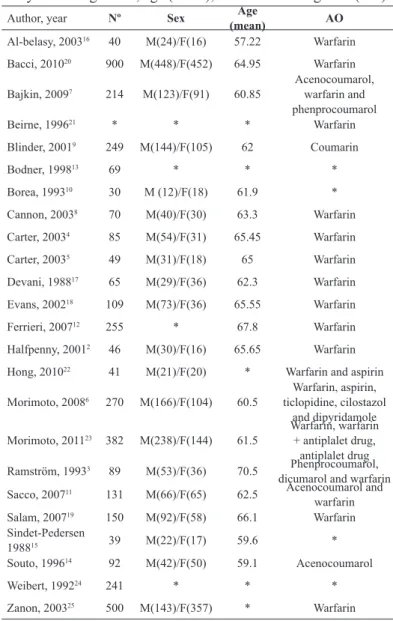
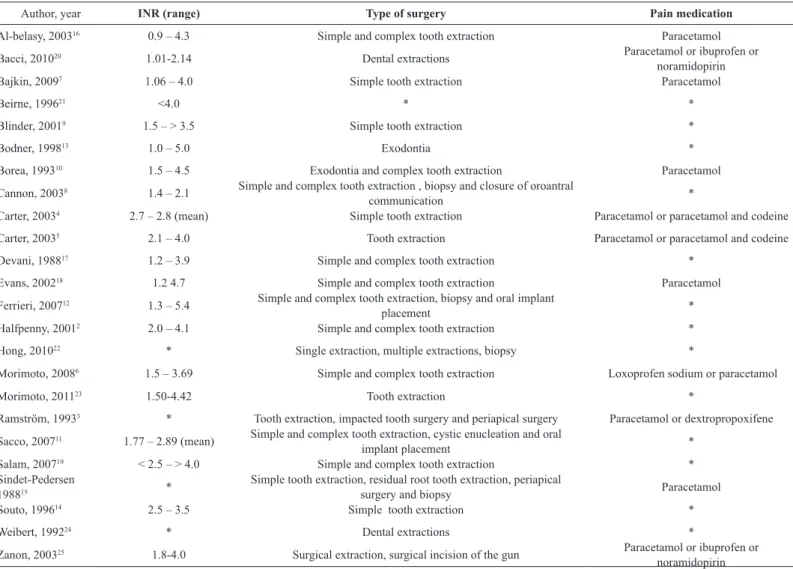
Of these, 3891 patients under anticoagulant therapy were analyzed according to sex, mean age (years), OA drug, International Normalized Ratio (INR) value before oral surgery,
type of surgery, and postoperative medication used for pain control
(Tables 1 and 2).
TABLE 1 - Distribution of patients analyzed in each
study according to sex, age (mean), and oral anticoagulant (OA).
Author, year Nº Sex Age
(mean) AO
Al-belasy, 200316 40 M(24)/F(16) 57.22 Warfarin
Bacci, 201020 900 M(448)/F(452) 64.95 Warfarin
Bajkin, 20097 214 M(123)/F(91) 60.85
Acenocoumarol,
warfarin and
phenprocoumarol
Beirne, 199621 * * * Warfarin
Blinder, 20019 249 M(144)/F(105) 62 Coumarin
Bodner, 199813 69 * * *
Borea, 199310 30 M (12)/F(18) 61.9 *
Cannon, 20038 70 M(40)/F(30) 63.3 Warfarin
Carter, 20034 85 M(54)/F(31) 65.45 Warfarin
Carter, 20035 49 M(31)/F(18) 65 Warfarin
Devani, 198817 65 M(29)/F(36) 62.3 Warfarin
Evans, 200218 109 M(73)/F(36) 65.55 Warfarin
Ferrieri, 200712 255 * 67.8 Warfarin
Halfpenny, 20012 46 M(30)/F(16) 65.65 Warfarin
Hong, 201022 41 M(21)/F(20) * Warfarin and aspirin
Morimoto, 20086 270 M(166)/F(104) 60.5
Warfarin, aspirin, ticlopidine, cilostazol
and dipyridamole
Morimoto, 201123 382 M(238)/F(144) 61.5 Warfarin, warfarin + antiplalet drug,
antiplalet drug
Ramström, 19933 89 M(53)/F(36) 70.5 Phenprocoumarol,
dicumarol and warfarin
Sacco, 200711 131 M(66)/F(65) 62.5 Acenocoumarol and
warfarin
Salam, 200719 150 M(92)/F(58) 66.1 Warfarin
Sindet-Pedersen
198815 39 M(22)/F(17) 59.6 *
Souto, 199614 92 M(42)/F(50) 59.1 Acenocoumarol
TABLE 2 - Distribution of patients analyzed in each study according to INR values, type of surgery and postoperative medication for pain control.
Author, year INR (range) Type of surgery Pain medication
Al-belasy, 200316 0.9 – 4.3 Simple and complex tooth extraction Paracetamol
Bacci, 201020 1.01-2.14 Dental extractions Paracetamol or ibuprofen or
noramidopirin
Bajkin, 20097 1.06 – 4.0 Simple tooth extraction Paracetamol
Beirne, 199621 <4.0 * *
Blinder, 20019 1.5 – > 3.5 Simple tooth extraction *
Bodner, 199813 1.0 – 5.0 Exodontia *
Borea, 199310 1.5 – 4.5 Exodontia and complex tooth extraction Paracetamol
Cannon, 20038 1.4 – 2.1 Simple and complex tooth extraction , biopsy and closure of oroantral
communication *
Carter, 20034 2.7 – 2.8 (mean) Simple tooth extraction Paracetamol or paracetamol and codeine
Carter, 20035 2.1 – 4.0 Tooth extraction Paracetamol or paracetamol and codeine
Devani, 198817 1.2 – 3.9 Simple and complex tooth extraction *
Evans, 200218 1.2 4.7 Simple and complex tooth extraction Paracetamol
Ferrieri, 200712 1.3 – 5.4 Simple and complex tooth extraction, biopsy and oral implant
placement *
Halfpenny, 20012 2.0 – 4.1 Simple and complex tooth extraction *
Hong, 201022 * Single extraction, multiple extractions, biopsy *
Morimoto, 20086 1.5 – 3.69 Simple and complex tooth extraction Loxoprofen sodium or paracetamol
Morimoto, 201123 1.50-4.42 Tooth extraction *
Ramström, 19933 * Tooth extraction, impacted tooth surgery and periapical surgery Paracetamol or dextropropoxifene
Sacco, 200711 1.77 – 2.89 (mean) Simple and complex tooth extraction, cystic enucleation and oral
implant placement *
Salam, 200719 < 2.5 – > 4.0 Simple and complex tooth extraction *
Sindet-Pedersen
198815 *
Simple tooth extraction, residual root tooth extraction, periapical
surgery and biopsy Paracetamol
Souto, 199614 2.5 – 3.5 Simple tooth extraction *
Weibert, 199224 * Dental extractions *
Zanon, 200325 1.8-4.0 Surgical extraction, surgical incision of the gun Paracetamol or ibuprofen or
noramidopirin
*Data not informed.
A total of 1851 men and 2040 women with a mean age of 60 years old was observed. The most used anticoagulant drug was warfarin, but the authors also mentioned the use of
phenprocoumarol, acenocoumarol, ticlopidine, cilostazol and dipyridamole.
Since there was no pattern for the INR values considered by each author prior to performing oral surgery, this variable was dificult to analyze. However, it was observed that the INR values varied a lot in each study, ranging from 0.9 to 5.4.
The surgical procedures comprised simple and complex exodontia, biopsy, impacted tooth surgery, cystic enucleation,
implant placement, closure of oroantral communication, and periradicular surgery. The most used postoperative medication in
all of the studies was paracetamol, but other authors3-5 prescribed
only paracetamol or the association of paracetamol and codeine,
and Morimoto6 indicated the use of loxoprofen sodium.
A total of 171 cases of hemorrhage was observed. The
local hemostatic measures used in anticoagulated patients, number of cases of bleeding in anticoagulated patients and the local hemostatic measures used to stop postoperative bleeding are listed
TABLE 3 - Distribution of local hemostatic measures used in anticoagulated patients, cases of bleeding in anticoagulated patients, and local hemostatic measures used to stop postoperative bleeding.
Author, year Primary local hemostatic protocol Postoperative
bleeding
Secondary local hemostatic protocol
Al-belasy, 200316 Cyanoacrylate glue + Suture or Gelatin sponge + Suture 5 LITA 2 min + LCG 30 min
Bacci, 201020 OC + Suture or TAGC 30-40 min 7 Gelatin sponge + Suture +
TAGC
Bajkin, 20097 Gelatin sponge + Suture 8 Suture
Beirne, 199621 Not reported Not reported Not reported
Blinder, 20019 Gelatin sponge + Suture 30 TAGC/Curettage + Gelatin
sponge + Suture
Bodner, 199813 Fibrin glue + Suture 3 LCG
Borea, 199310 TAM 2 min/4x day/ 7 days 1 Not reported
Cannon, 20038 OC + Suture 9 LCG
Carter, 20034 OC + Suture + TAM 2min/ 4x day/ 2 days or OC + Suture + TAM 2min/ 4x
day/ 5 days 3 LITA 2 min + LCG 20 min
Carter, 20035 OC + Suture + TAM 2min/ 4x day/ 7 days or OC + Fibrin glue + Suture 2 LCG
Devani, 198817 OC + Suture + LCG 30 min 9 Hospitalization
Evans, 200218 OC + Suture + LCG 10 min 15 Suture + LCG
Ferrieri, 200712 LITA (5 ml) + Suture + TAGC 5 TAGC
Halfpenny, 20012 Fibrin glue / OC 2 Hospitalization/Suture
Hong, 201022 Gelatin sponge + Suture 3 Gelatin sponge + Suture or
Suture
Morimoto, 20086 OC + Suture + LCG 30 min 11 OC + Suture + LCG/ LCG +
Warfarin dose reduction
Morimoto, 201123 OC + Suture + Compressed gauze 30 min 17 Compressed gauze, OC, Suture,
and/or Splint placement
Ramström, 19933 TAM 2min/4x day/7 days 0 LCG + TAGC/ OC or Gelatin
sponge + Suture
Sacco, 200711 Gelatin sponge or OC + Suture + TAM 4x day/ 2 days 10 Suture + TAM
Salam, 200719 OC + Suture + LCG 10 min 10 OC + Suture + LCG
Sindet-Pedersen 198815 TAM 10ml/2 min/4x day/ 7 days 1 TAGC
Souto, 199614 TAM immediately after surgery and TAM 2min/4x day/2 days 7 Not reported
Weibert, 199224 Not reported 9 Not reported
Zanon, 200325 OC + Suture + TAGC 30-60 min 4 Gelatin sponge + TAGC
TAM, Tranexamic acid mouthwash; OC, Oxidized Cellulose; TAGC, Tranexamic acid saturated gauze compression; LCG, local compression with gauze; LITA, local
irrigation with tranexamic acid.
Tranexamic acid (TA) was used as a local hemostatic measure in ten studies. In six studies, TA was associated with other local measures, such as oxidized cellulose (OC) and suture (three studies) or compression with gauze (one study). The ten studies that used TA as a local hemostatic measure associated or not with OC or hemostatic gauze, which accounted for 2170 patients, reported 35 episodes of bleeding. In four studies that used TA without associations in 250 patients, nine patients had hemorrhage. When TA was associated with other hemostatic measures, episodes of bleeding were observed in 31 out of 1786 patients. OC was used
glue was used in 40 patients, ive patients had hemorrhage. In one study, absorbable collagen sponge was used and, out of 214
patients undergoing oral surgery, eight had hemorrhage. Regarding the local hemostatic measures used to control postoperative bleeding, three studies used TA and six studies used tranexamic acid saturated gauze compression. In seven articles, hemostasis
with gauze was reported, which was associated with OC and dose modiication of oral anticoagulants in one study. OC was used in two studies, and in one of them, hospitalization of one patient was required. All of the bleeding cases were easily resolved with local
hemostatic measures, and systemic uses of vitamin K or fresh
plasma supplementation were not necessary.
Discussion
Patients undergoing oral surgery who are under
anticoagulant therapy to prevent thrombotic events have an
increased risk of transoperative and postoperative bleeding, since the anticoagulant therapy has the objective to maintain INR at a
therapeutic level and that leads to major bleeding in these patients7.
The possibility of postoperative bleeding is a concern
for any patient who is under anticoagulant therapy to prevent thrombosis, and usually, these patients are asked to discontinue
anticoagulants for a short period of time before surgery8. There is no case reported in the literature of life-threatening bleeding
in patients who maintained anticoagulant therapy prior to dental
surgery. Furthermore, life-threatening cases of thromboembolism after temporarily discontinuing anticoagulants have been reported1,2,9.
An increasing number of authors state that oral surgery
in anticoagulated patients can be safely performed without
discontinuing anticoagulant therapy. They emphasize, though, the
use of local hemostatic measures, such as OC (Surgicel), which
is dissolved to generate acid and other products that coagulate plasma proteins and hemoglobin to generate a clot8. Absorbable
gelatin, or collagen sponges and ibrin glue with sutures are also
used as local hemostatic measures7,10,11.
Some authors recommend discontinuing anticoagulants
and replacing them with heparin. Others recommend reducing
anticoagulant therapy prior to surgery and considering an INR
range of 1.5 – 2.0 as a condition to perform the procedures9,11,12.
The effectiveness of TA in anticoagulated patients undergoing oral surgery has been reported3,9,13,14, as well as the eficacy of ibrin glue, absorbable gelatin, collagen sponges and sutures8-10.
In the present study, TA was more effective in controlling hemorrhage when compared to OC and other local
measures. The higher effectiveness of TA compared to a placebo has been previously reported by some authors10,15 who suggested that the saliva concentration of TA after using it four times a day for rinsing is enough to reduce the incidence of postoperative bleeding complications, according to previously reported results of treatment of hemophilic patients4,5,8,13. There does not seem to
be any statistically signiicant difference between a two or ive day
prescription4.
Hemostasis in the oral cavity depends on the dynamic
balance between ibrin and plasmin formation, and is inluenced
by the environment that contains both plasminogen and activated plasminogen3,5. TA prevents proteolytic degradation of ibrin,
which impairs the ixation of plasminogen and plasmin. A TA solution (4.8%) has proved to be very effective in reducing bleeding
complications with insigniicant systemic absorption4. The ibrin
glue, however, stimulates the last phases of the coagulation
cascade, namely the conversion of ibrinogen to ibrin5.
The obvious advantage of local inhibition of ibrinolysis in anticoagulated patients is the simplicity and eficacy of the treatment in addition to the lack of serious side effects. The
anticoagulant therapy is not discontinued, the patient is not exposed to potential complications such as thromboembolism, and
hemostasis can be achieved in a safe and fast way, without major complications as observed in a few cases.
There is controversy in the literature regarding the necessity of discontinuing anticoagulant therapy prior to oral
surgery in patients who are at risk for thromboembolism.
Preliminary data of this study indicate that there is no need for discontinuing anticoagulation, as long as local hemostatic measures are used10.
Conclusions
Patients under anticoagulant therapy are frequently
submitted to oral surgery, which is why the necessity for
discontinuing or not anticoagulation poses a dilemma to dentists.
Potential risks are involved in this situation, whether it decided to discontinue the medication, which can cause thromboembolism, or maintain therapeutic dose, which can lead to hemorrhage.
Considering the data reported in the literature, discontinuing medication does not seem to be necessary, provided that dentists
References
1. Scully C, Wolff A. Oral surgery in patients on anticoagulant therapy. Oral Surg Oral Med Oral Pathol Oral Radiol Endod. 2002;94(1):57-64.
2. Halfpenny W, Fraser JS, Adlam DM. Comparison of 2 hemostatic
agents for the prevention of postextraction hemorrhage in patients
on anticoagulants. Oral Surg Oral Med Oral Pathol Oral Radiol Endod. 2001;92(3):257-9.
3. Ramstrom G, Sindet-Pedersen S, Hall G, Blomback M, Alander U.
Prevention of postsurgical bleeding in oral surgery using tranexamic
acid without dose modiication of oral anticoagulants. J Oral Maxillofac Surg. 1993;51(11):1211-6.
4. Carter G, Goss A. Tranexamic acid mouthwash--a prospective randomized study of a 2-day regimen vs 5-day regimen to prevent
postoperative bleeding in anticoagulated patients requiring dental
extractions. Int J Oral Maxillofac Surg. 2003;32(5):504-7.
5. Carter G, Goss A, Lloyd J, Tocchetti R. Tranexamic acid mouthwash versus autologous ibrin glue in patients taking warfarin undergoing
dental extractions: a randomized prospective clinical study. J Oral
Maxillofac Surg. 2003;61(12):1432-5.
6. Morimoto Y, Niwa H, Minematsu K. Hemostatic management of
tooth extractions in patients on oral antithrombotic therapy. J Oral
Maxillofac Surg. 2008;66(1):51-7.
7. Bajkin BV, Popovic SL, Selakovic SD. Randomized, prospective trial comparing bridging therapy using low-molecular-weight heparin with maintenance of oral anticoagulation during extraction of teeth. J Oral Maxillofac Surg. 2009;67(5):990-5.
8. Cannon PD, Dharmar VT. Minor oral surgical procedures in
patients on oral anticoagulants--a controlled study. Aust Dent J.
2003;48(2):115-8.
9. Blinder D, Manor Y, Martinowitz U, Taicher S. Dental extractions
in patients maintained on oral anticoagulant therapy: comparison
of INR value with occurrence of postoperative bleeding. Int J Oral Maxillofac Surg. 2001;30(6):518-21.
10. Borea G, Montebugnoli L, Capuzzi P, Magelli C. Tranexamic acid as a mouthwash in anticoagulant-treated patients undergoing oral
surgery. An alternative method to discontinuing anticoagulant
therapy. Oral Surg Oral Med Oral Pathol. 1993;75(1):29-31. 11. Sacco R, Sacco M, Carpenedo M, Mannucci PM. Oral surgery in
patients on oral anticoagulant therapy: a randomized comparison
of different intensity targets. Oral Surg Oral Med Oral Pathol Oral Radiol Endod. 2007;104(1):e18-21.
12. Ferrieri GB, Castiglioni S, Carmagnola D, Cargnel M, Strohmenger L, Abati S. Oral surgery in patients on anticoagulant treatment without therapy interruption. J Oral Maxillofac Surg. 2007;65(6):1149-54. 13. Bodner L, Weinstein JM, Baumgarten AK. Eficacy of ibrin sealant
in patients on various levels of oral anticoagulant undergoing
oral surgery. Oral Surg Oral Med Oral Pathol Oral Radiol Endod. 1998;86(4):421-4.
14. Souto JC, Oliver A, Zuazu-Jausoro I, Vives A, Fontcuberta J. Oral surgery in anticoagulated patients without reducing the dose of oral anticoagulant: a prospective randomized study. J Oral Maxillofac Surg. 1996;54(1):27-32.
15. Sindet-Pedersen S, Ramstrom G, Bernvil S, Blomback M. Hemostatic effect of tranexamic acid mouthwash in anticoagulant-treated patients undergoing oral surgery. N Engl J Med. 1989;320(13):840-3.
16. Al-Belasy FA, Amer MZ. Hemostatic effect of n-butyl-2-cyanoacrylate (histoacryl) glue in warfarin-treated patients undergoing oral surgery. J Oral Maxillofac Surg. 2003;61(12):1405-9.
17. Devani P, Lavery KM, Howell CJ. Dental extractions in patients on
warfarin: is alteration of anticoagulant regime necessary? Br J Oral Maxillofac Surg. 1998;36(2):107-11.
18. Evans IL, Sayers MS, Gibbons AJ, Price G, Snooks H, Sugar AW. Can warfarin be continued during dental extraction? Results of a randomized controlled trial. Br J Oral Maxillofac Surg. 2002;40(3):248-52.
19. Salam S, Yusuf H, Milosevic A. Bleeding after dental extractions in patients taking warfarin. Br J Oral Maxillofac Surg. 2007;45(6):463-6.
20. Bacci C, Maglione M, Favero L, Perini A, Di Lenarda R, Berengo M, Zanon E. Management of dental extraction in patients undergoing
anticoagulant treatment. Results from a large, multicentre,
prospective, case-control study. Thromb Haemost 2010;104(5):972-5.
21. Beirne OR, Koehler JR. Surgical management of patients on warfarin sodium. J Oral Maxillofac Surg 1996;54:1115-1118. 22. Hong CH, Napenas JJ, Brennan MT, Furney SL, Lockhart PB.
Frequency of bleeding following invasive dental procedures in patients on low-molecular-weight heparin therapy. J Oral Maxillofac Surg. 2010;68:975-9.
23. Morimoto Y, Niwa H, Minematsu K. Risk factors affecting
postoperative hemorrhage after tooth extraction in patients receiving
oral antithrombotic therapy. J Oral Maxillofac Surg. 2011;69:1550-6.
24. Weibert RT. Oral anticoagulant therapy in patients undergoing
dental surgery. Clin Pharm. 1992;11(1):857-64.
25. Zanon E, Martinelli F, Bacci C, Cordioli G, Girolami A. Safety of
dental extraction among consecutive patients on oral anticoagulant
treatment managed using a speciic dental management protocol. Blood Coagul Fibrinolysis. 2003;14:27-30.
Correspondence:
Fábio Wildson Gurgel Costa
Rua João Sorongo, 1016/205 60416-000 Fortaleza – CE Brasil Tel.: (55-85)88191364
Received: August 15, 2012 Review: October 17, 2012 Accepted: November 18, 2012 Conlict of interest: none
Financial source: none
1Research performed at School of Dentistry, Postgraduate Program
in Dentistry, Dental Clinic Area, Federal University of Ceara (UFC),