The effect of deep brain stimulation on
motor and cognitive symptoms
of Parkinson’s disease
A literature review
Flavia Amaral Machado1, Caroline Tozzi Reppold2
ABSTRACT. Deep brain stimulator (DBS) implant surgery is considered a breakthrough in the treatment of Parkinson’s disease, especially in cases where motor symptoms cannot be controlled through conventional drug treatment. Its benefits have been studied extensively in the literature, particularly in relation to motor symptoms. However, the disease’s cognitive aspects have been studied to a lesser extent. Objective: This systematic review aims to assess the effects of DBS surgery on motor and cognitive symptoms in patients with Parkinson’s disease. Methods: The search strategy included MEDLINE, LILACs, SCIELO and the Cochrane Library. Randomized clinical trials with DBS surgical intervention and Parkinson’s disease were included. Of the 178 studies identified, 19 met the eligibility criteria. These studies were descriptively analyzed as regards to their results.
Results: Control of motor symptoms, as assessed by the UPDRS Part III scale, was found in all of the studies, pointing to great interest in this outcome and demonstrating an advantage of DBS over conventional drug treatment. Regarding cognitive aspects, heterogeneity in the choice of subjects studied and the use of different assessment tools for each was evident, hampering comparisons and leading to inconclusive results. Conclusion: This review provides a broad overview of the effects of DBS on Parkinson’s disease symptoms. However, it is suggested that future studies be conducted to establish a gold-standard protocol for neuropsychological assessment, thereby enabling data comparison and more consistent conclusions.
Key words: Parkinson’s disease, deep brain stimulation (DBS), cognition, motor symptoms.
O EFEITO DA ESTIMULAÇÃO CEREBRAL PROFUNDA NOS SINTOMAS MOTORES E COGNITIVOS DA DOENÇA DE PARKINSON: REVISÃO DA LITERATURA
RESUMO. A cirurgia de implante de estimulador encefálico profundo (DBS) é considerada um avanço em termos de tratamento para doença de Parkinson, especialmente em casos nos quais o controle dos sintomas motores não é possível por meio de tratamento farmacológico convencional. Os benefícios são bastante estudados na literatura, especialmente no que se refere aos sintomas motores. Contudo, os aspectos cognitivos também envolvidos nessa doença vêm sendo estudados em menor escala.
Objetivo: O objetivo dessa revisão sistemática é verificar os efeitos da cirurgia DBS nos sintomas motores e cognitivos de pacientes com a Doença de Parkinson. Métodos: A estratégia de busca inclui MEDLINE, LILACS, SCIELO, Biblioteca Cochrane. Ensaios clínicos randomizados com a intervenção cirúrgica DBS e Doença de Parkinson foram incluídos. Dos 178 estudos identificados, 19 cumpriram os critérios de elegibilidade, os quais foram analisados de forma descritiva quanto aos seus resultados. Resultados: O controle dos sintomas motores avaliados através da escala UPDRS, seção III, foi encontrado em todos os estudos, evidenciando o grande interesse por esse desfecho e demonstrando uma vantagem do DBS em comparação com o tratamento convencional medicamentoso. Em relação aos aspectos cognitivos, existe uma heterogeneidade na escolha dos domínios estudados e a utilização de diferentes instrumentos de avaliação para cada um deles, dificultando a comparação e tornando os resultados inconclusivos. Conclusão: Essa revisão fornece um panorama amplo dos efeitos do DBS nos sintomas da Doença de Parkinson, no entanto sugere-se que futuros estudos estabeleçam um protocolo de avaliação neuropsicológica padrão-ouro para permitir confrontação dos dados e conclusões mais consistentes.
Palavras-chave: doença de Parkinson, estimulação encefálica profunda, cognição, sintomas motores.
1Physiotherapist, Master’s Student of Master’s Program of Rehabilitation Sciences – Universidade Federal de Ciências da Saúde de Porto Alegre (UFCSPA), Brazil. 2 PhD,
Psychologist, Neuropsychological Assessment Unit, Master’s Program of Rehabilitation Sciences and Health Sciences. Universidade Federal de Ciências da Saúde de Porto Alegre (UFCSPA), Brazil.
Flavia Amaral Machado. UFCSPA – Rua Sarmento Leite 245 – 90050-170 Porto Alegre RS – Brazil. E-mail: [email protected] Disclosure: The authors report no conflicts of interest.
Received Abril 01, 2014. Accepted in final form December 29, 2014.
INTRODUCTION
P
arkinson’s disease (PD), irst described by the Eng-lish doctor James Parkinson in 1817, is considered a neurodegenerative disease, highly prevalent in the el-derly population worldwide, whose incidence tends to increase with the population aging observed in recent years. Its main features are associated with motor symp-toms of bradykinesia, resting tremor, postural instabil-ity and muscle rigidinstabil-ity. However, non-motor symptoms also afect the individual and are responsible for limi-tations and disabilities that impair the quality of life in these individuals.1,2he neuropathology of PD involves the degeneration of dopaminergic neurons located in the brain’s substan-tia nigra. It is a process in which neurons are lost in the region called the pars compacta and results from the ac-cumulation of proteins (mainly alpha-synuclein) in this region. he loss of dopaminergic terminals leads to a decrease in dopamine transporter (DAT) density. When symptoms are present, this reduction in DAT density can reach 90% of normal levels.3-5
he main characteristic motor symptoms of PD are resting tremor, slow movement, muscular rigidity and postural instability. Secondary symptoms include freez-ing and problems with handwritfreez-ing. Contrary to James Parkinson’s initial description, PD presents a range of associated non-motor symptoms. hese include chang-es in relation to smell, cognitive/behavioral aspects, sleep disorders and others, all of which greatly interfere with patients’ general health and have a major impact on their quality of life.6-8 For this reason, these
symp-toms have been the focus of recent studies.
PD treatment is based on dopaminergic replacement, with levodopa being the most commonly used drug.9 A
precursor of dopamine, levodopa’s emergence in the late 1960s was considered a landmark in the treatment of pa-tients with PD. However, despite its positive efects, its extended use can lead to problems related to motor luc-tuations and dyskinesia.3 hese results vary according to
duration of levodopa use and disease progression. here-fore, it is generally preferred to delay initial levodopa treatment in order to postpone the onset of these related efects. Cases also exist in which patients do not respond to drug treatment or in which they develop intolerance to the drug, making treatment a challenge for medicine.10
In this context, deep brain stimulation (DBS) rep-resents one of the most important innovations for PD treatment. Many studies have shown that this type of surgical treatment can signiicantly improve the motor condition of individuals with luctuations and dyskine-sia.11,12 here is abundant information on the results
of short-term (up to one year) implants and a consid-erable number of medium-term studies (from one to ive years) on the disease’s motor aspects. To a lesser extent, studies have assessed post-operative cognitive aspects.13 hese studies have shown that DBS leads to
a marked and sustained improvement in dopaminergi-cally responsive motor symptoms, with a reduction in dyskinesia severity and duration. here is a drastic re-duction in the need for dopaminergic medication after implant,14 leading to a decrease in dyskinesia.
he main objective of this article was to present a systematic review of the literature, especially of the ran-domized clinical trials on the efect of deep DBS implant surgery on PD motor and cognitive symptoms. More speciically, the aim was to identify whether the im-plant surgery improved motor symptoms and resulted in changes (improvement/deterioration) in any speciic area of cognitive function.
METHODS
Search strategy. he following electronic databases were
searched: MEDLINE (accessed through PubMed), LILACS and the Cochrane Library. We used the research terms ‘deep brain stimulation’, ‘Parkinson disease’ and ‘randomized controlled trial’. he search period was not limited and included all articles published up to Septem-ber 2013. he exclusion criteria were: duplicate studies; lack of data or incomplete data on results obtained or sample results; and outcomes other than those de-scribed in the eligibility criteria.
Study eligibility. We included studies in English,
Portu-guese and Spanish that were designed as randomized clinical trials with DBS surgery as the main intervention in individuals with PD, having outcomes of control of motor symptoms and cognitive aspects (verbal luency, memory, attention and executive functions). Other out-comes of interest were quality of life and mood (behav-ioral aspects).
Study selection and data extraction. he titles and abstracts
Methodological quality. Evaluation of the studies’ quality was based on the GRADE approach, as recommended by the Cochrane Handbook for Systematic Reviews of Interventions.16 his was done independently by two
reviewers and included analysis of the following: gen-eration of appropriate randomization; allocation con-cealment; blind patients and investigators; blinding of result evaluators; use of intention-to-treat analysis; and descriptions of losses and exclusions. Studies lack-ing a clear description of their randomization process and those concealing their allocation lists (including terms such as “randomization by telephone”, “based on the Web” and “central”) were considered not to have satisied these criteria. Intention-to-treat analysis was considered after conirming that the participants who were randomized and analyzed were identical, except for those who were lost during follow-up or who with-drew their consent to participate in the study. hree other factors were analyzed to shed light on the studies’ quality: [1] study design limitations; [2] consistency of results; and [3] objectivity. All of the aspects considered were assessed as “adequate” or “inadequate”.
Analyses. he analysis was descriptive for outcomes
found and type of instrument used to assess motor and cognitive aspects. Furthermore, methodological charac-teristics and main evidence according to the central aim of the research were reported.
RESULTS
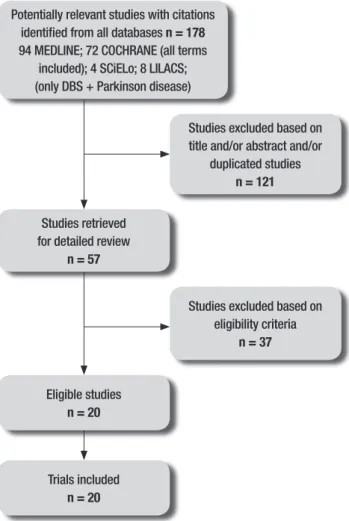
he initial search identiied 166 studies using all of the search terms. An additional 12 studies were found using only two search terms (‘Parkinson’s disease’ and ‘deep brain stimulation’) in two databases, giving a total of 178 studies. Of these, 57 were selected to have their full texts read and 19 satisied the present review’s eligibil-ity criteria. he complete low chart of studies included in this review is given in Figure 1. he included studies involved a total of 2,180 patients.
Study quality was classiied as good in half the stud-ies, according to the assessment based on the GRADE ap-proach as recommended by the Cochrane Handbook for Systematic Reviews of Interventions.16 With regard to
the impact factor of the journals in which the studies were published, a range of 1.161 to 50.807 was found. All of these are indexed in the ISI Web of Knowledge database.
As for the proposed intervention, 42% of the studies had controlled clinical trials performed with a sample divided into two groups: a surgical group that under-went surgery to implant a deep brain stimulator in the subthalamic nuclei (DBS-STN) and another group that
Eligible studies
n = 20
Potentially relevant studies with citations identified from all databases n = 178
94 MEDLINE; 72 COCHRANE (all terms included); 4 SCiELo; 8 LILACS; (only DBS + Parkinson disease)
Studies excluded based on title and/or abstract and/or
duplicated studies
n = 121
Studies retrieved for detailed review
n = 57
Studies excluded based on eligibility criteria
n = 37
Figure 1. Flow diagram of studies included in the review.
Trials included
n = 20
received best medical treatment, considering the drug treatment used.11,17-19, 22-25 Follow-up ranged from six to
24 months.
Cognitive aspects were assessed using various types of instruments, covering speciic cognitive areas (atten-tion, memory, executive functions and verbal luency) or cognitive functions in general. he Mattis Dementia Rating Scale (MDRS)26 was the most commonly used
instrument (used by researchers in 50% of the studies to assess cognitive functions overall), followed by the Semantic Category Verbal Fluency Test and the Phone-mic Category Verbal Fluency Test (37.5%).27 he Digit
Span Test for memory and the Stroop Test28 for
atten-tion were used in two studies (25%). he analysis of the data concerning the efects of surgery on cognitive symptoms suggested no adverse efects except on ver-bal luency (VF), which showed a greater decline after DBS (semantic VF declined 4.5 points and phonemic VF declined 3.06 points) compared with drug treatment.17
Witt et al.18 studied the relationship between the
Table 1. Study results.
Study, year
Participants N (male/female)
Treatment applied =N
Mean age (years)
Duration of disease (years)
Follow-up (months)
Number of assessments (period)
Burchiel et al., 1999 10
(7m/3f)
DBS GPi=4 DBS Stn=6
56 12.1 0-12m 5 (preop, 10 days, 3,6,12 months)
Daniels et al., 2011 121
(m/f=NI)
DBS Stn=61 Med=60
59.7 13 0-6m 2 (baseline ,6 months)
Deuschl et al., 2006 156
(100m/56f)
DBS Stn=78 Med=78
60.6 13.4 0-6m 2 (baseline ,6 months)
Deuschl et al., 2013 251
(m/f=NI)
DBS Stn+Med=123 Med=123
52.6 7.5 0-24m 3 (5,12,24 months)
Follet et al., 2010 299
(249m/50f)
DBS GPi=152 DBS Stn=147
61 11.3 0-24m 5 (3,6,12,18,24 months)
Gill et al., 2011 30
(27m/3f)
Med=15 DBS Stn+Med=15
60 2.2 0-24 m 5 (baseline, 6,12,18, 24 months)
Merello et al., 2008 16
(9m/7f)
DBSStn+Sub=5 DBS Stn Bil=6
Sub Bil=5
0-12m 3 (1,6,12 months)
Odekerken et al., 2013 128 (88m/38f)
DBS Stn:63 DBS GPi:65
60 11 0-12m 4 (1,3,6,12 months)
Okun et al., 2009 45
(m/f)
DBS GPi=23 DBS Stn=22
60 13 0-7m 2 (preop and 7 months)
Rocchi et al., 2012 66
(m/f=NI)
HC=28 PDC=9 DBS Stn=15 DBS GPi=14
61 12 0-6 m 3 (preop, baseline and 6 months)
Schubpach et al., 2007 20 (12m/8f)
DBS Stn=10 Med=10
48 6.8 0-18m 4 (preop, 6, 12, 18 months)
Smeding et al., 2005 34
(11m/23f)
Palli=14 DBS Stn=20
61 11.5 0-12m 3 (base, 6, 12 months)
Weaver et al., 2009 255
(206m/49f)
DBS GPi=61 DBS Stn=60 med=134
62 11 0-6m 2 (base, 6 months)
Weaver et al., 2012 156
(131m/25f)
DBS GPi=89 DBS Stn=70
60.5 11 0-36m 6 (3,6,12,18,24,36 months)
Weiss et al., 2013 12
(9m/3f)
DBS Stn=6 DBS Stn+SNi=6
65 >4.5 0-6 weeks 3 (baseline, 3 and 6 weeks)
Williams et al., 2010 366
(256m/110f)
DBS Stn=183 Med=183
59 11.3 0-12m 2 (baseline, 12 months)
Witt et al., 2008 123
(77m/46f)
DBS Stn=60 Med=63
59.5 13.9 0-6 m 2 (baseline, 6 months)
Witt et al., 2013 62
(28m/34f)
DBS Stn=31 Med=31
59.3 >5 0-6 m 2 (baseline, 6 months)
Zahodne et al., 2009 42
(30m/12f)
DBS GPi=22 DBS Stn=20
61.3 13 0-6m 2 (baseline, 6 months)
assessment results and found increased risk of a decline in global cognition and working memory performance in electrode trajectories involving caudate nuclei. Fur-thermore, the DBS group exhibited a decline in verbal luency in 75% of the patients and a signiicant difer-ence when compared with the group that received drug treatment (DBS= –6.1 points and Med=0.3 points).
Quality of life outcomes were also assessed in 100% of the studies, using the Parkinson’s Disease Question-naire (PDQ-39)29 in all assessments. he quality of life
results were better for those patients who underwent DBS. In the Daniels et al study,22 the main objective was
to evaluate the quality of life of patients who underwent DBS-STN surgery, unlike other studies that predomi-nantly aimed to assess the control of motor symptoms. Most of the scores on the quality of life questionnaires improved considerably after DBS-STN and the analysis showed a threshold of 10.9 points for the PDQ-39, indi-cating a change in quality of life. In the study by Schub-pack et al.,24 24% of those who underwent the surgery
showed better results on the activities of daily living, stigma and body discomfort subareas of the rating scale, reporting this improvement after 18 months of follow-up. here was no diference in outcome for the group that underwent drug treatment only.
he results for motor symptom control were as-sessed using the Uniied Parkinson’s Disease Rating Scale (UPDRS),30 section III, which covers the motor
as-pects related to the main PD symptoms, such as brady-kinesia, gait, rigidity, gait freezing, language and facial expression, among others. On this scale, a higher score indicates greater motor impairment in the individual. In the study by Gill et al.,23 the group that underwent
surgical stimulation had a reduction of four points com-pared to baseline scores after two years. A similar result was found in the study by William et al.,25 which found
a reduction of 6.6 points after one year of surgery, while the group undergoing drug treatment had an increase of 1.6 points after the same period. Conirming this trend, Deuschl et al.,11 showed results of 71% in favor
of surgical treatment and only 21% for drug treatment. Even within this context, it can be stated that all of the studies that compared DBS-STN with drug treatment showed better motor symptom control for those who underwent DBS-STN surgery.
Regarding the surgical target, comparisons between the brain locations in DBS surgery [implantation in the subthalamic nuclei (STN) vs. the internal globus pal-lidus (GPi)] and their efects on motor and cognitive symptoms were found in 31.5% of the studies, whose follow-up periods ranged from six to 36 months.
In-creased control of motor symptoms proved similar between the two implant groups, as the studies found no signiicant diferences and the results showed an im-provement ranging from 26% to 40% for STN and 28% to 40% for GPi.20,31,32 UPDRS section III was used as the
assessment tool in all studies.
he quality of life of patients was measured in four (66.6%) out of the six trials that compared the surgi-cal implant locations. PDQ-39 was the tool most used (75%) but results were conlicting since Weaver et al.33
and Follet et al.21 found no diference or insigniicant
diferences, whereas in other studies quality of life im-proved more for the GPi group than for the STN group (38% vs. 14% respectively; p=0.03), suggesting a greater improvement for the DBS-GPi group.20,31
Regarding cognitive symptoms, similarly to that de-scribed above, to compare the surgical and drug treat-ment groups, the areas of verbal luency, attention, memory and overall cognitive function were assessed. he evaluations were performed using the following tools: the Mattis Dementia Rating Scale (MDRS), the Wechsler Adult Intelligence Scale (WAIS III), the Stan-ford-Binet Intelligence Scale for overall cognitive func-tion in two (33.3%) of the studies, the Wisconsin Card Sorting Test (WCST) for executive functions in one study, and the Hopkins Verbal Learning Test (HVLT) for memory in two studies. he only cognitive area that showed signiicant decline was verbal luency, which was evaluated in three studies using semantic and phonemic verbal luency tests. Okun et al.31 presented evidence
that, between the pre- and post-surgery results, there was a greater worsening in the phonemic verbal luency test score for the DBS-STN group (STN −5.8±10.0 vs. GPi −3.1±7.6, p<0.05). Zahodne et al.,20 who also found
a greater worsening in the DBS-STN group (phonemic verbal luency: pre-surgery 37.9 (9.9) vs. post-surgery 32.5 (10.03) p<0.001), pointed out that their study did not provide conclusive evidence that the GPi is a safer target. he results for the other areas assessed did not indicate signiicant changes and were considered con-sistent with PD’s process of progression. However, the study by Weaver et al.33 concluded that cognitive
In another prior study, Weaver et al.12 performed
a comparison of three groups: the two surgical groups mentioned previously plus a drug treatment group. All groups had short-term follow-ups of six months. A bat-tery of neuropsychological assessments composed of the following tools was applied: the Mattis Dementia Rating Scale (MDRS), Wechsler Adult Intelligence Scale (WAIS-III), semantic and phonemic verbal luency tests, Wisconsin Card Sorting Test (WCST), Boston Naming Test, Brief Visuospatial Memory Test, Hopkins Verbal Learning Test (HVLT) and the Stroop test for attention. he neurocognitive tests revealed small decreases of be-tween 1.0 and 3.5 points in some areas of information processing for patients who received DBS compared to those who received medical treatment.
Compared with the drug treatment group, the DBS group showed signiicant improvement on seven of the eight subscales measuring quality of life according to the PDQ-39 results. he results in elderly patients were greatest for mobility (–12.3), activities of daily liv-ing (–14.0) and stigma (–12.5), considerliv-ing the difer-ence between the baseline and six-month assessments and bearing in mind that a higher score indicates worse quality of life for the individual. he group treated with medication showed little change from baseline, except in the stigma subarea (–4.2).
he motor results showed a signiicant improvement in the DBS group compared with the medical treatment group, as 71% of the DBS patients and only 32% of the drug therapy patients had better motor function scores, according to the UPDRS III. hese results contradict those found by Rocchi et al.,34 who compared the two
surgical targets (STN and GPi) and two control groups (one with PD patients and one composed of healthy in-dividuals) and found similar scores for the surgical and control groups, with PD: 45.5±16 and 22.9±8.9 at base-line and 45.9±12.8 and 24.2±9.6 after six months (of and on medication, respectively).
hree other studies eligible for this review reported controlled trials with diferent surgical approaches be-tween groups. One of these, by Weis et al.,35 entailed
a comparison using DBS-STN patients as the control group and DBS-STN plus substantia nigra (SN) patients as the combined therapy group, showing improvement in both surgical groups (from baseline to three weeks later) for motor symptom control, according to the UP-DRS III. here was no signiicant diference between the two groups: STN+SNi: 13 (6.47); STN: 14.25 (5.75); ef-fect=0.83 (3.86); 95% conidence interval (CI) –1.62-3.82; (P=0.470). However, determining the incidence of neuro-cognitive interference in the stimulation of the SN
com-bined with the STN requires cohort studies with greater numbers of participants and longer follow-up periods to obtain more robust conclusions, while the trial in question lasted for only three weeks and had only 12 participants.
he second study, by Merello et al.,36 compared three
surgical groups: bilateral DBS-STN, bilateral subthala-motomy and unilateral DBS-STN with contralateral subthalamotomy (total n=16). hese also showed im-provement in motor symptoms, as assessed by the UP-DRS III. However, sample size analysis showed that 16 individuals in each group would be necessary to dem-onstrate signiicant diferences. Neuropsychological assessment tools were used to evaluate six areas: atten-tion, memory, verbal luency, orientaatten-tion, language and visuospatial skills. However, this was a pilot study and its results cannot be considered suiciently consistent to infer any kind of conclusion.
Finally, Smeding et al.37 conducted a study with 12
months of follow-up, comparing a group that under-went DBS-STN and a group that underunder-went pallidoto-my, evaluating them using a battery of neurocognitive assessment tools including the following tests: the De-mentia Rating Scale (DRS), semantic and verbal luency tests, the Dutch Adult Reading Test (DART), Controlled Oral Word Association Test (COWAT), Paced Auditory Serial Addition Task (PASAT), auditory verbal learning test (AVLT), Groningen Intelligence Test, Stroop Test, Odd Man Out Test (OMO), Trail Making Test and the Boston Naming Test (BNT).
he results indicated no signiicant diference be-tween the DBS-STN and pallidotomy groups on the main neuropsychological assessments, although the DBS-STN group committed more errors than the palli-dotomy group on two executive tests (the Stroop and Trail Making tests) six months after surgery. he efect size was large (Cohen Stroop Test d=0.94; Cohen Trail Making Test Part B d=0.80), suggesting impairment in executive functions. After 12 months, there was a trend toward decreased verbal luency performance. Although the two groups did not difer signiicantly in degree of decline in verbal luency, the DBS-STN group exhibited a greater decrease (2.6 points). he results of this study are in line with those of Witt et al.,17,18 which found a
higher error rate on the Stroop Test for the bilateral DBS-STN group after six months. he authors concluded that bilateral STN stimulation has slightly more negative ef-fects on executive function than unilateral pallidotomy.
DISCUSSION
is well established in the literature. hrough this review, 18 articles were found that assessed motor symptoms, on/of time and control of symptoms such as dyskine-sias and motor luctuations. hese studies used difer-ent approaches and diferdifer-ent comparison groups, and their evaluation periods ranged from those that includ-ed pre-surgical patients to those evaluating patients 36 months after intervention. he common factor in these studies was the positive result of surgery compared to that of drug treatment in controlling motor symptoms. However, the studies do not present evidence that either the STN or GPi is better or worse as a surgical target.
Even within this context, the improvement in qual-ity of life after DBS is derived from motor symptom con-trol factors, and the length of time a patient stayed in the ‘of’ condition proved to be the most important pre-dictor of surgical results. he most commonly used tool was the PDQ-39 questionnaire, which has the advan-tages of being an assessment tool for a speciic validated disease, having 39 questions divided into eight areas, covering mobility, activities of daily living, emotional well-being, social support, body discomfort, stigma, cognition and communication.
However, signiicant gaps remain in understanding of the efects of DBS on cognitive functions. his litera-ture review dealing with DBS and cognitive aspects eval-uated the articles, concluding that the greatest diiculty in establishing the impact of DBS surgery on cognitive aspects was due to the diversity of tools used for each area, hampering comparison of studies. Taking the ex-ample of motor and quality of life assessments (in which most studies used the UPDRS III and PDQ-39, respec-tively), the uniication of tools for cognitive functions in PD could be an advantageous and efective way to comparing results for this population. his review iden-tiied only verbal luency, as measured by the semantic and phonemic verbal luency tests,12,17,18,20,23,31,33,36,37 as
an area exhibiting decline after DBS, a inding more evident in cases where the surgery targeted the subtha-lamic nucleus (STN). he moderate decline in semantic and phonemic verbal luency after DBS was described by Parsons et al.,38 who reviewed 28 cohort studies
in-vestigating the efect of DBS on the cognitive aspects of 612 patients. he explanation for this result remains unclear. However, the decline in executive functions af-ter DBS-STN could be due to an efect on basal ganglia circuits. Moreover, in the Witt et al. study,18 which
as-sessed electrode trajectory, the authors suggested that the caudate nucleus could be spared by this trajectory, preferring a more anterior-lateral path that would be cognitively safer.
Another important aspect of this review is the fact that it did not establish a single type of intervention as an eligibility criterion, leading to the inclusion of a larg-er numblarg-er of studies, which provided a much broadlarg-er scope in terms of surgical efects on patients’ motor and cognitive symptoms, afording a study covering six dif-ferent types of controlled clinical trials encompassing all the studies available in the databases. However, this became an obstacle for the reviewers when preparing the results and comparing them across studies. It was therefore decided to present the results by type of in-tervention. Furthermore, the variation in the number of patients in the study samples was considered large, ranging from 1032 to 366,25 demonstrating the
hetero-geneity of the studies found.
Finally, this review covered the most important studies conducted to date11,19, 21,25,31 and presented some
important considerations about the efects of DBS sur-gery on PD patients. However, some limitations should be noted, such as the diversity of tools used in the stud-ies for assessing the cognitive areas, which led to less consistent results. Another limiting factor was the small number of studies (1 or 2) for some intervention types, demonstrating that much more research is needed to es-tablish the safety and efectiveness of this procedure on cognitive and behavioral functions. Further controlled clinical trials should be conducted with groups eligible for DBS surgery employing diferent targets, as well as with control groups in use of drug treatment.
Acknowledgements. his study was supported in part by
the Conselho Nacional de Desenvolvimento CientÍico e Tecnológico (CNPq). here are no conlicts of interest.
REFERENCES
1. Rowland LP. Merrit- Tratado de Neurologia. 11ed. Rio de Janeiro: Gua-nabara-Koogan; 2007:1196.
2. Levy A, Ferreira, J. Doença de Parkinson - Manual Prático. Lisboa: Lidel. 2003.
3. Teixeira Jr AL, Cardoso, F. Tratamento inicial da doença de Parkinson. Rev Neurociênc 2004;12:141-6.
4. Vasconcellos LFR, Novis SAP, Moreira DM, Rosso ALZ, Leite ACC. Neuroimaging in Parkinsonism: a study with magnetic resonance and
spectroscopy as tools in the differential diagnosis. Arq Neuropsiquiatr 2009;67:1-6.
7. Silva JAM, Dibai Filho AV, Faganello FR. Measurement of quality of life for individuals with Parkinson’s disease through the questionnaire PDQ-39. Fisioter mov 2011;24:141-6.
8. Silva TBL, Yassuda MS, Guimarães VV, Florindo AA. Verbal fluency and sociodemographic variables in the aging process: an epidemiological study. Psicol Reflex Crit 2011;24:739-46.
9. Melo LM, Barbosa ER, Caramelli P. Cognitive impairment and dementia in Parkinson’s disease: clinical characteristics and treatment. Rev Psiq Clín 2007; 34:176-183.
10. Tosta ED, Rieder CRM, Borges V, e col. Doença de Parkinson: Reco-mendações. Academia Brasileira de Neurologia.1 ed. São Paulo; 2010. 11. Deuschl G, Schade-Brittinger C, Krack P, et al. A randomized trial of
deep-brain stimulation for Parkinson’s disease. N Engl J Med 2006; 355:896-908.
12. Weaver FM, Follett K, Stern M, et al. Bilateral deep brain stimulation ver-sus best medical therapy for patients with advanced Parkinson disease: a randomized clinical trial. JAMA 2009;301:63–73.
13. Limousin P, Krack P, Pollak P, et al. Electrical stimulation of the sub-thalamic nucleus in advanced Parkinson’s disease. N Engl J Med 1998;339:1105-11.
14. Romito LM, Contarino MF, Vanacore N, Bentivoglio AR, Scerrati M, Al-banese A. Replacement of dopaminergic medication with subthalamic nucleus stimulation in Parkinson’s disease: long-term observation. Mov Disord 2009;24:557-63.
15. Fasano A, Romito LM, Daniele A, et al. Motor and cognitive outcome in patients with Parkinson’s disease 8 years after subthalamic implants. Brain 2010;133:2664-76.
16. Higgins J, Green S. Cochrane Handbook for Systematic Reviews of Interventions . River Street: John Wiley; 2008.
17. Witt K, Daniels C, Reiff J, et al. Neuropsychological and psychiatric changes after deep brain stimulation for Parkinson’s disease: a ran-domised, multicentre study. Lancet Neurol 2008;7:605-14.
18. Witt K, Granert O, Daniels C, et al. Relation of lead trajectory and elec-trode position to neuropsychological outcomes of subthalamic neuro-stimulation in Parkinson’s disease: results from a randomized trial Brain 2013;136:2109-19.
19. Deuschl G, Schüpbach M, Knudsen K, et al. Stimulation of the sub-thalamic nucleus at an earlier disease stage of Parkinson’s disease: Concept and standards of the EARLYSTIM-study. Parkinsonism Relat Disord 2013;19:56-61.
20. Zahodne LB, Okun M S, Foote KD, et al. Greater improvement in qual-ity of life following unilateral deep brain stimulation surgery in the glo-bus pallidus as compared to the subthalamic nucleus. J Neurol. 2009; 256:1321-29.
21. Follett KA, Weaver FM, Stern M, et al. Pallidal versus subthalamic deep-brain stimulation for Parkinson’s disease. N Engl J Med 2010;362: 2077-91.
22. Daniels C, Krack P, Volkman J, et al. Is Improvement in the Quality of Life After Subthalamic Nucleus Stimulation in Parkinson’s Disease Pre-dictable? Mov Disord 2011; 26:2516-21.
23. Gill CE, Allen LA, Konrad PE, et al. Deep Brain Stimulation for Early Stage Parkinson’s Disease: An Illustrative Case. Neuromodulation 2011;14:515-22.
24. Schupbach WM, Maltete D, Houeto JL, et al. Neurosurgery at an earlier stage of Parkinson disease A randomized, controlled trial. Neurology 2007;68:267-71.
25. Williams A, Gill S, Varma T, et al. Deep brain stimulation plus best medi-cal therapy versus best medimedi-cal therapy alone for advanced Parkinson’s disease (PD SURG trial): a randomised, open-label trial. Lancet Neurol 2010;9:581-91.
26. Mattis S. Dementia rating scale. Odessa, FL: Psychological Assess-ment Resources Inc. 1988.
27. Spreen O, Strauss E. A compendium of neuropsychological tests. New York: Oxford University Press;1991.
28. Stroop JR. Studies of interference in serial verbal reactions. J Exp Psy-chol 1935;18:643-62.
29. Jenkinson C, Heffernan C, Doll H, Fitzpatrick R. The Parkinson’s dis-ease questionnaire (PDQ-39): evidence for a method of imputing miss-ing data. Age Agemiss-ing 2006;35:497-502.
30. Fahn S, Elton RL. Unified Parkinson’s disease rating scale. In: Fahn S, Marsden CD, Calne D, Goldstein M, editors. Recent developments in Parkinson’s disease.Florham Park, N.J.: MacMillan Health Care Infor-mation; 1987:153-63.
31. Okun MS, Fernandez HH, Wu SS, et al. Cognition and mood in Parkin-son’s disease in subthalamic nucleus versus globus pallidus interna deep brain stimulation: the COMPARE trial. Ann Neurol 2009;65:586–95. 32. Burchiel K, Anderson V, Favre J, Hammerstad F. Comparison of pallidal
and subthalamic nucleus deep brain stimulation for advanced Parkin-son’s disease: results of a randomized, blinded pilot study. Neurosur-gery 1999;45:1375-84.
33. Weaver FM, Follett KA, Stern MB, et al. Randomized trial for deep brain stimulation for Parkinson’s disease: 36 month outcomes. Neurology 2012;79:55-65.
34. Rocchi L, Carlson-Kuhta P, Chiari L, Burchiel KJ, Hogarth P, Horak FB. Effects of deep brain stimulation in the subthalamic nucleus or globus pallidus internus on step initiation in Parkinson disease: laboratory in-vestigation. J Neurosurg 2012;117:1141-49.
35. Weiss D, Walach M, Meisner C, et al. Nigral stimulation for resistant axial motor impairment in Parkinson’s disease? A randomized controlled trial. Brain 2013; 136:2098-08t
36. Merello M, Tenca E, Perez Lloret S, et al. Prospective randomized 1-year follow-up comparison of bilateral subthalamotomy versus bilat-eral subthalamic stimulation and the combination of both in Parkinson’s disease patients: a pilot study. Br J Neurosurg 2008; 22:415-22. 37. Smeding HM, Esselink BS, Schmand B, et al. Unilateral pallidotomy
versus bilateral subthalamic nucleus stimulation in PD A comparison of neuropsychological effects. J Neurol 2005;252:176–182.