596
Feio et al
Lipid profile and cardiovascular risk in two Amazonian populations
Arq Bras Cardiol 2003; 81: 596-9.
Universidade Federal do Pará - UFPA and Universidade Federal de São Paulo - UNIFESP Mailing address: Francisco A. H. Fonseca - Disciplina de Cardiologia/Escola Paulista de Medicina - UNIFESP - Rua Pedro de Toledo, 458 - São Paulo, SP, Brazil - Cep 04039-001 - E-mail: [email protected]
English version by Stela Maris C. e Gandour Received: 10/15/02
Accepted: 5/5/03
Arq Bras Cardiol, volume 81 (nº 6), 596-9, 2003
Claudine Maria Alves Feio, Francisco A. H. Fonseca, Simone S. Rego, Max N. B. Feio, Maria C. Elias, Eduardo A. S. Costa, Maria C. O. Izar, Ângelo A. V. Paola, Antonio C. C. Carvalho
Belém, PA - São Paulo, SP - Brazil
Lipid Profile and Cardiovascular Risk in Two Amazonian
Populations
Original Article
Atherosclerotic cardiovascular disease is the major cause of death in our country and occurs at earlier ages than that observed in the United States of America 1,2.
The initial results of the Framingham Study have asso-ciated serum cholesterol level, smoking, and arterial hyperten-sion with ischemic heart disease 3. More recently, the
Na-tional Cholesterol Education Program (NCEP III, USA) 4
pu-blished the recommendations for estimating absolute coro-nary risk, considering the total cholesterol level, age, HDL-C level, values of systolic and diastolic blood pressure, and smoking habit, with different scores for men and women.
In the past decade, several studies suggested that a more active lifestyle and higher consumption of fish could be beneficial, because they resulted in a lower incidence of cardiovascular events, a better lipid profile, and a reduction in blood pressure and in thrombotic risk 5-8.
Among the Eskimos in Greenland and the Japanese of Kohama Island, lower levels of total cholesterol and trigly-cerides and an extremely low incidence of coronary heart di-sease were observed as compared with those in the popula-tions living on the continent 9-11.
In Brazil, epidemiological data of the Ministry of Health for the City of Belém, in the State of Pará 12, showed that
mortality due to cardiovascular disease was the major cau-se of death in that city despite the proximity to rivers and fo-rests, and the high consumption of fish and typical fruits in that region.
This study aimed at comparing the cardiovascular risk of the urban population of Belém in the State of Pará with that of an Amazonian riverside population (village of Vigia) living mainly on fish and with very scarce contact with large urban centers.
Methods
The study sample comprised 100 individuals of both sexes with no personal antecedents of heart disease or dia-betes, whose ages ranged from 35 to 65 years, 50 in each mu-nicipality. They signed a written consent required by the
Objective - To compare the lipid profiles and coronary heart disease risks of 2 Brazilian Amazonian populations as follows: a riverside population (village of Vigia) and an ur-ban population (city of Belém in the state of Pará).
Methods - Fifty individuals controlled for age and sex were assessed in each region, and the major risk factors for coronary heart disease were analyzed.
Results - According to the National Cholesterol Edu-cation Program (NCEP III) and using the Framingham score, both populations had the same absolute risk of events (Vigia = 5.4 ± 1 vs Belém = 5.7 ± 1), although the population of Vigia had a lower consumption of saturated fat (P<0.0001), a greater consumption of mono- and polyunsaturated fat (P<0.03), in addition to lower values for body mass index (25.4± 0.6 vs 27.6 ± 0.7 kg/m2,
P<0.02), of biceps skin fold (18.6 ± 1.1 vs 27.5 ± 1.3 mm, P<0.0001), of triceps skin fold (28.7 ± 1.2 vs 37.3 ± 1.7 mm, P<0.002), and of total cholesterol (205 ± 5 vs 223 ± 6 mg/ dL, P< 0.03) and triglycerides (119 ± 9 vs 177 ± 18 mg/dL, P<0.005). Both populations did not differ in regard to HDL-C (46 ± 1 vs 46 ± 1 mg/dL), LDL-C (135 ± 4 vs 144 ± 5 mg/dL) and blood pressure (SBP 124 ± 3 vs 128 ± 3 mmHg; DBP 80 ± 2 vs 82 ± 2 mmHg).
Conclusion - The riverside and urban populations of Amazonia had similar cardiovascular risks. However, the marked difference in the variables studied suggests that different strategies of prevention should be applied.
Arq Bras Cardiol 2003; 81: 596-9.
Feio et al
Lipid profile and cardiovascular risk in two Amazonian populations
597
Committee on Ethics in Research of the Federal University of Pará. The sample was estimated with a power of 80% and an alpha risk of 5% to differentiate the lipid variables based on differences obtained for these variables in a previous study, comparing different regions of the country 13. Table I
shows the major characteristics of the populations. In the village of Vigia, the fishermen and their families were included in the study because their nutritional intake was mainly fish. The population selected underwent clinical examination and answered, during anamnesis, a question-naire 14,15 about profession, dietary habits, and personal and
familial antecedents. During a physical examination, blood pressure was measured according to the IV Brazilian Con-sensus on Systemic Hypertension 16, and the body mass
in-dex (weight/height2) was determined, as were the biceps
and triceps skin folds with the Lange pachymeter 17,18. The
lipid variables were obtained after a 12-hour fasting period through an automated enzymatic method, and the LDL-C fraction was estimated according to the Friedewald formu-la19. General biochemical tests were performed. For the
ana-lysis of the data obtained in the food questionnaire, a score was established for each food according to the recommen-dations of Block et al 14,15 used for analyzing the data of the
National Health and Nutrition Examination Survey (NHA-NES II) on food frequency.
The absolute risk of coronary events in 10 years was estimated with the score proposed by the NCEP III 4. This
score was based on the Framingham Study recently valida-ted for other distinct populations, such as white and black individuals, North American Indians, and North Americans of Japanese or Hispanic descent 20. The absolute risk of
co-ronary events estimated with that score in 10 years was classified as low (< 10%), intermediate (10 – 20%), or high (> 20%) 4. That score does not compute the diabetic
patients, because they are considered at high risk indepen-dently of other variables.
All data are shown as mean ± SEM. The nonpaired
t test was used for continuous variables, and the chi-square test was used for categorical variables. The significance level adopted for all tests was P<0.05.
Results
The population in the village of Vigia consumed a lo-wer amount of saturated fat and a higher amount of
mono-and polyunsaturated fat. They also had lower values for bo-dy mass index and biceps and triceps skin folds (tab. II).
The population in the village of Vigia had lower total cholesterol values (205 ± 5 vs 223 ± 6 mg/dL, P <0.03) and tri-glycerides (119 ± 9 vs 177 ± 18 mg/dL, P < 0.005) compared with those of the population in the city of Belém. On the other hand, the values obtained for HDL-C (46 ± 1 vs 46 ± 1 mg/dL) and LDL-C (135 ± 4 vs 144 ± 5 mg/dL) did not differ between the 2 populations (fig. 1).
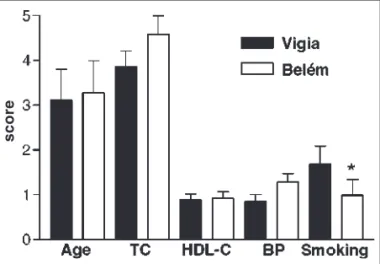
All variables composing the Framingham score (NCEP III) were analyzed and their distribution is shown in figure 2, but only the smoking habit differentiated the 2 populations. The greatest score belonged to the population of Vigia as compared with that of the City of Belém (tab. II and fig. 3).
Discussion
Our study found that the 2 populations, the riverside (Vigia) and the urban (Belém), had low cardiovascular risk for coronary events. However, important differences were observed in the lipid and anthropometric parameters, which were more favorable to the population from Vigia. On the other hand, excessive smoking was observed in this same population.
Table I - Major characteristics of the populations in Vigia and Belém
Parameters Vigia Belém P
Age (years) 48 ± 1 49 ± 1 0.71
Sex 0.54
Male (%) 23 (46) 20 (40)
Female (%) 27 (54) 30 (60)
Systolic blood pressure (mmHg) 124 ± 3 128 ± 3 0.34 Diastolic blood pressure (mmHg) 80 ± 2 82 ± 2 0.27
Smoking (%) 15 (30)* 10 (20) 0.04
* Greatest smoking score (NCEP III), chi-square test. The diabetic patients in both populations were excluded. Age and blood pressure expressed as mean±SEM.
Table II - Nutritional parameters obtained for the populations of Vigia and Belém
Parameters Vigia Belém P
Saturated fat score (%)* 0.0001
> 27 0 (0) 1 (2)
25 – 27 1 (2) 1 (2)
22 – 24 1 (2) 3 (6)
18 – 21 0 (0) 17 (34)
< 18 48 (96) 28 (56)
Mono/polyunsaturated fat score (%)* 0.03
> 29 15 (30) 7 (14)
20 – 29 35 (70) 39 (78)
< 20 0 (0) 4 (8)
BMI (kg/m2) 25.4 ± 0.6 27.6 ± 0.7 0.02
Biceps skin fold (mm) 18.6 ± 1.1 27.5 ± 1.3 0.0001 Triceps skin fold (mm) 28.7 ± 1.2 37.3 ± 1.7 0.002
* Values obtained based on the score by Block et al 14,15; BMI- body mass index.
Anthropometric values expressed as mean ± SEM.
Fig. 1 - Lipid variables expressed as mean ± SEM. * Total cholesterol (TC) Vigia < total cholesterol (TC) Belém, P=0.02 (nonpaired t test); †triglycerides (TG) Vigia<triglycerides (TG) Belém, P= 0.004 (nonpaired t test).
598
Feio et al
Lipid profile and cardiovascular risk in two Amazonian populations
Arq Bras Cardiol 2003; 81: 596-9.
The better lipid profile in the riverside community seems to be associated with a healthier diet rich in mono-and polyunsaturated fat.
Lower values for body mass index and biceps and tri-ceps skin folds may also have contributed for this better lipid profile, which may have been associated with greater physical activity as compared with that of the urban popula-tion of Belém. The latter had a greater prevalence of seden-tary lifestyle and obesity, which are findings classically rela-ted to an unfavorable lipid profile 21,22.
In fact, the values of total cholesterol and triglycerides obtained in Vigia are in accordance with the findings by Ka-gawa et al 9 in Japanese on Kohama Island, where those
li-pids were also reduced compared with those of the other Japanese in the country.
The greater frequency of smoking in Vigia and of a se-dentary lifestyle in Belém may be associated with the similar levels of HDL-C found in the 2 populations. Smoking cau-ses lower activity in LCAT 23, reduces reverse cholesterol
transport, and causes a reduction in the HDL-C level. This could attenuate the HDL-C level increased by the greater physical activity of the population in Vigia 24,25.
In regard to the LDL-C level, no differences were obser-ved between the 2 populations, suggesting that this variable is less influenced by lifestyle. In fact, data from the Framin-gham Study have shown that the LDL-C level, especially for the lowest values of its distribution, does not allow differen-tiation between coronary and noncoronary populations 26.
Although lower values of blood pressure were repor-ted for communities with a high intake of fish 10, our study
showed no difference between the populations studied. The community in Vigia, especially the fishermen, spent most of their time at sea, and alcoholism was a frequent asso-ciation. Although alcoholism was not assessed in the pre-sent study, the greater alcohol consumption in the popula-tion of Vigia may have contributed to a greater elevapopula-tion in blood pressure, attenuating the possible benefit of a heal-thier diet and greater physical activity 27,28.
Based on NCEP III, and assessing the entire set of the variables in that score, both populations had the same ab-solute risk of events, which was low (< 10%). However, aiming at an additional reduction in the cardiovascular risk, the study identified the need for greater attention to smo-king and possibly to alcoholism and stress in riverside po-pulations of Amazonia.
These findings seem even more relevant when popu-lations considered at low cardiovascular risk, but exposed to inadequate habits of modern society, reached an alarming prevalence of smoking, obesity, and sedentary lifestyle 29,30.
In fact, considering the values obtained for blood pres-sure, total cholesterol, and nutritional status in populations of 3 continents (Italian urban population, African popula-tions of Tanzania and Uganda, and Amazonian population of Brazil), the African diet poor in salt and rich in fish and vegetables was associated with lower levels of blood pres-sure, total cholesterol, and body mass index compared not only with those of the Italian population, but also with those of the Brazilian population, which differed from the African diet in regard to the greater consumption of salt and meat 31. Another study in Tanzania, confirmed the
substan-tial increase in cardiovascular risk as compared with that obtained 10 years before 32.
Pavan et al 33, comparing an isolated population in
Amazonia with 2 progressively more urbanized ones (in Po-land and Italy, respectively), reported that the Brazilian po-pulation had normal values for blood pressure, which did not increase with age, the systolic pressure being < 100mmHg in 46% of the cases. In addition, all individuals had normal values of cholesterol (< 200 mg/dL), and 90% had glycemia < 80 mg/dL.
All these studies show that the transition from a rural lifestyle to an urban lifestyle causes an increase in cardio-vascular risk, suggesting that the environment plays a cru-cial role in the cardiovascular risk of populations.
Fig. 2 - Variables of cardiovascular risk used to calculate the absolute risk of events (NCEP III). TC- total cholesterol; BP- systolic or diastolic blood pressure*; greater smoking score for the population of Vigia (P<0.04, chi-square test).
score
Fig. 3 - Score and absolute risk of coronary events in 10 years according to the NCEP III.
Arq Bras Cardiol 2003; 81: 596-9.
Feio et al
Lipid profile and cardiovascular risk in two Amazonian populations
599
1. Chor D, Fonseca MJM, Andrade CR, et al. Doenças cardiovasculares, panorama de mortalidade no Brasil. In: Minayo, MC, ed. Os Muitos Brasis: Saúde e População na Década de 80. São Paulo; Rio de Janeiro: Hucitec/ABRASCO, 1995: 57-86. 2. Adam PF, Benson, V. National Center for Health Statistics. Current estimates from
the National Heart Interview Survey, United State. 1989. Vital and Health Statis-tic DHHS Publ. Washington, NO (PHS) 1989:90-1504.
3. Dawber TR, Kannel WB, Revotskie N. Some factors associated with the develop-ment of coronary heart disease. Am J Public Health 1959; 49:1349-54. 4. Executive Summary of the Third Report of the National Cholesterol Education
Pro-gram (NCEP) Expert Panel on Detection, Evaluation, and Treatment of High Blood Cholesterol in Adults (Adult Treatment Panel III). JAMA 2001;285: 2486-97. 5. Gibson RA. The effects of diets containing fish oils on disease risk factors in
hu-mans. Aust N Z J Med 1988;18:713-20.
6. Katan MB. Fish and heart disease: what is real story? Nutr Rev 1995;53:228-9. 7. Hirai A, Hanazaki T, Terano T, et al. Eicosapentaenoic acid and platelet function
in Japanese. Lancet 1980;2:1132-3.
8. Batlouni M. Ácidos Graxos Omega-3 e cardiopatia Isquêmica. Arq Bras Cardiol 1989;2:175-80.
9. Kagawa Y, Nishizawa M, Suzuki M, et al. Eicosapolyenoic acids of serum, lipids of Japanese islanders with low incidence of cardio vascular diseases. J Nutr Sci Vitaminol 1982;28: 441-53.
10. Singer P, Jarger W, Wirth M, et al. Lipid and blood pressure -lowering effect of ma-ckered diet in man. Atherosclerosis 1983;49:99-108.
11. Simons LA, Hickie JB, Balasobramanian S. On the effects of dietary n-3 fatty acids (maxepa) on plasma lipids and lipoproteins in patients with hyperlipidemia. Atherosclerosis 1985;54: 75-88.
12. Brasil. Ministério da Saúde - Programas e Projetos. Doenças Cardiovasculares: Aspectos Epidemiológicos. Brasília 1999.
13. Forti N, Fukushima J, Giannini SD. Perfil lipídico de indivíduos submetidos à cine-coronariografia em diferentes regiões do Brasil. Arq Bras Cardiol 1997; 68:333-42. 14. Block G, Hartman AM, Dresser CM, Carrol MD, Gannon J, Gardner L. A data – based aproach to diet, questionnaire design and testing. Am J Epidemiol 1986;124:453-69.
15. Block G; Dresser CM, Hartman AM, et al. Nutrient source in the American diet: quantitative data from the NHANES II Survey I Vitamins and minerals. Am J Epi-demiol 1985;122:13-26.
16. IV Diretrizes Brasileiras de Hipertensão Arterial. Sociedade Brasileira de Hiper-tensão, Sociedade Brasileira de Cardiologia, Sociedade Brasileira de Nefrologia 2002: 1-40.
17. Frisancho AR. New standards of weight and body composition by frame size and height for assessment of nutritional status of adults and the elderly. Am J CIin Nutr 1984;40:808-19.
References
18. Philipp ST, Szarfarc SC, Latterza AR. Virtual nutr (software) Departamento de Nutrição/ Faculdade de Saúde Pública/ USP. São Paulo, 1996.
19. Friedewald WT, Levy RI, Friedrickson DS. Estimation of the concentration of low density lipoprotein cholesterol in plasma without use of the preparative ultracentrifuge. Clin Chem 1972;18:499-502.
20. D’Agostino RB Sr, Grundy S, Sullivan LM, Wilson P. CHD Risk Prediction Group. Validation of the Framingham coronary heart disease prediction scores: results of a multiple ethnic groups investigation. JAMA 2002;286:180-7. 21. Berlin JA, Colditz A. Meta-analysis of physical activity in the prevention of
co-ronary heart disease. Am J Epidemiol 1990;132:612-28.
22. Gurney JM, Jelliffe DB. Arm anthropometry in nutrional assessment: nomogram for rapid calculation os muscle circunference and cross-sectional muscle and fat areas. American J Clin Nutr 1973;26: 912-5.
23. Bielicki JK, Knoff LJ, Tribble DL, Forte TM. Relative sensitivities of plas-ma:cholesterol acyltransferase, platelet-activating factor acetylhydrolase, an pa-raoxonase to in vitro gas-phase cigarette smoke exposure. Atherosclerosis 2001;155:71-8.
24. Puska P, Neittaamaki L, Tuomileto J. A Survey of local health personnel and de-cision makers concerning the North Karelia Project: a community program for control of cardiovascular diseases. Evaluation of a comprehensive community programme for control of cardiovascular diseases. 1981;10:564-76. 25. Barnard RF. Effects of lifestyle modification on serum lipids. Arch Intern Med
1991;151:1389-94.
26. Castelli W. Cholesterol and lipids in the risk of coronary artery disease – The Fra-mingham Heart Study. Can J Cardiol 1988;4 (suppl A):5-10.
27. Kojima S, Rawano Y, Abe H - Acute effects of alcohol ingestion on blood pressure and erythrocyte sodium concentration. J Hypertens 1993;11: 185-90. 28. Marmot MG. Alcohol and coronary heart disease. Int J Epidemiol 2001;30:724-9. 29. Hanson RL, Imperatore G, Bennett PH, Knowler KC. Components of the “meta-bolic syndrome” and incidence of type 2 diabetes. Diabetes 2002;51:3120-7. 30. Gohdes D, Harvell TS, Cummings S, Moore KR, Smilie JG, Helgerson SD.
Smo-king cessation and prevention: an urgent public health priority for american indians in the northern plains. Public Health Rep 2002;117:281-90. 31. Pavan L, Casiglia E, Pauletto P, et al. Blood pressure, serum cholesterol and
nutritional state in Tanzania and in the Amazon: comparison with an Italian po-pulation. J Hypertens 1997;15:1083-90.
32. Njelekela M, Negish H, Nara Y, et al. Cardiovascular risk factors in Tanzania: a re-visit. Acta Trop 2001;79:231-9.