financial crisis
Miguel Ângelo Vilela Rodrigues
Universidade do Minho / Escola de Economia e Gestão Braga — Portugal
Public Administration is forced to strike a balance between eiciency and democracy in deining its agenda and course of action. One of the characteristics of Public Administration is that all decisions must relect democratic values, in addition to being eicient. Nevertheless, administrative reform, motivated by inancial stress, tends to highlight the importance of inancial performance while overlooking the democratic and political aspects of public management. his research seeks to analyze the link and tension between eiciency and democracy in light of the latest global inancial crisis. he paper uses a quantitative approach and collects data from Portuguese local governments to test the argument of an inverse linear relationship between inancial performance and democratic procedures. Findings conirm Waldo’s argument (1948) of an inverse relationship while the evidence gathered shows that the inancial crisis increased the negative efect of democratic procedures on inancial performance.
Keywords: democracy; inancial crises; local governments.
Democracia vs. eficiência: como alcançar equilíbrio em tempo de crise financeira
A administração pública é forçada a encontrar um equilíbrio entre eiciência e democracia na deinição da sua agenda e curso de ação. Uma das características da administração pública é que todas as decisões devem reletir valores democráticos, para além de serem eicientes. No entanto, a reforma administrativa, motivada por diiculdades inanceiras, tende a destacar a importância do desempenho inanceiro, em detrimento dos aspetos democráticos nas políticas de gestão pública. Esta pesquisa visa analisar a relação e tensão entre a eiciência e a democracia à luz da mais recente crise inanceira global. O trabalho utiliza uma abordagem quantitativa e recolhe dados de governos locais portugueses para testar o argumento de uma relação linear inversa de desempenho inanceiro e procedimentos democráticos. Os resultados conirmam o argumento de uma relação inversa, deinida por Waldo (1948). Adicionalmente, os resultados também permitem concluir que a crise inanceira evidenciou o efeito ne-gativo dos procedimentos democráticos no desempenho inanceiro.
Palavras-chave: democracia; crise inanceira; governos locais.
Democracia vs. eficiencia: como buscar un equilibrio en tiempos de crisis financiera
La administración pública se ve obligada, en el decurso de su acción, a encontrar un equilibrio entre la eiciencia y la. Una de las características de la administración pública es que, además de ser eiciente, todas las decisiones deben relejar los valores democráticos. Sin embargo, la reforma administrativa, motivada por el estrés inanciero, tiende a poner de relieve la importancia de los resultados inancieros, pasando por alto los aspectos democráticos y políticos de la gestión pública. Esta investigación busca analizar la relación y la tensión entre la eiciencia y la democracia en el decurso de la reciente crisis inanciera global. El trabajo utiliza un enfoque cuantitativo y recoge datos de los gobiernos locales portugueses para poner a prueba el argumento de una relación lineal inversa entre el rendimiento inanciero y los procedimientos democráticos. Los hallazgos conirman el argumento de Waldo (1948) de una relación inversa, mientras que la evidencia reunida muestra que la crisis inanciera incrementó el efecto negativo de los procedimientos democráticos en el desempeño inanciero.
Palabras clave: democracia; crisis inanciera; gobiernos locales.
DOI: http://dx.doi.org/10.1590/0034-7612165400
1. INTRODUCTION
he New Public Management reform, in the wake of a deep inancial crisis, focused on the use of market mechanisms for market delivery, the fragmentation of public units, pressure on eiciency, and pressure on private-sector management styles (Hood, 1991). No attention has been paid to political issues related to enhancing the quality of democracy or securing civic engagement. One reason is that the reform agenda focused on aspects that needed to be changed. In the 1980’s, as in the recent sovereign debt crisis, political aspects of democracy were thought not to be at risk. hus, changes focused on inancial performance and the way this could be improved by governments. Moreover, reform initiatives appeared to separate political values from the decision-making process. Waldo’s argument (1948) of a trade-of between democracy and eiciency supported this alternative. he understanding is that political agenda and democratic procedures can place rigid restrictions on eicient management (Svara, 2008). Waldo (1948) believes in a negative, linear relation between eiciency and democracy, explained by the impossibility of reconciling two diferent views of public administration: the irst, drawn from a managerial perspective, relies on the primacy of an eicient government through the discretional power of bureaucrats, their expertise and the use of market so-lutions; the second, closer to political science, is based on the primacy of democracy, legitimacy, and civic engagement. Dollery (2010) and Overeem (2008) claim that this is a recurrent clash portrayed in the literature under diferent excuses. It has been called as the tension between technical knowledge and peoples’ will, discretionary power and legitimacy or a dispute between bureaucracy and civic culture, a trade-of between local voices and diversity, accountability, and political responsiveness, and a primary concern with structural eiciency. Waldo’s classic argument of a negative relation has been tested under diferent contexts yet with inconsistent results (Gasiorowski, 2000; Skelcher, 2007; Vigoda, 2002).
Recently, a number of scholars adopted an alternative approach and argued the exact opposite of Waldo’s hypothesis. Norris (2012), based on a uniied theory, stated that democratic governance can boost prosperity, welfare and peace in developing countries. At the local level, some studies found evidence that supported a non-tradeof, i.e. a positive relation, between local democracy and eiciency (Aulich, 2005; Boyne, 1992; Dollery, 2010). he main purpose of this article is to shed light on the relation between inancial performance and the quality of the democratic testing both hypotheses of positive and negative linear relation. It also seeks to determine the efects of recent managerial initiatives on the link between democracy and eiciency. his last objective was prompted by the Portuguese inancial situation, which drove the government to implement a reform agenda according to the memorandum of understanding signed with the International Monetary Fund (IMF), European Union (EU) and European Central Bank (ECB) (the troika).
he article’s contribution to the literature is the confrontation of the alternative approach with Waldo’s classic argument of the democracy-eiciency link. he paper aims to contribute to the liter-ature of two diferent ields of expertise: management and political science.
reform initiatives imposed by the assistance program only serve to intensify the negative relationship between inancial performance and the quality of democracy.
his paper is structured as follows. First, the paper introduces the literature on the classic link between democracy and eiciency. hen, the paper presents the arguments for democratic eiciency. he third section discusses the operationalization of democracy and inancial performance indexes. he fourth and ith sections describes the research context, the data and methods employed in the empirical analysis. Finally, research indings are discussed, and policy implications and conclusions are presented.
2. WALDO’S CLASSIC TRADE-OFF
Waldo’s argument can be summarized as the major drawbacks of democratic procedures in eiciency eforts in public organizations. Better quality democracy can be achieved by increasing the accuracy of representation, engaging citizens and encouraging a better it between citizens’ will and political decisions. However, following Waldo’s argument, this strategy may strive for further integration and more decentralization, proposing a new balance of power-sharing with citizens. However, there deinitively has a risk of jeopardizing the ability to make eicient decisions. In fact, democracy is considered to have at least three drawbacks for an eicient decision-making process: pork barrel strategies; rent-seeking, and political cycles. First, increasing representation could lead to a situation where citizens could fully accomplish their preferences, which may have unbearable consequences for inancial sustainability. Citizens tends to prioritize their own preferences claiming importance over others’. Each one, using a pork barrel strategy, would be driven to request more public services, increasing overall spending since they internalize part of the cost (Weingast, Shepsle, and Johnsen, 1981). Second, elected oicials are traditionally deined as rational agents seeking to implement stra-tegies that guarantee their re-election. Likewise, vote-seeking strastra-tegies promote the implementation of the political agenda based on other values apart from economic ones. As such, elected oicials may ind it hard to approve and comply with bills that impose restrictions on themselves and their electo-ral support, which might pose a threat to inancial performance (Gasiorowski, 2000). Likewise, the literature points out the classic arguments of political cycles (Nordhaus, 1975) and the median-voter (Downs, 1957), in which elected oicials have a political deinition of eiciency driven by self-interest, and manage economic variables and inancial situation in such a way as to maximize their utility.
he managerial approach dominated the agenda, eliminating a more democratic attitude, since it believed that no signiicant cuts would be possible without placing some restrictions on residents’ ability to participate in these decisions.
3. DEMOCRATIC EFFICIENCY
From a political science perspective, the alternative argument builds on the idea that decentralization, civic engagement, active citizenship and better representation of citizens are not only able to preserve the legitimacy of political action but also to enhance public service performance and eiciency. he emphasis on inancial performance approximate public to private management style, which, of course, has its advantages. However, it may seriously distance its uniqueness and the respect for democratic values that is supposed to ensure. In fact, no democracy can survive if the government lacks the ability to provide citizens with the services they need. However, no expectations of prosperity are sustainable if stripped of legitimacy (homas and Memon, 2007). Local governments are therefore expected to balance the trade-of between inancial performance and democratic values. Norris (2012) centers on the Democratic Eiciency argument, a combination of political competition, and civic participation mechanisms with full access to information that leads to transparency and accountability, which in turn promotes accurate service delivery and inancial sustainability.
his approach challenges previous arguments supporting the beneits of managerial decisions without taking into account the political agenda. Particular interests may dominate reform initiatives since popular scrutiny is unable to participate in the decision-making process. Democratic procedures increase accountability, transparency and bring legitimacy to public decisions, which is particularly important when public decisions concern restrictive measures. Giving excessive discretionary power to bureaucrats allows them to make decisions with a reduced level of responsiveness. We can end up with a perfect solution, technically speaking, but one that does not have any democratic value at all. Moreover, without any democratic controls, there is the additional risk of bureaucratic decisions being diverted and addressing interests that diverge from citizens’ wishes. Public Choice theorists dealt with the problem of controlling bureaucracy by using market mechanisms. Although the market gives back to citizens the ability to express their preferences, this involves performance accountability rather than procedure (Pierre, 2009).
them (Haus and Klausen, 2011). he legitimacy to hold a political oice becomes separated from the legitimacy of using its power. he irst is acquired through the electoral process while the second is a constant process of civic involvement.
hree signiicant positive outcomes can be obtained from the efects of democracy on eiciency. First, a democratic system promotes a mechanism of representation of citizens’ needs. In an indirect democracy, the accurate representation of constituents’ preferences is determined by the veracity of the mechanism and the structure of governance (Copus, 2003). Second, political competition forces politicians to deliver a good performance since it is a mechanism of punishment that identiies and eliminates incompetent agents. It also improves the dissemination of information through several agents by avoiding situations of asymmetric information. Lastly, democracy brings transparency and accountability to political decision-making and implementation. Accountability will make elected oicials more responsive to citizen’s demands even if using a vote-seeking perspective (Norris, 2012) while transparency gives citizens better judgment over political actions. Adam and colleagues (2011) argue that civic engagement and governmental transparency also provide better control of political opportunism by increasing budget slack in service delivery.
4. WORKING HYPOTHESES
he literature review suggests two opposing arguments. hose who seek and uphold democratic values claim that reform initiatives that impose austerity and restrictions on individuals’ well-being must have a solid basis of legitimacy. hus, we ensure transparency and facilitate public acceptan-ce. On the other hand, the opposite argument states that some measures must be decided within a smaller circle. he rationale of politics tends to shy away from unpopular, but necessary courses of action. Hence, eforts to enhance inancial performance may be limitedly elected oicials’ evaluation of their political costs. he paper seeks to test these two opposing hypotheses. One is in line with the argument of Waldo’s trade-of:
H1: here is a linear negative relation between democracy and inancial performance; increases in the level of democracy will reduce levels of inancial performance.
he hypothesis is grounded in the assumption that bringing the decision-making process closer to the political arena will increase the risks of vote-seeking and logrolling. Moreover, public disclosure of a decision prior to its implementation may elicit political opposition that will lead to negotiation costs and pork barrel strategies. he alternative hypothesis upholds an argument in line with the idea of coexistence between democracy and eiciency:
H2: here is a linear positive relation between democracy and inancial performance; increases in the level of democracy will increase levels of inancial performance.
In this case, democratic procedures increase accountability, responsiveness, and transparency. Bu-reaucrats’ decision will be closer to citizens’ wishes, which will minimize the risk of lobbying strategies.
4.1 FINANCIAL PERFORMANCE INDEX
Fernandes, 2008). Public service outputs are rarely measured in prices that relect the costs of their inputs while market fails to give prices for those services. Despite this drawback, some techniques are used to measure service eiciency without the requisition of deining relative weights for outputs and inputs. Non-parametric estimations can drive eiciency scores, based on a production function frontier, on the basis of relative distances of ineicient observation from the frontier (Afonso and Fernandes, 2008; Moore, Nolan, and Segal, 2005).
In this paper, we use inancial performance as a proxy for local government eiciency. We ack-nowledge the diference between the two concepts, but we justify their goodness of it for two main reasons. First, we found very little consensus in the literature on the measurement of eiciency. Second, and most importantly, we think that reform initiatives implemented in countries such as Portugal, Greece and Ireland focused on inancial issues, cutback policies, and austerity measures. he motto is “doing less with less”, where inancial performance is a key concept that captures the speciic objective and eforts of managerial initiatives.
Financial performance of local governments is assessed using two indicators: government capa-city and productivity. Government capacapa-city means its ability to ensure institutional roots, and public services (Kaufmann, Kraay, and Mastruzzi, 2010; Stiglitz 1989). Financial crises trigger environmental entropy, which jeopardizes this capacity. Governments become unable to comply with all the de-mands of public service and begin to rethink the scope of government, opting for a policy of cutback management and streamlining businesslike processes (Scorsone and Plerhoples, 2010). Public sector productivity captures the added-value of bureaucrats to public service and seeks to assess the degree to which the government structure its the context in which it operates.
4.2 THE QUALITY OF LOCAL GOVERNMENT DEMOCRACY INDEX
here are several ways to calculate democracy indexes: the Freedom House Index (FHI); the Efective Democracy Index (EDI); the Economist Intelligence Unit’s Index of Democracy and Political IV.
FHI (House, 2011) is widely used among academics to measure democracy. FHI is closely linked to a concept of democracy based on the electoral process and the presence of democratic institutions (Knutsen, 2010). It rates countries by civil liberties and political rights. Conversely, EDI stresses the importance of measuring substantive democracy, in other words the actual functioning of democra-tic institutions (Inglehart and Welzel, 2005). he Economist Intelligence Unit’s Index of Democracy (Economist, 2010) rates democracy by electoral process and pluralism, political participation, de-mocratic political culture and civil liberties. Political IV establishes elements of executive constraint and recruitment to determine the level of democracy.
However, these indexes were supposed to be used at the national level. Adapting them to the local level must consider the responsibilities given to this tier of government as well as its limitations and diferences. For the purpose of the paper, we built an index that relects the reality of local government. he Quality of Local Democracy Index will be calculated using two elements: electoral competition and accuracy of representation.
strategies to avoid losing the next elections. As a result, elected oicials, driven by their basic survival instincts, will provide proposals that are better suited to citizens’ interests, to obtain their vote (Downs, 1957).
In addition to the emphasis on citizens’ needs, competition may also increase transparency. A narrow win, where the diference of votes between winner and loser is minimal, can motivate both sides. In the quest for popular support, the winner will strive to present himself as trustworthy and reliable in order to guarantee his re-election and a larger win. he defeated party, encouraged by a larger number of votes, will increase its supervision of the oicial elected to make them ac-countable for their actions. Ultimately, we can compare the electoral process to a political market: citizens’ choices will determine who wins or loses. So, the more intense the disputed election, the better will be for citizens. As long as the competition intensity decreases, oicials’ accountability towards the citizens diminishes, meaning that they become more reliant on their electoral strength and legitimacy.
Together with competitiveness, pluralism plays a signiicant role in the intensity of democracy. Pluralism in governing bodies ensures the accurate representation of constituents’ preferences (Copus, 2003). Excessive focus on the average voter’s preferences may result in a tyranny of the democratic majority (Weimer and Vining, 2010). In this situation, indirect democratic mechanisms will fail to achieve their mission to represent people’s trust and sovereignty.
5. RESEARCH CONTEXT
he recent sovereign debt crisis puts local governments under stress, making their ability to comply with their responsibilities and afecting constituents’ well-being vulnerable. Municipalities were therefore under serious pressure to increase revenues and obtain inancial sustainability at any cost. Moreover, the external environment was characterized by adverse conditions, prompted by the central government’s decision to apply for the international inancial assistance mechanism. he Memorandum of Understanding with the troika envisages a set of reforms to improve inancial capacity and maximize revenues. All the reforms began in late 2010 and reached a peak in the 2012 election that drew up a new governance framework, set to be implemented by the beginning of 2013.
Reform agendas imposed by local governments can be classiied into three main categories: cen-tralization, revenue maximization, and popular representation reduction.
government. A central council is created comprising several ministers, including the minister of inance, and local government representatives. If necessary, the council has the power to overrule the law, reduce local government grants and balance the national budget. In addition to this super-visory council, the local inancial act establishes two additional forms of inancial support, to be used only in case of iscal stress: municipal inancial restructuring and municipal inancial reba-lancing. In both cases, inancial indicators trigger a mechanism whereby a containing plan must be drawn up to specify all the measures to be undertaken to ensure long-term inancial sustainability. During this period, elected oicials lose some of their freedom and autonomy regarding central government. he idea is to ensure credit from central government to municipalities under iscal stress, which, in exchange, can appoint a city manager to control the use of funds.
Revenue maximization is mostly felt in the management of public municipal corporations. Cre-ated as local entities with legal personality and administrative, inancial, and patrimonial autonomy, they are regulated by the law of public enterprises and the private commercial partnership’s code. Supported by the international trend of externalization and agenciication, the number of municipal enterprises never stopped growing. Reform initiatives changed that status. Municipalities ceased to have the power to decide whatever they wanted to maintain or eliminate these entities. As a result of high levels of indebtedness, local enterprises rapidly became a scapegoat for the poor inancial situa-tion of local governments. Nowadays, a set of inancial indicators (indebtedness, net proit, municipal inancial dependency) has been established and are applied to all municipal enterprises. Failure to comply with these measures lead to a compulsory shut down of that local government, in a process directly triggered by the minister of inance.
Lastly, reform initiatives also reduced popular representation. Every municipal jurisdiction is divided into smaller jurisdictions known as parishes. hese entities have two speciic political roles. he irst is to give citizens a voice, identify their needs and provide a solution to their problems. Moreover, parishes play a signiicant role in the governance scheme in the structure of munici-palities. Each parish is entitled to have one representative on the city council. On average, parish representatives comprise nearly half the city council. he reform adopted by the troika reduced the number of parishes. It used the argument of excessive fragmentation and its consequences on the capacity to promote eiciency, arguing that it caused excess spending. he political costs of excluding representatives were completely overlooked in the quest to improve inancial eiciency.
6. DATA AND METHODS
computes two models. he irst is used to test the linear relationship between inancial performance and democracy, while the second tests the consistency of the irst model, by adding control variables that measure the economic background of each local government. Since the last political cycle only includes one year (2013), we used OLS regression.
Our models can be represented by:
Financial Performance Index = α + β1 (Quality of Local GovernmentDemocracy Index) + μ [1]
Financial Performance Index = α+β1 (Quality of Local GovernmentDemocracy Index)+
β2 ln(Population)+ β3 ln(Income) + β4 (Density) + Size+ μ [2]
he empirical analysis was undertaken in two sequential steps. First, we computed the inancial performance index and the quality of local government democracy index. hen, we used econometric techniques to compute models for three political cycles. In each, we computed two models: [1] [2]. Models were computed for the 278 jurisdictions of mainland Portugal.
Both indexes were built using the same methodology (Morris and McAlpin, 1982). For each indicator, the paper establishes the best and worst value in such a way that all indexes became unidi-rectional and could be combined (Dholakia, 2005). Each indicator is placed on a 0 to 1 scale, with 0 representing the worst observed score and 1 the best. hen, indexes are appropriately weighted. For the purpose of this paper, all indicators were equally weighted (0.5). To compute both indexes, the indicators used are structured as follows:
CHART 1 FINANCIAL PERFORMANCE AND THE QUALITY OF LOCAL GOVERNMENT DEMOCRACY INDEX
Index Variable Indicador
Financial Perfor
mance Government Capacity
Indebtedness, per capita
Proportion of own resources
Productivity
Productivity of public servants
Net benefit, per capita
Quality of Democr
ac
y Electoral
Competition
Difference of votes between the two most voted parties
Participation rate
Accuracy of Representation
Number of different political parties in city council
Number of parishes per municipal jurisdiction
6.1 FINANCIAL PERFORMANCE INDEX
he levels of inancial performance of each local government are obtained by the combination of two variables: government capacity and productivity. Government capacity is a measure of the level of municipal indebtedness and the proportion of the municipalities’ own revenue. he argument for using municipal indebtedness as a proxy for government capacity is that the troika’s reform agenda focuses on implementing measure to increase income and reduce debt at all levels of government. he level of indebtedness provides a clear indication of how well the municipality is performing and how (un)balanced it is. Financial indebtedness is estimated by the diference between inancial liabilities and assets. Governing capacity is also estimated by using the proportion of own revenues generated by each municipality. his indicator provides information about the capacity of each municipality to maximize revenues using its structure, without the need for central government funds. Both in-dicators are obtained from oicial inancial data from the National Oice of Local Administration (Direção-Geral das Autarquias Locais).
Financial Performance is also computed using municipal productivity. his paper considers two types of productivity: internal and external. Internal productivity is calculated by the ratio between the total amount of income and the number of public servants. It provides an estimation of the value added of each public servant and indicates the organisation’s goodness of it to its demand. External productivity is obtained from the ratio between net income and population. his measure makes it possible to assess the value that municipality adds to its community.
6.2 THE QUALITY OF LOCAL GOVERNMENT DEMOCRACY INDEX
he quality of local government democracy index is calculated using two indicators: electoral com-petition and accuracy of representation.
Electoral competition is evaluated by means of two factors: voting diference between the two parties with the highest number of votes, and the number of votes. he distance between winners and losers in the electoral outcome may relect the competitive pressure on the elected oicial to focus on constituents’ preferences. A narrow win will therefore encourage incumbents to be more accountable to their voters. Another indicator of electoral competition is voters’ attendance. A higher level of participation is a good indicator of an electoral dispute. Usually, competitive elections tend to attract the attention of more constituents, therefore increasing participation levels.
6.3 CONTROL VARIABLES
In the second model estimated in the paper, three control variables were used: population, population density and income. Control variables are used as a proxy of the economic context of local govern-ment, which somehow interferes the level of eiciency. Population, population density and population size are control variables that capture the efect of economies of scale that may boost municipalities’ inancial performance. Finally, per capita income is used to control the efect of citizens’ capacity to pay for public services and is one of the most important revenue-based municipal taxes.
7. EMPIRICAL FINDINGS
he results show signiicant variations in the inancial performance index during the period under review (table 1). Between the 2005-08 and 2009-12 political cycles, we ind an increase of inequalities of inancial performance and an increasing disparity between municipalities. Although the average score improved from 0.44 to 0.46, the fact is that there were fewer municipalities with a inancial performance score above 0.5, dropping from 34% in 2005-08 to 32% in 2009-12. Furthermore, the distance between municipalities increased even though it is insigniicant. Scores may relect the ef-fects of the beginning of the international sovereign debt crisis. Nevertheless, the efect was muted by the legislative election period in 2010-11. he incumbent government struggled to avoid external intervention, using public resources to deal with inancial problems at various government levels.
Signiicant changes are identiied in the comparison with the political cycle initiated in 2013. he number of municipalities with a inancial performance above 0.5 increased to 63%, meaning an increase of 100% in comparison with the 32% of 2009-12. he average score also increased and is now positive with a score of 0.53, while the disparity between the highest and lowest score decreased to 0.52.
his result allows us to argue that inancial performance improved signiicantly in 2013, which cannot be isolated to the reform agenda implemented in late 2010.
TABLE 1 FINANCIAL PERFORMANCE INDEX EVOLUTION (2005-13)
Financial Performance Index
Period Proportion of LG with score
higher then 0.5 Average Score
Difference between highest
and lowest score
2005-08 34% 0.44 0.71
2009-12 32% 0.46 0.73
2013 64% 0.53 0.52
Source: Elaborated by the author.
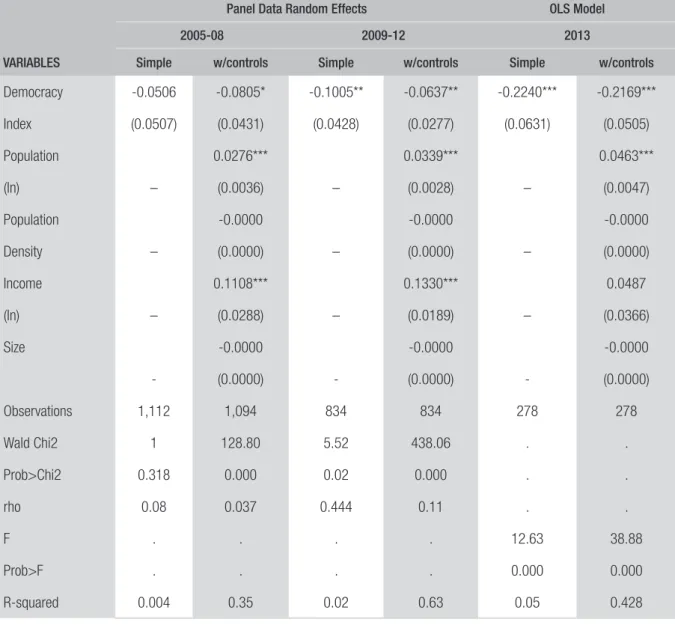
performance and mainly, that this efect has deteriorated in the recent years, in the repercussion of the implementation of the reform agenda agreed with the troika. All models displayed a negative value for the quality of local government democracy index, indicating an inverse relationship with the inancial performance index.
TABLE 2 ESTIMATION RESULTS MODELS
Panel Data Random Effects OLS Model
2005-08 2009-12 2013
VARIABLES Simple w/controls Simple w/controls Simple w/controls
Democracy -0.0506 -0.0805* -0.1005** -0.0637** -0.2240*** -0.2169***
Index (0.0507) (0.0431) (0.0428) (0.0277) (0.0631) (0.0505)
Population 0.0276*** 0.0339*** 0.0463***
(ln) – (0.0036) – (0.0028) – (0.0047)
Population -0.0000 -0.0000 -0.0000
Density – (0.0000) – (0.0000) – (0.0000)
Income 0.1108*** 0.1330*** 0.0487
(ln) – (0.0288) – (0.0189) – (0.0366)
Size -0.0000 -0.0000 -0.0000
- (0.0000) - (0.0000) - (0.0000)
Observations 1,112 1,094 834 834 278 278
Wald Chi2 1 128.80 5.52 438.06 . .
Prob>Chi2 0.318 0.000 0.02 0.000 . .
rho 0.08 0.037 0.444 0.11 . .
F . . . . 12.63 38.88
Prob>F . . . . 0.000 0.000
R-squared 0.004 0.35 0.02 0.63 0.05 0.428
Source: Elaborated by the author. Standard errors in parentheses *** p<0.01, ** p<0.05, * p<0.1
quality of local government democracy index has a score of -0.0805, representing a decrease in the inancial performance index resulting from the increase of one unit of quality of local government democracy index. he statistic rho, which measures the variation in the dependent variable due to diferences across panels, has a low value of 3,7%. As expected, population and income have a positive impact on the inancial performance index score, supporting the efect of economies of scale and citizens’ inancial capacity on a better inancial performance.
During the period from 2009 to 12, both models show statistical signiicance. In the simple and complete models, we ind evidence of a negative impact of the quality of local government democracy index on the inancial performance index. Increases of one unit in the quality of local government democracy index result in a decrease of -0.1005 and -0.0637 in the inancial perfor-mance index, respectively. Control variables efects were consistent with the previous period and are still consistent with our expectations. he statistic rho displays a value of 44% indicating the variation explained by the diferences between municipalities on the panel. Nevertheless, the score decreases in the complete model.
he last estimation concerns 2013. his is the irst year of the political cycle incorporating all the modiications in the governing institutions and structure. Again, both models were statistically signiicant. he models show a much higher impact on the quality of local government democracy index than on the inancial performance index. In both models, the negative impact of an increase in quality of local government democracy index is approximately -0.22. Compared to the other models, the negative relation clearly increases. he model estimated ater the implementation of the reform agenda displays the highest value: -0.22 for 2013, -0.0637 for 2009-12 and -0.0805 for 2005-08. Among the control variables, only population has statistical signiicance and, as expected, has a positive impact. he R2 statistic of 0.428 in the complete model suggests that, approximately, 43% of the variation of the dependent variable can be explained by the model.
8. CONCLUSION AND DISCUSSION
he sovereign debt crises have been seen worldwide in the past recent years. Several European countries were forced to apply for inancial assistance from the troika. Each country was obliged to sign a Memorandum of Understanding specifying the terms of the reform agenda to achieve inancial stability. Several reform initiatives were decided in a centralized way and imposed on countries. Despite the signiicant diferences from the Emergency Managers’ Initiatives in Mi-chigan (see Scorsone and Plerhoples, 2010; Mears, 2012; Anderson, 2011), this attitude led the EU to reconsider much of the modus operandi of the troika for dealing with democratic values and principles.
he paper tests both the arguments using the inancial performance index, as a suitable proxy for eiciency in the context of sovereign debt crises, and the quality of local government democracy index. he results allowed us to argue the existence of an inverse linear relation between inancial performance and democracy. he goal of this paper is to shed light on the relation and trade-ofs between inancial performance and democracy. Moreover, the results support the argument that this negative relation tended to increase as a result of the implementation of the reform agenda negotiated with the troika.
We also need to highlight the fact that the irst period under analysis is one of economic expan-sion: GDP grows 1,19% from 2005-08. On the contrary, the following periods are of clear economic depression. From 2009-12 GDP drops 3,99% while public debt grows from 83,6% of the GDP to 126,2%; and the year of 2013 recorded a drop in the GDP of 1,13% and the public debt reached the top value of 129% of the GDP. he trend displayed by our results are consistent with the economical cycles since the trade-of between eiciency and democracy is more evident in the second and third period when compared with the irst.
In addition, two further ideas should be highlighted. One of the traditional arguments of po-litical science is that a democracy that is unable to provide wealth and prosperity for a nation will soon be overtaken by a revolution or regime change. As Norris (2012) suggested, “People can’t eat democracy” and, sooner or later, they will recognize the huge opportunity costs of the democratic system if it reduces well-being. Despite the results presented in the paper, 12,5% of the municipalities bypassed the general trend and managed to maximize the inancial performance and democracy index. his is a case of optimization where democratic procedures promote inancial performance. hese cases require in-depth analysis to determine the factors that lead to such a situation. his would give us a glimpse of how to balance the trade-of and maximize both inancial performance and democracy.
REFERENCES
ADAM, Adam; DELIS, Manthos; KAMMAS, Pan-telis. Are democratic governments more eicient?
European Journal of Political Economy, v. 27, n. 1, p. 75-86, 2011.
AFONSO, António; FERNANDES, Sónia. Assessing and explaining the relative eiciency of local gover-nment. he Journal of Socio-Economics, v. 37, n. 5, p. 1946-1979, 2008.
ANDERSON, Janet. Rightsizing government. State and Local Government Review, v. 43, n. 3, p. 224-232, 2011.
AULICH, Chris. Australia: still a tale of Cinderela. In: DENTERS, Bas; ROSE, Lawrence (Ed.). Compar-ing local governance: trends and developments. New York: Palgrave, 2005. p. 288-310.
BEETHAM, David. Democracy and human rights. Cambridge: Polity Press, 1999.
BOYNE, George A. Local-government structure and performance — lessons from America. Public Administration, v. 70, n. 3, p. 333-357, 1992. COPE, Glen. Bureaucratic reform and issues of poli-tical responsiveness. Journal of Public Administration Research and heory, v. 7, n. 3, p. 461-471, 1997. COPUS, Colin. Re-engaging citizens and councils: he importance of the councillor to enhanced citizen involvement. Local Government Studies, v. 29, n. 2, p. 32-51, 2003.
DHOLAKIA, Archana. Measuring iscal performan-ce of states: an alternative approach. Economic and Political Weekly, v. 30 p. 3421-3428, 2005.
DOLLERY, Brian. Are there tensions between democracy and eiciency in local government? A conceptual note on the structural reform debate.
Urban Policy and Research, v. 28, n. 1, p. 117-123, 2010.
DOWNS, Anthony. An economic theory of democ-racy. New York: Harper & Row. 1957.
GASIOROWSKI, Mark. Democracy and macroeco-nomic performance in underdeveloped countries: an empirical analysis. Comparative Political Studies, v. 33, n. 3, p. 319-349, 2000.
HAUS, Michael; ERLING KLAUSEN, Jan. Urban leadership and community involvement: ingredients
for good governance? Urban Afairs Review, v. 47, n. 2, p. 256-279, 2011.
HOOD, Christopher. A public management for all seasons? Public Administration, v. 69, n. 1, p. 3-19, 1991.
HOOD, Christopher; DIXION, Ruth. A model of cost-cutting in government? he great management revolution in UK central government reconsidered.
Public Administration, v. 91, n. 1, p. 114-134, 2013. HOUSE, Freedom. Freedom in the World 2011. Rowman & Littleield Pub Incorporated, 2011. INGLEHART, Ronald; WELZEL, Christian. Mod-ernization, cultural change, and democracy. New York: Cambridge University Pres, 2005.
KAUFMANN, Daniel; KRAAY, Aart; MASTRUZZI, Massimo. he worldwide governance indicators: me-thodology and analytical issues. World Bank Policy Research Working Paper, n. 5430, 2010.
KNUTSEN, Carl. Measuring efective democracy.
International Political Science Review, v. 31, n. 2, p. 109-128, 2010.
MEARS, Patrick. Michigan’s emergency inancial manager law and its impact on creditors of munici-palities and school districts. Business Law Journal, Spring, 2012.
MOORE, Adrian; NOLAN, James; SEGAL, Geofrey. Putting out the trash: measuring municipal service eiciency in U.S. cities. Urban Afairs Review, v. 41, n. 2, p. 237-259, 2005.
MORRIS, Morris; MCALPIN, Michelle. Measuring the condition of India’s poor. New Delhi: Humanities Pr ed.,1982.
NORDHAUS, William. he political business cycle.
he Review of Economic Studies, v. 42, n. 2, p. 169-190, 1975.
NORRIS, Pippa. Making democratic governance work. New York: Cambridge University Press, 2012. OVEREEM, Patrick. Beyond heterodoxy: Dwight Waldo and the politics-administration dichotomy.
Public Administration Review, v. 68, n. 1, p. 36-45, 2008.
SCORSONE, Eric; PLERHOPLES, Christiana. Fiscal stress and cutback management amongst state and local governments. State and Local Government Review, v. 42, n. 2, p. 176-187, 2010.
SKELCHER, Chris. Does democracy matter? A transatlantic research design on democratic perfor-mance and special purpose governments. Journal of Public Administration Research and heory, v. 17, n. 1, p. 61-76, 2007.
SCHUMPETER, Joseph. Capitalism, Socialism and Democracy. London: Allen and Unwin.
STEIN, Robert. Arranging city services. Journal of Public Administration Research and heory, v. 3, n. 1, p. 66-92, 1993.
STIGLITZ, Joseph. he economic role of the State. London: Wiley-Blackwell, 1989.
SVARA, James. Beyond dichotomy: Dwight Waldo and the intertwined politics-administration rela-tionship. Public Administration Review, v. 68, n. 1, p. 46-52, 2008.
THE ECONOMIST. he Economist intelligence unit’s index of democracy 2010. Available at: <http://gra-phics.eiu.com/PDF/Democracy_Index_2010_web. pdf>. Accessed on: 26 Dec. 2012.
THOMAS, Steven; MEMON, Ali. New Zealand local government at the crossroads? Relections on the recent local government reforms. Urban Policy and Research, v. 25, n. 2, p. 171-185, 2007.
VAN RYZIN, Gregg. Outcomes, process, and trust of civil servants. Journal of Public Administration Research and heory, v. 21, n. 4, p. 745-760, 2011. VIGODA, Eran. Administrative agents of de-mocracy? A structural equation modeling of the relationship between public-sector performance and citizenship involvement. Journal of Public Administration Research and heory, v. 12, n. 2, p. 241-272, 2002.
WALDO, Dwight; MILLER, Hugh. he adminis-trative state. London: Transaction Publishers,1948. WEIMER, David; VINING, Aidan. Policy analysis. New Jersey: Longman Pub Group. 2010.
WEINGAST, Barry; SHEPSLE, Kenneth; JOHNSEN, Christopher. he political economy of beneits and costs: a neoclassical approach to distributive poli-tics. he Journal of Political Economy, v. 89, n. 4, p. 642-664, 1981.
Miguel Ângelo Vilela Rodrigues