Contents lists available atScienceDirect
Precambrian Research
journal homepage:www.elsevier.com/locate/precamres
Field and geochronological evidence for origin of the Contendas-Mirante
supracrustal Belt, São Francisco Craton, Brazil, as a Paleoproterozoic
foreland basin
Stefano A. Zincone
a,b,⁎, Elson P. Oliveira
aaDepartment of Geology and Natural Resources, Institute of Geosciences, University of Campinas, P.O. Box 6152, 13083-970 Campinas, Brazil bDepartment of Geology, School of Mines, Federal University of Ouro Preto, Ouro Preto, Minas Gerais, Brazil
A R T I C L E I N F O
Keywords:
Detrital zircon
Contendas-Mirante supracrustal Belt Paleoproterozoic foreland basin Paleoarchean basement dome São Francisco craton Brazil
A B S T R A C T
The low-grade Contendas-Mirante meta-volcano-sedimentary belt (CMB) was previously interpreted as an Archean greenstone belt with the uppermost formation deposited in the Paleoproterozoic. New zircon U-Pb LA-ICP-MS ages on sedimentary groups and granite sheets intrusive in the belt constrain the timing of basin de-velopment. Phyllites of the Lower Group and meta-arenites of the Upper Group yielded similar young zircon populations at ca. 2080 Ma, which are interpreted as the maximum deposition age for the entire sequence. The unique exception is the 3273–3338 Ma zircon-bearing quartzite that occurs in spatial association with the 3300 Ma rhyolite. A granite sheet intrusive into metagraywacke of the Lower Group constrains the minimum deposition age of 2045 ± 26 Ma for the CMB. Altogether four main age clusters of detrital zircon grains were recognized, namely 2075–2200 Ma, 2200–2440 Ma, 2500–2770 Ma, 3270–3380 Ma. These age intervals match the ages of igneous and metamorphic rocks in the different terranes that comprise the São Francisco craton. Maximum deposition age for both groups indicates that sedimentation occurred immediately prior the high-grade metamorphism in the adjacent Archean-Paleoproterozoic Jequié Block and Itabuna-Salvador-Curaçá Orogen. These observations, along with coarsening upwards in the sediments, indicate that the CMB represents a foreland basin developed along the eastern margin of the Gavião Block during plate convergence. Paleoarchean basement rocks were reactivated and emplaced into the CMB during basin inversion and is timely correlated with the granitic intrusion. Recognition of older supracrustal fragments is ambiguous, one main example is the 3273–3338 Ma zircon-bearing quartzite, which correlates with the northern Jacobina basin along the Contendas-Mirante lineament (e.g., Bahia gold belt) and may represent part of an Archean intracontinental rift sequence.
1. Introduction
The original stratigraphy of Precambrian basins is in most cases erased by later deformation and metamorphism. In addition, an in-complete geological record or absence of continuous outcrop means reconstructing the sedimentary and tectonic evolution of a given basin relies heavily on geochronological and isotopic data. Determining the provenance of metasedimentary rocks using precise age dating of det-rital zircon grains and volcanic rocks conformable with sedimentary layers is a robust tool to establish the maximum age of sediment de-position and basin formation (e.g.Wang et al., 2008; Ávila et al., 2014; Guadagnin et al., 2015). In the absence of datable syn-sedimentary volcanism, the dating of igneous units that crosscut the sedimentary sequence constrains the timing of sediment deposition and basin clo-sure, defining a restricted time range for basin development (Davis,
2002; Grisolia and Oliveira, 2012; Ancelmi et al., 2015).
The São Francisco Craton (SFC) represents a paleocontinent frag-ment stabilized at the end of the Paleoproterozoic (Teixeira et al., 1996; Silva et al., 2002; Barbosa and Sabaté, 2004). Only in recent years has the evolution and tectonic significance of its sedimentary basins been disclosed, particularly after the opening of several new LA-ICP-MS la-boratories in several Brazilian universities. In the northern part of the SFC four accreted Archean blocks represent the basement of the craton: Gavião Block, Jequié Block, Serrinha Block and the Neoarchean Caraíba arc complex, which were intensely reworked during the Paleoproter-ozoic Itabuna-Salvador-Curaçá Orogen (Oliveira et al., 2004a, 2010a; Barbosa and Sabaté, 2004). Geochronological constraints indicate that regional metamorphism resulting from crustal thickening during colli-sion of the blocks took place around 2.08–2.04 Ga (Barbosa and Sabaté, 2004; Oliveira et al., 2004a, 2010a; Leite et al., 2009). In addition to
http://dx.doi.org/10.1016/j.precamres.2017.07.031
Received 18 June 2017; Accepted 19 July 2017
⁎Corresponding author at: Departamento de Geologia, Universidade Federal de Ouro Preto, Morro do Cruzeiro, Ouro Preto 35400, MG, Brazil.
E-mail address:[email protected](S.A. Zincone).
Available online 20 July 2017
0301-9268/ © 2017 Elsevier B.V. All rights reserved.
high-grade gneisses and plutonic igneous rocks, two of the above blocks also contain low-grade supracrustal sequences, such as the Archean Umburanas (e.g.Menezes Leal et al., 2015) and Mundo Novo (Peucat et al., 2002; Zincone et al., 2016) in the Gavião block, and the Paleo-proterozoic Rio Itapicuru (Kishida and Riccio, 1980; Silva et al., 2001; Oliveira et al., 2010b) and Rio Capim (Oliveira et al., 2011) in the Serrinha block. Another low-grade supracrustal sequence occurs be-tween the Gavião and Jequié blocks, called the Contendas-Mirante volcano-sedimentary belt (CMB), however, prior to this study, its age and stratigraphy was a matter of contention.
Previous U-Pb geochronological studies on the CMB belt have yielded zircon ages between 3.40 Ga and 3.35 Ga on granitic domes (Nutman and Cordani, 1993; Martin et al., 1997), 3.30 Ga on the high-silica plutonic-volcanic system (Zincone et al., 2016), and about 2.16 Ga on a conglomerate of the upper sedimentary formation (Nutman et al., 1994). However, uncertainty remains as to whether the sequence's older sedimentary units were Archean or Paleoproterozoic. In order to establish precise and accurate time constraints on the evo-lution of the CMB, this study reports new zircon U-Pb ages for meta-sedimentary and intrusive rocks of the belt, and discusses possible sources of the detrital zircon populations in light of comparable sedi-mentary sequences in the São Francisco Craton.
2. Geologic setting
The eastern border of the Gavião block (3.45–3.30 Ga) is delineated by a north-south, 600 km-long linear tectonic structure, i.e. the Contendas-Jacobina lineament (Sabaté et al., 1990). This lineament represents a major left-lateral thrust fault. Peraluminous granitic in-trusions occur along the lineament and are related to Himalayan-type continent-continent collision (Sabaté et al., 1990; Cuney et al., 1990). Different supracrustal sequences occur along this lineament, some of which are akin to greenstone belts and lacking clear tectonic sig-nificance. Two of those supracrustal sequence present evidence to be, at least in part, of Paleoproterozoic age (Nutman et al., 1994; Mougeot, 1996; Paquette et al., 2015; Zincone et al., in press), and the correlation between them is a matter of contention. The CMB is located in the southern part of the Contendas-Jacobina lineament, while the Saúde Complex occurs at the northern part (Fig. 1). The CMB represents a 190 km-long, N-trending synform pinched between the Archean Jequié and Gavião blocks. The low to medium grade granite-gneiss massifs of the Gavião Block occur south-east of the supracrustal belt, forming domes up to 80 km long within the CMB (Fig. 2). These 3.40–3.35 Ga domes and the 3.30 Ga plutonic-volcanic system form one of the oldest continental nuclei of São Francisco craton (Nutman and Cordani, 1993; Martin et al., 1997; Zincone et al., 2016). The contact between meta-sedimentary rocks of the CMB and the domes is tectonic. The ex-humation of those domes tilts the sediments of the CMB to subvertical and developed metamorphic aureole characterized by porphyroblasts of staurolite, muscovite, chlorite and magnetite (Fig. 3). The 3.30 Ga Contendas Rhyolite of Entroncamento Village was originally assigned to the Lower group of the CMB (Marinho et al., 1994a,b), instead, it belong to an inter-related plutonic–volcanic system formed in an in-tracontinental tectonic setting (Zincone et al., 2016). It is still a chal-lenge to distingue if the metasedimentary units that occur associated with the Archean rocks are part of the CMB or if it corresponds to remnants of older basins. As will be discussed here, it is suggestive that fragments of Archean (3.28–2.45 Ga) basins unconformably overlie or are tectonic imbricated with the ca. 2.1 Ga CMB.
The Jequié block corresponds to the lower crustal segment of an Archean terrane; and is composed mainly of 2.8–2.5 Ga orthopyroxene-bearing granitic gneisses (Silva et al., 2002; Barbosa et al., 2004). The tectonic contact between the Jequié block and sedimentary rocks of the CMB is marked by the N-trending vanadium-bearing Rio Jacaré gab-broic intrusion and sheared hornblende-bearing granitic gneisses, whereas the relationship between rocks of the CMB and the Gavião
block is constrained by reactivated faults that thrust the supracrustal belt over the rigid block or unconformably overlie it. Importantly, the hornblende granitic gneisses occur on both sides of the gabbroic in-trusion (Fig. 2): on the west it corresponds to augen gneisses that were thrusted over the Gavião Block and are imbricated with the CMB, while on the east its present vertical foliation and mylonitic fabric. From west to east of the CMB the metamorphic grade increases from low greens-chist to upper-greensgreens-chist/low-amphibolite facies. To the north and south, the supracrustal sequence branches out into narrow belts, in-terfingering with gneisses and migmatites of the Gavião block.
Although metamorphism, deformation and tectonic imbrications make it hard to understand the original stratigraphy and chronological relationships between formations of the CMB, we adopt the original stratigraphy ofMarinho et al. (1978), however replacing Unit with Group. As such, the CMB is divided into two groups, i.e. Lower and Upper groups. From base to top, the former is composed of the Jurema-Travessão and Santana formations, and the latter by the Mirante, Ga-vião and Areião formations (Fig. 2).
The lower Jurema-Travessão Formation is here divided into two members: the Travessão and the Jurema Leste members. The Travessão member in its type area, NW of the belt, is composed of crenulated meta-claystone, gray phyllites associated with carbonaceous layers, reworked chert and banded iron formations (Fig. 4 A and B). The banded iron formation yielded a Pb-Pb isochron at 3256 ± 51 Ma, which was interpreted as the age of sediment deposition (Marinho et al., 1994b). The Jurema Leste member is composed of meta-basalts and meta-andesites with minor interlayered schists, banded iron for-mations and meta-ultramafic rocks. The sharp contact between the rocks from the Jurema Leste formation and the allochthones augen gneisses of the Jequié Block possibly indicates that at least part of this unit does not belong to the CMB.Marinho et al. (1978)described the Santana Formation as biotite-garnet schist, intercalated with amphi-bolite, meta-basalts, meta-andesites and calc-silicate rocks (Fig. 4C and D). In spite of metamorphism and deformation some rocks still preserve igneous and sedimentary primary structures, like such as amygdales, porphyritic texture, graded bedding, and ripple marks (Marinho et al., 1978, 1994a).
3. Sampling and analytical procedures
3.1. Sampling
Samples were chosen to represent the full range of stratigraphic and metamorphic conditions as they change from east to west (Fig. 2). Samples were collected from unweathered outcrops and rocks hosting quartz and carbonate veins were avoided to ensure newly formed zircon xenocrysts did not contaminate samples. Ten samples of metasedi-mentary rocks and two samples of intrusive granites were collected for zircon LA-ICP-MS geochronology (Table 1).
3.2. Sample preparation
Samples were comminuted using a jaw crusher and disk mill at the University of Campinas. Heavy minerals were concentrated by panning in water and density separation in methylene iodide. The diamagnetic zircon grains were separated using a Frantz magnetic separator. More than 120 zircon grains per sample were handpicked under a binocular microscope; all types of grain shape and color were included. When only a few dozen zircons were separated from a sample, all were picked for further study. The grains were mounted in epoxy resin and polished to half height to expose any growth zoning. The internal structures were revealed by cathodoluminescence (CL) imaging using a LEO 430i (Zeiss Company) SEM equipped with an Oxford energy dispersive spectro-scopy system and a Gatan Chroma CL detector (Fig. 5).
3.3. Analytical technique
U–Pb age dating was done by laser ablation mass spectrometry at
the University of Campinas using a Thermo Fisher Element XR sector field ICP-MS and a Photon Machines Excite 193 nm ultra-short pulse excimer laser ablation system (Analyte Excite WH) with a HelEx 2 vo-lume cell. The typical laser settings were a spot size of 25μm, a
fre-quency of 10 Hz, and a laserfluence of approximately 4.7 J/cm2. The acquisition protocol adopted was: 30 s of gas blank acquisition followed by the ablation of the sample for 45 s in ultrapure He. All U-Pb data were reduced off-line using Iolite software (version 2.5) following the method described byPaton et al. (2010), which involves subtraction of gas blank followed by downhole fractionation correction comparing with the behavior of the 91,500 reference zircon (Wiedenbeck et al., 1995). The Peixe zircon standard (564 ± 4 Ma,Dickinson and Gehrels, 2003) was used to check the correction. Common Pb correction was accomplished using VizualAge version 2014.10 (Petrus and Kamber, 2012). The resulting concordia age of 1063 ± 2.2 Ma for 91,500 provides confidence on the data. Only ages from a single growth zone and avoiding irregular features such as cracks and inclusions were used. Grains withƒ206% higher than 1.0 were rejected. For plotting in age histograms, we used zircon grains less than 10% discordant. Concordia plots and discordant arrays were calculated using Isoplot 4.1 (Ludwig, 2009). The detrital age distribution is plotted using the kernel density estimator plot (Vermeesch, 2012). All the ages are given as207Pb/206Pb age ± 2 SD (standard deviation). The complete geochronological data set of the U-Pb analyses is in the online data repository (Tables S2 and S3). A total of 631 detrital zircon grains were analyzed for provenance, but only 414 grains were considered further.
Fig. 1.Simplified geological map of the São Francisco Craton. Paleo-Mesoarchean terranes (> 3.0 Ga): G–Gavião Block, including the Porteirinha, Itapetinga, Gavião, Mairi, Sobradinho, Remanso and Santa Bárbara complexes. Mesoarchean-Early Neoarchean terranes (3.0–2.7 Ga): S–Serrinha; St–Southern São Francisco; Gu–Guanhães; J–Jequié. Late Neoarchean (2.7–2.5 Ga) to Early Paleoproterozoic (2.3–2.0 Ga) terranes: 1–Itabuna-Salvador-Curaçá (including the ca. 2.6 Ga Caraíba arc complex); 2–Esplanada-Boquim Belt; 3–Mineiro Belt; 4–
4. Results
4.1. Lower group
4.1.1. Travessão formation
Sample TZD-6 was collected from a quartzite with layers of con-glomerate and recrystallized quartz pebbles, and rare millimeter-size
micaceous layers (Fig. 4E). The quartzite ridge crops out continuously for at least 20 km in the NeS direction, contain abundant barite
(Fig. 4F), and surround the 3.30 Ga Contendas rhyolite (Zincone et al., 2016; Marinho et al., 1994a,b). Importantly,field relations between the quartzite and the 3.30 Ga volcanic could not be established due to lack of exposures. 30 out of 38 analyzed zircon grains are less than 10% discordant (Fig. 6A). Zircon grains are broken and inequant, with
sub-N
N
A B
C D
Fig. 3.Field aspects of the metasedimentary rocks of the Contendas-Mirante supracrustal belt modified by the exhumation of Paleoarchean basement domes and intrusive granite. A) Tilted meta-graywacke of the Mirante Formation with compositional bedding, situated between the Sete Voltas and Serra dos Meiras domes. B) Tilted metarenite of the Areião Formation with cross-stratification, western border of Sete Voltas dome (correlated with sample TZD-48 of this study). C) Schist of Mirante Formation, western border of Serra dos Meiras dome. Note the distinct texture characterized by elongated porphyroblasts composed by chlorite, muscovite, quartz and magne-tite dispersed in a sericitic staurolite-bearing matrix. D) Compositional layering of biotite-schist of Santana Formation (cor-related with sample TZD-85 of this study). Note the porphyroblastic texture developed during contact metamorphism of Paleoproterozoic intrusive granite (sample TZD-86 of this study).
spherical forms and rarely preserving prismatic habit. The grains are colorless, light pink, pale yellow to dark brown, with concentric oscil-latory zoning, and some of them have pitted surfaces, suggestive of abrasion during sediment transport. The main age cluster forms a continuous array from 3338 Ma to 3234 Ma, with an intercept age of 3324 ± 6 Ma (MSWD 2.2). The maximum depositional age of the se-diment protolith is 3283 ± 13 Ma based on the youngest cluster of 5 zircon grains. The mean age of this sample matches the crystallization age of the nearby 3.30 Ga Contendas Rhyolite (Zincone et al., 2016), and contrasts markedly with all other samples investigated in the CMB. Sample TZD-10 is a gray phyllite associated with chert and carbo-naceous layers. Zircon grains are mostly small (100–200 μm), have
prismatic habit, and range from almost euhedral to sub-euhedral pink to brown fragments. 51 out of 64 analyzed zircon grains are less than 10% discordant (Fig. 6B). The main age cluster ranges from 2212 and 2095 Ma (73% of total grains). The maximum depositional age is ca. 2123 ± 25 Ma using 4 zircon grains. Two minor peaks are at 3315 and 3270 Ma (16% of total grains) and 2259–2223 Ma (10% of total grains). The oldest zircon of the sequence was found in this sample (Z66); it shows207Pb/206Pb zircon age of 3452 ± 9 Ma.
4.1.2. Santana Formation
Sample TZD-85 is an albite-biotite hornfels at the contact with the intrusive pink granite (sample TZD-86). Biotite is as abundant as pla-gioclase (ca. 20–25% each), and quartz comprises 55%. Accessory mi-nerals include muscovite, zircon and opaques. Zircon grains range from 80 to 300μm and are mostly sub-rounded to euhedral short prisms.
Grains color ranges from pink to light brown and growth zoning is well observed on CL imagery. 66 zircon grains were analyzed, of which 32 are less than 10% discordant (Fig. 6C). The grains range continuously in age from 2219 to 2091 Ma. The most concordant grains intercept the concordia at 2194 ± 28 Ma. One single grain holds the age of 2331 Ma.
Sample TZD-20 is dark gray schist that unconformably overlies gabbroic rocks 2 km west of the Rio Jacaré V-bearing basic-ultrabasic intrusion. It is not clear whether the gabbroic rock should be considered as part of the volcano-sedimentary sequence or of the Rio Jacaré gab-broic intrusion. The sample was collected from a few-meter thick schist intensely intruded by syn-deformation quartz veins (Fig. 4C). Injection of the quartz vein is related to the tectonic imbrication of hornblende augen gneisses from the Jequié Block with the metasedimentary rocks of the CMB. The schist is composed of magnetite, biotite, plagioclase, quartz, and garnet. Spinel, apatite, zoisite, and epidote occur in minor abundance. Zircon grains range from 50 to 200μm in length and are
mostly clear and colorless, but pink, yellow and brown types also occur.
Grain shape ranges from euhedral to distinctly round and from pris-matic to angular fragments, attesting the detrital nature of the sample. Some of the grains have pitted surfaces, suggestive of abrasion during sedimentary transport. This sample yielded 92 zircon grains, of which 50 grains are concordant within 10%. Four main age clusters were re-cognized (Fig. 6D). The youngest and largest cluster ranges in age from 2208 to 2090 Ma (50% of total). These grains are prismatic (2:1), colorless or brown, with inclusion and concentric oscillatory zoning. Three younger grains yielded a mean age of 2092 ± 21Ma, indicating the maximum depositional age of the protolith. Two other Paleopro-terozoic ages were identified in this sample: (i) 2233–2225 Ma and 2347–2345 Ma (8% of total). Older Neoarchean zircon grains range from 2728 Ma to 2596 Ma (40% of total). These grains are distinctly rounded or fragmented and present oscillatory zoning. One single grain holds the age of 3282 Ma.
Sample TZD-201 is from the eastern border of the 3.35 Ga Boa Vista basement dome (Nutman and Cordani, 1993). It represents part of narrow garnet mica schist belt between gneiss-migmatite of the base-ment and the ca. 2.65 Ga hornblende monzogranites of the Jequié Block (Zincone, 2016). The sample is light gray garnet mica schist (Fig. 4D). Although more than 5 kg have been collected only 35 zircon grains were obtained, of which 15 grains are concordant within 10%. Zircon grains are mostly prismatic, and range from almost euhedral to sub-euhedral fragments of brown color. Six grains corroborate the 2.0–2.1 Ga maximum deposition age of the protolith. Three zircon grains has ages between 2.35–2.65 Ga and 2.98–3.12 Ga, respectively, whereas seven other grains range between 3.28 and 3.36 Ga (Fig. 6E). In spite of the small number of grains obtained the results are in agreement with the same pattern observed in the other samples, which confirm the Paleoproterozoic time of deposition.
4.2. Upper Group
4.2.1. Mirante Formation
Sample TZD-3 is a violet to pale green chloritoid meta-siltite. A few rounded blocks of meta-chert can be observed within the meta-siltite. This sample yielded only 18 zircon grains and 14 yielded reliable U-Pb ages (Fig. 7A). Zircon grains are mostly clear, shorter than 160μm,
prismatic (2.5–2:1) to sub-rounded (3.5:2.5) and colorless to light or-ange. The dominant population consists of Paleo- to Mesoarchean zircon grains ranging from 3384 to 3306 Ma (57% of total). A minor Neoarchean zircon population ranges from 2656 to 2604 Ma (36% of total). The youngest concordant zircon grains have207Pb/206Pb ages of 2177 ± 17.
Sample TZD-4 is a meta-graywacke characterized by thin (0.5 mm)
Table 1
Summary of sample localities, rock types, zircon characteristics, and maximum depositional age of the protolith or zircon ages of intrusive rocks from the Contendas-Mirante supracrustal belt, Brazil.
ID sample Unit E. Longitude S. Latitude Rock type Size (μm) Shape Maximum age
Lower Group TZD–6 Travessão Fm. (?)
40°54′22.51″ 13°41′14.75″ Jacobina-like quartzite
> 220 broken; inequant; sub-spherical, rarely prismatic
3283 ± 13 Ma TZD–10 Travessão Fm. 40°59′13.54″ 13°43′30.15″ Gray phyllite 100–200 euhedral to sub-euhedral prism 2123 ± 25 Ma
TZD–201 Santana Fm. 40°43′27.36″ 14°24′35.92″ Grt mica schist 100–300 mostly prismatic; fragments 2128 ± 21 Ma TZD–85 Santana Fm. 40°41′21.64″ 13°34′4.72″ Ab-Bt hornfels 80–300 sub-rounded to euhedral short prism 2090 ± 17 Ma TZD–20 Santana Fm. 40°42′45.42″ 13°45′44.65″ dark gray schist 150–200 euhedral to distinctly round; prismatic 2092 ± 21 Ma Upper Group TZD–3 Mirante Fm. 40°50′12.44″ 13°38′9.16″ meta-siltite < 160 prismatic to sub-rounded 2177 ± 17 Ma TZD–4 Mirante Fm. 40°51′26.38″ 13°38′54.23″ meta-graywacke 100–250 2:1 prism 2103 ± 18 Ma TZD–5 Mirante Fm. 40°53′1.69″ 13°39′31.06″ Msc meta-arenite 100–250 2:1 prism 2090 ± 17 Ma TZD–44 Rio Gavião Fm. 40°46′29.37″ 14° 1′17.87″ meta-pelite < 350 mostly prismatic 2121 ± 15 Ma TZD–48 Areião Fm. 40°58′44.32″ 14° 1′53.69″ meta-arenite 120–400 mostly prismatic 2107 ± 15 Ma Intrusive
Granite
TZD–86 40°41′7.43″ 13°33′59.61″ pink granite 75–200 Type I: stubby, metamictic margin and unaltered core Type II: irregular and rounded shape
2045 ± 25 Ma
layers of sericite and muscovite associated with euhedral plagioclase, fractured and faceted quartz, few euhedral garnet grains (0.5 mm), biotite, and opaques. The disappearance of chloritoid and the
appearance of euhedral garnet associated with biotite indicate a me-tamorphic grade between upper greenschist and lower amphibolite facies. Zircon grains are very similar to the ones of sample TZD-5. They
TZ48_22
2122 ± 2
TZ48_24
2182 ± 11
TZ44_74
2139 ± 2
TZ4_75
2249 ± 18
64
TZ4_30
2165 ± 15
TZ4_20
2109 ± 20
TZ48_73
2210 ± 4
2221 ± 6
TZ48_28
2265 ± 8
TZ20_64
2193 ± 2
TZ44_63
2585 ± 10
TZ44_34
2584 ± 10
TZ44_84
2549 ± 10
TZ5_41
2108 ± 15
TZ5_40
2127± 21
TZ3_1
3347 ± 14
3310 ± 14
TZ3_16
3384 ± 17
TZ10-70
3305 ± 4
3309 ± 3
TZ3_7
3362 ± 17
TZ6_3
3303 ± 12
TZ6_18
3338 ± 11
TZ44_4
2378 ± 10
Fig. 5.Cathode-luminescence images of representative detrital zircon grains labeled with sample identification, grain number and207Pb/206Pb age (supplementary data Table 2). White
have a predominance of concentric oscillatory zoning, typical of pri-mary magmatic crystals (Corfu et al., 2003). These petrographic fea-tures and zircon typology suggest a volcanoclastic component to this sample or, at least, a very near source area. 65 zircon grains were
analyzed, from which 58 are less than 10% discordant (Fig. 7B). The main age cluster ranges from 2216 to 2087 Ma with an average con-cordia age at 2159 ± 16 Ma. Thefive youngest zircon grains have 207Pb/206Pb mean age of 2103 ± 18 Ma, which provides the maximum
Number of zircon
207 206
Pb/ Pb Age (Ma)
207 235
Pb/ U
2800 2200 2600 3000 3200 0.35 0.45 0.55 0.656 10 14 18 22
2400 2000 2100 2200 2300 2500 2600 2700 2800 TZD-20 Magnetite Schist
2000 2200 2400 2600 2800 3000 3200 3400 0 2 5 7 10 Santana Fm. Magnetite Schist TZD-20
n= 50
(92)
3280 2100 2160 2350 2600 2700
E)
2050 2150 2250 2350 0.13 0.14 0.152.25 2.35 2.45 2.55 2.65
TZD-85 Albite Hornfels 0 2 5 8 1 Santana Fm. Albite Hornfels TZD-85
n= 32
(66)
2170 2320 2100
D)
206 238Pb/
U
2000 2400 2800 3200 0.12 0.16 0.20 0.24 0.281.4 1.8 2.2 2.6
TZD-201 Garnet Schist
0 1 2
Santana Fm. Garnet Schist
TZD-201
n= 15 (35)
2060 3310 2200 2610 2510
C)
3300 2150 2000 2100 2200 2300 0.35 0.45 0.55 0.658 12 16 20 24
2200 2600 3000 3400 3240 3280 3320 3360 TZD-10 Grey Phyllite 0 3 7 10 14 Travessão Fm. Grey Phyllite TZD-10 n= 51 (64)
B)
0.63 0.65 0.67 0.69 0.7123.5 24.5 25.5 26.5 27.5
32603280 3300 3320 3340 33603380 3400 TZD-6 Quartzite
3307±3 Ma MSWD: 25 0 5 11 16 22 Jacobina-like(?)* Quartzite TZD-6
n= 30 (38)
Relative Probability
2000 2200 2400 2600 2800 3000 3200 3400
3300 0.73
Fig. 6.U-Pb LA-ICP-MS results for detrital zircon grains of the Lower Group from the Contendas Mirante Belt. The left column represents concordia diagram and the right column presents the Kernel density estimation plot. Distribution frequency is for less than 10% discordant grains. A)*Quartzite
age of deposition for the protolith.
Sample TZD-5 is afine to medium-grained muscovite meta-arenite with biotite, apatite, zircon and zoisite as minor mineral phase. Zircon grains are 100–250μm long, mostly prismatic (2:1), light pink to brown
with some inclusions, and have a predominance of concentric oscilla-tory zoning. 58 out of 71 zircon grains are within 10% of concordance (Fig. 7C). The majority of grains range from 2241 Ma to 2075 Ma, with concordant 207Pb/206Pb age of 2150 ± 19 Ma. The seven youngest TZD-48 Metarenite TZD-3 TZD-4 Metagreywacke TZD-5 Metarenite TZD-44 Metapelite 3280 3340 3400 2100 2200 2600 2700 2000 2100 2200 2300 2000 2100 2200 2300 0.5 0.6
6 10 14 18
2200 2400 2600 2800 3000 0.4 0.35 0.45 0.55 0.65
10 14 18 22 26
2200 2600 3000 3400 0.38 0.42 0.46 0.50 0.54
8 10 12 14
2200 2400 2600 2800 0.34 0.38 0.42 0.46 0.50
6 8 10 12
2000 2200 2400 2600 2080 2120 2160 2200 2240 0.34 0.38 0.42 0.46 0.50
6 8 10 12 14
2200 2400 2600 2700 0 1 2 3
Mirante Fm. Metasiltite
TZD-3 n= 14 (18)
0 4 8 12 16
Mirante Fm. Metagreywacke
TZD-4 n= 58 (65)
0 3 6 9 13
Mirante Fm.
Metarenite
TZD-5
n= 58
(71)
0 3 6 9 12
Rio Gavião Fm. Metapelite
TZD-44 n= 57 (104)
2000 2200 2400 2600 2800 3000 3200 3400
0 2 5 8 11
Areião Fm.
Metarenite
TZD-48
n=49
(60)
2175 3355 2645 3310 2605 21452300 2590 2840
2150 2230 2690 2125 2400 2580 2690 3010 3100 2210 2275 2500 2280 2225 2130 2770 2350 207 206
Pb/ Pb Age (Ma)
Relative Probability
Number of zircon
207 235 Pb/ U 206 238
Pb/
U
A)
B)
C)
D)
E)
2000 2200 2400 2600 2800 3000 3200 3400 Fig. 7.grains of Upper Group from the ContendasU-Pb LA-ICP-MS results for detrital zircon
grains hold mean age of 2090 ± 17 Ma, which provides the maximum depositional age for this formation.
4.2.2. Rio Gavião formation
Sample TZD-44 is an epidote meta-pelite. Zircon grains are mostly prismatic, less than 350μm long, sub-rounded, pink to dark brown, with
some inclusions and metamitic alteration. 104 zircon grains were ex-tracted from this sample, of which 57 are within 10% of concordance (Fig. 7D). The maximum depositional age is estimated at 2121 ± 15 Ma (207Pb/206Pb mean age of
five youngest zircon grains). The four main age clusters are: 3117–3012 Ma (10.5% of total), 2693–2542 Ma (45.6% of total), 2507–2378 Ma (19.3% of total) and 2278–2193 Ma (15.8% of total).
4.2.3. Areião formation
Sample TZD-48 is a meta-arenite interleaved with or transitioned to hematite-rich sandstone. Zircon grains range from 120μm to 400μm in
length, mostly light to dark brown and prismatic, but also light pink to yellow and sub-rounded. Concentric oscillatory zoning is a common feature. 49 out of 60 zircon grains are within 10% of concordance (Fig. 7E). The younger and larger cluster spreads from 2199 to 2107 Ma (73.5% of total) and the three youngest grains have concordant 207Pb/206Pb mean age at 2107 ± 15 Ma establishing the maximum
depositional age of the sediment protolith. Older Paleoproterozoic zircon grains range from 2361 Ma to 2207 Ma (25% of total) and a single grain holds the age of 2772 Ma.
4.3. Intrusive rocks
4.3.1. Granite
Sample TZD-86 is an undeformed, equigranular, pink granite with biotite and minor muscovite content. The stock is intrusive into the sedimentary rocks of Santana Formation, locally converting the latter into an albite-biotite hornfels (sample TZD-85). Zircon grains show two main morphologies. Type I is needle-shaped acicular to stubby zircon crystals containing metamitic margin and unaltered core. Type II occurs in minor amount and is characterized by irregular and rounded shape. Zircon grains form a discordant array with an upper intercept at 2045 ± 25 Ma, indicating the crystallization age (Fig. 8). Four older zircon grains provides an upper intercept of 2095 ± 25 Ma and a single zircon of 3531 ± 8 Ma were identified (Table S3). Those older zircon grains may represent inherited crystals from the country meta-sedimentary rocks and surrounding basement, respectively.
4.3.2. Granodioritic dyke
The outcrop where sample TZD-15 was collected is characterized by the association of two mica granite and enclaves of different composi-tion, resembling a roof pendant structure. We have sampled a grano-dioritic dyke that crosscuts the two mica granite. The dyke consists of centimeter-size phenocrysts of plagioclase surrounded by an equi-granular matrix composed of biotite, microcline, quartz, plagioclase and muscovite. Zircon grains may be divided into two groups on the
basis of color and inclusion content. Each type forms approximately 50% of the population. Type I is mostly colorless fragments of inclusion-free euhedral prismatic grains. Type II consists of colorless, pale yellow to orange prismatic grains with brown inclusions. The sample yielded 52 zircon grains, 30 of which are concordant within 5%. The crystal-lization age is constrained by the youngest age cluster of 1681–1807 Ma (12 zircon grains–40% of total) (Fig. 9). The calculated207Pb/206Pb mean age of 1744 ± 21 Ma is similar to upper intercept of 1747 ± 48 Ma and interpreted as the crystallization age. Older inherited grains yielded ages in four main intervals of 2072–2169 Ma, 2477–2708 Ma, and 3275–3215 Ma.
5. Discussion
5.1. Time interval of basin infill
Igneous rocks intrusive into supracrustal sequences provide the best constraint on the minimum depositional age of sediments, whereas the youngest zircon population characterizes the maximum age of sediment deposition. The U-Pb crystallization age of 2045 ± 26 Ma for the un-deformed intrusive granite constrains the minimum age of sediment deposition in the CMB. On the other hand, the youngest zircon popu-lation of the Lower Group is 2092 ± 17 Ma and of the Upper Group is 2084 ± 15 Ma. As a result, the time interval of basin infill in the CMB appears to have been very tight, i.e. from ca. 2080–2070 Ma to ca. 2040 Ma. Indeed, samples TZD-4 of the Mirante Formation (Upper Group) show petrographic features that suggest contribution from volcanic sources, such as fractured faceted quartz and euhedral zoned plagioclase. Zircon grains from that sample show concentric oscillatory zoning typical of igneous zircon and a single age population (Figs.6D and7B). The 2159 ± 16 Ma U-Pb concordia age overlap the main peak of detrital zircon grains in the CMB and is here considered the best estimate age for early basin infill. The age of ca. 2090–2080 Ma is slight older that the high-pressure metamorphism of the nearby Je-quié Block and the Itabuna-Salvador-Curaçá Orogen (ISCO). According toCawood et al. (2012)a large proportion of individual detrital zircon ages are expected to be close to the depositional age of the sediment, in assemblages related to convergent plate margins. We therefore inter-pret the tight time interval of basin infill and the sediment coarsening upwards as representative of a foreland basin developed at the eastern margin of the Gavião Block during compression associated with the ISCO and the Paleoproterozoic magmatism related to the western border of the São Francisco craton.
5.2. Possible source areas
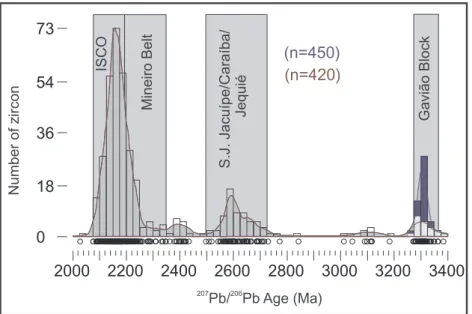
Combining the 414 detrital zircon grains analyzed in this study with 37 zircon grains fromNutman et al. (1994)within 10% of concordance the dataset yields four main age clusters: 2075–2200 Ma (48.7% of total), 2200–2440 Ma (16.7% of total), 2500–2770 Ma (13.1% of total), 3270–3380 Ma (11% of total), and a minor clusters at 3000-3200Ma (1.8% of total) (Fig. 10).
intercepts at 2045 ± 26 Ma
xenocrysts at 2095 ± 24 Ma
1000 1400
1800
2200
0.1 0.2 0.3 0.4
2 4 207 235 6
Pb/ U
206
238
Pb/
U
5.2.1. 2075–2200 Ma and 2500–2770 Ma clusters
The Rhyacian (2300–2050 Ma) was a period of widespread con-tinental crust formation and growth worldwide, and is of particular importance during basement formation of the South American Platform (seeBrito Neves, 2011for a review). On the northernmost São Fran-cisco Craton, the 2190–2070 Ma Itabuna-Salvador-Curaçá Orogen (ISCO) represents a reworked continental arc of Neoarchean (2690–2580 Ma) age (Silva et al., 2002; Oliveira et al., 2004a, b, 2010b). However, it is uncertain whether the continental arc was built onto the Serrinha or Gavião blocks in the northern ISCO segment, or onto the Jequié or Gabon Blocks in the southern ISCO segment.Peucat et al. (2011)estimated that part of the southern segment of the ISCO is composed of approximately 50% reworked Archean tonalitic crust re-lated to the Jequié Block and 50% Paleoproterozoic granitic plutons of the ISCO. The northern segment is represented by the Neoarchean (2690–2580 Ma) Caraíba arc complex (Oliveira et al., 2004a, 2010b). A long cycle of basement reworking, accretion of magmatic arcs, andfinal continental collision is suggested for the evolution of this northern segment (Teixeira and Figueiredo, 1991; Oliveira et al., 2002, 2004b, 2010b). The 2080–2040 Ma regional granulite facies to ultra-high temperature metamorphism (sapphirine-bearing, silica-undersaturated granulite) is coeval with shoshonite magmatism and may represent the time of crustal thickening during continental collision (Barbosa and Sabaté, 2004; Oliveira et al., 2004b, 2010b; Leite et al., 2009), which indicates that sediment deposition, regional metamorphic peak and igneous activity were closely related in time. The Th/U ratios of all analyzed zircon grains are greater than 0.10. Specifically, zircon grains younger than 2104 Ma (older evidence of high-grade metamorphism is at 2086 ± 18 Ma;Silva et al., 2002) show Th/U ratios high than 0.3. So far, there is no evidence of high-grade zircon (re)-crystallization on
the studied detrital zircon grains.
In summary, the detrital zircon grains of age intervals 2080–2190 Ma and 2500–2770 Ma observed in metasedimentary rocks of the CMB were most likely eroded away from the ISCO and the Archean basement involved within the orogeny. Alternative sources for these age intervals are also found in the western margin of São Francisco craton (Fuck et al., 2014; Cordeiro et al., 2014; Sousa et al., 2016) and in the Gavião Block, including the 2720–2680 Ma alkaline Caraguataí and Serra do Eixo gneisses (Cruz et al., 2011; Santos-Pinto et al., 2012) and intrusive granites of 2140–2030 Ma (Cruz et al., 2016 and references therein). However, the small number of zircon grains older than 3300 Ma, the absence of rocks crystalized between 2680 and 2550 Ma and the low abundance of > 2140 Ma Paleoproterozoic granitic rocks indicate that the Gavião Block and rocks from the western domains of the São Francisco craton are not the main favorable sources of clasts.
5.2.2. 2200–2430 Ma time interval
The 2200–2430 Ma age interval is poorly documented in the global U-Pb zircon age database of both granitoids and detrital zircon popu-lations (Condie et al., 2009), in large igneous provinces (Ernst, 2014), and in the northernmost São Francisco Craton (Grisolia and Oliveira, 2012). Recent works have demonstrated that ages between 2380 and 2200 Ma record orogenic events related to greenstone belt formation and island arc development across South America, both as large geo-graphic-geologic occurrences or preserved as relicts within Archean or Rhyacian terranes (McReath and Faraco, 2006; Vasquez et al., 2008; Klein et al., 2009; Ávila et al., 2010, 2014; Seixas et al., 2012; Fuck et al., 2014; Teixeira et al., 2015). This is in agreement with the emerging record on that time interval (Partin et al., 2014).
1700 ± 20 1747 ± 20
Granodioritic Dyke TZD - 15
n = 30 (44)
1750
2080 2690 3290
0.3 0.4 0.5 0.6 0.7
10 20
1800 2200
2600 3000
3400
5 15 25
1700 1740
1780 1820
Mean age at 1744±21 Intercept at 1747±48 2020
2060 2100
2140
207 235
Pb/ U
206
238
Pb/
U
1600 1800 2000 2200 2400 2600 2800 3000 3200 3400 4
3
2
1
0
Fig. 9.LA-ICP-MS U-Pb concordia diagram and age histogram for zircon grains from the intermediate dyke (sample TZD-15). Data boxes in the histogram are defined by 2-sigma errors.
Number of zircon
207 206
Pb/ Pb Age (Ma)
2000
2200
2400
2600
2800
3000
3200
3400
0
18
36
54
73
(n=450)
(n=420)
ISCO
Mineiro Belt
S.J. Jacuípe/Caraíba/
Jequié
Gavião Block
The 2430–2200 Ma age interval includes 16.7% of the detrital zircon grains in the CMB and the main source area can be found in the Mineiro Belt, southern São Francisco Craton and in the Natividade-Cavalcanti domain, western São Francisco craton. The 2360–2120 Ma Mineiro Belt is roughly contemporaneous with the ISCO, and records the earliest Proterozoic orogeny in the São Francisco Craton. The units dated between 2360 and 2320 Ma are found in the high-Al Lagoa Dourada TTG suite (Seixas et al., 2012) and in the orthogneisses of Resende Suite (Teixeira et al., 2015).Seixas et al. (2012)interpreted the suite as an island arc segment evolved at the root of a tholeiitic greenstone belt. In addition, the 2230–2200 Ma age interval comprises volcanic–subvolcanic rocks of the Serrinha and Tiradentes suites, which are associated with a Rhyacian oceanic arc in the Mineiro Belt (Ávila et al., 2010, 2014). In the western border of the São Francisco craton, the Natividade-Cavalcanti domain includes granite-gneisses formed at 2375 ± 6 Ma and 2346 ± 16 Ma (Fuck et al., 2014). Moreover, we include other potential source for detrital zircon within this age interval in the South America Platform. In the Borborema Province, to the north of the São Francisco craton, this age interval is recognized in six do-mains: (i) juvenile 2360 Ma TTG gneiss related to island arc setting as the basement of the Médio Coreaú domain (Santos et al., 2009); (ii) 2350 Ma tonalite-granodiorite gneiss associated with the Neoarchean Granjeiro Complex (Ancelmi, pers. comm.); (iii) ca. 2300 Ma grano-diorite gneiss of the Ceará Central Domain (Castro, pers. comm.); (iv) ca. 2300 Ma meta-andesites associated with the Rio Piranhas Massif, Rio Grande do Norte domain (Dantas et al., 2008); (v) 2250–2150 Ma high-K, calc-alkaline granitoids of the Caicó complex (Souza et al., 2007); and (vi) 2236 ± 55 Ma Sm-Nd isochron on meta-basalts of the Algodões Suite, which is interpreted as an oceanic plateau or back-arc basin suite (Martins et al., 2009). The Taquarembó block of Rio de la Plata craton has granodiorite gneiss with U-Pb (SHRIMP) zircon age of 2366 ± 8 Ma (Hartmann et al., 2008) and granulite of granodiorite composition with monazite dated at 2360–2340 Ma (Tickyj et al., 2004). The enderbitic gneisses of Luís Alves craton also has U/Pb crystallization age at ca. 2350 Ma (Basei et al., 1998). In the São Luís craton,Klein et al. (2009)report the age at 2240 ± 5 Ma for arc-re-lated calc-alkaline meta-pyroclastic rocks of Pirocaua Formation. The Bacajás domain, Amazonian Craton, is a greenstone belt developed between 2360 and 2340 Ma and intruded by granites at 2300 Ma (Vasquez et al., 2008). On the eastern part of the Amazonian craton, gabbroic rocks of the Île de Cayenne complex have ages between 2260 and 2200 Ma (Delor et al., 2003) and the greenstones of the Vila Nova group are 2267 Ma old (McReath and Faraco, 2006).
The widespread distribution of this age interval and its tectonic significance in South America deserves further investigation. Lastly, there is still a possibility that rocks of this age may remain undiscovered in the ISCO, or even in the Jequié Block.
5.2.3. Zircon grains older than 3270 Ma
The 3270–3380 Ma age cluster is chiefly related to the quartzite (sample TZD-6). This sample yielded a single age cluster and con-tributes most of the grains (∼60%) within this interval (Figs.6A and10). The closest possible source areas of this age are the felsic volcanic rocks of the Contendas Rhyolite, 1 km to the north, the coeval Mundo Novo Rhyolite and the southern gneiss-migmatite-granite massifs (Zincone et al., 2016; Martin et al., 1997; Nutman and Cordani, 1993). The Contendas Rhyolite is confined between the quartzite (sample TZD-6) and the metasediments of the CMB (Mirante Fm. - samples TZD-5, TZD-4 and TZD-3; Fig. 2), which suggests a basement inlier with fault-bounded contact. Consequently, the quart-zite may not be part of the Paleoproterozoic CMB and it can be part of an older basin. Conversely, it is not clear whether the quartzite consists of Paleoarchean detritus and unconformably overlies the rhyolite, or Paleoproterozoic detritus containing only Paleoarchean zircon grains. The great age similarity between detrital zircons from the quartzite and the Au-U detrital pyrite-bearing metaconglomerates and quartzites of
the Jacobina Basin to the north (Teles et al., 2015) raises the possibility of correlation between them (seeZincone et al., 2016for discussion). Moreover, the contrast between the sharp age peak of the quartzite TZD-6 and the other clastic sediments of the CMB reinforces the pos-sibility that the quartzite is part of an older basin formed before the GOE. The scarcity of detrital zircon grains older than 3300 Ma within Paleoproterozoic sediments suggests that basement domes and base-ment inliers within the CMB were not available for erosion during basin formation.
5.3. Exhumation of basement domes and basement inliers
Within the CMB there are three granite-gneiss domes (Sete Voltas, Boa Vista and Serra dos Meiras;Fig. 2), up to 80 km long, dated at 3403–3353 Ma (Martin et al., 1997; Nutman and Cordani, 1993). The contact between metasedimentary rocks of the CMB and the domes is tectonic, as indicated by the tilting of strata in the metasedimentary rocks of the Upper Group (these preserve primary sedimentary struc-ture as compositional bedding, ripple marks and cross bedding strati-fication), and metamorphic aureole on rocks of the Lower Group ad-jacent to the domes (Figs. 2 and 3A–C). The intrusive granite holds inherited zircons of 3571 ± 9 Ma and ca. 2100 Ma. The presence of an early Paleoarchean component in the granite indicates that the Gavião Block may have contributed as the source of the granite, and assim-ilation of the supracrustal sequence occurred during magma generation and emplacement. Hence, we interpret the Gavião Block, including the 3400–3350 Ma granite-gneiss domes and the 3300 Ma Contendas Rhyolite, as basement rocks that were reactivated and emplaced into the CMB during basin inversion. The development of Paleoproterozoic dome-and-keel structure (in the sense ofMarshak et al., 1992) resulted in the exhumation of Paleoarchean basement, and was coeval with the ca. 2050–2030 Ma magmatism intrusive into the Gavião Block (this study;Barbosa et al., 2013; Cruz et al., 2016). The generation of nu-merous syn- to post-tectonic granites along the Contendas-Jacobina lineament (Cuney et al., 1990; Sabaté et al., 1990) may have been partly assisted by the sinistral, crustal-scale mylonitic zone that sepa-rates the Paleoproterozoic CMB and its Paleoarchean basement from the Neoarchean Jequié Block.
5.4. Tectonic setting and stratigraphic correlations
The most important aspect of the detrital zircon data presented here is the Paleoproterozoic age of sediment deposition in the Contendas-Mirante basin. As discussed before, with the exception of the quartzite (sample TZD-06) the geochronological data show no significant diff er-ences between the two groups. The Lower Group has a maximum de-position at age ca. 2082 ± 12 Ma, whereas the Upper Group shows a younger age cluster at 2072 ± 12 Ma and main age peak at 2140 Ma. These data suggest they developed in a single coherent basin, which evolved from ca. 2070 to 2040 Ma, as constrained by the ages de-termined from detrital zircon grains and intrusive granite. The tight time interval of basin infill and the sediment coarsening upwards is interpreted to record a foreland basin deposited upon the eastern margin of the Gavião Block at the time of convergence of the Jequié Block and the Itabuna-Salvador-Curaçá Orogen to the east, with the Gavião Block to the west. In this geological scenario, thefine-grained sediments of the Lower Group possibly record an early stage of a foreland basin and could be interpreted as aflysch deposit, whereas the coarser-grained Upper Group may represent the molasses deposit sup-plied by the orogenic front or mountain chain as it evolves.Sinclair (1997)emphasized that a peripheral foreland basin evolves from an underfilledflysch stage to afilled or overfilled molasse stage.
(Paquette et al., 2015), and the Monteiro Sequence–Serrinha Block (Grisolia and Oliveira, 2012) yielded very similar detrital zircon age patterns. The correlation between clastic sediments of the CMB and the Saúde Complex along the ca. 600 km Contendas-Jacobina lineament suggests that a large NeS Paleoproterozoic basin developed at the
margin of the Gavião Block or, at least, multiple depocenters evolved along the same system. The detrital zircon study of the Ibitira-Ubira-çaba sequence shows the presence of another Paleoproterozoic basin along this Paleoarchean terrane (Paquette et al., 2015). The maximum deposition age at ca. 2010 Ma of the sediments from Ibitira-Ubiraçaba sequence suggests that basin development within the Gavião block was still occurring after the closure of the CMB. Other supracrustal belts within the Gavião Block–e.g., Licínio de Almeida, Brumado, Guajeru, and Riacho de Santana sequences–can also be of Paleoproterozoic age, but the absence of detrital zircon studies presently precludes the cor-relation between them. The Monteiro sequence comprises metasedi-mentary rocks of the Rio Itapicuru greenstone belt in the Serrinha Block (Grisolia and Oliveira, 2012). The time interval of sedimentation in this sequence is also very short (ca. 20 Ma). The youngest zircon population spans between 2137 and 2125 Ma and the metasedimentary rocks, in-terpreted as part of a forearc basin, were intruded by potassic plutons at 2111–2106 Ma in an arc-continent collision zone (Costa et al., 2011;
Grisolia and Oliveira, 2012).
Furthermore, in its African counterpart, the Franceville basin, a large foreland basin contains unmetamorphosed and undeformed se-dimentary rocks that rest unconformably on Archean basement rocks, showing similarities in both the successions and distribution of the se-dimentary and tectonic events with the São Francisco-Congo craton (Weber, 1969; Feybesse et al., 1998; Gauthier-Lafaye and Weber, 2003).
The 1750 Ma granodioritic dike crosscuts a two-mica granite that is intrusive into the CMB rocks and is coeval with 1.77–1.73 Ga alkaline to peralkaline potassic bimodal volcanism and A-type granites at the base of the Espinhaço Rift to the west of the CMB (Danderfer et al., 2009; Danderfer Filho et al., 2014). This magmatism occurs dis-continuously along > 600 km throughout the Chapada Diamantina, Northern Espinhaço, Central Espinhaço and Southern Espinhaço (Turpin et al., 1988; Machado et al., 1989; Pimentel et al., 1991; Silva et al., 2002; Lobato et al., 2015). Regionally, the magmatism is known as Borrachudos Suite and is interpreted as product of an anorogenic igneous event associated with the ca. 1.75 Ga Espinhaço rifting (Lobato et al., 2015 and references therein). Coeval magmatism is also the 1.76 Ga alkaline granites and volcanic rocks of the Goiás tin province in the Araí Rift (Pimentel et al., 1991). Furthermore, Ordovician age has been revealed by the U-Pb titanite age at 480 Ma from a mineralized albitite of the Lagoa Real granite suite, and has been interpreted as reworking of the uranium mineralization (Lobato et al., 2015). Those data corroborate the K-Ar and Ar-Ar ages obtained by various authors (seeLobato et al., 2015for a review) that indicate significant Cambro-Ordovician deformation along the Paramirim deformation corridor, which separates the Chapada Diamantina from the Northern Espinhaço range. However, it is still unclear what tectonic trigger has driven such young intracratonic deformation during the late stage of Gondwana amalgamation.
6. Conclusions
•
The Contendas-Mirante supracrustal belt (CMB) represents a Paleoproterozoic foreland basin developed along the eastern margin of the Gavião Block during plate convergence.•
The tectonic exhumation of Paleoarchean basement domes is cor-related with the intrusion of 2045 ± 26 Ma granite, and was par-tially assisted by the crustal-scale Contendas-Jacobina left-lateral thrust fault.•
The majority of the samples record age peaks at 3380–3270 Ma, 2770–2500 Ma, 2430–2200 Ma, and most abundant,2200–2070 Ma. The youngest detrital zircon population indicates a maximum depositional age at ca. 2080–2070 Ma for both the Lower and Upper Group. The general upwards coarsening from the Lower to the Upper Groups has no larger difference. The exception is the 3380–3270 Ma zircon-bearing quartzite that surrounds the 3300 Ma felsic volcanic, which may correlate with the northern Jacobina basin and represent part of a Paleoarchean intracontinental rift se-quence deposited at a maximum age of ca. 3270 Ma (seeZincone et al., 2016andTeles et al., 2015for discussion). The 3.30 Ga high-silica intraplate volcanic-plutonic system of the Gavião Block re-presents the initial stage of the intracontinental rifting that was followed by continental break-up (Zincone et al., 2016).
•
The most abundant age peak of the CMB detrital zircon is coeval with syn- to late tectonic (2.19–2.07 Ga) magmatic rocks of the Paleoproterozoic Itabuna-Salvador-Curaçá Orogen, that intensely reworked Neoarchean terranes (e.g. Jequié Block and Caraíba arc complex), and to many granitic intrusions that occurs at the western segment of the Gavião Block. Those terranes/complexes are the main source areas of zircon and clasts.•
A tectonic quiescence occurred between 2.03 and 1.77 Ga, after which the 1.75 Ma granodioritic dikes were intruded into S-type granites of the CMB recording the easternmost expression of an in-tracratonic extension event that culminates in the Chapada Diamantina rift.Acknowledgements
This research was partially funded by the INCT-ET project co-ordinated by Prof. R. Fuck, and the thematic project on the Archean of the São Francisco Craton and Borborema Province (FAPESP grant 12/ 15824-6). SZ thanks CAPES–Brazil for a PhD grant and EPO for a CNPq –Brazil research grant (305658/2015-8). We wish to thank the editor Randal Parrish for expert advice, Allen Nutman and an anonymous reviewer for their constructive comments. Penny Lancaster kindly re-viewed an early version of the paper. We appreciate the technical as-sistance by Felipe V. Oliveira, Bárbara A. F. Lima and Margareth Sugano during data acquisition and reduction.
Appendix A. Supplementary data
Supplementary data associated with this article can be found, in the online version, athttp://dx.doi.org/10.1016/j.precamres.2017.07.031.
References
Ancelmi, M.F., dos Santos, T.J.S., da Silva Amaral, W., Fuck, R.A., Dantas, E.L., Zincone, S.A., 2015. Provenance of metasedimentary rocks from the Ceará Central Domain of Borborema Province, NE Brazil: implications for the significance of associated ret-rograded eclogites. J. S. Am. Earth Sci. 58, 82–99.
Ávila, C.A., Teixeira, W., Cordani, U.G., Moura, C.A.V., Pereira, R.M., 2010. Rhyacian (2.23–2.20 Ga) juvenile accretion in the southern São Francisco craton, Brazil: geo-chemical and isotopic evidence from the Serrinha magmatic suite, Mineiro belt. J. S. Am. Earth Sci. 29, 464–482.
Ávila, C.A., Teixeira, W., Bongiolo, E.M., Dussin, I.A., Vieira, T.A.T., 2014. Rhyacian evolution of subvolcanic and metasedimentary rocks of the southern segment of the Mineiro belt, São Francisco craton. Brazil. Precambrian Res. 243, 221–251.
Barbosa, J.S.F., Sabaté, P., 2004. Archaean and Paleoproterozoic crust of the São Francisco Craton, Bahia, Brazil: geodynamic features. Precambrian Res. 133, 1–27.
Barbosa, J.S.F., Martin, H., Peucat, J.J., 2004. Paleoproterozoic dome forming structures related to granulite facies metamorphism. Jequie Block, Bahia, Brasil: petrogenetic approaches. Precambrian Res. 135, 105–131.
Barbosa, N., Teixeira, W., Leal, L.R.B., Menezes Leal, A.B., 2013. Evolução crustal do setor ocidental do Bloco Arqueano Gavião, Cráton do São Francisco, com base em evidências U-Pb, Sm-Nd e Rb-Sr. Geologia USP. Série Científica 13 (4), 63–88.
Basei, M.A.S., McReath, I., Siga, O., 1998. The Santa Catarina granulite complex of southern Brazil: a review. Gondwana Res. 1, 383–391.
Brito Neves, B.B., 2011. The Paleoproterozoic in the South-American continent: Diversity in the geologic time. J. S. Am. Earth Sci. 32 (4), 270–286.
Cawood, P.A., Hawkesworth, C.J., Dhuime, B., 2012. Detrital zircon record and tectonic setting. Geology 40, 875–878.
15, 228–242.
Cordeiro, P.F.O., Oliveira, C.G., Giustina, M.E.S.D., Dantas, E.L., Santos, R.V., 2014. The Paleoproterozoic Campinorte Arc: tectonic evolution of a central Brazil pre-Columbia orogen. Precambrian Res. 251, 49–61.
Corfu, F., Hanchar, J.M., Hoskin, P.W., Kinny, P., 2003. Atlas of zircon textures. Rev. Mineral. Geochem. 53, 469–500.
Costa, F.G., Oliveira, E.P., McNaughton, N.J., 2011. The Fazenda Gavião granodiorite and associated potassic plutons as evidence for Palaeoproterozoic arc-continent collision in the Rio Itapicuru greenstone belt, Brazil. J. S. Am. Earth Sci. 32, 127–141.
Cruz, S.C.P., Peaucat, J.J., Teixeira, Leo., Carneiro, M.A., Martins, A.A.M., Santana, J.S.S., Souza, J.S., Barbosa, J.S.F., Leal, A.B.M., Dantas, E., Pimentel, M., 2011. The Caraguataí syenitic suite, a ca. 2.7 Ga-old alkaline magmatism (petrology, geo-chemistry and U/Pb zircon ages). Southern Gavião block (São Francisco Craton). Brazil. J. S. Am. Earth Sci. 37, 95–112.
Cruz, S.C.P., Barbosa, J.S.F., Pinto, M.S., Peucat, J.J., Paquette, J.L., de Souza, J.S., Martins, V.S., Chemale Junior, F., Carneiro, M.A., 2016. The Siderian-Orosirian magmatism in the Gavião Paleoplate, Brazil: U-Pb geochronology, geochemistry and tectonic implications. J. S. Am. Earth Sci. 69, 43–79.
Cuney, M., Sabaté, P., Vidal, Ph., Marinho, M.M., Conceição, H., 1990. The 2 Ga per-aluminous magmatism of the Jacobina - Contendas Mirante belt (Bahia-Brazil): major- and trace-element geochemistry and metallogenic potential. J. Volcanol. Geotherm. Res. 44, 123–141.
Danderfer, A., de Waele, B., Pedreira, A.A.J., Nalini Jr., H.A., 2009. New geochronolo-gical constraints on the geologeochronolo-gical evolution of Espinhaço basin within the São Francisco craton-Brazil. Precambrian Res. 170, 116–128.
Danderfer Filho, A., Lana, C.C., Júnior, H.N., Costa, A.F.O., 2014. Constraints on the Statherian evolution of the intraplate rifting in a Paleo-Mesoproterozoic paleoconti-nent: New stratigraphic and geochronology record from the eastern São Francisco craton. Gondwana Res. 28 (2), 668–688.
Dantas, E. L., Negrão, M. M., Buhn, B. 2008. 2.3 Ga continental crust generation in the Rio Grande do Norte terrane, NE Brazil. In: VI South American Symposium on Isotope Geology, San Carlos de Bariloche, Argentina (CD-ROM, 4p), Abstracts (p. 40).
Davis, D.W., 2002. U-Pb geochronology of Archean metasedimentary rocks in the Pontiac and Abitibi subprovinces, Quebec, constraints on timing, provenance and regional tectonics. Precambrian Res. 115 (1), 97–117.
Delor, C., Egal, E., Lafon, J.M., Cocherie, A., Guerrot, C., Rossi, P., Truffert, C., Théveniaut, H., Phillips, D., Avelar, V.G., 2003. Transamazonian Crustal Growth and Reworking as Revealed by the 1:500,000-Scale Geological Map of French Guiana, second ed. v. 2-3-4 Géologie de la France pp. 5–57.
Dickinson, W., Gehrels, G., 2003. U-Pb ages of detrital zircons from Permian and Jurassic eolian sandstones of the Colorado Plateau, USA: paleogeographic implications. Sed. Geol. 163, 29–66.
Ernst, R.E., 2014. Large Igneous Provinces. Cambridge University Press.
Feybesse, J.L., Johan, V., Triboulet, C., Guerrot, C., Mayaga-Mikolo, F., Bouchot, V., N'dong, J.E., 1998. The West Central African belt: a model of 2.5–2.0 Ga accretion and two-phase orogenic evolution. Precambrian Res. 87 (3), 161–216.
Fuck, R.A., Dantas, E.L., Pimentel, M.M., Botelho, N.F., Armstrong, R., Laux, J.H., Praxedes, I.F., 2014. Paleoproterozoic crust-formation and reworking events in the Tocantins Province, central Brazil: a contribution for Atlantica supercontinent re-construction. Precambrian Res. 244, 53–74.
Gauthier-Lafaye, F., Weber, F., 2003. Natural nuclearfission reactors: time constraints for occurrence, and their relation to uranium and manganese deposits and to the evo-lution of the atmosphere. Precambrian Res. 120, 81–100.
Grisolia, M.F.P., Oliveira, E.P., 2012. Sediment provenance in the Palaeoproterozoic Rio Itapicuru greenstone belt, Brazil, indicates deposition on arc settings with a hidden 2.17–2.25 Ga substrate. J. S. Am. Earth Sci. 38, 89–109.
Guadagnin, F., Chemale, F., Magalhães, A.J., Santana, A., Dussin, I., Takehara, L., 2015. Age constraints on crystal-tufffrom the Espinhaço Supergroup—Insight into the Paleoproterozoic to Mesoproterozoic intracratonic basin cycles of the Congo-São Francisco Craton. Gondwana Res. 27 (1), 363–376.
Hartmann, L.A., Dunyi, L., Wang, L., Massone, H.J., Santos, J.O., 2008. Protolith age of Santa Maria Chico granulites dated on zircons from an associated amphibolite-facies granodiorite in southernmost Brazil. An. Acad. Bras. Cienc. 80, 543–551.
Kishida, A., Riccio, L., 1980. Chemostratigraphy of lava sequences from the Rio Itapicuru Greenstone Belt, Bahia, Brazil. Precambrian Res. 11, 161–178.
Klein, E.L., Luzardo, R., Moura, C.A., Lobato, D.C., Brito, R.S., Armstrong, R., 2009. Geochronology, Nd isotopes and reconnaissance geochemistry of volcanic and me-tavolcanic rocks of the São Luís Craton, northern Brazil: implications for tectonic setting and crustal evolution. J. S. Am. Earth Sci. 27, 129–145.
Leite, C.M.M., Barbosa, J.S.F., Goncalves, P., Nicollet, C., Sabaté, P., 2009. Petrological evolution of silica-undersaturated sapphirine-bearing granulite in the
Paleoproterozoic Salvador-Curaçá Belt, Bahia, Brazil. Gondwana Res. 15, 49–70.
Lobato, L.M., Pimentel, M.M., Cruz, S.C., Machado, N., Noce, C.M., Alkmim, F.F., 2015. U-Pb geochronology of the Lagoa Real uranium district, Brazil: Implications for the age of the uranium mineralization. J. S. Am. Earth Sci. 58, 129–140.
Ludwig, K.R. 2009. Isoplot 4.1. A geochronological toolkit for Microsoft Excel. Berkeley Geochronology Center Special Publication, 4, 76.
Machado, N., Schrank, A., Noce, C.M., Gauthier, G., 1996. Ages of detrital zircon from Archean-Paleoproterozoic sequences: implications for Greenstone Belt setting and evolution of a Transamazonian foreland basin in Quadrilátero Ferrífero, southeast Brazil. Earth Planet. Sci. Lett. 141, 259–276.
Marinho, M.M., Costa, P.H.O., Silva, E.F.A., Torquato, J.R.F., 1978. A sequência vulca-nossedimentar de Contendas-Mirante: uma estrutura do tipo greenstone belt? CBPM, Salvador p. 64.
Marinho, M.M., Sabaté, P., Barbosa, J.S.F., 1994a. The Contendas-Mirante volcano-se-dimentary belt. Boletim do Instituto de Geociências, Universidade de São Paulo
Publicação especial 17, pp. 38–72.
Marinho, M.M., Vidal, P., Alibert, C., Barbosa, J.S.F., Sabaté, P., 1994b. Geochronology of the Jequié-Itabuna granulitic belt and of the Contendas-Mirante volcano-sedimentary belt. Boletim de Instituto de Geociências, Universidade de São Paulo Publicação especial 17, pp. 73–96.
Marshak, S., Alkmim, F., Jordt-Evangelista, H., 1992. Proterozoic crustal extension and the generation of dome-and-keel structure in an Archaean granite–greenstone ter-rane. Nature 357, 491–493.
Martin, H., Peucat, J.J., Sabaté, P., Cunha, J.C., 1997. Crustal evolution in the early Archean of South America: example of the Sete Voltas Massif, Bahia State, Brazil. Precambrian Res. 82, 35–62.
Martins, G., Oliveira, E.P., Lafon, J.M., 2009. The Algodões amphibolite–tonalite gneiss sequence, Borborema Province, NE Brazil: geochemical and geochronological evi-dence for Palaeoproterozoic accretion of oceanic plateau/back-arc basalts and ada-kitic plutons. Gondwana Res. 15, 71–85.
McReath, I., Faraco, M.T.L., 2006. Paleoproterozoic greenstone-granite belts in northern Brazil and the former Guyana Shield-West African craton province. Geologia USP. Série Científica 5, 49–63.
Menezes Leal, A.B., Santos, A.L., Leal, L.R.B., Cunha, J.C., 2015. Geochemistry of con-taminated komatiites from the Umburanas greenstone belt, Bahia State, Brazil. J. S. Am. Earth Sci. 61, 1–13.
Mougeot R., 1996. Etude de la limite Archéen-Protérozoïque et des minéralisations Au, ± U associées. Exemples de la région de Jacobina (Etat de Bahia, Brésil) et de Carajas (Etat de Para, Brésil). Thèse de l’Université de Montpellier II, 306 p.
Nutman, A.P., Cordani, U.G., 1993. Shrimp U-Pb zircon geochronology of Archean granitoids from the Contendas-Mirante area of the São Francisco Craton, Bahia, Brazil. Precambrian Res. 163, 179–188.
Nutman, A.P., Cordani, U.G., Sabaté, P., 1994. SHRIMP U-Pb ages of detrital zircons from the early Proterozoic Contendas-Mirante supracrustal belt, Francisco Craton, Bahia, Brazil. J. S. Am. Earth Sci. 7, 109–114.
Oliveira, E.P., Mello, E.F., McNaughton, N., 2002. Reconnaissance U-Pb geochronology of Precambrian quartzites from the Caldeirão belt and their basement, NE São Francisco Craton, Bahia, Brazil: implications for the early evolution of the Paleoproterozoic Itabuna–Salvador–Curaçá orogen. J. S. Am. Earth Sci. 15, 349–362.
Oliveira, E.P., Windley, B.F., McNaughton, N.J., Pimentel, M., Fletcher, I.R., 2004a. Contrasting copper and chromium metallogenic evolution of terranes in the Palaeoproterozoic Itabuna-Salvador-Curacá orogen, São Francisco craton, Brazil: new zircon (SHRIMP) and Sm-Nd (model) ages and their significance for orogen-parallel escape tectonics. Precambrian Res. 128, 143–165.
Oliveira, E.P., Carvalho, M.J., McNaughton, N.J., 2004b. Evolução do Segmento Norte do Orógeno Itabuna-Salvador-Curaçá: Cronologia de acresção de arcos, colisão con-tinental e escape de terrenos. Geol. USP Ser. Cient. 4, 41–54.
Oliveira, E.P., Windley, B.F., Araújo, M.N., 2010a. The Neoproterozoic Sergipano oro-genic belt, NE Brazil: a complete plate tectonic cycle in western Gondwana. Precambrian Res. 181, 64–84.
Oliveira E.P., McNaughton N.J., Armstrong R., 2010b. Mesoarchaean to
Palaeoproterozoic growth of the northern segment of the Itabuna Salvador Curaçá orogen, São Francisco craton, Brazil. Geological Society, London, Special Publications 338, 263–286.
Oliveira, E.P., Souza, Z.S., McNaughton, N.J., Lafon, J.-M., Costa, F.G., Figueiredo, A.M., 2011. The Rio Capim volcanic-plutonic-sedimentary belt, São Francisco Craton, Brazil: geological, geochemical and isotopic evidence for oceanic arc accretion during Palaeoproterozoic continental collision. Gondwana Res. 19, 735–750.
Paquette, J.L., Barbosa, J.S.F., Rohais, S., Cruz, S.C.P., Goncalves, P., Peucat, J.J., Leal, A.B.M., Santos-Ointo, M., Martin, H., 2015. The geological roots of South America: 4.1 Ga and 3.7 Ga zircon crystals discovered in NE Brazil and NW Argentina. Precambrian Res. 271, 49–55.
Partin, C.A., Bekker, A., Sylvester, P.J., Wodicka, N., Stern, R.A., Chacko, T., Heaman, L.M., 2014. Filling in the juvenile magmatic gap: evidence for uninterrupted Paleoproterozoic plate tectonics. Earth Planet. Sci. Lett. 388, 123–133.
Paton, C., Woodhead, J.D., Hellstrom, J.C., Hergt, J.M., Greig, A., Maas, R., 2010. Improved laser ablation U-Pb zircon geochronology through robust downhole frac-tionation correction. Geochem. Geophys. Geosyst. 11 (3).
Petrus, J.A., Kamber, B.S., 2012. VizualAge: a novel approach to laser ablation ICP-MS U-Pb geochronology data reduction. Geostand. Geoanal. Res. 36 (3), 247–270.
Peucat, J.J., Mascarenhas, J.F., Barbosa, J.S., Souza, F.S., Marinho, M.M., Fanning, C.M., Leite, C.M.M., 2002. 3.3 Ga SHRIMP U-Pb zircon age of a felsic metavolcanic rock from the Mundo Novo greenstone belt in the São Francisco craton, Bahia (NE Brazil). J. S. Am. Earth Sci. 15, 363–373.
Peucat, J.J., Barbosa, J.S.F.B., Pinho, I.C.A., Jean-Louis Paquette, J.L., Martin, H., Fanning, M., Leal, A.B.M.L., Cruz, S., 2011. Geochronology of granulites from the south Itabuna-Salvador-Curaçá Block, São Francisco Craton (Brazil): Nd isotopes and U/Pb zircon ages. J. S. Am. Earth Sci. 31, 397–413.
Pimentel, M.M., Heaman, L., Fuck, R.A., Marini, O.J., 1991. U-Pb zircon geochronology of Precambrian tin-bearing continental-type acid magmatism in central Brazil. Precambrian Res. 52, 321–335.
Sabaté, P., Marinho, M.M., Vidal, P., Caen Vachette, M., 1990. The 2 Ga peraluminous magmatism of the Jacobina-Contendas Mirante belts (Bahia, Brazil): geologic and isotopic constraints on the sources. Chem. Geol. 83, 325–338.
Santos, T.J.S., Fetter, A.H., Schums, W.R.V., Hackspacher, P.C., 2009. Evidence for 2.35 to 2.30 Ga juvenile crustal growth in the northwest Borborema Province, NE Brazil. Geological Society, London, Special Publication 323, 271–281.
Seixas, L.A.R., David, J., Stevenson, R., 2012. Geochemistry, Nd isotopes and U-Pb geo-chronology of a 2350 Ma TTG suite, Minas Gerais, Brazil: implications for the crustal evolution of the southern São Francisco craton. Precambrian Res. 196, 61–80.
Silva, M.G., Coelho, C.E.S., Teixeira, J.B.G., Alves da Silva, F.C., Silva, R.A., Souza, J.A.B., 2001. The Rio Itapicuru greenstone belt, Bahia, Brazil: geologic evolution and review of gold mineralization. Miner. Deposita 36, 345–357.
Silva, L.C. da, Armstrong, R., Delgado, I.M., Pimentel, M.M., Arcanjo, J.B., Melo, R.C., Teixeira, L.R., Jost, H., Pereira, L.H.M., Cardoso Filho, J.M., 2002. Reavaliação da evolução geológica em terrenos pré-cambrianos brasileiros, com base em novos dados U-Pb SHRIMP, Parte I: Limite centro-oriental do Cráton São Francisco na Bahia. Rev. Bras. Geoc. 32 (4), 501–512.
Sinclair, H.D., 1997. Flysch to molasse transition in peripheral foreland basins: the role of the passive margin versus slab breakoff. Geology 25 (12), 1123–1126.
Sousa, I.M.C., Della Giustina, M.E.S., Oliveira, C.G., 2016. Crustal evolution of the northern Brasília Belt basement, central Brazil: a Rhyacian orogeny coeval with a pre-Rodinia supercontinent assembly. Precambr. Res. 273, 129–150.
Souza, Z.S., Martin, H., Peucat, J.J., Jardim de Sá, E.F., Macedo, M.H.F., 2007. Calcalkaline magmatism at the Archean-Proterozoic transition: the Caicó complex basement (NE Brazil). J. Petrol. 48, 2149–2185.
Teixeira, W., Figueiredo, M.C.H., 1991. An outline of Early Proterozoic crustal evolution in the São Francisco craton, Brazil: a review. Precambrian Res. 53, 1–22.
Teixeira, W., Carneiro, M.A., Noce, C.A., Machado, N., Sato, K., Taylor, P.N., 1996. Pb, Sr and Nd isotope constraints on the Archean evolution of gneissic granitoid complexes in the southern Sao Francisco Craton, Brazil. Precambrian Res. 78, 151–164.
Teixeira, W., Ávila, C.A., Dussin, I.A., Neto, A.C., Bongiolo, E.M., Santos, J.O., Barbosa, N.S., 2015. A juvenile accretion episode (2.35–2.32 Ga) in the Mineiro belt and its role to the Minas accretionary orogeny: Zircon U-Pb–Hf and geochemical evidences. Precambrian Res. 256, 148–169.
Teles, G., Chemale, F., de Oliveira, C.G., 2015. Paleoarchean record of the detrital pyrite-bearing, Jacobina Au–U deposits, Bahia, Brazil. Precambrian Res. 256, 289–313.
Tickyj, H., Hartmann, L.A., Vasconcellos, M.A.Z., Philip, R.P., Resmus, V.D., 2004.
Electron micropobe dating of monazite substantiates ages of major geological events in the southern Brazilian shield. J. S. Am. Earth Sci. 16, 699–713.
Turpin, L., Maruejol, P., Cuney, M., 1988. U-Pb, Rb-Sr and Sm-Nd chronology of granitic basement, hydrothermal albitites and uranium mineralization (Lagoa Real, South-Bahia, Brazil). Contrib. Miner. Petrol. 98, 139–147.
Vasquez, M.L., Macambira, M.J.B., Armastrong, R., 2008. Zircon geochronology of granitoids from western Bacajá domain, southeastern Amazonia Craton, Brazil: Neoarchean to Orosirian evolution. Precambrian Res. 161, 297–302.
Vermeesch, P., 2012. On the visualisation of detrital age distributions. Chem. Geol. 312, 190–194.
Wang, X.L., Zhao, G., Zhou, J.C., Liu, Y., Hu, J., 2008. Geochronology and Hf isotopes of zircon from volcanic rocks of the Shuangqiaoshan Group, South China: implications for the Neoproterozoic tectonic evolution of the eastern Jiangnan orogen. Gondwana Res. 14 (3), 355–367.
Weber, 1969. Une série précambrienne du Gabon: le Francevillien. Sédimentologie, géochimie, relations avec les gîtes minéraux associés. PhD. 28. Université Louis Pasteur and Memoire Service Cartes Géologique Alsace-Lorraine, Strasbourg, France, pp. 328.
Wiedenbeck, M., Allé, P., Corfu, F., Griffin, W.L., Meier, M., Oberli, F., von Quadt, A., Roddick, J.C., Spiegel, W., 1995. Three natural zircon standards for U-Th–Pb, Lu–Hf, trace element and REE analyses. Geostand. Newsl. 19, 1–23.
Zincone, S.A. 2016. Evolution of the Contendas-Mirante Supracrustal Sequence and Basement: Implications for Paleoarchean to Paleoproterozoic Tectonic in the Northeast São Francisco Craton (PhD Thesis). University of Campinas, Brazil.
Zincone, S.A., Oliveira, E.P., Laurent, O., Zhang, H., Zhai, M., 2016. 3.30 Ga high-silica intraplate volcanic–plutonic system of the Gavião Block, São Francisco Craton, Brazil: evidence of an intracontinental rift following the creation of insulating continental crust. Lithos 266–267, 414–434.