Article
ISSN 0102-695X doi: 10.1590/S0102-695X2011005000020 Received 21 Aug 2009 Accepted 11 Aug 2010 Available online 25 Feb 2011
Tecomella undulata
on paracetamol-induced
hepatotoxicity in rats
Krishna N. Patel,
*,1Gajendra Gupta,
2Manoj Goyal,
3B. P. Nagori
41SAL Institute of Pharmacy, Opp. Science city, India,
2Department of Pharmaceutical Chemistry, Lachoo Memorial College of
Science & Technology, India,
3Department of Pharmacology, Lachoo Memorial College of Science &
Technology, India,
4Lachoo Memorial College of Science & Technology, India.
Abstract:The aim of the present study was to validate the hepatoprotective activity of bark of Tecomella undulata (Sm.) Seem., Biognoniaceae, against paracetamol (PCM) induced hepatic damage. Chloroform soluble fraction (Fraction-I), acetone soluble fraction (Fraction-II), methanol soluble fraction (Fraction-III) and methanol insoluble fraction (Fraction-IV) of ethanolic extract of bark of T. undulata were evaluated for hepatoprotective activity against paracetamol induced hepatic damage using biochemical, morphological, functional and histopathological studies. The methanol soluble fraction (Fraction-III) was most potent among the four fractions
studied in detail. Fraction-III showed signii cant hepatoprotective activity against
paracetamol induced hepatic damage as evident by normalization of substantially elevated levels of aspartate amino transferase (AST), alanine amino transferase (ALT), alkaline phosphatase (ALP) and total bilirubin (TBil), decreased level of total protein (TP), increased wet liver weight and volume, increased thiopentone sodium induced sleeping time and abnormal histopathology. Present study showed that the Fraction-III of ethanolic extract of bark of T. undulata signii cantly restores physiological integrity
of hepatocytes. Fraction-III did not show any sign of toxicity up to oral dose of 1500 mg/kg in mice.
Keywords:
Tecomella undulata
Biognoniaceae hepatoprotective activity
Introduction
Management of liver diseases is still a challenge to the modern medicine. Modern medicines have little to offer for alleviation of hepatic ailments, whereas most important representatives are of phytoconstituents (Sallie et al., 1991). About 170 phytoconstituents isolated from 110 plants belonging to 55 families are stated to possess liver protective
activity (Handa et al., 1986). Tecomella undulata
(Sm.) Seem., Bignoniaceae, is a deciduous or nearly evergreen large ornamental tree of arid and semi arid regions (Chopra et al., 1992) and known as Rohida in Hindi (The Ayurvedic Pharmacopoeia of India, 2004). Plant has anti-bacterial (Gehlot et al., 2000; Parekh et al., 2007), analgesic (Ahmad et al., 1994), anti-AIDS (Azam, 1999), anti-oxidant (Gautam et al., 2007) and hepatoprotective activity (Khatri et al., 2009; Rana et al., 2008).
In the ethnobotanical claims, the bark is used for the treatment of jaundice and other hepatic diseases by the folk tribes of Rajasthan state, India (Punjani &
Kumar, 2003). There is no scientific report available in
support of the hepatoprotective activity of Tecomella
undulata bark on paracetamol-induced hepatotoxicity in rats.
Materials and Methods
Drugs and chemicals
Paracetamol was procured from Rajasthan Drug Pharmaceuticals Limited (RDPL), Jaipur. Silybon-140 tablets (Micro Labs) of silymarin and Thiosol vial (Neon Labs) of thiopentone sodium were purchased from the local market. Standard kits (Logotech India Pvt. Ltd, New Delhi, India) were used for determination of aspartate amino transferase (AST), alanine amino transferase (ALT), alkaline phosphatase (ALP), total bilirubin (TBil) and total protein (TP).
Plant material
Biognoniaceae, was procured from Cazri region of Jodhpur, Rajasthan, India in the month of October. The identity of the plant was confirmed at The Botanical Survey of India, Government of India, Ministry of environment & forest, Jodhpur. The voucher specimen (No. BSI/AZC/I.12012/Tech-2005/17) was deposited at the herbarium of Botanical Survey of India, Jodhpur.
Experimental animals
Albino mice 20-40 g and Wistar rats 140-160 g of either sex were used to carry out acute toxicity studies and hepatoprotective activity respectively. They were obtained from the animal house, Indian Institute of Veterinary Science, Izatnagar (U.P), India. The approval of experimental protocols of animal studies was taken from Institution Animal Ethics Committee (LMC/PHARM/OFFICE/2008-09/835/CPCSEA). The animals were grouped and housed in polyacrylic cages (38 x 23 x 10 cm) with not more than six animals per cage and maintained under standard laboratory
conditions (temperature 27±2 oC) with light and dark
cycle (12/12 h). The animals were fed with standard pellet diet (Lipton India Ltd., Mumbai, India) and fresh
water ad libitum. All the animals were acclimatized to
laboratory condition for a week before commencement of experiment.
Preparation of extract
The bark was cut into small pieces; shade dried; powdered with a mechanical grinder to obtain a coarse powder. About 125 g powdered drug was subject to defating with petroleum ether (1200 mL x 2). The defatted material (marc) was extracted with 95% ethanol (1200 mL x 4) and resulting ethanolic extract was concentrated and vacuum dried. The dried total ethanolic extract was fractionated successively with chloroform (500 mL x 2), acetone (500 mL x 2) and methanol (500 mL x 2). All the fractions; chloroform soluble fraction, acetone soluble fraction, methanol soluble fraction and methanol insoluble fraction, were concentrated and dried under vacuum and were marked as Fraction-I, Fraction-II, Fraction-III and Fraction-IV respectively and were used for evaluation of hepatoprotective activities.
Preliminary phytochemical investigation
The different fractions of ethanolic extract of Tecomella undulata bark were subjected for phytochemical study (Harbone, 1979).
Acute toxicity studies
The acute toxicity studies for different fractions
of ethanolic extract of Tecomella undulata bark were
performed as per stair case method using albino mice (Ghosh, 1984). The animals were fasted overnight prior to the experiment and maintained under standard conditions. All the fractions were administrated orally in increasing dose and found safe up to dose of 2000, 2000, 1500 and 1000 mg/kg for Fraction-I, Fraction-II, Fraction-III and Fraction-IV respectively.
Paracetamol induced hepatotoxicity
Rats were divided into seven groups (n=6). Group I (Normal control) animals received once daily 2 mL/kg orally 2% gum acacia suspension for four days and single dose of sucrose solution 2 mL/kg orally on day three. Group II (PCM control) animals received once daily 2 mL/kg orally 2% gum acacia suspension for four days and single dose of 2 mL/kg orally PCM (2 g/kg) suspension in sucrose on day three. Group III (standard) animals received once daily 2 mL/kg orally standard drug Silymarin (100 mg/kg) suspension in 2% gum acacia for four days. Test groups animals (Groups IV–VII) received once daily 2 mL/kg orally Fraction-I (200 mg/kg), Fraction-II (200 mg/kg), Fraction-III (150 mg/kg) and Fraction-IV (100 mg/kg) suspension in 2% gum acacia for four days respectively. The groups III-VII animals were administered simultaneously single dose of 2 mL/kg orally PCM (2 g/kg) suspension in 2% gum acacia on day three after 30 min. of administration of the Silymarin, Fraction-I, Fraction-II, Fraction-III and Fraction-IV respectively. On the day 5th, aqueous
solution of thiopentone sodium (37 mg/kg, i.p.) in
water for injection was injected to the animals and the sleeping time was noted. After complete recovery from thiopentone sodium effect, blood was withdrawn by puncturing the retro-orbital. Blood was collected, allowed to clot and serum was separated at 2500 rpm for 15 min and biochemical investigations were carried out. Animals were sacrificed with excess of light ether anesthesia. Liver was dissected out, rinsed with water and used for morphological and histopathological studies.
Biochemical studies
The biochemical parameters AST (Reitman et al., 1957), ALT (Reitman et al., 1957), ALP (King, 1965), TBil (Malloy et al., 1937), TP (Thapa et al., 2007) were assayed.
Morphological studies
weight was determined by using an electronic balance. The wet liver volume was determined by dropping the liver in a measuring cylinder containing a fixed volume of distilled water and the volume displaced was recorded.
Functional studies
Thiopentone sodium was used to determine the functional capacity of liver. The time interval between the loss and the regaining of the righting reflex was measured as sleeping time. Onset and duration of action of sleeping time was noted.
Histopathological studies
The dissected liver was fixed in 10% formalin, dehydrated in gradual isopropyl alcohol (60-100%), cleared in xylene, and embedded in paraffin. Sections were prepared and then stained with hematoxylin and eosin (H-E) dye for photomicroscopic observation (Luna, 1968).
Statistical analysis
The values were expressed as mean±S.E.M. The statistical analysis was carried out by one way analysis of variance (ANOVA) followed by Dunnett
test. p values <0.05 were considered significant.
Results
Phytochemical study
All the fractions of ethanolic extract of
Tecomella undulata bark showed the red to brown colouration, characteristic odour and semi-solid like consistency. The percentage yields (% w/w) of Fraction-I, Fraction-II, Fraction-III and Fraction-IV were 7.2, 6.4, 7.9 and 2.6 respectively. Phytochemical analysis of fractions showed the presence of glycosides, flavonoids, proteins, amino acids, tannins, saponins, triterpenoids and gums.
Acute toxicity studies
The effective doses of Fraction-I, Fraction-II, Fraction-III and Fraction-IV were 200, 200, 150 and 100 mg/kg respectively.
Effect of fractions on ALT, AST, ALP, TBil, TP level
The result of the effect of fractions on biochemical parameters in PCM treated rats is shown in Table I. In the PCM treated rats, the level of AST,
ALT, ALP and TBil were increased to 301.0±4.16 IU/L, 248.2±3.09 IU/L, 260.3±3.77 IU/L and 2.66±0.02 mg/ dL respectively and TP decreased to 3.56±0.19 mg/dL, whereas these values were 128.5±2.26 IU/L, 93.2±3.82 IU/L, 145.8±4.69 IU/L, 1.01±0.02 mg/dL and 7.02±0.28 mg/dL in normal control rats respectively. On administration of Silymarin, I, Fraction-II, Fraction-III and Fraction-IV in group IFraction-II, IV, V, VI and VII respectively, the level of these biochemical parameters were found retrieving towards normalcy. Fraction-III of ethanolic extract showed significant activity in comparison to the other fractions.
Effects of fractions on wet liver weight and volume
The result of the effect of fractions on morphological parameters in PCM treated rats is shown in Table I. In the PCM treated rats, wet liver weight and liver volume were increased to 4.74±0.13 /100 g and 6.28±0.36 mL/100 g respectively whereas these values were 3.91±0.13 g/100 g and 3.87±0.25 mL/100 g in normal control rats respectively. On administration of Silymarin, Fraction-I, Fraction-II, Fraction-III and Fraction-IV in group III, IV, V, VI and VII respectively, the level of these morphological parameters were found retrieving towards normalcy. Fraction-III of ethanolic extract showed significant activity in comparison to the other fractions.
Effects of fractions on thiopentone sodium induced sleeping time
The result of the effect of fractions on functional parameters in PCM treated rats is shown in Table I. In the PCM treated rats, onset of action of sleeping time was decreased to 94.8±2.18 sec. and duration of action was increased to 154.6±6.38 min., whereas these values were 164.6±6.44 sec. and 77.6±5.32 min. in normal control rats respectively. On administration of Silymarin, I, Fraction-II, Fraction-III and Fraction-IV in group IFraction-II, IV, V, VI and VII respectively, the sleeping time were found retrieving towards normalcy. Fraction-III of ethanolic extract showed significant activity in comparison to the other fractions.
Histopathological observations
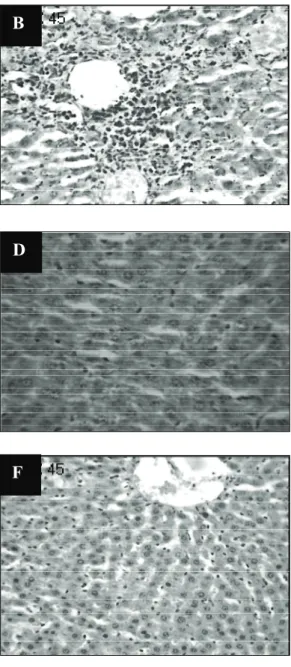
treated rats. The histological architecture of liver sections of the rats treated with fractions showed more or less normal lobular pattern with a mild degree of fatty changes, necrosis and lymphocyte infiltration (Figures 1D, E, F, G) almost comparable to the control and silymarin treated rats (Figure 1C).
E
F
G
A
B
C
D
Discussion and Conclusion
In the present study, fractions of ethanolic
extracts of Tecomella undulata bark were evaluated
for the hepatoprotective activity using hepatotoxicity induced by PCM in rats. The hepatoprotective effect
of fractions of ethanolic extract of Tecomella undulata
bark was compared with Silymarin, which is an active
constituent of the fruit of the milk thistle (Silybum
marianum, Asteraceae). Liver damage was assessed by biochemical (AST, ALT, ALP, TBil and TP level), morphological (wet liver weight and volume), functional (sleeping time) and by histopathological studies. PCM-induced hepatic injury method is commonly used for the study of hepatoprotective effects of medicinal plants extracts and drugs. The PCM is widely used analgesic-antipyretic agent and its large dose produces hepatic injury in man and experimental animals by depletion of glutathione and binding of toxic metabolite to vital proteins and enzymes. Cytochromes P450 2E1 (CYP2E1) and 3A4 (CYP3A4) convert paracetamol to a highly reactive intermediary metabolite,
N-acetyl-p-benzoquinone imine (NAPQI). Under normal
conditions, NAPQI is detoxified by conjugation with glutathione. In case of paracetamol toxicity, the sulfate and glucuronide pathways become saturated, and more paracetamol is shunted to the cytochrome P450 system to produce NAPQI. As a result, hepatocellular supplies of glutathione become exhausted and NAPQI is free to react with cellular membrane molecules, resulting in widespread hepatocytes damage and death, clinically leading to acute hepatic necrosis.
In this view, the reduction in level of AST and ALT towards the normal value by the fractions is an indication of stabilization of plasma membrane as well as repair of hepatic tissue damage caused by paracetamol. This effect is in agreement with the commonly accepted view that serum level of transaminases returns to normal
with the healing of hepatic parenchyma and regeneration of hepatocytes (Raja et al., 2007). Reduction of ALP level with concurrent depletion of raised bilirubin level suggests the stability of the biliary function during injury with PCM (Ploa & Hewit, 1989). The protein level was also raised suggesting the stabilization of endoplasmic reticulum required for protein synthesis. The results of biochemical parameters revealed the hepatoprotective activity of fractions of ethanolic extracts of bark against the toxic effect of PCM, which was also supported by morphological, functional and histological studies. The preliminary phytochemical analysis of the fractions has shown the presence of flavonoids, which has been known for their antioxidant and hepatoprotective activities (Di Carlo et al., 1999). Thus, it can be concluded that possible mechanism
of hepatoprotective activity of Tecomella undulata
bark may be due to its free radical-scavenging and antioxidant activity. Histopathological changes in the liver sections also reveal the process of regeneration and reduction the necrosis.
Thus the present study proves the
hepatoprotective action of Tecomella undulata
(Sm.) Seem., Biognoniaceae, bark extract against experimentally induced liver damage in the rats and justify its use in traditional folk medicine and hepatoprotective preparations for liver affection.
Acknowledgement
Authors are thankful to the Management, Lachoo Memorial College of Science and Technology, Pharmacy Wing, Jodhpur (Rajasthan), India for the encouragement and for providing laboratory facilities.
References
Ahmad F, Khan RA, Rasheed S 1994. Preliminary screening Table 1. Effect of fractions on biochemical, morphological and functional parameters in PCM treated rats.
Groups
Biochemical parameters Morphological parameters Functional parameters Sleeping time
AST (IU/L)
ALT (IU/L)
ALP (IU/L)
TBil (mg/dL)
TP (mg/dL)
Wet liver weight (g/100 g)
Wet liver volume (mL/100 g)
Onset of action (Sec.)
Duration of action (Min.)
Group I 128.5±2.26 93.2±3.82 145.8±4.69 1.01±0.02 7.02±0.28 3.91±0.13 3.87±0.25 164.6±6.44 77.6±5.32
Group II 301.0±4.16 248.2±3.09 260.3±3.77 2.66±0.02 3.56±0.19 4.74±0.13 6.28±0.36 94.8±2.18 154.6±6.38
Group III 143.7±2.93 105.5±3.03 151.5±3.38 0.90±0.02 6.46±0.33 3.96±0.11 3.95±0.16 159.6±2.26 97.3±1.05
Group IV 249.3±3.69a,b 199.7±4.34a,b 215.5±4.31a,b 2.25±0.05a,b 3.78±0.07b 4.79±0.19 6.25±0.33b 103.3±4.33b 139.1±4.83b
Group V 185.2±6.48a,b 158.5±4.64a,b 191.3±3.77a,b 1.61±0.03a,b 5.15±0.28a,b 4.31±0.17 5.13±0.28b 118.8±3.32a,b 116.8±5.13a,b
Group VI 140.0±3.84a 111.3±2.33a 148.2±5.24a 0.96±0.05a 6.49±0.20a 3.98±0.26 3.88±0.32a 148.0 ± 5.61a 100.3±5.90a
Group VII 154.8±4.27a 123.3±2.60a,b 161.5±4.36a 1.26±0.04a,b 5.13±0.30a,b 4.40±0.22 4.50±0.15a 129.2±5.01a,b 112.1±4.93a,b
Results are presented as mean±SEM, (n=6) One-Way ANOVA followed Dunnett test. ap<0.05 signiicantly different from PCM treated group. bp<0.05
of methanolic extracts of Celastrus paniculatus
and Tecomella undulata for analgesic and anti-inflammatory activities. J Ethnopharmacol 42: 193-198.
Azam MM 1999. Anti-HIV agents and other compounds from
Tecomella undulata. Orient J Chem 5: 375-377. Chopra RN, Nayer SL, Chopra IC, 1992. Glossary of Indian
Medicinal Plants, New Delhi: National Institute of Science Communication (CSIR), p.240.
Di Carlo G, Mascolo N, Izzo AA, Capasso F 1999. Flavonoids: old and new aspects of a class of natural therapeutic drugs. Life Sci 65: 337.
Gautam SP, Ganjiwale RO, Yeole PG 2007. Free radical scavenging properties of aqueous extract of Tecomella undulata leaves. Indian J Nat Prod 23: 33-37. Gehlot D, Bohra A 2000. Antibacterial effect of some leaf
extracts on Salmonella typhi. Indian J Med Sci 54: 102-105.
Ghosh MN, 1984. Fundamentals of experimental pharmacology. Calcutta: Scientific book agency, pp. 155-170.
Handa SS, Sharma A, Chakarborty KK 1986. Natural products and plants as liver protecting drugs. Fitoterapia 57: 307-351.
Harbone JB, 1979. Phytochemical methods, 2nd ed., London:
Chapman and Hall, pp. 70-85.
Khatri A, Garg A, Agrawal SS 2009. Evaluation of hepatoprotective activity of aerial parts of Tephrosia purpurea L. and stem bark of Tecomella undulata. J Ethnopharmacol 122: 1-5.
King J, 1965. The hydrolases-acid and alkaline phosphatases, Practical Clinical Enzymology, Van, D (ed.), London: Nostrand Company Ltd. pp: 191-197.
Luna LG, 1968. (ed) , Manual of Histologic staining methods of the Armed Forces Institute of Pathology, 3rd ed.,
New York: McGraw Hill Book Co., 1968.
Malloy HJ, Evelyn KA 1937. The determination of bilirubin with the photometric colorimeter. J Biol Chem 119: 481-490.
Parekh J, Chanda SC 2007. In vitro antimicrobial activity and phytochemical analysis of some Indian medicinal plants. Turk J Biol 31: 53-58.
Ploa GL, Hewit WR, 1989. Detector and evaluation of chemically induced injury, In: Wallace, Hayes A. (ed), Principals and methods of toxicology, 2nd ed, p.399.
Punjani BL, Kumar V 2003. Ethnomedicinal plants specially used for liver disorders in the Aravalli ranges of Gujarat, India. J Nat Rem 3: 195-198.
Raja S, Nazeer EFH, Kumar V, Mukherjee K, Bandyopadhyay A, Mukherjee PK 2007. Antioxidant effect of Cytisus scoparius against carbon tetrachloride treated liver injury in rats. J Ethnopharmacol 109: 41-47.
Rana MG, Katbamna RV, Dudhrejiya AV, Sheth NR 2008. Hepatoprotection of Tecomella undulata
against experimentally induced liver injury in rats,
Pharmacologyonline 3: 674-682.
Reitman S, Frankel S 1957. A colorimetric method for the determination of serum glutamate oxaloacetate transaminase. Am J Clin Path 28: 53-56.
Sallie R, Tredger JM 1991. Drugs and the liver. Biopharm Drug Dispos 12: 251-259.
Thapa BR, Walia A 2007. Liver function tests and their interpretation, Indian J Pediatr 74: 663-671.
The Ayurvedic Pharmacopoeia of India, Published by Govt. of India, Ministry of Health and Family Welfare, Department of Indian Systems of Medicine and Homoeopathy, New Delhi Part-I, 2004; Ist edition, vol
II, p.50.
*Correspondence
Krishna N. Patel
SAL Institute of Pharmacy, Opp. Science City, Village Bhadaj, Ahmedabad-380060 Gujarat, India