339
Rev Bras Med Esporte – Vol. 19, No 5 – Sep/Oct, 2013
ATENoLoL BETA-BLocK DoES NoT DEcREASE AERoBIc
PoWER oR ALTER VENTILAToRY THRESHoLDS IN
SEDENTARY HYPERTENSIVE SUBJEcTS
Dinoélia Rosa Souza, (Physical Education)1 Ricardo Saraceni Gomides, (Physical Education)1
luiz Augusto Riani Costa, (Doctor)1 João Ricardo Cordeiro
Fernandes, (Doctor)2 Katia Coelho Ortega, (Doctor)2 Décio Mion Jr, (Doctor)2 Taís Tinucci, (Doctor)1 Claudia lúcia de Moraes Forjaz, (Physical Education teacher)1
1. Exercise Hemodynamic laboratory, School of Physical education and Sport, University of São Paulo SP, Brazil.
2. Hypertension Unit of the Clinics Hospital of the University of São Paulo – São Paulo, SP, Brazil.
Mailing address:
Cláudia lúcia deMoraes Forjaz Av. Prof. Melo Moraes, 65, Butantã. 05508-030 – São Paulo, SP, Brasil. [email protected]
ABSTRAcT
Introduction: Aerobic exercise is recommended for the treatment of hypertension. Its intensity can be prescribed based on the percentage of maximum heart rate (% MHR) or peak oxygen con-sumption (VO2peak%) in which the ventilatory thresholds (VT) are achieved. However, some hyper-tensive patients who begin aerobic training may be receiving beta-blockers, which can influence these parameters. Objective: To investigate the effects of atenolol on VT of sedentary hypertensive patients. Methods: Nine volunteers performed two cardiopulmonary exercise tests until exhaustion after 4 weeks of treatment with atenolol (25 mg orally twice daily) and with placebo, administered in a fixed order and in a blinded manner. During the tests, heart rate (HR), blood pressure (BP), VO2 at rest, anaerobic threshold (AT), respiratory compensation point (RCP) and peak effort were analyzed. Results: VO2 increased progressively throughout the exercise and the values were similar for both treatments. Systolic blood pressure and heart rate also increased progressively during the exercise, but their absolute values were significantly lower with atenolol. However, the increase in systolic BP and HR during exercise was similar in both treatments. Thus, the % of MHR and %VO2peak at which lA and PCR were achieved were not different between placebo and atenolol. Conclusion: Atenolol, at a dosage of 50mg/day, did not affect the % of VO2peak and % of MHR corresponding to the VTs, which confirms that prescription of training intensity based on these percentages is adequate to hypertensive patients receiving beta-blockers.
Keywords: beta-adrenergic blockers, anaerobic threshold, hypertension.
Article received on 7/19/2012 and approved on 6/6/2013.
INTRoDUcTIoN
Systemic hypertension is one of the main risk factors for the cardiovascular disease, being responsible for 47% of the deaths by coronary disease and 54% of the ones by encephalic vascu-lar accident1. According to the VI Brazilian Guidelines of Arterial Hypertension, over 30% of the adult population in our country is hypertensive and this prevalence increases to over 50% in adults older than 60 years1. The aerobic training is highly recommended in the treatment of hypertension1-3 due to its proved hypotensive effects4. In order to individualize this training, the exercise intensity should be determined based on the heart rate (HR) of the anaerobic threshold (AT) and of the respiratory compensation point (RCP)5. However, due to operational difficulties (cost, equipment, among others) of the performance of cardiopulmonary tests for identifi-cation of ventilatory thresholds (VT), the guidelines say that the training of hypertensive patients should be performed between 50 and 80% of HRmax1, which would be equal to 40 and 70% of VO2peak or HR reserve 2,3,5, assuming that the range is within the VT. However, many hypertensive subjects who will initiate an aerobic training program are receiving pharmacological treatment, which may consist of different medication classes, such as beta blockers, diuretics, inhibitors angiotensin converting-enzyme
inhibitors1,6. Nevertheless, some of these medications, especially the beta blockers, may alter the physiological responses and especially the HR response during physical exercise7-9. This fact has generated some concern in the physical education field about the prescription of exercise intensity for patients who are under use of beta blockers. The basic recommendation in these cases is to perform a maximum test under use of medication and establish the training HR range based on the HRmax reached in this test1,5,10. This concept is based on the premise that the beta blocking does not alter the HRmax percentage at which the AT and RCP are reached.
The beta blockers decrease blood pressure (BP) by blunting sympathetic activation to the heart, decreasing heart rate (HR) and the cardiac output6. Old reviews on the effects of beta blockers on cardiovascular responses to exercise have already concluded that beta blockers have this same effect during exercise, decreasing HRmax and the maximum BP8,9 However, the effect on the VO
2peak is controversial8, being especially reported with the use of non-selective beta blockers and in healthy or already trained individuals8,9. Moreover, the beta blockers effect on the anaerobic metabolism during exercise is also controversial in the literature7, and effect of beta blocker on AT and RCP of sedentary hypertensive individuals is not clear, which may have implications in the prescription of the aerobic exercise intensity for hypertensive patients under use of this medication.
340 Rev Bras Med Esporte – Vol. 19, No 5 – Sep/Oct, 2013 Thus, the aim of this study was to verify the effect of atenolol
(selective β1beta blocker) on the VO2 and HR measured at rest, AT, RCP and exercise peak.
METHoDS
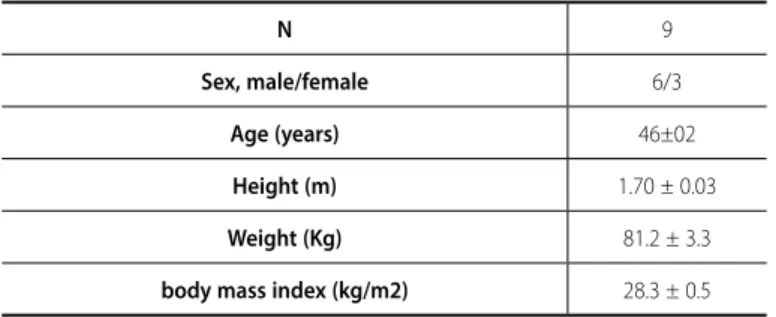
Nine primary level 1 and 2 hypertensive individuals (six men and three women – 30 to 60 years) participated in this study after having signed the that follows the Consent Form. The study was approved by the Ethics Committee from the Clinics Hospital of the Medicine School of the University of São Paulo (HCFMUSP – protocol number 096/06). The sample’s characteristics are presented in table 1.
The hypertensive patients were recruited through posters and newspaper and magazine advertisements and the ones who volunteered to participation were enrolled in the Hypertension Unit of the HCFMUSP, where they were submitted to routine examination of that unit, which follow recommendations of the VI Brazilian Guideline of Hypertension1. The volunteers who presented secondary hypertension, BP values above level 2, cardiovascular disease signs and other risk factors and/or injury of target-organs were excluded. Moreover, the patients who were involved in regular exercise programs were not included in the study. The hypertensive were studied in two occasions: a) after six weeks of treatment with placebo (lactose 40 mg, 102 mg of cornmeal, cellulose and 5 mg magnesium 3 mg); and b) after six weeks of treatment with atenolol (25 mg). The two treatments were administered twice a day (morning and evening). The administration order of the medication was fixed (placebo and atenolol), but the patients remained blind for the type of medication they received in each phase of the study. During the entire study period, the patients were not receiving any other medication with cardiovascular effects.
On the third and fourth weeks of each treatment, auscultatory BP was measured three times in two visits to the laboratory and the mean of the six measurements was used to define the BP level of the patient in each treatment. The phases I and V of the Korotkoff sounds were applied, respectively to determine systolic and diastolic BP. Only the hypertensive patients who presented systolic/diastolic BP levels between 140 and 160/90 and 105 mmHg in the period receiving placebo were included in the study.
three minutes of rest on the treadmill, at every two minutes of exercise, at the exercise peak, and at one, two, four and six minutes of recovery.
The inspired and expired gas was collected at each respiratory cycle by a computer gas analyzer (Medical Graphics Corporation, CPX/D, USA). The oxygen consumption (VO2), ventilation (VE), carbon dioxide production (VCO2), ventilatory equivalents of O2 and CO2 (VE/VO2 and VE/VCO2) as well as final expired pressures of O2 and CO2 (PETO2 and PETCO2) were assessed for determination of the AT and RCP. The AT was established based on the following parameters: a) non-linear increase of VE; b) non-linear increase of respiratory exchange ratio; c) systematic increase of VE/VO2 without increase of VE/VCO2; and d) systematic increase PETO211. The RCP was set based on the following criteria: a) second non-linear increase of VE; b) systematic increase in VE/VCO2; and c) systematic decrease of PETCO211. The ventilatory thresholds were detected in an independent way by three experienced evaluators and the conflicts were decided by consensus.
Adrenergic block efficiency
The efficiency of the β-adrenergic block was assessed through the rest HR evaluation and the spectral analysis of the HR variability in eight individuals under use of placebo and atenolol. Thus, the ECG wave (NDM Dayton company, Ohio, USA) and the respiratory movements (thorax belt, Pneumotrace II UFI 1138, California USA) of the individuals were recorded during 10 minutes of laid rest by an analyzer of biological signs (Windaq, DI720, Series Data Loggers, USA) with sampling frequency of 500 Hz/canal. Subsequently, in stationary periods of al teast 120 beats, the spectral analysis of the RR intervals was performed by autoregressive model, using the lA software (Programma di Analisi Lineare, Universita Degli Studi di
Milão, Italy). The spectral components were classified according to
their central frequency in low (lFR-R, 0.04-0.15 Hz) and high (HFR-R, 0.15-0.4 Hz) frequencies. The two components were analyzed in normalized units (nu), which represent the relative value of each component related to the total power of the spectrum minus the very low frequency component (VlFR-R, 0-0.04 Hz). The normal-ized components of lFR-R and HFR-R were considered, respectively, as predominant markers of the cardiac sympathetic and parasym-pathetic modulations and the ratio between these components (lF/HF) was considered an index of the cardiac sympathovagal balance, following interpretations by the Task Force on the issue12.
Data analysis
The respiratory and cardiovascular data were assessed in means of 30s. The VO2peak and the HRmax were considered by the higher values reached during the test. In this study, only the systolic BP response was assessed during the exercise since this the pressure value is considered valid when the measurement is taken by the auscultatory technique during the aerobic exercise13. As the BP was measured at every two minutes during the test, in some situations this measurement did not agree with the moment in which the VT was detected. In these cases, the systolic BP value was estimated from the linear regression between the systolic BP and time of exercise.
Table 1. Sample’s characteristics.
N 9
Sex, male/female 6/3
Age (years) 46±02
Height (m) 1.70 ± 0.03
Weight (Kg) 81.2 ± 3.3
body mass index (kg/m2) 28.3 ± 0.5
Data mean ± se.
Measurements
341
Rev Bras Med Esporte – Vol. 19, No 5 – Sep/Oct, 2013
Statistical analysis
The data normality was verified by the Shapiro-Wilk test. The lF/HF ratio did not present normal distribution, and therefore, this variable was transformed by the Neperian logarithm, which resulted in normal distribution.
The rest variables measured during the atenolol and placebo use were compared by paired t-test. Two-way ANOVA for repeated measures was used for comparing the responses during the car-diopulmonary test, having as main factors: the treatments (pla-cebo or atenolol) and the exercise stages (Pre, AT, RCP and PEAK). Whenever necessary, the Newman-Keuls post hoc test was used. The P < 0.05 value was accepted as significant. The data are pre-sented as mean ± SE.
RESULTS
Adrenergic block efficiency
The cardiovascular variables and the autonomic indices mea-sured at rest under the use of placebo and atenolol are presented in table 2. HR, systolic BP and diastolic BP were significantly lower with atenolol than with the placebo. Actually, HR decreased in all individuals. Moreover, comparing with the placebo, atenolol increased the RR interval, decreased the normalized lFR-R compo-nent, increased the normalized HFR-R component and, consequently, reduced the lF/HF ratio.
Table 2. Cardiovascular variables at rest (n = 9) and cardiac autonomic indices (n = 8)
measured after four weeks under placebo and atenolol.
Placebo Atenolol P
Systolic BP, mmHg 139 ± 4 119 ± 2 * 0.01 Diastolic BP, mmHg 96 ± 1 81 ± 2 * 0.00
HR, bat/min 69 ± 3 62 ± 1* 0.01
lFR-R, un 61 ± 9 38 ± 7 * 0.04
HFR-R, un 28 ± 7 51 ± 7 * 0.02
ln lF/HF 0.7 ± 0.5 -0.4 ± 0.3 * 0.01
Data = Mean ± SE. BP = blood pressure, HR = heart rate, lFR-R = low-frequency component of the interval variability
R-R, HFR-R = high frequency component of the interval variability of the interval R-R. un = normalized units, ln =
Napierian logarithm; * different from placebo.
Responses to the maximum test
All tests were interrupted by fatigue and there were no altera-tions in the ECG during the performance. The tests had duration between six and 10 minutes and maximum respiratory exchange ratio (RER) higher than 1.0 in all individuals, both with placebo and atenolol. The total exercise time was similar with the two treatments (placebo = 7.6 ± 0.4 versus atenolol = 8.0 ± 0.4 min, P > 0.05).
The atenolol effects in the VO2 and in the cardiovascular variables measured during the tests are presented in table 3. No significant interaction between the treatment and stages factors was observed for any of the variables, demonstrating hence that atenolol did not affect the HR, systolic BP and VO2 increase during the progressive exercise. In fact, in the VO2 analysis there was significant effect only in the stages factor (P = 0.000), demonstrating that the VO2 increased significantly and progressively along the exercise phases and the VO2 values in each stage were similar with the placebo and atenolol. In the HR and systolic BP analyses, the two main factors, treatments
(HR, P = 0.000 and systolic BP, P = 0.006) and stages (HR, P = 0.000 and systolic BP, P = 0.000) were significant and there was no interac-tion between them. Thus, the HR and the systolic BP also increased
Table 3. Oxygen volume (VO2), heart rate (HR), blood pressure (BP), pre-exercise
measurement (PRE) and anaerobic threshold (AT), respiratory compensation point (RCP) and exercise peak (PEAK) in the maximum cardiopulmonary capacity test in the exercise test performed after five weeks under placebo and atenolol.
PRE AT RcP PEAK
VO2, ml.kg-1.min-1 Placebo
Atenolol
2.9 ±0.2 3.1 ± 0.2
16.5 ± 0.8 # 15.8 ± 2.0 #
25.8 ± 1.1 # 25.2 ± 1.5 #
29.0 ± 1.4 # 29.5 ± 1.5 #
HR, bat/min Placebo Atenolol
82 ± 4 65 ± 2*
135 ± # 113 ± 5 #*
163 ± 5 # 147 ± 3 #*
172 ± 3 # 151 ± 3 #*
Systolic BP, mmHg
Placebo Atenolol
155 ± 4 132 ± 4*
189 ± 9 # 149 ± 8 #*
222 ± 10 # 188 ± 9 #*
230 ± 7 # 198 ± 8 #*
Data = Mean ± SE *different from placebo, # different from the previous stage.
significantly, progressively and similarly during the test with the two treatments. However, the HR and systolic BP absolute values were significantly lower with atenolol than with the placebo in all stages; that is to say, from the pre-exercise phase to the exercise peak.
As atenolol did not influence the increase rate of VO2 and HR during the exercise, the percentage VO2peak and HRmax in which the VT were reached were similar with placebo and atenolol (AT = 57 ± 3 versus 54 ± 6 and RCP = 89 ± 2 versus 86 ± 4% of VO2peak and AT = 79 ± 3 versus 73 ± 3 and RCP = 95 ± 2 versus 95 ± 2% of HRmax, respectively, P > 0.05).
DIScUSSIoN
The main findings of this study were that, in sedentary hyper-tensive subjects, atenolol: a) did not alter the VO2 peak; b) decreased the absolute values of HR and systolic BP measured in the AT, RCP and exercise peak; and c) did not alter the increment of HR and systolic BP during the exercise, causing the VT to be reached in the same percentage of the VO2peak and the HRmax.
The beta blockers effect in the VO2peak is very controversial in the literature7-9, with some studies presenting decrease 14-17 and others no alteration18-20. The main explanations for these discrepan-cies between studies are the methodological differences, especially concerning the population studied and the type of beta blocker used. Thus, the decrease in VO2peak with the use of beta blockers has been reported, especially in healthy and trained individuals as well as with the use of non-selective beta blockers8,9. Therefore, the results of the present investigation corroborate this idea when demonstrate that a selective β1 beta blocker did not alter the VO2peak in sedentary hypertensive subjects. When the beta blocker decreases the VO2peak, this reduction has been mainly attributed to the medication effect, reducing the HRmax and, consequently, the maximum cardiac out-put14,16,17. However, in the present study, although the VO
342 Rev Bras Med Esporte – Vol. 19, No 5 – Sep/Oct, 2013 make the medication effect more difficult. These aspects may explain
why atenolol did not harm the aerobic power in sedentary patients, as happens in trained subjects9.
The VO2peak and HRmax percentages in which the VT were reached were not influenced by the treatment with atenolol. This response is similar to the observed in other studies18,21 which did not report alteration of lactate threshold with the use of beta blockers, despite the lactate concentration during the exercise be decreased with the use of atenolol18.
The fact the use of atenolol does not affect the HRmax and VO2peak percentages in which the VT were reached in sedentary hyper-tensive patients, supports the current recommendation of aerobic exercise intensity prescription based on the same HRmax percentage for hypertensive subjects, regardless of the use of selective beta blockers. In other words, physical training may be prescribed in the same percentage of the HRmax as long as this HR is determined by a maximum test performed with the use of the beta blocker.
Although the HRmax percentage in which the VT were reached has not been altered by atenolol, the absolute values of HR and sys-tolic BP observed both in AT and in RCP were lower with atenolol. It is known that high levels of systolic BP in patients with hypertension may increase the risk of rupture of pre-existent aneurysm22, high HR values may increase the risk of arrhythmia in prone individuals23 and high values of rate pressure product (HR x systolic BP) represent increase of cardiac work, which increases the risk of heart attack in cardiac hypertensive patients2. Thus, as in this study, atenolol reduced the HR, systolic BP values and consequently, of the rate pressure product for the same exercise intensity (AT and RCP), it is possible to say that its use reduced the cardiovascular risk during performance of the aerobic exercise in these patients.
This study presents some limitations. The number of subjects investigated was small, but similar to other studies which identified reduction of VO2 with the beta blocker14,15,21, which suggests that this small number was not responsible for the absence of atenolol effect in the aerobic fitness and ventilator thresholds. Another aspect to be considered is that, despite having included men
and women, the differences between sexes were not assessed. However, there are suggestions in the literature24 that the responses to exercise and to atenolol are not different between men and women. The beta blockage was done by the atenolol, a selective β1 beta blocker, in a way that the results cannot be extrapolated to other types of beta blockers, such as the non-selective or the ones with concomitant peripheral activity. All patients received the same dose, which may have resulted in different levels of blockade. Nevertheless, the HR reduction in all subjects suggests that all were beta blocked and the reduction of cardiac sympathetic modulation, assessed by the decrease of the lF band and the lF/HF ratio of the HR variability in the total sample demonstrates the effectiveness of this blockage. Another aspect which may be raised is the short time of beta blocked used (four weeks. Nonetheless, as the efficiency of this blockage has been verified by the reduction of cardiac sympathetic modulation, this period was sufficient for the medication to have its effect. An important limitation is the fact that the treatments were not applied in a random manner, which may have influenced the results, leading to better performance in the second test due to adaptation to the testing. However, as the VO2 response did not change with atenolol, it is not probable that this influence had occurred.
coNcLUSIoN
Atenolol in the 50 mg/day dose did not affect the VO2peak and HRmax percentages in which the VT are reached in sedentary hyper-tensive subjects. These results support the recommendation that training intensity may be determined at the same percentage HRmax obtained in a maximum test in sedentary hypertensive patients who received or not atenolol.
AcKNoWLEDGEMENTS
FAPESP support and to Astra zeneca for the medication donation.
All authors have declared there is not any potential conflict of interests concerning this article.
REFERENcES
1. Sociedade Brasileira de Hipertensão, Sociedade Brasileira de Cardiologia, Sociedade Brasileira de Nefrologia. VI Diretrizes Brasileiras de Hipertensão. Rev Hipertensão 2010;13:1-68.
2. American College Sports Medicine. ACSM’s Guidelines for exercise testing and prescription. 8 ed. Philadelphia: lippincott Williams & Wilkins, 2010.
3. Pescatello lS, Franklin BA, Fagard R, Farquhar WB, Kelley GA, Ray CA. American College of Sports Medicine position stand. Exercise and hypertension. Med Sci Sports Exerc 2004;36:533-53.
4. Fagard RH, Cornelissen VA. Effect of exercise on blood pressure control in hypertensive patients. Eur J Cardiovasc Prev Rehabil 2007;14:12-7.
5. Negrão CE, Barreto ACP Cardiologia do Exercício: do atleta ao cardiopata. 3ª ed. Barueri: Manole, 2010. 6. Brunton ll, lazo JS, Parker Kl. Goodman & Gilman as bases farmacológicas da terapêutica. 11ª. ed. Rio de
Janeiro: McGraw-Hill, 2007.
7. Chick TW, Halperin AK, Gacek EM. The effect of antihypertensive medicantions on exercise performance: a review. Med Sci Sports Exerc 1988;20:447-54.
8. Tesch PA. Exercise performance and beta-blockade. Sports Med 1985;2:389-412.
9. Van Baak MA. Beta-adrenoceptor blockade and exercise. An update. Sports Med 1988;5:209-25. 10. Vanzelli AS, Bartholomeu JB, Mattos lNJ, Brum PC. Prescrição de exercício físico para portadores de doenças
cardiovasculares que fazem uso de beta-bloqueadores. Rev Soc Cardiol Estado de São Paulo 2005;15:10-6. 11. Wasserman K. Principles of exercise testing and interpretation. 2nd ed. Philadelphia: lea & Febiger, 1994. 12. Task Force. Heart rate variability: standards of measurement, physiological interpretation and clinical use. Task
Force of the European Society of Cardiology and the North American Society of Pacing and Electrophysiol-ogy. Circulation 1996;93:1043-65.
13. Rasmussen PH, Staats BA, Driscoll DJ, Beck KC, Bonekat HW, Wilcox WD. Direct and indirect blood pressure during exercise. Chest 1985;87:743-8.
14. Epstein S, Robinson BF, Kahler Rl, Braunwald E. Effects of beta-adrenergic blockade on the cardiac response to maximal and submaximal exercise in man. J Clin Invest 1965;44:1745-53.
15. Pearson SB, Banks DC, Patrick JM. The effects of betaadrenoceptor blockade on factors affecting exercise tolerance in normal men. Br J Clin Pharmacol 1979;8:143-8.
16. Van Baak MA, Koene FM, Verstappen FT, Tan ES. Exercise performance during captopril and atenolol treatment in hypertensive patients. Br J Clin Pharmacol 1991;32:723-8.
17. Thompson PD, Cullinane EM, Nugent AM, Sady MA, Sady SP. Effect of atenolol or prazosin on maximal exercise performance in hypertensive joggers. Am J Med 1989;23:104-9.
18. Eynon N, Sagiv M, Amir O, Ben-Sira D, Goldhammer E, Amir R. The effect of long-term beta-adrenergic recep-tor blockade on the oxygen delivery and extraction relationship in patients with coronary artery disease. J Cardiopulm Rehabil Prev 2008;28:189-94.
19. Gordon NF, van Rensburg JP, Russell HM, Kawalsky Dl, Celliers CP, Cilliers JF, et al. Effect of beta1 selective adrenoceptor blockade on physiological response to exercise. Br Heart J 1985;54:96-9.
20. Reybrouck T, Amery A, Billiet l. Hemodynamic response to graded exercise after chronic beta-adrenergic blockade. J Appl Physiol 1977;42:133-8.
21. Mcleod AA, Knopes KD, Shand DG, Williams RS. Beta 1-selective and non-selective beta-adrenoceptor block-ade, anaerobic threshold and respiratory gas exchange during exercise. Br J Clin Pharmacol 1985;19:13-20. 22. Vlak MH, Rinkel GJ, Greebe P, van der Bom JG, Algra A. Trigger factors for rupture of intracranial aneurysms in
relation to patient and aneurysm characteristics. J Neurol 2012;259:1298-302.
23. Cole CR, Foody JM, Blackstone EH, lauer MS. Heart rate recovery after submaximal exercise testing as a predictor of mortality in a cardiovascularly healthy cohort. Ann Intern Med 2000;132:552-5.