HUGO CARDOSO DE MOURA COSTA
Movimentos sazonais de vertebrados terrestres entre florestas periodicamente
alagadas e de terra firme
Movimentos sazonais de vertebrados terrestres entre florestas periodicamente
alagadas e de terra firme
Dissertação apresentada ao Programa de Pós Graduação em Zoologia, do convênio da Universidade Federal do Pará e Museu Paraense Emílio Goeldi, como requisito parcial para obtenção do título de Mestre em Zoologia. Área de concentração: Biodiversidade e conservação Linha de Pesquisa: Ecologia animal
Orientador(a): Prof. Dr. Carlos A. Peres
HUGO CARDOSO DE MOURA COSTA
Movimentos sazonais de vertebrados terrestres entre florestas periodicamente
alagadas e de terra firme
Dissertação apresentada ao Programa de Pós-Graduação em Zoologia, do convênio da
Universidade Federal do Pará e Museu Paraense Emílio Goeldi, como requisito parcial
para obtenção do título de Mestre em Zoologia, sendo a COMISSÃO JULGADORA
composta pelos seguintes membros:
Prof. Dr. CARLOS A. PERES University of East Anglia (Presidente)
Prof. Dra. ANA CRISTINA MENDES DE OLIVEIRA Universidade Federal do Pará
Prof. Dra. FERNANDA MICHALSKI Universidade Federal do Amapá
Prof. Dr. FRANCISCO PALOMARES FERNÁNDEZ Estação Ecológica de Doñana
Prof. Dr. NUNO MIGUEL NEGRÕES SOARES Universidade de Aveiro
Aprovada em: 01 de abril de 2014.
AGRADECIMENTOS
Desde o final da minha graduação eu tive o desejo de aprofundar meus estudos para me tornar um profissional melhor e hoje ao final deste degrau olho para trás e vejo que algumas pessoas foram importantes para que eu chegasse até aqui. Gostaria de agradecer às seguintes pessoas e instituições:
Ao meu orientador Dr. Carlos Peres por me aceitar como seu aluno, pela paciência e tempo a mim dedicados e por tudo que tem me ensinado sobre como ser um competente cientista.
A meus pais Neri e Gildete que sempre me apoiaram em todas as decisões (mesmo a de ir para Belém tendo sido aprovado em outro programa de mestrado próximo de casa e da família) e ajudaram financeiramente nas minhas viagens de campo e na compra de equipamentos.
Ao João Batista, comodoro, que me ajudou muito em Belém arrumando lugar para morar, mostrando os melhores locais para comer e beber e me ensinando a pegar o temível TAMOIOS rumo ao museu!
Aos amigos que fiz em Belém que estudaram, questionaram, reclamaram e também festejaram comigo: Erlane, Geraldo, Áurea, Michele, Bianca, Jacqueline, Marcela, Fernanda, Luciana, Adriano, Lincoln, Pablo, Gabriela, Fernando e Yulie.
Aos moradores da RESEX Médio Juruá, da RDS Uacari e de Carauari que me ajudaram bastante e me receberam de coração aberto em suas casas. Em especial ao Edervan, Sr. Antonio e Dona Raimunda. Ao pessoal da ASPROC e da AMARU que me ajudaram na logística do trabalho.
À turma do HYLEA: JB, Almir, Antonia, Gustavo, Davi e Mark pelos momentos agradáveis de conversas e piadas enquanto navegávamos pelo Juruá.
À Ana Carla que me apoiou durante as decisões difíceis, chorou durante as despedidas, me acalmou durante os momentos de angústia sempre com muito carinho e paciência. Agora podemos compartilhar esse momento de realizações! Você é muito importante para mim!
ABSTRACT 7
RESUMO 8
INTRODUÇÃO GERAL 9
REFERÊNCIAS BIBLIOGRÁFICAS 11
Capítulo 1 13
CONCLUSÕES GERAIS 42
ANEXOS 43
Seasonal movements of terrestrial vertebrate between Amazonian flooded and
unflooded forests
ABSTRACT
The flood pulse is the main factor structuring and differentiating the ecological communities of Amazonian unflooded (terra firme) and seasonally-flooded (várzea) forests as they require unique
adaptations to survive the prolonged annual floods. Therefore, várzea and terra firme forests hammer
out a spatio-temporal mosaic of resource availability, which may result in landscape scale seasonal movements of terrestrial vertebrates between adjacent forest types. Yet the lateral movements of terrestrial vertebrates between hydrologically distinct neighbouring forest types exhibiting staggered resource availability remains poorly understood, despite the important implications of this spatial dynamic for the ecology and conservation of forest wildlife. We examined the hypothesis of seasonal movements between two adjacent forest types at two contiguous sustainable-use forest reserves in Western Brazilian Amazonia, investigating the effects of water level, landscape and anthropogenic disturbance on the overall species richness, composition, and abundance of nine major vertebrate trophic guilds. Species richness differed in neighboring terra firme forests between the high-and
low-water phases of the flood pulse and terra firme forests were more species rich than várzea forests.
There were clear differences in species composition between both forest types and seasons. Generalized Linear Models showed that water level was the main factor explaining aggregate abundance of all species and three trophic guilds. Anthropogenic disturbance and geographic setting of camera trap stations, including distance to the nearest urban center, the number of residents of the nearest community, elevation and the surrounding area of várzea of each camera trap station, had a
variety of effects on the terrestrial vertebrate assemblage. Overall vertebrate biomass increased with distance from the nearest urban center. Our results indicate that the persistence of viable populations of large terrestrial vertebrates adjacent to major Amazonian rivers requires large, wellconnected forest landscapes encompassing different forest types to ensure large-scale lateral movements by forest wildlife.
Movimentos sazonais de vertebrados terrestres entre florestas periodicamente
alagadas e de terra firme
RESUMO
O pulso de inundação é o principal fator para a estruturação e diferenciação das comunidades ecológicas de florestas de terra firme e de várzea na Amazônia, uma vez que são requeridas adaptações exclusivas para sobreviver às prolongadas enchentes anuais. Desta forma, as várzeas e a terra firme constituem um mosaico espaço-temporal da disponibilidade de recursos, o qual provavelmente resulta em um movimento lateral e sazonal na fauna terrestre entre esses dois ambientes adjacentes. Apesar das importantes implicações desta dinâmica sazonal para a ecologia e conservação da biodiversidade este fenômeno ainda é pouco conhecido. Nós testamos a hipótese de movimentação sazonal entre dois tipos florestais adjacente em duas reservas de uso sustentável na Amazônia ocidental, investigando os efeitos do nível da água bem como características da paisagem e de distúrbio antropogênico sobre a riqueza, composição e abundancia de nove guildas tróficas de vertebrados terrestres. A riqueza de espécies se diferenciou entre as fases seca e cheia do pulso de inundação, florestas de terra firme apresentaram maior riqueza do que as florestas de várzea. Encontramos uma clara diferença na composição de espécies tanto entre as duas fases do pulso de inundação quanto entre os dois tipos florestais. Os modelos lineares generalizados mostram que o nível da água é a principal variável para explicar a variação na abundancia de todas espécies e de três guildas tróficas em particular. As caraterísticas da paisagem e variáveis de distúrbio antopogenico, incluindo distância para o centro urbano mais próximo, elevação e área de várzea no entorno de cada armadilha fotográfica apresentaram uma variedade de efeitos sobre a assembleia de vertebrados terrestres. A biomassa total apresentou uma relação positiva com a distância do centro urbano mais próximo. Nossos resultados indicam que a persistência de populações viáveis de grandes vertebrados terrestres em regiões adjacentes aos grandes rios Amazônicos, requer grandes paisagens bem conectadas e que englobem diferentes formações florestais para assegurar os movimentos laterais d fauna terrestre.
INTRODUÇÃO GERAL
O uso do hábitat pode ser definido como a maneira em que um indivíduo ou uma espécie utiliza os recursos físicos e biológicos do ambiente para sua alimentação, reprodução, fuga de predadores e/ou de competidores. As várias atividades de um animal requerem condições ambientais específicas que podem variar sazonalmente de forma que diferentes espécies podem exercer alguma forma de partição de habitat em diferentes escalas temporais (Krausman 1999). A seleção do hábitat por uma espécie pode ser entendida como um processo hierárquico de decisões inatas e comportamentais sobre qual tipo de hábitat será usado em diferentes escalas ambientais (Hutto 1985).
Diferentes fatores influenciam a seleção do habitat por uma espécie ou indivíduo. A competição, intraespecífica ou interespecífica, pode determinar qual tipo de hábitat será selecionado ou mesmo restringir a distribuição espacial devido à partição dos recursos disponíveis (Palomares et al. 1996, Sollmann et al. 2012). A existência de predadores pode restringir a ocupação de uma área pelas espécies, sendo a reprodução e sobrevivência as forças ecológicas que direcionam a seleção do hábitat a ser utilizado (Block & Brennan 1993). Uma vez que os predadores são removidos, áreas com recursos disponíveis podem ser novamente ocupadas.
De acordo com Dunning et al. (1992), a complementaridade e suplementação dos habitats são fatores importantes na dinâmica das populações e na estruturação das comunidades de ambientes complexos como as florestas tropicais. Em habitats complementares, as espécies se movimentam pelos diferentes ambientes para obter recursos não-substituíveis, ou seja, os habitats possuem uma série de recursos exclusivos ou que são raros em outros habitats, determinando a utilização obrigatória de um mosaico de vários tipos ambientes, enquanto que em habitats suplementares, o recurso não é exclusivo de algum tipo de habitat, mas a utilização de diferentes ambientes ainda se faz necessária para que a quantidade mínima de determinado recurso seja obtida, portanto, independente do tipo de recurso a ser obtido (não-substituível ou substituível), em uma paisagem complexa as espécies necessitam transitar por diferentes habitats.
A Amazônia, com cerca de sete milhões de quilômetros quadrados, é a maior e mais biodiversa floresta tropical do mundo, abrigando cerca de um terço de toda a diversidade global (Azevedo-Ramos et al. 2006). A vegetação Amazônica é formada por um mosaico de habitats distintos que incluem florestas de transição, matas secas, matas semidecíduas, matas de bambu, campinaranas, enclaves de cerrado, buritizais, florestas alagáveis (igapós e várzeas), e principalmente por florestas de terra firme, os quais podem ocorrer em uma mesma localidade.
uma combinação de fatores edáficos, topográficos e ecológicos (Tuomisto et al. 1995). As florestas e os campos alagáveis compreendem aproximadamente 30% da bacia Amazônica sendo que cerca de 250 mil quilômetros quadrados são ocupados por florestas periodicamente inundadas por rios de água branca como o Amazonas (Solimões), Japurá, Madeira e Juruá e são localmente conhecidas como várzeas (Prance 1979, Junk et al. 2011). As inundações periódicas dos rios de água branca transformam a paisagem criando um gradiente de sucesão de vegetação favorecendo a heterogeneidade ambiental e regeneram os solos com ricos sedimentos drenados da Cordilheira dos Andes constituindo ambientes de grande produtividade primária (Wittmann et al. 2006, Junk et al. 2011).
quantidade de recursos disponível neste ambiente durante. Desta forma, deverá ocorrer uma alta abundância de vertebrados terrestres na terra firme adjacente à várzea causada pelo movimento lateral da fauna deixando a várzea no início da estação cheia.
Para testar esta hipótese, instalamos armadilhas fotográficas tanto em florestas de várzea quanto em florestas de terra firme ao longo de um grande rio afluente do Solimões durante as duas fases do pulso de inundação. Examinamos diferenças na abundancia, riqueza e mudanças na composição de espécies entre os dois tipos florestas e entre as duas fases do pulso de inundação, bem como a influência de características da paisagem e variáveis de distúrbio antropogênico.
REFERÊNCIAS BIBLIOGRÁFICAS
AZEVEDO-RAMOS, C., AMARAL, B. D., NEPSTAD, D. C., FILHO, B. S. & NASI, R. 2006. Integrating ecosystem management, protected areas and mammal conservation in the Brazilian Amazon. Ecology and Society 11.
BLOCK, W. M. & BRENNAN, A. 1993. THE HABITAT CONCEPT IN ORNITHOLOGY: Theory and Applications. Pp. 35–91in Power, D. M. (ed.).Current Ornithology. Plennum
Press, New York.
DUNNING, J., DANIELSON, B. & PULLIAM, H. 1992. Ecological processes that affect populations in complex landscapes. Oikos 65:169–175.
HAUGAASEN, T. & PERES, C. 2005a. Tree Phenology in Adjacent Amazonian Flooded and Unflooded Forests1. Biotropica 37:620–630.
HAUGAASEN, T. & PERES, C. A. 2005b. Mammal assemblage structure in Amazonian flooded and unflooded forests. Journal of Tropical Ecology 21:133–145.
HAUGAASEN, T. & PERES, C. A. 2007. Vertebrate responses to fruit production in Amazonian flooded and unflooded forests. Biodiversity and Conservation 16:4165–4190.
HUTTO, R. 1985. Habitat selection by nonbreeding, migratory land birds. Habitat selection in birds:455–476. Academic Press, Orlando.
JUNK, W. J., PIEDADE, M. T. F., SCHÖNGART, J., COHN-HAFT, M., ADENEY, J. M. & WITTMANN, F. 2011. A Classification of Major Naturally-Occurring Amazonian Lowland Wetlands. Wetlands 31:623–640.
KRAUSMAN, P. 1999. Some basic principles of habitat use. Pp. 85–90in Launchbauch, K. L., Sanders, K. D. & J.C.Mosley (eds.).Grazing behavior of livestock and wildlife.
MENDES PONTES, A. R. & CHIVERS, D. J. 2007. Peccary movements as determinants of the movements of large cats in Brazilian Amazonia. Journal of Zoology 273:257–265.
PALOMARES, F., FERRERAS, P. & FEDRIANI, J. M. 1996. Spatial relationships between Iberian lynx and other in an area of south-western carnivores Spain. Journal of Applied Ecology 33:5–13.
PERES, C. 1997. Primate community structure at twenty western Amazonian flooded and unflooded forests. Journal of Tropical Ecology 13:381–405.
PRANCE, G. 1979. Notes on the vegetation of Amazonia III. The terminology of Amazonian forest types subject to inundation. Brittonia 31:26–38.
SALVADOR, S., CLAVERO, M. & LEITE PITMAN, R. 2011. Large mammal species richness and habitat use in an upper Amazonian forest used for ecotourism. Mammalian Biology - Zeitschrift für Säugetierkunde 76:115–123. Elsevier GmbH.
2002. Phenology and stem-growth periodicity of tree species in Amazonian floodplain forests.
Journal of Tropical Ecology 18:581–597.
SOLLMANN, R., FURTADO, M. M., HOFER, H., JÁCOMO, A. T. A., TÔRRES, N. M. & SILVEIRA, L. 2012. Using occupancy models to investigate space partitioning between two sympatric large predators, the jaguar and puma in central Brazil. Mammalian Biology - Zeitschrift für Säugetierkunde 77:41–46. Elsevier GmbH.
TOBLER, M. W., CARRILLO-PERCASTEGUI, S. E., LEITE PITMAN, R., MARES, R. & POWELL, G. 2008. An evaluation of camera traps for inventorying large- and medium-sized terrestrial rainforest mammals. Animal Conservation 11:169–178.
TUOMISTO, H., RUOKOLAINEN, K., KALLIOLA, R., LINNA, A., DANJOY, W. & RODRIGUEZ, Z. 1995. Dissecting amazonian biodiversity. Science 269:63–66.
VOSS, R. & EMMONS, L. 1996. Mammalian diversity in Neotropical lowland rainforests: a preliminary assessment. Bulletin of the American Museum of Natural History.
WITTMANN, F., SCHONGART, J., MONTERO, J. C., MOTZER, T., JUNK, W. J., PIEDADE, M. T. F., QUEIROZ, H. L. & WORBES, M. 2006. Tree species composition and diversity gradients in white-water forests across the Amazon Basin. Journal of Biogeography 33:1334–
Capítulo 1
Seasonal dynamics of terrestrial vertebrate
abundance between Amazonian flooded and
unflooded forests
O capítulo I desta Dissertação foi elaborado e formatado conforme as normas da publicação científica PEER J, as quais se encontram em anexo
Seasonal dynamics of terrestrial vertebrate abundance
between Amazonian flooded and unflooded forests
Hugo Cardoso de Moura Costa1, Carlos A. Peres2, Mark I. Abrahams2,3
1 Programa de Pós-Graduação em Zoologia, Museu Paraense Emílio Goeldi, Belém, Pará, Brazil
2 Centre for Ecology, Evolution and Conservation, School of Environmental Sciences, University of East Anglia, Norwich, United Kingdom
3 Field Conservation and Science Department, Bristol Zoological Society, Bristol, United Kingdom
Corresponding author:
Introduction
Wetland habitats are both challenging to conserve and globally important for biodiversity conservation and human wellbeing (Keddy et al., 2009). Seasonal and perennial wetlands are globally important and exceptionally productive habitats that support both high densities and a high diversity of wild species (Halls, 1997; Junk et al., 2006). They also directly underpin the livelihoods of millions of people and provide ecosystem services including productive fisheries, water purification, hydrological regulation, nutrient cycling and naturally-fertilized agricultural land (Costanza et al., 1997; François et al., 2005). The associated seasonal movements of wetland fauna are especially challenging to conserve because their spatially complex life histories require resources provided by several distinct habitats and entail diverse anthropogenic threats at multiple sites (Martin et al., 2007; Wilcove & Wikelski, 2008).
Hunted migratory species — including salmonids, bats, passerines, waterfowl and grassland ungulates — often contend with severe demographic depletion due to unsustainable offtake (Madsen & Fox, 1995; Dudgeon et al., 2006; Bolger et al., 2007; McCulloch, Tucker & Baillie, 2008; Epstein et al., 2009). Overharvesting may be exacerbated by a “tragedy of the commons” whereby human harvesters have little incentive to conserve their common-pool resource stock in the absence of communal resource management institutions or governance norms (Ostrom, 2008). Species which form large aggregations during migrations are especially attractive targets to human hunters, who can maximize the return on their foraging investment by slaughtering many individuals in a short period (Peres, 1996).
A vast proportion of the Amazon Basin is formed by natural landscape mosaics of wetlands embedded within a matrix of upland (hereafter, terra firme) forests on generally nutrient-poor soils
well above the maximum water-level of adjacent floodplains (Tuomisto et al., 1995). Amazonian floodplains comprise a variety of habitats including swamp forests, hydromorphic savannas, coastal wetlands, tidal forests, and seasonally-flooded forests. These Amazonian wetlands are classified according to their climatic, edaphic and floristic characteristics (Junk & Piedade, 2010; Junk et al., 2011). Based on these criteria, two large groups of wetlands have been broadly distinguished: those with either (i) relatively stable or (ii) oscillating water levels (Junk et al., 2011).
Japurá and Juruá have their origins in the Andes or Andean piedmonts, are nutrient-rich, and have neutral pH. These rivers deposit their alluvial sediments along wide swaths of floodplain forests of high primary productivity, which are locally known as várzeas (Wittmann et al., 2006; Junk et al.,
2011). In contrast, Amazonian black-water rivers such as the Negro, Tefé and Jutaí rivers discharge transparent-blackish waters with low suspended sediment loads and acidic pH. Forests inundated by black-water rivers are locally known as igapós and are typically supported by low-fertility soils
and their trees exhibit 50% lower diameter increment compared to várzea forests (Junk & Piedade,
2010; Junk et al., 2011).
The flood pulse is the main factor structuring and differentiating the ecological communities of
várzea and igapó forests from adjacent terra firme forests (Peres, 1997; Haugaasen & Peres, 2005a,
Haugaasen & Peres, 2005b; Beja et al., 2009) as they require unique adaptations to survive the prolonged annual floodwaters. Terra firme forests are more species-rich, including more forest
habitat specialists than várzeas and igapó, while the average population biomass density is higher
in seasonally-flooded forests along white-water rivers (Peres, 1997). This predictable long-lasting and monomodal flood pulse triggers and synchronizes critical ecological events including the availability of plant reproductive parts (Nebel et al. 2001, Schöngart et al. 2002, Haugaasen & Peres 2005a, Hawes & Peres 2016), dietary shifts in primates, ungulates and fishes (Bodmer 1990, Peres 1994, 1999, Saint-Paul et al. 2000), human extractive activities of non-timber forest products, and the exploitation of both terrestrial and aquatic prey (Newton, Endo & Peres 2011; Endo, Peres & Haugaasen 2016).
As they are structurally and compositionally different, Amazonian várzeas, igapós and terra firme
forests engender a spatio-temporal mosaic of resource availability which may result in landscape-scale seasonal movements of terrestrial vertebrates between these often neighbouring forest types (Bodmer 1990, Peres 1999, Haugaasen & Peres 2007). Terra firme, várzea and igapó forests
exhibit complementary fruit production peaks, whereby the fruiting peak in terra firme forests
occurs during the onset of the wet season, whereas fruit maturation in várzeas and igapós begin
during the late high-water season (Schöngart et al., 2002; Haugaasen & Peres, 2005a, 2007; Hawes & Peres, 2016).
This asynchrony in fruit production attracts frugivorous fish and arboreal frugivores to floodplain forests during the high-water period (Saint-Paul et al. 2000; Beja et al. 2009), whereas ungulates,
carnivores, terrestrial insectivores and ant-following birds are attracted to várzeas and igapós
(Bodmer 1990, Peres 1994, Adis & Junk 2002, Haugaasen & Peres 2007, Mendes Pontes & Chivers 2007, Beja et al. 2009).
Our study seeks to investigate the seasonal dynamics of terrestrial vertebrates in Amazonian seasonally-flooded and unflooded forests by quantifying their relative abundance during both the high- and low-water phases of the flood pulse. We predict that the species richness, abundance and biomass of terrestrial vertebrates in terra firme forests adjacent to seasonally-flooded várzea forests
during the flood pulse will be higher than during the low-water phase. This abundance contrast would indicate that the terrestrial fauna most likely leave terra firme forest and move into várzea
forests during the low-water phase to take advantage of higher resource availability. Conversely, there should be transient overcrowding of the terrestrial vertebrate fauna in adjacent terra firme
forests driven by lateral movements away from the rising floodwaters during the high-water phase.
To test this hypothesis we conducted camera-trapping surveys in both terra firme and várzea forests
along a major white-water tributary of the Amazon river during the high- and low-water phases of the flood pulse. We examined differences in vertebrate abundance, species richness, and changes in species composition between these two forest types and seasons and the associated effects of geographic or landscape setting of camera traps in relation to anthropogenic disturbance. We provide crucial empirical evidence supporting the notion that Amazonian terra firme and várzea
forests should be juxtaposed within fully functional floodplain protected areas, thereby enhancing both the spatial configuration of reserve design and landscape management of highly heterogeneous forest macromosaics in Amazonia for both biodiversity persistence and the subsistence of local extractive communities.
Materials & Methods
Study Area
This study was carried out in two contiguous sustainable-use forest reserves within the State of Amazonas, Brazil: the Médio Juruá Extractive Reserve (RESEX) spanning 253,227 ha, and the Uacari Sustainable Development Reserve (RDS) spanning 632,949 ha. Both reserves border the white-water Juruá River, the second largest white-water tributary of the Amazonas/Solimões River. These protected areas contain large expanses of terra firme forests (80% of both reserves) as well
as an approximately 18.40 ± 5.71 km wide band of seasonally-flooded várzea forest (17.9%)
November (Peres, 1997). The regional elevation range is 65 – 170 m above sea level. All forest sites surveyed consist of largely undisturbed primary forest, although commercially valuable timber species have experienced small-scale selective logging along the Juruá River from 1970 to 1995, especially in várzea forests.
The RESEX Médio Juruá and RDS Uacari were created in 1997 and 2005, respectively, and are currently inhabited by some 4,000 legal residents, distributed across 74 local communities. These communities are located on both sides of the Juruá River, adjacent to either the main river channel or tributaries and oxbow lakes. Residents of these reserves are variously engaged in agricultural and extractive activities for both subsistence and cash income (Newton, Endo & Peres, 2011; Campos-Silva & Peres, 2016).
Camera trapping
Data on the relative abundance of terrestrial vertebrates were collected at 279 camera-trapping stations (CTS) deployed at distances of 3,100 ± 367 m (x̅ ± SD) apart, along a ~514-km nonlinear
section of the Juruá River (Fig. 1). We used Bushnell Trophy Cam119436c, Reconyx Hyperfire HC500 and Bushnell 8MP Trophy Cam HD camera traps. These were programmed to record three and five consecutive photographs and 10-sec videos, respectively, at each trigger event without intervals. A CTS consisted of one camera trap deployed 40-60 cm above ground, and operated over a functional period of 38.7 ± 13.9 days (≈ 928.8 ± 333.6 hours). The sensor sensitivity was set to high, and all CTS were unbaited and deployed away from trails.
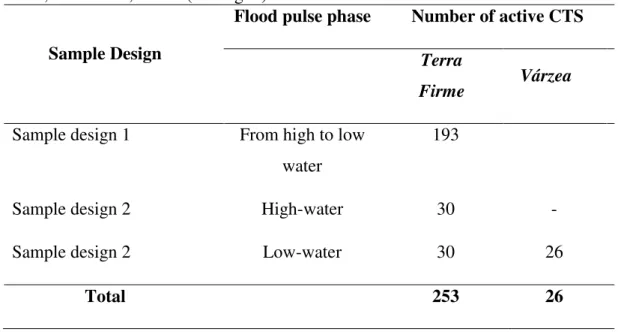
Camera-trapping stations were deployed in two complementary sample designs (Table 1; Fig. 1): From April 2013 to June 2014, 193 CTS were deployed at intervals of 50m, 350m, 1000m, 3000m and 6000m Euclidean distance along transects, arrayed in contiguous terra firme primary forest,
radiating away from local communities. This design facilitated surveys of terrestrial vertebrate abundance at varying distances from the várzea interface and at varying intervals during the
receding flood pulse. In the second design, repeated over two inundation (March-April 2013 and 2015) and two low-water phases (September-October 2013 and 2014), CTS were deployed in both
várzea forests and adjacent terra firme sites. In this arrangement, terra firme CTS were deployed
during both high- and low-water phases whereas várzea CTS were surveyed only during the
low-water phase, as várzea habitat is only available to the terrestrial fauna during this time of year.
Data management and estimates of the number of independent detections were undertaken using
camtrapR version 0.99.8 (Niedballa et al., 2016). Images of conspecifics >30 min apart were
from our analyses, but all other avian and mammalian taxa were considered. Congener brocket deer (Mazama spp.), armadillos (Dasypus spp.), and small tinamous (Crypturellus spp.) were each
treated as single species functional group due to difficulties in differentiating them in nocturnal (black and white) images.
All species considered here were grouped into nine trophic guilds (frugivore-insectivores, granivore-frugivores, frugivores, carnivores, frugivore-carnivores, insectivore-frugivores, insectivores, browsers and frugivore-browsers) based on Benchimol & Peres (2015). An assemblage-wide metric of aggregate biomass was calculated by multiplying the species-specific camera-trap detection rate (number of detections/100 trap-nights) by the mean adult body mass per species, which could then be summed across all species detected at each CTS. For group-living species, we multiplied individual body mass values by the mean observed group size obtained from line-transect surveys conducted in the same study landscape (Abrahams, Peres & Costa, 2017).
For each CTS, we extracted landscape and human disturbance covariates using ArcGIS (version 10.3) (Table 2). We calculated the mean water level of the Juruá River during the exposure period of each CTS using daily water-level readings, recorded over 38 years (from 1st January 1973 to 31st
December 2010; N≈ 14,600 measurements) at a nearby locality (Gavião Metereological Station in
Carauari-AM). As a continuous variable, mean water-level during CTS sampling intervals was a far more powerful descriptor of seasonality period than either categorical season (e.g. low-water vs high-water season) or time of the year (e.g. Julian day) per se.
Data analysis
All analyses were conducted in R version 3.3.2 (R Core Development Team 2016). We first used both Student’s paired t-tests and ordinary t-tests to examine differences in species richness and abundance of terra firme forests between the high- and low-water phases, and between terra firme
sites during the low-water phase and várzea forests, respectively. We estimated species richness per
CTS, accounting for any differences in the number of trap nights, using a rarefaction method and first-order Jackknife estimator available in the specaccum function of the “vegan” package of R. We
choose this estimator because it gives the most reliable results in tropical forest camera-trap studies (Tobler et al., 2008). For the abundance analyses, we considered the camera-trapping rate (number of independent detections per 100 trap-nights) as our response variable. These analyses were performed using CTS data from our second sample design.
vertebrate abundance was standardized by dividing the number of detections of each species by the total number of detections at each CTS. Differences in species composition between forest types, and seasons were tested using Permutational Multivariate ANOVA (PERMANOVA) (Anderson,
2001) performed using the Bray-Curtis similarity matrix. To test for seasonal effects on species composition at terra firme CTS, we performed a Procrustes rotation analysis of the ordination
matrices derived from CTS that were surveyed during both the high- and low-water phases of the flood pulse. In the PCoA and PERMANOVA analyses, we employed all CTS, whereas the Procrustes rotation was performed using only the data from the second sample design.
We tested the hypothesis of seasonal faunal movement between forest types and investigated the effects of landscape context and anthropogenic disturbance employing Generalized Linear Models (GLMs). We used a Poisson distribution for count data using CTS from both sample designs, but a Negative Binomial distribution was chosen when overdispersion was detected (Hilbe 2007). For the metric of biomass we used a Gaussian error structure. The number of camera-trapping nights per CTS was specified as an offset variable in all models to account for difference in sampling
effort (i.e. number active nights) between CT deployments.
We controlled for high levels of variable inter-dependence by performing a Pearson’s correlation matrix, retaining non-correlated variables (r < 0.70). We retained 11 variables describing the local habitat, season, landscape context, and level of human disturbance of CTS sites (vz1k, vzdist, elev, waterlevel, riverdist, defor1k, defor5k, defordist, ctydist, popcomm1 and commdist1; see description of these variables in Table 2). For those variables representing the same class of human disturbance (e.g. deforestation area), the appropriate buffer size was determined by running all models using different buffer thresholds, and then using the threshold resulting in the strongest effect on our response variables. We mitigated for collinearity between the predictors using the Variance Inflation Factor (VIF < 3), excluding the variables above this threshold. We used Akaike’s Information Criteria (AICc) to select the models that best fit the data, employing a stepwise method starting with the full model and discarding predictors until we reached a model with the lowest AICc value.
Results
On the basis of 10,447 trap-nights, we recorded 4,059 independent detections of 25 terrestrial vertebrate species, including 21 mammals representing 12 families and eight orders and four large-bodied bird species (Table 3). We found clear differences in terra firme forestsites in both species
0.009, Fig. 2 B). Similarly, species richness was higher in terra firme sites (18.42 ± 3.11 species)
than in adjacent várzea sites (14.31 ± 3.00 species; t = 4.748, df = 48, p < 0.001, Fig. 2 D).
At terra firme sites, the black agouti (D. fuliginosa) was the most common species followed by the
brocket deer (Mazama spp), pale-winged trumpeter (P. leucoptera), razor-billed curassows (M. tuberosum) and collared peccaries (P. tajacu). The detection rates of these species were higher
during the high-water season than during the low-water season, whereas pacas (C. paca), jaguars
(P.onca), giant anteaters (M. tridactyla), giant armadillos (P. maximus) and tapirs (T. terrestris)
were more frequently detected during the high-water phase (Fig. 3A). During the low-water season, brocket deer, black agoutis, pacas, pale-winged trumpeter, razor-billed curassows and collared peccaries were more abundant in terra firme than in adjacent várzea forests, while tapirs, ocelots
(L. pardalis), pumas (Puma concolor) and small tinamous (Crypturellus spp) presented higher
detection rates in várzea (Fig. 3B).
PCoA ordination revealed differences between sample clusters formed by all terra firme sites
between the high- and low-water phases of the flood pulse, and between várzea forests and terra firme sites during the low-water phase (Fig. 4A), which was further confirmed by permutation tests
(PERMANOVA; F = 3.964, p = 0.002; F = 10.401, p = 0.001, respectively). Terra firme sites
occupied the largest area in community space during the high-water phase, with both terra firme
and várzea forest sites during the low-water phase occupying subsets of the larger group, and várzea sites occupying the smallest area. Additionally, the Procrustes rotation performed with the terra firme CTS from sample design two indicated significant differences in ordination space in
the multivariate structure of community composition between the high- and low-water phases (R = 0.74, p = 0.007, Fig. 4B).
Generalized linear models (GLMs) revealed that water level was a significant positive predictor of both overall species abundance and the detection rates for three trophic guilds: frugivore-insectivores, granivore-frugivores and carnivores (Fig. 5 A, D, F, G). The size of the nearest local extractive community was associated with higher detection rates for browsers (Fig. 5 J). Likewise, elevation was a positive predictor of detection rates of insectivore-frugivores (Fig. 5 I). The best model for frugivores retained only elevation as a significant negative predictor (Fig. 5 E). The area of várzea within a 1000-m buffer around each CTS best explained insectivore detection rates (Fig.
Discussion
Species richness and seasonal movements between forest types
Our camera-trapping study provides tantalizing evidence that water level governs the distribution of large terrestrial vertebrates in Amazonian pristine forest mosaics. These species appear to exhibit lateral seasonal movements to take advantage of periodic resource availability in extremely productive floodplain forests. In our study area, the swath of floodplain forest is approximately 20 km wide, thereby providing a vast area of highly productive habitat for terrestrial species during the low-water phase.
In general, terra firme forest sites were more species-rich than várzea forest sites, a pattern that
conforms with results from previous studies comparing assemblages of all mammals, primates, bats, birds and small mammals in Amazonian seasonally-flooded and unflooded forests (Peres 1999, 1997, Haugaasen & Peres 2005b; c; Beja et al. 2009; Pereira et al. 2009, Bobroweic et al.
2014). Salvador, Clavero & Leite Pitman (2011) reported that floodplain forests in the Peruvian Amazon are more species-rich than terra firme forests during the dry season. They also report that
the number of species in floodplain forest during the wet season remains the same throughout the year, while in terra firme,a sharp increase in species richness coincided with the onset of the wet
season. These shifts in the number of species between the two forest types are consistent with our seasonal movement hypothesis, as the bulk of terrestrial vertebrate species likely exit terra firme
terrains to feed on the seasonally abundant várzea forest resources.
Water level represents a physical barrier for most vertebrate species attempting to access várzea
forests during the high-water phase. This was confirmed by the positive relationship between water level and aggregate community-wide abundance, and the number of detection events of frugivore-insectivores, granivore-frugivores and carnivores. Bobrowiec et al. (2014) noted that the flood
pulse constituted a physical barrier even for Phyllostomid bats, whose species composition differed between terra firme and várzea forests during the high-water period, but this effect did not persist
year-round. We found clear differences in species composition between terra firme and várzea
forests during the low-water phase and within our terrafirme samples between the high- and
low-water phases of the annual cycle. These results imply that forest fauna can exhibit ephemeral occupancy of várzea sites during the dry season and that the rising flood waters force several
species to seek suitable habitats in upland forests. These seasonal lateral movements drive differences in species richness and composition between both seasons and forest types.
2004; Haugaasen & Peres, 2007). In terra firme forests, fruit production occurs during the early
wet season whereas in várzea forests, fruit production starts during the late wet season (Hawes &
Peres, 2016). A substantial proportion of the large terrestrial fauna may therefore move between
várzea and terra firme forests to exploit seasonally available resources. For instance, frugivore
species in our models exhibited a negative abundance relationship with terrain elevation. This predictor can be used to distinguish both forest types, as our terra firme CTS were on average
situated on terrains 14 m higher than our várzea CTS (t-value = 9.458, df = 277, p-value < 0.001).
As water levels recede, the terrestrial fauna rapidly colonize várzea forests to forage on the seasonal
production of residual fruit- and seed-fall (total production minus dispersal and consumption by arboreal frugivores), which can be twice as high as in adjacent terra firme forests during this period
(Bodmer, 1990). Ungulate species such as collared peccaries and brocket deer exhibit a marked dietary shift following the flood pulse, consuming more fruits in seasonally-flooded forests during the low-water period compared to the high water period (Bodmer 1990).
Water level is an important determinant of species detection rates in highly heterogeneous forest landscapes subjected to marked seasonal floods (Negrões et al., 2011; De Lázari et al., 2013). Haugaasen & Peres (2007) reported three different strategies of landscape movements across forest types, which were reflected in our results: wide-ranging species, year-round residents and interface species. Large-bodied granivore-frugivores such as the large-group-living white-lipped peccaries is a wide-ranging “landscape” species that, on a seasonal basis, occupies large home ranges in different forest types and shift their diets and habitat use in response to both seasonal flooding and resulting resource fluctuations (Bodmer, 1990; Fragoso, 1998; Keuroghlian, Eaton & Desbiez, 2009). Large-bodied myrmecophages and insectivore-frugivores such as giant anteaters and armadillos exhibited low detection rates in várzea forests, likely because they are year-round
residents in terra firme forests. They seldom move between forest types because the permanently
wet várzea soils preclude their fossorial foraging behavior. We never observed giant armadillo (P. maximus) holes in várzea forests, but commonly observed them in terra firme forests, and this is
consistent with previous studies in the Araguaia River (Negrões et al. 2011) and Peruvian
floodplain forests (Salvador, Clavero & Leite Pitman 2011).
Detection rates of carnivores increased with the water level, a pattern that can be explained by their swimming and climbing abilities, which allow them to both move between temporary forest islands and utilize the tree canopy as floodwaters rose. Jaguars (P. onca) in várzea forests in the lower
caimans (Caiman crocodilus (Linnaeus, 1758), and Melanosuchus niger (Spix, 1825)) (Ramalho
2006).
Conservation implications
Our research supports the existing body of evidence that the Médio Juruá region, and many other regions of the lowland neotropics, should be viewed as an essentially interconnected multi-habitat socio-ecological system. The massive long-lasting seasonal flood pulse (Junk, Bayley & Sparks, 1989) and the associated phenological (Hawes & Peres, 2016), hydrological, ecological (Hawes et al., 2012) and livelihood impacts this engenders (Endo, Peres & Haugaasen, 2016) require conservation planning at the scale of the entire landscape, with major drainage basins representing complementary management units.
Amazonian freshwater ecosystems such as seasonally white-water flooded forests are vulnerable to anthropogenic disturbance. Várzea and terra firme forests function as ecologically integrated
and hydrologically interconnected habitats that are seasonally utilized by a suite of mobile species, with terrestrial fauna often relying upon the temporally staggered resources of both habitats. As such, they are threatened by both aquatic and terrestrial anthropogenic activities at the local and regional scales. The immense fluvial transport network of the lowland Amazon makes even remote forests accessible to hunters (Peres & Lake, 2003), making their faunal resources non-excludable, whilst simultaneously difficult to monitor. These institutional governance challenges over vast tracts of forest partly explain why terrestrial hunting management has thus far proved elusive. Amazonian terrestrial fauna may be comparatively robust to anthropogenic threats as they seasonally move short distances, usually do not form large aggregations, and often occupy large areas of structurally intact forest. White lipped peccaries, which range over vast areas and form herds of hundreds of individuals, are a notable exception. Not only are they a highly preferred hunted species, vulnerable to overhunting even under low-offtake scenarios (Abrahams, Peres & Costa, 2017), but they play an important ecological role as natural agents of disturbance in plant community dynamics (Silman, Terborgh & Kiltie, 2003) and re-distributing nutrients and fertilizing upland forests.
The existing protected area network and management policies were created principally to protect terrestrial ecosystems and are therefore not adequate to mitigate the aforementioned impacts. Protected areas also suffer from design, implementation and monitoring deficiencies and their delimitations does not adequately represent or protect the full suite of biotic diversity (Peres & Terborgh, 1995, Albernaz et al. 2012, Castello et al. 2013). Although a protected area coverage of
the aggregate area of Amazonian floodplains in Brazil is strictly protected (Albernaz et al. 2012).
Sustainable development and extractive reserves represent the majority of all protected areas worldwide. Their conservation effectiveness can be compromised by high human population density, the uncertain economic viability of exploitating non-timber resources and a shortfall in available animal protein resulting from depleted game vertebrate populations (Peres, 2011; Terborgh & Peres, 2017), but see Abrahams, Peres & Costa (2017) and Campos-Silva & Peres (2016) for best-case scenarios of terrestrial subsistence hunting and local fisheries management.
We have shown that a substantial part of the large vertebrate fauna modulates their use of different forests types within a highly heterogeneous forest landscape according to the marked seasonality of várzea floodplain forests. Várzea forests adjacent to major rivers are preferentially settled by
Amazonian extractivists seeking reliable access to transport routes, fertile soils and animal protein (Endo, Peres & Haugaasen, 2016). In Amazonian extractive reserves, the forest type within which villages are situated can modulate their livelihood strategies. Communities with greater access to
terra firme forests are inherently more agricultural, while communities with greater access to
seasonally-flooded forests rely more heavily on the seasonal extraction of non-timber resources such as palm fruits (Euterpe spp., Martius 1824 and Astrocaryum aculeatum, Meyer), rubber
(Heavea spp., Aublet) and oil seeds (Carapa guianensis, Aublet and Astrocaryum murumuru,
Mart.) (Newton, Endo & Peres 2011).
situated adjacent to protected areas to ensure terrestrial fauna protection during the prolonged inundation season.
Study limitations
In our study, we were unable to estimate the species richness in várzea forests during the
high-water phase of the flood pulse, because our camera trapping method focused only on terrestrial species, which are more sensitive to the flood pulse than arboreal and semi-aquatic species. Várzea
forests along this section of the Juruá River are typically subjected to an annual flood pulse amplitude of 8 to 12 m, which lasts for up to six months. Any camera traps deployed in várzea forests during the high-water period would need to be placed almost half way up into the forest canopy.
We acknowledge that these landscape-scale seasonal movements between forest types can only be conclusively verified by either radio or GPS telemetry studies targeting multiple species. The prohibitive costs of such an undertaking limit its community-wide feasibility. Our evidence is based on patterns of local population abundance, species richness and biomass, particularly along the
várzea - terra firme interface, where temporary overcrowding is expected to occur for species
abandoning the wide belt of várzea forest during the rise of floodwaters.
Conclusions
The annual floodwaters along several major white-water rivers in the Amazon is the main factor structuring and differentiating várzea floodplains from adjacent terra firme forests as unique
adaptations are required to tolerate the prolonged flood pulse. This remarkable natural phenomenon drives several key ecological processes, including staggered plant phenology, high plant productivity, and supports major local livelihood activities such as subsistence fishing and hunting. This landscape scale seasonal dynamics between these major adjacent forest types was investigated in terms of species richness, species composition and population abundance for as many as 25 vertebrate species. We have shown that many upland forest terrestrial vertebrate species make seasonal use of várzea forests to take advantage of the abundant trophic resource in this forest type
following the receding waters. We acknowledge that detailed movement data using GPS telemetry can further clarify the magnitude and seasonal importance of várzea habitat use by terra firme
Acknowledgements
We are deeply grateful to the local communities of the Juruá region for their hospitality and friendship during fieldwork and to Gilberto Olavo from the Centro Estadual de Unidades de Conservação do Amazonas (CEUC/SDS/AM); and Rosi Batista and Manoel Cunha from the Instituto Chico Mendes de Conservação da Biodiversidade (ICMBio) for permitting our research work. We thank A. C. Mendes-Oliveira, F. Michalski, F. Palomares, and N. Negrões-Soares for their comments on previous versions of the manuscript. This publication is part of the Projeto Médio Juruá series on Resource Management in Amazonian Reserves. (www.projetomediojurua.org).
References
Abrahams MI., Peres CA., Costa HCM. 2017. Measuring local depletion of terrestrial game vertebrates by central-place hunters in rural Amazonia. PLoS ONE 12:1–25. DOI:
10.1371/journal.pone.0186653.
Adis J., Junk WJ. 2002. Terrestrial invertebrates inhabiting lowland river floodplains of Central Amazonia and Central Europe: a review. Freshwater Biology 47:711–731. DOI:
10.1046/j.1365-2427.2002.00892.x.
Anderson MJ. 2001. A new method for non parametric multivariate analysis of variance. Austral ecology 26:32–46. DOI: 10.1111/j.1442-9993.2001.01070.pp.x.
Beja P., Santos CD., Santana J., Pereira MJ., Marques JT., Queiroz HL., Palmeirim JM. 2009. Seasonal patterns of spatial variation in understory bird assemblages across a mosaic of flooded and unflooded Amazonian forests. Biodiversity and Conservation 19:129–152. DOI:
10.1007/s10531-009-9711-6.
Benchimol M., Peres CA. 2015. Predicting local extinctions of Amazonian vertebrates in forest islands created by a mega dam. Biological Conservation 187:61–72. DOI:
10.1016/j.biocon.2015.04.005.
Bobrowiec PED., Rosa L dos S., Gazarini J., Haugaasen T. 2014. Phyllostomid Bat Assemblage Structure in Amazonian Flooded and Unflooded Forests. Biotropica 46:312–321. DOI:
10.1111/btp.12102.
Bodmer RE. 1990. Responses of ungulates to seasonal inundations in the Amazon floodplain.
Journal of Tropical Ecology 6:191–201.
Bodmer RE. 2009. Responses of ungulates to seasonal inundations in the Amazon floodplain.
Journal of Tropical Ecology 6:191. DOI: 10.1017/S0266467400004314.
10.1111/j.1461-0248.2007.01109.x.
Campos-Silva JV., Peres CA. 2016. Community-based management induces rapid recovery of a high-value tropical freshwater fishery. Scientific Reports 6:1–13. DOI: 10.1038/srep34745.
Costanza R., Arge R., Groot R De., Farberk S., Grasso M., Hannon B., Limburg K., Naeem S., O’Neill R V., Paruelo J., Raskin RG., Suttonkk P., van den Belt M. 1997. The value of the world ’ s ecosystem services and natural capital. Nature 387:253–260. DOI:
10.1038/387253a0.
Dudgeon D., Arthington AH., Gessner MO., Kawabata Z-I., Knowler DJ., Lévêque C., Naiman RJ., Prieur-Richard A-H., Soto D., Stiassny MLJ., Sullivan CA. 2006. Freshwater biodiversity: importance, threats, status and conservation challenges. Biological Reviews 81:163. DOI:
10.1017/S1464793105006950.
Endo W., Peres CA., Haugaasen T. 2016. Flood pulse dynamics affects exploitation of both aquatic and terrestrial prey by Amazonian floodplain settlements. Biological Conservation 201:129–
136. DOI: 10.1016/j.biocon.2016.07.006.
Epstein JH., Olival KJ., Pulliam JRC., Smith C., Westrum J., Hughes T., Dobson AP., Zubaid A., Rahman SA., Basir MM., Field HE., Daszak P. 2009. Pteropus vampyrus , a hunted migratory
species with a multinational home-range and a need for regional management. Journal of Applied Ecology 46:991–1002. DOI: 10.1111/j.1365-2664.2009.01699.x.
Fragoso JM V. 1998. Home Range and Movement Patterns of White-lipped Peccary (Tayassu pecari) Herds in the Northern Brazilian Amazon. Biotropica 30:458–469.
François GGH., K GF., Marcelle GSL., Mooney HA., Cropper A., Leemans R., Arico S.,
Bridgewater P., Peterson G., Revenga C., Rivera M., Peter AW., Fallis A., Dubay L., Point P., Aboutayeb H., Mermet L., Raphaël Billé., Maya Leroy., Poux X., Schuyt K. 2005. Ecosystems AND HUMAN WELL-BEING: WETLANDS AND WATER. Regions and Cohesion 13:127–
137. DOI: 10.1017/CBO9781107415324.004.
Halls AJ. 1997. Wetlands, Biodiversity and the Ramsar Convention: The Role of the Convention on Wetlands in the Conservation and Wise Use of Biodiversity.
Haugaasen T., Peres C. 2005a. Tree Phenology in Adjacent Amazonian Flooded and Unflooded Forests1. Biotropica 37:620–630.
Haugaasen T., Peres C A. 2005b. Mammal assemblage structure in Amazonian flooded and unflooded forests. Journal of Tropical Ecology 21:133–145. DOI:
Haugaasen T., Peres C A. 2005c. Primate assemblage structure in Amazonian flooded and unflooded forests. American Journal of Primatology 67:243–58. DOI: 10.1002/ajp.20180.
Haugaasen T., Peres C A. 2007. Vertebrate responses to fruit production in Amazonian flooded and unflooded forests. Biodiversity and Conservation 16:4165–4190. DOI:
10.1007/s10531-007-9217-z.
Hawes JE., Peres CA. 2016. Patterns of plant phenology in Amazonian seasonally-flooded and unflooded forests. Biotropica 48:465–475.
Hawes JE., Peres C A., Riley LB., Hess LL. 2012. Landscape-scale variation in structure and biomass of Amazonian seasonally-flooded and unflooded forests. Forest Ecology and Management 281:163–176. DOI: 10.1016/j.foreco.2012.06.023.
Junk WJ., Bayley PB., Sparks RE. 1989. The flood pulse concept in river -floofplain systems. In: Dodge DP ed. International Large River Symposium. 110–127.
Junk WJ., Brown M., Campbell IC., Finlayson M., Gopal B., Ramberg L., Warner BG. 2006. The comparative biodiversity of seven globally important wetlands: a synthesis. Aquatic Sciences
68:400–414. DOI: 10.1007/s00027-006-0856-z.
Junk WJ., Piedade MTF. 2010. An Introduction to South American Wetland Forests: Distribution, Definitions and General Characterization. In: Junk WJ, Piedade MTF, Wittmann F, Schöngart J, Parolin P eds. Amazonian Floodplain Forests Ecophysiology, Biodiversity and Sustainable Management. Ecological Studies. Dordrecht: Springer Netherlands, 4–24. DOI:
10.1007/978-90-481-8725-6.
Junk WJ., Piedade MTF., Schöngart J., Cohn-Haft M., Adeney JM., Wittmann F. 2011. A
Classification of Major Naturally-Occurring Amazonian Lowland Wetlands. Wetlands 31:623–
640. DOI: 10.1007/s13157-011-0190-7.
Keddy PA., Fraser LH., Solomeshch AI., Junk WJ., Campbell DR., Arroyo MTK., Alho CJR. 2009. Wet and Wonderful: The World’s Largest Wetlands Are Conservation Priorities. BioScience
59:39–51. DOI: 10.1525/bio.2009.59.1.8.
Keuroghlian A., Eaton DP., Desbiez A. 2009. The response of a landscape species, white-lipped peccaries, to seasonal resource fluctuations in a tropical wetland, the Brazilian Pantanal.
International Journal of Biodiversity and Conservation 1:87–97.
Lindenmayer D., Hobbs RJ., Montague-Drake R., Alexandra J., Bennett A., Burgman M., Cale P., Calhoun A., Cramer V., Cullen P., Driscoll D., Fahrig L., Fischer J., Franklin J., Haila Y., Hunter M., Gibbons P., Lake S., Luck G., MacGregor C., McIntyre S., Mac Nally R., Manning A., Miller J., Mooney H., Noss R., Possingham H., Saunders D., Schmiegelow F., Scott M., Simberloff D., Sisk T., Tabor G., Walker B., Wiens J., Woinarski J., Zavaleta E. 2008. A checklist for ecological management of landscapes for conservation. Ecology Letters 11:78–
91. DOI: 10.1111/j.1461-0248.2007.01114.x.
Madsen J., Fox a D. 1995. Impacts of hunting disturbance on waterbirds - a review. Wildlife Biology 1:193–207.
Martin TG., Chadès I., Arcese P., Marra PP., Possingham HP., Norris DR. 2007. Optimal conservation of migratory species. PLoS ONE 2:3–7. DOI: 10.1371/journal.pone.0000751.
McCulloch MN., Tucker GM., Baillie SR. 2008. The hunting of migratory birds in Europe: a ringing recovery analysis. Ibis 134:55–65. DOI: 10.1111/j.1474-919X.1992.tb04734.x.
Mendes Pontes A. 2004. Ecology of a community of mammals in a seasonailly dry forest in Roraima, Brazilian Amazon. Mammalian Biology-Zeitschrift für Säugetierkunde 69:319–336.
Mendes Pontes a. R., Chivers DJ. 2007. Peccary movements as determinants of the movements of large cats in Brazilian Amazonia. Journal of Zoology 273:257–265. DOI:
10.1111/j.1469-7998.2007.00323.x.
Nebel G., Dragsted J., Vega AS. 2001. Litter fall , biomass and net primary production in floodplain forests in the Peruvian Amazon. Forest Ecology and Management 150:93–102.
Negrões N., Revilla E., Fonseca C., Soares AMVM., Jácomo AT a., Silveira L. 2011. Private forest reserves can aid in preserving the community of medium and large-sized vertebrates in the Amazon arc of deforestation. Biodiversity and Conservation 20:505–518. DOI:
10.1007/s10531-010-9961-3.
Newton P., Endo W., Peres CA. 2011. Determinants of livelihood strategy variation in two
extractive reserves in Amazonian flooded and unflooded forests. Environmental Conservation
39:97–110. DOI: 10.1017/S0376892911000580.
Niedballa J., Sollmann R., Courtiol A., Wilting A. 2016. camtrapR : an R package for efficient camera trap data management. Methods in Ecology and Evolution 7:1457–1462. DOI:
10.1111/2041-210X.12600.
Pereira MJR., Marques JT., Santana J., Santos CD., Valsecchi J., de Queiroz HL., Beja P.,
Palmeirim JM. 2009. Structuring of Amazonian bat assemblages: the roles of flooding patterns and floodwater nutrient load. The Journal of animal ecology 78:1163–71. DOI:
10.1111/j.1365-2656.2009.01591.x.
Peres C. A. 1994. Primate responses to phenological changes in amazonian terra firme forest.
Biotropica 26:98–112.
Peres C.A. 1996. Population status of white-lipped Tayassu pecari and collared peccaries T. tajacu in hunted and unhunted Amazonian forests. Biological Conservation 7:115–123.
Peres C.A. 1997. Primate community structure at twenty western Amazonian flooded and unflooded forests. Journal of Tropical Ecology 13:381–405.
Peres C. A. 2001. Synergistic Effects of Subsistence Hunting and Habitat Fragmentation on Amazonian Forest Vertebrates. Conservation Biology 15:1490–1505. DOI:
10.1046/j.1523-1739.2001.01089.x.
Peres C.A. 2005. Why We Need Megareserves in Amazonia. Conservation Biology 19:728–733.
DOI: 10.1111/j.1523-1739.2005.00691.x.
Peres C.A. 2008. Soil fertility and arboreal mammal biomass in tropical forests. In: Schnitzer, S. & W. Carson (eds.) Tropical Forest Community Ecology. Blackwell Scientific, Oxford p:349–
364.
Peres C. A. 2011. Conservation in sustainable-use tropical forest reserves. Conservation biology
25:1124–9. DOI: 10.1111/j.1523-1739.2011.01770.x.
Peres C.A., Lake I. 2003. Extent of nontimber resource extraction in tropical forests: accessibility to game vertebrates by hunters in the Amazon basin. Conservation Biology 17:521–535. DOI:
10.1046/j.1523-1739.2003.01413.x.
Peres C.A., Terborgh J. 1995. Amazonian nature reserves: an analysis of the defensibility status of existing conservation units and design criteria for the future. Conservation Biology 9.
Prance G. 1979. Notes on the vegetation of Amazonia III. The terminology of Amazonian forest types subject to inundation. Brittonia 31:26–38.
Saint-paul U., Zuanon J., Villacorta Correa MA., Garcia M., Fabré NN., Berger U., Junk WJ. 2000. Fish communities in central Amazonian white- and blackwater floodplains. Environmental Biology of Fishes 57:235–250.
Säugetierkunde 76:115–123. DOI: 10.1016/j.mambio.2010.04.007.
Schöngart J., Piedade MTF., Ludwigshausen S., Horna V., Worbes M. 2002. Phenology and stem-growth periodicity of tree species in Amazonian floodplain forests. Journal of Tropical Ecology 18:581–597. DOI: 10.1017/S0266467402002389.
Silman MR., Terborgh JW., Kiltie RA. 2003. Population regulation of a dominant rain forest tree by a major seed predator. Ecology 84:431–438. DOI:
10.1890/0012-9658(2003)084[0431:PROADR]2.0.CO;2.
Sioli H. 1984. The Amazon and its main afluents: Hydrography, morphology of the river courses and river types. In: Sioli H ed. The Amazon Liminology and landscape ecology of a mighty tropical river and its basin. 127–165.
Terborgh J., Peres CA. 2017. Do community-managed forests work? a biodiversity perspective.
Land 6:22. DOI: 10.3390/land6020022.
Tobler MW., Carrillo-Percastegui SE., Leite Pitman R., Mares R., Powell G. 2008. An evaluation of camera traps for inventorying large- and medium-sized terrestrial rainforest mammals.
Animal Conservation 11:169–178. DOI: 10.1111/j.1469-1795.2008.00169.x.
Tuomisto H., Ruokolainen K., Kalliola R., Linna A., Danjoy W., Rodriguez Z. 1995. Dissecting amazonian biodiversity. Science 269:63–66.
Wilcove DS., Wikelski M. 2008. Going, going, gone: Is animal migration disappearing? PLoS Biology 6:1361–1364. DOI: 10.1371/journal.pbio.0060188.
Wittmann F., Schongart J., Montero JC., Motzer T., Junk WJ., Piedade MTF., Queiroz HL., Worbes M. 2006. Tree species composition and diversity gradients in white-water forests across the Amazon Basin. Journal of Biogeography 33:1334–1347. DOI:
Map of the study area in the central Rio Juruá region of western Brazilian Amazonia, Amazonas, Brazil. Map inset shows the geographic location of the study region (black square). The boundaries of the RESEX Médio Juruá and RDS Uacari are outlined in black. Background colors represent elevation, with blue and brownish orange shades indicating low and high elevation, respectively. Solid red circles represent camera trap stations (CTS) deployed radiating inland into
terra firme forest(sample design 1). Green and aqua circles represent CTS deployed at terra firme
forest sites near forest habitat boundaries along the várzea interface and far into várzea forest,
Comparison between terra fime and várzea forests during both the high- and low-water phases
of the flood pulse considering both the total abundance and species richness of terrestrial forest vertebrates. Boxplots comparing abundance and rarefied species richness between terra firme forests
Camera trapping rate of terrestrial vertebrates recorded in terra firme and várzea forests. (A) Camera trapping rates in terra firme forests during both high- (dark green bars) and low-water phase
of the flood pulse (light green bars). (B) Camera trapping rates in both terra fime and in várzea forests
during the low-water phase of the flood pulse. Light green and orange bars represent terra firme and várzea forests, respectively. Species are represented by the first four letters of each genus and first
Terrestrial vertebrate species composition in Amazonian seasonally-flooded and unflooded forests during both high- and low-water phases of the flood pulse. (A) Principal Coordinates Analysis (PCoA) ordination of the terrestrial vertebrate assemblage structure detected by camera traps in Amazonian terra firme forestsduring both high- and low-water phases of the flood pulse (green
and light-green circles, respectively) and in várzea forests (orange circles). (B) Procrustes rotation
plot of terra firme sites sampled during both high- and low-water phase of the flood pulse. Arrows
Table 1. Camera trapping effort at Amazonian flooded and unflooded forests, along the Juruá River, Amazonas, Brazil (see Fig. 1).
Sample Design
Flood pulse phase Number of active CTS
Terra
Firme Várzea
Sample design 1 From high to low water
193
Sample design 2 High-water 30 -
Sample design 2 Low-water 30 26
Table 2. Covariates used to investigate the seasonal dynamics of terrestrial vertebrates in Amazonian flooded and unflooded forests, along the Juruá
River region, western Brazilian Amazonia.
Covariate Abbreviation Description
Area of várzea forest vz0.5k
vz1k vz5k
Area (m²) of seasonally flooded forest within a 500m circular buffer centered at each CTS Area (m²) of seasonally flooded forest within a 1000m circular buffer centered at each CTS Area (m²) of seasonally flooded forest within a 5000m circular buffer centered at each CTS Distance to várzea forest vzdist Euclidean distance from each CTS to the nearest várzeaforest
Deforestation area defor0.5k defor1k defor5k
Total area (m²) of deforestation within a 500m circular buffer centered at each CTS Total area (m²) of deforestation within a 1000m circular buffer centered at each CTS Total area (m²) of deforestation within a 5000m circular buffer centered at each CTS Distance to nearest
deforestation
defordist Euclidean distance from each CTS to the nearest deforestation patch
Community size popcomm1 Number of residents of the local community nearest each CTS Distance to local
community
commdist1 Euclidean distance from each CTS to the nearest local community
Distance to urban center citydist Euclidean distance from each CTS to the nearest urban center Elevation elev Elevation (m) of the CTS above the main channel of the Juruá river. River distance riverdist Distance from each CTS to the midpoint of Juruá river
Table 3. Terrestrial vertebrate species detected by camera trapping stations (CTS) deployed in this study in Amazonian flooded and unflooded forests, along Juruá river, Amazonas, Brazil.
Class Order Species English vernacular name Trophic guild
AVES GRUIFORMES
STRUTHIONIFORMES
GALLIFORMES
Psophia leucoptera (Spix, 1825) Pale-winged trumpeter Frugivore-Insectivore Crypturellus spp
(Brabourne & Chubb, 1914)
Small tinamous Granivore-frugivore
Tinamus sp (Hermann, 1783) Great tinamous Granivore-frugivore Mitu tuberosum (Spix, 1825) Razor billed curassow Frugivore
MAMMALIA CARNIVORA Panthera onca (Linnaeus, 1758) Jaguar Carnivore
Procyon cancrivorus
(G.[Baron] Cuvier, 1798)
Crab-eating-racoon Frugivore-insectivore
Puma concolor (Linnaeus, 1771) Puma Carnivore Herpailurus yagouaroundi
(É. Geoffroy Saint-Hilaire, 1803)
Jaguarundi Carnivore
Leopardus wiedii (Schinz, 1821) Margay Carnivore Leopardus pardalis
(Linnaeus, 1758)
Ocelot Carnivore
Speothos venaticus (Lund, 1842) Bush dog Carnivore Eira barbara (Linnaeus, 1758) Tayra Frugivore-Carnivore Atelocynus microtis (Sclater, 1883) Small-eared-dog Frugivore-Carnivore Nasua nasua (Linnaeus, 1766) Coati Frugivore-insectivore
Dasypus spp (Linnaeus, 1758) Armadillo Insectivore-Frugivore
Class Order Species English vernacular name Trophic guild
CETARTIODACTYLA Tayassu pecari (Link, 1795) White lipped peccary Granivore-Frugivore Pecari tajacu (Linnaeus, 1758) Collared peccary Granivore-Frugivore Mazama spp (Rafinesque, 1817) Brocked deer Browser
MAMMALIA PERISSODACTYLA Tapirus terrestris (Linnaeus, 1758) Tapir Browser
PILOSA Tamandua tetradactyla
(Linnaeus, 1758)
Southern tamandua Insectivore
Myrmecophaga tridactyla
(Linnaeus, 1758)
Giant anteater Insectivore
RODENTIA Myoprocta pratti
(Pocock, 1913)
Green acouchy Granivore-frugivore
Dasyprocta fuliginosa
Wagler, 1832
Black agouti Granivore-frugivore
Cuniculus paca
(Linnaeus, 1766)
CONCLUSÕES GERAIS