of Chemical
Engineering
ISSN 0104-6632 Printed in Brazil www.scielo.br/bjce
Vol. 35, No. 02, pp. 313 - 326, April - June, 2018 dx.doi.org/10.1590/0104-6632.20180352s20160321
PVT EXPERIMENTAL AND MODELLING STUDY
OF SOME SHALE RESERVOIR FLUIDS FROM
ARGENTINA
#
Martin Cismondi
1,*, Natalia G. Tassin
1, Carlos Canel
2, Francisco
Rabasedas
2and Carlos Gilardone
21 Instituto de Investigación y Desarrollo en Ingeniería de Procesos y Química Aplicada (IPQA), Universidad Nacional de Córdoba – CONICET. Córdoba, Argentina. 2 Field Development Consultants (FDC de Argentina SRL). Buenos Aires, Argentina.
(Submitted: May 19, 2016; Revised: January 9, 2017; Accepted: January 19, 2017)
Abstract - Shale reservoir fluids have been receiving much attention, especially during the last decade, due to the important reserves confirmed in many places around the world and the recent production growth in the United States, Argentina, and probably other countries to follow. In some fields of the Vaca Muerta formation in Argentina, the fluids can be classified as gas condensate or near-critical in some cases, presenting retrograde condensation of up to 30% in volume. This work presents compositional and PVT data of two gas condensate fluids, together with a new methodology for assigning molecular weights and densities to the different carbon number fractions when measured values are available for the whole fluid or liquid phase and only a weight fraction is collected through chromatography for each single cut. A thermodynamic modelling study of these fluids, and also a third one classified as volatile oil, is based on both the PR (Peng and Robinson, 1976) and RKPR (Redlich Kwong Peng Robinson, apud Cismondi and Mollerup, 2005) equations of state, together with different ways of characterizing the heavy fractions. The focus is on phase envelopes, but knowing only the saturation point at the reservoir temperature, and also on retrograde behavior.
Keywords: Gas Condensate, RKPR EoS, Phase Envelope, Retrograde Condensation, Characterization.
INTRODUCTION
Since 2005, and in the context of an important decline in the reserves of conventional hydrocarbon resources, Argentina has been facing the challen-ge of maintaining the production level of gas, the
main component of its energy matrix. The difference
between the demand and production curves should be
compensated by fluids from new non-conventional re -servoirs, mainly Shale Gas.
In many of the recently discovered fields, the pro
-duced fluids could be classified as near-critical, wi -th some cases presenting retrograde condensation of around 30% in volume at the reservoir temperature.
Material balances and numerical simulations, which
are used for predicting the fluids production beha
-vior and proposing development strategies, require an adequate characterization of the reservoir fluids and a good fitting of the laboratory data, in order to adequa
-tely reproduce field and well behaviors.
As far as we know, and despite the relevance of the Vaca Muerta formation, no articles have been pu-blished so far containing PVT or compositional data
on the produced fluids. A Scopus search for the words
“Vaca Muerta” by the end of year 2016 returned 24 publications, starting from 2003, all of them related to geological studies of the formation. A second search with the words “Shale” + “Argentina” returned 10 pu-blications, again with focus mainly on geological as-pects, and including also two articles published in the Journal of Petroleum Technology, on trends and pers-pectives about the production of shale gás and shale
oil worlwide (Beckwith, 2011). But no specific data on the fluids could be found.
This work presents compositional and PVT data obtained at the ITBA-FDC laboratory for two gas
con-densate fluids from different fields corresponding to
the Vaca Muerta formation in Argentina. The experi-mental methods are summarized in the next section. Then, a new methodology for assigning molecular
weights and densities to the different carbon number fractions is described and implemented to the two flui -ds and also a third one from the FDC data base, which
was classified as volatile oil. Finally, another section is
dedicated to a thermodynamic modeling study of the
fluids, based on two different cubic equations of sta
-te: the PR EoS (Peng and Robinson, 1976) and RKPR EoS (Redlich Kwong Peng Robinson, apud Cismondi and Mollerup, 2005), and exploring the effects of di
-fferent factors on the equation-of-state description of the fluids, including different ways of representing the
heavy residual fraction.
EXPERIMENTAL METHODS AND EQUIPMENT
The compositional analysis and PVT tests perfor-med at the ITBA-FDC laboratory followed essentially the procedures described in the books by Danesh (1998) and Pedersen and Christensen (2006), for the case of surface separator samples. Chromatographic analyses were carried out according to the norms
ASTM D-1945/03, GPA 2286 and ISO 6976/95 for gases, and EPA 8015 and ASTM D-2789 for liquid chromatography. The main equipment involved, for the fluids reported in this work, were the following:
(a) PVT cell “DBR-Jefri”, serial 0150-100-200,
maximum pressure: 10000 psi, maximum tempera-ture: 200 ºC; (b) chromatograph HP6890 G1530A with a capillary column HP-PONA Methyl Siloxane HP 19091S-001; (c) chromatograph HP6890 G1530A with a capillary column HP-PONA Methyl Siloxane HP 19091S-001 and a packed column DC200-PO-TM – HP 19006 80005. With both chromatographs the car-rier was hydrogen, with a FID front detector and TCD back detector.
The reservoir fluid tested in the PVT cell is the re
-sult of the recombination of a gas sample and a liquid
sample taken from the separator at the surface of the well, according to the gas-oil ratio (GOR), which is
also obtained from the flows measured at the surfa
-ce separator. Sin-ce the liquid sample is taken at the separator pressure, it also needs to be flashed before
analyzing its composition. Then, the steps leading to
the analytical determination of the reservoir fluid com -position are the following:
• Determination of the separator gas composition by chromatography.
• Determination of the separator liquid composition
through the following procedure:
▪ A flash separation of the liquid sample is per -formed at atmospheric pressure and room tem-perature, obtaining the so called flash gas and
flash liquid.
▪ The volumes of the two recovered phases are measured and the gas-liquid ratio is obtained. ▪ The compositions of the flash gas and liquid
phases are determined by chomatography.
▪ The average molecular weight for the flash li
-quid is determined by the melting point depres -sion method, using benzene as solvent.
▪ The flash liquid density is measured using a
pycnometer and a high precision weighing scale.
▪ The separator liquid composition is determi -ned from a recombination of the flash gas and
liquid compositions, in a similar way to what
is described, for example, in section 2.2 of the book by Pedersen and Christensen (2006).
• Finally, the reservoir fluid composition is determi -ned from the recombination of the separator gas
and liquid phases.
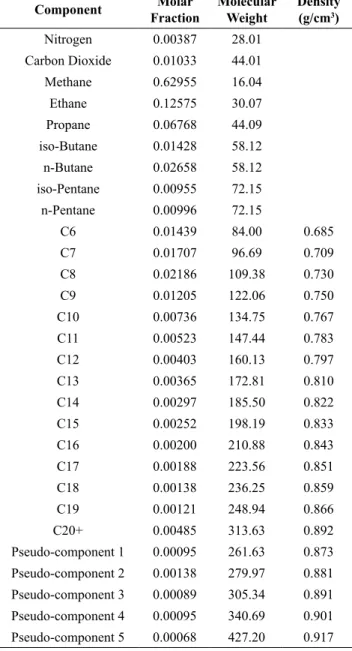
Tables 1 and 2 present the compositions of two
different gas condensate fluids analyzed at the
assigned according to the methodology described in
the next section. The five pseudo-components at the
end of each Table correspond to the decomposition of the residual C20+ fraction. More details are given in
the next section and specifically in Table 6.
Table 1: Composition for the Gas Condensate fluid
identified as GC1 in this work
Component Molar
Fraction
Molecular Weight
Density (g/cm3)
Nitrogen 0.01744 28.01
Carbon Dioxide 0.00042 44.01
Methane 0.75731 16.04
Ethane 0.08026 30.07
Propane 0.03625 44.09
iso-Butane 0.00652 58.12
n-Butane 0.01372 58.12
iso-Pentane 0.00516 72.15
n-Pentane 0.00596 72.15
C6 0.00877 84.00 0.685
C7 0.01263 96.63 0.710
C8 0.01255 109.27 0.732
C9 0.00739 121.90 0.753
C10 0.00592 134.53 0.771
C11 0.00426 147.16 0.788
C12 0.00361 159.80 0.803
C13 0.00321 172.43 0.817
C14 0.00275 185.06 0.829
C15 0.00247 197.69 0.840
C16 0.00198 210.33 0.851
C17 0.00184 222.96 0.860
C18 0.00139 235.59 0.868
C19 0.00126 248.22 0.876
C20+ 0.00694 328.44 0.907
Pseudo-component 1 0.00200 266.64 0.885
Pseudo-component 2 0.00142 291.90 0.896
Pseudo-component 3 0.00141 322.60 0.907
Pseudo-component 4 0.00121 370.31 0.920
Pseudo-component 5 0.00090 476.99 0.935
Table 2: Composition for the Gas Condensate fluid
identified as GC2 in this work
Component Molar
Fraction
Molecular Weight
Density (g/cm3)
Nitrogen 0.00387 28.01
Carbon Dioxide 0.01033 44.01
Methane 0.62955 16.04
Ethane 0.12575 30.07
Propane 0.06768 44.09
iso-Butane 0.01428 58.12
n-Butane 0.02658 58.12
iso-Pentane 0.00955 72.15
n-Pentane 0.00996 72.15
C6 0.01439 84.00 0.685
C7 0.01707 96.69 0.709
C8 0.02186 109.38 0.730
C9 0.01205 122.06 0.750
C10 0.00736 134.75 0.767
C11 0.00523 147.44 0.783
C12 0.00403 160.13 0.797
C13 0.00365 172.81 0.810
C14 0.00297 185.50 0.822
C15 0.00252 198.19 0.833
C16 0.00200 210.88 0.843
C17 0.00188 223.56 0.851
C18 0.00138 236.25 0.859
C19 0.00121 248.94 0.866
C20+ 0.00485 313.63 0.892
Pseudo-component 1 0.00095 261.63 0.873
Pseudo-component 2 0.00138 279.97 0.881
Pseudo-component 3 0.00089 305.34 0.891
Pseudo-component 4 0.00095 340.69 0.901
Pseudo-component 5 0.00068 427.20 0.917
In order to study the PVT behavior of each
re-servoir fluid, a Constant Mass Experiment (CME) is
performed. This experiment is also referred to as a Constant Composition Expansion (CCE) or simply as
a Pressure-Volume (PV) test. Irrespective of the fluid
type, it is common practice to carry out a CME test at the reservoir temperature. This study consists of suc-cessive expansions of the PVT cell to reproduce the
evolution of the fluid at the reservoir temperature. In
this evolution, the dew point pressure and the amount
of retrograde liquid deposited in the cell at pressures
below the dew point are determined. The methodology is as follows:
• A physical recombination from the separator samples is charged to a Robinson PVT cell. This double-window cell allows a direct observation
of the fluid and measurement of the volume of condensed liquid. The cell is kept at the reservoir temperature and the fluid is pressurized through a
hydraulic piston.
• The monophasic condition of the sample is
veri-fied. A visual confirmation is enough for gas con
-densate fluids, while an additional verification of the compressibility through a differential pressure
• The total volume is registered at different pres -sures, measuring also the volume of retrograde
liquid accumulated at pressures below the dew
point, which is determined visually.
• The curves pressure vs. relative volume, as well as
% of retrograde liquid vs. pressure are determined.
Regarding experimental uncertainties in the PVT
tests, it is difficult to estimate a level of accuracy for the different values informed, since several stages are involved and different factors can affect the results.
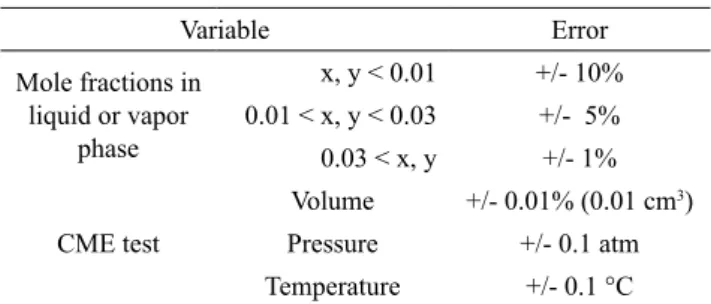
Nevertheless, based on the repeatibility experience accumulated at the ITBA-FDC lab, the assumed com-positional errors are given in Table 3, together with
uncertainties for the different measurements associa -ted with the CME test.
(1978), whose table is also included in books covering
these topics, like the one by Pedersen and Christensen (2006, see Table 2.1 in the book) .
Those values may work quite well in many cases,
providing reasonable values for the residual fraction, e.g., C20+, but may also lead to unreasonable estima-tions for the residual fracestima-tions when the real values of densities or molecular weights for the SCN fractions
have important differences with the assumed genera -lized values. In the latter case, a consistent characte-rization of the residual fraction (typically C20+) will
be clearly hindered, since solving the equations that equal average values with measured density or mole
-cular weight for the whole fluid makes it accumulate
the errors in the previous SCN fractions, for which it will have to compensate.
Therefore, in this work we propose a new methodo-logy for the estimation of molecular weights and den-sities for single carbon cuts from C6 on, based on
me-asured values for the fluid and general assumptions on
the distribution or evolution of these properties along
SCN fractions in reservoir fluids.
It is a well established fact that the diversity of mole-cular structures within a given SCN fraction increases with carbon number. For example, most C6 fractions consist mainly of n-hexane, plus some cyclopentane
and different quantities of a few branched hexanes. On
the other hand, as it is illustrated for example in Table 2.4 in the book of Pedersen and Christensen (2006), a C9 fraction already includes typically more than 20
different compounds detected by chromatography, including normal and branched paraffinic, naphthe -nic and aromatic structures. For fractions around C20
there can be various dozens of different compounds, with very small quantities of each, and it could be very difficult to achieve a complete list for a specific fluid. As a consequence of that, there is normally no risk in
assuming typical values for the density and molecular
weight of C6, while the differences can be important
for higher cuts. For that reason, we adopt the
recom-mended values from Katz and Firoozabadi only for C6, and assume specific mathematical functionalities
in terms of carbon number for the rest, depending on only one parameter for each property, which can be adjusted in order to match the measured value for the
whole fluid.
For molecular weights a linear relation with car-bon number is normally accepted. In our methodolo-gy, following the reasoning above, the corresponding
equation for estimating the SCN molecular weights is:
Mi = 84 + C(i − 6) (1)
Table 3: Experimental uncertainties associated with
the mole fractions determined for defined compounds
and measurements in the CME test.
Variable Error
Mole fractions in
liquid or vapor
phase
x, y < 0.01 +/- 10%
0.01 < x, y < 0.03 +/- 5%
0.03 < x, y +/- 1%
CME test
Volume +/- 0.01% (0.01 cm3)
Pressure +/- 0.1 atm
Temperature +/- 0.1 °C
A new methodology for assigning molecular weights and densities
In some compositional studies of reservoir fluids
(see for example Pedersen et al., 1992) average mole-cular weights are calculated from the chromatographic single-component distributions for the C6-C9 frac-tions, and measured by freezing point depression for the distillate fractions obtained for higher cuts through True Boiling Point (TBP) analysis.
Nevertheless, in routine PVT studies like the ones reported here, it is more common that only a mass fraction can be assigned to each cut from C6 on,
ba-sed on measured quantities. Density at standard con -ditions and molecular weight are measured only for
each separator phase, and sometimes also for the C7+
or C10+ fractions.
Then, reported values for single carbon number (SCN) fractions are either estimated based on correla-tions, or taken from Tables of recommended generali-zed values. This has been a common practice in the in-dustry and a popular and typical source for generalized density and molecular weight values for single carbon
where i is a number identifying a SCN fraction and C
is an adjustable constant.
The relation with density is not that simple. Pedersen, for example, recommends a linear relation with the logarithm of the carbon number. Instead, in
this work, we use the following equation with Ad and
Bd being adjustable constants:
ρi = Ad * e
−i/10 + B
d (2)
For this relation we have found a better correlation capacity when considering experimental values,
in-cluding those recommended by Katz and Firoozabadi (1978).
Fixing this equation to the typical recommended
value for C6, there is only one degree of freedom left, which can be associated with the Ad parameter, since
Bd becomes
Bd = 0.685 − Ad * e−0.6 (3)
Finally, as it is well established that there exist a high linearity between the logarithm of molar frac-tions and the carbon number of the corresponding cut
(Pedersen et al., 1992), the following equation will be
adopted for the distribution of the C20+ fraction:
ln(zi) = A * i + B (4)
So, Eqs. (1-4) are our working equations, and the
proposed procedure for decomposing the available
mass fractions and assigning densities for the different
SCN fractions is as follows:
1) Find the value of C for Eq. (1) that leads to a
consistent distribution of fractions, where an ex-trapolation to the C20+ range is in agreement with
the measured values for the fluid. This requires
the following sub-steps:
a. Obtain the value of z6+ and products (z*M)i ba-sed on the experimental information available. b. For a given value of C, calculate the values of
the Mi’s (i= 6 to 19) from Eq. (1), and the cor -responding mole fractions as zi = (z*M)i / Mi. c. Calculate z20+ = z6+ − ∑i=6zi
d. Calculate M20+ = (z * M)20+ / z20+
e. Obtain the Best Feasible Extrapolation (Ramello and Cismondi, 2016) based on mole fractions from step b, providing the coefficients
A and B for the distribution (Eq. 4), and find
the corresponding Cmax where the summation reaches z20+.
19
f. Based on the estimated distribution of the C20+ fraction from the previous point, obtain the corresponding M20+ = ∑i=20zi * Mi/z20+. If it
is not equal to the value from step d, estimate
a new value for C, e.g., following the secant method, and go back to step b.
2) Find the value of Ad for Eq. (2) that leads to re
-covering the density of the fluid. This requires the
following sub-steps:
a. Obtain the experimental value of V6+ (see Nomenclature section), depending on the in-formation available. With a report with densi-ty values assigned somehow, it is calculated as
V6+ = ∑i=6 + . The following steps aim at a sort of redistribution of the densities (or volumes), considering that arbitrary values,
e.g. those from Katz and Firoozabadi (1978),
will be replaced by a continuous function like
Eq. (2) which, when applied from C6 to Cmax,
can consistently recover the density measured for the fluid.
b. For a given value of Ad, obtain the correspon-ding Bd from Eq. (3) and calculate the values of
the ρi’s (i= 6 to Cmax) from Eq. (2).
c. Obtain V6+,calc = ∑i=6 .
d. If it is not equal to the V6+, estimate a new va-lue for Ad, e.g., following the secant method, and go back to step b.
3) Lump the C20+ distribution into Nps pseudo--components having similar mass fractions or z*M products. In this work Nps = 5.
Note that the products (z*M)i are available based
on measurements, from the equation:
(z * M)i= mi/ntotal where ntotal = mtotal/Mtotal (5)
and total can refer to C6+, C10+ or the complete fluid,
etc., depending on available measurements.
The procedure has been explained for fluids analyzed up to C20+, but would be equally applicable
to cases with C30+ or C35+.
Regarding the concept of Best Feasible Extrapolation referred to in step 1d, its detailed ex-planation is part of a parallel article to be published
soon (Ramello and Cismondi, 2017). Nevertheless, it essentially implies that an extrapolation based on Eq.
(4) and pre-20 mole fraction values will be applied to the 20+ range as long as the slope falls in between the two feasibility limits alluded to in the following lines. If the slope is too pronounced, the distribution along
calc Cmax
19 zi Mi z20+M20+
ρi ρ20+
Cmax zi Mi
carbon numbers will go up to infinity without ever re -aching z20+. In this case, the limiting slope for which the summation of mole fractions reaches z20+ at infinity
(in practice, a high carbon number) will be adopted. On the other hand, if the slope is too small very low and unrealistic Cmax values can be obtained. In these cases, a slope leading to a Cmax near 60 is adopted.
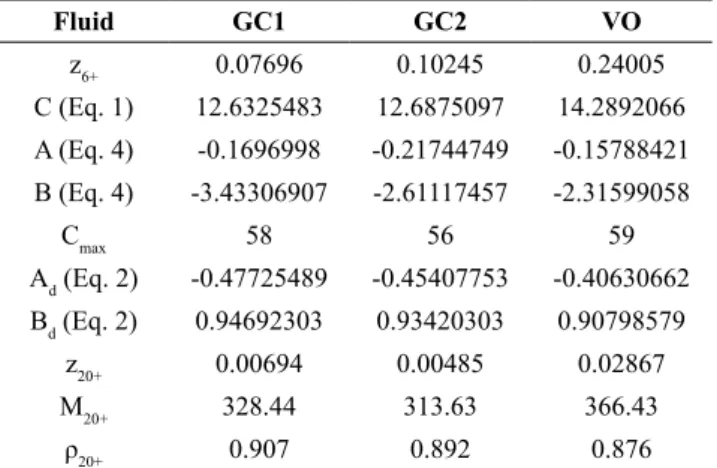
Table 4 presents the values of the different parame -ters involved for each of the analyzed gas condensate
fluids, and also a volatile oil from the FDC data base (VO in this work), whose composition and different
assigned values are given in Table 5. Details on the decomposition of the C20+ fractions, including car-bon numbers covered by each pseudo-compound and distribution of the z*M products, are given in Table 6.
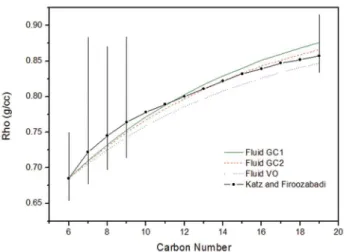
Figs. 1 and 2 show the molecular weight and den-sity functions obtained, in comparison to the
generali-zed values from Katz and Firoozabadi (1978) and also
some ranges of expected values. For fractions from C6 to C9 these ranges are given by the values corres-ponding to the single components that can be found, according to Table 2.4 in the book of Pedersen and Christensen (2006), while the ranges for C19 covers
the values found in more than 30 reservoir fluids taken
from the works of Pedersen et al. (1992), Jaubert et al. (2002) and also Chapter 3 in the book of Pedersen and Christensen (2006). In comparison to those ranges and generalized values, the trends resulting from our pro-posed methodology appear to be reasonable. The two gas condensates GC1 and GC2 show nearly the same line for molecular weights and similar curves for den-sities. The volatile oil presents the higher molecular weights and lower densities, which could be an
indica-tion of a more paraffinic fluid than the others.
Table 4: Parameters related to the proposed molecular weight and density functions, together with the
distribution of the C20+ fraction, for the three fluids
studied in this work.
Fluid GC1 GC2 VO
z6+ 0.07696 0.10245 0.24005
C (Eq. 1) 12.6325483 12.6875097 14.2892066
A (Eq. 4) -0.1696998 -0.21744749 -0.15788421
B (Eq. 4) -3.43306907 -2.61117457 -2.31599058
Cmax 58 56 59
Ad (Eq. 2) -0.47725489 -0.45407753 -0.40630662
Bd (Eq. 2) 0.94692303 0.93420303 0.90798579
z20+ 0.00694 0.00485 0.02867
M20+ 328.44 313.63 366.43
ρ20+ 0.907 0.892 0.876
Table 5: Composition for the Volatile Oil identified
as VO in this work.
Component Molar
Fraction
Molecular Weight
Density (g/cm3)
Nitrogen 0.00525 28.01
Carbon Dioxide 0.00193 44.01
Methane 0.51688 16.04
Ethane 0.10377 30.07
Propane 0.06374 44.09
iso-Butane 0.01214 58.12
n-Butane 0.03087 58.12
iso-Pentane 0.01123 72.15
n-Pentane 0.01414 72.15
C6 0.02090 84.00 0.685
C7 0.03031 98.29 0.706
C8 0.03803 112.58 0.725
C9 0.02621 126.87 0.743
C10 0.01964 141.16 0.759
C11 0.01438 155.45 0.773
C12 0.01111 169.74 0.786
C13 0.01073 184.02 0.797
C14 0.00905 198.31 0.808
C15 0.00827 212.60 0.817
C16 0.00661 226.89 0.826
C17 0.00595 241.18 0.834
C18 0.00546 255.47 0.841
C19 0.00473 269.76 0.847
C20+ 0.02867 366.43 0.876
Pseudo-component 1 0.00778 290.63 0.855
Pseudo-component 2 0.00567 319.21 0.865
Pseudo-component 3 0.00576 354.00 0.874
Pseudo-component 4 0.00519 408.19 0.885
Pseudo-component 5 0.00426 533.63 0.898
Table 6: Decomposition of the C20+ fraction from
each fluid into 5 pseudo-components.
Pseudo-component
GC1 GC2 VO
CN
range z*M
CN
range z*M
CN
range z*M
1 20-21 0.533 20 0.249 20-21 2.261
2 22-23 0.414 21-22 0.386 22-23 1.810
3 24-26 0.455 23-24 0.272 24-26 2.039
4 27-31 0.448 25-28 0.324 27-31 2.119
THERMODYNAMIC MODELLING
In this work we do not have the goal of achieving the best match or description of some behaviour for
the specific fluids studied. Instead, we rather want to use these cases in order to analyze how different as
-pects or parameters in the equation-of-state modelling of PVT properties may affect the results. Then, this
study is meant to provide some insight for future mo-delling works concerned with these types of reservoir
fluids, and probably help in guiding the definition of
new strategies for modelling algorithms.
Figure 1: Molecular weight values assigned to the reservoir fluids
according to the proposed methodology. Generalized values recommended
by Katz and Firoozabadi (1978) are included for comparison. Vertical bars
indicate ranges of expected values (see text).
Figure 2: Density values assigned to the reservoir fluids according to the
proposed methodology. Generalized values recommended by Katz and Firoozabadi (1978) are included for comparison. Vertical bars indicate
ranges of expected values (see text).
There are mainly three factors affecting the calcu
-lation of PVT properties, once an equation of state has been chosen to model a given reservoir fluid of known
composition, like the ones considered in this work: I) How to represent the residual heavy fraction, in
these cases C20+. Just as one pseudo-component? Decompose it? Into how many pseudo-compo-nents and how?
II) Critical temperatures and pressures (TC, PC), and also acentric factors, assigned to each pseudo--component from C6 on, typically as functions of density and molecular weight of each given frac-tion, and then eventually adjusted through some matching procedure.
III) Interaction parameters: typically the kij’s (attrac-tive ones) and alterna(attrac-tively lij’s (repulsive, not used in the common practice with classic models like PR).
In this study we defined and implemented three di
-fferent approaches in order to roughly see the effects
of choices regarding factors I and II:
Approach A: Fractions C6 to C19 are represented by n-alkanes with the same carbon numbers. The C20+ fraction is represented by another single n-alkane, the one with closest molecular weight.
Approach B: TC and PC for the pseudo-compo-nents representing fractions from C6 on are estimated by Pedersen correlations based on MW and density. The same for the acentric factor, using the correlation designed for PR. The C20+ is treated the same way, as if it were a single carbon number.
Approach C: Idem to Approach B, except that the
C20+ fraction is split into five pseudo-components wi
-th similar mass fractions. Details for -the fluids studied
here are provided in Table 6.
Note that Approach A, the simplest one, may be the least realistic among the three studied approaches. But it was considered in order to see –based on
compari-sons with Approach B- the effect of factor II on calcu -lations. Similarly, comparison between approaches B
and C will show the effects of decomposing the C20+
fraction (factor I).
In relation to factor III, we used approaches A to
C in two different ways: first a purely predictive mo -de, with default alkane-alkane interaction parameters taken from a previous work (Cismondi Duarte et al., 2015, adapted also to SCN cuts in approaches B and C as explained below). And then a matching mode,
whe-re a factor f affects all default interaction parameters
(both kij and lij for RKPR, kij for PR), and its value is
defined such that the experimental saturation pressure
Besides using estimated critical constants and acen-tric factors for any SCN fraction or pseudo-component in approaches B and C, their default parameters in the predictive mode were assigned according to the follo-wing rules:
- For the δ1 parameter (RKPR EoS) the following correlation defined by Cismondi Duarte et al.
(2015) for n-alkanes is adapted here for pseudo--components based on their molecular weights:
δ1 = 0.91 + 0.33 * CNEff * e
(-CNEff
11
)
M − 214
; CNEff = (6)
- Interaction parameters kij (with methane and pro-pane) and lij (with all lighter defined alkanes) are
estimated using the same RKPR correlations pro -posed for n-alkanes by Cismondi Duarte et al. (2015), dependent on the ac and δ1 parameters of the components involved, respectively.
- All interaction parameters between pseudo-com-ponents are zero.
- For the PR EoS all lij interactions are zero, while
kij‘s with the lighter components are estimated ba-sed on correlations like the ones uba-sed by Cismondi
Duarte et al. (2015), but using an effective carbon
number, calculated as (M-2)/14, instead of the no-minal carbon number.
Table 7 presents the required values of f with the
different approaches and two models, for the three fluids considered. Only in two cases (Approaches B and C with RKPR for fluid GC1) was it not possible
to match the saturation pressure with a positive f va-lue. Therefore, f = 0.50 (giving the lowest error with Approach B) and f = 0 (null interaction parameters for Approach C, in order not to invert the sense of the de-fault values) were applied for making the comparisons. Figs. 3 to 8 show the predicted phase envelopes for
the three fluids, with both the pure predictive and the
matching mode. There is a clear trend showing that the
extent of predicted immiscibility, and consequently
also the predicted saturation pressure, increases from approach A to B and from B to C.
Table 7: Matching of saturation pressure: Multiplying factors f for interaction parameters of the PR and RKPR
equations of state, with the different fluids studied in this work.
Fluid GC1 (Psat = 482.6 bar at 99.4 °C)
Fluid GC2 (Psat = 313.8 bar at 110 °C)
Fluid VO (Psat = 268.0 bar at 100 °C)
PR RKPR PR RKPR PR RKPR
Approach A 1.6707 1.4879 2.1294 1.8521 1.6461 1.3454
Approach B 0.9635 0.5 1.5515 2.2340 0.6709 0.9800
Approach C 0.6383 0 1.3267 1.4913 0.6715 0.9844
Figure 3: Pure predictions of the phase envelope for fluid GC1, with the
PR and RKPR equations of state and the three approaches considered.
Default interactions for alkanes assigned to all fractions.
Figure 4: Predictions of the phase envelope for fluid GC1 with the PR
and RKPR equations of state and the three approaches considered, when the f value in Table 7 multiplies all interactions in order to match the
Figure 5: Pure predictions of the phase envelope for fluid GC2, with the
PR and RKPR equations of state and the three approaches considered.
Default interactions for alkanes assigned to all fractions.
Figure 6: Predictions of the phase envelope for fluid GC2 with the PR
and RKPR equations of state and the three approaches considered, when the f value in Table 7 multiplies all interactions in order to match the
experimental saturation pressure at the reservoir temperature.
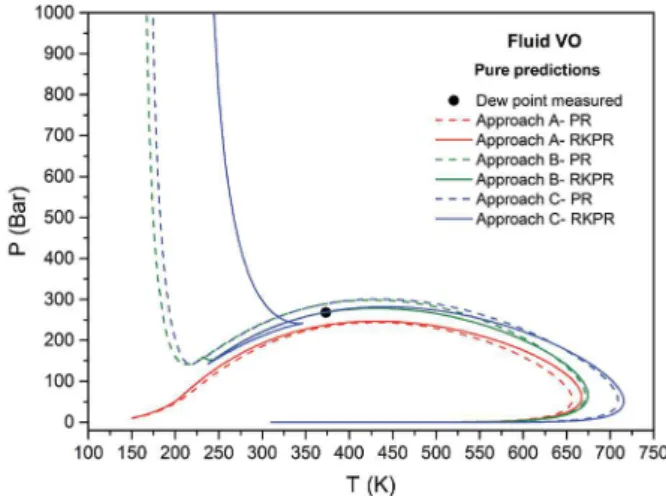
Figure 7: Pure predictions of the phase envelope for fluid VO, with the PR
and RKPR equations of state and the three approaches considered. Default
interactions for alkanes assigned to all fractions.
Figure 8: Predictions of the phase envelope for fluid VO with the PR
and RKPR equations of state and the three approaches considered, when the f value in Table 7 multiplies all interactions in order to match the
experimental saturation pressure at the reservoir temperature.
Accordingly, the f values in Table 7 show the oppo
-site evolution: Approach A always requires the highest
f values in order to match the experimental pressure,
while Approach C always requires values lower than
one, given the overestimation obtained from pure pre-dictions. Two partial exceptions can be observed: The
first one involves a very high f value for the GC2 fluid with RKPR and approach B, denoting a low sensitivi -ty of the envelope around the reservoir temperature, probably related to the combination of kij and lij inte-ractions. The second appears in the volatile oil (VO), where there is practically no change in the predicted
saturation pressure when going from approach B to C,
i.e., there is practically no effect from decomposing
the C20+ fraction in this regard.
It is important to remark that predictions
correspon-ding to Approaches B and C in Figs. 3, 5 and 7 should
not be considered as a demonstration of the predicti-ve potential of these approaches, since such potential could only be developed when appropriate interaction
weight and density of each fraction. Nevertheless, ap-proaches B and C have shown a reasonable predictive capacity for the saturation pressures available,
espe-cially with RKPR for the volatile oil.
Once again, we emphasize that the three
approa-ches implemented in this work were defined in order to study the effect of three different factors separately:
representation of the residual fraction, pure (pseudo-) component parameters and interaction parameters. Indeed, results in Figs. 3 to 8 show that all of them
play an important role in the fluids investigated, and that the effects are even more appreciable for the gas
condensates than for the volatile oil. Moreover, the
sa-me types of effects are observed either with the PR or the RKPR EoS.
A specific observation regarding the limitations of
Approach A can be made based on the results in Fig. 8. While the upper part of a gas condensate phase enve-lope can go either up or down in pressure as tempera-ture decreases, depending on the case (the divergence to higher pressures occurring for the most asymmetric
mixtures that show liquid-liquid like immiscibility), it most frequently goes down for a volatile or (espe -cially) black oil. This expected behaviour is indeed the one observed in Fig. 8 with approaches B and C, when the saturation pressure has been matched
throu-gh adjustment of the interaction coefficients (the on
-ly exception is given by approach B with RKPR, but liquid-liquid separation develops only up to tempera
-tures around 200 K). Nevertheless, the same procedu
-re leads to the artificial p-rediction of what could be a
wrong behaviour with approach A, apparently forced by the large values of interaction parameters that were
required to match the experimental saturation point. It
is interesting to see that this happens with both models,
even when they were parameterized very differently:
only constant kij values for the PR EoS (the classic way) and lij plus some temperature dependent kij for
the RKPR EoS (see Cismondi Duarte et al., 2015). It
should be noted that the crossings appearing in some
of the envelopes calculated with the RKPR EoS for the VO fluid denote three-phase behaviour, always below
the reservoir temperature, but we do not have evidence
to confirm or discard this possibility.
Other strong reasons for which it could be an
impor-tant mistake to represent the different SCN fractions as
n-alkanes are exposed in Fig. 9, which shows how the
M – ρ coordinates of real reservoir fluids are located at
important distances from the n-alkanes curve.
Figure 9: Data for reservoir fluids and their fractions, from three of the
main basins in Argentina (Canel and Mediavilla, 1990), in comparison to the n-alkanes molecular weight – density characteristic curve and the Cragoe Correlation (Craft and Hawkins, 1991). Points correspond to wells from the Vaca Muerta formation.
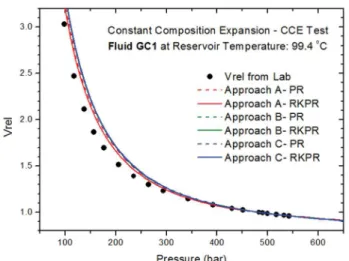
Figures 10 and 11 show the predicted liquid drop
--out curves for the GC1 and GC2 fluids, while the
corresponding pressure-volume curves are presented in Figs. 12 and 13. In all cases volume shift correla-tions were implemented. Predicted curves are shown in comparison to experimental data obtained from the CCE tests, as described before in the experimental section. Note that even when the reproduction of the saturation pressure is imposed on all approaches and models, the predicted retrograde behaviour below
su-ch common point can be very different from one case
to another (Figs. 10 and 11). The same observations
regarding the influence of all factors studied apply he -re, as for the prediction of phase envelopes. On the contrary, all pressure-relative volume curves look very
similar in Figs. 12 and 13. In the case of fluid GC2 (Fig. 13) curves seem to be affected only by the EoS
and not by the approach, with a better approximation
to the experimental curve by the RKPR EoS.
On the other hand, something that is specific to
the retrograde condensation curves and could not be
to Approach B with the same model. The effect is
perhaps clearer for GC2, with the B-C crossings at lower pressures, and also higher maximum values of condensation with Approach C, for which results are closer to the experimental. The same is valid for GC1
with PR and, in a way, also with RKPR except for the
shift in the curve for approach C, due to not matching the saturation pressure.
Figure 10: Predictions of the liquid drop-out curve for fluid GC1 at 372.55
K, with the PR and RKPR equations of state and the three approaches
considered. The f value in Table 7 multiplies all interactions in order
to match the experimental saturation pressure. Black dots represent measurements.
Figure 11: Predictions of the liquid drop-out curve for fluid GC2 at 383.15
K, with the PR and RKPR equations of state and the three approaches
considered. The f value in Table 7 multiplies all interactions in order
to match the experimental saturation pressure. Black dots represent measurements.
Figure 12: Predictions for the CCE Pressure-Volume curve for fluid
GC1 at 372.55 K, with the PR and RKPR equations of state and the three
approaches considered. The f value in Table 7 multiplies all interactions in
order to match the experimental saturation pressure. Black dots represent measurements
Figure 13: Predictions for the CCE Pressure-Volume curve for fluid
GC2 at 383.15 K, with the PR and RKPR equations of state and the three
approaches considered. The f value in Table 7 multiplies all interactions in
order to match the experimental saturation pressure. Black dots represent measurements.
This improvement would confirm the effect and ne -cessity of decomposing the C20+ fraction.
What was not expected are the correct shapes of the curves predicted with Approach A (only with the
RKPR EoS), even with a reasonable quantitative agre
-ement with the data for the GC1 fluid in Fig. 10. So far,
CONCLUSIONS
Compositional and PVT data have been reported
for two gas condensate fluids from the Vaca Muerta
formation in Argentina. Motivated by the fact that ea-ch composition was analyzed only by ea-chromatography, without making density and molecular weight measu-rements for each single fraction, a new methodology was developed to estimate these properties from C6 to C20+, based on selected functionalities with carbon
number and on measured values for the fluid. The pro
-posed strategy avoids use of the unique generalized values from Katz and Firoozabadi (1978) and would allow, instead, capturing the different characteristics of each fluid. It was applied to the two gas condensa
-tes, and also a third fluid classified as volatile oil.
A thermodynamic modelling study was carried out
for the three fluids, based on the PR and RKPR equa
-tions of state and three different approaches designed to evaluate the effects of different factors or degrees of
freedom involved in this type of modelling. In appro-ach A eappro-ach SCN fraction is treated as a normal alka-ne, while correlations based on density and molecular weight are used to estimate each fraction parameters in approaches B an C. Only in approach C a split of
the C20+ fraction into five pseudo-components is
performed.
Clear differences were found from the application of approaches A, B and C, and different observations were made that could help to define a more specific and complete methodology aiming at the quantitative description of the PVT behaviour of this type of fluids.
Both the phase envelopes and isothermal retrograde
condensation curves turned out to be quite sensitive to
the modelling approach, but not the CCE
pressure-re-lative volume curves. In particular, the best qualitative
representation of the experimental retrograde behavior in the CCE experiment for the gas condensates was obtained with approach C. This involves especially the higher pressure region, where the heaviest fractions
condense first, and would be a consequence of the mo -re detailed t-reatment of the C20+ fraction through 5
different pseudo-components. Much better quantita -tive results are expected for the near future if some
RKPR parameters are correlated with properties of the different fluid cuts, like density and molecular weight.
ACKNOWLEDGEMENTS
We want to thank Osvaldo Migliavacca for his work in the PVT lab.
We also acknowledge the financial support received
from the following Argentinean institutions: Consejo
Nacional de Investigaciones Científicas y Técnicas de
la República Argentina (CONICET), Agencia Nacional
de Promoción Científica y Tecnológica (ANPCyT),
and Universidad Nacional de Córdoba (UNC).
NOMENCLATURE
Abbreviations
CCE: Constant Composition Expansion.
CME: Constant Mass Experiment.
CN: Carbon Number.
EoS: Equation of State.
FDC: Field Development Consultants (FDC de Argentina SRL)
GC1: Gas Condensate fluid (N°1). GC2: Gas Condensate fluid (N°2). GOR: Gas-Oil Ratio.
HP: Hewlett-Packard
ITBA: Instituto Tecnológico de Buenos Aires
PR: Peng-Robinson equation of state. PV: Pressure-Volume.
PVT: Pressure, Volume and Temperature.
RKPR: Generalized
Redlich-Kwong-Peng-Robinson equation of state.
SCN: Single Carbon Number.
TBP: True Boiling Point.
VO: Volatile Oil fluid.
Roman letters
A: Constant in Eq. (4) for the estimation of
a SCN mole fraction.
Ad: Constant in Eq. (2) for the estimation of
a SCN fraction density.
B: Constant in Eq. (4) for the estimation of
a SCN mole fraction.
Bd: Constant in Eq. (2) for the estimation of
a SCN fraction density.
C: Constant in Eq. (1) for the estimation of
a SCN fraction molecular weight.
Ci (i=6 to 19): Hydrocarbon cut or fraction of the
reservoir fluid.
Ci+ (i=6, 7, 10, 20, 30 or 35): Residual fraction of
the reservoir fluid, containing the SCN
fractions starting from i and higher.
Cmax: For a given distribution of the C20+
f: factor involved in the matching mode.
i: number identifying a hydrocarbon SCN cut or fraction.
kij: attractive interaction parameter between compound “i” and compound “j”.
lij: repulsive interaction parameter between compound “i” and compound “j”.
M: Molecular weight.
m: Collected mass.
M20+: Molecular weight of the residual fraction C20+.
Nps: Number of pseudo-components.
P: Pressure.
T: Temperature.
V: Volume.
V6+: The volume occupied by the C6+
frac-tion per mole of total fluid. Since it is de
-fined just as an auxiliary variable in the
procedure of assigning density values for
the different SCN and residual fractions,
it refers to the same standard conditions
for which densities are defined.
z: Mole fraction.
z6+: Mole fraction of the residual fraction C6+.
z20+: Mole fraction of the residual fraction C20+.
Greek letters
ρ Density.
ρ20+ Density of the residual fraction C20+. Super/subscripts
c Critical property.
calc Calculated property.
i number identifying a hydrocarbon SCN cut or fraction.
sat saturation state.
REFERENCES
Beckwith, R., Shale Gas: Promising Prospects Worldwide. Journal of Petroleum Technology,
63(07), 37-40 (2011).
Beckwith, R., The trend toward shale oil. Journal of
Petroleum Technology, 63(7), 42-43 (2011).
Canel C. and Mediavilla J., Estudios PVT a partir de datos de boca de pozo. Proceedings of the 2das Jornadas de Informática Aplicada a la Producción. Argentina (1990).
Cismondi, M. and Mollerup, J., Development and
Application of a Three-Parameter RK-PR Equation
of State. Fluid Phase Equilibria, 232, 74-89 (2005).
Cismondi Duarte, M., Cruz Doblas, J., Gomez, M.J., Montoya, G.F., Modelling the phase behavior of alkane mixtures in wide ranges of conditions: New parameterization and predictive correlations
of binary interactions for the RKPR EOS. Fluid
Phase Equilibria, 403, 49-59 (2015).
Craft, B. C., and Hawkins, M., Applied Petroleum Reservoir Engineering, Prentice Hall PTR,
Englewood Cliffs, NJ 07632, 2nd ed. (1991).
Danesh, Ali, PVT and Phase Behavior of Petroleum Reservoir Fluids, Elsevier (1998).
Jaubert, J-N, Avaullee, L. and Souvay, J-F. A crude oil data bank containing more than 5000 PVT and gas injection data. Journal of Petroleum Science and
Engineering 34, 65–107 (2002).
Katz, D.L. and Firoozabadi, A., Predicting phase
behavior of condensate/crude-oil systems using
methane interaction coefficients, J. Petroleum Technol. 20, 1649–1655 (1978).
Pedersen, K.S., Blilie, A.L., Meisingset, K.K., PVT calculations on petroleum reservoir fluids using
measured and estimated compositional data for the
plus fraction, Ind. Eng. Chem. Res. 31, 1378–1384
(1992).
Pedersen, K.S. and Christensen, P.L. , Phase Behavior
of Petroleum Reservoir Fluids, CRC/Taylor & Francis, Boca Raton (2006).
Peng, D.-Y., Robinson, D.B., A New Two-Constant
Equation of State, Industrial & Engineering Chemistry Fundamentals, 15, 59-64 (1976).
Ramello, J.I. and Cismondi, M., On the estimation
of carbon number distributions in reservoir fluids
heavy fractions: Revision of the logarithmic relation and proposition of a new simple and