Department of Social and Organizational Psychology
Putting some order in person memory:
Memory for (serial) order in impression formation
Rui S. Costa
Thesis submitted in partial fulfillment of the requirements for the degree of Doctor in Social and Organizational Psychology
Specialty in Social Psychology
Supervisor: Leonel Garcia-Marques
University of Lisbon Co-supervisor: Jeffrey W. Sherman University of California, Davis
The present work was sponsored by a Doctoral Grant (Ref. SFRH/BD/23748/2005) of the Science and Technology Foundation (FCT), Portugal, and the Program POCI2010, which is funded by the Portuguese Ministry of Science, Technology and Higher Education, and the European Social Fund (Community Support Framework III).
European Union European Social Fund
Governo da República Portuguesa
Key Words: social cognition, person memory, impression formation, memory for order information
American Psychological Association (PsycINFO Classification Categories and Codes) 2340 Cognitive Processes
2343 Learning & Memory 3000 Social Psychology
Acknowledgments
Here we are. The thesis – also known among friends as the monster, or simply, the beast – reached its finale! So, first, I want to thank the monster for being done. Not sure whether this “thank you monster” is a very common procedure, but it felt necessary. A disclaimer is needed, dear reader. I hope you will pardon this drivel: bear in mind that I am among the few that leave the writing of these lines to the very last minute. So, some delusion is understandable.
A bit more seriously now. First of all I want to thank Leonel. Surprisingly, this part is, at the same time, extremely easy and difficult. On the one hand, it is easy to picture the things for which I am grateful to Leonel. On the other hand, one quickly notices that this is an impossible choice from an endless pool. Leonel has been incredibly more than a brilliant and caring advisor. In fact, I am thankful for so many things that I prefer to simply say: thank you for having me as a friend and colleague. It has been an incredible honor, privilege and pleasure to share my professional and academic life with you, as well as to be your friend. Your brilliance as an academic, together with your beauty as a person, makes you an unusual and amazing mentor, one that insists in making close friends out of his students. For all that, a profound and touched thank you.
I am also extremely thankful to Jeff, for accepting me as a doctoral student and receiving me in Davis. Thank you for being so supportive and encouraging regarding research, and all the ideas and projects I have brought to you. Thanks for being constantly available and open to exchange ideas about science and much more. Thanks for all the truly bright insights, comments, conversations and drinks tempered with honest friendship. Also, thank you, Jeff, for being the scientist you are, one of the most inspiring people in social cognition.
I also want to thank the research teams that I have taken part of during the last 4 years and that contributed so deeply to shape this research project and myself as a researcher. First, the SOCAS research team (aka SOcial Cognition bAsket aSsociation), constituted by the joint labs of Leonel and Tammy Garcia-Marques. I am extremely thankful to Leonel, Marga, Sofia, Sara, Ritinha J., Mário, Tomás, Tânia, Sérgio, Rui, André, David K., Ludmila, and also Tammy, Pedro, Ritinha S., Alexandre, Marília, David R., Ricardo and Ana, for providing such a fascinating, warm and stimulating research environment. Second, I am extremely thankful to all the members of the Social Cognition Lab at UC Davis, for making it such an extraordinary dynamic lab, for hosting me, providing full support, resources, and all that led me to consider Davis as my second home. I am especially grateful to Tom, Karen, Dario and Courtney. Also, special thanks to all the Research Assistants at the Social Cognition Lab for their dedicated collaboration in most of the studies reported here. Thanks to Fionnuala for the long and fascinating conversations, and also Yanine, Kelly, Cindy and Alison for the joint lab meetings.
away from home a better experience. Thanks to GCIR research group and all its members for providing such a stimulating research environment. To DEPSO and CIS for placing ISCTE in the international research scene.
A word of gratitude to the Science and Technology Foundation (FCT) that provided me financial support throughout these four years with a doctoral grant.
A very special thank you to all that contributed so carefully to shape the final form of this thesis. Su, Sara, Marga, Sofia and Ian, I am profoundly thankful for your wise and detailed revisions. Ian, my friend, the native English speaker that so gently accepted to review this work. Su, Sara, Marga and Sofia, for even before I have asked for your for help, you have offered it. I also want to thank my amazing friends that so closely followed the unfolding of this work, with constant support and care. Thanks Sofia, Marga, Sara and Tomás.
I also want to thank my family. For their constant support, care, friendship, tolerance, happiness, ideology, fierce discussions and all the things with which all of them contributed to make me the way I am. I owe you all profoundly. Thank you beautiful and crazy family for being so kind, gentle, honest, pure and ideologically beautiful. What I am as a person, way beyond what I am as a researcher, is greatly due to your amazing influence. I would like to leave special thanks to my parents and siblings. To my dad, for being a constant source of inspiration that showed me the beauty of ideas. To my mom, the most profound gratitude, for having me in such high standards and turning the world upside down to make me a better person – you are a constant and unlimited source of love, support and energy and an example that I hope I will be able to honor – you are the person I owe the most. I would also like to say “thank you” Tita Catita, Aurora, Artur, Alentejo, André, Pedro, Ritinha, Marta, Joana, Carolina for being part of what I care the most. To my beautiful little sister – Manana – that is only 10 but already asserts that I should thank her here because she gives me “good ideas”. To Luís and his constant happiness and energy. Then, to my most beloved brother that I miss dearly, every day, thank you for being you, someone that is so genuinely good that sometimes hurts. I will get to Su soon, but a word is necessary to those that are now part of my family as well: Vira and Zé for taking me as your own. To Si and Cláu for being so good friends. To my dearest beloved niece – Nhinhinha – that with 2 years old has a smile that makes the world a better place.
Finally, I want to thank Su for being undoubtedly the most important thing in my life. You are all that matters. You are like the most fundamental laws of physics – if without the principle of the conservation of energy the universe would not be possible, without you I would be meaningless. Thank you for your love, trust, constant support, help, and above all, for your smile, still the most beautiful thing I have ever seen. For offering me that, I owe you all, my beautiful companion and I dedicate you this work with all my deep love.
Abstract
The present work examines the representation and retrieval of order information in person memory. The study of memory for serial order has been absent from the research on the underling memory processes of impression formation, which has been focusing exclusively on item information. In this work we argue that our understanding of person memory is incomplete without an account for order and item information representation and retrieval. According to a chaining hypothesis, we predicted that the organizational processes involved in impression formation would hinder the ability to represent order by means of associations between items in successive positions. The first three experiments indicated, contradicting our hypothesis, that when people form impressions they are able to represent, retrieve and use order information for order judgements and (serial) recall. The two following studies, experiment 4 and 5, directly manipulated the associations that were built in memory when people formed impressions, to understand whether order information representation was based on associations between items that appeared in successive serial positions. Results showed that the ability to use order information was unaffected by changes in the structure of non-serial inter-item associations, which suggests that order representation is not derived from mere serial associations. Experiment 6, the last from the set of experiments reported here, suggested that the representation of order information is less dependent on episodic memory, in contrast to item information. The findings from this set of 6 experiments suggested, firstly, that when people form impressions they are able to reconstruct serial order (even when such order has no meaning), and secondly, that order representation in person memory seem not to be derived from the inter-item associations formed at encoding. Finally, an ordinal proposal for the representation and use of order in person memory is discussed.
Resumo
O objectivo central do presente trabalho é o estudo da representação e recuperação da informação de ordem em memória de pessoas. A memória de ordem serial tem permanecido fora da investigação sobre os processos mnésicos subjacentes à formação de impressões, investigação esta que se tem centrado exclusivamente na informação de item. Argumentamos que o conhecimento sobre memória de pessoas não pode ser completo sem que haja uma compreensão dos processos envolvidos na representação e recuperação da informação de ordem. De acordo com a hipótese de chaining, os processos que caracterizam a formação de impressões prejudicam o estabelecimento de associações entre itens em posições sucessivas, interferindo com a representação da informação de ordem. As três primeiras experiências sugerem, contrariamente ao esperado, que quando as pessoas formam impressões estão a representar informação de ordem, que pode ser utilizada em tarefas de julgamento e recordação. Nas experiências 4 e 5 manipulámos directamente as associações que se formam durante a codificação, quando as pessoas formam impressões, tentando perceber se a representação de ordem se basearia em associações entre itens em posições seriais sucessivas. Os resultados indicam que, independentemente da mudança na densidade associativa da rede, a capacidade de os participantes acederem e utilizarem informação de ordem não é afectada. Estes dados sugerem que a representação da informação não acontece pela mera associação de itens em posições sucessivas. A experiência 6 sugere que a representação da informação de ordem, em contraste com a informação de item, depende menos da memória episódica. Este conjunto de resultados sugere (i) que quando as pessoas formam impressões são capazes de reconstruir a ordem e (ii) que a representação da informação de ordem em memória de pessoas não é dependente das associações que se estabelecem entre os itens, durante a codificação. Finalmente, uma proposta ordinal para a representação e recuperação da ordem
TABLE OF CONTENTS
INTRODUCTION...1
0. OVERVIEWOFTHE INTRODUCTORY SECTION...1
1. COGNITIVE REPRESENTATIONSOF PEOPLEAND PERSON MEMORY...6
1.1. Representing people in memory: Social cognition from the cognitive revolution to the present day...6
1.1.1. Theoretical and methodological contributions...6
1.1.2. Representations of people: Impressions, the person representations...8
1.1.3. Studying impression formation: A long history...9
1.1.4. The contribution of social cognition to the study of impression formation (or how the study of impression formation adopted the principles of the renaissance)...17
1.1.5. Summary – Section (1.1.): Representing people in memory, social cognition from the cognitive revolution to the present day...20
1.2. Person Representations: Impressions in Person Memory...21
1.2.1. Impression: A definition...21
1.2.2. The Incongruency effect...27
1.2.3. Person memory modeling: Accounts for (impression formation and) the incongruency effect...31
i) Modeling the incongruency effect – Take 1: The seeds...33
i.i. von Restorff effect...34
i.ii. Schemas...35
i.iii. Human associative memory model...36
i.iv. Levels of processing approach...42
ii) Modeling the incongruency effect – Take 2: The person memory model(s)...45
ii.i. Person memory model...45
complementary proposals...61
iii.i. Item vs. relational processing...61
iii.ii. Encoding flexibility model...64
iii.iii. Flexible use of source information model...66
iii.iv. Trait inference inhibition model...69
iii.v. Semantic and episodic memory distinction in the incongruency effect...72
1.2.4. Elements of the associative network models...73
1.2.5. Summary – Section (1.2.): Person representations, impressions in person memory...77
1.3. Summary – Chapter (1): Cognitive Representations of People and Person Memory...78
2. SERIAL POSITION EFFECTSAND ORDER EFFECTSIN SOCIAL PSYCHOLOGY...79
2.1. Serial position and order effects in the study of impression formation...80
2.1.1. Serial position effects on judgment...83
i) Primacy effect...83
2.1.2. Serial position effects on recall...84
i) Recency effect...84
ii) Moving forward: Primacy and recency or, the serial position effect in impression formation ...86
2.1.3. Order effects on judgment ...87
i) Distinctive item effect...87
2.1.4. Summary – Section (2.1.): Serial position effects in the study of impression formation...88
2.2. Event Memory: The case of temporality in Social Memory, or An Approach to Memory for Order in the Representation of Social Information...89
2.2.1. Event memory and memory for sequences...92
i) Prototypical events (and order)...95
ii) Nonprototypical events and order...96
2.2.3. Summary – Section (2.2.): Event memory, the case of temporality in social memory, or an approach to memory for order in the representation of social
information...104
2.3. Order information in person memory: A crucial element to make sense of the (impression formation) world...104
2.3.1. The role of order information in making sense of the world (or, is it possible to make sense of the world without order information?)...104
2.3.2. Order effects vs. The representation of order information: An important distinction and a missing link in person memory...106
i) Order effects...107
ii) Order information...108
iii) The representation of order information...108
2.3.3. Summary – Section (2.3.): Order information in person memory, a crucial element to make sense of the (impression formation) world...109
2.4. Summary – Chapter (2): Serial Position Effects and Order Effects in Social Psychology...109
3. MEMORYFOR SERIAL ORDERIN HUMAN MEMORY...111
3.1. Types of information in the cognitive mind and general considerations within memory for serial order...112
3.1.1. Defining concepts: Types of information...113
i) Item information...113
ii) Order information...114
iii) Associative information...114
3.1.2. Two tasks generally used in memory for serial order...116
3.1.3. Two findings widely found in memory for serial order...117
3.1.4. Summary – Section (3.1.): Types of information in the cognitive mind and general considerations within memory for serial order...119
3.2. Memory for serial order and long-term memory...119
3.2.2. Summary – Section (3.2.): Memory for serial order and long-term memory
...121
3.3. Theories of memory for serial order...122
3.3.1. Positional theory...123
i) Representation of order information...123
ii) Retrieval of order information...124
iii) Models...125
3.3.2. Chaining theory...131
i) Representation of order information...132
ii) Retrieval of order information...132
iii) Models...133
3.3.3. Ordinal theory...137
i) Representation of order information...138
ii) Retrieval of order information...139
iii) Models...139
3.3.4. Long-term memory: The case of the chaining and ordinal models...144
3.3.5. Summary – Section (3.3.): Theories of memory for serial order...145
3.4. Summary – Chapter (3): Memory for Serial Order in Human Memory...145
THEORETICAL PROPOSAL/CONTRIBUTION...147
1. THE THEORETICALAND EMPIRICAL PROPOSALOFTHE PRESENT PROJECT...147
1.1. Order information in person memory: A theoretical possibility...148
1.1.1. Three theories of memory for serial order...148
1.1.2. Chaining proposal: An associative chaining person memory model for order information...148
1.1.3. Impression formation according to the chaining proposal...150
similar hypothesis...155
1.2. Summary – Chapter (1): The Theoretical and Empirical Proposal of the Present Project...157 2. GENERAL HYPOTHESES...158 EXPERIMENTAL RESEARCH...161 1. EXPERIMENT 1...161 1.1. Research question...162 1.2. Hypotheses...164 1.3. Method...165 Participants...165 Design...166 Material...166 Procedure...167 Dependent measures...167 Order memory...167 Item memory...168 1.4. Results...169 Item Memory...169 Order Memory...170 1.5. Discussion...172 2. EXPERIMENT 2...177 2.1. Research question...177 2.2. Hypotheses...179 2.3. Method...180
Participants...180 Design...180 Material...180 Procedure...180 Dependent measures...181 Item memory...181 Order memory...181 Chaining...181 2.4. Results...181 Item Memory...181 Order Memory...182 Chaining...182 2.5. Discussion...183 3. EXPERIMENT 3...187 3.1. Research question...188 3.2. Hypotheses...190 3.3. Method...191 Participants...191 Design...192 Material...192 Procedure...192 Dependent measures...193 Item memory...193 Order memory...193 3.4. Results...193 Item Memory...193 Order Memory...194 3.5. Discussion...196
4. EXPERIMENT 4...202 4.1. Research question...203 4.2. Hypotheses...205 4.3. Method...207 Participants...207 Design...207 Material...207 Procedure...208 Dependent measures...209 Item memory...209 Order memory...209 4.4. Results...209
Item Memory: congruent and irrelevant items (for the lists that had no incongruent information)...210
Item Memory: congruent, incongruent and irrelevant items (for the lists that had incongruent information, that is, the incongruent lists) 212 Order Memory...214 4.5. Discussion...216 5. EXPERIMENT 5...220 5.1. Research question...220 5.2. Hypotheses...222 5.3. Method...223 Participants...223 Design...223 Material...224 Procedure...224 Dependent measures...225 Item memory...225
5.4. Results...226 Item Memory...226 Order Memory...227 5.5. Discussion...228 6. EXPERIMENT 6...231 6.1. Research question...232 6.2. Hypotheses...233 6.3. Method...234 Participants...234 Design...234 Material...235 Procedure...235 Dependent measures...236 Item memory...236 Order memory...236 6.4. Results...236 Item Memory...236 Order Memory...237 6.5. Discussion...239
GENERAL DISCUSSION AND CONCLUSIONS...243
1. Summary of the main findings...243
1.1. Experiment 1...244 1.2. Experiment 2...245 1.3. Experiment 3...246 1.4. Experiment 4...247 1.5. Experiment 5...248
1.6. Experiment 6...249 1.7. Summary...250
2. Contributions...251
2.1. Revisiting the existing theories and the current data...251 i) The event memory proposal...251 ii) The chaining proposal...252 2.2. Alternative proposal: Directions for an ordinal model of order information in person memory...255
i) Ordinal proposal: Coding for an ordinal dimension in person memory 257 i.i. Episodic and episodic-independent memory in order information in person memory...259 i.ii. Summing up...260 ii) Modeling order information in person memory: An indirect route...260 iii) Summary...261
3. Empirical limitations and future directions...262
3.1. Serial position and informativeness: A plausible ordinal dimension...262 3.2. Future studies...263 i) Pilot study...263 ii) Experiment 1...264 iii) Experiment 2...265 iv) Experiment 3 ...265 REFERENCES...269 APPENDICES...297 APPENDIX I – EXPERIMENT 1...297 1. Stimulus Material...297 1.1. Artistic behaviors...297 1.2. Intelligent behaviors...298
1.3. Ecollogical behaviors...299 1.4. Friendly behaviors...300 1.5. Version 1 of the stimulus list...301 1.6. Version 2 of the stimulus list...304 1.7. Version 3 of the stimulus list...307 1.8. Version 4 of the stimulus list...310
2. Instructions...313
2.1. General instructions...313 2.2. Processing Goal instructions...314 i) Impression Formation...314 ii) Memorization...315 iii) Memorization of Order...316 2.3. Recall instructions...317 i) Order Measure...317 ii) Item Measure...318 2.4. Final instructions...319
3. Dependent Variables...320
3.1. Order Measure...320 3.2. Item Measure...323
4. Test of Normality and Homogeneity of Variances...324
4.1. Normality...324 i) Item measure...324 ii) Order measure...324 4.2. Homogeneity of Variances...325 i) Item measure...325 ii) Order measure...325
APPENDIX II – EXPERIMENT 2...326 1. Stimulus Material...326 1.1. Friendly behaviors...326 1.2. Neutral behaviors...327 2. Instructions...328 2.1. General instructions...328 2.2. Processing Goal instructions...329 i) Impression Formation...329 ii) Memorization...330 iii) Memorization of Order...331 2.3. Recall instructions...332
3. Dependent Variables...333
3.1. Item Measure...333 3.2. Order Measure...334 3.3. Chaining Measure...335
4. Test of Normality and Homogeneity of Variances...336
4.1. Normality...336 i) Item measure...336 ii) Order measure...336 4.2. Homogeneity of Variances...337 i) Item measure...337 ii) Order measure...337 APPENDIX III – EXPERIMENT 3...338
1.2. Kind/Friendly behaviors...339 1.3. Adventurous behaviors...340 1.4. Extraverted behaviors...341
2. Instructions...342
2.1. General instructions...342 2.2. Processing Goal instructions...343 i) Impression Formation...343 ii) Memorization of Order...344 2.3. Recall instructions...345 i) Free Recall...345 ii) Ordered Recall...346
3. Dependent Variables...347
3.1. Item Measure...347 3.2. Order Measure...348
4. Test of Normality and Homogeneity of Variances...350
4.1. Normality...350 i) Item measure...350 ii) Order measure...350 4.2. Homogeneity of Variances...351 i) Item measure...351 ii) Order measure...351 APPENDIX IV – EXPERIMENT 4...352
1. Stimulus Material...352
1.1. Irrelevant behaviors...352 1.2. Intelligent behaviors...353
1.3. Stupid behaviors...354 1.4. Friendly behaviors...355 1.5. Unfriendly behaviors...356
2. Instructions...357
2.1. General instructions...357 2.2. Processing Goal instructions...358 i) Impression Formation...358 ii) Memorization of Order...359 2.3. Expectancies...360 i) Intelligent...360 i.i. Impression Formation...360 i.ii. Memorization of Order...360 ii) Stupid...361 ii.i. Impression Formation...361 ii.ii. Memorization of Order...361 iii) Friendly...362 iii.i. Impression Formation...362 iii.ii. Memorization of Order...362 iv) Unfriendly...363 iv.i. Impression Formation...363 iv.ii. Memorization of Order...363 2.4. Recall instructions...364 i) Free Recall...364 ii) Ordered Recall...365
3. Dependent Variables...366
3.1. Item Measure...366 3.2. Order Measure...367
4. Test of Normality and Homogeneity of Variances...369
ii) Order measure...369 4.2. Homogeneity of Variances...370 i) Item measure...370 ii) Order measure...370 APPENDIX V – EXPERIMENT 5...371 1. Stimulus Material...371 1.1. Intelligent behaviors...371 1.2. Kind/Friendly behaviors...372 1.3. Adventurous behaviors...373 1.4. Extraverted behaviors...374 2. Instructions...375 2.1. General instructions:...375 2.2. Processing Goal instructions...376 i) Impression Formation...376 ii) Memorization of Order...377 iii) Different Processing Goal instructions – impression formation:...378 2.3. Recall instructions...379 i) Free Recall...379 ii) Ordered Recall...380
3. Dependent Variables...381
3.1. Item Measure...381 3.2. Order Measure...382
4. Test of Normality and Homogeneity of Variances...384
4.1. Normality...384 i) Item measure...384
4.2. Homogeneity of Variances...385 i) Item measure...385 ii) Order measure...385 APPENDIX VI – EXPERIMENT 6...386 1. Stimulus Material...386 1.1. Intelligent behaviors...386 1.2. Kind/Friendly behaviors...387 1.3. Adventurous behaviors...388 1.4. Extraverted behaviors...389 2. Instructions...390 2.1. General instructions:...390 2.2. Processing Goal instructions:...391 i) Impression Formation...391 ii) Memorization of Order...392 2.3. Directed forgetting instructions:...393 i) Forget...393 i.i. Impression Formation...393 i.ii. Memorization of Order...393 ii) Remember...394 ii.i. Impression Formation...394 ii.ii. Memorization of Order...394 2.4. Recall instructions...395 i) Free Recall...395 i.i. Remember...395 i.ii. Forget...395 ii) Ordered Recall...396 ii.i. Remember...396 ii.ii. Forget...396
3.1. Item Measure...397 3.2. Order Measure...398
4. Test of Normality and Homogeneity of Variances...400
4.1. Normality...400 i) Item measure...400 ii) Order measure...400 4.2. Homogeneity of Variances...401 i) Item measure...401 ii) Order measure...401
INDEX OF FIGURES
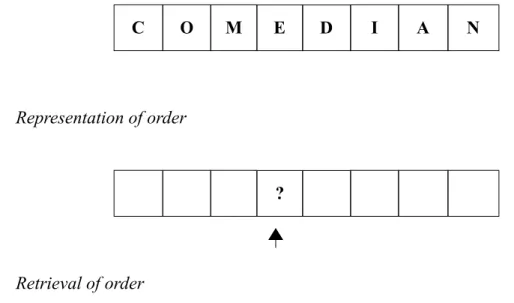
Figure 1: Representation and retrieval of order for a sequence of eight items, COMEDIAN,
according to a Positional model – inspired in Conrad's (1965) Box model (adapted from Henson, 1996).Overview of the Introductory Section...127
Figure 2: Representation and retrieval of order for a sequence of eight items, COMEDIAN,
according to a Positional model – inspired in Burges and Hitch's (1992) Articulatory Loop model (adapted from Henson, 1996)...129
Figure 3: Representation and retrieval of order for a sequence of eight items, COMEDIAN,
according to a Simple Chaining model – inspired in Crowder (1968) model (adapted from Henson, 1996)...134
Figure 4: Representation and retrieval of order for a sequence of eight items, COMEDIAN,
according to a Compound Chaining model – inspired in Ebbinghaus (1885/1964) chaining model (adapted from Henson, 1996)...135
Figure 5: Representation and retrieval of order for a sequence of eight items, COMEDIAN,
according to an Ordinal model – inspired in Page and Norris' (1996) Primacy model (adapted from Henson, 1996)...142
Figure 6: Mean recall of targets as a function of the processing goal (IF: impression
formation; M: memorization; MO: memorization of order)...169
Figure 7: Index of order (0-3) as a function of the behavior's target...170 Figure 8: Index of order (0-3) as a function of the processing goal and behavior's target....171 Figure 9: Index of order (0-3) as a function of the behavior's target and behavior's
position...172
Figure 10: Proportion of recalled items as a function of the processing goal...182 Figure 11: Proportion of chaining as a function of the processing goal...183
Figure 13: Index of order (0-1) as a function of the processing goal...194 Figure 14: Index of order (0-1) as a function of the recall mode...195 Figure 15: Index of order (0-1) as a function of the processing goal and recall mode...196 Figure 16: Proportion of recalled items as a function of the processing goal...210 Figure 17: Proportion of recalled items as a function of the item type...211 Figure 18: Proportion of recalled items as a function of the processing goal and item
type...211
Figure 19: Proportion of recalled items as a function of the processing goal...212 Figure 20: Proportion of recalled items as a function of the item type...213 Figure 21: Proportion of recalled items as a function of the processing goal and item
type...214
Figure 22: Index of order (0-1) as a function of the processing goal...214 Figure 23: Index of order (0-1) as a function of the recall mode...215 Figure 24: Index of order (0-1) as a function of the processing goal and recall mode...216 Figure 25: Proportion of recalled items as a function of the processing goal...226 Figure 26: Index of order (0-1) as a function of the recall mode...227 Figure 27: Index of order (0-1) as a function of the processing goal and recall mode...228 Figure 28: Proportion of recalled items as a function of the processing goal...236 Figure 29: Proportion of recalled items as a function of the processing goal and directed
forgetting...237
Figure 30: Index of order (0-1) as a function of the recall mode...238 Figure 31: Index of order (0-1) as a function of the processing goal and recall mode...239
INTRODUCTION
0. OVERVIEWOFTHE INTRODUCTORY SECTION
“The importance of the order of impressions of a person in daily experience is a
matter of general observation and is perhaps related to the process under investigation. It may be the basis for the importance attached to first impressions. It is a matter of general experience that we may have a “wrong slant” on a person, because certain characteristics first observed are given a central position when they were actually subsidiary, or vice versa.”
Solomon Asch, 1946, p.273 Experiment VII
Today is a typical day. As usual, you get up and it is still dark outside. Across the street, the park quietly awakes. You get your running gear and head out for your daily run into the darkness, before the first light arrives. Brr, it is cold today. As soon as you leave the door you can see your breath. You start running right away. Today you decide to go right, running anti-clockwise in the greenbelt park. No, you are not alone in your early morning incursions into the darkness. There are a few others that, like you, go out before the sunrise. Actually, it is not uncommon that you run by a few people during your daily runs. Mostly, people walking their energetic, happy and smiley dogs. Since you have been doing this daily routine for the past couple of months, you already know pretty much everyone. Actually, it is not easy to balance your cardiopulmonary rhythm with too many “hi”s. But you have been doing this for quite a long time, so you are trained and able to manage it. Today, however, you spotted someone new. Apart from you, there is someone else running. Wow, you are not alone in you early morning running craziness. This person, like you, is running anti-clockwise. So, you decide to keep a distance of about one hundred meters (approximately 110
yards) and there you go, observing this new person. You cannot see much, it is dark and you can only see that there is a person running in front of you. But immediately your mind starts wondering, how this person should be. At that moment, you see that this person briefly stops running to help an old lady that slipped on the grass and fell. Then, the person continues, reaches for their ipod from the pocket and, a few meters afterwards, kicks a sleepy squirrel that was passing by. Shortly after the person turns right, exits the park and your time span of observation is now over. During the remainder of your run you wonder about what your new running buddy is like. You only saw that this person helped an old lady and kicked a squirrel. For some reason you have the feeling that this is a friendly person. You get yourself thinking that apart from being an early runner, this person decided to help the old lady. The squirrel episode must have been, for sure, just a mishap, you guess.
A few hours later, at lunch, you are introduced to a new colleague that has recently moved to your department. Since your colleagues know you run every morning, you are introduced as a running geek. Apparently this guy that you are meeting also loves to run. Your first comment is “Really? Interesting!”, followed by “Where in town have you been running?”. To your surprise, the guy tells you that not only he has been running in the same park as you but, moreover, he likes to run a dawn. Ok, you realize that this is the person you saw in the morning and immediately your impression of friendliness pops-up. Well, actually you do not know much. Only that the guy was friendly enough to help the old lady, but unfriendly enough to kick the sleepy squirrel. However, for some reason you noticed that you have a positively glazed impression of the guy and you wonder why. Is it because he runs? Is it because he does so in the mornings? Sure, but it cannot be just that. Is it because he helped an old lady? Maybe. But wait, he also kicked a sleepy squirrel.
Ok, you decided to briefly imagine what would have been your impression if, before anything else, the guy had kicked the sleepy squirrel? Even if afterwards he had helped the
lady, and you realize that the negativity of that kick would have stuck to the impression he left – no way could he be a good person! Well, you realize that fortunately you first saw the guy helping the lady, otherwise you would have to somehow, “accidentally”, spill your iced coffee over his back!
The introduction of the present thesis is divided in three chapters: (1) Cognitive
Representation of People and Person Memory; (2) Serial Position Effects and Order Effects in Social Psychology; and (3) Memory for Serial Order in Human Memory. The overarching
goal of such introduction is to lead an informed and contextualized reader through a series of literatures and research findings to reach the conclusion that person memory – an area of knowledge about the way we represent and access information describing persons in memory – although extremely well developed from the theoretical and modeling perspective, is dramatically incomplete without a proper account for order information, a pervasive type of information in the world. The representation of order information in the memory structures we develop about persons must account for order, otherwise, you would not find yourself thinking about spilling your drink over the guy's back if he had behaved in the reverse order.
To do so, we propose to take the reader from the contribution of the inception of the social cognitive level of analysis in the study of impression formation, to the way the knowledge about persons is represented in memory. We will emphasize the modeling efforts that were developed to understand impressions and to account for the impressive array of findings produced by this literature, namely the incongruency effect.
After detailing what is the current understanding of the way information is encoded, stored and retrieved from memory, we turn the spotlight to what is known about order in social psychology, namely the serial position and order effects. Knowing what is (un)known about order in social psychology leaves us with the clear notion that, from the person
memory perspective, it is striking that memory models have neglected order information, a pervasive type of information of immense importance.
We finish the introduction by presenting an overview of a literature that has been thoroughly explored outside social psychology, namely in human memory research, and that specifically deals with the modeling of order information in memory. We review what is known about order from the human memory perspective to gain insights and inspiration for possible ways to model order information in person memory.
In detail, this introduction can be summarized as follows. The first chapter, entitled
Cognitive Representations of People and Person Memory, is about the way social psychology
has been dealing with the issue of (social) information representation in memory. More specifically, how people represent information about persons in memory. It stresses the representation of individualist information – i.e., information about persons – in a research area that has came to be known as person memory. The chapter starts by mentioning, in a nutshell, how social cognition, conceptualized as a level of analysis instead of a content area, contributed – both theoretically and methodologically – to the better understanding of the cognitive processes involved in the formation and use of mental representations of people (groups and persons). Secondly, the chapter points the spotlight towards the social cognitive approach to person memory research, particularly to impression formation. We consider what is an impression; what is the incongruency effect; the role these phenomena play in triggering research on person memory modeling; and how these phenomena are modeled in person memory. These are core topics of this section.
The second chapter of the introduction, entitled Serial Position Effects and Order
Effects in Social Psychology, describes well-known serial position and order effects in
chapter deals with an approach to model temporality in event memory, and its relation to person memory. Finally, the chapter ends with a discussion on the importance and necessity of order information and order representation in person memory modeling, as crucial elements to make sense of the world.
The third and last chapter of the introductory section, entitled Memory for Serial
Order in Human Memory, describes the areas from the human memory research tradition in
cognitive psychology that are crucial to the study of order in person memory. We argue, in line with social cognition tenets, that human memory literature can inform social psychological questions to a great extend. The chapter starts by describing the literature known as memory for serial order, which, in recent years, has generated an incredible amount of computer simulations, empirical research, and theoretical modeling to account for the encoding, representation, storage, and retrieval of order information in memory. This human memory literature has profoundly important role in enlightening the way order information can be represented in person memory. Different types of information are described, before presenting the three major theoretical proposals of memory for serial order: the positional, chaining, and ordinal theories.
Following the introduction, we will describe the theoretical proposal advanced by the current work, before presenting and discussing the experimental research that was conducted to test such ideas.
1. COGNITIVE REPRESENTATIONSOF PEOPLEAND PERSON MEMORY
1.1. Representing people in memory: Social cognition from the cognitive revolution to the present day
In this first section (1.1.), we will briefly mention how social cognition, understood as a level of analysis rather than a content area, contributed to the understanding of person memory and impression formation. That is, how the investigation of the cognitive underpinnings of person memory phenomena granted new insights into the way the cognitive processes underlying social thought and behavior operate. We propose to do so by emphasizing social cognition's theoretical and methodological contributions, focusing on the representation of people, namely on person memory.
1.1.1. Theoretical and methodological contributions
Advocating that social cognition should be conceptualized as a level of analysis (or
approach, cf. Hamilton, Devine, & Ostrom, 1994) entails that irrespective of the social
phenomena under scrutiny, social cognition approach will always focus on the investigation of the cognitive underpinnings of any given phenomenon. A necessary consequence is, thus, that there is no content area where social cognition research is developed but, instead, any given topic, content area or domain can be studied from a social cognitive perspective, as long as the emphasis is on the understanding of its underlying cognitive structures and processes. As such, social cognition cannot be defined has having a content or issue, but rather has an approach to any given social psychological content or issue. There is no content constraint, it is an approach that can be – and to a large extend has been – used in the study of any given topic within social psychology. Actually, social psychologists have pursued their
diversified and miscellaneous research interests with an information-processing framework as level of analysis (Hamilton, 1981; Hastie, Ostrom, Ebbesen, Wyer, Hamilton, & Carlston, 1980; Higgins, Herman, & Zanna, 1981; Wyer & Srull, 1984; 1994). It should be noted that from the social cognition perspective, the study of the cognitive structures and processes is deeply intertwined. To fully understand one, it is necessary to understand the other.
Social cognition adopted the information-processing assumptions to study long-standing issues in the field. The social perceiver is viewed as an information processor. A person attends to, encodes, interprets, elaborates on, represents and retrieves information that is used to produce thought, judgment and behavior. The information-processing principles for social phenomena are assumed to be fundamentally the same for non-social phenomena.
The contribution of the social cognition approach, as a level of analysis oriented towards the understanding of the cognitive structures and processes of social psychological phenomena, span from intrapersonal (e.g., impressions, causal attribution, trait inferences, self, attitudes), interpersonal, and intergroup (e.g., social influence, stereotypes, prejudice, aggression, affect, group decision making) topics (Abelson, 1994; Berkowitz, 1999; Forgas, 1990; Hamilton, Stroessner, & Driscoll, 1994; Leyens & Fiske, 1994; Linville & Carlston, 1994; Mackie & Skelly, 1994; Monteith, Zuwerink, & Devine, 1994; Ostrom, Skowronski, & Nowak, 1994; Pennington & Hastie, 1992; Rothbart & Lewis, 1994; Smith, 1994; Wyer & Lambert, 1994).
One of the topics in which the social cognition research tradition has been central is the study of how people represent information about others in memory. Social cognition has contributed deeply to inform our understanding of person representations – impressions –, following the tradition of one of social psychology's most classical endeavors – the person
1.1.2. Representations of people: Impressions, the person representations
Mental representations are among the core issues of interest in social cognition. Representations have often been described has the encoding of information in memory (cf., Smith & Queller, 2004). People form, maintain, and access representations that can be used to guide judgment and behavior. Much research has been devoted to the better understanding of mental representations in a variety of domains. In fact, pretty much all research topics in social psychology involve mental representations – e.g., in the persuasion literature, attitudes are (multi-dimensional) mental representations; in the study of the self, the self-concept is a mental representation as well; etc. One of the fundamental questions regarding representations is related to how such knowledge structures are built, that is, searching for how social information is represented in memory. Mental representations of persons can be structured in memory (Wyer & Carlston, 1994), as schemas (Wyer & Srull, 1989), exemplars (Smith, 1984, 1988, 1990), associative networks (Carlston & Smith, 1996; Hastie, 1988; Wyer & Carlston, 1979) or parallel distributed representations (Kunda & Thagard, 1996). The person memory research has been especially focused on the associative network framework, and that is be the theoretical approach that shall be further explored in the following section (1.2.).
The research tradition on impression formation has, at least, 63 years of cumulative knowledge. It all started in 1946 with a paper entitled “Forming Impressions of Personality” by Solomon E. Asch. This work – an undeniably seminal paper – triggered decades of research on impression formation and the representation of person knowledge, spanning several generations of illustrious researchers. Asch was exceptionally good in asking truly important questions (Garcia-Marques & Garcia-Marques, 2004). His work left numerous specific and decisive unresolved questions, whose answers have been pursued in the past decades. According to Asch, impressions were coherent, integrated representations of
persons where inferential processes play an important role. As Marques and Garcia-Marques (2004) noted, research on impression formation is one of those (rare) cases in psychology where over the course of time, the approaches that followed Asch (1946), especially the cognitive approach, built on Asch's original ideas, expanding and exploring them to the deeply understand of impressions' underlying processes.
We will now detail an integrative historical overview of the study on impression formation, since its inception until the current days, emphasizing three approaches (Asch, Anderson, and Social Cognition). We will argue that Social Cognition contributed dramatically to the study of impression formation, bringing the information processing paradigm to the study of person perception and memory.
1.1.3. Studying impression formation: A long history
Human beings (tend to) live in complex social societies. An important facet of such complexity is that people are constantly interacting with each other. To do so in a somehow efficient manner, people need to have memory of the social world. The impression we hold of someone plays a critical role in how we relate to them. For example, it helps to know that someone was friendly at a given moment, before jumping into a wholehearted hug in a subsequent interaction. Putting it simply, it helps to know, and memory is the place where knowledge lives. Impressions are, after all, knowledge entities about persons. We need to know how people are in order to guide what we think and do in our socially determined world. Thus, forming impressions about persons is something pervasive in people's daily lives. This very same issue has been interesting social psychologists since the early 1920s.
There are, at least, five major ways or trends in which social psychologists have looked at the way people form, develop, maintain and use person impressions, that inspired Garrido (2006) to advance five metaphors about the perceivers' role in impression formation
(for an exhaustive review see Garrido, 2006). The first trend spanned from the early 1920s (Allport & Allport, 1921; Thorndike, 1920) to the late 1930s. Research focused on the accuracy and precision of social perception – how accurate were people as perceivers? As such, the first metaphor conceives the social perceiver as a judge of character (Garrido, 2006). The second trend started in 1946, and was triggered by Asch's seminal research. The attention was directed to the perceiver's processes in forming impressions, namely to the conceptualization of impressions as gestalt representations – could a gestalt theory explain
the way people form impressions? The metaphor was that of a perceiver as a pattern seeker
(Garrido, 2006). Third, the trend that followed was mostly interested in investigating the structure of personality impressions (Bruner & Tagiuri, 1954) – what was the underlying
structure of impressions? The metaphor anchored, here, in the conceptualization of perceivers as an implicit theorist (Garrido, 2006). The fourth trend was concerned with the
development of algebraic models to predict evaluative judgments (Anderson, 1962, 1965a) –
can an algebraic model represent the process of impression formation? The metaphor
conceived the social perceiver as a data miner (Garrido, 2006). Finally, the fifth trend focuses on the cognitive underpinnings of impression formation (Hastie & Carlston, 1980; Hastie & Kumar, 1979). This is what can be considered as the social cognitive approach to the study of person impression – what are the processes and structures by which impressions
are formed, maintained and used? Here the metaphor conceptualizes the social perceiver as a database manager (Garrido, 2006).
We will now look to a subset of three of those five trends, the ones especially concerned with the processes involved in impression formation, and that played a critical role in shaping the development of research in impression formation to where it stands today: (1) Asch's gestalt proposal (second trend); (2) Anderson's algebraic models (fourth trend); and (3) the social cognitive process-oriented approach (fifth trend).
First, in what was called the second trend, one can literally say that the study of impression formation can be traced back to 1946, and to the groundbreaking work of Asch. Before Asch, social psychologists were merely concerned with the accuracy of social perception – how accurate where perceivers? (Bruner & Tagiuri, 1954; Jones, 1985; Leyens & Fiske, 1994). Asch turned the spotlight into the (perceiver's) processes involved in making sense about a person – that is, actually, impression formation. The question changed to “how do we come to know persons as distinctive psychological entities?” (Asch, 1952, p. 205). The theoretical proposal advanced by Asch (1946, 1952; Asch & Zukier, 1984) was that impressions were gestalt representations of persons. Asch (1946) demonstrated that different informational elements – for example, different traits – were organized into a unitary impression, as if elements were related amongst themselves, so that the impression is irreducible to its parts. Impressions were, therefore, organized, coherent, and integrated representations of persons. An impression would be substantially more than the collection of its discrete, individual, independent, and unrelated elements. Elements interacted to synthesize the meaning of the whole impression into a holistic representation. This is the gestalt view over the elemental, summative approach of impression formation. Asch's concern was to test whether a gestalt theory could explain impression formation. He did so in a set of experiments by adapting the classical verbal learning paradigm. Asch instructed participants to form impressions about a target person about whom they read a list of traits. Participants were then asked to perform three different tasks. Firstly, to write a brief description of the impression they had about the person. Secondly, to rank the traits according to their importance to the development of their impression. Thirdly, to choose the attribute that best suits the impression – that is, the target person –, from a list of 18 pairs of opposite meaning attributes. The main conclusions that were drawn from the variations Asch (1946) introduced in the list of traits, led him to discuss (a) the importance of central versus
peripheral traits (Asch, 1946, Experiment I) – central traits had an exceptional importance in the sense they colored the way perceivers would interpret other traits; and (b) the importance of traits presented first versus traits presented last (Asch, 1946, Experiment VI) – the primacy effect showed the exceptional importance of the traits presented at the beginning of a sequence. These two findings – necessarily a subset of the array of findings provided by Asch's groundbreaking work1 – contributed to the idea that impression formation resulted in the integration of traits in a general impression, in support of a gestalt conceptualization of impressions.
To test the (a) central-peripheral assumption, Asch (1946) gave participants, in two experimental conditions, a list with the exact same traits, with the exception of a single trait, located in the middle of the list. In one condition the middle trait was warm, and in the other was cold. A group read that the target was intelligent, skillful, industrious, warm, determined, practical, and cautious. The other group, instead of warm, read the attribute cold in the exact same position (intelligent, skillful, industrious, cold, determined, practical, and cautious). The variation in one single trait resulted in largely different impressions and largely different patterns of traits selected to describe the target. The warm condition generated more positive impressions and the use of more favorable attributes to describe the person, than the cold condition. To test the primacy assumption, Asch (1946) gave participants the exact same list of traits, varying exclusively the order of the traits in the list. In one condition participants read a list that started with positive attributes and proceeded to negative ones (intelligent, industrious, impulsive, critical, stubborn and envious), whereas in the other condition participants read the exact same list in the opposite order (envious, stubborn, critical, impulsive, industrious and intelligent). The resultant impressions were dramatically different.
1 Two other findings are also crucial in Asch's gestalt approach to impression formation, although they are less relevant to the scope of the present work, namely: the change of meaning effect (Asch, 1946, Experiment V) – the meaning of a given trait changes according to its immediate context, that is, depends on the attributes that accompany the trait –, and the holistic nature of person impressions (Asch, 1946, Experiment VIII) –
If in the first condition participants reported a positive impression with the corresponding positive attributes being selected to describe the target, in the other condition the opposite occurred. Participants reported a negative impression and selected negative attributes to describe the target.
The warm-cold effect, as sometimes the central-peripheral trait effect is named, together with the primacy effect, demonstrates that information is not all equal. Some information is more important than other. Peripheral traits are of lesser importance in the global gestalt representation, compared to the central traits in turn of which the impression is organized and built. In the same vein, the first traits in a sequence set the direction that the emerging impression takes, exerting a continuous effect on the interpretation of later information.
With these findings Asch (1946) argued that impressions were holistic person representations that resulted from the interaction of traits. The elemental assumption of impression formation would predict such results with difficulty. However, the historical significance and the legacy of Asch go well beyond the gestalt theory testing (Leyens & Fiske, 1994). Firstly, Asch was among the initiators of the process oriented research in impression formation, as opposed to the focus on the accuracy or validity of the impression formation outputs (Jones, 1990). The processes underlying impression formation, regardless of whether they were correct or incorrect, got irremediably into the bloodstream of impression formation research. Secondly, the legacy of Asch is also associated to the cognitive orientation that research on impression formation took from that moment onwards. He was the first to attend to, and emphasize, the cognitive aspect of impression formation (Asch, 1952). Thirdly, the innovations that Asch brought into the classic verbal learning paradigms, by using complex stimuli (not simple syllables) in experimental settings, opened the spectrum of possible studied domains (Garcia-Marques & Garcia-Marques, 2004).
Finally, Asch ingeniously demonstrated that it was possible to study individuals' and groups' cognition in controlled, lab environments (Garcia-Marques & Garcia-Marques, 2004). Asch is considered, not surprisingly then, the “absolute reference” (Marques & Garcia-Marques, 2004) in impression formation research.
Second, in what was called the fourth trend, although absolutely in line with the approach focused on the intrinsic nature of the underlying processes of impression formation, Norman H. Anderson research program was dramatically different from Asch's one. One can argue that, metaphorically, Anderson was Asch's archenemy. Anderson was especially interested with the development and comparison of a formal algebraic information integration theory of impression formation (Anderson, 1971, 1981)2. Anderson's approach, which spanned over more than three decades, was in sharp contrast with Asch gestalt conceptualization of person impressions and, moreover, challenged Asch's assumptions of the processes underlying impression formation (Jones, 1985). Anderson was especially concerned with the way perceivers cumulatively combined and integrated different and discrete informational elements to produce a unidimensional evaluative judgment of a person, that is, an overall positive or negative impression. According to the proposal advanced by the algebraic models of impression formation, people consider all informational elements, compiling every single piece of the available information, in the representation of the target. The information integration mathematical models that were put forward as an account of impression formation were able to correctly summarize people's judgments about the personality of the target, with simple rules (Anderson, 1962, 1965a; 1967; Fishbein & Hunter, 1964). Several algebraic models were developed (Anderson, 1965a; Hendrick, 1968), with the additive model – an impression, or evaluative judgment, results from the mere summation of the different traits known about the person (Fishbein & Hunter, 1964) – and the
averaging model – an impression, or evaluative judgment, results from averaging the different traits known about the person (Anderson, 1962) – stepping up as the most prominent theoretical proposals. Jones (1985) alerted us, however, to possible methodological reasons for such a collection of findings supporting the information integration algebraic proposal. In fact, given the experimental settings used by Anderson and others (Anderson, 1962, 1965a, 1967; Fishbein & Hunter, 1964; Triandis & Fishbein, 1963), instead of reflecting on sophisticated judgment strategies, such paradigms fostered participants' reliance on the use of simplified and heuristic judgment strategies, which can easily push the results towards the information integration assumptions. Furthermore, it seems to be the case that people form impressions in highly diverse settings, and not only in strict situations where information is integrated in a single judgment continuum, as shown by Rosenberg, Nelson and Vivekananthan (1968).
In a rare application of multidimensional scaling (Coombs, 1950; Kruskal, 1964a, 1964b; Shepard, 1962a, 1962b) to social psychological research, Rosenberg and collaborators (1968) demonstrated that the traits used by Asch are organized in a trait-space around two (almost) orthogonal evaluative dimensions, the social and interpersonal dimension; and the intellectual and mental ability dimension. The multidimensional analysis is a statistical technique that allows the placement of discrete elements (traits in this case) in an Euclidian multidimensional space. Rosenberg and colleagues (1968) found that the social and intellectual dimensions were sufficient to represent the trait information used in Asch's paradigm, as if forming impressions meant to place a target person in a space defined by the social and intellectual dimensions. Moreover, the central-peripheral hypothesis could actually be re-interpreted since the supposed central traits (warm or cold) were, in Asch's paradigm, the only informational elements representing the social dimension, in a set of traits portraying the intellectual dimension. Therefore, the warm-cold effect, or the increased impact of central
traits, was not a necessary consequence of a trait-centrality principle, but rather the product of an inflated informativeness provided by a specific experimental context.
Third, in what was called the fifth trend, social cognition can be considered the final approach to the study of impression formation that lies on the tradition of thinking about the processes of impression formation and use. The social cognition approach can be characterized, even further, by an attempt to dive deeper into the waters of the cognitive basis of person perception and representation. Now, it was not only about (perceptive) processes, but also about cognitive processes of impression formation. Inspired by the comprehensive legacy of the earlier approaches (theories and methods), as well as by cognitive psychology (theories and methods), social cognition took this orientation to cognitive processes and structures, as opposed to descriptive outcomes of impressions, a step further – or a swim deeper – into the study of how impressions are formed, kept and accessed. It did so in a remarkable way, integrating into a critical analysis previous research and theory (Garcia-Marques & Hamilton, 1996; Garcia-(Garcia-Marques, Hamilton, & Maddox, 2002; Hamilton, Katz, & Leirer, 1980a, 1980b; Hastie, 1984, 1988; Hastie & Kumar, 1979; Sherman & Hamilton, 1994; Srull, 1981; Srull, Lichtenstein, & Rothbart, 1985).
The social cognition approach broke away from the approach of the Implicit Personality Theories (Bruner & Tagiuri, 1954, Cronbach, 1958) and its goal to describe the content of the mental representations of persons, in an attempt to understand how person representations interact with the processes involved in the information processing approach of social information. This framework advanced our understanding of what happens from encoding to retrieval and judgment (Wyer & Carlston, 1994), namely the cognitive operations that take place when information is perceived, the resultant cognitive mental representation of the transformed information, and the rules by which information is accessed and retrieved to generate behavior and judgment. In the following sections (1.2.1. and 1.2.3.), we will look
in detail to the social cognition research tradition on impression formation, emphasizing the representational, or memory modeling, component of person impressions.
Summing up, from Asch and Anderson, to contemporary modern social cognition, the approaches on the study of impressions were focused on the perceivers' processes involved in forming impressions, rather than on the accuracy of normative models of impression or social judgment (Bruner & Tagiuri, 1954; Kahneman, Slovic, & Tversky, 1982). From Asch to person memory, social psychology was able to translate the changes that took place in psychological sciences into its own research arena, from perceptive processes to cognitive processes.
1.1.4. The contribution of social cognition to the study of impression formation (or how the study of impression formation adopted the principles of the renaissance)
In two consecutive years, 1979 and 1980, two papers were published that triggered the social cognition approach over person memory, generally speaking, and impression formation in particularly. These were the papers by Reid Hastie and Purohit A. Kumar, and by Dave L. Hamilton, Lawrence B. Katz, and Von O. Leirer, respectively. The first introduced the incongruency effect in person memory research. The second instituted the notion of impressions as organized cognitive mental representations about persons, and introduced the impression formation paradigm. Together, these two papers precipitated the immense endeavor that is known as person memory, both to account for the surprising and counterintuitive incongruency effect, as well as to conceptualize impressions as organized cognitive memory structures describing persons. In the following section (1.2.) we will define the current understanding of a person impression and we will detail the incongruency effect. Then, we will discuss the memory modeling efforts that have resulted from these seminal works to achieve a comprehensive understanding of the memory structure
representing information about persons.
As we argued up to this point, person perception, or impression formation, is not only a research tradition with nearly a century (if we consider the first trend), but it is also one of the core research topics in social cognition. Overall, social cognition – and, in particular, the social cognitive study of person memory – is one of the freshest, most vigorous, auspicious, strongest and most innovative social psychological endeavors. Social cognition is a theory-driven approach oriented to develop and test models of social information processing. It is, furthermore, one of a kind theory driven approach, one that is particularly enthusiastic about the cognitive processes underlying social phenomena. Actually, we can borrow a cultural (and artistic) metaphor to illustrate social cognition contribution to social psychology, overall, and impression formation in particular. Social cognition, like the cultural movement that surfaced in Florence, Tuscany, as the middle age started to stumble in Italy, and that came to be known as the Renaissance, embodies a synthetic rebellion with the immediate historical conventions, bridging contemporary elements with longstanding classical issues. Social cognition embodies the synthesis and rebirth of the (cognitive) process oriented research in social psychology. As with the Renaissance artistic movement, we also have our Leonardo da Vincis and Michelangelos, the ones that lead the transformation and, most importantly, inspired others to continue the pursuit. Hopefully it won't be necessary to explicitly mention them, as we expect they will become evident as this introduction unfolds.
Some critical voices of the focus on the cognitive underpinnings of social phenomena that characterizes the social cognitive (Renaissance) approach, argue that social cognition has been drifting way from what really matters as regards the social psychological standpoint, that is, the impact social psychologists should have on the real world. This critique of how social cognitive low level of analysis has no direct application and impact in the real world and, thus, amputates social psychology's responsibility to contribute to change the world, has
a parallel in some of the Renaissance's most fierce critics. Renaissance advances were questioned and taken as nostalgia for the classical Greek tradition. Others argued that the Renaissance represented, more than anything else, a continuity between eras.
We claim that the emergence of the social cognitive level of analysis, like the advent of the Renaissance, does not constitute a romantic, plaintive or nostalgic view over the (Greek) classics like Asch, but rather an extraordinary endeavor to advance our scientific knowledge about social memory in dramatic and expressive ways. The inspiration sought from the distant past was used to re-center the locus of research attention in the microscopic processes involved in impression formation. This inspiration, together with the new theories and methodologies from the cognitive revolution, created the ground for impressive theoretical developments that dramatically advanced our understanding about the social world in general, and impression formation in particular, by re-framing it in person memory. It is not that social cognition researchers disdained the social-world-impact component of social psychology but, instead, they relied on the complementary nature of social psychology research enterprises. Some emphasized basic knowledge, others built on top of such basic knowledge to impact the world.
Indeed, as we have been arguing, research on impression formation is one of the illustrious examples of cumulative research. It should be noted, however, the synthetic/blending component of social cognition – the combination of ideas from different origins that ended up being bridged together. This is, indeed, what our renaissance metaphor entails. Or, similarly, a metaphor of social cognition as the virtuoso musician. Like the virtuoso player of an orchestra, social cognition aces play different instruments, frequently at the same time.