PERCEIVED ORGANISATIONAL SUPPORT: A
PROSPECTIVE PROXY OF THE INDIVIDUAL
MANAGER’S COMMITMENT TO STRATEGIC
DECISION-MAKING IN ORGANISATIONAL
CONTEXT
Nuno Correia
Tese submetida como requisito parcial para a obtenção do grau de
Doutor em Gestão Empresarial Aplicada
Orientador:
Profo Doutor Luís Bernardino, Professor Auxiliar, ISCTE-IUL
Co-Orientadora:
Profª Doutora Maria de Fátima Salgueiro, Professora Associada com Agregação, ISCTE-IUL, Departamento de Métodos Quantitativos para Gestão e Economia
ACKNOWLEDGMENTS
Other than the natural difficulties related to the nature of a doctoral project, certainly increased by the fact that during the years that it took me to conclude this research, I had to cope with important professional and personal changes, while making sure that my professional behaviour and reputation remained unchallenged, one of the main difficulties of this project, if not the main one, is that the subjects supposed to answer the survey instruments used are managers. Being aware of the low rates of responses provided by managers in surveys, and being a manager myself, that is, knowing my own past behaviour in respect to surveys, my upmost gratitude needs to go to all those who helped me getting access to firms and managers in order to get a reasonable number of respondents.
First of all, I would like to thank all those managers, who spared some of their valuable time to participate in the interviews, which helped me to frame the research subject and building, and or clarifying, bridges between academic literature and managerial views. By the same token, I would like to thank the ‘panel of judges’, who helped me fine-tuning the questionnaire. For the interviews, I would like to express my sincere gratitude to Professor Luís Bernardino, who, through his acquaintances, managed to give me access to a number of very high-level managers with Siemens Portugal. As for the ‘judges’, and for some of the interviewees, I’m very grateful to a number of managers, including Carmen Gullo, Steve Howden, Pierre Riera, Jean-Christophe Gavrel, Derek Anchondo and Kevin Robert.
I’m also very thankful to the CEOs of some companies, and or to acquaintances, who provided me with access to their organisations by sponsoring the surveys. In that respect, I’m particularly grateful to Mr. Louis Raspino, CEO of Pride International, who sponsored a questionnaire within his organisation, which was used as a pre-test, to Mr. John O’Leary a board member of Technip and of a few other companies and to Mr. Thierry Pilenko, CEO of Technip, who sponsored the final questionnaire within their organisation, and to a number of other people including Gary Casswell and Paul Bragg, CEOs of Northern Offshore and Vantage, respectively.
I shall thank as well all the anonymous managers, who provided answers to the questionnaires. Without them this study would not have been possible.
I’m very thankful to Professor Fátima Salgueiro, my co-supervisor, for her wise advice and support with the methodological aspects of this study, including the
interpretation of the findings, and also for her continuous availability. Professor Salgueiro is the responsible for having awoken in me a strong curiosity in respect to structural equation modelling.
In a way that probably is uncommon, I would like to equally thank Professor Bernardino, my supervisor, and my wife Paula for the same reason. It is common to thank one’s supervisor for his or her guidance, his or her knowledge of a certain subject, and so on. However, in this specific case, Professor Bernardino’s major contribution without any doubt, and the one of my wife Paula, were a permanent ‘moral’ support and push that made me finish this work. Both believed in me and pushed me to conclude this project.
To finalise I would like to have a word for my children Sílvia and Miguel. They did not contribute directly to this study. On the contrary, they may have contributed to delay somehow its conclusion. However, this personal project is a way to show them that it is never too late to pursue even long-term endeavours. In that respect, they were a permanent source of motivation.
ABSTRACT
The purpose of this research project was the design of a model, which provides possible explanations of the behaviour of individual managers in organisational contexts when involved in strategic decision-making, but also some prospective level of prediction.
The model proposed integrates variables that are related to each individual manager, such as the experiences with decision-making outcomes and the illusions of control that individual managers have, variables which derive from the perceptions that individual managers have of some components of their organisational contexts and perceptions of the risks intrinsic to each topic, which is subjected to decision-making processes.
The organisational support for risk-taking, which is perceived by each individual manager, is considered as a proxy of the perception that that manager has of the risks for him or herself, and as a proxy of his or her behaviour, that is, is seen as a predictor of the willingness of the individual manager to engage in strategic decision-making activities on the behalf of his or her organisation.
The data gathered by the questionnaire, and the hypotheses defined in accordance with the model proposed, were treated within the structural equation modelling framework. The results provide support for the model proposed and suggest that the perceived organisational support has antecedents, which had neither been proposed nor tested thus far.
The findings of this study provide individual managers and their organisations with a better understanding of the variables involved in risk perception and risk behaviour, thus providing additional tools for risk management.
Key Words: Individual Managers in Organisational Contexts; Risk
Perception; Criteria for Decision-making in Organisational Contexts; Individual Risk-behaviour
RESUMO
O objectivo deste projecto foi a concepção de um modelo que fornecesse possíveis explicações para o comportamento individual de gerentes e gestores em contexto organizacional, quando envolvidos na tomada de decisões estratégicas, mas também que previsse esse mesmo comportamento.
O modelo proposto considera variáveis que estão relacionadas com cada indivíduo, tais como a experiência com resultados de tomadas de decisão e com o controlo que pensam exercer sobre os assuntos a decidir e sobre as variáveis relacionadas com fatores que resultam dos contextos organizacionais.
O apoio da organização para a assunção de riscos que é percebido por cada indivíduo é considerado neste estudo como um indicador da percepção que cada um dos indivíduos tem dos riscos em que pode incorrer ele próprio, e, consequentemente, como um indicador do respetivo comportamento e da vontade desse indivíduo participar na tomada de decisões estratégicas organizacionais.
Os dados obtidos através do questionário final, e as hipóteses definidas de acordo com o modelo proposto, foram analisados com recurso a modelos de equações estruturais. Os resultados sugerem que o modelo proposto é fundamentado e que o apoio organizacional à assunção de riscos dependerá também de outros determinantes que não tinham sido anteriormente considerados nem testados.
Os resultados deste estudo permitirão aos gerentes e gestores a título individual e ainda às respectivas organizações, uma compreensão mais aprofundada das variáveis envolvidas na percepção dos riscos e nos comportamentos face aos riscos, proporcionando medidas adicionais de gestão de risco.
Palavras-Chave: Gerentes/Gestores a título Individual em Contextos
Organizacionais; Percepção de Riscos; Critérios para Tomadas de Decisão em Contexto Organizacional; Comportamento dos Indivíduos face ao Risco
Table of Contents
Chapter 1. Introduction and Overview
1.1 Research Background Pg. 1
1.2 Relevance and Expected Contribution of the Research to the field of Applied Management
Pg. 4
1.2.1 Relevance of the Research Pg. 5
1.2.2 Expected Contribution of the Research Pg. 12
1.3 Research Aims Pg. 14
1.4 Methodology Pg. 16
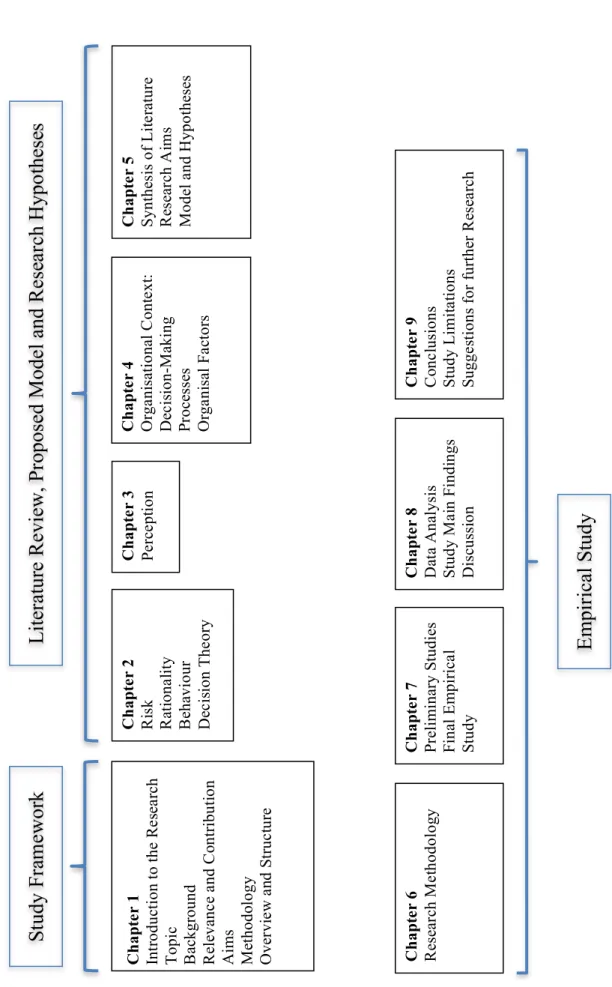
1.5 Overview and Structure of the Study Pg. 19
1.5.1 Overview of the Study Pg. 19
1.5.2 Structure of the Study Pg. 21
Chapter 2. Risk, Rationality, Behaviour and Decision Theory
2.1 Definition(s) of Risk and Risk Construct Pg. 23
2.1.1 Definition(s) of Risk Pg. 23
2.1.2 Risk Construct Pg. 28
2.2 Rationality, Behaviour and Decision Theory Pg. 31
2.2.1 Rationality and Behaviour Pg. 31
2.2.2 Decision Theory Pg. 36
2.2.2.1 Utility and Probabilities Pg. 38
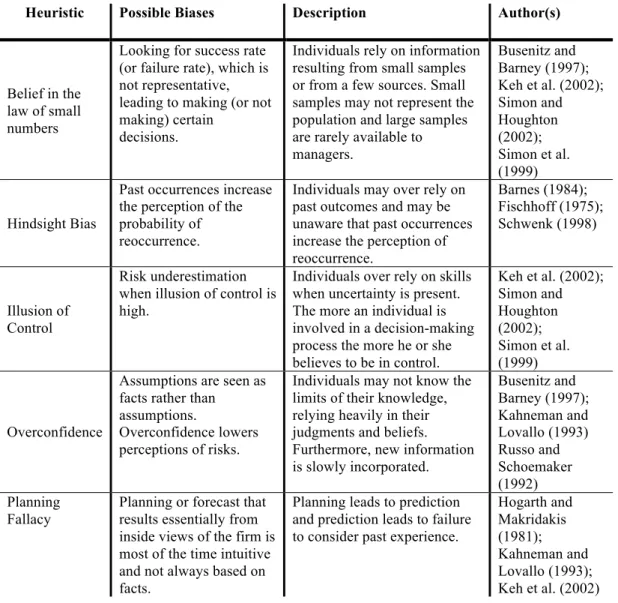
2.2.2.2 Heuristics and Biases Pg. 41
2.2.2.2.1 Heuristics and Biases related to Subjective Probabilities
Pg. 42 2.2.2.2.2 Heuristics and Biases related to Personal and
Contextual Variables Pg. 45
2.3 Summary of Chapter 2 Pg. 47
Chapter 3. Perception
3. Risk Perception Pg. 48
3.1 Significance of Perception(s) in the Managerial
Realm Pg. 48
3.2 Definition of Perception Pg. 51
3.3 Perception and Cognitive Maps Pg. 60
3.4 Perception and Decision-Making Behaviour Pg. 65
3.5 Summary of Chapter 3 Pg. 71
Chapter 4. Organisational Context: Decision-making in
Organisational Contexts and Organisational Factors
4. Organisational Context Pg. 73
4.1 Decision-making Processes in Organisational Contexts –Where do Human Cognition and Contextual Variables fit into the Decision-making Processes?
Pg. 75
4.2 Organisational Culture – Risk Culture Dimension Pg. 80
4.3 CEO’s Risk Behaviour Pg. 88
4.4 Perceived Organisational Support Pg. 95
Table of Contents
Chapter 5. Literature Synthesis and Model Development, Research Aims and Stated Hypotheses
5.1 Introduction Pg. 102
5.2 Synthesis and Integration of the Literature Pg. 102
5.2.1 Rationality and Behaviour Pg. 106
5.2.2 Risk Pg. 110
5.2.3 Decision Theory and Risk Behaviour Pg. 113
5.2.4 Decision Subject Characteristics and Decision-maker related aspects
Pg. 116
5.2.5 Perception Pg. 118
5.2.6 Organisational Context Pg. 119
5.2.6.1 Decision-making Processes Pg. 120
5.2.6.2 Organisational Risk Culture Pg. 122
5.2.6.3 CEO’s Risk-taking and Decision-making Behaviour Pg. 124 5.2.6.4 Organisational Support Perceived by Managers Pg. 126
5.3 Model Proposed Pg. 128
5.4 Research Aims and Hypotheses Pg. 130
5.5 Summary of Chapter 5 Pg. 141
Chapter 6. Research Methodology
6.1 Introduction Pg. 142
6.2 Research Philosophy, Approach to Methodology and Methodology Strategy
Pg. 142
6.2.1 Research Philosophy Adopted Pg. 144
6.2.2 Research Paradigm Adopted Pg. 148
6.3 Research Approach and Mixed Research Design Adopted
Pg. 149
6.4 Constructs’ Content Validity Pg. 156
6.4.1 Qualitative Studies – Direct Observation Pg. 157
6.4.2 Qualitative Studies – Semi-Structured Interviews Pg. 158 6.4.3 Quantitative Studies – Pilot Questionnaire/ Pre-Test Pg. 160
6.4.4 Final Questionnaire Pg. 162
6.5 Survey Design Pg. 162
6.5.1 Types of Scales Pg. 162
6.5.2 The Sampling Procedure Pg. 164
6.5.3 Data Collection and Coding Procedures Pg. 169
6.6 Statistical Data Analysis Pg. 170
6.6.1 Why SEM? Pg. 170
6.6.2 The Properties of the Measurementand of the Structural Models
Pg. 171
6.6.3 Model Specification/Model Estimation Pg. 173
6.6.4 Measures of Model-data Fit Pg. 178
6.6.5 Testing for Moderation Effects Pg. 183
6.6.6 Testing for Mediation Effects Pg. 185
6.6.7 SEM – Methodology Checklist Pg. 187
6.7 Structural Equation Modelling – Constructs’ Validities and Hypotheses Testing
Pg. 189
Table of Contents
Chapter 7. Results of the Preliminary Studies and Preparation of the Final Empirical Study
7.1 Introduction Pg. 192
7.2 Direct Observation of Managers Pg. 193
7.2.1 Conclusions Drawn from the Direct Observation of Managers
Pg. 193
7.3 Semi-Structured Interviews Pg. 195
7.4 Pre-Test of Questionnaire (Pilot Questionnaire) Pg. 201
7.4.1 Pre-Test Sample Pg. 201
7.4.2. Contents of the Questionnaire for Pre-Test Pg. 202 7.4.3 Conclusions Drawn from the Questionnaire Pre-Test Pg. 206
7.5 Final Version of the Questionnaire Pg. 207
7.5.1 Constructs’ Scales Pg. 208
7.5.2 Response Bias Pg. 217
7.6 Summary of Chapter 7 Pg. 218
Chapter 8. Data Analysis and Study Main Findings
8.1 Introduction Pg. 219
8.2 Characteristics of the Sample – Descriptive Statistics Pg. 219
8.2.1 Socio-demographic Characteristics Pg. 219
8.2.2 Latent Variables Measuring the Constructs Pg. 224
8.3 Measurement Models for the Constructs Pg. 230
8.3.1 Constructs’ Reliabilities, Validities and Single-factor CFA Models
Pg. 231
8.3.2 Proposed Measurement Model Pg. 238
8.4 Proposed Structural Models Pg. 241
8.4.1 Structural Sub-Models Pg. 242
8.4.2 Main Structural Model and Testing of Hypotheses Pg. 244
8.5 Moderation Effects Pg. 249
8.6 Mediation Effects Pg. 254
8.6.1 Mediating Effect of the Latent Variable “Illusion of Control”
Pg. 255 8.6.2 Mediating Effect of the Latent Variable “Perceived
Organisational Risk Culture
Pg. 257
8.7 Summary of Chapter 8 Pg. 260
Chapter 9. Research Conclusions – Contributions, Limitations and Suggestions for Further Research
9.1 Introduction Pg. 262
9.2 Summary of Main Conclusions Pg. 262
9.2.1 Research Aim 1 Pg. 263 9.2.2 Research Aim 2 Pg. 264 9.2.3 Research Aim 3 Pg. 268 9.2.4 Research Aim 4 Pg. 269 9.3 Research Contributions Pg. 270 9.3.1 Theoretical Contributions Pg. 270
Table of Contents
9.3.1.1 Integration of Constructs in Research on Managerial Risk-taking and Decision-making
Pg. 271 9.3.1.2 Antecedents of Perceived Organisational Support Pg. 273
9.3.2 Managerial Contribution Pg. 274
9.4 Research Limitations Pg. 280
9.4.1 Limitations Related to the Sample Pg. 280
9.4.2 Limitations Related to the Model Proposed Pg. 281
9.4.3 Limitations Related to the Data and to the Methodology Adopted
Pg. 282
9.4.4 Causality Pg. 283
9.4.5 Generalisability of the Findings Pg. 284
9.5 Directions for Future Research Pg. 285
9.6 Summary of Chapter 9 Pg. 288
Bibliography Pg. 291
Annex 1 Definitions of Constructs – Questionnaire
Building Pg. 326
Annex 2 Scales of Constructs and Final Version of
Questionnaire Pg. 328
A2.1 Scales of Constructs Pg. 328
A2.2 Final Version of the Questionnaire Pg. 335
Annex 3 Complement of the Analysis of the Results of the Data Collected through the Final Questionnaire
A3.1 Constructs’ Statistics Pg. 341
A3.2 CFA and SEM – Information Complement Pg. 343
Annex 4 Methodology
A4.1 Estimation Methods - Estimators Pg. 349
A4.2 Fit Measures Pg. 355
A4.3 Constructs’ Properties Pg. 356
Annex 5 Rationality, Utility, Probabilities and Decision-Making Theory
A5.1 Rationality Pg. 363
A5.2 Utility and Probabilities Pg. 365
A5.2.1 Utility Pg. 365
A5.2.2 Probabilities Pg. 369
A5.3 Expected Utility Theory (EUT) Pg. 373
A5.3.1 Axioms of Expected Utility Theory Pg. 379
A5.4. Subjective Expected Utility Theory (SEU) Pg. 380
A5.4.1 Axioms of Subjective Expected Utility Theory Pg. 382
A5.5 Behavioural Decision Theory Pg. 388
A5.5.1 Prospect Theory and Cumulative Prospect Theory Pg. 400
A5.5.1.1 Main Features of Prospect Theory Pg. 405
Table of Contents
A5.5.2 Naturalistic Decision-Making Pg. 409
A5.5.3 Image Theory Pg. 411
Annex 6 Decision-Making as a Process
A6.1 Decision-making and the Bottom line – Firm Performance
Pg. 414
A6.2 Decision-making viewed as a Process Pg. 417
A6.3 Routine making versus Strategic Decision-making
List of Figures
Chapter 1. Introduction and Overview
Fig. 1.1 Structure of the Study Pg. 22
Chapter 4. Organisational Context: Decision-making in Organisational Contexts and Organisational Factors
Fig. 4.1 Where Perceptions fits into Decision-making Pg. 79
Chapter 5. Literature Synthesis and Model Development, Research Aims and Stated Hypotheses
Fig. 5.1 How Theories and Concepts fit together Pg. 103
Fig. 5.2 Base Model of Relationships Pg. 129
Chapter 6. Research Methodology
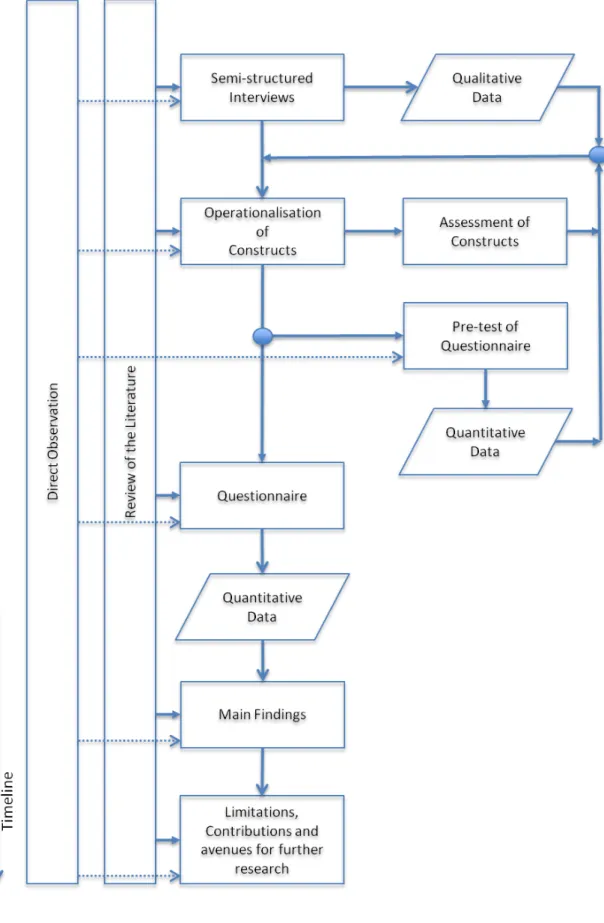
Fig. 6.1 Research Design Pg. 155
Chapter 8. Data Analysis, Study Main Findings and Discussion
Fig. 8.1 Tenure in Industry Pg. 223
Fig. 8.2 Illusion of Control – Distribution of the Indicators Pg. 225 Fig. 8.3 Outcome Experience – Distribution of the Indicators Pg. 226 Fig. 8.4 Perceived Risk of the Decision Subjects –
Distribution of the Indicators
Pg. 227 Fig. 8.5 Perceived Organisational Risk Culture – Distribution
of the Indicators Pg. 228
Fig. 8.6 Perceived CEO’s Risk Behaviour – Distribution of the Indicators
Pg. 229 Fig. 8.7 Perceived Organisational Support – Distribution of
the Indicators
Pg. 230 Fig. 8.8 Structural Sub-model 1 – Estimates – Standardised
Solution Pg. 243
Fig. 8.9 Structural Sub-model 2 – Estimates – Standardised Solution
Pg. 244 Fig. 8.10 Estimates of Relationships – Standardised Solution Pg. 246 Fig. 8.11 Direct Effect Relationship Model (No Mediation
Effect of Illusion of Control)
Pg. 255 Fig. 8.12 Model of Full Mediation by Illusion of Control Pg. 256 Fig. 8.13 Direct Effect Relationship Model (No Mediation
Effect by the Perceived Organisational Risk Culture)
Pg. 258 Fig. 8.14 Model of Full Mediation by the Perceived
Organisational Risk Culture Pg. 259
Annex 5 Rationality, Utility, Probabilities and Decision-Making Theory
Fig. A5.1 Risk Aversion Pg. 405
Fig. A5.2 Decision Weights vs. Probabilities Pg. 407
List of Tables
Chapter 2. Risk, Rationality, Behaviour and Decision Theory
Table 2.1 Examples of Heuristics and Biases Related to the Utilisation of Probabilities
Pg. 44 Table 2.2 Examples of Heuristics and Biases related to
Personal and Contextual Variables
Pg. 46
Chapter 3. Perception
Table 3.1 Examples of Studies involving Managerial Perceptions
Pg. 50
Chapter 4. Organisational Context: Decision-making in Organisational Contexts and Organisational Factors
Table 4.1 Comparison between Organisational Culture and Organisational Climate
Pg. 82
Chapter 5. Literature Synthesis and Model Development, Research Aims and Stated Hypotheses
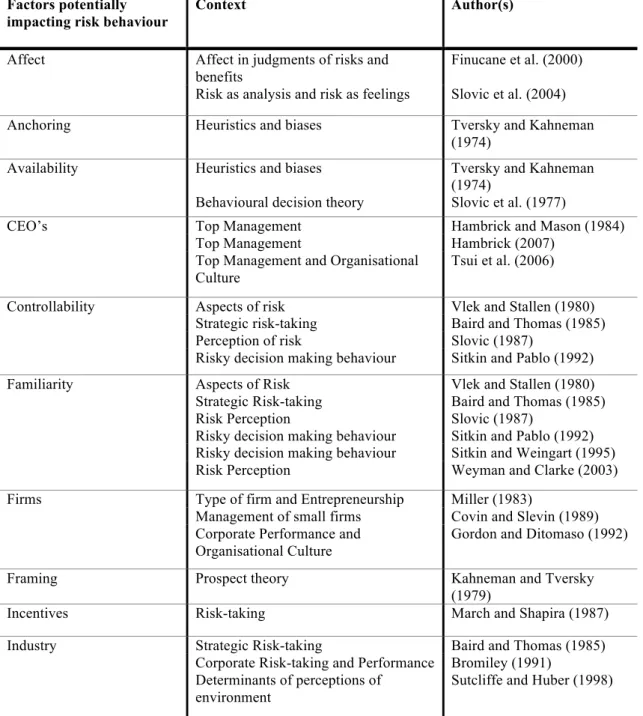
Table 5.1 Examples of Factors, which impact Risk Behaviour Pg. 104 Table 5.2 Seminal Work providing Theoretical Support for this
Research Project
Pg. 106 Table 5.3 Common Factors, which impact Decisions in
Organisational and Societal Contexts
Pg. 113
Table 5.4 Research Aims Pg. 130
Chapter 6. Research Methodology
Table 6.1: Sources of the Scales of the Pre-test Questionnaire Pg. 160 Table 6.2 Example of Fit Measures – Recommended Ranges
of Values
Pg. 182
Chapter 8. Data Analysis, Study Main Findings and Discussion
Table 8.1 Socio-demographic Characteristics considered in the
Study Pg. 220
Table 8.2 Age of Respondents Pg. 220
Table 8.3 Education Level of Respondents Pg. 221
Table 8.4 Tenure in Position of Respondents Pg. 222
Table 8.5 Tenure in Firm of Respondents Pg. 222
Table 8.6 Tenure in Industry of Respondents Pg. 223
Table 8.7 Hierarchical Level of Respondents Pg. 224
Table 8.8 Polychoric Correlations Pg. 232
Table 8.9 Outcome Experience – Construct Measurement Pg. 233 Table 8.10 Illusion of Control - Construct Measurement Pg. 233 Table 8.11 Perceived Risk of Decision Subjects - Construct
Measurement and Fit
Pg. 234 Table 8.12 Perceived CEO's Risk Behaviour – Construct
List of Tables
Table 8.13 Perceived Organisational Risk Culture – Construct Measurement and Fit
Pg. 236 Table 8.14 Perceived Organisational Support – Construct
Measurement and Fit
Pg. 237 Table 8.15 Estimates and t-values of a six-factor Measurement
Model
Pg. 238 Table 8.16 Confirmatory Factor Analysis – Fit Comparison of
Models with Different Number of Factors – Models’ Measurement
Pg. 239
Table 8.17 Correlations and Shared Variance among Constructs
- Six-factor Measurement Model Pg. 240
Table 8.18 Disentangling the ‘Perceived CEO’s Risk Behaviour’ and the ‘Perceived Organisational Risk Culture’ Constructs
Pg. 241
Table 8.19 Squared Multiple Correlations for Structural Equations – Overall Model
Pg. 247 Table 8.20 Results of Relationships Hypothesised Pg. 248 Table 8.21 Groups and Group Selection Criteria for Moderator
Variables
Pg. 251 Table 8.22 Multi-group Effect Analysis – Hierarchical Level Pg. 252 Table 8.23 Moderator Effects of the Hierarchical Level by
Group
Pg. 253 Table 8.24 Results of the Hypotheses related to the Moderating
Variables
Pg. 254
Annex 1 Definitions of Constructs – Questionnaire Building
Table A1.1 Definition of the Constructs for questionnaire building purposes (Pilot and Final Questionnaires)
Pg. 326
Annex 2 Scales of Constructs and Final Version of Questionnaire
Table A2.1 Indicators of ‘Perceived Risk of the Decision Subjects’
Pg. 328
Table A2.2 Indicators of ‘Outcome Experience’ Pg. 330
Table A2.3 Indicators of ‘Illusion of Control’ Pg. 331
Table A2.4 Indicators of ‘Perceived Organisational Risk
Culture’ Pg. 332
Table A2.5 Indicators of ‘Perceived CEO’s Risk Behaviour’ Pg. 333 Table A2.6 Indicators of ‘Perceived Organisational Support’ Pg. 334
Annex 3 Complement of the Analysis of the Results of the Data Collected through the Final Questionnaire
Table A3.1 Construct ‘Illusion of Control’ – Statistics Pg. 341 Table A3.2 Construct ‘Outcome Experience’ - Statistics Pg. 341 Table A3.3 Construct ‘Perceived Risk of Decision Subjects’ -
Statistics
List of Tables
Table A3.4 Construct ‘Perceived Organisational Risk Culture’ - Statistics
Pg. 342 Table A3.5 Construct ‘Perceived CEO’s Risk Behaviour’ -
Statistics
Pg. 342 Table A3.6 Construct ‘Perceived Organisational Support’ -
Statistics
Pg. 343 Table A3.7 CFA – One-factor Model – 23 indicators –
Standardised Loadings and t-values Pg. 343
Table A3.8 CFA – Two-factor Model – 23 indicators – Standardised Loadings and t-values
Pg. 344
Table A3.9 Fit of the Structural Sub-model 1 Pg. 344
Table A3.10 Fit of the Structural Sub-model 2 Pg. 345
Table A3.11 Fit of the Structural Overall Model Pg. 345
Table A3.12 Moderator Effects of the Socio-demographic
Variables Retained Pg. 346
Table A3.13 Mediation Models – Mediation role of the Construct ‘Illusion of Control’
Pg. 346 Table A3.14 Mediation Models – Mediation role of the Construct
‘Perceived Organisational Risk Culture’
Pg. 347 Table A3.15 SEM – Six-factor Model – 9 relationships among
Latent Variables - Largest standardised Residuals ( ≥ |2.5| )
Pg. 347
Table A3.16 SEM – Six-factor Model –9 relationships among Latent Variables – Largest Modification Indices (MI) and Expected Changes (EC)
Pg. 347
Annex 5 Rationality, Utility, Probabilities and Decision-Making Theory
Table A5.1 Examples of Topics where Prospect Theory has been used
CHAPTER 1. INTRODUCTION AND OVERVIEW
1.1 Research Background
The importance of strategic decisions and risks involved in business activities is manifest through simple observation of corporate life and behaviour of individual actors under organisational contexts. Furthermore, in the academic realm, the number of journals of relevance addressing strategy, decision-making, business venturing, organisational behaviour, risk behaviour, and so forth, is impressive and the number of published studies is even more impressive, definitely removing any doubt that could remain in respect to the importance of the general topic of risk-taking and risk-taking associated to strategic decision-making.
At this point, and to make things clear since the very beginning, it is important to stress that strategic decisions are to be understood in the context of this study as those decisions that are “large enough to the organisation, but not so large as to be truly
unique, or potentially fatal” (Kahneman and Lovallo, 1993: 18), and to which
organisations and managers are willing to devote resources and take actions of a certain importance (Mintzberg, Raisinghani and Théorêt, 1976).
The importance of risk is obvious. What is not obvious is how the risks perceived by the individuals, who contribute to decision-making in organisations, impact organisational decision-making and risk-taking and, ultimately, the performance of the organisations. Those impacts on organisations are beyond the scope of this study. Nevertheless, it is posited here that the risks perceived by individual managers, in organisational contexts, have an influence on the behaviours of those managers, which in their turn have an influence on organisational decision-making and, at last, on firms’ results. Before getting to the end of the chain of behavioural influences into firms’ results, which we restate is beyond the scope of this study, it is necessary to study the antecedents of individual behaviour in the face of risk associated to strategic decision-making in organisational contexts.
It is also quite clear that different people do not always ‘see’ situations in the same way, and with the same level of risk. Why is that so? That could be because people are different and, or, because things are different and, or, because people see the same things in different ways, that is, perceive them differently.
Regardless of decision-makers making decisions alone, in groups or in organisations, they have, as put by Beach and Mitchell (1996: 3), “to make up their own
minds first.” Furthermore, Beach and Mitchell (1996: 3) argue that “groups are not seen as decision makers per se; they are merely the contexts in which individual members’ decisions become consolidated to form a group product.” Cyert and March1 (1992) see organisations as coalitions of individuals and groups, where individual goals may, and in general do, materialise into collective goals. This is the line of research embraced in this study where, therefore, the individual manager is the level of analysis, notwithstanding the fact that individual managers, by making decisions in organisational contexts, deal with organisational variables, and, eventually, make decisions at a group or organisational level. These organisational variables, which will be discussed at a later stage, are ‘seen’, that is, perceived, by the individual managers in certain ways, thus becoming, as far as this study is concerned, individual variables.
Individual decision-making behaviour and organisational decision-making meet at the workplace. In organisational contexts individual managers make many of the organisational decisions. On the other hand, “participants in organisational
decision-making are part of ongoing processes. Even if they don’t take on active roles in all phases of decision making they are a part of the decision processes and its consequences” (Shapira, 1997: 5). Research on individual decision-making behaviour
has focused on laboratory studies, where no contextual variables are taken into account. However, “organisations are systems of coordinated action among individuals and
groups whose preferences, information, interests, or knowledge differ” (March and
Simon2, 1993: 2). Furthermore, “organisation members are social persons, whose
knowledge, beliefs, references, loyalties are all products of the social environments in which they grew up, and the environments in which they now live and work” (March
and Simon, 1993: 13). Decisions and behaviours originate also from rules, such as procedures and norms, in which case decisions ‘happen’ as the result of behaving in accordance with those rules (March, 1991). Organisations have contexts, and individual behaviour needs to be understood and explained within the context in which that behaviour is produced. Individuals decide to join or leave organisations, and individuals
1 Original work dates from 1963. 2 Original work dates from 1958. 2 Original work dates from 1958.
decide as well, depending on the contexts, how and with what intensity they get involved in decision-making (March and Simon, 1993).
When this research project started, the author came across two papers published in top journals, which provided him with guidance and, most importantly, gave him comfort, insofar the issues, which had been noticed, were real and had attracted the attention of renowned scholars.
In one of those papers, Sitkin and Pablo (1992: 11) in a proposition to reconceptualise the determinants of risk behaviour argue that there are “three clusters of
factors that influence a decision maker when he or she must choose a more or less risky response to a problem”. Those authors say that those clusters are related to the very
issues originating the decision process, that is, the decision subject, to the context in which the decision is supposed to be made, and to the decision-maker. It is not clear in the work of Sitkin and Pablo (1992) if the effects of the business environment, which would be a fourth cluster of variables, are, or not, part of those effects related to the organisational context and, or, to the issues that are at the centre of decision-making.
In addition, in the other seminal paper that was used to provide guidance to this research project, Baird and Thomas (1985) propose a model in which ‘environmental’, or external environment, and ‘industrial’ variables are included and separated from organisational, decision-maker or situation related variables.
Both the work of Baird and Thomas (1985) and Sitkin and Pablo (1992) refer to the relevance of the risk element in decision-making and, as far as risk behaviour is concerned, posit, among other propositions, that risk perception plays a crucial role in decision-making and risk-taking. However, the main shortcoming of the study of Sitkin and Pablo (1992), which this research project intends to gap, is the vagueness in respect to the unit facing the risk perceived. The unit perceiving the risk is clearly the individual manager. However, the unit facing the risk perceived is not spelled out.
Sitkin and Pablo (1992) first, and Sitkin and Weingart (1995) after, in a study that partially tests a model proposed by Sitkin and Pablo (1992), did not address the risks that managers perceive for themselves. This might be because that was not the focus of those authors. Nevertheless, one of the aims of this project is precisely to address that shortcoming, since much less is known about the perceptions that managers have of the
variables that determine the risks that managers perceive to incur, and about the support that they perceive in order to be able to incur those risks.
On the one hand, the main purpose of this study is to assess if the perceptions that managers have of the risks involved in decision making play a role in the way that those managers, at an individual level, ‘see’, that is, perceive, if they are supported by their organisations to engage in risk-taking activities, namely making or participating in strategic decisions in an organisational context. The intention is to assess the perception of risks from the individual manager perspective, including the risks that he or she faces at a personal level, through the perceived organisational support deemed adequate by the manager to reciprocate and commit, engage and take risks on the behalf of the organisation. The thesis supported in this study is that the organisational support perceived by the managers ultimately mediates the variables mentioned in this study, thus impacting directly the risk perceived by the managers and, consequently, their behaviour. On the other hand, the chief suggestion of this research project is that individual managers consider, consciously, or unconsciously, when deciding to engage, or not, in decision-making, the perceptions that they have of factors intrinsic to the decision subjects, the perceptions of aspects that relate the decision-maker to the decision subjects, and the perceptions that they have of factors embedded into the organisational contexts. Furthermore, that engagement results from the support that individual managers perceive as provided by their organisations, and that support wraps up all the other factors retained in this study.
1.2 Relevance and Expected Contribution of the Research to the Field of Applied Management
Risk and decision-making are pervasive in all organisations whether for profit or not. Risk and decision-making have been related to firm performance (Baird and Thomas, 1985; Bromiley, 1991; Lumpkin and Dess, 1996; Lumpkin and Dess, 2001; Singh, 1986; Wiseman and Gomez-Mejia, 1998). Risk perceived by individuals and risk propensity of individuals, together, have been posited by Sitkin and Pablo (1992) as mediators of individual risk behaviour. Sitkin and Weingart (1995), however, tested, partially, a model proposed by Sitkin and Pablo (1992), and concluded that risk perception is the main mediator of individual risk behaviour, mediating, inclusively, the effects of risk propensity. Weber et al. (2002) and Weber and Milliman (1997) suggest
as well that individual risk perception is the main mediator of the variables contributing to individual risk behaviour, and confirm that risk behaviour is associated with risk perception, rather than with risk attitudes, or preferences. It shall be noted that whereas the study of Sitkin and Weingart (1995) was conducted with subjects, students, who provided their perceptions of the risk associated to a hypothetical decision that would be faced by someone else, the study of Weber and Milliman (1997) was performed with subjects facing the risks themselves, as public transportation commuters and stock market brokers. Nevertheless, none of the studies was made in organisational contexts with managers.
Risk is pervasive in strategic decision-making. Moreover, the decision-making processes, through the outcomes and the dynamics of the decisions made, or not made, are undoubtedly a contributor to firm performance. If it is assumed that individual risk perception is a mediator of the factors contributing to individual risk behaviour, that is, to individual decision-making behaviour, and if individual decision-making behaviour, in organisational context, is related to organisational decision-making, then the conclusion is that individual risk perception plays a very important role in decision-making in organisational contexts, and, therefore, plays a relevant role in firms’ performance.
1.2.1 Relevance of the Research
Drawing from the work of Hambrick (2007), who calls for managerial facts to be part of papers to be brought to the attention of the academy, the author decided to provide a real life example, experienced by the author, to better situate the research problem.
In 2005 a firm for which the author was working at that time underwent some significant management changes. There were changes in the board of directors and changes at the top management team level. Changes cascaded and led to other changes in the senior and middle management levels. Those management changes transformed the firm to a great extent. Transformations were seen, and felt, in aspects such as centralisation, procedures and controls, decision-making style, decision-making processes, decisions made or not made, focus on certain business segments rather than in others, including divestments, and so on.
In 2005 as well, the market in which that firm was active – chartering and operation of oil and gas drilling platforms – saw the commencement of one of its brightest up-cycles ever, with full utilisation of available capacity, and a multiplication of prices of services supplied to clients for the offshore (maritime) segment by a factor of 7 in certain cases. With that upward trend in prices of services driven by full utilisation of drilling platforms, which, on the other hand, was driven by sustained increases of the oil price, a number of oil and gas drilling firms decided to invest in new equipment worth, depending on the equipment, between US$150 million and US$750 million per piece, for offshore equipment, while a number of other firms decided not to invest. Those who invested adopted different strategies. Some opted to invest without a certainty of employment for the drilling platforms in which they were investing, that is, without contracts, while others decided to invest only if they had initial contracts. Some others decided not to invest at all. Some companies invested at the beginning of the cycle, while some others invested further down the road. Some invested in some type of equipment, while others invested in some other type. Some invested in an incremental manner and others at once. Some grew organically, while others grew through acquisitions of companies. Some took the risk of constructions. Others decided to acquire units once built and pay a premium to avoid construction risk. It is true that investing US$750 million or US$150 million is not the same. It is also true that operating equipment worth US$150 million and equipment worth US$750 million – quite different technically and in terms of expertise required – is not the same. Still, some companies without expertise went for the top dollars assets, others with expertise did not move, others without expertise went for the less expensive and easily operated assets, others, with or without expertise, went for both types of assets, and so on. The disparity of strategies adopted and of decisions made by the different players in that market was so striking, as was the disparity of behaviours perceived between the new top management of the author’s employer and the former one, that it awakened in the author an intellectual curiosity and a willingness to investigate the reasons, or, at least, some of the reasons, of those differences that, as mentioned above, were so pungent and obvious.
The author commenced the sketch of this research project when the strong growth cycle initiated in 2005 was still in progress. It was intuitive that different
decision-making behaviours should lead to different consequences to the firms that were part of the drilling industry.
At that time, the company where the researcher was working had certain characteristics, promoted by the top management in place, which led to very slow decision-making processes and to a certain tendency to the status quo. The reasons for the slow decision-making processes were essentially two-fold:
- Participation in the decision-making processes of all the departments/functions of the organisation with equal decision-making power; and
- Extensive reviews of all the decision subjects
The CEO of the company, a relatively newcomer in the industry, considered that all the functions in the organisation, such as operations, marketing, finance, accounting, legal, marketing, etc., not only had the right, and the duty, to provide inputs, but had also the right to participate in the decision-making processes with the same power of any other department, regardless of the topics being considered. For example, at the executive committee level, which included the CEO, the COO, the CFO, Senior Vice President Marketing, Senior Vice President Human Resources and Chief Counsel, decisions were made by consensus, meaning that any member of the executive committee had the power to veto any decision.
Furthermore, the executive committee, and by default the whole organisation, attempted to forecast or to anticipate business scenarios in a rather unrealistic way, since, in reality, the purpose was the elimination of all uncertainty or risk.
Knowing that the assets involved in the drilling of offshore oil and gas wells have a lifetime of around 30 years, that the initial contracts for a newbuild asset range, typically, from 3 to 5 years, that the daily rates paid by oil and gas companies to drilling contractors depend very much on the price of the barrel of oil, which in its turn depends on international economic cycles, geostrategic considerations and so forth, it is clear that most of the lifetime of a given asset is subject to uncertainty. When we consider assets worth US$750 million that explains a certain level of review of the strategic decision-making process and of the decision subject. However, the cost of the investment alone does not explain everything.
The behaviour that resulted from a requirement to have all the departments involved, with equal decision-making power, coupled with the aim to eliminate all uncertainty, was in sharp contrast with behaviours observed by the author in previous
organisations in the same industry. The author noticed that the search for zero risk led managers at all levels to seek zero risk for themselves. In short, why would someone take risks when nobody else, including the organisation, did? The researcher noticed as well, on the one hand, that the representatives of all the corporate functions became experts in finding risks or sources of risks. However, on the other hand, it was rare to see somebody proposing solutions to mitigate the risks found. The standard solution became, at least in the first years, not to invest, not to do, not to risk or, in other words, the status quo.
At the same time, however, competitors were moving their pieces. Some were investing heavily; others were looking for potential merger & acquisition targets, while some others were investing more modestly. The author realises that not all the companies had exactly the same resources at exactly the same time. There were, for sure, different financial conditions, different pools of human resources, different levels of engineering skills, etc. This could explain, and certainly does, part of the resulting behaviours. However, there were companies that with conditions that were objectively worse made bold decisions. The bottom line is that different decision-making behaviours (individual and organisational) led to very different market shares, and different financial situations, including firm survival in certain cases.
The situation depicted above led the author of this study to get interested by the human part of the picture. How do managers perceive risks in strategic decision-making and what leads managers to engage in strategic decision-making processes? Which factors contribute to that engagement and to lead managers to do or to propose to their organisations to do things or, alternatively, to lead them to look for reasons not to do anything?
The author thought that individual behaviour, in organisations and in the context of strategic decision-making, ought to be related to the way an individual perceives the support provided to him or her by his or her organisation.
CEOs have been so omnipresent in all the organisations where the author collaborated that it seemed obvious that their own behaviours should have contributed to the organisational support perceived by individuals and to the ways individual managers behaved. Likewise, the behaviour of the organisation as a whole, the rewards, the promotions, or lack of promotions, the praise or criticism, all that had to have an impact on the support perceived by managers. Other than the perceptions that individual
managers could have of organisational factors, that seemed obvious as well that characteristics of the decision-makers and of the decision matters should contribute to the support to engage in strategic decision-making that managers perceived in their organisations. After all, in spite of some ‘standardisation’ of behaviour resulting from the behaviour of CEOs and organisations, all individual behaviours were not exactly the same.
The author expected perceptions of certain dimensions, rather than the dimensions themselves, to be the key to explain the organisational support perceived. Decision-making being one the most important tasks of managers, if not the most important, and consequences of decisions made (or not made) impacting firms heavily, the relevance of the research subject for the field of the applied management and for organisations and individual managers is obvious.
The author expected as well that characteristics of individual managers, individual perceptions of decision problems and individual perceptions of organisational dimensions would be related and would contribute to explain the individual perceptions of the organisational support. Intuitively, the researcher predicted that perceptions of organisational factors coupled with characteristics of individuals and perceptions of the subjects being decided would contribute to the organisational support perceived. This is the core of this research project.
The business issues mentioned herein, and related individual behaviours, which are the main driver of this research project, are easily extrapolated to many other industries. What needs to be common is the complexity of the situations, the uncertainty in respect to the actions to be taken and to the outcomes and consequences, the ambiguity, the lack of clarity, hence the focus on strategic decisions, and above all the need for interpretation (Finkelstein, Hambrick and Cannella, 2009), which brings to the equation, if there were any doubts, the human factor. Simon (1955) suggests that the relations between an individual and the environment in which he or she acts play a relevant role, since the individual (the organism) adapts or reacts to the environment. As far as this study is concerned, we look for evidence, at least at a sample level, to conclude that the way individual managers of that sample, in their organisational contexts, ‘see’ certain aspects of the organisational life and of the situations being the subject of decision-making, play a role in the risks and the support for taking risks that they ‘perceive’.
Kenneth Arrow (1951: 404) stresses that “there is no need to enlarge upon the
importance of a realistic theory explaining how individuals choose among alternate courses of action when the consequences of their actions are incompletely known to them.” Still according to this same author (Arrow, 1951: 409) “if we were to compare the businessman to the scientist, we would be forced to the melancholy conclusion that little of a systematic nature can be said about the former’s decision-making processes.”
Hambrick (2007) calls for appealing and motivating facts to be reported, as a way for knowledge to advance, either through theory testing, or by bringing to the attention of the academic and practitioners’ worlds important empirical aspects and let others, the academy for instances, test and, or, develop them. Locke (2007) calls instead for theory building based on induction, by going from substantial observations, or data, to general theories, and by looking for evidence of causality. In both cases, however, both authors call for facts to be raised and brought to the research realm. Miller and Tsang (2010: 140), making a point about theory testing in social sciences, including management, argue that one of the difficulties to make tests is the fact that “organisational decision
makers are not passive. They exercise choice and take actions that enact their organisations’ environments.” Risk perception and risk-taking by individuals, in the
context of organisational decision-making, are certainly part of those important facts in management science mentioned by Hambrick (2007) and Locke (2007).
Decision-making is pervasive in the lives of firms and managers. Decisions are fraught with risk, especially strategic decisions. Risk-taking is related to decision-making and to risk behaviour and risk behaviour is related to the perceptions of risks and to the perceptions of organisational factors that managers held. Decision-making has drawn the attention of scholars and practitioners due to the relevance of the subject in many fields such as economy – decisions made by different agents such as families, businesses and governments, medicine – medical treatments, decisions such as to go, or not to go, for surgeries, for instances, management – firm performance, life in society – nuclear power, and so on. MacCrimmon and Wehrung (1986: 4) extend decision-making and risk-taking to all fields of life by saying that “life requires choices; choices
require risk.” However, MacCrimmon and Wehrung (1986: 6) go on to say that “although everyone makes daily decision involving risk, not all of us make decisions that result in risk for thousands or even millions of people”, considering that managers
context of firms “strategic decisions are fraught with peril” (MacCrimmon and Wehrung, 1986: 7).
Theories of choice or decision-making have their origins within the economic science. Von Neumann and Morgenstern (19533: 8) state that “the subject matter of
economic theory is the very complicated mechanism of prices and production, and of the gaining and spending of incomes.” Nevertheless, those authors (von Neumann and
Morgenstern, 1953: 8) add that “in the course of the development of economics it has
been found, and it is now well nigh-nigh universally agreed, that an approach to this vast problem is gained by the analysis of the behaviour of the individuals which constitute the economic society”, thus bringing the individual decision-maker to the
centre of the discussion.
Simple observation and an important bulk of literature (e.g. Allais, 1953; Beach and Mitchell, 1987; Bell, Raiffa and Tversky, 1988; Cyert and March, 1992; Edwards, 1954, 1951; Einhorn and Hogarth, 1981; Ellsberg, 1961; Fishburn, 1989; Gilboa, 2009; Kahneman and Tversky, 1979, 1984; Lopes, 1987, 1994; MacCrimmon and Wehrung, 1986; March, 1978, 1991; March and Shapira, 1987; March and Simon, 1993; Schoemaker, 1993; Simon, 1955, 1959, 1997) indicate that actual individual behaviour is different from behaviours prescribed by decision theories of a normative nature, such as those originated from economic science.
Behavioural theories, of a descriptive nature, posit the existence of determinants of, or contributors to, behaviour, which are not considered by normative theories, and challenge some of the fundamentals of normative theories, such as maximisation, the existence of clear preferences and some properties of probabilities, whether those are objective (based on frequencies) or subjective.
Recognising the relevance of decision-making and individual risk behaviour for the performance of firms, and the very importance of firms’ performances, it would be a paradox not to study risk behaviour, including individual risk perceptions and individual perceptions of organisational support for decision-making and risk-taking.
1.2.2 Expected Contribution of the Research
The number of studies dealing with risk perception, outside the domain of the societal risk, is scarce. The studies dealing with risk perception in an organisational context are scarcer, and the studies dealing with risk perception in organisational context, using managers as subjects, are extremely reduced not to say non-existent. Furthermore, it is not clear if the existing studies on risk perception in organisational contexts address the perceptions that individuals have about the risks faced, or to be faced, by organisations and, or, by themselves. On the other hand, in spite of the fact that risk perception is referred to, or dealt with, in a few studies, there is also a gap in terms of an integration of perception theory with behavioural theory. This study tries to fill some of those gaps within the limitation of such a vast field.
There is a growing number of studies that deal with perceived organisational support (e.g. Conway and Coyle-Shapiro, 2012; Kraimer et al., 2011; Rhoades et al., 2002; Shore and Wayne, 1993), perceived supervisory support (e.g. Maertz et al., 2007; Shanock and Eisenberger, 2006) and leader-member exchange and social exchange (e.g. Settoon et al., 1996; Vidyarthi et al., 2010; Wayne et al., 1997). In those studies, the aspects related to the support perceived by employees as provided to them by their organisations and, or, by their leaders, and reciprocity, commitment and engagement by employees are treated. However, it is the opinion of the author that those constructs, or at least part of those constructs, shall be integrated with individual perceptions of other organisational variables, and with the perceptions of the decision subjects at stake, being this integration an expected contribution of this research project.
The findings of this study are of value for individual managers, for top managements of organisations and for the academic community interested in decision-making, in organisational behaviour, in individual risk behaviour in organisational contexts, in entrepreneurship and, or, corporate entrepreneurship, in relational matters under organisational contexts, in firms’ performance, in short in firms’ management. “Understanding how organisational and individual characteristics influence executives’
filtering processes may both help executives themselves to behave more effectively and help researchers to predict the types of filtering processes that executives use”
(Starbuck and Milliken, 1988: 42). Understanding the filters used by managers as the mechanism that allows individuals to see and, or, feel in a certain way, is important,
insofar, and from a managerial perspective, organisations and individuals have the opportunity to act upon those filters.
The conclusions of this thesis are expected to be important for managers and organisations. It is assumed that decisions can be made in more appropriated ways, that is, more informed and less biased, or unbiased if at all possible, by handling the ‘right’ factors. Managers may work on the factors affecting risk perception, thus influencing the decision-making processes, including their participation, and the decisions made, hence influencing the outcomes of the decisions. As for organisations, the conclusions of this research project could contribute for the definition of training programmes to minimise biasing aspects, raise awareness of the factors that are involved in decision-making and risk-taking, and reengineer decision-decision-making and organisational processes.
Concerning the academic universe this research project follows several avenues for research suggested in the literature (Baird and Thomas, 1985; Cyert and March, 1992; Eisenberger et al., 1986; Kuratko et al., 2004; March and Shapira, 1987; March and Simon, 1993; Shapira, 1995; Simon et al., 1999; Sitkin and Pablo, 1992; Sitkin and Weingart, 1995), and is expected to contribute to assess the influence of some factors on risk perceptions, which have been posited but have, nevertheless, barely be tested, taking into account the difficulties to have access to managers and firms to develop academic work. This is the case of controllability, a factor that has been presented with the potential to impact risk behaviour (Baird and Thomas, 1985; Sitkin and Pablo, 1992; Slovic, 1987; Vlek and Stallen, 1980), which has been tested in psychometric studies in terms of societal risk (Slovic, 1987), but has not received full empirical attention as far as managers are concerned. This is also the case of a given combination of factors, including the perception that managers have of risks related to some contextual organisational variables (Baird and Thomas, 1985; Sitkin and Pablo, 1992). Likewise, this is the case of leadership behaviour, that is, in this specific case, the risk behaviour of CEOs and the relationship with perceived organisational support, as suggested by Eisenberger et al. (1986). Kuratko et al. (2004) suggest that research is necessary to determine the occurrence of entrepreneurial behaviour, which is related to the engagement in decision-making and the assumption of risks, and call for further research related to the relationship between the hierarchical levels of managers and their behaviour, a call that is addressed in this research project through the study of the moderator effects of hierarchical levels in the perceptions of variables of interest. Simon et al. (1999), on the other hand, suggest that researchers look for the impact of social
risks on risk perception. This aspect is also addressed in this research project through the perceptions that individual managers have of the variables retained, which are related to the organisational contexts in which managers are socially embedded.
The main contributions of this research are expected to be:
i) Provide empirical evidence, within the limitations of the study sample, that context influences the risks and the support perceived by managers, and, therefore, the decisions that they make. This would be expected to lead managers to deal with contextual variables as they would deal with ‘business variables’, namely through training, relational work in their organisations, evaluation and monitoring of contextual variables, evaluation and debriefing of decisions made, and so forth; ii) Provide scholars and practitioners with findings allowing them to have a better
understanding on how decisions are made in organisational contexts, namely the dynamics of decision-making;
iii) Contribute to having decision-making in firms based, whenever possible, on hard business facts/assumptions, rather than on perceptions of the working environment and contexts, by making decision-makers aware of those perceptions and relationships;
iv) Provide significant evidence, within the limitations of the sample of the study, of the existence of relationships among factors not considered by models of a normative nature assumed by economic theories of decision-making, thus promoting awareness of behavioural theories among policy makers and practitioners;
v) Finally, it is expected that the model proposed is seen with a predictive role and not only as a model that simply describes relationships among constructs. It is contended in this research project that there is a point in studies like this one if they help people creating or sponsoring decision-making and other organisational processes, and better decision-making. From an applied management perspective a simple description of behaviour may not help managers, unless there are lessons learned and application of those lessons to management practices.
1.3 Research Aims
This study is meant to be about determinants of behaviour, more specifically about determinants of risk behaviour of managers, at an individual level of analysis, when managers are involved with decision-making of a strategic nature in the context of their
firms. The main aim of this study is to focus on those phases of the decision-making processes, where human cognition, namely perception, is more important, that is, during the phases of recognition/identification of the decision matter and the evaluation/assessment of the solutions, or actions, to deal with that same decision matter. It shall link the perception that a decision-maker has of a decision matter and some of his or her own idiosyncrasies to the perceptions that he or she has of certain organisational factors. And, finally, we shall see how all that contributes to the perception that the decision-maker has of the organisational support that he or she gets to carry on his or her decision-making tasks.
This research project has four research goals, each one of them involving the testing of several hypotheses:
1) Identify determinants, or antecedents, of the organisational support for risk-taking perceived by individual managers in their organisations, in the context of strategic decision-making. Identify relationships between the antecedents and the main construct. Define a model that explains, at least partially, the mechanisms that influence the organisation support for risk-taking, which is perceived by individual managers in the contexts of their organisations.
2) Find relationships among the antecedents of the organisational support. Namely, look for antecedents related to the organisational contexts, on the one hand, and for antecedents related to the decision subjects and personal experiences and heuristics of individual managers, on the other hand; check for cross influences, or effects. 3) Replicate and, or, develop existing studies and, or, known relationships, looking, for
example, for mediation effects.
4) Control the effects of demographic variables related to organisational life on relationships among antecedents of the perceived organisational support, and between those antecedents and the main construct, with the purpose of identifying mechanisms that influence the intensity of those relationships.
The aims stated above will be further detailed through the hypotheses to be stated in chapter 5 (literature synthesis and model development, research aims and hypotheses) and will be analysed in the subsequent chapters.
1.4 Methodology
The approach followed in this study is of a deductive type, based on existing theory, with explanatory and predictive purposes, in spite of some exploratory work aimed at clarifying the nature of some concepts and relationships, and of the very nature of the constructs considered – unobserved variables, which could very well call for an inductive approach (Locke, 2007). Basically, hypotheses are deduced and theory is tested with the purpose of looking for dependency relationships.
The research strategy (Saunders, Lewis and Thornhill, 2007) employed in this study is based on a survey, using a questionnaire. However, due to the subjectivity of the matter of interest, mixed methods were used. In this study the researcher used direct observation and semi-structured interviews prior to the survey and to complement it.
As for the methods, direct observation and semi-structured interviews were used to frame the research subject, namely to clarify certain concepts, confirm, or not, certain relationships and look for new relationships.
A panel of ‘experts’, or ‘judges’, was utilised to match questions with prospective constructs while another panel was utilised to test for reliability, by answering the questionnaire at two different points in time (Hair et al, 2006). 4 ‘experts’ or ‘judges’ were asked to assess the match between variables and potential constructs – one of the judges is Brazilian, another one is British and two other are French. A second panel helped assess reliability, by answering the first version of the questionnaire twice with a three weeks gap. All the 4 judges, who assessed the first version of the questionnaire for reliability purposes, are American.
Semi-structured interviews were conducted with 7 individuals of 5 different nationalities – American, Brazilian, British, French and Portuguese. The cut-off criterion, in respect to the number of interviewees, was established as the point in time when interviewees brought nothing new to the study.
A pilot questionnaire, whose development was made based on a mix of existing scales and questions derived from the semi-structured exploratory interviews and direct observation, served the purpose of making a first test and fine-tune the questions, or items, to be measured by the final questionnaire (Hair et al, 2006).
Links to questionnaires were sent by email, and questionnaires answered directly via Internet through a survey site (www.surveymonkey.com). Answers were downloaded from that same site in excel format. Subjects were not requested to provide their names, or their organisations, in order to promote absolute anonymity. Based on lessons learned from the pre test questionnaire, which was also responded via internet through the same website, and where a significant number of respondents, percentage wise, answered only the demographic questions, and considering that the sampling methodology (purposive sampling) did not provide guarantees for a sounded methodology for missing data, it was decided to take an ‘all or nothing’ approach with the final questionnaire. Therefore, respondents had the option to drop the questionnaire at any time, but the questionnaire not being concluded was not retained, except for the demographic questions. 216 managers answered the final questionnaire completely. The questionnaire was developed originally in the English language. Then the questionnaire was translated from English into French, Brazilian Portuguese and European Portuguese and retro translated into the original language to avoid translation biases.
The items of interest were measured using questionnaires with Likert type scales of 5 points.
The author of this study relied on acquaintances to spread the questionnaire within organisations deemed representative of the universe of those organisations with substantial strategic decision-making processes. Given the universe of potential respondents - all managers involved in strategic decision making in organisational contexts - which is so vaste that, from a practical standpoint, could be seen as infinite, and considering that resources, including time, are limited and shall be properly managed, the author decided to use a purposive sample. In order to limit the population, the author focused on a limited number of organisations in the domain of the energy and utilities industries. The respondents work for companies such as Petrobras, Technip, Ensco, Siemens and EDP, among a few others. Bearing in mind that people are different and so are companies, and that any generalisations, in this specific case, could always be challenged, even if the sampling methodology was irreprehensible, the sampling approach adopted seemed appropriated. It shall be noted, however, that the ‘purposive’ aspect was related essentially to a few people who acted as facilitators and sponsored the questionnaire within organisations of interest. In different words, the author picked the acquaintances, or facilitators, but did not select the respondents.