An Acad Bras Cienc (2014) 86 (4) Anais da Academia Brasileira de Ciências (2014) 86(4):
(Annals of the Brazilian Academy of Sciences)
Printed version ISSN 0001-3765 / Online version ISSN 1678-2690
www.scielo.br/aabc
1609-1629
http://dx.doi.org/10.1590/0001-3765201420140014
An experimental study of the partitioning of trace elements between
rutile and silicate melt as a function of oxygen fugacity
GUILHERME MALLMANN1,4, RAÚL O.C. FONSECA2 and ADOLFO B. SILVA3 1Instituto de Geociências, Universidade de São Paulo, Rua do Lago, 562,
Cidade Universitária, 05508-080 São Paulo, SP, Brasil
2Steinmann Institut für Geologie, Mineralogie und Palëontologie,
Universität Bonn, Poppelsdorfer Schloss, Bonn, 53115, Germany
3Instituto de Astronomia, Geofísica e Ciências Atmosféricas, Universidade de São Paulo,
Rua do Matão, 1226, Cidade Universitária, 05508-090 São Paulo SP, Brasil
4School of Earth Sciences, The University of Queensland, Brisbane, QDL 4072, Australia
Manuscript received on January 23, 2014; accepted for Publication on April 25, 2014
ABSTRACT
Subduction zone or arc magmas are known to display a characteristic depletion of High Field Strength
Elements (HFSE) relative to other similarly incompatible elements, which can be attributed to the presence
of the accessory mineral rutile (TiO
2) in the residual slab. Here we show that the partitioning behavior
of vanadium between rutile and silicate melt varies from incompatible (~0.1) to compatible (~18) as a
function of oxygen fugacity. We also confirm that the HFSE are compatible in rutile, with D(Ta) > D(Nb)
>> (D(Hf) >/~ D(Zr), but that the level of compatibility is strongly dependent on melt composition, with
partition coefficients increasing about one order of magnitude with increasing melt polymerization (or
decreasing basicity). Our partitioning results also indicate that residual rutile may fractionate U from Th
due to the contrasting (over 2 orders of magnitude) partitioning between these two elements. We confirm
that, in addition to the HFSE, Cr, Cu, Zn and W are compatible in rutile at all oxygen fugacity conditions.
Key words:
arc magma, HFSE, partition coefficient, redox, rutile.
Correspondence to: Guilherme Mallmann E-mail: [email protected]
INTRODUCTION
Despite their similar compatibility during mantle
melting, the High Field Strength Elements (HFSE:
Nb, Ta, Zr and Hf) display a characteristic depletion
relative to the Rare Earth (REE) and Large Ion
Lithophile (LILE) elements in subduction-related
or arc magmas (see Tatsumi and Eggins 1995). In
fact, this geochemical signature has long been used
as a distinctive feature of arc magmas, yet its reason
remains controversial. Some authors argue that
HFSEs are less mobile than LILEs and REEs and that,
because of this, fluids produced by slab dehydration
are depleted in these elements (e.g. McCulloch and
Gamble 1991, Keppler 1996). However, recent
experimental evidence indicates that the mobility of
HFSEs during slab dehydration may approach that
of light REEs and LILEs at increasing pressures
and salute contents of fluids, which would then
An Acad Bras Cienc (2014) 86 (4)
1610 GUILHERME MALLMANN, RAÚL O.C. FONSECA and ADOLFO B. SILVA
the HFSEs to explain their depletion (e.g. Brenan
et al. 1995, Stalder et al. 1998, Ionov and Hofmann
1995, Tiepolo et al. 2000).
Rutile (TiO
2) is considered the prime candidate
to retain HFSEs in residual subducted slabs since it
has been shown to be a ubiquitous accessory phase in
eclogites (e.g. Rudnick et al. 2000, Zack et al. 2002)
and to incorporate large amounts of HFSEs (Green
and Pearson 1987, Zack et al. 2002). Experimental
studies have demonstrated that HFSEs are indeed
compatible in rutile, but their partitioning behavior
appears to be strongly dependent on melt composition
(Horgn and Hess 2000, Klemme et al. 2005). In
principle, the partitioning of HFSEs between rutile
and silicate melt may also be influenced by the
presence of other trace-element cations, which can
either compete for crystallographic sites and/or allow
for coupled substitution mechanisms such as M
2++
M
5+= Ti
4++ M
3+, or M
2++ 2 M
5+= 3 Ti
4+, or 4 M
5++
[ ] = 5 Ti
4+; where M
x+is a metal cation of specified
valence and [ ] is a vacancy (Horng and Hess 2000).
Vanadium is a multivalent element which
can occur as V
2+, V
3+, V
4+and V
5+, depending
on oxygen fugacity (fO
2), in geological settings
(e.g. Mallmann and O’Neill 2009, 2013). In its
quadrivalent and pentavalent states, vanadium
shows the same geochemical characteristic that
defines the HFSEs, which is high ionic charge/
ionic radius ratio. Hence, at appropriate redox
conditions, vanadium should behave similarly to
the HFSEs. Interestingly, the transition between
the various vanadium valence states occurs over
the range of oxygen fugacities inferred for the
genesis of terrestrial magmas. Assuming that arc
magmas are indeed formed under more oxidizing
conditions than mid-ocean ridge and island arc
magmas (e.g. Kelly and Cottrell 2009, Cottrell
and Kelley 2011, Evans 2012), one would expect
the partitioning behavior of V between rutile
and silicate melt to vary considerably during
the genesis of these different types of terrestrial
magmas. To what extent the partitioning of
vanadium between rutile and silicate melt changes
as a function of oxygen fugacity and, particularly,
what is the indirect effect of changing oxygen
fugacity (and vanadium partition coefficients)
on the partitioning behavior of the homovalent
HFSEs remains to be tested.
In this paper we report the results of an
experimental study aimed at determining the effect
of oxygen fugacity on the partitioning of trace
elements between rutile and silicate melt. High
temperature and pressure partitioning experiments
were carried out over a range of oxygen fugacities
(from 10
-12to 10
+4.3bars at 1300°C) sufficiently
large to cover the transition from V
3+to V
4+to
V
5+and, most importantly, the redox conditions
inferred for terrestrial magmas.
MATERIALS AND METHODS
STARTING MATERIALS
We studied three compositions (SKHDAN1,
SKHDRH1 and SM20), selected from the work of
Klemme et al. 2005, which are known to equilibrate
rutile and silicate melt at atmospheric pressure (1 bar)
between 1250 and 1300°C (Table I). All compositions
were prepared by combining appropriate amounts of
reagent-grade oxides (SiO
2, TiO
2, Al
2O
3, MgO, Fe
2O
3)
and carbonates (CaCO
3, Na2CO
3and K
2CO
3) to make
5 g of material. Composition SKHDAN1 was doped
with 3 different cocktails of trace elements (to make
3 different starting materials labeled SKHDAN1-a,
SKHDAN1-b, and SKHDAN1-c): the first containing
250-500 µg g
-1of the HFSEs Zr, Hf, Ta and Nb (i.e.
only homovalent trace elements of valence 4+ and 5+);
the second also containing, in addition to the HFSEs
listed above, about 250-500 µg g
-1of V (a multivalent
element); and the third containing 250-500 µg g
-1of
several trace-element cations of various valence states,
namely Zr, Hf, Ta, Nb, V, Th, Sc, U, Ga, Y, Fe, P,
Cr, Li, Ni, Cu, Zn, Ba, Sr, Pb, In, Sb, Sn, Co, Ta, W.
An Acad Bras Cienc (2014) 86 (4)
1611
RUTILE/SILICATE-MELT PARTITIONING
ONE-ATMOSPHERE HIGH TEMPERATURE GAS-MIXING
EXPERIMENTS
Charges for one-atmosphere (i.e. 1-bar) experiments
were prepared by mixing about 100 mg of powder of
each composition with a gel made from polyethylene
oxide and water, and mounting the resulting sludge
on either Pt or Re wire loops; the choice of wire
depends on the target oxygen fugacity of a particular
experiment (see Mallmann and O’Neill 2009). Five
compositions were suspended together from a Pt
“chandelier”. The samples were introduced in the
furnace at a temperature between 600 and 900°C
(pre-conditioned with the desired gas mix). The
temperature was then increased at a rate of 6°C min
-1to 1425-1450°C. This temperature was maintained
for 1 hour, and then slowly cooled at a rate of 6 to
12°C h
-1until the target equilibrium temperature of
1300°C had been reached. The slow cooling from the
superliquidus temperature is necessary to minimize
nucleation points and therefore grow fewer but
larger crystals. Experiments were then held under
these conditions for approximately 2 days and then
dropped-quenched in water. All experiments were
carried out in a GERO HRTV 70-250/18 vertical
tube (high-purity 99.9% alumina) furnace at the
Instituto de Geociências, Universidade de São
Paulo, Brazil (Fig. 1). Gas flows were controlled
by Aalborg mass flow controllers of 10, 100
and 200 SCCM calibrated for CO, CO
2and O
2.
Oxygen fugacity imposed by gas mixing was
calculated using thermodynamic data compiled in
Kress et al. (2004), and checked before starting
the experimental campaign with a SIRO
2C700+
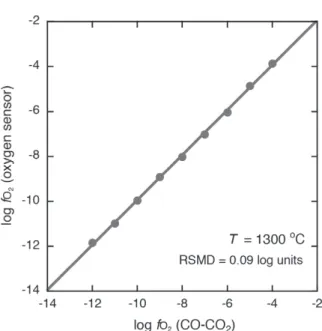
solid zirconia electrolyte oxygen sensor. Results
are shown in Fig. 2, and indicate accuracy better
than 0.1 log fO
2units. Temperature at the hot zone
was checked with the help of a type B (Pt
70Rh
30-Pt
94Rh
6) thermocouple internal to the tube prior to
the experiments. The furnace hotspot, identified
via a temperature vertical profile, spans over 5cm
SKHDRH1 SKHDAN1 SM20
SiO2 55.98 45.80 40.37
TiO2 20.01 23.70 32.38
Al2O3 12.00 15.30 7.60
Na2O 6.41 6.10 9.80
K2O 5.60 3.10 1.55
CaO --- 6.00 2.31
MgO --- --- 1.90
FeO --- --- 4.09
TABLE I
Starting compositions in cg/g.
Figure 1 - Schematic drawing (a) and photograph (b) of the one-atmosphere vertical tube furnace with drop-quench mechanism
An Acad Bras Cienc (2014) 86 (4)
1612 GUILHERME MALLMANN, RAÚL O.C. FONSECA and ADOLFO B. SILVA
vertically with temperature variability within ±2°C
(Fig. 3). During the experiments, temperature was
controlled by a type B thermocouple external to
the muffl e tube, feeding into a Eurotherm PID
controller. A summary of experimental conditions
is given in Table II.
HIGH PRESSURE AND TEMPERATURE PISTON-CYLINDER
EXPERIMENTS
In order to achieve conditions more oxidizing
than those accessible via pure O
2gas at 1 bar,
each of the 5 starting compositions were loaded
into 2.3 mm Pt capsules along with PtO
2and
equilibrated at 1 GPa and 1300°C (Table II). Under
the pressure and temperature conditions of these
experiments, PtO
2breaks down to Pt and suffi cient
O
2to produce a partial pressure equal to the
confi ning pressure, buffering the oxygen fugacity,
which was calculated to be ~ 10
+4.3bars from the
equation of state of pure O
2given by Belonoshko
and Saxena (1991). The 5 capsules containing
the samples and PtO
2were placed inside a rod of
crushable MgO, with interstitial spaces between the
capsules fi lled with alumina cement. The MgO rod
containing the 5 capsules was then placed inside
a ¾” NaCl-Pyrex-graphite pressure assembly and
equilibrated at pressure and temperature using a
Bristol-type end-loaded piston cylinder apparatus
housed at the Institute of Geosciences, University
of São Paulo, Brazil (Fig. 4). Temperature was
monitored using a type B thermocouple protected
by high-purity alumina tubing. As for the 1-bar
experiments, temperature was fi rst raised above or
near the liquidus and slowly cooled to the target
temperature of 1300°C to promote the growth of
fewer but larger crystals. After about 2 days at
the equilibrium temperature, the experiment was
quenched by switching off the power supply.
ANALYTICAL PROCEDURES
Recovered experimental charges were mounted in
epoxy resin, grinded to expose the phases, polished,
and then etched/cleaned for a few minutes in an
ultrasonic bath with a dilute (1:10) solution of
Citranox and distilled water in order to better reveal
the crystals at the surface in refl ected light. The major
and trace element composition of experimental
run products were analyzed by a JEOL JXA 8900
electron microprobe, and by a 193 nm Resonetics
M50-E excimer laser ablation (LA) system coupled
to a single collector quadrupole Thermo X-Series
2 mass spectrometer (ICP-MS), respectively. Both
instruments are housed at the Steinmann Institut,
Universität Bonn, Germany.
The crystalline phase present in all experimental
samples was determined to be rutile after qualitative
(EDS) electron microprobe spectral analyses, and
further assumed to have a stoichiometric TiO
2composition. Silicate melt quenched to glasses were
analyzed by electron microprobe in WDS mode
at 15 kV acceleration voltage, 10nA beam current
and 10 micron beam diameter. Calibrations for Ca,
Figure 2 - Comparison between oxygen fugacity determined by CO-CO2 gas mixing and measured by a SIRO2 C700+ solid
An Acad Bras Cienc (2014) 86 (4)
1613
RUTILE/SILICATE-MELT PARTITIONING
Run Type exp./pressure Wire loop/capsule Tsup. (°C)
Duration (h) at sup.
Cooling rate (°C/h)
T (°C) eq.
Duration (h) at eq.
CO
Gas mix
CO2 O2 log fO 2 (% full scale x MFC range)
SP280613 GMF / 1bar Re 1450 1 6 1300 42 48.0x200 6.9x10 --- -14.0
SP040713 GMF / 1bar Re 1450 1 6 1300 40 22.0x200 10.0x10 --- -13.0 SP070713 GMF / 1bar Re 1450 1 6 1300 40 22.0x200 31.6x10 --- -12.0 SP220713 GMF / 1bar Re 1450 1 6 1300 45 22.0x200 100.0x10 --- -11.0 SP300713 GMF / 1bar Re 1450 1 6 1300 45 22.0x200 15.9x200 --- -10.0 SP070813 GMF / 1bar Pt 1450 1 6 1300 40 9.6x200 22.0x200 --- -9.0 SP100813 GMF / 1bar Pt 1450 1 6 1300 46 61.0x10 22.0x200 --- -8.0 SP050313 GMF / 1bar Pt 1450 1 9 1300 36 19.2x10 22.0x200 --- -7.0 SP020313 GMF / 1bar Pt 1450 1 9 1300 53 13.3x10 48.0x200 --- -6.0
SP270213 GMF / 1bar Pt 1425 1 6 1300 45 4.2x10 48.0x200 --- -5.0
SP180213 GMF / 1bar Pt 1425 1 12 1300 51 --- 30.0x200 --- -3.4
SP130813 GMF / 1bar Pt 1450 1 6 1300 43 --- 30.0x200 --- -3.4
SP210213 GMF / 1bar Pt 1425 1 12 1300 58 --- 32.0x200 4.3x15§ -2.0
SP250713 GMF / 1bar Pt 1450 1 6 1300 45 --- --- air* -0.7
SP240213 GMF / 1bar Pt 1425 1 12 1300 46 --- --- 25.0x300 0.0
PC100813 PC / 1 GPa Pt 1425 1 12 1300 48 --- --- --- 4.3
TABLE II Experimental conditions.
GMF = gas mixing furnace, PC = piston cylinder. § MFC oscillating in the fi rst 12 hours, then stable to 0.5%. *Furnace open to air. ¶ Starting mixes loaded in Pt capsules with PtO
2.
Figure 3 - Vertical temperature profi le determined for the
vertical tube furnace with a type B thermocouple placed inside the tube. All measurements were obtained at 1200°C (set by a type B thermocouple external to the tube) in air. All temperature values presented in the paper have been corrected for the 3°C offset between the internal and external thermocouples. Uncertainty in temperature is expected to be less than ±2°C at the hot zone.
Mg, Al, Si and Fe were obtained on BCR silicate
glass standard, for Na on an in-house Jd-Di eutectic
silicate glass, and for Ti on rutile. Accuracy and
reproducibility were checked using the VG2 basaltic
glass standard. The close to 100% totals obtained in
all silicate glasses suggest that under the operation
conditions Na loss was not an issue during analysis.
The trace element compositions of silicate
glasses and rutile were determined by
laser-ablation ICP-MS using the following isotopes:
7Li,
23Na,
24Mg,
27Al,
29Si,
31P,
39K,
43Ca,
45Sc,
47Ti,
51V,
52Cr,
55Mn,
57Fe,
59Co,
60Ni,
65Cu,
66Zn,
71Ga,
85Rb,
88Sr,
89Y,
90Zr,
93Nb,
115In,
118Sn,
119Sn,
121Sb,
123Sb,
138Ba,
178Hf,
181Ta,
184W,
208Pb,
232Th, and
238U. Data for Li, P, Rb, In, Sn, Sb and Pb are not
An Acad Bras Cienc (2014) 86 (4)
1614 GUILHERME MALLMANN, RAÚL O.C. FONSECA and ADOLFO B. SILVA
size of the phase and whether melt inclusions were
present. Count rates were normalized to either
29
Si (for silicate melts) or
47Ti (for rutile) with
concentrations defined by electron microprobe and
stoichiometry, respectively. Normalized counts
were then transformed into concentrations using the
NIST-SRM 610 silicate glass as external reference
standard assuming the concentrations given in
Jochum et al. (2011). The standard NIST-SRM 612
silicate glass was used to monitor the variability
and accuracy of measurements. For each phase,
we collected between 5 and 15 individual spot
analyses, with each spectrum consisting of 20
seconds of background measurements and 40
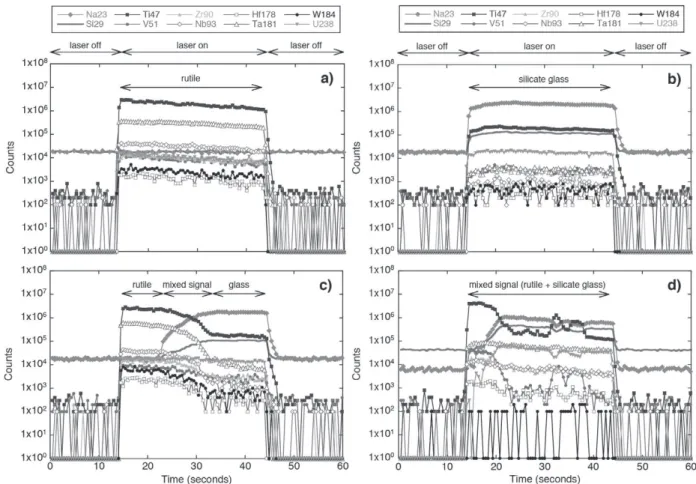
seconds of sample integration (Fig. 5). However,
in many cases, due to the severity of
cross-contamination between the rutile and silicate
glass signal, either because of the small size of
rutile crystals, presence of melt inclusions in
rutile, or presence of micro-crystals of rutile in
the silicate melt, several individual spot analyses
had to be discarded (Fig. 5). To assess the level
of contamination we monitored the signals of
29
Si,
23Na,
138Ba and
47Ti, and only considered
spectrum that showed no or very little signal cross-
contamination. For many samples we could not
obtain “clean” uncontaminated analyses of either
rutile and silicate melt, hence the gaps in the data
presented in the paper.
RESULTS AND DISCUSSION
In total, our study resulted in 80 individual
expe-rimental samples, which produced upon quenching
euhedral to subhedral rutile crystals of sizes ranging
from about 1 to 500 microns and homogeneous silicate
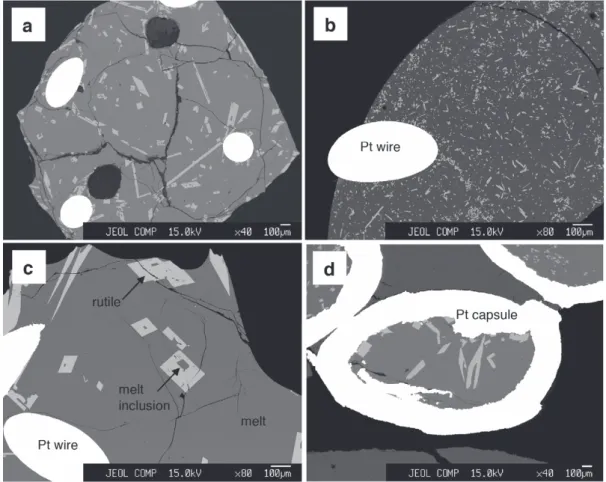
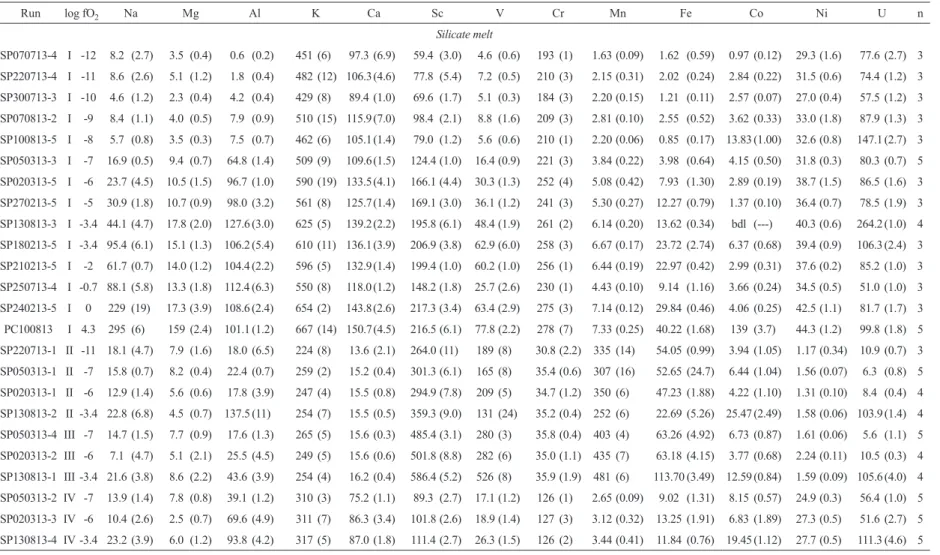
glass. No other phase was observed. Examples of
typical run products are illustrated in Fig. 6. The
major element composition of silicate glasses
(only selected samples for which trace element
contents in both rutile and silicate melt could be
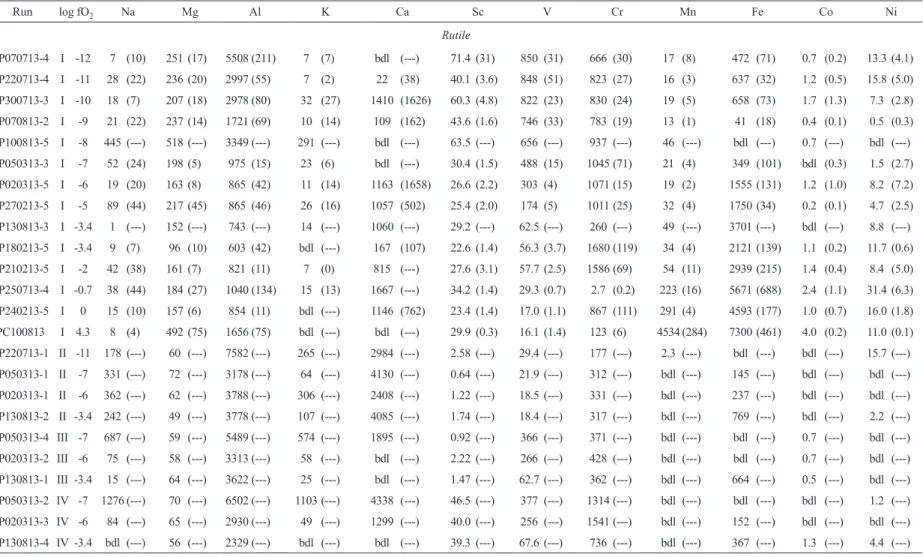
determined) is presented in Table III. The trace
element composition of silicate glasses and rutile
of selected samples is presented in Table IV, and
rutile/silicate-melt partition coefficients, calculated
by dividing the concentrations of trace elements, is
given in Table V. Composition SM20 yielded the
largest rutile crystals, hence we were able to analyze
all experiments in the oxygen fugacity series.
Composition SKHDRH1 yielded extremely small
rutile crystals, which we were not able to analyze for
An Acad Bras Cienc (2014) 86 (4)
1615
RUTILE/SILICATE-MELT PARTITIONING
trace elements and therefore have no data to present.
Composition SKHDAN1 also yielded very small
rutile crystals, but we were able to collect at least
one “clean” rutile analysis in a few samples with
this composition, which cover the various doping
cocktails we used at oxygen fugacities ranging from
reduced to intermediate to oxidized.
Calculated rutile/silicate-melt partitioning
coeffi cients (Table V) are in good agreement with
literature data. Specifi cally, our experiments with
composition SM20 at 1300°C and log fO
2of -3.4
(SP130813-3 and SP180213-5) resulted in partition
coeffi cients that are consistent with those reported
by Klemme et al. (2005) for their equivalent
experiment RT10-20, attesting for attainment
of equilibrium. We note, however, that there is
a systematic change in partitioning coeffi cients
calculated for experiments with composition SM20
as a function of oxygen fugacity (Fig. 7). While this
behavior is normally assumed to be due to changes
in valence states, we observe that such changes
occur even for trace-element cations which are
known from previous studies to display a constant
valence state (i.e. homovalent elements) over
the range of oxygen fugacity conditions covered
in our experiments (Fig. 7a). This change must
therefore result from the effect of another variable,
which we identifi ed to be melt composition. There
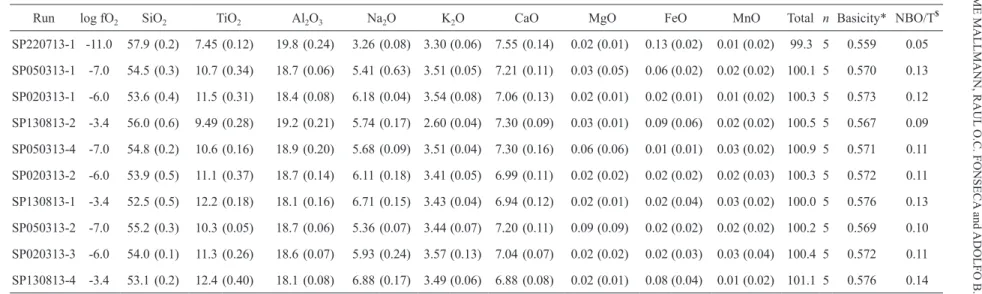
is a systematic change in melt major-element
composition with oxygen fugacity, with noticeable
Figure 5 - Examples of laser time-resolved laser-ablation ICP-MS spectra recorded in this study. a) “Clean” rutile spectrum. b) “Clean” silicate glass spectrum. c) Mixed rutile (15-22 sec) and silicate glass (36-45 sec) spectrum. In this case, the laser drilled trough the rutile crystal and reached the silicate glass, resulting in a mixed signal from around seconds 22 to 36. d) Completely
mixed signal between rutile and silicate melt where it is diffi cult to extract a “clean” rutile and/or silicate glass signal. This
An Acad Bras Cienc (2014) 86 (4)
1616 GUILHERME MALLMANN, RAÚL O.C. FONSECA and ADOLFO B. SILVA
decrease in Ti and Na and increase in Si, Al, Ca and
Mg with decreasing fO
2, which results in a gradual
increase in melt polymerization from oxidized to
reducing conditions as evidenced by melt descriptors
such as optical basicity (Λ) and NBO/T (Table III,
Fig. 8). The most likely explanation for this change
is the progressive loss of Na by volatility with
decreasing fO
2. Despite our efforts, we also noted
that a signifi cant proportion of Fe was lost to Pt wire
in experiments at log fO
2-7, -8 and -9 (Table III),
hence these specifi c experiments with composition
SM20 should be interpreted with caution.
PARTITIONING AND SPECIATION OF HETEROVALENT ELEMENTS
Klemme et al. (2005) reported rutile/silicate-melt
partition coeffi cients for vanadium, noting that the
lowest values were obtained for the most oxidizing
experiments. However, they found no consistent trend
with oxygen fugacity. Our results for composition
SM20 show a systematic increase in V partition
coeffi cients from ~ 0.04 to ~ 19 towards reducing
conditions (Fig 7b). However, as noted previously,
there is a systematic change in melt composition
concomitant with the change in oxygen fugacity that
most certainly affected the partitioning of all elements
An
Acad Bras Cienc
(2014)
86
(4) 1617
RUTILE/SILICA
TE-MEL
T
P
AR
TITIONING
Run log fO2 SiO2 TiO2 Al2O3 Na2O K2O CaO MgO FeO MnO Total n Basicity* NBO/T$
SP070713-4 -12.0 64.8 (0.8) 7.75 (0.13) 12.8 (0.15) 1.30 (0.08) 2.39 (0.06) 4.10 (0.09) 3.10 (0.06) 2.01 (0.13) 0.38 (0.07) 98.6 5 0.542 0.15
SP220713-4 -11.0 62.5 (0.2) 9.42 (0.13) 12.2 (0.18) 2.89 (0.07) 2.53 (0.04) 4.05 (0.12) 2.97 (0.04) 3.00 (0.14) 0.47 (0.05) 100.0 5 0.533 0.21
SP300713-3 -10.0 62.2 (0.8) 8.87 (0.17) 12.3 (0.21) 2.76 (0.07) 2.50 (0.04) 3.89 (0.06) 2.95 (0.06) 2.93 (0.18) 0.49 (0.07) 99.0 5 0.551 0.20
SP070813-2 -9.0 62.6 (0.9) 9.65 (0.21) 12.7 (0.15) 4.83 (0.11) 2.20 (0.06) 4.07 (0.15) 3.02 (0.09) 0.08 (0.03) 0.39 (0.03) 99.5 5 0.552 0.19
SP100813-5 -8.0 64.9 (0.2) 7.96 (0.17) 12.6 (0.05) 3.37 (0.16) 2.83 (0.05) 4.05 (0.08) 3.13 (0.24) 0.01 (0.01) 0.32 (0.05) 99.1 5 0.546 0.16
SP050313-3 -7.0 58.6 (0.4) 14.2 (0.30) 11.4 (0.18) 7.11 (0.20) 2.17 (0.03) 3.65 (0.12) 2.85 (0.15) 0.49 (0.06) 0.46 (0.13) 100.9 5 0.564 0.25
SP020313-5 -6.0 53.9 (0.4) 17.1 (0.29) 10.6 (0.14) 8.36 (0.22) 2.05 (0.05) 3.30 (0.04) 2.49 (0.04) 2.18 (0.11) 0.43 (0.04) 100.5 5 0.575 0.32
SP270213-5 -5.0 53.1 (0.4) 18.1 (0.42) 10.6 (0.06) 8.87 (0.28) 2.03 (0.04) 3.22 (0.04) 2.48 (0.10) 1.59 (0.10) 0.45 (0.05) 100.5 5 0.577 0.32
SP180213-5 -3.4 48.4 (0.2) 21.3 (0.61) 9.52 (0.09) 10.0 (0.22) 1.87 (0.06) 2.96 (0.09) 2.23 (0.19) 2.13 (0.16) 0.41 (0.07) 98.9 5 0.586 0.37
SP130813-3 -3.4 50.7 (0.2) 20.2 (0.16) 10.0 (0.12) 9.38 (0.15) 2.13 (0.07) 3.10 (0.05) 2.36 (0.06) 2.27 (0.07) 0.37 (0.09) 100.6 5 0.583 0.35
SP210213-5 -2.0 49.4 (0.2) 21.8 (0.22) 9.68 (0.04) 10.4 (0.20) 1.88 (0.02) 2.99 (0.07) 2.41 (0.12) 2.22 (0.12) 0.42 (0.07) 101.2 5 0.587 0.38
SP250713-4 -0.7 54.8 (0.3) 15.7 (0.15) 10.8 (0.12) 7.83 (0.22) 2.17 (0.06) 3.33 (0.06) 2.54 (0.08) 2.69 (0.07) 0.41 (0.07) 100.2 5 0.574 0.32
SP240213-5 0.0 49.0 (0.4) 21.5 (0.25) 9.57 (0.04) 10.0 (0.16) 2.00 (0.08) 2.96 (0.04) 2.26 (0.02) 2.13 (0.08) 0.33 (0.08) 99.8 5 0.586 0.36
PC100813 4.3 50.0 (0.3) 20.4 (0.32) 9.56 (0.09) 10.2 (0.17) 2.24 (0.02) 3.07 (0.02) 2.49 (0.01) 2.21 (0.01) 0.43 (0.02) 100.6 3 0.587 0.39
TABLE III
Major element composition (in cg/g) of silicate
melts (glass) determined by electron microprobe.
Values in parenthesis are standard deviation (1-sigma) of the mean of n measurements. * Optical basicity calculated as described by Duffy (1993) assuming a value for TiO2 of 0.61.
An
Acad Bras Cienc
(2014)
86
(4)
1618
GUILHERME MALLMANN, RAÚL
O.C. FONSECA
and
ADOLFO B. SIL
V
A
Run log fO2 SiO2 TiO2 Al2O3 Na2O K2O CaO MgO FeO MnO Total n Basicity* NBO/T$
SP220713-1 -11.0 57.9 (0.2) 7.45 (0.12) 19.8 (0.24) 3.26 (0.08) 3.30 (0.06) 7.55 (0.14) 0.02 (0.01) 0.13 (0.02) 0.01 (0.02) 99.3 5 0.559 0.05
SP050313-1 -7.0 54.5 (0.3) 10.7 (0.34) 18.7 (0.06) 5.41 (0.63) 3.51 (0.05) 7.21 (0.11) 0.03 (0.05) 0.06 (0.02) 0.02 (0.02) 100.1 5 0.570 0.13
SP020313-1 -6.0 53.6 (0.4) 11.5 (0.31) 18.4 (0.08) 6.18 (0.04) 3.54 (0.08) 7.06 (0.13) 0.02 (0.01) 0.02 (0.01) 0.01 (0.02) 100.3 5 0.573 0.12
SP130813-2 -3.4 56.0 (0.6) 9.49 (0.28) 19.2 (0.21) 5.74 (0.17) 2.60 (0.04) 7.30 (0.09) 0.03 (0.01) 0.09 (0.06) 0.02 (0.02) 100.5 5 0.567 0.09
SP050313-4 -7.0 54.8 (0.2) 10.6 (0.16) 18.9 (0.20) 5.68 (0.09) 3.51 (0.04) 7.30 (0.16) 0.06 (0.06) 0.01 (0.01) 0.03 (0.02) 100.9 5 0.571 0.11
SP020313-2 -6.0 53.9 (0.5) 11.1 (0.37) 18.7 (0.14) 6.11 (0.18) 3.41 (0.05) 6.99 (0.11) 0.02 (0.02) 0.02 (0.02) 0.02 (0.03) 100.3 5 0.572 0.11
SP130813-1 -3.4 52.5 (0.5) 12.2 (0.18) 18.1 (0.16) 6.71 (0.15) 3.43 (0.04) 6.94 (0.12) 0.02 (0.01) 0.02 (0.04) 0.03 (0.02) 100.0 5 0.576 0.13
SP050313-2 -7.0 55.2 (0.3) 10.3 (0.05) 18.7 (0.06) 5.36 (0.07) 3.44 (0.07) 7.20 (0.11) 0.09 (0.09) 0.02 (0.02) 0.02 (0.02) 100.2 5 0.569 0.10
SP020313-3 -6.0 54.0 (0.1) 11.3 (0.26) 18.6 (0.07) 5.93 (0.24) 3.57 (0.13) 7.04 (0.07) 0.02 (0.02) 0.02 (0.03) 0.03 (0.04) 100.4 5 0.572 0.11
SP130813-4 -3.4 53.1 (0.2) 12.4 (0.40) 18.1 (0.08) 6.88 (0.17) 3.49 (0.06) 6.88 (0.08) 0.02 (0.01) 0.08 (0.04) 0.01 (0.02) 101.1 5 0.576 0.14
TABLE III (continuation)
An Acad Bras Cienc (2014) 86 (4)
1619
RUTILE/SILICATE-MELT PARTITIONING
Figure 7 - Rutile/silicate-melt partition coeffi cient obtained for HFSEs (a) and several heterovalent elements (b) plotted against oxygen fugacity. Note that the systematic change in Zr, Hf, Nb and Ta partition coeffi cients
with oxygen fugacity is in fact due to a concomitant change in melt composition (see Fig. 8) and not changes in valence states.
Figure 8 - Rutile/silicate-melt partition coeffi cient obtained for HFSEs
An
Acad Bras Cienc
(2014)
86
(4)
1620
GUILHERME MALLMANN, RAÚL
O.C. FONSECA
and
ADOLFO B. SIL
V
A
Run log fO2 Na Mg Al K Ca Sc V Cr Mn Fe Co Ni
Silicate melt
SP070713-4 I -12 10794 (324) 22199 (319) 92051 (1140) 26426 (1207) 36388 (421) 78.8 (3.3) 45.4 (1.0) 109.0 (2.1) 4332 (75) 17918 (168) 1.4 (0.0) 38.9 (0.8)
SP220713-4 I -11 27675 (9) 24542 (462) 97907 (2144) 30631 (94) 38420 (2243) 97.8 (3.5) 71.5 (1.2) 97.5 (2.8) 6020 (110) 25734 (219) 31.9 (1.0) 67.0 (8.8)
SP300713-3z I -10 21607 (197) 21642 (349) 89616 (1599) 26845 (176) 34090 (975) 103.2 (3.1) 61.1 (1.9) 47.6 (0.5) 5452 (83) 25640 (158) 34.7 (0.9) 30.6 (0.7)
SP070813-2 I -9 43665 (905) 25387 (233) 103277 (3982) 26054 (559) 39566 (1414) 98.3 (3.1) 83.8 (5.0) 31.2 (5.4) 5293 (24) 548 (87) 0.7 (0.1) 0.7 (0.5)
SP100813-5 I -8 28731 (371) 22776 (78) 92363 (514) 30701 (491) 35993 (291) 103.7 (1.4) 64.6 (1.5) 20.3 (1.8) 3235 (65) 215 (12) 0.4 (0.1) 0.4 (0.3)
SP050313-3 I -7 83687 (599) 28527 (229) 109081 (1965) 32635 (319) 41270 (645) 109.3 (1.7) 215.3 (4.4) 38.0 (0.9) 6817 (76) 6821 (212) 9.9 (0.5) 9.8 (1.4)
SP020313-5 I -6 113495 (1424) 29220 (671) 120754 (2317) 34385 (349) 47222 (1279) 124.3 (5.1) 311.7 (3.9) 54.7 (7.1) 7344 (125) 26455 (1040) 73.9 (2.1) 73.1 (7.5)
SP270213-5 I -5 123570 (1631) 29589 (309) 118722 (1091) 35633 (322) 44276 (872) 118.8 (3.4) 341.7 (5.7) 41.2 (1.6) 7590 (7) 20282 (378) 44.2 (0.6) 55.3 (3.4)
SP130813-3 I -3.4 145928 (593) 30776 (126) 129144 (1961) 42200 (643) 48533 (2396) 137.0 (3.1) 376.5 (6.4) 16.6 (2.6) 7761 (47) 32406 (477) 89.2 (2.1) 64.7 (3.6)
SP180213-5 I -3.4 161021 (3338) 31311 (204) 131767 (2355) 37370 (390) 47635 (1399) 136.3 (0.9) 414.8 (1.3) 175.0 (31) 8038 (104) 37106 (582) 108.8 (2.4) 161.7 (4.0)
SP210213-5 I -2 157975 (795) 30787 (135) 130998 (1041) 36785 (144) 46582 (464) 139.9 (1.0) 407.8 (1.5) 93.4 (3.4) 7876 (31) 34978 (179) 96.4 (0.8) 81.9 (1.6)
SP250713-4 I -0.7 100577 (2477) 27498 (206) 114880 (1220) 34192 (446) 43938 (105) 123.9 (0.7) 277.4 (13) 1.3 (0.1) 6380 (63) 31921 (135) 103.4 (1.0) 242.0 (4.5)
SP240213-5 I 0 168890 (572) 32284 (251) 134881 (395) 42061 (539) 49187 (3011) 140.8 (2.5) 441.2 (9.3) 148.2 (0.6) 7485 (46) 35683 (267) 110.6 (1.2) 184.2 (13)
PC100813 I 4.3 192625 (1647) 31769 (382) 128167 (1813) 37763 (274) 51478 (1060) 137.6 (3.6) 448.6 (5.8) 374.6 (8.4) 6789 (105) 26409 (342) 116.5 (1.6) 161.9 (3.0)
SP220713-1 II -11 85078 (1095) 236 (14) 167353 (2673) 56056 (1068) 105909 (3616) 29.7 (3.9) 10.9 (2.1) 3.5 (2.5) 13.3 (17) 326 (245) bdl (---) 13.1 (2.4)
SP050313-1 II -7 71039 (765) 279 (5) 221285 (3337) 60662 (762) 98870 (2212) 22.7 (1.2) 7.3 (0.6) 7.9 (0.6) 9.0 (0.8) 308 (20) bdl (---) 32.2 (4.1)
SP020313-1 II -6 83345 (808) 273 (11) 198066 (806) 60576 (547) 89840 (2554) 16.0 (1.2) 9.5 (0.5) 5.3 (1.6) 8.6 (3.4) bdl (---) bdl (---) bdl (---)
SP130813-2 II -3.4 76597 (1246) 286 (4) 200261 (2689) 42321 (629) 93280 (3199) 15.1 (2.6) 27.1 (0.9) 6.1 (1.3) 11.7 (2.5) 1002 (67) bdl (---) 23.0 (3.2)
SP050313-4 III -7 71383 (234) 275 (7) 216075 (3108) 60074 (342) 99094 (1276) 21.9 (1.8) 102.8 (2.0) 7.0 (0.8) 9.5 (1.1) 74 (20) bdl (---) 5.7 (2.1)
SP020313-2 III -6 78678 (419) 254 (12) 198025 (518) 57972 (545) 91391 (2408) 11.1 (2.8) 122.6 (4.6) 7.4 (0.9) 8.9 (3.1) 255 (160) bdl (---) 5.3 (1.5)
SP130813-1 III -3.4 96523 (102) 262 (8) 204063 (2761) 60027 (177) 87908 (3153) 16.7 (0.6) 159.4 (3.1) 6.1 (0.5) 13.1 (4.1) 770 (155) bdl (---) 18.5 (4.5)
SP050313-2 IV -7 66997 (610) 287 (4) 208356 (3672) 58362 (563) 92885 (1701) 89.1 (1.8) 115.8 (2.8) 32.7 (3.5) 11.5 (0.3) 99 (33) 2.2 (0.4) 5.7 (0.2)
SP020313-3 IV -6 79398 (896) 294 (13) 197054 (2239) 60078 (343) 91385 (2852) 88.2 (3.8) 141.9 (4.6) 30.9 (3.0) 7.5 (0.7) 330 (88) 7.5 (1.6) 11.3 (2.3)
SP130813-4 IV -3.4 94941 (423) 256 (2) 199393 (1962) 60249 (411) 92429 (5259) 82.2 (3.0) 197.5 (4.0) 15.7 (1.4) 10.3 (2.5) 1272 (123) 55.7 (3.1) 54.0 (5.9)
TABLE IV
Trace element composition (in µg/g) of silicate melt (glass)
and rutile determined by laser-ablation ICP-MS.
An
Acad Bras Cienc
(2014)
86
(4) 1621
RUTILE/SILICA
TE-MEL
T
P
AR
TITIONING
Run log fO2 Na Mg Al K Ca Sc V Cr Mn Fe Co Ni
Rutile
SP070713-4 I -12 7 (10) 251 (17) 5508 (211) 7 (7) bdl (---) 71.4 (31) 850 (31) 666 (30) 17 (8) 472 (71) 0.7 (0.2) 13.3 (4.1)
SP220713-4 I -11 28 (22) 236 (20) 2997 (55) 7 (2) 22 (38) 40.1 (3.6) 848 (51) 823 (27) 16 (3) 637 (32) 1.2 (0.5) 15.8 (5.0)
SP300713-3 I -10 18 (7) 207 (18) 2978 (80) 32 (27) 1410 (1626) 60.3 (4.8) 822 (23) 830 (24) 19 (5) 658 (73) 1.7 (1.3) 7.3 (2.8)
SP070813-2 I -9 21 (22) 237 (14) 1721 (69) 10 (14) 109 (162) 43.6 (1.6) 746 (33) 783 (19) 13 (1) 41 (18) 0.4 (0.1) 0.5 (0.3)
SP100813-5 I -8 445 (---) 518 (---) 3349 (---) 291 (---) bdl (---) 63.5 (---) 656 (---) 937 (---) 46 (---) bdl (---) 0.7 (---) bdl (---)
SP050313-3 I -7 52 (24) 198 (5) 975 (15) 23 (6) bdl (---) 30.4 (1.5) 488 (15) 1045 (71) 21 (4) 349 (101) bdl (0.3) 1.5 (2.7)
SP020313-5 I -6 19 (20) 163 (8) 865 (42) 11 (14) 1163 (1658) 26.6 (2.2) 303 (4) 1071 (15) 19 (2) 1555 (131) 1.2 (1.0) 8.2 (7.2)
SP270213-5 I -5 89 (44) 217 (45) 865 (46) 26 (16) 1057 (502) 25.4 (2.0) 174 (5) 1011 (25) 32 (4) 1750 (34) 0.2 (0.1) 4.7 (2.5)
SP130813-3 I -3.4 1 (---) 152 (---) 743 (---) 14 (---) 1060 (---) 29.2 (---) 62.5 (---) 260 (---) 49 (---) 3701 (---) bdl (---) 8.8 (---)
SP180213-5 I -3.4 9 (7) 96 (10) 603 (42) bdl (---) 167 (107) 22.6 (1.4) 56.3 (3.7) 1680 (119) 34 (4) 2121 (139) 1.1 (0.2) 11.7 (0.6)
SP210213-5 I -2 42 (38) 161 (7) 821 (11) 7 (0) 815 (---) 27.6 (3.1) 57.7 (2.5) 1586 (69) 54 (11) 2939 (215) 1.4 (0.4) 8.4 (5.0)
SP250713-4 I -0.7 38 (44) 184 (27) 1040 (134) 15 (13) 1667 (---) 34.2 (1.4) 29.3 (0.7) 2.7 (0.2) 223 (16) 5671 (688) 2.4 (1.1) 31.4 (6.3)
SP240213-5 I 0 15 (10) 157 (6) 854 (11) bdl (---) 1146 (762) 23.4 (1.4) 17.0 (1.1) 867 (111) 291 (4) 4593 (177) 1.0 (0.7) 16.0 (1.8)
PC100813 I 4.3 8 (4) 492 (75) 1656 (75) bdl (---) bdl (---) 29.9 (0.3) 16.1 (1.4) 123 (6) 4534 (284) 7300 (461) 4.0 (0.2) 11.0 (0.1)
SP220713-1 II -11 178 (---) 60 (---) 7582 (---) 265 (---) 2984 (---) 2.58 (---) 29.4 (---) 177 (---) 2.3 (---) bdl (---) bdl (---) 15.7 (---)
SP050313-1 II -7 331 (---) 72 (---) 3178 (---) 64 (---) 4130 (---) 0.64 (---) 21.9 (---) 312 (---) bdl (---) 145 (---) bdl (---) bdl (---)
SP020313-1 II -6 362 (---) 62 (---) 3788 (---) 306 (---) 2408 (---) 1.22 (---) 18.5 (---) 331 (---) bdl (---) 237 (---) bdl (---) bdl (---)
SP130813-2 II -3.4 242 (---) 49 (---) 3778 (---) 107 (---) 4085 (---) 1.74 (---) 18.4 (---) 317 (---) bdl (---) 769 (---) bdl (---) 2.2 (---)
SP050313-4 III -7 687 (---) 59 (---) 5489 (---) 574 (---) 1895 (---) 0.92 (---) 366 (---) 371 (---) bdl (---) bdl (---) 0.7 (---) bdl (---)
SP020313-2 III -6 75 (---) 58 (---) 3313 (---) 58 (---) bdl (---) 2.22 (---) 266 (---) 428 (---) bdl (---) bdl (---) 0.7 (---) bdl (---)
SP130813-1 III -3.4 15 (---) 64 (---) 3622 (---) 25 (---) bdl (---) 1.47 (---) 62.7 (---) 362 (---) bdl (---) 664 (---) 0.5 (---) bdl (---)
SP050313-2 IV -7 1276 (---) 70 (---) 6502 (---) 1103 (---) 4338 (---) 46.5 (---) 377 (---) 1314 (---) bdl (---) bdl (---) bdl (---) 1.2 (---)
SP020313-3 IV -6 84 (---) 65 (---) 2930 (---) 49 (---) 1299 (---) 40.0 (---) 256 (---) 1541 (---) bdl (---) 152 (---) bdl (---) bdl (---)
SP130813-4 IV -3.4 bdl (---) 56 (---) 2329 (---) bdl (---) bdl (---) 39.3 (---) 67.6 (---) 736 (---) bdl (---) 367 (---) 1.3 (---) 4.4 (---)
Compositions: I = SM-20, II = SKHAND1-a, III = SKHAND1-b, IV = SKHAND1-c. Values in parenthesis are standard deviation (1-sigma) of the mean of n measurements. bdl = below detection limit.
An
Acad Bras Cienc
(2014)
86
(4)
1622
GUILHERME MALLMANN, RAÚL
O.C. FONSECA
and
ADOLFO B. SIL
V
A
Run log fO2 Na Mg Al K Ca Sc V Cr Mn Fe Co Ni U n
Silicate melt
SP070713-4 I -12 8.2 (2.7) 3.5 (0.4) 0.6 (0.2) 451 (6) 97.3 (6.9) 59.4 (3.0) 4.6 (0.6) 193 (1) 1.63 (0.09) 1.62 (0.59) 0.97 (0.12) 29.3 (1.6) 77.6 (2.7) 3
SP220713-4 I -11 8.6 (2.6) 5.1 (1.2) 1.8 (0.4) 482 (12) 106.3 (4.6) 77.8 (5.4) 7.2 (0.5) 210 (3) 2.15 (0.31) 2.02 (0.24) 2.84 (0.22) 31.5 (0.6) 74.4 (1.2) 3
SP300713-3 I -10 4.6 (1.2) 2.3 (0.4) 4.2 (0.4) 429 (8) 89.4 (1.0) 69.6 (1.7) 5.1 (0.3) 184 (3) 2.20 (0.15) 1.21 (0.11) 2.57 (0.07) 27.0 (0.4) 57.5 (1.2) 3
SP070813-2 I -9 8.4 (1.1) 4.0 (0.5) 7.9 (0.9) 510 (15) 115.9 (7.0) 98.4 (2.1) 8.8 (1.6) 209 (3) 2.81 (0.10) 2.55 (0.52) 3.62 (0.33) 33.0 (1.8) 87.9 (1.3) 3
SP100813-5 I -8 5.7 (0.8) 3.5 (0.3) 7.5 (0.7) 462 (6) 105.1 (1.4) 79.0 (1.2) 5.6 (0.6) 210 (1) 2.20 (0.06) 0.85 (0.17) 13.83 (1.00) 32.6 (0.8) 147.1 (2.7) 3
SP050313-3 I -7 16.9 (0.5) 9.4 (0.7) 64.8 (1.4) 509 (9) 109.6 (1.5) 124.4 (1.0) 16.4 (0.9) 221 (3) 3.84 (0.22) 3.98 (0.64) 4.15 (0.50) 31.8 (0.3) 80.3 (0.7) 5
SP020313-5 I -6 23.7 (4.5) 10.5 (1.5) 96.7 (1.0) 590 (19) 133.5 (4.1) 166.1 (4.4) 30.3 (1.3) 252 (4) 5.08 (0.42) 7.93 (1.30) 2.89 (0.19) 38.7 (1.5) 86.5 (1.6) 3
SP270213-5 I -5 30.9 (1.8) 10.7 (0.9) 98.0 (3.2) 561 (8) 125.7 (1.4) 169.1 (3.0) 36.1 (1.2) 241 (3) 5.30 (0.27) 12.27 (0.79) 1.37 (0.10) 36.4 (0.7) 78.5 (1.9) 3
SP130813-3 I -3.4 44.1 (4.7) 17.8 (2.0) 127.6 (3.0) 625 (5) 139.2 (2.2) 195.8 (6.1) 48.4 (1.9) 261 (2) 6.14 (0.20) 13.62 (0.34) bdl (---) 40.3 (0.6) 264.2 (1.0) 4
SP180213-5 I -3.4 95.4 (6.1) 15.1 (1.3) 106.2 (5.4) 610 (11) 136.1 (3.9) 206.9 (3.8) 62.9 (6.0) 258 (3) 6.67 (0.17) 23.72 (2.74) 6.37 (0.68) 39.4 (0.9) 106.3 (2.4) 3
SP210213-5 I -2 61.7 (0.7) 14.0 (1.2) 104.4 (2.2) 596 (5) 132.9 (1.4) 199.4 (1.0) 60.2 (1.0) 256 (1) 6.44 (0.19) 22.97 (0.42) 2.99 (0.31) 37.6 (0.2) 85.2 (1.0) 3
SP250713-4 I -0.7 88.1 (5.8) 13.3 (1.8) 112.4 (6.3) 550 (8) 118.0 (1.2) 148.2 (1.8) 25.7 (2.6) 230 (1) 4.43 (0.10) 9.14 (1.16) 3.66 (0.24) 34.5 (0.5) 51.0 (1.0) 3
SP240213-5 I 0 229 (19) 17.3 (3.9) 108.6 (2.4) 654 (2) 143.8 (2.6) 217.3 (3.4) 63.4 (2.9) 275 (3) 7.14 (0.12) 29.84 (0.46) 4.06 (0.25) 42.5 (1.1) 81.7 (1.7) 3
PC100813 I 4.3 295 (6) 159 (2.4) 101.1 (1.2) 667 (14) 150.7 (4.5) 216.5 (6.1) 77.8 (2.2) 278 (7) 7.33 (0.25) 40.22 (1.68) 139 (3.7) 44.3 (1.2) 99.8 (1.8) 5
SP220713-1 II -11 18.1 (4.7) 7.9 (1.6) 18.0 (6.5) 224 (8) 13.6 (2.1) 264.0 (11) 189 (8) 30.8 (2.2) 335 (14) 54.05 (0.99) 3.94 (1.05) 1.17 (0.34) 10.9 (0.7) 3
SP050313-1 II -7 15.8 (0.7) 8.2 (0.4) 22.4 (0.7) 259 (2) 15.2 (0.4) 301.3 (6.1) 165 (8) 35.4 (0.6) 307 (16) 52.65 (24.7) 6.44 (1.04) 1.56 (0.07) 6.3 (0.8) 5
SP020313-1 II -6 12.9 (1.4) 5.6 (0.6) 17.8 (3.9) 247 (4) 15.5 (0.8) 294.9 (7.8) 209 (5) 34.7 (1.2) 350 (6) 47.23 (1.88) 4.22 (1.10) 1.31 (0.10) 8.4 (0.4) 4
SP130813-2 II -3.4 22.8 (6.8) 4.5 (0.7) 137.5 (11) 254 (7) 15.5 (0.5) 359.3 (9.0) 131 (24) 35.2 (0.4) 252 (6) 22.69 (5.26) 25.47 (2.49) 1.58 (0.06) 103.9 (1.4) 4
SP050313-4 III -7 14.7 (1.5) 7.7 (0.9) 17.6 (1.3) 265 (5) 15.6 (0.3) 485.4 (3.1) 280 (3) 35.8 (0.4) 403 (4) 63.26 (4.92) 6.73 (0.87) 1.61 (0.06) 5.6 (1.1) 5
SP020313-2 III -6 7.1 (4.7) 5.1 (2.1) 25.5 (4.5) 249 (5) 15.6 (0.6) 501.8 (8.8) 282 (6) 35.0 (1.1) 435 (7) 63.18 (4.15) 3.77 (0.68) 2.24 (0.11) 10.5 (0.3) 4
SP130813-1 III -3.4 21.6 (3.8) 8.6 (2.2) 43.6 (3.9) 254 (4) 16.2 (0.4) 586.4 (5.2) 526 (8) 35.9 (1.9) 481 (6) 113.70 (3.49) 12.59 (0.84) 1.59 (0.09) 105.6 (4.0) 4
SP050313-2 IV -7 13.9 (1.4) 7.8 (0.8) 39.1 (1.2) 310 (3) 75.2 (1.1) 89.3 (2.7) 17.1 (1.2) 126 (1) 2.65 (0.09) 9.02 (1.31) 8.15 (0.57) 24.9 (0.3) 56.4 (1.0) 5
SP020313-3 IV -6 10.4 (2.6) 2.5 (0.7) 69.6 (4.9) 311 (7) 86.3 (3.4) 101.8 (2.6) 18.9 (1.4) 127 (3) 3.12 (0.32) 13.25 (1.91) 6.83 (1.89) 27.3 (0.5) 51.6 (2.7) 5
SP130813-4 IV -3.4 23.2 (3.9) 6.0 (1.2) 93.8 (4.2) 317 (5) 87.0 (1.8) 111.4 (2.7) 26.3 (1.5) 126 (2) 3.44 (0.41) 11.84 (0.76) 19.45 (1.12) 27.7 (0.5) 111.3 (4.6) 5
Compositions: I = SM-20, II = SKHAND1-a, III = SKHAND1-b, IV = SKHAND1-c. Values in parenthesis are standard deviation (1-sigma) of the mean of n measurements. bdl = below detection limit.
An
Acad Bras Cienc
(2014)
86
(4) 1623
RUTILE/SILICA
TE-MEL
T
P
AR
TITIONING
Run log fO2 Na Mg Al K Ca Sc V Cr Mn Fe Co Ni U n
Rutile
SP070713-4 I -12 105 (1) 71 (8) bdl (---) 0.30 (0.27) 0.55 (0.13) 452 (25) 412 (48) 0.10 (0.12) 17.3 (0.7) 265 (84) 57.0 (8.4) 0.077 (0.049) 13.5 (0.2) 3
SP220713-4 I -11 118 (8) 69 (5) bdl (---) 0.61 (0.61) 0.18 (0.05) 356 (34) 401 (7) 0.12 (0.18) 15.4 (1.2) 254 (27) 103.7 (17) 0.048 (0.043) 9.3 (0.2) 3
SP300713-3 I -10 69 (5) 36 (4) bdl (---) 0.38 (0.33) 0.19 (0.14) 399 (22) 366 (20) 0.15 (0.15) 18.5 (1.2) 250 (47) 112.2 (9.1) 0.018 (0.003) 12.5 (0.9) 3
SP070813-2 I -9 90 (4) 57 (2) bdl (---) 0.23 (0.22) 0.19 (0.07) 314 (15) 416 (64) 0.02 (0.04) 13.4 (0.4) 442 (222) 90.1 (8.1) 0.020 (0.009) 15.9 (2.7) 5
SP100813-5 I -8 83 (---) 48 (---) bdl (---) 4.71 (---) 1.57 (---) 401 (---) 324 (---) 2.53 (---) 14.9 (---) 110 (---) 193.0 (---) 0.383 (0.191) 42.0 (---) 1
SP050313-3 I -7 59 (7) 34 (4) 2.83 (1.42) 0.32 (0.05) 0.11 (0.14) 272 (19) 507 (11) 0.10 (0.04) 12.2 (1.0) 682 (143) 39.5 (5.1) 0.016 (0.008) 21.0 (0.5) 3
SP020313-5 I -6 77 (9) 47 (3) 1.47 (0.88) 0.33 (0.35) 0.11 (0.02) 265 (11) 484 (6) 0.02 (0.05) 11.7 (0.3) 349 (44) 20.1 (1.6) 0.025 (0.035) 29.2 (2.6) 4
SP270213-5 I -5 105 (5) 65 (3) 1.49 (0.43) 0.44 (0.18) 0.22 (0.11) 285 (5) 573 (17) 0.14 (0.09) 12.5 (0.3) 721 (171) 15.1 (1.4) 0.029 (0.013) 29.6 (2.7) 5
SP130813-3 I -3.4 82 (---) 50 (---) 0.33 (---) 0.12 (---) 0.13 (---) 253 (---) 696 (---) 0.01 (---) 12.5 (---) 1375 (---) 16.6 (---) 0.027 (0.014) 44.0 (---) 1
SP180213-5 I -3.4 77 (9) 136 (68) 1.38 (1.04) 0.15 (0.07) 0.20 (0.16) 345 (16) 800 (42) 0.06 (0.07) 16.7 (1.0) 1348 (127) 51.3 (1.6) 0.037 (0.028) 44.6 (4.6) 6
SP210213-5 I -2 74 (11) 49 (6) 1.58 (0.25) 0.24 (0.11) 0.28 (0.02) 256 (13) 662 (20) 0.06 (0.05) 11.6 (0.7) 960 (21) 29.9 (2.3) 0.042 (0.019) 25.0 (0.7) 3
SP250713-4 I -0.7 76 (2) 52 (13) 2.62 (0.45) 0.51 (0.38) 0.26 (0.10) 317 (33) 578 (41) 0.19 (0.21) 13.7 (1.1) 882 (196) 63.3 (3.5) 0.039 (0.032) 48.2 (1.5) 4
SP240213-5 I 0 55 (4) 34 (4) 1.25 (0.78) 0.16 (0.15) 0.11 (0.05) 262 (5) 675 (13) 0.02 (0.03) 12.1 (0.3) 1149 (105) 31.0 (1.3) 0.011 (0.008) 23.4 (0.9) 6
PC100813 I 4.3 37 (1) 19 (5) 2.57 (0.82) 1.03 (0.12) 0.18 (0.02) 232 (1) 576 (6) bdl (---) 9.9 (0.9) 653 (6) 154.0 (4.5) 0.003 (0.003) 23.4 (1.0) 2
SP220713-1 II -11 151 (---) 90 (---) bdl (---) 2.76 (---) 0.41 (---) 1154 (---) 3694 (---) 0.36 (---) 1699 (---) 2060 (---) 15.7 (---) 0.100 (---) 0.3 (---) 1
SP050313-1 II -7 79 (---) 64 (---) bdl (---) 0.21 (---) 0.08 (---) 1072 (---) 4102 (---) 0.09 (---) 1622 (---) 4402 (---) 20.1 (---) 0.175 (---) 1.4 (---) 1
SP020313-1 II -6 80 (---) 64 (---) bdl (---) 2.24 (---) bdl (---) 959 (---) 4478 (---) 0.12 (---) 1640 (---) 3771 (---) 12.7 (---) 0.076 (---) 2.5 (---) 1
SP130813-2 II -3.4 88 (---) 66 (---) 2.13 (---) 0.09 (---) 0.27 (---) 1427 (---) 3424 (---) 0.14 (---) 1442 (---) 2053 (---) 43.1 (---) 0.016 (---) 113.9 (---) 1
SP050313-4 III -7 99 (---) 56 (---) 0.06 (---) 3.54 (---) 0.40 (---) 1774 (---) 6086 (---) 0.91 (---) 2103 (---) 6447 (---) 15.6 (---) 0.092 (---) 1.4 (---) 1
SP020313-2 III -6 104 (---) 48 (---) 0.27 (---) 0.15 (---) bdl (---) 1717 (---) 5859 (---) 0.18 (---) 2151 (---) 4729 (---) 14.3 (---) 0.068 (---) 2.8 (---) 1
SP130813-1 III -3.4 103 (---) 67 (---) 4.62 (---) bdl (---) 0.25 (---) 1715 (---) 7474 (---) bdl (---) 2156 (---) 6982 (---) 10.1 (---) 0.072 (---) 27.8 (---) 1
SP050313-2 IV -7 83 (---) 53 (---) 3.38 (---) 5.02 (---) 1.64 (---) 354 (---) 509 (---) 2.59 (---) 16.5 (---) 842 (---) 76.4 (---) 0.471 (---) 32.6 (---) 1
SP020313-3 IV -6 77 (---) 55 (---) 6.44 (---) 0.42 (---) 0.31 (---) 351 (---) 566 (---) 0.11 (---) 15.2 (---) 1073 (---) 67.4 (---) 0.116 (---) 32.7 (---) 1
SP130813-4 IV -3.4 94 (---) 61 (---) 8.38 (---) 0.23 (---) 0.14 (---) 329 (---) 600 (---) bdl (---) 14.8 (---) 915 (---) 59.3 (---) bdl (---) 76.8 (---) 1
Compositions: I = SM-20, II = SKHAND1-a, III = SKHAND1-b, IV = SKHAND1-c. Values in parenthesis are standard deviation (1-sigma) of the mean of n measurements. bdl = below detection limit.
An
Acad Bras Cienc
(2014)
86
(4)
1624
GUILHERME MALLMANN, RAÚL
O.C. FONSECA
and
ADOLFO B. SIL
V
A
Run log fO2 D(Na) D(Mg) D(Al) D(K) D(Ca) D(Sc) D(V) D(Cr) D(Mn) D(Fe) D(Co) D(Ni)
SP070713-4 I -12 <7e-4 (---) 0.0113 (0.0008) 0.0598 (0.0024) <3e-4 (---) --- (---) 0.907 (0.391) 18.72 (0.81) 6.1 (0.3) 0.0039 (0.0018) 0.026(0.004) 0.498(0.141) 0.34 (0.11)
SP220713-4 I -11 <1e-3 (---) 0.0096 (0.0008) 0.0306 (0.0009) <2e-4 (---) <6e-4 (---) 0.410 (0.040) 11.85 (0.74) 8.4 (0.4) 0.0026 (0.0004) 0.025(0.001) 0.038(0.015) 0.24 (0.08)
SP300713-3 I -10 <8e-4 (---) 0.0096 (0.0008) 0.0332 (0.0011) <1e-3 (---) <4e-2 (---) 0.585 (0.050) 13.45 (0.56) 17.4 (0.5) 0.0035 (0.0010) 0.026(0.003) 0.049(0.037) 0.24 (0.09)
SP070813-2 I -9 <5e-4 (---) 0.0093 (0.0006) 0.0167 (0.0009) <4e-4 (---) <3e-3 (---) 0.444 (0.021) 8.90 (0.66) 25.1 (4.4) 0.0024 (0.0002) 0.074(0.035) 0.596(0.190) 0.76 (0.76)
SP100813-5 I -8 <1e-2 (---) 0.0227 (0.0018) 0.0363 (0.0015) <9e-3 (---) --- (---) 0.612 (0.044) 10.15 (0.47) 46.1 (4.7) 0.0142 (0.0019) --- (---) 1.903(0.790) --- (---)
SP050313-3 I -7 <6e-4 (---) 0.0069 (0.0002) 0.0089 (0.0002) <7e-4 (---) --- (---) 0.278 (0.014) 2.265 (0.084) 27.5 (2.0) 0.0031 (0.0006) 0.051(0.015) --- (---) 0.15 (0.27)
SP020313-5 I -6 <2e-4 (---) 0.0056 (0.0003) 0.0072 (0.0004) <3e-4 (---) <2e-2 (---) 0.214 (0.020) 0.971 (0.017) 19.6 (2.6) 0.0026 (0.0003) 0.059(0.005) 0.016(0.014) 0.11 (0.10)
SP270213-5 I -5 <7e-4 (---) 0.0073 (0.0015) 0.0073 (0.0004) <7e-4 (---) <2e-2 (---) 0.214 (0.018) 0.508 (0.016) 24.6 (1.2) 0.0042 (0.0005) 0.086(0.002) 0.005(0.001) 0.09 (0.05)
SP130813-3 I -3.4 <1e-5 (---) 0.0049 (0.0004) 0.0058 (0.0002) <3e-4 (---) <2e-2 (---) 0.213 (0.016) 0.166 (0.007) 15.7 (2.6) 0.0063 (0.0008) 0.114 (0.012) --- (---) 0.14 (0.05)
SP180213-5 I -3.4 <1e-4 (---) 0.0031 (0.0003) 0.0046 (0.0003) --- (---) <3e-3 (---) 0.166 (0.010) 0.136 (0.009) 9.6 (1.8) 0.0042 (0.0005) 0.057(0.004) 0.010(0.002) 0.07 (0.00)
SP210213-5 I -2 <3e-4 (---) 0.0052 (0.0002) 0.0063 (0.0001) <2e-4 (---) <1e-2 (---) 0.197 (0.022) 0.142 (0.006) 17.0 (1.0) 0.0069 (0.0014) 0.084(0.006) 0.015(0.004) 0.10 (0.06)
SP250713-4 I -0.7 <4e-4 (---) 0.0067 (0.0010) 0.0091 (0.0012) <5e-4 (---) <3e-2 (---) 0.276 (0.011) 0.106 (0.005) 2.1 (0.3) 0.0350 (0.0026) 0.178(0.022) 0.023(0.011) 0.13 (0.03)
SP240213-5 I 0 <1e-4 (---) 0.0049 (0.0002) 0.0063 (0.0001) --- (---) <2e-2 (---) 0.166 (0.010) 0.039 (0.003) 5.9 (0.7) 0.0389 (0.0006) 0.129(0.005) 0.009(0.006) 0.09 (0.01)
PC100813 I 4.3 <5e-5 (---) 0.0155 (0.0003) 0.0129 (0.0006) --- (---) --- (---) 0.217 (0.006) 0.036 (0.003) 0.33 (0.02) 0.6678 (0.0431) 0.276(0.018) 0.034(0.002) 0.07 (0.00)
SP220713-1 II -11 <2e-3 (---) 0.2566 (0.0256) 0.0453 (0.0020) <4e-3 (---) <3e-2 (---) 0.087 (0.013) 2.701 (0.534) 51.2 (38) 0.1762 (0.2264) --- (---) --- (---) 1.20 (0.52)
SP050313-1 II -7 <4e-3 (---) 0.2565 (0.0210) 0.0144 (0.0006) <1e-3 (---) <4e-2 (---) 0.028 (0.002) 2.990 (0.285) 39.3 (3.4) --- (---) 0.472(0.056) --- (---) --- (---)
SP020313-1 II -6 <4e-3 (---) 0.2254 (0.0200) 0.0191 (0.0008) <5e-3 (---) <2e-2 (---) 0.076 (0.008) 1.948 (0.124) 62.3 (18) --- (---) --- (---) --- (---) --- (---)
SP130813-2 II -3.4 <3e-3 (---) 0.1715 (0.0139) 0.0189 (0.0008) <2e-4 (---) <4e-2 (---) 0.115 (0.022) 0.679 (0.036) 51.8 (12) --- (---) 0.767(0.092) --- (---) 0.09 (0.04)
SP020313-2 III -7 <9e-3 (---) 0.2144 (0.0181) 0.0254 (0.0011) <9e-3 (---) <2e-2 (---) 0.042 (0.005) 3.562 (0.159) 53.3 (6.8) --- (---) --- (---) --- (---) --- (---)
SP220713-2 III -6 <1e-3 (---) 0.2269 (0.0212) 0.0167 (0.0007) <1e-3 (---) --- (---) 0.199 (0.051) 2.169 (0.119) 57.9 (7.6) --- (---) --- (---) --- (---) --- (---)
SP050313-4 III -3.4 <2e-4 (---) 0.2460 (0.0209) 0.0177 (0.0007) <4e-4 (---) --- (---) 0.088 (0.007) 0.393 (0.017) 59.7 (5.8) --- (---) 0.862(0.194) --- (---) --- (---)
SP130813-4 IV -7 <2e-2 (---) 0.2446 (0.0198) 0.0312 (0.0014) <2e-2 (---) <4e-2 (---) 0.522 (0.038) 3.257 (0.153) 40.2 (4.7) --- (---) --- (---) --- (---) 0.20 (0.08)
SP020313-3 IV -6 <1e-3 (---) 0.2216 (0.0203) 0.0149 (0.0006) <8e-8 (---) <1e-2 (---) 0.454 (0.037) 1.805 (0.093) 49.9 (5.4) --- (---) 0.460(0.131) --- (---) --- (---)
SP050313-2 IV -3.4 --- (---) 0.2172 (0.0175) 0.0117 (0.0005) --- (---) --- (---) 0.478 (0.038) 0.342 (0.015) 47.0 (4.9) --- (---) 0.289(0.040) 0.023(0.008) 0.08 (0.03)
TABLE V
Rutile/silicate melt partition coefficients.
An
Acad Bras Cienc
(2014)
86
(4) 1625
RUTILE/SILICA
TE-MEL
T
P
AR
TITIONING
Run log fO2 D(Na) D(Mg) D(Al) D(K) D(Ca) D(Sc) D(V) D(Cr) D(Mn) D(Fe) D(Co) D(Ni) D(U)
SP070713-4 I -12 12.9 (4.3) 20.1 (3.3) --- (---) <7e-4 (---) 0.0057 (0.0014) 7.60 (0.57) 89.6 (16) <5e-4 (---) 10.7 (0.75) 164.2 (79.6) 58.5 (11) 0.0026 (0.0017) 0.174 (0.006)
SP220713-4 I -11 13.7 (4.3) 13.5 (3.4) --- (---) <1e-3 (---) 0.0017 (0.0005) 4.57 (0.54) 55.7 (4.0) <6e-4 (---) 7.16 (1.17) 125.3 (19.9) 36.6 (6.8) 0.0015 (0.0014) 0.126 (0.003)
SP300713-3 I -10 14.8 (3.9) 15.8 (3.5) --- (---) <9e-4 (---) 0.0022 (0.0016) 5.73 (0.34) 71.5 (6.2) <8e-4 (---) 8.41 (0.78) 206.7 (43.7) 43.7 (3.7) 0.0007 (0.0001) 0.218 (0.017)
SP070813-2 I -9 10.7 (1.4) 14.3 (2.0) --- (---) <5e-4 (---) 0.0016 (0.0007) 3.20 (0.17) 47.5 (11) <1e-4 (---) 4.77 (0.22) 173.3 (93.7) 24.9 (3.2) 0.0006 (0.0003) 0.181 (0.031)
SP100813-5 I -8 14.7 (2.2) 13.8 (1.8) --- (---) <1e-2 (---) 0.0150 (0.0060) 5.08 (0.27) 57.6 (6.5) <1e-3 (---) 6.78 (0.38) 129.0 (36.0) 14.0 (1.6) 0.0117 (0.0059) 0.286 (0.018)
SP050313-3 I -7 3.5 (0.4) 3.7 (0.5) 0.044 (0.022) <6e-4 (---) 0.0010 (0.0013) 2.19 (0.16) 31.0 (1.8) <4e-4 (---) 3.17 (0.33) 171.4 (45.1) 9.5 (1.7) 0.0005 (0.0003) 0.262 (0.006)
SP020313-5 I -6 3.2 (0.7) 4.5 (0.7) 0.015 (0.009) <6e-4 (---) 0.0008 (0.0002) 1.60 (0.08) 16.0 (0.7) <1e-4 (---) 2.31 (0.20) 44.1 (9.1) 7.0 (0.7) 0.0006 (0.0009) 0.338 (0.030)
SP270213-5 I -5 3.4 (0.3) 6.1 (0.6) 0.015 (0.004) <8e-4 (---) 0.0018 (0.0008) 1.68 (0.04) 15.9 (0.7) <6e-4 (---) 2.36 (0.13) 58.8 (14.5) 11.0 (1.3) 0.0008 (0.0003) 0.377 (0.036)
SP130813-3 I -3.4 1.9 (0.2) 2.8 (0.4) 0.003 (0.001) <2e-4 (---) 0.0009 (0.0004) 1.29 (0.08) 14.4 (0.9) <1e-4 (---) 2.04 (0.12) 100.9 (20.3) --- (---) 0.0007 (0.0003) 0.166 (0.010)
SP180213-5 I -3.4 0.8 (0.1) 8.9 (4.5) 0.013 (0.010) <2e-4 (---) 0.0015 (0.0011) 1.67 (0.08) 12.7 (1.4) <2e-4 (---) 2.50 (0.17) 56.8 (8.5) 8.1 (0.9) 0.0009 (0.0007) 0.420 (0.044)
SP210213-5 I -2 1.2 (0.2) 3.5 (0.5) 0.015 (0.002) <4e-4 (---) 0.0021 (0.0001) 1.28 (0.07) 11.0 (0.4) <3e-4 (---) 1.80 (0.12) 41.8 (1.2) 10.0 (1.3) 0.0011 (0.0005) 0.293 (0.009)
SP250713-4 I -0.7 0.9 (0.1) 3.9 (1.1) 0.023 (0.004) <9e-4 (---) 0.0022 (0.0008) 2.14 (0.22) 22.5 (2.8) <8e-4 (---) 3.09 (0.26) 96.5 (24.7) 17.3 (1.5) 0.0011 (0.0009) 0.945 (0.035)
SP240213-5 I 0 0.2 (0.1) 1.9 (0.5) 0.012 (0.007) <2e-4 (---) 0.0008 (0.0004) 1.21 (0.03) 10.6 (0.5) <1e-4 (---) 1.70 (0.05) 38.5 (3.6) 7.6 (0.6) 0.0003 (0.0002) 0.286 (0.012)
PC100813 I 4.3 0.13 (0.0) 0.12 (0.0) 0.025 (0.008) <2e-3 (---) 0.0012 (0.0002) 1.07 (0.03) 7.4 (0.2) --- (---) 1.36 (0.12) 16.2 (0.7) 1.1 (0.1) 0.0001 (0.0001) 0.234 (0.011)
SP220713-1 II -11 8.4 (2.3) 11.4 (2.5) --- (---) <1e-2 (---) 0.0302 (0.0129) 4.37 (0.28) 19.5 (1.3) <1e-2 (---) 5.08 (0.33) 38.1 (7.7) 4.0 (1.1) 0.0856 (0.0496) 0.026 (0.002)
SP050313-1 II -7 5.0 (0.4) 7.9 (0.9) --- (---) <8e-4 (---) 0.0052 (0.0021) 3.56 (0.19) 24.8 (1.7) <2e-3 (---) 5.28 (0.38) 83.6 (42.7) 3.1 (0.6) 0.1127 (0.0565) 0.228 (0.033)
SP020313-1 II -6 6.2 (0.8) 11.4 (1.7) --- (---) <9e-4 (---) --- (---) 3.25 (0.18) 21.5 (1.2) <3e-3 (---) 4.69 (0.25) 79.8 (16.3) 3.0 (0.8) 0.0577 (0.0292) 0.291 (0.022)
SP130813-2 II -3.4 3.8 (1.2) 14.6 (2.8) 0.016 (0.006) <4e-4 (---) 0.0174 (0.0070) 3.97 (0.22) 26.1 (5.0) <4e-3 (---) 5.71 (0.31) 90.5 (27.7) 1.7 (0.2) 0.0098 (0.0049) 1.096 (0.067)
SP020313-2 III -7 6.7 (0.8) 7.2 (1.1) 0.003 (0.001) <1e-2 (---) 0.0256 (0.0103) 3.66 (0.18) 21.8 (1.1) <2e-2 (---) 5.22 (0.27) 101.9 (21.9) 2.3 (0.4) 0.0570 (0.0286) 0.245 (0.051)
SP220713-2 III -6 14.7 (9.8) 9.4 (4.0) 0.011 (0.005) <6e-4 (---) --- (---) 3.42 (0.18) 20.8 (1.1) <5e-3 (---) 4.95 (0.26) 74.9 (15.8) 3.8 (0.8) 0.0303 (0.0152) 0.267 (0.018)
SP050313-4 III -3.4 4.8 (0.9) 7.8 (2.2) 0.106 (0.043) --- (---) 0.0151 (0.0061) 2.92 (0.15) 14.2 (0.7) --- (---) 4.49 (0.23) 61.4 (12.4) 0.8 (0.1) 0.0452 (0.0228) 0.263 (0.019)
SP130813-4 IV -7 5.9 (0.7) 6.8 (1.0) 0.086 (0.035) <1e-2 (---) 0.0218 (0.0087) 3.96 (0.23) 29.8 (2.6) <2e-2 (---) 6.23 (0.38) 93.4 (23.1) 9.4 (1.1) 0.0190 (0.0095) 0.577 (0.036)
SP020313-3 IV -6 7.5 (1.9) 22.0 (6.7) 0.093 (0.038) <1e-3 (---) 0.0036 (0.0014) 3.45 (0.19) 30.0 (2.7) <8e-4 (---) 4.87 (0.56) 80.9 (20.0) 9.9 (2.9) 0.0042 (0.0021) 0.634 (0.051)
SP050313-2 IV -3.4 4.0 (0.7) 10.2 (2.3) 0.089 (0.036) <7e-4 (---) 0.0016 (0.0007) 2.95 (0.16) 22.8 (1.7) --- (---) 4.29 (0.56) 77.3 (16.2) 3.0 (0.3) --- (---) 0.690 (0.050)
TABLE V (continuation)
An Acad Bras Cienc (2014) 86 (4)
1626 GUILHERME MALLMANN, RAÚL O.C. FONSECA and ADOLFO B. SILVA
with composition SM20. In order to separate these
two effects, we fitted the partitioning data obtained for
quadrivalent homovalent cations (Zr
4+, Hf
4+, Ti
4+and
Th
4+) for each individual experiment with composition
SM20 to the lattice strain model of Blundy and Wood
(1994), and then extracted a theoretical estimate for
the partitioning of V
4+by taking its ionic radius in
VI-fold coordination and substituting it into the Blundy
and Wood’s equation. The results are illustrated in Fig.
9, and show that at low oxygen fugacity, the measured
partition coefficients of V agree well with the modeled
parabola for the other quadrivalent element, but as fO
2conditions increase, the partition coefficients become
progressively smaller. Taking the difference between
the theoretically calculated partition coefficient for V
4+(determined by the lattice strain fits) and the measured
V partition coefficient and plotting these values as a
function of oxygen fugacity, we could then evaluate
the sole effect of oxygen fugacity on the vanadium
rutile/silicate partitioning (Fig. 10). The results show
a relatively constant value from log fO
2of 0 up to
-7, and then a pronounced increase towards more
reducing conditions. The transition is better fitted with
a slope of 0.25 rather than 0.5, indicating a 1-electron
redox processes and therefore a change from V
4+to
V
5+(see Mallmann and O’Neill 2009 for a theoretical
background). Surprisingly, even at the most reducing
conditions, there is no indication for the presence of
V
3+in our rutile/silicate partitioning experiments.
Other well-known heterovalent elements included in
our study for which we were able to collect data are
Cr, Fe, W and U. Results obtained for composition
SM20 are plotted as a function of oxygen fugacity in
Fig. 7b. Tungsten gives relatively constant partition
coefficients (~ 9) from log fO2
of 0 to -7, which are
interpreted as reflecting W
6+based on recent results
obtained by Fonseca et al. (2014) for other phases,
and then shows a constant increase from about
log fO
2of -7 towards reducing conditions, likely
due to the presence of small amounts of W
4+. The
partition coefficient obtained for W at log fO2
of
+4.3 is almost an order of magnitude lower, which
could indicate a significant pressure effect on W
partitioning since this experiment was carried out
at a pressure of 1 GPa. Iron behaved as would be
expected for an element with transition from 2+ to
3+ valence states, with partitioning data plotting
along a sigmoidal-shaped function of slope of o.25
with a plateau at the oxidizing end defining the
partitioning of Fe
3+as ~ 0.1, and a plateau at the
reducing end defining the partitioning of Fe
2+as ~
0.026. Chromium, with expected transition from
2+ to 3+ (Berry and O’Neill 2004), and uranium,
with expected transition from 4+ to 5+ to 6+ (Berry
et al. 2008), do not show a clear trend with oxygen
fugacity. This may be due to the superimposed
effects of oxygen fugacity and melt composition.
PARTITIONING OF HOMOVALENT ELEMENTS
Partitioning data for a number of homovalent
trace element cations were determined. Among
the trivalent cations, Sc is the least incompatible
Figure 9 - Partition coefficients of quadrivalent cations and
vanadium between rutile and silicate melt plotted as a function
of ionic radius in VI-fold coordination. The lines are best fits
An Acad Bras Cienc (2014) 86 (4)
1627
RUTILE/SILICATE-MELT PARTITIONING
(average Ds ~ 0.36), followed by Al and Ga (average
Ds ~ 0.02) and then Y (average Ds ~ 0.003), although
there is a systematic change with composition,
with Ds increasing by a factor of 4 with increasing
melt polymerization. Among the divalent cations,
Cu and Zn are compatible and strongly affected
by melt composition, with Ds ranging from about
unity to 10-20 as melt polymerization increases.
All the other divalent cations (Mg, Ca, Mn, Co, Ni
and Sr) give Ds < 0.1. All monovalent cations (Na,
Ba, K) are highly incompatible in rutile, and their
partition coefficients should be seen as maximum
due to the potential contamination of rutile
LA-ICP-MS analyses with melt inclusions. The HFSEs are
all compatible in rutile, with partition coefficients
for Zr (1.1-7.6), Hf (1.4-10.7), Nb (7.4-90) and
Ta (16-206) showing a range that is in agreement
with previous experimental studies (see Figure 1 in
Klemme et al. 2005). The absolute values, however,
vary quite significantly with melt composition. In
particular, there is an increase in Ds for all HFSEs
from less to more polymerized melts (Fig. 8). We
did not observe, however, any systematic difference
in HFSEs partition coefficients determined for
experiments with compositions SKHDAN1a, b and
c. In other words, the type of trace element doping
appears to have no effect on HFSE incorporation
into rutile. Finally, as previously reported by
Klemme et al. (2005), (D = 10
-5– 10
-3) is at least
2 orders of magnitude more incompatible in rutile
than (D = 0.12 – 1.1).
SOME PETROLOGICAL IMPLICATIONS
As previously noted in other experimental studies,
melt composition has a strong effect on the
parti-tioning of HFSE between rutile and silicate melt.
Rutile/melt partition coefficients increase with
increasing melt polymerization. Linear regressions
of our experimental data at 1-bar for compositions
SM20 and SKHDAN1 give (Fig. 8):
D
Rt/melt=
– 109Λ + 65 (r
2= 0.76)
ZrD
Rt/melt Nb=
– 1187Λ + 703 (r
2= 0.92)
D
Rt/melt=
– 155Λ + 93 (r
2= 0.75)
Hf
D
Rt/melt=
– 3091Λ + 1856 (r
2= 0.70)
Tawhere Λ is the optical basicity of the melt as defined
by Duffy (1993). Hence, the amount of HFSE that
can be incorporated (or retained) in rutile will be
strongly dependent on the composition of the
partial melts.
An interesting result of this study is the fact
that Ta and Nb, both with valence 5+, are more
compatible in rutile than Zr and Hf, which have
valence 4+ and therefore do not require charge
balance to substitute for Ti
4+in rutile. This indicates
that the most important factor in the incorporation
of trace elements in mineral phases is the size of the
cation rather than its charge, since Ta
5+and Nb
5+ Figure 10 - Absolute difference between partitioning coefficientscalculated for V4+ using the lattice strain model fits to other quadrivalent cations (see Figure 6) and the measured partition
coefficients for V between rutile and silicate melt plotted against oxygen fugacity. The lines are best fits of the data to an equation
of the same functional form as Equation 15 in Mallmann and
O’Neill (2007), assuming a redox transition between 1 electron
(fO2 raised to the coefficient of 0.25; solid line) and 2 electrons
(fO2 raised to the coefficient of 0.5; dashed line). QFM refers to
An Acad Bras Cienc (2014) 86 (4)
1628 GUILHERME MALLMANN, RAÚL O.C. FONSECA and ADOLFO B. SILVA
both have ionic radii in octahedral coordination
closer to Ti
4+than Zr
4+and Hf
4+. In this connection,
our results do not indicate any change in HFSE
partition coefficients due to the presence of other
trace elements, as evidenced by results obtained
with composition SKHDAN1 doped with different
cocktails of trace elements.
Finally, Th is about 2 orders of magnitude more
incompatible than U in rutile, a result that may have
implications for interpreting U-series disequilibria,
particularly because U is a heterovalent element
and Th is not.
ACKNOWLEDGMENTS
Guilherme Mallmann acknowledges financial support
from the Fundação de Amparo à Pesquisa do Estado
de São Paulo (FAPESP) via JP grant
2010/05512-1 “Experimental studies of planetary accretion
and differentiation”. Raúl Fonseca acknowledges
financial support from the Forschungsgemeinschaft
via DFG grant FO 698/1-1. We thank the constructive
reviews by Lauro Nardi and an anonymous referee.
RESUMO
Magmas produzidos em zonas de subducção possuem
um característico empobrecimento em elementos de
elevado potencial de ionização (HFSE) em comparação
com outros elementos de incompatibilidade similar. Essa
assinatura geoquímica pode ser atribuída a presença
do mineral acessório rutilo (TiO
2) como fase residual.
Dados experimentais obtidos nesse estudo mostram
que o coeficiente de partição de vanádio entre rutilo e
líquidos silicáticos varia entre ~0,1 (incompatível) e ~18
(compatível) em função da fugacidade de oxigênio. Os
resultados experimentais confirmam ainda que HFSE são
compatíveis em rutilo, com coeficientes de partição (D)
para Ta > Nb >> Hf >/~ Zr, porém fortemente dependentes
da composição do líquido silicático. Coeficientes de
partição para HFSE aumentam aproximadamente
uma ordem de magnitude com aumento do grau de
polimerização do líquido silicático (ou decréscimo
da basicidade). Os resultados experimentais também
indicam que a presença de rutilo como fase acessória
residual pode resultar no fracionamento de U relativo
a Th devido a diferença (~ duas ordens de magnitude)
entre os coeficientes de partição desses dois elementos.
Também confirma-se com os resultados desse estudo
que além dos HFSE, Cr, Cu, Zn e W são compatíveis em
rutilo em qualquer fugacidade de oxigênio.
Palavras-chave:
magmas de arco, elementos de elevado
potencial de ionização, coeficientes de partição, redox, rutilo.
REFERENCES
BELONOSHKO A AND SAXENA SK. 1991. A molecular dynamics study of the pressure-volume-temperature properties of
supercritical fluids: II. CO2, CH4, CO, O2 and H2. Geochim
Cosmochim Acta 55: 3191-3208.
BERRY AJ AND O’NEILL HStC. 2004. A XANES determination of the oxidation state of chromium in silicate glasses. Am Mineral 89: 790-798.
BERRY AJ, O’NEILL HStC AND FORAN GJ. 2008. The oxidation state of uranium in mantle melts. Goldschmidt Conference, Abstract. Geochim Cosmochim Acta 72: A79-A79. BLUNDY J AND WOOD B. 1994. Prediction of crystal-melt
partition coefficients from elastic moduli. Nature 372:
452-454.
BRENAN JM, SHAW HF, RYERSON FJ AND PHINNEY DL. 1995.
Mineral-aqueous fluid partitioning of trace elements at
900°C and 2.0 GPa – Constraints on the trace element
chemistry of mantle and deep crustal fluids. Geochem
Cosmochim Acta 59: 3331-3350.
COTTRELL E AND KELLEY KA. 2011. The oxidation state of Fe in MORB glasses and the oxygen fugacity of the upper mantle. Earth Planet Sci Lett305: 270-282.
DUFFY FA. 1993. A review of optical basicity and its applications to oxidic systems. Geochim Cosmochim Acta 57: 3961-3970. EVANS KA. 2012. The redox budget of subduction zones. Earth
Sci Rev 113: 12-32.
FONSECA ROC, MALLMANN G, SPRUNG P, SOMMER JE, HEUSER A, SPEELMANNS IM AND BLANCHARD H. 2014. Redox controls on tungsten and uranium crystal/silicate melt partitioning and implications for the W/U and Th/U ratio of the lunar mantle. Earth Planet Sci Lett 404: 1-13. GREEN TH AND PEARSON NJ. 1987. An experimental study
of Nb and Ta partitioning between Ti-rich minerals
and silicate minerals at high pressure and temperature. Geochim Cosmochim Acta 51: 55-62.
HORGN WS AND HESS PC. 2000. Partition coefficients of Nb and Ta between rutile and anhydrous haplogranite melts. Contrib Mineral Petrol 138: 176-185.