ISSN 0001-3765 www.scielo.br/aabc
Effects of acute and chronic physical exercise and
stress on different types of memory in rats
PÂMELA BILLIG MELLO1,2, FERNANDO BENETTI1,2, MARTÍN CAMMAROTA2 and IVÁN IZQUIERDO2 1Programa de Pós-Graduação em Ciências Biológicas: Fisiologia, Instituto de Ciências Básicas da Saúde,
Universidade Federal do Rio Grande do Sul (UFRGS), Rua Sarmento Leite 500, 2◦andar, 90050-170 Porto Alegre, RS, Brasil
2Centro de Memória, Instituto de Pesquisas Biomédicas, Pontifícia Universidade Católica do Rio Grande do Sul (PUCRS),
Av. Ipiranga 6690, 2◦andar, 90610-000 Porto Alegre, RS, Brasil
Manuscript received on August 17, 2007; accepted for publication on November 15, 2007; contributed byIVÁNIZQUIERDO*
ABSTRACT
Here we study the effect of acute and chronic physical exercise in a treadmill and of daily stress (because forced exercise involves a degree of stress) during 2 or 8 weeks on different types of memory in male Wistar rats. The memory tests employed were: habituation in an open field, object recognition and spatial learning in the Morris water maze. Daily foot-shock stress enhanced habituation learning after 2 but not after 8 weeks; it hindered both short- (STM) and long-term memory (LTM) of the recognition task at 2 weeks but only STM after 8 weeks and had no effect on spatial learning after either 2 or 8 weeks. Acute but not chronic exercise also enhanced habituation in the open field and hindered STM and LTM in the recognition task. Chronic exercise enhanced one important measure of spatial learning (latency to escape) but not others. Our findings indicate that some care must be taken when interpreting effects of forced exercise on brain parameters since at least part of them may be due to the stress inherent to the training procedure.
Key words:physical activity, stress, learning and memory, forced running.
INTRODUCTION
The functional benefits of physical exercise on brain function have been studied in humans (Winter et al. 2007, Arkin 2007, Abbot et al. 2004) and also in laboratory an-imals, especially rodents. Regular physical activity has been related to improvement of cognitive function in rats (Kramer et al. 1999, Sutoo and Akiyama 2003, Cotman and Berchthold 2002, Berchthold et al. 2005). Physical exercise modulates hippocampal neurogenesis (During and Cao 2006, Fabel et al. 2003, van Praag et al. 1999), reduces oxidative stress (Ogonovszky et al. 2005, Radak et al. 2006), increases brain-derived neurotrophic factor levels (Vaynman et al. 2006, Huang et al. 2006, Berch-told et al. 2005, Neeper et al. 1995) and brain
vascu-*Member Academia Brasileira de Ciências Correspondence to: Iván Izquierdo E-mail: [email protected]
larization (Isaacs et al. 1992), and causes a variety of morphological changes (Arida et al. 2004).
et al. 2005, Ang et al. 2006, Blustein et al. 2006). Stress, especially if subacute or chronic, can produce profound alterations on memory processing (McEwen and Maga-rinos 2001, McGaugh 2004, 2005, 2006, Das et al. 2005, Manikandan et al. 2006, Radley et al. 2005). Conse-quently, it is important to distinguish the effects caused by the exercise itself from those produced by the stress inherent to physical exercise.
Here we investigate the effects of acute and chronic physical training in a treadmill and of daily exposure to 5 min mild footshock stimulation on three different learn-ing tasks: habituation of exploration in an open field, object recognition and the Morris water maze.
MATERIALS AND METHODS
ANIMALS
One hundred and twelve male Wistar rats purchased at Centro de Reprodução e Experimentação Animal (CREAL) from Universidade Federal do Rio Grande do Sul (UFRGS) were used. The animals were housed into plastic cages under a light/dark cycle (lights on at 7:00 AM), with water and Purina lab chow freely available and at a constant temperature of 23◦C. The animals started
the physical training with 45 or 80 days old (for animals trained for 8 or 2 weeks, respectively). In consequence, they were around 100 days old when they were submitted to behavioral testing.
All efforts were made to minimize animal suffer-ing and to reduce the number of animals used. In all experiments the “principles of laboratory animal care” (NIH publication N◦85-23, revised 1996) were strictly
followed.
BEHAVIORALPROCEDURES
Animals were separated in four experimental groups, as follows: acute exercise (for 2 weeks), acute stress (for 2 weeks), chronic exercise (for 8 weeks) and chronic stress (for 8 weeks). Each group was further divided in two sub-groups: experimental and control. After the physical exercise period, the animals were tested in three different memory tests: open field, object recognition and Morris water maze.
PHYSICALEXERCISEPROTOCOL
Animals were submitted to protocols of acute (2 weeks) or chronic physical exercise (8 weeks) in a treadmill
(see below). Prior to exposure to the exercise or stress, all animals were placed in the training apparatus for 10 min during the first week in order to minimize novelty-induced stress.
In the first day of the second week an incremen-tal test was carried out on an adapted motorized rodent treadmill (INBRAMED TK 01, Porto Alegre, Brazil) to determine the physical exercise intensity that would be used in the training period. The indirect measurement of oxygen uptake (VO2) peak was measured as recom-mended by Brooks and White (1978). Each rat ran for 25 min on the treadmill at a low initial speed followed by increases of speed of 5 m/min every 3 minutes until they reached their point of exhaustion (i.e, failure of the rats to continue running). The time to fatigue (in minutes) and workload (expressed by velocity in m/min) were taken as indexes of capacity for exercise, and as a measure of VO2peak.
This measure was used to control the exercise tensity during the physical training program. The in-tensity of the physical training protocol (50 min/day 5 day/week) was adapted for each animal so it never sur-passed 60-75% of the respective maximum oxygen up-take. Each training session started with a 10 min-long warm-up (gradual acceleration) followed by 30 min at 60-75% level of the maximum oxygen consumption. The last 10 min of each session were for gradual deceleration. The running sessions were conducted between 10:00 AM and 14:00 PM on an adapted motorized rodent treadmill with individual 10 cm wide, 50 cm long lanes separated by acrylic walls. Neither electric shock nor physical prodding was used in this study. Those animals that refused to run were encouraged by gen-tly tapping on their backs. Animals that were not able to perform the exercise were excluded of the sample. The sedentary group was transported to the experimental room and handled exactly as the experimental animals but were not submitted to the forced running protocol (adapted from Scopel et al. 2006). To do that the animals were daily put in the running lanes with the treadmill off for ten minutes, and then returned to their home cages.
STRESSPROTOCOL
parallel bronze bars 1 cm apart. The animal received a 0,4 mA, 2-seconds footshock every 30 seconds dur-ing 5 min (adapted from Cao et al. 2007), five times a week during 2 or 8 weeks. There was no apparent tissue damage observed in the footpads of shocked rats. The control group was transported to the experimental room and handled exactly as the experimental animals, but did not receive footshocks.
OPEN-FIELDTEST
To analyze exploratory and locomotor activities, as well as habituation memory, animals were placed on the left rear quadrant of a 50×50×39 cm open field with white walls and floor divided into 12 equal rectangles by black lines on the floor. The number of line crossings and the number of rearings were measured over 5 minutes. These are classical measures of locomotor and exploratory ac-tivities. Twenty-four hours later, animals were left to ex-plore the apparatus again for another 5 minutes and the same measures were recorded to evaluate habituation to the task (Barros et al. 2006).
OBJECTRECOGNITIONTEST
The object recognition test (Ennaucer and Delacour 1988) was carried out one in the same arena used for the open field test, as described by Dere et al. (2005). All animals were habituated to the experimental arena in the absence of any specific behavioral stimulus for 20 min/day during 4 days. The objects, made of metal or glass, were fixed to the arena’s floor with adhesive ribbon. In the first day (training session) the animals were placed in the arena containing two different objects (M and N) and left to explore them freely for 5 minutes. The test was repeated 180 minutes later to test short-term memory (STM) or 24 hours later to evaluate long-term memory (LTM) after the physical training program. In the tests, one of the objects was changed for a new ob-ject (P, for STM or R, for LTM) and the rat was intro-duced in the arena for more 5 minutes. The positions of the objects (familiar or novel) were randomly permuted for each experimental animal and the arena was cleaned between trials. Exploration was defined as sniffing or touching the object with the nose and/or forepaws. Sit-ting on or turning around the object was not considered exploratory behavior. The time spent to explore each
ob-ject was recorded by an observer blind to the treatment and expressed as a percentage of the total exploration time computed in seconds (Rossato et al. 2007).
MORRISWATERMAZE(MWM)
The water maze was a black circular pool (200 cm in diameter) conceptually divided in four equal imaginary quadrants for the purpose of data analysis. The wa-ter temperature was maintained between 21–23◦C. Two
centimeters beneath the surface of the water and hidden from the rats view there was a black circular platform of 12 cm in diameter. It had a rough surface, which allowed the rat climbing onto it easily once detected. The swim-ming path of the rats was recorded using a video camera mounted above the center of the pool and analyzed using a video tracking and analysis system. The water maze was located in a well-lit white room with several posters and other distal visual stimuli hanging on the walls to provide spatial cues. A curtain separated the water maze room from the room where the computer setup was in-stalled and the animals were temporarily housed during the behavioral sessions. Morris water maze training pe-riod began 24 hours after the object recognition test and was carried out during five consecutive days (Rossato et al. 2006b). A 5-day training-test procedure was em-ployed. This is more sensitive to the analysis of differ-ent parameters of spatial learning (Rossato et al. 2006b, 2007) than the 1-day protocol (Frick et al. 2000) pre-ferred by some (eg., Ang et al. 2006). On each training day/session, the rats received eight consecutive training trials while the hidden platform was kept in constant po-sition. A different starting location was used for each trial, which consisted of swimming followed by a 30 seconds platform sit. Rats who did not find the platform within 60 seconds were guided to the platform by the experimenter. Memory retention was evaluated during a 30 seconds probe trial carried out 24 hours after the last training session in the absence of the escape platform (Rossato et al. 2006a).
STATISTICALANALYSIS
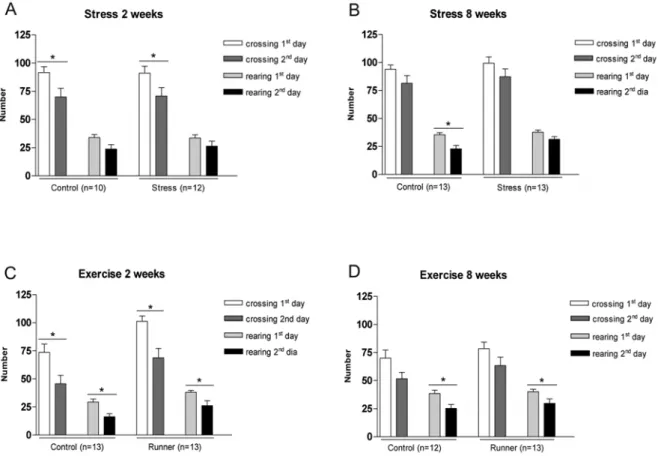
Fig. 1 – Effects of daily footshock stress for 2 (A) or 8 weeks (B), and of forced exercise during 2 (C) or 8 weeks (D) on the habituation of exploration on an open field (OF). Animals were placed for 5 min in the OF (training session) and 24 h later were submitted to a similar exposure (test session). Values are expressed as means±SEM of crossings and rearings. N indicated in each figure. Each graph compare the experimental and control groups; * p<0.05 (training×test) in a Student’st-test.
RESULTS
OPEN-FIELDTEST
Both daily stress (Fig. 1A) and forced running proto-cols (Fig. 1C) enhanced habituation learning after 2 weeks (acute), but not after 8 weeks of training (chronic) (Figs. 1B and 1D).
OBJECTRECOGNITIONTEST
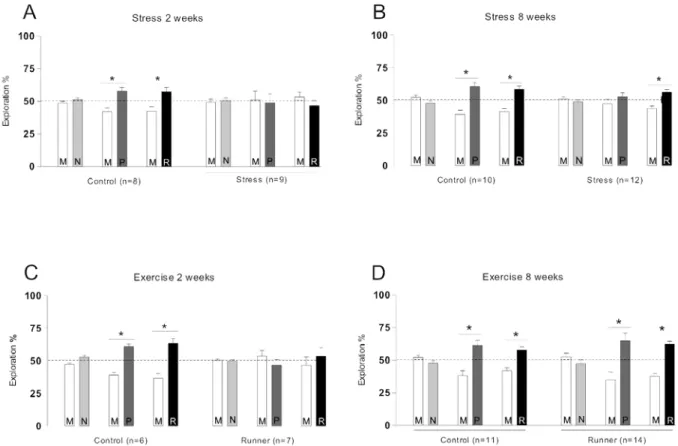
Acute stress impaired both short- (STM) and long-term object recognition memory (LTM) while chronic stress hampered only LTM (Fig. 2A and Fig. 2B). Similarly, acute physical exercise also hindered short- and long-term object recognition memory (Fig. 2C). However, chronic forced exercise did not affect short-or long-term memory retention (Fig. 2D).
MORRISWATERMAZE
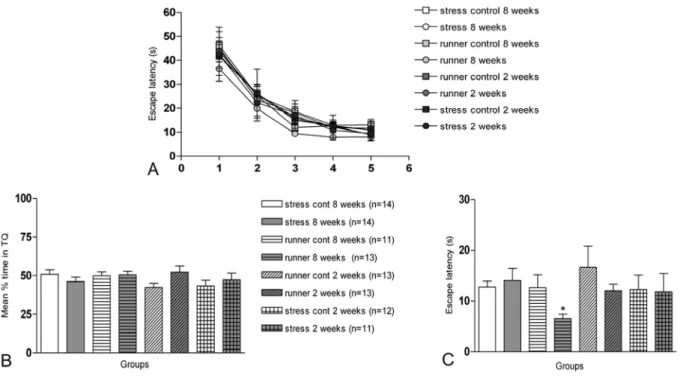
Neither stress nor physical exercise, chronic or acute, had any effect on spatial memory acquisition or reten-tion (Fig. 3A and Fig. 3B). However, chronic physical exercise induced a clear decrease in the latency to swim over the previous location of the escape platform during a probe test carried 24 h after the last training session (Fig. 3C). No difference in swimming speed was ob-served among experimental groups.
ANALYSIS OFMAXIMUMOXYGENUPTAKE
Fig. 2 – Effects of daily footshock stress for 2 (A) or 8 weeks (B) and of forced exercise during 2 (C) or 8 weeks (D) on object recognition memory. Rats were exposed to two different objects (M and N) for 5 min in the training session. Three hours later a short-term memory (STM) test was carried out: animals were exposed to a familiar object (M) and a novel object (P) again for 5 min. Long-term memory (LTM) was measured 24 h after training: the animals were exposed again to the familiar object (M) and to another novel object (R) for 5 min. Data are presented as means
±SEM of the percentage of time spent exploring a particular object divided by the total time of object exploration. * p<0.05 in Student’st-test.
indicating that forced running protocol indeed enhanced physical aerobic capacity (Fig. 4). Maximum oxygen uptake was not evaluated at the end of the training period to avoid confounding strin the end of running period be-cause this test can be-cause some stress to the animals, and immediately after the exercise protocol was finished the animals were submitted to the memory tests.
DISCUSSION
The effects of daily forced exercise and daily footshock stress were quite similar, but not identical in the three tasks here examined. Our results fall within the wide variability of reports in the literature on the nature of these effects (van Praag et al. 2005, Ogonovsky et al. 2005, Uysal et al. 2005, Radak et al. 2006, Blustein et al. 2006, Alaei et al. 2006, Ang et al. 2006). Further,
our findings correlate with others in humans showing that high impact running improves some forms of learning, but also causes blood catecholamine and other changes indicative of stress (Winter et al. 2007).
Fig. 3 – Animals were trained during 5 days in a spatial version of the Morris Water Maze (MWM). (A): Mean±SEM escape latency (time spent to find the escape platform) on each training session (data shown as blocks of 8 trials). (B): Mean±SEM time spent to find the target quadrant (TQ) during a 60 s probe test carried out 24 h after the 5thtraining session; no significant differences among groups were detected. (C): Mean± SEM latency, measured in the probe test, to detect the position where the escape platform had been during the training. Animals submitted to the forced exercise during 8 weeks showed a significantly lower latency than all the others (* p<0,05 in Duncan’s test).
Fig. 4 – Animals submitted to forced running during 8 weeks were sub-mitted to two indirect measurements of maximum oxygen consumption (VO2peak) using the procedure of Brooks and White (1978). The first
measurement was one day before the beginning of training, and the second was after 4 weeks of training. Note that the training procedure significantly enhanced VO2(* p<0,05 in Student’st-test), showing that it effectively served the purpose of an exercise.
Finally, a slight but significant enhancing effect of chronic exercise was observed in the Morris maze (Fig. 3C), which agrees with a report of Ang et al. (2006); Alaei et al. (2008) and with those of Radak et al. (2006) and Blustein et al. (2006). No such influence or any others were detected in the acute or chronic stress groups or in the acute exercise group.
In summary, our results suggest that while physi-cal exercise can play a key role to influence the learned behavior in rats, the amount of stress inherent to each experimental procedure also has a prominent effect. It is difficult to establish exactly the degree of stress asso-ciated with the physical exercise protocol utilized in our experiments. However, it is clear that since it forces the animal to run at the experimenter demand, running in a treadmill is far more stressing than doing so, at will, in a running wheel (Blustein et al. 2006).
(During and Cao 2006, Fabel et al. 2003, van Praag et al. 1999), reduced oxidative stress (Ogonovszky et al. 2005, Radak et al. 2006), and increased brain-derived neurotrophic factor levels (Vaynman et al. 2006, Huang et al. 2006, Berchtold et al. 2005, Neeper et al. 1995).
In any case, the question that remains open is how the influence of exercise on cognitive function can be ascribed to the exercise and stress separately (McEwen and Magarinos 2001, Cotman and Berchtold 2002), since the forced exercise per se also includes a degree of stress as suggested by stress oxidative investigations (Radak et al. 2006, Ogonovsky et al. 2005). Proper experiments are in course to answer this issue.
ACKNOWLEDGMENTS
This work was supported by research grants from the Conselho Nacional de Desenvolvimento Científico e Tecnológico (CNPq) to II and MC. The authors thank Dra. Adriane Belló Klein for her technical advice.
RESUMO
Neste trabalho estudamos os efeitos do exercício forçado diário em esteira rolante e da exposição diária ao estresse (porque o exercício forçado envolve um certo grau de estresse) durante 2 ou 8 semanas em diferentes tipos de memória em ratos Wistar machos. Os testes de memória utilizados foram: habituação da exploração em um campo aberto, reconhecimento de ob-jetos, e memória espacial no labirinto aquático de Morris. O estresse diário facilitou a memória de habituação, os animais aprenderam após 2 mas não após 8 semanas; houve prejuízo na memória curta (STM) e de longa duração (LTM) no teste de reconhecimento em 2 semanas, mas somente de STM após 8 semanas; não houve nenhum efeito na memória espacial após 2 ou 8 semanas. O protocolo do exercício facilitou também a memória de habituação no campo aberto após 2 mas não após 8 semanas; prejudicou STM e LTM na tarefa do reconheci-mento após 2 mas não após 8 semanas; e facilitou uma medida importante da aprendizagem espacial após 8 semanas (latên-cia de escape), mas não outras medidas. Nossos resultados indicam que algum cuidado deve ser tomado ao se interpretar efeitos de exercício forçado sobre as funções cognitivas, já que uma parte deles, embora não todos, podem ser atribuídos ao estresse inerente ao exercício.
Palavras-chave: atividade física, estresse, aprendizagem e
memória, corrida forçada.
REFERENCES
ABBOTRD, WHITE LR, ROSSGW, MASAKI KH, CURB
JDANDPETROVITCHH. 2004. Walking and dementia in physically capable elderly men. JAMA 292: 1447–1453. ALAEI H, BORJEIAN L, AZIZI M, ORIAN S, POURSHA
-NAZARI A AND HANNINEN O. 2006. Treadmill run-ning reverses retention deficit induced by morphine. Eur J Pharmacol 536: 138–141.
ALAEIH, MOLOUDIRANDSARKAKIAR. 2008. Effects of treadmill running on mid-term memory and swim in the rat with Morris water maze test. J Bodywork Mov Ther 12: 72–75.
ANGET, DAWEGS, WONGPTH, MOOCHHALASANDNG
YK. 2006. Alterations in spatial learning and memory after forced exercise. Brain Res 1113: 186–193. ARIDARM, SCORZACA,DASILVAAV, SCORZAFAAND
CAVALHEIROEA. 2004. Differential effects of sponta-neous versus forced exercise in rats on the staining of parval-bumin-positive neurons in the hippocampal forma-tion. Neurosci Lett 364: 135–138.
ARKINS. 2007. Language-enriched exercise plus
socializa-tion slows cognitive decline in Alzheimer’s disease. Am J Alzheimers Dis Others Demen 22: 62–77.
BARNESCA, FORSTERMJ, FLESHNERM, AHANOTUEN,
LAUDENSLAGER ML, MAZZEO RS, MAIER SF AND
LALH. 1991. Exercise does not modify spatial memory, brain autoimmunity, or antibody response in aged F-344 rats. Neurobiol Aging 12: 47–53.
BARROS D, AMARAL O, IZQUIERDO I, GERACITANO L, RASEIRAMCB, HENRIQUESATANDRAMIREZMR. 2006. Behavioral and genoprotective effects of Vacci-nium berries intake in mice. Pharmacol, Biochem and Behav 84: 229–234.
BERCHTOLDNC, CHINNG, CHOUM, KESSLAKJPAND
COTMAN CW. 2005. Exercise primers a
molecu-lar memory for brain-derived neurotrophic factor protein induction in the rat hippocampus. Neuroscience 133: 853–861.
BLUSTEINJF, MCLAUGHLINMANDHOLFMANJR. 2006. Exercise effects stress-induced analgesia and spatial learning in rats. Physiol Behav 89: 582–586.
BROOKS GA AND WHITE TP. 1978. Determination of metabolic and heart rate responses of rats in treadmill exercise. J Appl Physiol 45: 1009–1015.
CAOL, HUDSONCAANDMOYNINHANJA. 2007. Chronic
anti-inflammatory responses in mice. J Neuroimmunol 186: 63–74.
COTMANCW ANDBERCHTOLDNC. 2002. Exercise: a
behavioral intervention to enhance brain health and plasticity. Trends in Neurosci 25: 295–301.
DASA, RAID, DIKSHITM, PALITGANDNATHC. 2005. Nature of stress: Differential effects on brain acetylcho-linesterase activity and memory in rats. Life Sci 77: 2299–2311.
DEREE, HUSTONJP ANDSILVAMAS. 2005. Integrated memory for objects, places, and temporal order: Evidence for episodic-like memory in mice. Neurobiol Learn Mem 84: 214–221.
DURINGMJANDCAOL. 2006. VEGF a mediator of the
effect of experience on hippocampal neurogenesis. Curr Alzheimer Res 3: 29–33.
ENNAUCERAANDDELACOURJ. 1988. A new one-trail test for neurobiological studies of memory in rats. 1: Behav-ioral data. Behav Brain Res 31: 47–59.
FABELK, FABELK, TAMB, KAUFERD, BAIKERA, SIM
-MONS N, KUO CJANDPALMERTD. 2003. VEGF is necessary for exercise-induced adult hippocampal neuro-genesis. Eur J Neurosci 18: 2803–2812.
FRICK KM, STILLNER ET AND BERGER-SWEENEY J. 2000. Mice are not little rats: species differences in a one-day water maze task. Neuro Report 11: 3461–3465. HUANGAM, JEN CJ, CHEN HF, YU L, KUO YM AND
CHEN HI. 2006. Compulsive exercise Acutely
upregu-lates rat hippocampal brain-derived neurotrophic factor. J Neural transm 113: 803–811.
ISAACSKR, ANDERSONBJ, ALCANTARAAA, BLACKJE
ANDGREENOUGHWT. 1992. Exercise and the brain: an-giogenesis in the adult rat cerebellum after vigorous phys-ical activity and motor skill learning. J Cereb Blood Flow Metab 12: 110–119.
KRAMERAFET AL. 1999. Ageing, fitness and
neurocogni-tive function. Nature 400: 418–419.
MANIKANDAN S, PADMA M, SRIKUMARK, PARTHASA -RATHYNI, MUTHUVELAANDDEVIRS. 2006. Effects
of chronic noise stress on spatial memory of rats in relation to neuronal dendritic alteration and free radical-imbalance in hippocampus and medial prefrontal cortex. Neurosci Lett 399: 17–22.
MCEWEN BS AND MAGARINOS AM. 2001. Stress and hippocampal plasticity: implications for the pathophys-iology of affective disorders. Hum Psychopharmacol 16: 117–127.
MCGAUGHJL. 2004. The amygdala modulates the
consoli-dation of memories of emotionally arousing experiences. Annu Rev Neurosci 27: 1–28.
MCGAUGH JL. 2005. Emotional arousal and enhanced amygdala activity: new evidence for the old persever-ation-consolidation hypothesis. Learn Mem 12: 77–79. MCGAUGHJL. 2006. Make mild moments memorable: add
a little arousal. Trends Cog Sci 10: 345–347.
NEEPERSA, GOMÉZ-PINILLAF, CHOIJANDCOTMANC. 1995. Exercise and brain neurotrophins. Nature 373: 109. OGONOVSZKY H, BERKES I, KUMAGAI S, KANEKO T, TAHARAS, GOTOSANDRADAKZ. 2005. The effects of moderate-, strenuous- and overtraining on oxidative stress markers, DNA repair, and memory, in the rat brain. Neurochem Int 46: 635–640.
RADAK Z, TOLD A, SZABO Z, SIAMILISS, NYAKAS C,
SILYE G, JAKUS J AND GOTO S. 2006. The effects of training and detraining on memory, neurotrophins and oxidative stress markers in rat brain. Neurochem Internat 49: 387–392.
RADLEY JJ, ROCHER AB, JANSSEN WG, HOF PR, MCEWENBSANDMORRISONJH. 2005. Reversibility of apical dendritic retraction in the rat medial prefrontal cortex following repetead stress. Exp Neurol 196: 199– 203.
ROSSATOJI, BEVILAQUALRM, LIMARH, MEDINAJH,
IZQUIERDOIANDCAMMAROTAM. 2006a. On the par-ticipation of hippocampal p38 mitogen-activated protein kinase in extinction and reacquisition of inhibitory avoid-ance memory. Neuroscience 143: 15–23.
ROSSATOJI, BEVILAQUALRM, MEDINAJHANDCAM
-MAROTA M. 2006b. Retrieval induces hippocampal-dependent reconsolidation of spatial memory. Learn Mem 13: 431–440.
ROSSATOJI, BEVILAQUALRM, MYSKIWJC, MEDINAJH,
IZQUIERDO IANDCAMMAROTAM. 2007. On the role
of hippocampal protein synthesis in the consolidation and reconsolidation of object recognition memory. Learn Mem 14: 36–46.
SCOPELD, FOCHESATTO C, CIMAROSTI H, RABBO M, BELLÓ-KLEIN A, SALBEGO C, NETTO CA AND
SIQUEIRA IR. 2006. Exercise intensity influences cell injury in rat hippocampal slices exposed to oxygen and glucose deprivation. Brain Res Bull 71: 155–159. SUTOODANDAKIYAMAK. 2003. Regulation of brain
UYSAL N, TUGYAN K, KAYATEKIN BM, ACIKGOZ O,
BAGRIYANIKHA, GONENCS, OZ-DEMIRD, AKSUI,
TOPCUA ANDSEMIN I. 2005. The effects of regular aerobic exercise in adolescent period on hippocampal neuron density, apoptosis and spatial memory. Neurosci Lett 383: 241–245.
VANPRAAGH, CHRISTIEBR, SEJNOWSKITJANDGAGE
FH. 1999. Running enhances neurogenesis, learning, and long-term potentiation in mice. Proc Natl Acad Sci USA 96: 13427–13431.
VANPRAAGH, SHUBERTT, AHAOCANDGAGEF. 2005.
Exercise enhances learning and hippocampal neuroge-nesis in aged mice. J Neurosci 25: 8680–8685.
VAYNMANSS, YING Z, YINDANDGOMEZ-PINILLAF. 2006. Exercise differentially regulates synaptic proteins associated to the function of BDNF. Brain Res 1070: 124–130.