Evaluation of pozzolanic reactivity of artificial pozzolans
J. Pontes
1, a, A. Santos Silva
2,band P. Faria
1,c1
Department of Civil Engineering – Nova University of Lisbon, Caparica, Portugal
2
National Laboratory of Civil Engineering, Av. Do Brasil 101, Lisbon, Portugal
a
[email protected], [email protected], [email protected]
Keywords: Pozzolan; Reactivity; Chapelle; Fratinni; Strenght Activity Index; fly ash; metakaolin
Abstract.
Pozzolanicity is a very interesting issue regarding building materials, as a way to enhance mortars and concrete durability. This property results from the reaction between calcium hydroxide and silica and alumina based materials. Different types of natural and artificial pozzolans show pozzolanic activities that differ depending on the materials characteristics. Therefore, the study of this property, namely its reactivity with calcium hydroxide, reveals itself to be important in the selection of the type and content of these materials.
This paper presents the results of several pozzolanic reactivity methods, applied to different pozzolanic materials. The selected pozzolanic methods include Chapelle method, Fratinni method and Strength Activity Index. Those tests have been applied to evaluate the reactivity of various kinds of artificial pozzolans. The correlation between the test methods are presented and discussed.
Introduction
Pozzolans are materials known to be rich in amorphous silica and alumina, being of natural or artificial origin, used in the optimization of mortar and concrete durability. They contribute to more sustainable construction products partially substituting mineral binders, in terms of durability, applicability and energetic consumption [1][2][3].
The use of pozzolanic materials in lime mortars and concretes is well documented and has been studied intensively. However, some questions are still open, namely in order to know its reactivity, e.g., why a certain pozzolan reacts faster than others, what type of materials can be used as pozzolans, what amounts of pozzolan needed to achieve optimization. In order to measure the reactivity of pozzolans used in mortars and concretes, several methods have been studied and are in use currently, measuring and studying different aspects of the lime/pozzolan and cement/pozzolan reaction, such as compression strength, reaction kinetics and lime consumption [2][4].
This paper presents the results of three pozzolanic reactivity test methods, including Chapelle test, Fratinni test and Strenght Activity Index (SAI) methods, that were applied to metakaolin and other thermally treated clay, ashes and glass. The results obtained are discussed.
Experimental
Materials and characterization.
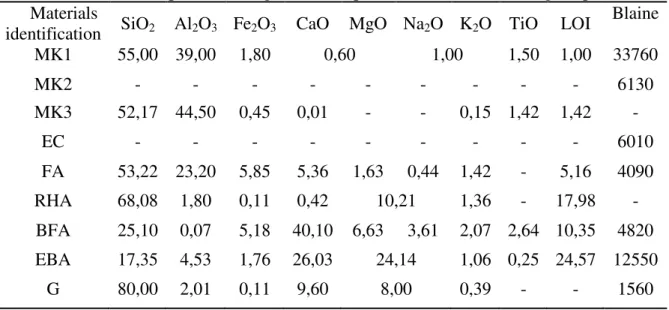
Table 1 – Chemical composition (weight %) and specific surface areas (cm2/g) of pozzolans Materials
identification SiO2 Al2O3 Fe2O3 CaO MgO Na2O K2O TiO LOI
Blaine
MK1 55,00 39,00 1,80 0,60 1,00 1,50 1,00 33760
MK2 - - - 6130
MK3 52,17 44,50 0,45 0,01 - - 0,15 1,42 1,42 -
EC - - - 6010
FA 53,22 23,20 5,85 5,36 1,63 0,44 1,42 - 5,16 4090
RHA 68,08 1,80 0,11 0,42 10,21 1,36 - 17,98 -
BFA 25,10 0,07 5,18 40,10 6,63 3,61 2,07 2,64 10,35 4820
EBA 17,35 4,53 1,76 26,03 24,14 1,06 0,25 24,57 12550
G 80,00 2,01 0,11 9,60 8,00 0,39 - - 1560
Pozzolanic reactivity tests
Strength Activity Index (SAI)
The procedure followed the EN 196-1 [5]. Control mortar were prepared by mixing 1350g of normalized sand, 450g of CEM-I 42,5 R and 225g of water. The blended mortars were prepared with 25% of the cement mass replaced by pozzolan, according to EN 450-1 [6].
The mortars prisms of 40x40x160 mm were cast maintaining the same flow properties as the control mortar (± 10 mm).
The specimens were demoulded after 24h and put in a water bath at 20ºC until 28 days of cast. Afterwards were tested for compressive strength being the results expressed according to equation 1:
SAI = A/B x 100. (eq. 1)
A is the unconfined compressive strength of the pozzolan mortar (MPa) and B is the unconfined
compressive strength of the control mortar (MPa).
Chapelle Test
The test followed NF P 18-513 [7], that measures the reduction of Ca(OH)2 by combination with siliceous or aluminosilicates materials present in pozzolans.
In our case, a mixture of 3g of CaO and 1g of pozzolan (instead of 2g of CaO referred in NF P 18-513) was placed in a plastic Erlenmeyer with 250 ml of distilled and decarbonized water, and set in a bath at 90º C during 16 h. A control mixture is made under the same condition but only with CaO. A mixture of 60g of sugar with the same described volume of water was added in order to dissolve the free Ca(OH)2. The solution was then filtered and titrated with 0,1M HCl, being the amount of calcium consumed determined by equation 2:
mg CaO = 2 x ((v2-v1)/v2) x 74/56 x 1000. (eq. 2)
v2 is the titration volume of the control mixture (CaO) and v1 is the titration volume of the pozzolanic mixture (CaO + pozzolan).
Fratinni Test
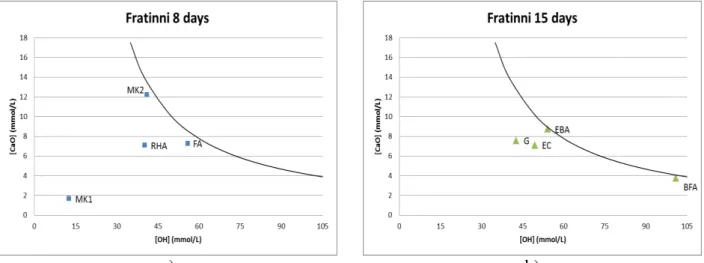
The values are displayed in a XY graph, with [CaO] (mmol/L) in the Y axis and the [OH-] (mmol/L) in X axis. The obtained values are compared with the lime solubility curve in an alkaline medium. The pozzolan is considered as reactive only if its value is plotted below the lime solubility curve. However, in the opposite case the method recommends a new titration using a sample cured at longer time (15 days).
Results and discussion
Figures 1 to 3 presents the results obtained for the pozzolans tested according to the SAI, Fratinni and Chapelle test respectively.
The values of the SAI test correspond to the average of three prismatic specimens.
Fig. 1 – SAI results at 28 days. The reference line corresponds to the threshold value indicated in the EN 450-1 [6].
According to the NP EN 450-1 [6] a material is considered pozzolanic if SAI ≥75%, therefore only MK1, MK2 and FA are considered pozzolanic materials in respect to this method. These results did not show any correlation with the chemical composition and specific surface area (Blaine) as shown in Table 1.
Figure 2 shows the plotted values obtained at 8 and 15 days (values in duplicate) according to the Fratinni test.
a) b)
Fig. 2 – Fratinni test results for the pozzolans tested at 8 days (a) and 15 days (b) of curing at 40º C.
Figure 3 shows the results obtained according to the Chapelle test. In respect to the NF P 18-513 [7], the amount of CaO consumed must be higher than 660 mg/1 g of pozzolan in order to be considered a pozzolanic material.
Fig. 3 – Amount of CaO consumed by 1g of each pozzolanic material.
The results obtained (Fig. 3) shows that only MK1 is considered pozzolanic. This conclusion relatively to MK1 is in agreement with the results obtained according to the SAI and Fratinni tests. Although, the Chapelle test was the fastest test used, the behavior of MK1 in the different pozzolanic tests could imply that this test is highly selective when considering the classification of pozzolanic reactivity.
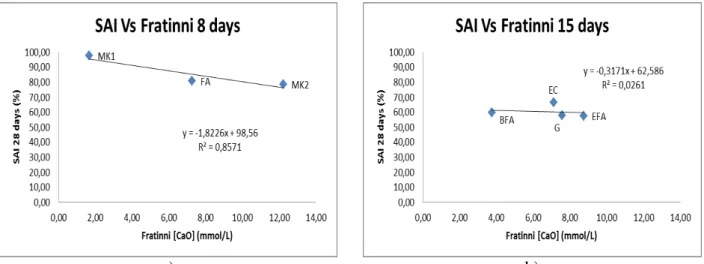
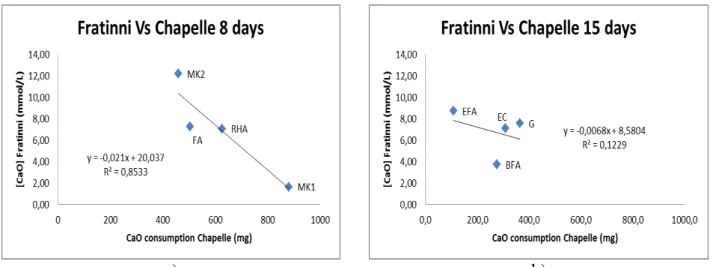
Figures 4 and 5 shows the correlation graphs obtained between Fratinni vs SAI results and Chapelle vs Fratinni results, respectively. It is clear that there is a low correlation between the results of Fratinni test at 15 days and the SAI or Chapelle test, which can be explained by the low reactivity of the tested materials. Once again, this confirms that both Fratinni and Chapelle could be used to assess the pozzolan reactivity degree. The pozzolan/binder ratio was the same for all test methods, therefore this fact does not influence the results obtained.
a) b)
a) b)
Fig. 5 – Correlation between Chapelle vs Fratinni results at 8 days (a) and 15 days (b).
Figure 6 shows a significant correlation between the SAI vs Chapelle test results. This correlation does not seem to be dependent on the chemical composition of the two families of tested materials (treated clays and ashes).
a) b)
Fig. 6 – Correlation between Chapelle vs SAI for clay (a) and ash (b) materials.
Conclusions
The following conclusion can be withdrawn from this study:
- The Chapelle and the Fratinni tests focus is on the CaO consumption, while the SAI test focuses on the mechanical strength gain.
- The order of reactivity of the tested materials by SAI test is:
MK1>FA>MK2>EC>MK3>BFA>G>EBA. This sequence order is very similar to the one obtained by the Chapelle test. Therefore, the Chapelle test is preferable to the SAI due to its lower time and material consumption.
- The Fratinni test is very useful in the discrimination of the kinetics rate of the pozzolans. However, this test does not distinguish which pozzolan is the best, regarding materials with the same reactivity according to this test.
- The correlation obtained between the pozzolanic reactivity tests performed shows that Fratinni results should only be applied up to 8 days. In the same way, the Chapelle and SAI tests presents a good correlation between the results within the same families group (e.g. clays and ashes).
- The tests are limited to the composition precognized in the standard test methods, so the results obtained refer to a specific mixture. This does not mean that a material is or is not pozzolanic; it means that the result is according to that mixture made. This motivates the need to invest and continue this type of studies in different conditions than those initially tested.
Acknowledgments
The authors wish to acknowledge the Fundação para a Ciência e Tecnologia (FCT) for the financial support under project METACAL (PTDC/ECM/100431/2008) and to the enterprises Fradical, Portucel and IMERYS for the supply of pozzolans used in this work.
The authors wish also to aknowledge the institutions of LNEC – Laboratório Nacional de Engenharia Civil and FCT–UNL – Faculdade de Ciências e Tecnologia – Universidade Nova de Lisboa for the technical support and facilities admission in order to perform the tests.
References
[1] Lea’s Chemistry of Cement and Concrete, 4th
Edition, Arnold, London 1997
[2] A. Sousa Coutinho, Pozolanas, betões com pozolanas e cimentos pozolânicos, Memoria nº136 (1958), LNEC, Lisboa.
[3] P. Kumar Mehta, Pozzolanic and Cementitious Byproducts as Mineral Admixtures for Concrete
– A Critical Review, SP 79-1, ACI (1983).
[4] S. Donatello et al., Comparison of test methods to assess pozzolanic activity, Cement & Concrete Composites 32 (2010) 121-127.
[5] CEN, EN 196-1: 2005 – Methods of testing cement - Part 1: Determination of strength, Brussels, 2005.
[6] CEN, EN 450-1: 2004 - Fly ash for concrete - Part 1: Definition, specifications and conformity criteria, Brussels, 2004.
[7] AFNOR, NF P 18-513 – Métakaolin, addition pouzzolanique pour bétons - Définitions, spécifications, critères de conformité, Paris, 2010.
[8] CEN, EN 196-5: 2005 – Methods of testing cement - Part 5: Pozzolanicity test for pozzolanic cement, Brussels, 2005.
PONTES, J.; SANTOS SILVA, A.; FARIA, P. - Evaluation of pozzolanic reactivity of artificial pozzolans. Trans Tech Publications, Switzerland, Materials Science Forum 730-732 (2013), 433-438