Indirect and direct Chapelle’s methods for the
determination of lime consumption in pozzolanic materials
Métodos de ensaio indiretos e método Chapelle direto
para determinação do consumo de cal pelos materiais
pozolânicos
a Instituto de Pesquisas Tecnológicas do Estado de São Paulo (IPT) - Laboratório de Materiais de Construção Civil, São Paulo, Brazil; b Escola Politécnica da Universidade de São Paulo – Departamento de Engenharia Metalúrgica e de Materiais. São Paulo, Brazil; c Escola Politécnica da Universidade de São Paulo – Departamento de Engenharia de Construção Civil, São Paulo, Brazil.
Received: 28 Jan 2014 • Accepted: 11 Nov 2014 • Available Online: 03 Feb 2014
Abstract
Resumo
In this work, comments are made about indirect methods and direct Chapelle’s method applied to the determination of the reactivity of
pozzo-lanic materials. The Chapelle’s method is based on the lime-pozzolan reaction and quantiies the pozzopozzo-lanic reactivity of any material intended
to be applied by the cement industry. This lime consumption determination by the pozzolan through this reaction can be made with mass
pro-portions – lime:pozzolan 1:1, as originally proposed by Chapelle or 2:1, as speciied in Brazilian and French Standards. Comparative results with both proportions are presented for sugar cane bagasse ash, rice rusk ash, silica fume, ly ash, and metakaolin, commonly studied in our
country. Statistical calculations showed that for some materials of similar characteristics to the researched RHA, FA e MK at issue, essays carried out with only 1g of CaO may be underestimating the amounts of CaO consumed per gram of pozzolanic material that can be obtained. Comments were made about the Brazilian and French Standards based on this method and emphasized the expression of lime consumption
per mass of the amorphous phase of these materials, as determined by X ray diffraction analysis with the Rietveld reinement method.
Keywords: pozzolanic reactivity, Chapelle’s method, sugar cane bagasse ash, rice rusk ash, silica fume, ly ash, metakaolin
Neste trabalho, são discutidos os métodos indiretos e método de Chapelle direto aplicados para a determinação da reatividade de materiais
pozolânicos. O método Chapelle baseia-se na reação química cal-pozolana e quantiica a reatividade pozolânica de materiais destinados à
aplicação pela indústria de cimento. A determinação do consumo de cal pela pozolana que ocorre por meio desta reação química pode ser feita
empregando-se as proporções em massa cal: pozolana 1:1, como proposto originalmente por Chapelle, ou 2:1, conforme especiicado nas nor -mas técnicas brasileira e francesa. São apresentados os resultados comparativos com as duas proporções cal-pozolana para cinza de bagaço de cana-de-açúcar, cinza de casca de arroz, sílica ativa, cinza volante e metacaulim, comumente estudados em nosso país. Os cálculos estatísticos indicaram para alguns materiais com características semelhantes aos da cinza de casca de arroz (CCA), cinza volante (CV) e metacaulim (MC), pesquisados em questão, que os ensaios realizados com apenas 1 g de CaO podem estar subestimando os valores obtidos de CaO consumidos por grama de material pozolânico. As normas brasileira e francesa foram discutidas com base nos resultados de ensaios Chapelle e enfatizou-se
a quantiicação do consumo de cal, em massa, pela fase amorfa destes materiais, que pode ser determinada pela análise de difração de raios-X por meio do método de reinamento de Rietveld.
Palavras-chave: reatividade pozolânica, método Chapelle, cinza de bagaço de cana-de-açúcar, cinza de casca de arroz, sílica ativa, cinza vo-lante, metacaulim.
V. A. QUARCIONI a [email protected]
F. F. CHOTOLI a [email protected]
A. C. V. COELHO b [email protected]
1. Introduction
The chemical effect resulting from the application of pozzolanic
materials, as Portland cement clinker substitution, modiies the in -trinsic characteristics of the paste due to a reaction with calcium hydroxide, which is called pozzolanic activity. Calcium hydroxide
― portlandite ― is released during the hydration of calcium sili -cates of the clinker and reacts with the pozzolan, forming hydraulic compounds, the most important of which being calcium silicate
hy-drate ― C-S-H ― due to the contribution of its mechanical prop
-erties to the hydrated paste. Not less important is the reinement
of the porous system resulting from the precipitation of hydrated
products and the physical effect from the pozzolan ine fraction [1].
The pozzolanic material does not react immediately with Portland cement under ambient temperature and pressure. As found in liter-ature, the reaction can start anytime between one and seven days, depending on the reactivity of the pozzolanic material. Although
such reaction may not have begun, the pozzolan has a beneicial
effect by decreasing the released by hydration, which is particularly important for the concrete mass. Mitigation of the alkali-aggregate reaction and reduction of the concrete’s susceptibility to leaching
are other beneicial effects which occur at later ages [1, 2].
Pozzolans are composed by inert crystalline phases and a reac-tive vitreous phase. The pozzolanic reaction is the interaction of the solubilized elements of the vitreous phase, in a strong alkaline medium, pH 13.5, with the calcium ion present in the solution in
contact with the cement [3]. Therefore, these materials are char -acterized by the degree of pozzolanic reaction, i.e., by its calcium consumption, which depends on: the Portland cement
composi-tion, with or without calcareous iller; the content and composition of the vitreous phase; cement and pozzolan speciic surface area;
the proportion cement:pozzolan.
Besides the quantiication method of calcium consumption, the de -termination of the pozzolanic reactivity and its effect on the Port-land cement hydration has been improved by the development of new methods of X-ray diffractometry applied to the qualitative determination in “real time”, also called in situ, which allows the
identiication of the hydrated products formed during the irst twen -ty hours, period in which the effects of additions and admixtures is studied, as well as their rheological properties. The analysis by the
Rietveld reinement method quantiies the crystalline and vitreous
phases, and the real consumption by the vitreous phase can be
calculated; this determination applied over time allows the moni -toring of the consumption of the vitreous phase and its effect on
mortar or concrete properties [4, 5, 6].
Other methods are applied to determine the pozzolanic interaction in hardened state systems, hydrated lime or pozzolan-Portland cement. The portlandite consumption and the chemically combined water content are determined by thermogravimetry,
fol-lowing the reaction development [7, 8, 9]. The physical effect is
commonly analyzed by the evolution of mechanical properties and porosity decrease.
Literature proposes a few methods for ly ash, which provide an
indirect determination of pozzolanic reactivity. However, to explain the hydrated cement composition and the microstructure resulting from the interaction with the calcium from the cement and the ele-ments of the pozzolan vitreous phase, the best way is the direct determination of the interaction degree of pozzolan-calcium oxide or calcium hydroxide. In fact, the direct determination conceived
by Chapelle is at present a Standard Method in France for
metaka-olin [10], and in Brazil for pozzolanic materials in general [11].
In this work some comments are made about indirect methods published and the results of Chapelle’s method applied to silica
fume, ly ash, sugar cane bagasse and rice husk ashes, comparing
the effect with the mass proportion lime: pozzolan 1:1, as originally
proposed and 2:1 as speciied in Brazilian and French Standards.
2. Comments about methods to
determine pozzolanic reactivity
2.1 Indirect methods to determine ly
ash pozzolanic reactivity
The most common criteria to determine pozzolanic activity is its
strength activity index according to the ASTM C311 Standard [12]
by applying the compressive strength test on a mix of cement-poz-zolanic material. This test is indirect and does not give any informa-tion about the pozzolanic material itself, since the result depends on the chemical and physical characteristics of the cement. Since the C-S-H is the reaction product with lime, which improves the mechanical properties, a high content of silica is the most
im-portant parameter of the vitreous phase. Raask & Bhaskar [13] proposed evaluating the ly ash quality by measuring the electrical conductivity of the dissolved silica content in hydroluoric acid (0.1
M at 300°C, for 10 minutes) and the result inferred from a calibra-tion curve plotted with silica fume. The authors admitted that in that concentration only the silica from the vitreous phase is solubilized. The most serious drawback to this method is that the authors did not prove that all silica present in the glass phase only was dis-solved. Further, Majumdar & Larner also questioned the
applicabil-ity of this method for ly ash [14].
Considering that lime consumption is an indicative of pozzolanic
reactivity, Luxán et al. [15] proposed measuring the conductivity
of a suspension of an opaline rock in saturated calcium
hydrox-ide, stirring at 40°C. The conductivity decreased during the irst
2 minutes then it stabilized. In the light of this result, this method was applied to a set of 100 natural materials, and a reactivity
clas-siication was proposed. The authors mentioned that during this
period, the adsorption phenomenon is predominant, but did not seek to prove whether there was, in fact, early pozzolanic activity by chemical reaction. The method is therefore, questionable.
How-ever, Payá et al. [16] applied this method with modiications, on different ly ashes and concluded that the results were affected by: the soluble salts, the ly ash: lime suspension ratio, and the method does not apply to high-calcium ly ash.
Tashiro et al. [17] proposed to measure the resistivity of pastes of
different materials with calcium hydroxide, steam cured at 70°C for 72 hours, determining the progress of the consumption of
portland-ite by XRD. No relationship was identiied between the consump -tion of calcium hydroxide and the resistivity measurements.
Katyal et al. [18] were concerned only with the determination of the amount of active silica in ly ash, by comparing two treatments: a)
initial heating in diluted hydrochloric acid until dry up, and the solid
residue is digested in a digestion pump with potassium hexaluoro
-silicate; in the solution obtained, the hydroluoric acid released by
hydroxide 25% solution and quantiication of the solubilized silica.
The issue that arises is that since the content of the glass phase has not been provided it does not show whether or not the dissolution was complete and from what phase the dissolved silica came from. The purpose of these methods was the speed which the pozzola-nic activity could be determined, but in practice it did not happen. Surface phenomena interfere with these results, especially those
relating to the high speciic surface area of ly ash. In addition, the beginning of the speciic reactivity for each pozzolan, it is highly
important to determine the age at which the lime consumption is
more signiicant, and the extension of the reaction contributing to
the mechanical properties of cementitious materials.
Concerning the hardened state of pastes or mortars, the exten-sion of the interaction was determined by quantifying the calcium
hydroxide consumption by thermogravimetry [7,8, 9], or by deter
-mining the amount of unreacted ly ash, both methods were ap
-plied after different periods of cure. To quantify the unreacted ly
ash, the hydrated products were washed with selective reagents.
Different reagents were studied ― picric acid-methanol, salicylic acid-methanol, hydrochloric acid-sodium carbonate [2, 19, 20, 21]. They all affect the results a little with some solubility of the ly ash,
or the incomplete dissolution of hydrated products, which means that some corrections have to be made.
Direct determination of calcium consumption by Chapelle´s test
Chapelle’s method modiied by Raverdy et al. [22], is an accel -erated method for the direct determination of the pozzolan lime consumption. A suspension of pozzolan/lime (1g/1g) and a blank of
lime are kept reacting at 90°C for 16 hours; the lime consumed is
calculated by the difference between the added and the remaining lime. This method was applied on industrial Portland pozzolanic cements and also on laboratory prepared with three Portland ce-ments of different contents of C3A and seven pozzolans, whose substitution levels were 10%, 20% and 35% at the same Blaine
ineness, totalizing 63 samples. The authors evaluated the con -tribution of pozzolanic reactivity by comparing any increase in the compressive strength of the cements with pozzolans, after 28 days, with the corresponding pozzolan cements without addition. This study had the merit of indicating a minimum consumption as a reference data obtained from pozzolanic cements. Strength re-sistance at 180 days was plotted against the content of the glass
phase [23] indicating only the gain for pozzolans for which lime
consumption was greater than 330 mg per gram of glass phase.
In France, the Chapelle´s method was speciied to select metaka
-olin for addition in concrete. The conformity criteria [10] are: (a) the
content of SiO2+Al2O3 >90%, calcined between 600°C and 850°C; this result means that metakaolin has to be obtained from high
quality kaolin; (b) the loss on ignition has to be <4.0%; compared to the theoretical ignition loss of pure kaolin, of 13.76%. Thus, we
can conclude that the kaolin must have a transformation degree of
at least 70%; (c) the speciied calcium hydroxide consumption has to be 700 mg/g of metakaolin [700mg of Ca(OH)2 is equal to 530
mg of CaO]. In this standard method, the reaction is one gram of
metakaolin and two grams of lime.
Chapelle’s method was standardized too by ABNT - Associação Brasileira de Normas Técnicas (NBR 15895:2010), being
applica-ble to natural and artiicial pozzolans ─ calcined clay minerals, ly ash, silica fume and metakaolin but not to siderurgical slags [11]. In
fact, it is also not applicable to metallurgical slags, as granulated blast furnace slag.
3. Experimental
Chapelle´s method is commonly applied by the IPT- Construction Materials Laboratory for pozzolanic reactivity determination of dif-ferent materials. Raverdy´s et al. procedure underwent some ad-justments to obtain a good reproduction of results. The results ob-tained with one gram of lime were carried out before the Brazilian Standard publication.
Test: All materials have their ineness speciied, that is, a maximum
residue of 12% of 45µm, or around 800 m2/kg. One gram of
poz-zolan is mixed with one gram of calcium oxide, added to 250 mL water in a 500 mL plastic Erlenmeyer and sealed. Calcium oxide is obtained from the calcination of a calcium carbonate pure re-agent for analysis at 1000°C for 1 hour. After, the material is mixed quickly and manually and calcined for an additional half hour. The pozzolanic-lime mix and a blank are kept at 90±5°C in a closed
Dubnoff shaking water bath for 16±2 hours (Fig. 1A and 1B), with
some Telon rods and stainless steel little balls. After cooling, 250
mL of a saccharose solution (240g/L) is added (Fig. 1C),
Erlen-meyer is closed and the solution shaken for ifteen minutes (Fig. 1D); it is then iltered (Fig. 1E) through a pleated ilter paper with
an aliquot of 50 mL, the alkalinity is determined with
hydrochlo-ric acid 0.1M (Fig. 1I). During the iltration (Fig. 1F and 1G) and
pipetting (Fig. 1H) phases it is important to carry them out as fast as possible to avoid carbon dioxide absorption. The result is
expressed in reacted milligrams of lime (CaO) reacted or ixed per
gram of pozzolan.
Figure 1-A illustrates the Nova Ética, type 304E Thermostatic Bath, with a digital microprocessed controller, at a 0.1°C resolution and a sensor Pt-100. The bath reservoir has an available capacity of 12 L of water, which is enough to maintaining the level of the Er-lenmeyer solution covered, kept constant. The evaluation of its
thermal proile showed that the 4°C temperature gradient does not interfere with the test results [24].
Calculation considering 2g of CaO and 1g of pozzolan:
(1)
being:
m2 = grams of pozzolanic material;
m3 = grams of CaO mixed with pozzolanic material; m4 = grams of CaO in the blank test;
v2 = milliliters of HCl 0.1M consumed by the sample solution; v3 = milliliters of HCl 0.1M consumed by the blank solution; Fc = correction factor of HCl 0.1M standard solution.
4. Results and discussion – calcium
consumption of different pozzolans
pozzolanic materials analyzed in the IPT’s Laboratory in the last three years, tests being carried out with one gram and two grams of calcium oxide, respectively.
5. Results and discussion – calcium
consumption of different pozzolans
Regarding the reference metakaolin, the mean, maximum, minimum and standard deviation results are presented on Table 1. We can see
that the CaO consumption increases. Table 1 also presents calcium oxide results calculated as calcium hydroxide (CaO x 1.32). Table 2 illustrates the calcium consumption of the pozzolanic materials that has been analyzed in IPT’s Laboratory in the last three years, tests being carried out with one gram and two grams of calcium oxide. Analysis of variance (ANOVA) was carried out between 1g and 2g
results in order to observe if one gram of calcium oxide is suficient
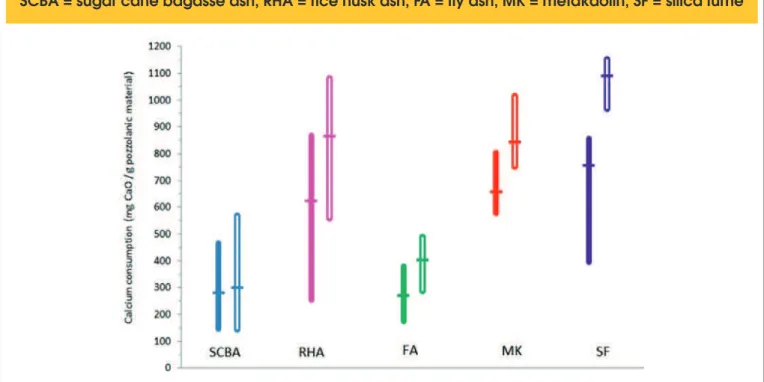
to consume all the existing vitreous phase in pozzolanic material. Figure 2 presents graphically the dispersion of the results.
Figur
1 – Dubnof f shaking water bath with Erlenmeyer prepared
e
for the Chapelle´s test and illustrative steps of this essay
A B C
Dubnoff shaking water bath Addition of a sucrose solution
I
Titration of a sample Detail of Dubnoff shaking water bath
F
Filtering the set of tests
D
Agitation after addition of the sucrose solution
E
Decantation before filtration
H
Pipetting a volume set to titration
G
A wide result variation was observed in three materials: sugar cane bagasse ash (SCBA), rice husk ash (RHA) and silica fume (SF). SCBA and RHA are generally collected at the production site and
calcined under temperature conditions and residence time speciic
to each research laboratory. Consequently, the composition of the ash and content of vitreous phase may vary. The region from
where they come from also inluences their composition due to the type of fertilizer employed. This can explain the signiicant calcium
consumption difference for these two materials.
SF, on the contrary, comes from industrial processes under con-trolled conditions and should have homogeneous characteris-tics which restricts the variation of calcium consumption. At the moment, we have no explanation for the wide degree of varia-tion observed.
Fly ash (FA) and metakaolin (MK) also come from industrial pro-cesses under controlled conditions. In the case of these two mate-rials, the variation of the results was quite small as expected. An analysis of variance (ANOVA) carried out for the 1g and 2g CaO
results made it possible to conirm that the results of consumed
CaO are statistically equal, whether starting from 1g or 2g of CaO,
for sugar cane bagasse ash and for ly ash. It can be said that for these two types of materials, 1g CaO is suficient to consume
practically the whole vitreous phase contained in one gram of poz-zolanic material, and that an increase in the amount of CaO does not give rise to an increase in consumption.
In the other tested materials (RHA, FA and MK), the increase in the amount of CaO initially added (from 1g to 2g) gives rise to a
statistically signiicant increase in CaO consumption. These ma -terials should have vitreous phases whose nature and/or amount are such that they do not completely react when only 1g of CaO
is added, and require a higher lime concentration. This inding, in
addition to the metakaolin results presented on Table 1, suggest that for some materials of similar characteristics to the researched RHA, FA e MK at issue, essays carried out with only 1g of CaO may be underestimating the amounts of CaO consumed per gram of pozzolanic material that can be obtained. For this very reason, the French and Brazilian standards were objective by adopting the use of 2g of CaO.
6. Conclusions
The number of tests made with metakaolin illustrates the good re-producibility of the method for each lime-pozzolan proportion.
The dificulty found in applying Chapelle’s method as disclosed
by Raverdy et al. was the glassy phase determination, which has
now been solved with the introduction of the Rietveld reinement
method of the XRD analysis interpretation. All these results of
cal-cium consumption refer to the pozzolanic material as received; real
consumption cannot be given because the vitreous phase was not determined.
Table 1 – Calcium consumption of metakaolin as the reference material
Calcium consumption
Test with 1g of CaO (188 tests) Test with 2g of CaO (56 tests) CaO
mg/g sample
Ca(OH)2 mg/g sample
CaO mg/g sample
Ca(OH)2 mg/g sample
Medium 857 1131 1068 1410
Maximum 876 1156 1134 1497
Minimum 833 1100 973 1284
Standard deviation 11 – 48 –
Table 2 – Calcium consumption (g of CaO/g of pozzolanic material) of different pozzolanic materials.
Tests were carried out with 1g or 2g of CaO. SCBA = sugar cane bagasse ash; RHA = rice husk ash;
FA = fly ash; MK = metakaolin; SF = silica fume
SCBA RHA FA MK SF
1g 2g 1g 2g 1g 2g 1g 2g 1g 2g
Mean value 279 298 622 864 269 403 656 842 755 1089
Minimum value 146 143 255 559 174 286 579 752 394 967
Maximum value 468 568 867 1080 378 489 804 1015 858 1153
Standard deviation 106 145 141 179 97 91 50 101 117 71
Number of materials 7 13 16 6 4 4 17 8 16 5
ANOVA analysis - with 95%
However, these results allow us to emphasize that the conclusions drawn about the chemical effect of the properties of Portland ce-ments where the clinker has been replaced by pozzolan have to take in account the real content of the vitreous phase and the ef-fective reactivity.
Chapelle’s method quantiies the calcium consumption related to
the amorphous or vitreous phase of pozzolanic materials. The
Ri-etveld reinement method gives the percentage of the amorphous
and vitreous phase. These available methods allow correlating the effective calcium consumption with the effect of mechanical properties of the cements with clinker replacement by pozzolanic materials.
7. Acknowledgements
The authors are very thankful to Instituto de Pesquisas
Tecnológi-cas (IPT) for its permission to publish these results and the inan -cial support for this study.
8. References
[01] MASSAZZA, F. Pozzolans and pozzolanic cements. In:
Lea´s chemistry of cement and concrete. Edited by Peter C. Hewlett. Fourth Edition. 1998.
[02] UCHIKAWA, H. Effect of blending components on hydra -tion and structure forma-tion. In: 8th INTERNATIONAL
CON-GRESS ON THE CHEMISTRY OF CEMENT (ICCC). Spe
-cial Reports – Vol. 1, p. 249 – 280. Rio de Janeiro, 1986. [03] UCHIKAWA, H., USHIDA, S., HANEHARA, S Effect of
character of glass phase in blending components on their re-activity in calcium hydroxide mixture. 8th INTERNATIONAL
CONGRESS ON THE CHEMISTRY OF CEMENT. Vol. IV,
Rio de Janeiro - Brazil, 1980, 245- 250.
[04] HESSE, C., GOETZ-NEUNHOEFFER, F., NEUBAUER, J., BRAEU, M., GAEBERLEIN, P. Quantitative in-situ x-ray diffraction analysis of early hydration of portland cement at
deined temperatures. JCPDS-International Centre for Dif -fraction Data 2009 ISSN 1097-0002.
[05] WARD, C. R.; FRENCH, D. Determination of glass content and estimation of glass composition in ly ash using quantita
-tive X-ray diffractometry. Fuel, Volume 85, Issue 16, p. 2268 – 2277, November 2006.
[06] GOBBO, L. A.; SANT’AGOSTINO, L. M.; D’AGOSTINO, L. Z. XRD-Rietveld quantitative analysis of glass-containing
by-products used in the Brazilian cement industry, 12th Inter-national Congress on the Chemistry of Cements. Montreal, Canada, 2007.
[07] VEDALAKSHMI, R.; RAJ, A. S.; SRINIVASAN, S.; BABU, K. G. Quantiication of hydrated cement products of blended cements in low and medium strength concrete using TG and
DTA technique. Thermochimica Acta, Vol. 407, Issues 1 – 2,
p. 49 – 60, December 2003.
[08] ROSZCZYNIALSKI, W. Determination of pozzolanic activity
of materials by thermal analysis. Journal of Thermal Analysis and Calorimetry, Vol. 70, Number 2, p. 387 – 392, Septem-ber 2002.
[09] BAERT, G., HOSTE, S., De SHUTTER, G., De BELLIE, N. Reactivity of ly ash in cement paste studied by means
Figure 2 – Calcium consumption (g of CaO/g of vitreous of materials) of different pozzolanic
materials. Tests were carried out with 1g (solid lines) or 2g (hollow lines) of CaO. Vertical lines
represent the scattering of the results; mean values are shown as horizontal dashes.
of thermogravimetry and isothermal calorimetry. Journal of Thermal Analysis and Calorimetry, 94, Issue 2 (2008) 485-492.
[10] AFNOR – Association Française de Normalisation - Stan -dard NF P 18-513/2010 – “Pozzolanic addition for concrete
– Metakaolin – Deinitions, Speciications and Conformity
Criteria,19 p.
[11] ABNT- Associação Brasileira de Normas Técnicas NBR
15.895/10 “Materiais pozolânicos - Determinação do teor de
hidróxido de cálcio ixado - Método Chapelle modiicado” [12] American Society for Testing and Materials - ASTM C 311
Standard methods for sampling and testing ly ash in natural
pozzolans for use as a mineral admixture in Portland cement concrete.
[13] RAASK, E., BHASKAR, M. C., Pozzolanic activity of
pulver-ized ash, Cement and Concrete Research, 5(1975) 363-375. [14] MAJUMDAR, A. J., LARNER, L. J., The measurement of
pozzolanic activity (Note), Cement and Concrete Research, 7 (1977) 209-210.
[15] LUXÁN, M. P., MADRUGA, F., SAAVEDRA, J. Rapid evalu-ation of pozzolanic activity of natural products by conductivity measurements, Cement and Concrete Research, 19 (1989)
63-68.
[16] PAYÁ, J., BORRACHERO, M. V., MONZÓ, J., PERIS-MO
-RA, E., AMAHJOUR, F., Enhanced conductivity
measure-ment techniques for evaluation of ly ash pozzolanic activity,
Cement and Concrete Research, 31(2001) 41-49.
[17] TASHIRO, C., IKEDA, K., INOUE, Y., Evaluation of pozzo -lanic activity by the electric resistance measurement meth-od. Cement and Concrete Research, 24(1994) 1133-1139.
[18] KATYAL, N. K., SHARMA, J. M., DHAVAN, A.K., ALI, M.
M., MOHAN, K., Development of a rapid method for the
es-timation of reactive silica in ly ash, Cement and Concrete Research, 38 (2008) 104-106.
[19] OHSAWA, R., ASAGA, K, GOTO, S., Daimon, M. Quantitative
determination of ly ash in hydrated ly ash-CaSO4-Ca(OH)2. Cement and Concrete Research, 15 (1985) 357-366.
[20] SHIQUN LI, DELLA M. ROY, AMITHABA KUMAR, Quan-titative determination of pozzolans in hydrated systems of
cement or Ca(OH)2 with ly ash or silica fume, Cement and Concrete Research, 13(1985) 1079-1086.
[21] BEN HAHA, M., E Weerdt, K., LOTHENBACH Quantiication of the degree of reaction of ly ash. Cement and Concrete Research, 40 (2010)14620-11629.
[22] RAVERDY, M.; BRIVOT, F.; PAILLERE, A. M.; DRON, R. Ap -preciation of pozzolanic reactivity of minor components. 7th
INTERNATIONAL CONGRESS ON THE CHEMISTRY OF
CEMENT. Vol. 3, Paris, France, 1980.
[23] MILLET, J., HOMMEY, R., BRIVOT, F. Dosage de la phase vitreuse dans les matériaux pozzolaniques. Bulletin nº. 92, 1977, 101-104.
[24] CHOTOLI, F. ,F., ALEIXO, D.M., COSTA, R.G., CASTANHO, M. A. P. Avaliação do peril térmico de banho-maria com agitação tipo “Dubnoff” ENQUALAB-2007 – Congresso da