Brazilian nurses’ sociodemographic changes in the first decade of
the 21
stcentury
Enfermeiros no Brasil: transformações socioeconômicas no início do século XXI
Enfermeros en Brasil: transformaciones socioeconómicas a principios del siglo XXI
Gerson Luiz Marinho1
Elisabete Pimenta Araújo Paz1
Rafael Tavares Jomar2
Ângela Maria Mendes Abreu1
1. Universidade Federal do Rio de Janeiro, Rio de Janeiro, RJ, Brasil.
2. Instituto Nacional de Câncer José Alencar
Gomes da Silva, Rio de Janeiro, RJ, Brasil.
Corresponding author:
Gerson Luiz Marinho. E-mail: [email protected].
Submitted on 07/26/2018. Accepted on 10/22/2018.
DOI: 10.1590/2177-9465-EAN-2018-0198.
A
bstrActObjective: analyze income and work conditions of nurses in Brazil in 2000 and 2010. Methods: based on demographic census samples, socioeconomic characteristics of nurses were described according to income and work hours. Statistic models estimated the chances (odds ratios) of nurses having lower income despite working more than 40 hours per week. Results: the nurse population in Brazil grew at a rate of 12.5% per year. In the two study periods, approximately 11.0% of nurses received the lowest incomes and worked more than 40 hours per week. The most pronounced chances of belonging to this group were observed for those residing in the interior the South and Southeast regions of Brazil. They were also more elevated for nurses whose color/race was black or brown (pardo) and who lived with their parents. Conclusion and implications for practice: the expressive increase in nurses occurred within the context of reduced socioeconomic inequalities. Less favorable work conditions were most evident
for those classified as black and brown who lived in their parents’ homes. We argue that the scenarios described may be related to the expansion of university educational institutions during the first decade of the twenty-first century, among other aspects.
Keywords: Nursing Human Resources; Socioeconomic Factors; Censuses; Brazil.
r
esumoObjetivo: analisar condições de renda e trabalho dos enfermeiros no Brasil em 2000 e 2010. Método: a partir das amostras
dos censos demográficos, foram descritas características socioeconômicas dos enfermeiros segundo rendimento e jornada de trabalho. Modelos estatísticos estimaram as chances (Odds Ratio) de os enfermeiros pertencerem ao grupo que, apesar de
trabalhar mais de 40 horas, possuía rendimentos mais baixos. Resultados: no Brasil, a população de enfermeiros cresceu a uma
velocidade de 12,5% ao ano. Nos dois períodos, aproximadamente 11,0% dos enfermeiros recebiam os menores rendimentos
e trabalhavam mais de 40 horas semanais. As chances mais expressivas de pertencerem a esse grupo foram observadas para aqueles que residiam no interior das regiões Sul e Sudeste. Também foram mais elevadas para enfermeiros de cor ou raça preta e parda, que moravam com os pais. Conclusão e implicações para a prática: o expressivo aumento de enfermeiros ocorreu
no contexto de redução das desigualdades socioeconômicas. As condições menos favoráveis de trabalho foram mais evidentes para os classificados pretos e pardos que moravam na casa dos pais. Argumentamos que os cenários descritos podem estar
relacionados, dentre outros aspectos, à expansão de centros de formação universitária ao longo da primeira década do século XXI.
Palavras-chave: Recursos Humanos de Enfermagem; Fatores Socioeconômicos; Censos; Brasil.
r
esumenObjetivo: analizar las condiciones de trabajo y renta de los enfermeros que residían en Brasil en 2000 y 2010. Método: a partir
de los datos muestrales de los censos demográficos se describieron características socioeconómicas de los enfermeros según rendimiento y jornada de trabajo. Los modelos estadísticos estimaron las probabilidades de que los enfermeros pertenecieran al grupo que a pesar de trabajar más de 40 horas, tenían ingresos más bajos. Resultados: en Brasil, la población de enfermeros aumentó rápidamente a lo largo del período (12,5% a.a), con mayor participación de hombres y reducción de la renta mensual. El segmento que trabajaba por más tiempo y poseía menores rendimientos mensuales residía en las regiones Sudeste y Sur y se declararon de color ‘negro’ o ‘parda’. Conclusión e implicación para la práctica: el crecimiento acelerado de los enfe rmeros
ocurrió en el contexto de desigualdades socioeconómicas y regionales, lo que puede estar relacionado, entre otros aspectos, a la expansión de centros de formación universitaria a lo largo de la primera década del siglo XXI.
Palabras clave: Personal de Enfermería; Factores Socioeconómicos; Censos; Brasil.
INTRODUCTION
Over the last century, although in different ways, populations
in all countries have been experiencing a similar trend regarding
life expectancy increase. Although manifested in different
con-texts, with faster or slower, the processes of population aging, in
different places, happen together with the increase of the burden of chronic non-communicable diseases. These are scenarios
that pose challenges to plan public health policies, among which are the availability and performance of health professionals1-3.
At a global level, people increasingly lack health care, whi -ch has led to the emergence of new professions related to this
field3-4. Nevertheless, in the current reality of several countries, including Brazil’s2-3, doctors and nurses represent the largest
share among health professionals1-2.
In Brazil, more than half of the health professionals are from the Nursing area; however, only 20% of these professionals are have completed undergraduate courses in Nursing5-6. The population of nurses with higher education, hereinafter referred
to as “nurses”, is unequally distributed in the different regions of
the country, whose concentration is highest in the Southeast5. In addition to the regional distribution, other sociodemographic characteristics have been observed in relation to nurses, such as, for example, the increase in male professionals and younger age groups5,7.
The political and macrossocial scenarios that characterized
Brazil in the first decade of the 21st century favored the success
of a health care model, supported by preventive care and the work of multiprofessional teams. The operationalization of this care model, centered on actions to promote health and prevent
injuries, also characterized an accelerated increase in the
trai-ning of new health professionals, especially nurses4,6. Between 2000 and 2010, the number of undergraduate courses in Nur
-sing grew from 176 to 799 in Brazil, and the increase in private
courses exceeded three times those of public institutions, with an important concentration in the Southeast region8.
One of the first national surveys on the characteristics of
Nursing workers and their insertion in the labor market dates
to the mid-1950s. At that time, there was already an increase
in the number of courses, especially in the southern regions of the country, despite a low demand for vacancies9. Nevertheless, the most recent reality of Nursing professionals is marked by
socioeconomic disparities between the categories - high and upper educational levels -, showing a maintenance of regional inequalities, already seen more than fifty years ago9-10.
The Nursing Profile survey in Brazil (Perfil da Enfermagem no Brasil) showed an increased share of undergraduate profes -sionals, greater participation of young people (who are under
30) and males, in addition to a significant concentration in the
metropolises, especially in the Southeast region5,10. The survey also recorded extensive working hours, precarious relations and
a substantial difference in income between nurses and nursing
technicians (middle level), especially those working in the public sector5. It should be mentioned that this study was carried out based on data from the council that regulates the professional
practice of Nursing categories in Brazil, the Federal Nursing Council. Nevertheless, information is not publicly accessible, which impedes comparative initiatives and the conduct of longitu -dinal studies. On the other hand, data collected by demographic censuses, representative of all countries, are sources available
for research of specific demographic dynamics of the various
professional categories11.
National censuses are recognized tools to enable the cre -ation of representative indicators of the entire popul-ation and provide subsidies for the implementation and evaluation of public
policies. In addition, in defining the socioeconomic and demogra-phic profiles of specific groups, censuses also reflect collective
identities, including the occupational categories investigated11-12. Data collected by national censuses have been widely used as sources for the socioeconomic characterization of the population of nurses in countries such as the United States11, Canada13, the United Kingdom14, Mexico, Peru15 and Brazil16.
Thus, based on data from the censuses conducted in Brazil
in 2000 and 2010, the objective of this study was to analyze
characteristics of the population of nurses according to their monthly income and weekly working hours.
METHOD
The data come from the census samples collected in Brazil by the Brazilian Institute of Geography and Statistics (IBGE) in 2000 and 2010. In the data collection, both surveys used two ins -truments: the Basic Questionnaire, which collected information of all households; and the Sample Questionnaire, applied to a part of the population, which, in addition to the basic questions, answered a larger number of questions on the most varied as -pects, including work and income17-18.
In describing the way by which national censuses are opera -tionalized, IBGE clarifies that obtaining populational information, representative of demographic and social dynamics, is a very complex task. In the case of research on “work and income”, in
addition to referring to constructs of different natures - weekly
working time measured in hours, and remuneration for work
measured in monetary values, for example - the questions and
categories of answers are constantly revised updated, especially for international comparisons18.
The Brazilian censuses conducted in 2000 and 2010 inves -tigated the professions through the more than 500 categories of “occupations” at work, referred to by the people interviewed in the samples. These categories include the 10 main occupation
groups - including “health professions” - defined by the Brazilian Classification of Occupations based on recommendations of the International Labor Organization, whose definitions are covered by the International Standard Classification of Occupations18. According to IBGE, the occupational categories investigated by the censuses of 2000 and 2010 were made compatible, allowing comparisons over time18.
Those investigated in this study were interviewed in the national census samples, included in the following criteria: 1)
nurses and related ones” [code 2235], in 2000; and “Nursing pro-fessionals” [code 2221] in 2010); 2) last completed undergraduate course (Nursing); 3) age greater than or equal to 20 years old; and 4) monthly per capita income between 1 and 19 minimum wages. Thus, from the Census 2000 sample, 4,718 people (83.5% of the
total number of “Undergraduate Nurses”) were selected, and from
the 2010 sample, 11,896 people (49.5% of the total classified as “Nursing professionals”). It should be clarified that in the national censuses conducted in Brazil, mid-level (technical) Nursing pro-fessionals are assesses using a specific occupational category.
After selecting people according to the criteria above, it
was verified that half the nurses of the 2000 Census declared
an income of up to 5.7 minimum wages, whereas in the 2010
Census the average income was equal to 3.9 minimum wages. In both censuses, the average of the weekly workload (WW) in the main job was 40 hours. Then, those with a monthly income below the average value were identified and, at the same time, reported WW over 40 hours per week in the main job, representing 11.2% of the nurses in the 2000 Census, and 11.6% in the 2010
Census. For analysis, the nurses assigned to these groups were considered in less favorable working conditions.
The nurses with the lowest incomes and highest WW were
characterized according to the distribution in the geographic re
-gions of Brazil - North, Northeast, Southeast, South and Center West -, and lived in the capitals of the Federated Units. In addition,
the following variables were analyzed: sex (male and female), age
(<40 and ≥ 40), color or race (white, pardo and black) and role they played at home (person in charge/spouse/child). The nurses
were classified as “yellow” and “indigenous people” in questions regarding color or race - together accounting for 2.9% of the total
in 2000, and 1.4% in 2010 were not included in the analysis. In
order to highlight characteristics of nurses living in their parents’ house (19.1% in 2000, and 16.8% in 2010), those occupying
the roles of “person in charge” and “spouses or leaders” were analyzed together.
The distribution of nurses in the country’s regions was
analyzed by means of population rates (per 100,000 inhabi -tants), whose denominators were obtained in the Aggregated database of IBGE (https://sidra.ibge.gov.br/). Average annual growth rates (% a.a.) of the population of nurses with the lowest
incomes (< average minimum wage) and the highest WW (> 40
hours per week) were compared with the rates of the population
that reported receiving the highest income (≥ average minimum wage) and the lowest WW (≤ 40 hours per week), projected for the 2000-2010 period. The calculations were performed using
the following formula:
In which:
r = annual growth rate; Pt = final period; Po = initial period and n = years in the period
Multivariate logistic models were generated to verify the pro -babilities (estimated by OddsRatio - OR) of the nurses belonging to the group that presented less favorable conditions of work and income, according to the characteristics included in the analyzes,
for the two periods. The nurses whose job and income conditions were more favorable - (income above the average wage and less than 40 weekly WW composed the reference group. At this stage, it was defined that the accuracy of the estimates would allow
sample errors of up to 5% (p value ≤ 0.05).
The estimates were generated taking into account methodo -logical aspects employed by the IBGE in obtaining the samples, in both censuses, characterized by the probabilistic selection of households and people representing Brazil (complex sampling multiple levels) and applying individual sampling weights 17-18. The
statistical packagesurveyof Stata 13.0 was used.
As for the ethical aspects, it should be noted that the sample
of Brazilian Census micro-data, in addition to not identifying
res-pondents, are in the public domain and have free access. Thus, it didn't require the assessment of the Protocol of this study by the Ethics Committee on Research Involving Human Beings, as advocated by the legislation in force in Brazil, that is, the resolution
No. 466/2012, of the National Health Council.
RESULTS
According to the population censuses carried out in Brazil in 2000 and 2010, the population of nurses was estimated at
approximately 45,500 and 145,800 people, respectively. When considering the annual growth rate of 12.3%, the number of nurses in the country has tripled over the first decade of the 21st
century. In 2000, the group of nurses in the group whose working conditions were less favorable represented 11.2% of the total (CI95% 10.4-12.0), and in 2010 the same group represented 11.6% (CI95% 11.0-12.2) (Table 1).
Higher proportions of those observed for the entire Brazil
in both periods (>11.0%) were recorded among nurses living
in the Southern region and municipalities. They were also more expressive among males, under 40, pardo or black, and who lived
in their parents’ house (Table 1).
The comparison between the two periods allows the
verifi-cation that, in all Brazil, there was a discrete increase of the ratio of nurses who worked longer hours and received the less wages
(+0.4%). The variations were more significant in the regions of Brazil - with emphasis on the Southeast and Center-West - where
the proportional increase of this segment surpassed in six and nine times, respectively, the national averages. The proportions of nurses whose working conditions were less favorable were also higher among those aged over 40, and of race black or white in both censuses (Table 1).
Between both censuses there was an increase in nurses
classified as blacks and pardosin the question about color or
race, and among these the reduction in the proportion of those
identified in less favorable conditions of work and income could
be observed. That is, in 2000, they represented 18.0% (CI95%
14.0-22.8) of all black nurses, and in 2010 the percentage went
up to 12.6% (CI95% 10.2-15.5) (Table 1). Similarly, there was a decrease of 2.3 percentage points among nurses who lived in their parents’ house (children). Of the total number of nurses identified as the children of the person in charge at home in the 2000 Census, 19.1% (CI95% 16.9-21.5) were subjected to
less favorable working conditions. In the following census, they
represented 16.8% (CI95% 15.5-18.2) of the total number of
children (Table 1).
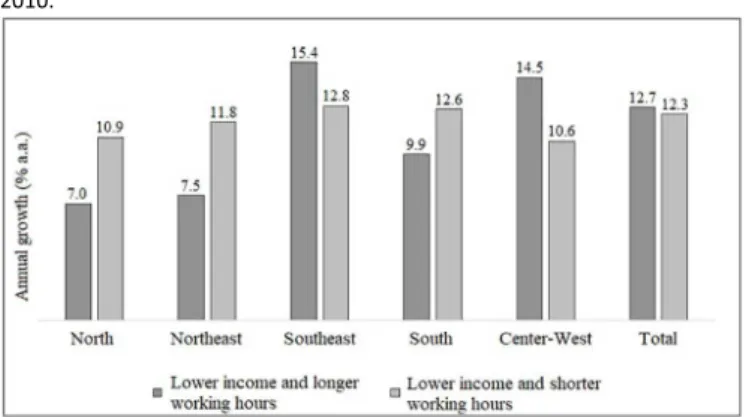
As mentioned, between 2000 and 2010, the population of nurses in Brazil grew at a rate of 12.5% per year (a.a.). Growth rates close to the national rate were found for the geographic
regions, ranging from 10.8% a.a. in the North region to 13.3%
in the Southeast. The groups assessed according to weekly workload and income, the specific growth rates presented
different variations in the regions of Brazil (Figure 1).
The share of nurses who reported income above the average
Table 1.
Sociodemographic characteristics of nurses belonging to the group with the lowest monthly income and the
highest weekly workload. Brazil, 2000 and 2010.
2000 Census
2010 Census
N
%
(CI 95%)
N
%
(CI 95%)
Total
45,513
11.2*
(10.4-12.0)
145,829
11.6*
(11.0-12.2)
Region
North
2,761
7.9
(5.4-11.3)
7,572
5.6
(4.0-8.0)
Northeast
10,381
10.9
(9.4-12.6)
30,633
7.6
(6.5-8.8)
Southeast
23,026
11.1
(10.0-12.2)
78,927
13.5
(12.6-14.4)
South
6,390
14.3
(12.3-16.5)
20,248
11.6
(10.3-12.9)
Center-West
2,955
9.8
(7.4-13.0)
8,449
13.3
(11.0-16.1)
Capital
Yes
25,076
9.1
(8.1-10.1)
70,257
8.6
(7.7-9.5)
No
20,437
13.8
(12.7-15.0)
75,573
14.4
(13.6-15.2)
Sex
Male
3,976
15.1
(12.4-18.3)
17,400
13.4
(11.8-15.3)
Female
41,537
10.8
(10.0-11.6)
128,429
11.3
(10.7-12.0)
Age (years)
< 40
28,995
12.5
(11.5-13.6)
101,074
12.4
(11.7-13.2)
≥ 40
16,518
8.9
(7.8-10.1)
44,756
9.6
(8.6-10.6)
Color or race**
White
32,664
10.5
(9.7-11.4)
94,941
11.3
(10.6-12.1)
Pardo
9,373
12.7
(11.0-14.6)
39,113
11.8
(10.6-13.0)
Black
2,134
18.0
(14.0-22.8)
9,682
12.6
(10.2-15.5)
Role played at home
Person in charge/Spouse
34,017
8.8
(8.0-9.6)
96,192
9.0
(8.4-9.7)
Child
8,623
19.1
(16.9-21.5)
36,876
16.8
(15.5-18.2)
* The coefficients of variation calculated for all categories were under 0.5%.
**The “yellow” and “indigenous” categories were excluded from the analyzes (<2.0% in both periods). Source: 2000 and 2010 Demographic Censuses (IBGE)
value and, concurrently, worked less than 40 hours per week, increased at a rate over 10.0% per year in all regions of Brazil,
ranging from 10.6% in the Center-West to 12.8% in the Southeast
(Figure 1). On the other hand, the growth rates of those with less favorable working conditions were broader across the regions.
Whereas in the North and Northeast of Brazil this segment grew
at approximately at 7.0 a.a., growth rates twice as high were
recorded in the Southeast and Central West regions (15.4% and
14.5% a.a., respectively) (Figure 1).
Table 2 presents, for the two censuses, the probabilities of nurses belonging to the group whose working and income
conditions were less favorable. Estimates were adjusted
according to the characteristics selected in this study, namely: Brazilian regions, whether they resided in capitals, sex, age, color or race and role at home.
favorable conditions of work and income were observed in the North, and at the beginning of the decade (Census 2000) these conditions were not related to the regions of the country, except
in the South region, where they were twice as likely to belong
to the less favored group, compared to the North (OR = 1.99,
p = 0.017). By the end of the decade (Census 2010), working
conditions were related more significantly to the regions of Brazil. With the exception of the Northeast, the odds of belonging to this group were significantly higher in all regions of the country when compared to the North (p <0.001). There was also a significant (> 10.0%) increase in the probability of nurses working over 40
hours a week and receiving lower wages when they lived in the countryside (p <0.001) (Table 2).
The fact that they belonged to the group with longer working hours and lower income was not associated with their sex and age, which can be observed in both periods analyzed. Nevertheless, the magnitudes of the probabilities were quite
significant as to the differences between the color or race groups, with more pronounced work disadvantages for nurses classified
as black and pardos compared to white ones (Table 2).
In 2000, nurses classified as black had twice the odds of
Figure 1. Annual growth rates of the population of nurses (% a.a.), regarding
monthly income and weekly workload related to the regions of Brazil, 2000-2010.
Table 2.
Odds Ratio (OR) to belong to the group of nurses who declared lower monthly income and greater weekly
working day. Brazil, 2000 and 2010
2000 Census
2010 Census
Odds Ratio*
p
-value
Odds Ratio*
p
-value
Region
North
1.00
-
1.00
Northeast
1.54
0.104
1.18
0.501
Southeast
1.36
0.240
2.36
0.000
South
1.99
0.017
1.85
0.011
Center-West
1.34
0.365
2.50
0.000
Capital
Yes
1.00
-
1.00
No
1.51
0.000
1.71
0.000
Sex
Female
1.00
-
1.00
Male
1.39
0.048
1.11
0.275
Age (years)
< 40
1.23
0.080
1.04
0.642
≥ 40
1.00
-
1.00
-Color or race
White
1.00
-
1.00
Pardo
1.41
0.008
1.29
0.003
Black
2.18
0.000
1.36
0.038
Role at home
Person in charge/Spouse
1.00
-
1.00
Child
2.32
0.000
1.98
0.000
belonging to the group whose conditions were less favorable when compared to white ones (OR = 2.18, p = 0.000). Likewise,
those classified as pardos were approximately 40% more likely to belong to this group (OR = 1.41, p = 0.008). In the following Census (2010), there was a reduction in the magnitude of the iniquities related to the working conditions of white and black/ pardo nurses. However, for those black or pardo, higher chances of working longer and receiving lower wages (p <0.05) stood out (Table 2).
In the analyzed decade, about three out of ten nurses lived
in their parents’ house (guardian/spouse). Significant odds of
belonging to the group were observed, whose working and in -come conditions were less favorable to those whom the census
identified as children. Influenced by factors unrelated to sex and
age, nurses who lived with their parents had twice the odds of those who played roles of person in charge or spouse at home (p = 0.000) (Table 2).
DISCUSSION
This study analyzed aspects related to the working condi -tions of nurses living in Brazil, based on census data collected at
the beginning (year 2000) and at the end (year 2010) of the first
decade of the 21st century. For the purposes of the analyzes, nurses with less favorable socioeconomic conditions were those who, at the same time, reported a higher weekly workload and
lower monthly income, whose rates were 11.2% and 11.6%, in
2000 and 2010, respectively.
The Nursing population tripled over the analyzed period, increasing at a rate of 12.5% per year. The hypotheses concer -ning this dynamics are related, more closely, to the occupational categories investigated in the censuses of 2000 and 2010, as well as to the excessive growth of new Nursing undergraduate courses, especially in the Southeast and South regions of the country. In general, the data analyzed in the present study re -present nurses who experienced increased working hours and reduced remuneration over the decade.Aligned with studies based on census data, the results were related to the increase of male professionals6,10who lived in the countryside6,16.
Among the analyzed characteristics, the higher chances of belonging to the share with less favorable working and income conditions were observed for nurses living in the most industriali -zed regions of the country (South and Southeast), in cities in the
countryside of the states. Chances were also more significant among nurses classified as black or pardo, who lived in the their
parents’ home. In general, no differences were observed
betwe-en male and female odds and the halves of younger and older
age groups. With the exception of the 2000 Census, when men
had the opportunity to belong to that group, the odds of making
up the less favored segment - in terms of income and WW - were
not related to gender and age groups.
The high number of nurses in the South and Southeast
regions (> 60% in both periods), described from the census data, accompany the expansion effects of Nursing
undergra-duate courses, which has been occurring more significantly in
these regions8,19. Although the availability of nurses, in terms
of population coverage, is insufficient for health needs19-20, it is
important to recognize that the unequal distribution of courses in
different regions of the country causes differentiated dynamics in
the health work market, whose direction points to a substantial wage depreciation due to the expressive supply of places with higher education20. It is noteworthy that the number of Nursing undergraduate courses jumped boosted from 106, in 1991, to 799, in 2011, representing a growth of 754% in Brazil8.
The high increase in higher education courses had, as a consequence, the increase in the population of nurses in
Brazil - especially in the Southeast - during the first decade
of this century. As a result of this phenomenon, the search for opportunities to act as nurses overlaps the supply of vacancies in the labor market, being this important factor related to the so
-cioeconomic conditions verified in the present study. Information from professional records of nurses working in Brazil in 20135) noted that approximately 40% of the total number of professionals received up to four minimum wages. According to the study, in the case of undergraduate professionals who work in the health
sector, said their income range is considered a “sub-income”5,10. The expansion of vacancies and undergraduate courses was more expressive in private institutions5, which, together with government policies to support university education, enabled the entry of young people. Between 2000 and 2010, the volume of
nurses aged 20-29 increased by 11.3%, signaling that, in addition
to the process of “masculinization”, the category was also likely to receive a larger number of younger students.
The demographic trend that characterize age and sex structures of nurses in Brazil are similar to those observed in international scenarios2,11,14-15.There is an expressive set of
information that points out men and women receiving different
wages, even when they perform similar functions and work the same hours14,21. Women are increasingly present in different jobs, which, and in many cases, mean they have a “double” working day, as they continue to be responsible for domestic activities, a reality faced even by a large number of nurses21-22.
The participation of men in the Nursing work market refers to the recurrent theme in the debates that surround this profession, that is, the professional identity. Based on this question, qualitative studies have shown the importance of gender
relations established in the scope of nurses’ activities. Despite the increase in male representation - whether in Europe14, or in Latin America15-, the time men stay in this profession has been decreasing.
In Brazil, the history of the professional identity of nurses began to be told in the early twentieth century, more precisely
in the 1920s, with the performance of US sanitarian nurses23-24. At that time, the legitimacy of women’s participation in the labor
throughout the American continent, receiving a strong influence
from institutionalized racism in the United States11,23.
Today, the debate about race relations is complex and leads
to a deeper argument in the field of Sociology, which is
concer-ned with labor market scenarios. From the present analysis, it
should be pointed out that the stratification of the population into categories of color or race - according to census nomenclature -
presents itself as a relevant marker of socioeconomic inequalities.
As shown, in both periods (2000 and 2010), more than 60% of the nurses were classified as white; however, black and pardo nurses had, comparatively, chances for belonging to the group
with less favorable socioeconomic conditions higher than 30%.
In 2000, when compared to white professionals, black or pardo nurses of had roughly double the chances of belonging to that
group. Although the socioeconomic differences between white,
black and pardo nurses have decreased, in the 2010 Census
the inequalities,regarding the racial classification, remained significant.
In Brazil, nurses with the lowest incomes and who work over 40 hours per week lived in the countryside of the Southernmost regions of the country. Professionals who declared themselves as black or pardo and who lived in their parents’ house had
significant chances of belonging to this socioeconomic stratum.
CONCLUSIONS AND IMPLICATIONS FOR THE
PRACTICE
Data from the Brazilian demographic census are in line with some estimates made by some other research and indicate, for the Nursing population, sociodemographic phenomena in chan -ge. The most expressive are those that account for the trend of
concentration of nurses in the country’s regions where the largest
metropolises are located, the increased participation of men and black or pardoprofessionals. These characteristics were related and strongly associated with the group of nurses who reported the lowest incomes and, concurrently, a longer working day.
Considering limitations on census data (self-reported
in-formation), this study demonstrated consistent patterns in the
changes in the socioeconomic profile of resident nurses in Brazil,
and are aligned with analyzes performed at an international level. The exponential growth of undergraduate Nursing professionals
during the first decade of the twenty-first century was not
accom-panied by improvements in the aspects of wages, nor in exces
-sive weekly workload. What can be seen from the census data
analysis is that, in terms of public policies, the national agencies that regulate the Nursing work must pay attention to evidence of socioeconomic disparities as well as the processes of uncritical expansion of university training centers.
REFERENCES
1. World Health Organization - WHO. The World Health Report 2006 - Working Together for Health [Internet]. Geneva: World Health Organization; 2013 [cited 2017 Nov 23]. Available from: http://www.who.int/whr/2006/en/
2. Frenk J, Chen L, Bhutta ZA, Cohen J, Crisp N, Evans T, et al. Health professionals for a new century: transforming education to strengthen
health systems in an interdependent world. Lancet [Internet]. 2010; [cited 2017 Nov 23]; 376(9756):1923-58. Available from: https://www. thelancet.com/journals/lancet/article/PIIS0140-6736(10)61854-5/ fulltext#articleInformation. DOI: 10.1016/S0140-6736(10)61854-5 3. Zurn P, Dal Poz MR, Stilwell B, Adams O. Imbalance in the health workforce.
Hum Resour Health [Internet]. 2004 Sep 17; [cited 2017 Nov 23]; 2(1):13. Available from: https://www.ncbi.nlm.nih.gov/pubmed/15377382. DOI: 10.1186/1478-4491-2-13
4. Assunção AÁ, Brito J. Trabalhar na Saúde: Experiências cotidianas edesafios para a gestão do trabalho e do emprego. Rio de Janeiro: Fiocruz;
2011.
5. Machado MH, Oliveira E, Lemos W, Lacerda WF, Aguiar Filho W, Wermelinger M, et al. Mercado de trabalho da enfermagem: aspectos gerais. Enferm Foco [Internet]. 2016; [cited 2017 Nov 23]; 7(Esp):35-53.
Available from: http://revista.cofen.gov.br/index.php/enfermagem/article/
view/691/301. DOI: 10.21675/2357-707X.2016.v7.nESP.691
6. Vieira ALS. Empregabilidade dos enfermeiros no Brasil. Esc Anna Nery. 2002;6(Supl 1):65-74.
7. Movimentos de Profissionalização da Enfermagem. In: Moreira A, Oguisso T (Orgs.). Trajetória Histórica e Legal da Enfermagem. Barueri: Manole;
2014.
8. Ministério da Educação (BR). Instituto Nacional de Estudos e Pesquisas
Educacionais Anísio Teixeira. Censo da Educação Superior 2010.
Divulgação dos principais resultados do Censo da Educação Superior
2010. [Internet]. Brasília: Instituto Nacional de Estudos e Pesquisas Educacionais Anísio Teixeira; 2011 [cited 2017 Ago 23]. Available
from: http://download.inep.gov.br/educacao_superior/censo_superior/ documentos/2010/divulgacao_censo_2010.pdf
9. de Carvalho AC. Associação Brasileira de Enfermagem 1926-1986. Rev Bras Enferm [Internet]. 1986; [cited 2017 Nov 23]; 39(1):7-12.
Available from: http://www.scielo.br/scielo.php?script=sci_arttext&pid
=S0034-71671986000100002. DOI: 10.1590/S0034-71671986000100002 10. Machado MH, Wermelinger M, Vieira M, Oliveira E, Lemos W, Aguiar Filho
W et al. Aspectos gerais da formação da enfermagem: o perfil da formação dos enfermeiros, técnicos e auxiliares. Enferm Foco [Internet]. 2016; [cited 2017 Nov 23]; 7(Esp):15-27. Available from: http://revista.cofen.gov.br/ index.php/enfermagem/article/viewFile/687/297. DOI: 10.21675/2357-707X.2016.v7.nESP.687
11. D'Antonio P, Whelan JC. Counting nurses: the power of historical census data. J Clin Nurs [Internet]. 2009 Oct; [cited 2017 Nov 23]; 18(19):2717-24.
Available from: https://www.ncbi.nlm.nih.gov/pubmed/?term=Counting+n
urses%3A+The+power+of+historical+census+data. DOI: 10.1111/j.1365-2702.2009.02892.x
12. Kertzel DI, Arel D. Census and identity. The politics of Race, Ethnicity,
and Language in National Censuses [Internet]. Cambridge: Cambridge University Press; 2002 [cited 2017 Ago 23]. Available from: http://catdir. loc.gov/catdir/samples/cam031/2001037352.pdf
13. Strachota E, Normandin P, O'Brien N, Clary M, Krukow B. Reasons
registered nurses leave or change employment status. J Nurs Adm
[Internet]. 2003 Feb; [cited 2017 Nov 23]; 33(2):111-7. Available from: https://www.ncbi.nlm.nih.gov/pubmed/12584464. DOI: 10.1097/00005110-200302000-00008
14. Curtis L, Robinson S, Netten A. Changing patterns of male and female
nurses' participation in the workforce. J Nurs Manag [Internet]. 2009 Nov; [cited 2017 Nov 23]; 17(7):843-52. Available from: https://www.ncbi.nlm.
nih.gov/pubmed/?term=Changing+patterns+of+male+and+female+nur
ses%E2%80%99+participation+in+the+workforce. DOI: 10.1111/j.1365-2834.2009.00982.x
15. De Córdova MIP, Mier N, Quirarte NH, Gómez TG, Piñones S, Borda A.
Role and working conditions of nurses in public health in Mexico and
Peru: a binational qualitative study. J Nurs Manag [Internet]. 2013 Nov; [cited 2017 Nov 23]; 21(8):1034-43. Available from: https://www.ncbi.
nlm.nih.gov/pubmed/?term=Role+and+working+conditions+of+nurse
16. Silva KL, de Sena RR, Tavares TS, Belga SMMF, Maas LW. Migrant nurses in Brazil: demographic characteristics, migration flow and relationship with the training process. Rev Lat Am Enfermagem [Internet]. 2016; [cited 2017 Nov 23]; 24:e2686. Available from: https://www.ncbi.nlm.nih.gov/ pubmed/?term=Migrant+nurses+in+Brazil%3A+demographic+charac teristics%2C+migration+flow+and+relationship+with+the+training+pro cess. DOI: 10.1590/1518-8345.0390.2686
17. Instituto Brasileiro de Geografia e Estatística (BR). Metodologia do Censo Demográfico 2000. [Internet]. Rio de Janeiro: Instituto Brasileiro de Geografia e Estatística; 2003 [cited 2017 Ago 23]. 568 p. Available from: http://biblioteca.ibge.gov.br/visualizacao/livros/liv5295.pdf 18. Instituto Brasileiro de Geografia e Estatística (BR). Metodologia do
Censo Demográfico 2010 [Internet]. Rio de Janeiro: Instituto Brasileiro de Geografia e Estatística; 2013 [cited 2017 Ago 23]. 712 p. Available from: http://biblioteca.ibge.gov.br/visualizacao/livros/liv81634.pdf 19. Fernandes JD, Teixeira GAS, Silva MG, Florêncio RMS, Silva RMO, Rosa
DO. Expansion of higher education in Brazil: increase in the number of
undergraduate nursing courses. Rev Latino-Am Enfermagem [Internet]. 2013 May-Jun; [cited 2017 Nov 23]; 21(3):670-8. Available from: https://
www.ncbi.nlm.nih.gov/pubmed/?term=Expansion+of+higher+educatio
n+in+Brazil%3A+increase+in+the+number+of+undergraduate+nursin g+courses. DOI: 10.1590/S0104-11692013000300004
20. Teixeira E, Fernandes JD, Andrade AC, Silva KL, Rocha MEMO, Lima RJO. Panorama dos cursos de Graduação em Enfermagem no Brasil na década
das Diretrizes Curriculares Nacionais. Rev Bras Enferm [Internet]. 2013; [cited 2017 Nov 23]; 66(spe):102-10. Available from: http://www.scielo. br/scielo.php?script=sci_arttext&pid=S0034-71672013000700014. DOI: 10.1590/S0034-71672013000700014
21. Spindola T, Santos RS. Mulher e trabalho: a história de vida de mães trabalhadoras de enfermagem. Rev Lat Am Enfermagem [Internet]. 2003; [cited 2017 Nov 23]; 11(5):593-600. Available from: http://www.scielo. br/scielo.php?script=sci_arttext&pid=S0104-11692003000500005. DOI: 10.1590/S0104-11692003000500005
22. Leone ET, Baltar P. A mulher na recuperação recente do mercado de
trabalho brasileiro. Rev Bras Estud Popul [Internet]. 2008; [cited 2017 Nov 23]; 25(2):233-49. Available from: http://www.scielo.br/pdf/rbepop/ v25n2/v25n2a03.pdf. DOI: 10.1590/S0102-30982008000200003 23. Moreira MCN. A Fundação Rockefeller e a construção da identidade
profissional de enfermagem no Brasil na Primeira República. Hist Ciênc Saúde-Manguinhos [Internet]. 1999; [cited 2017 Nov 23];
5(3):621-45. Available from: http://www.scielo.br/scielo.php?script=sci_ar
ttext&pid=S0104-59701999000100005. DOI: 10.1590/S0104-59701999000100005