Original
Received 2/8/2012
Accepted 4/10/2012 (00Q5812)
1 Department of Food Science, Faculty of Food Engineering, University of Campinas – UNICAMP, CEP 13083-862, Campinas, SP, Brazil, e-mail: [email protected] 2 Department of Food Science and Technology, State University of Londrina – UEL, CP 6001, CEP 86051-970, Londrina, PR, Brazil
3 Trabalho agraciado em 1° lugar (classificação geral) com o Prêmio Leopoldo Hartmanno XXIII Congresso Brasileiro de Ciência e Tecnologia de Alimentos (01 a 4 de maio de 2012), Campinas, SP, Brasil.
*Corresponding author
Correlation, by multivariate statistical analysis, between the scavenging capacity
against reactive oxygen species and the bioactive compounds from frozen fruit pulps
3Correlação, por análise estatística multivariada, entre desativação de espécies
reativas de oxigênio e compostos bioativos de polpas de frutas congeladas
Lizziane Cynara VISSOTTO1, Eliseu RODRIGUES1, Renan Campos CHISTÉ1, Marta de Toledo BENASSI2, Adriana Zerlotti MERCADANTE1*
1 Introduction
Results of epidemiological studies showed an inverse association between a diet rich in fruits and vegetables and the decreased risk of developing chronic degenerative diseases. This relationship is attributed to the presence of bioactive compounds, including phenolic compounds, carotenoids, and vitamins C and E (GARCÍA-ALONSO et al., 2004). These compounds are able to protect biomolecules, such as lipids and proteins, against the oxidative damage induced by reactive oxygen (ROS) and nitrogen species (RNS).
In most of the studies, the antioxidant capacity of fruits is determined using methods based on the deactivation
of non-biological radicals, such as 2,2’-azinobis-(3-ethylbenzothiazoline-6-sulfonic acid) radical (ABTS•+)
and 2,2-diphenyl-1-picrylhydrazyl radical (DPPH•)
(KUSKOSKI et al., 2006; MELO et al., 2008a, b; SANTOS et al., 2008, 2010; BARRETO; BENASSI; MERCADANTE, 2009; ROP et al., 2010; CONTRERAS-CALDERÓN et al., 2011; MEDINA et al., 2011; FU et al., 2011), which are not present in the biological system and have different properties as compared to the ROS produced in the human body. There are some data available in the literature concerning the scavenging capacity of fruit pulps against peroxyl radicals (ROO•) (WANG; CAO; Resumo
Os teores de compostos fenólicos totais (CFT), flavonoides totais (FT) e ácido ascórbico (AA) foram determinados em 18 polpas de frutas congeladas, assim como a capacidade antioxidante na desativação do radical peroxila (ROO•), peróxido de hidrogênio (H
2O2) e radical hidroxila (•OH). De acordo com a Análise de Componentes Principais (ACP), CFT e AA apresentaram correlação positiva com a capacidade
de desativar o ROO• e o teor de FT apresentou correlação positiva com a capacidade de desativar o •OH e ROO•. Entretanto, a capacidade
de desativar o H2O2 apresentou baixa correlação com FT, CFT e AA. A Análise Hierárquica de Agrupamentos (HCA) permitiu a separação das polpas de frutas em três grupos: o primeiro formado pela polpa de açaí, com elevado teor de FT (134,02 mg EC/100 g polpa) e maior desativação do ROO•, •OH e H
2O2; o segundo pela polpa de acerola, com elevado teor de CFT (658,40 mg EAG/100 g polpa) e de AA (506,27 mg/100 g polpa); e o terceiro grupo formado pelas polpas de abacaxi, cacau, cajá, caju, coco, cupuaçu, goiaba, laranja, limão, manga, maracujá, melancia, pitanga, tamarindo, tangerina e umbu, que não puderam ser separadas considerando apenas os teores dos compostos bioativos e a propriedades antioxidantes.
Palavras-chave: compostos bioativos; capacidade antioxidante; polpa de fruta.
Abstract
The contents of total phenolic compounds (TPC), total flavonoids (TF), and ascorbic acid (AA) of 18 frozen fruit pulps and their scavenging capacities against peroxyl radical (ROO•), hydrogen peroxide (H
2O2), and hydroxyl radical (•OH) were determined. Principal Component Analysis (PCA) showed that TPC (total phenolic compounds) and AA (ascorbic acid) presented positive correlation with the scavenging capacity against ROO•, and TF (total flavonoids) showed positive correlation with the scavenging capacity against •OH and ROO•However,
the scavenging capacity against H2O2 presented low correlation with TF (total flavonoids), TPC (total phenolic compounds), and AA (ascorbic acid). The Hierarchical Cluster Analysis (HCA) allowed the classification of the fruit pulps into three groups: one group was formed by the açai pulp with high TF, total flavonoids, content (134.02 mg CE/100 g pulp) and the highest scavenging capacity against ROO•, •OH and H
2O2; the second group was formed by the acerola pulp with high TPC, total phenolic compounds, (658.40 mg GAE/100 g pulp) and AA , ascorbic acid, (506.27 mg/100 g pulp) contents; and the third group was formed by pineapple, cacao, caja, cashew-apple, coconut, cupuaçu, guava, orange, lemon, mango, passion fruit, watermelon, pitanga, tamarind, tangerine, and umbu pulps, which could not be separated considering only the contents of bioactive compounds and the scavenging properties.
(Na2HPO4), hydrogen peroxide (H2O2), aluminium chloride (AlCl3), sodium hydroxide (NaOH), sodium nitrite (NaNO2), and DMSO (dimethyl sulfoxide) were purchased from Synth (São Paulo, Brazil). DCFI (2-6-dichlorophenolindophenol) was purchased from Nuclear (São Paulo, Brazil) and sodium carbonate (Na2CO3) from Ecibra (São Paulo, Brazil).
A microplate reader (Synergy Mx, Biotek, Vermont, USA) for fluorescence, UV-vis and, chemiluminescence measurements, equipped with a thermostat, was used for all the assays. All measurements were performed in triplicate.
2.2 Material and fruit pulp preparation
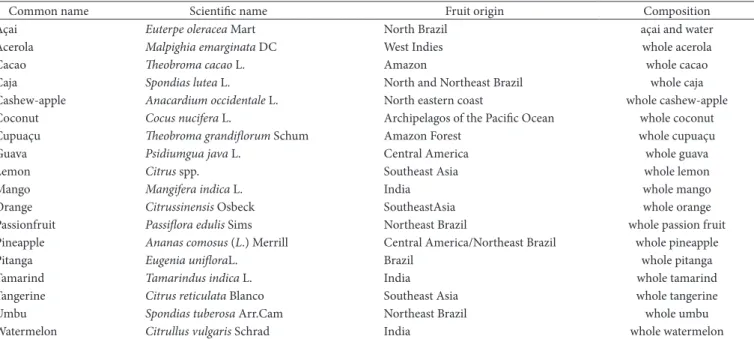
Two batches of each the frozen fruit pulp (100 g) (Table 1) were acquired from the same manufacturer in Campinas, São Paulo (Brazil) and stored at –80 °C. The samples were prepared by mixing four packages of 100 g of fruit pulp from the same batch, followed by homogenisation with water in the proportion of 100 g of pulp and 250 mL of ultrapure water (1:2.5, w/v) in a domestic blender (according to the manufacturer instructions), and centrifuging at 6450 g for 20 minutes at 20 °C. The supernatant (aqueous extract) was used to analyze both the bioactive compounds and antioxidant capacity.
2.3 Bioactive compounds determination
Total phenolic compounds
The content of total phenolic compounds (TPC) of each frozen fruit pulp was determined using the Folin-Ciocalteu colorimetric method, according to Singleton and Rossi (1965) adapted to microplate reader. The reaction mixture (300 µL) contained the Folin-Ciocalteu reagent, the fruit pulp extracts at different concentrations (1 to 83 mg/L), and Na2CO3 (7%). The quantification was performed at 765 nm from an analytical curve PRIOR, 1996; WU et al., 2004); however, there is no information
regarding the scavenging capacity of frozen fruit pulps against other ROS with physiological importance, such as hydrogen peroxide (H2O2) and hydroxyl radical (•OH).
Brazil is the third largest producer of fruits in the world. In 2010, the production reached over 42 million tons (KIST et al., 2012), from which about 53% were destined for processing and 47% for fresh consumption. Currently, the Brazilian production is focused on tropical, subtropical, and temperate fruits due to the large territorial extension of the country, as well as the soil and favourable climatic conditions (XEYLA, 2009). Fruits are perishable; consequently they deteriorate quickly, within a few days, making their in natura trading over long distances difficult. Therefore, the production of frozen fruit pulps has become an option to reap the benefits of fruits, to facilitate trading them in places where there is no production, and to preserve them for a longer period after harvest. Therefore, the contents of total phenolic compounds, total flavonoids, and ascorbic acid of 18 frozen fruit pulps were determined, and these values were correlated applying multivariate statistical analysis to the antioxidant capacity against the oxidizing effects of ROO•, H
2O2 and
•OH.
2 Materials and methods
2.1 Chemicals
Folin-Ciocalteu reagent, catechin (96.0%), gallic acid (98.0%), AAPH (α,α’-azodiisobutyramidinedihydrochloride), ascorbic acid (99.0%), lucigenin, fluorescein, luminol, and Tris-(hydroxymethyl) aminomethane were purchased from Sigma-Aldrich (Steinheim, Germany). Trolox (6-hydroxy-2,5,7,8-tetramethylchromane-2-carboxylic acid) (99.5%) was purchased from Fluka ChemieGmbH (Steinheim, Germany). Monosodium phosphate (NaH2PO4), disodium phosphate
Table 1. Common and scientific names, fruit origin, and composition of the frozen fruit pulps analyzed, commercialized in Brazil.
Common name Scientific name Fruit origin Composition
Açai Euterpe oleracea Mart North Brazil açai and water
Acerola Malpighia emarginata DC West Indies whole acerola
Cacao Theobroma cacao L. Amazon whole cacao
Caja Spondias lutea L. North and Northeast Brazil whole caja
Cashew-apple Anacardium occidentale L. North eastern coast whole cashew-apple
Coconut Cocus nucifera L. Archipelagos of the Pacific Ocean whole coconut
Cupuaçu Theobroma grandiflorum Schum Amazon Forest whole cupuaçu
Guava Psidiumgua java L. Central America whole guava
Lemon Citrus spp. Southeast Asia whole lemon
Mango Mangifera indica L. India whole mango
Orange Citrussinensis Osbeck SoutheastAsia whole orange
Passionfruit Passiflora edulis Sims Northeast Brazil whole passion fruit
Pineapple Ananas comosus (L.)Merrill Central America/Northeast Brazil whole pineapple
Pitanga Eugenia unifloraL. Brazil whole pitanga
Tamarind Tamarindus indica L. India whole tamarind
Tangerine Citrus reticulata Blanco Southeast Asia whole tangerine
Umbu Spondias tuberosa Arr.Cam Northeast Brazil whole umbu
528 nm, respectively, for 60 minutes. Trolox was used as positive control (Net area (2 µM) = 7.4 ± 0.9; Net area (4 µM) = 13.1 ± 1.1, and Net area (8 µM) = 22.6 ± 1.4) (RODRIGUES et al., 2012). The results were expressed as µmol trolox equivalent and were obtained from the analytical curve of trolox with concentration varying from 12 to 94 µM.
Hydrogen peroxide (H2O2) scavenging assay
The H2O2 scavenging capacity was measured by monitoring the effect of the extracts of fruit pulps on the H2O2-induced oxidation of lucigenin (GOMES et al., 2007). Reaction mixtures contained the following reagents at final concentrations (final volume of 250 µL): 50 mM Tris–HCl buffer pH 7.4, lucigenin (0.8 mM) dissolved in the buffer solution, extract of fruit pulps at different concentrations (10 to 200 mg/L) and completely dissolved in Tris-HCl buffer, and 1% H2O2. The assays were performed at 37 °C. The chemiluminescence signal was detected using the microplate reader after 10 minutes of incubation. Ascorbic acid was used as the positive control (IC50 = 171 µg/mL) (RODRIGUES et al., 2012).
Hydroxyl radical (•OH) assay
The •OH scavenging capacity was measured by monitoring
the effect of the extracts of fruit pulps on the •OH-induced
oxidation of luminol (GOMES et al., 2006). The •OH was
generated by the Fenton reaction (FeCl2-EDTA-H2O2). The reaction mixtures contained the following reagents at final concentrations (final volume of 250 µL): luminol (20 µM), extracts of fruit pulps in different concentrations (5 to 100 mg/L), diluted in carbonate buffer (pH 10), FeCl2 – EDTA (25 µM and 100 µM, respectively), and H2O2 (3.5 µM). The assays were performed at 37 °C. The chemiluminescence signal was detected using the microplate reader after 5 minutes of incubation. Gallic acid was used as the positive control (IC50 = 0.11 µg/mL) (RODRIGUES et al., 2012).
2.5 Statistical analysis
The contents of bioactive compounds and antioxidant capacity values obtained (mean ± standard deviation) were analyzed using the Statistica 6.0 software (Statsoft Inc., 2001). Two multivariate exploratory techniques, Principal Components Analysis (PCA) and Hierarchical Cluster Analysis (HCA), were applied to correlate and classify the extracts of frozen fruit pulps using the Statistica 6.0 software. For PCA, the bioactive compounds (total phenolic compounds, total flavonoids, and ascorbic acid) and the scavenging capacity against the reactive oxygen species (ROO•, H
2O2 and
•OH) were used as variables
in the derivation of the principal components. The HCA hierarchical tree was obtained considering the same variables of PCA, and the extracts were grouped by unweighted pair-group average as the linkage rule considering the Euclidian distance as the coefficient of similarity.
In order to successfully perform the PCA and HCA, some considerations were applied. When ascorbic acid was not detected in the extracts of fruit pulps (açai, cacao, watermelon, (measurements in duplicate) using gallic acid as a standard with
concentrations ranging from 12.5 to 150 mg/L. The analytical curve was linear (r² = 0.997), the limit of detection was 8 mg/L, and the limit of quantification was 25 mg/L. The results were expressed as milligrams of gallic acid equivalent (GAE) per 100 g of pulp. The contribution of AA to the Folin-Ciocalteau reaction was not evaluated in the present study.
Total flavonoids
The quantification of total flavonoids (TF) was carried out using the colorimetric assay described by Zhishen, Mengcheng and Jianming (1999), with adaptations for the microplate reader. The reaction mixture (300 µL) contained at final concentrations the fruit pulp extracts at different concentrations (1.2 to 100 mg/L), NaNO2 (5%), AlCl3 (10%), and NaOH (1 M). The quantification was performed at 510 nm from an analytical curve (measurements in duplicate) using catechin as a standard with concentrations ranging from 12.5 to 200 mg/L. The analytical curve was linear (r² = 0.998), the limit of detection was 10 mg/L, and the limit of quantification was 30 mg/L. The results were expressed as milligrams of catechin equivalent (CE) per 100 g of fruit pulp.
Ascorbic acid
The ascorbic acid (AA) contents were determined using the Tillman’s method (INSTITUTO..., 2004). An oxalic acid solution (1%) was added (50 mL) to the fruit pulp extract and kept in the dark for 15 minutes. The quantification was performed by titration with 0.2% DCFI solution and compared to the AA standard titration (50 mg/100 mL). The results were expressed as milligrams of ascorbic acid (AA) per 100 g of fruit pulp.
2.4 Antioxidant capacity against reactive oxygen species (ROS)
The assays were carried out using a microplate reader (Synergy Mx, BioTek, Vermont, USA) for fluorescence, UV-vis, and luminescence measurements, equipped with a thermostat set at 37 °C and dual reagent dispenser. The results of H2O2 and •OH were expressed as IC
50 (µg/mL), i.e., concentration
necessary to inhibit oxidation by 50%,calculated using non-linear regression analysis and the GraphPad Prism 5 software.
Peroxyl radical (ROO•) scavenging assay
The ROO•scavenging capacity was determined by
monitoring the decay of fluorescence of fluorescein as result of ROO•-induced oxidation of fluorescein (HUANG et al., 2002).
The ROO• species were generated by thermo-decomposition
AA/100 g pulp), caja (0.3 mg AA/100 g pulp), cashew-apple (12.4 mg AA/100 g pulp), and tamarind (0.1 mg AA/100 g pulp); while lower than those of açai (10.1 mg AA/100 g pulp) and of cupuaçu pulps (3.3 mg AA/100 g pulp). Ascorbic acid was not detected in açai pulp by Hassimotto, Genovese and Lajolo (2005) either; however, the values for frozen pulps of guava (49.9 mg AA/100 g pulp), cashew-apple (195 mg AA/100 g pulp), and acerola (885 mg AA/100 g pulp) were higher than those found in the present study.
In general, the great variation in the contents of bioactive compounds between the analyzed frozen fruit pulps can be associated to intrinsic (species, cultivar, and maturity stage) and extrinsic characteristics (environmental conditions, storage, and processing) of each fruit pulp and can lead to the variability in the composition of both the fresh fruit and processed products, including the frozen fruit pulp (KING; YOUNG, 1999; TOMÁS-BARBERÁN; ESPÍN, 2001; BALASUNDRAM; SUNDRAM; SAMMAM, 2006). Furthermore, the difference between the contents of bioactive compounds in the frozen fruit pulps found in this study and the contents reported in the literature may be explained due to the different extraction methods of these bioactive compounds.
3.2 Antioxidant capacity against the reactive oxygen species (ROS)
When the antioxidant capacity of bioactive compounds is evaluated, an important factor to be considered is the scavenging mechanism against the specific analyzed reactive species. The ROO• in the presence of an antioxidant, for example, is mainly
scavenged by the hydrogen atom transfer; the scavenging mechanism against H2O2 probably occurs by the addition of this reactive species to the system of conjugated double bonds and umbu), the value was considered as 0 (zero). When the IC50
value was not reached at the highest tested concentration in the H2O2 scavenging assay, the IC50 values were estimated after fitting the curves of concentration versus inhibition percentage, as did for coconut and watermelon. In addition, the IC50 values obtained in the H2O2 and •OH scavenging assays were used as
the inverse of IC50 (1/IC50) in the data matrix to facilitate the graphical analysis of PCA and HCA.
3 Results and discussion
3.1 Bioactive compounds in the frozen fruit pulps
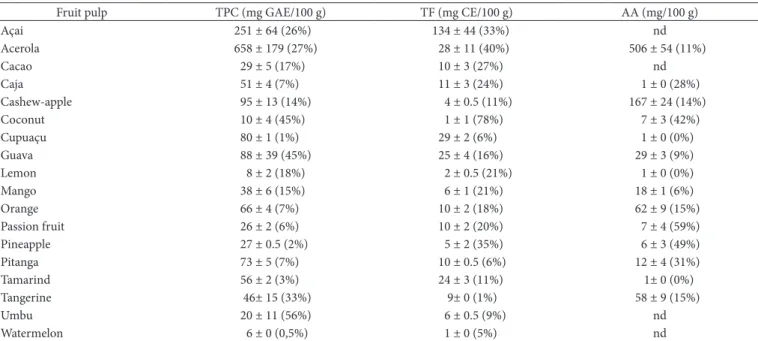
A wide variation was found in the contents of: total phenolic compounds, from 6 (watermelon) to 658 (acerola) mg GAE/100 g pulp of; total flavonoids, from 1 (coconut and watermelon) to 134 (açai) mg CE/100 g pulp; and ascorbic acid from not detected levels to 506 (acerola) mg of ascorbic acid/100 g of pulp (Table 2).
The TPC contents of frozen fruit pulps were similar to other values reported in the literature (KUSKOSKI et al., 2006; EVANGELISTA; VIEITES, 2006; SANTOS et al., 2008, 2010; GENOVESE et al., 2008; MEZADRI et al., 2008; DANTAS et al., 2010), except for the contents found by Melo et al. (2008a), who used catechin as the analytical standard. The contents of bioactive compounds in açai frozen pulp were related to the protective effects of the pulp against doxorubicin-induced in vivo DNA damage in liver and kidney cells (RIBEIRO et al., 2010).
With regard to ascorbic acid, the contents found for the frozen fruit pulps in the present study were higher than those found by Canuto et al. (2010) for the pulps of acerola (378.5 mg
Table 2. Contents of total phenolic compounds (TPC), total flavonoids (TF), and ascorbic acid (AA) from the frozen fruit pulps analyzed.
Fruit pulp TPC (mg GAE/100 g) TF (mg CE/100 g) AA (mg/100 g)
Açai 251 ± 64 (26%) 134 ± 44 (33%) nd
Acerola 658 ± 179 (27%) 28 ± 11 (40%) 506 ± 54 (11%)
Cacao 29 ± 5 (17%) 10 ± 3 (27%) nd
Caja 51 ± 4 (7%) 11 ± 3 (24%) 1 ± 0 (28%)
Cashew-apple 95 ± 13 (14%) 4 ± 0.5 (11%) 167 ± 24 (14%)
Coconut 10 ± 4 (45%) 1 ± 1 (78%) 7 ± 3 (42%)
Cupuaçu 80 ± 1 (1%) 29 ± 2 (6%) 1 ± 0 (0%)
Guava 88 ± 39 (45%) 25 ± 4 (16%) 29 ± 3 (9%)
Lemon 8 ± 2 (18%) 2 ± 0.5 (21%) 1 ± 0 (0%)
Mango 38 ± 6 (15%) 6 ± 1 (21%) 18 ± 1 (6%)
Orange 66 ± 4 (7%) 10 ± 2 (18%) 62 ± 9 (15%)
Passion fruit 26 ± 2 (6%) 10 ± 2 (20%) 7 ± 4 (59%)
Pineapple 27 ± 0.5 (2%) 5 ± 2 (35%) 6 ± 3 (49%)
Pitanga 73 ± 5 (7%) 10 ± 0.5 (6%) 12 ± 4 (31%)
Tamarind 56 ± 2 (3%) 24 ± 3 (11%) 1± 0 (0%)
Tangerine 46± 15 (33%) 9± 0 (1%) 58 ± 9 (15%)
Umbu 20 ± 11 (56%) 6 ± 0.5 (9%) nd
Watermelon 6 ± 0 (0,5%) 1 ± 0 (5%) nd
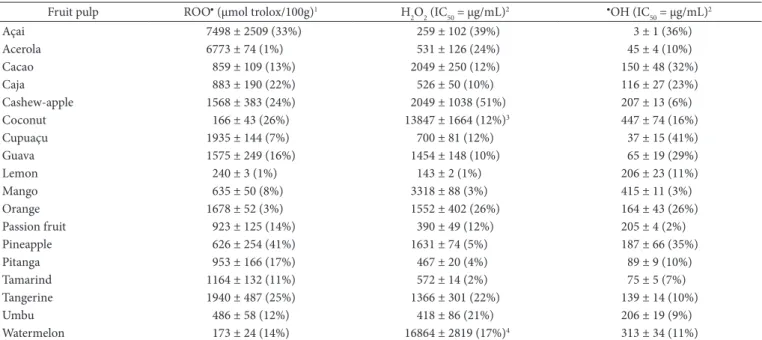
coconut and watermelon did not reach the IC50 value for H2O2 scavenging, showing efficiency of only 20% (coconut) and 27% (watermelon) at the highest tested concentrations (13847 and 16864 µg/mL, respectively).
The pulps of açai, cupuaçu, acerola, guava, tamarind, and pitanga exhibited the lowest IC50 values of scavenging against
•OH, varying from 3 (açai) to 89 µg/mL (pitanga), and thus
they were the best scavengers of this species among the samples analyzed (Table 3).
As for the other frozen fruit pulps, the comparison with the literature data concerning the scavenging capacity against the analyzed ROS could not be made since either the applied methodology or the reactive species was different from those used in the present study
3.3 Correlation and classification of frozen fruit pulps by multivariate statistical analysis
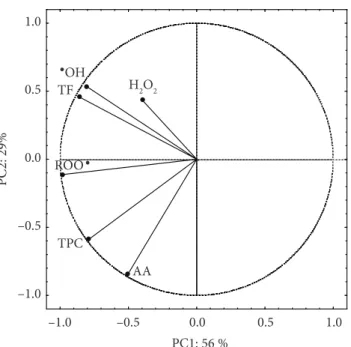
In the PCA, the first two principal components (PC1 and PC2) accounted for 85% of the total explained variance (Figure 1).
According to the PCA, a positive correlation was observed between the scavenging capacity against ROO•, and the contents
of TPC (r = 0.82), TF (r = 0.81) and AA (r = 0.58) (Figure 1). These correlation values show that the TPC, including the TF, make the highest contribution to the antioxidant capacity against ROO•, probably due to the excellent capacity of this
class of bioactive compounds to transfer hydrogen atom, whilst AA presented the lowest contribution. Similar results were previously reported for 12 different fruits, with high positive correlation between the TPC and the antioxidant of the antioxidant compound; while the •OH can be scavenged
either by its addition to the conjugated double bonds or by hydrogen atom transfer of the bioactive compound (HUANG; OU; PRIOR, 2005; ANOUAR et al., 2009). All bioactive compounds determined in this study (TPC, TF, and AA) have the necessary structural characteristics to scavenge the analysed ROS, such as, hydroxyl groups and conjugated double bonds. In fact, in general, frozen fruit pulps presenting the highest contents of TPC, or TF, or AA are expected to be the most efficient scavengers of ROS.
The aqueous extracts of the 18 frozen fruit pulps also exhibited great variation in the values of antioxidant capacity against the analyzed ROS (Table 3).
The açai and acerola pulps, which had the highest TPC and TF contents (Table 2) among all pulps analyzed, were the most efficient scavenger of ROO• (7498 and 6773 µmol trolox/100 g
pulp, respectively). The values of scavenging capacity against the ROO• found in this study were in the same range as that reported
for açai pulp (9970 µmol trolox/100 g pulp) (SCHAUSS et al., 2006), but higher than those found for acerola pulp (3458-5883 µmol trolox/100 g pulp) (MEZADRI et al., 2008). All other fruit pulps can be ranked according to the decreasing efficiency of ROO• scavenging capacity, as follows: tangerine, cupuaçu,
orange, guava, cashew-apple, tamarind, pitanga, passion fruit, caja, cacao, mango, pineapple, umbu, lemon, watermelon, and coconut (Table 3).
With regard to the scavenging capacity against H2O2, the pulps of lemon, açaí, passion fruit, umbu, and pitanga had the highest efficiencies, i.e., the lowest IC50 values, varying from 143 (lemon) to 467 µg/mL (pitanga). On the other hand, the pulps of
Table 3. Scavenging capacities of frozen fruit pulps against peroxyl radical (ROO•), hydrogen peroxide (H2O2) and hydroxyl radical (•OH).
Fruit pulp ROO• (µmol trolox/100g)1 H
2O2 (IC50 = µg/mL)2 •OH (IC50 = µg/mL)2
Açai 7498 ± 2509 (33%) 259 ± 102 (39%) 3 ± 1 (36%)
Acerola 6773 ± 74 (1%) 531 ± 126 (24%) 45 ± 4 (10%)
Cacao 859 ± 109 (13%) 2049 ± 250 (12%) 150 ± 48 (32%)
Caja 883 ± 190 (22%) 526 ± 50 (10%) 116 ± 27 (23%)
Cashew-apple 1568 ± 383 (24%) 2049 ± 1038 (51%) 207 ± 13 (6%)
Coconut 166 ± 43 (26%) 13847 ± 1664 (12%)3 447 ± 74 (16%)
Cupuaçu 1935 ± 144 (7%) 700 ± 81 (12%) 37 ± 15 (41%)
Guava 1575 ± 249 (16%) 1454 ± 148 (10%) 65 ± 19 (29%)
Lemon 240 ± 3 (1%) 143 ± 2 (1%) 206 ± 23 (11%)
Mango 635 ± 50 (8%) 3318 ± 88 (3%) 415 ± 11 (3%)
Orange 1678 ± 52 (3%) 1552 ± 402 (26%) 164 ± 43 (26%)
Passion fruit 923 ± 125 (14%) 390 ± 49 (12%) 205 ± 4 (2%)
Pineapple 626 ± 254 (41%) 1631 ± 74 (5%) 187 ± 66 (35%)
Pitanga 953 ± 166 (17%) 467 ± 20 (4%) 89 ± 9 (10%)
Tamarind 1164 ± 132 (11%) 572 ± 14 (2%) 75 ± 5 (7%)
Tangerine 1940 ± 487 (25%) 1366 ± 301 (22%) 139 ± 14 (10%)
Umbu 486 ± 58 (12%) 418 ± 86 (21%) 206 ± 19 (9%)
Watermelon 173 ± 24 (14%) 16864 ± 2819 (17%)4 313 ± 34 (11%)
The values correspond to the mean ± standard deviation (relative standard deviation) from two batches (each batch in triplicate). 1Trolox equivalent; 2IC
50 = Inhibitory concentration
necessary to decrease 50% the oxidative effect of reactive species in the tested media; 3the inhibition at the highest tested concentration (13846.50 µg/mL) was 20%; 4the inhibition at
capacity against ROO•(also determined by ORAC assay) and
low contribution of AA to the scavenging capacity against the oxidizing effect of ROO• (WANG; CAO; PRIOR, 1996).
With regard to the scavenging capacity against H2O2, no significant correlation was observed for TF (r = 0.37), TPC (r = 0.12), and AA (r = –0.06). Therefore, the bioactive compounds considered in this study do not contribute greatly to the scavenging capacity of this specific ROS. On the other hand, carbohydrates, proteins, and amino acids are also components of the extracts and therefore can play a great hole in its scavenging capacity against H2O2 since these compounds have been previously reported as efficient scavengers of ROS (PATTISON; DAVIES, 2006). For example, annatto seed extracts, which have both phenolic compounds (minor compounds) and carotenoids (major compounds) exhibited higher scavenging capacity against H2O2 (IC50 from 11 to 47 µg/mL) (CHISTÉ et al., 2011) than those of the 18 frozen fruit pulps analyzed in this study. Moreover, H2O2 is rather inert at low concentrations, and its oxidation power is believed to be observed in combination with Fe(II) through Fenton reaction (HUANG; OU; PRIOR, 2005). As for the scavenging capacity against •OH, a high positive
correlation was observed with TF (r = 0.97), and no significant correlation was found for TPC (r = 0.31) and AA (r = –0.06). In
Figure 2. Dendrogram obtained by HCA analysis, considering the content of bioactive compounds and the values of scavenging capacity, against the tested ROS, for the 18 frozen fruit pulps analyzed in two different batches (B1 e B2).
pulp and to the high content of AA (166.56 mg AA/100 g pulp) found in the cashew-apple pulp (Figures 2 and 3, Table 2 and 3).
4 Conclusions
The frozen fruit pulps contain bioactive compounds which
are in vitro scavengers of reactive oxygen species of biological
importance, namely the ROO•, H
2O2, and
•OH. In general, the
scavenging capacities against ROO•, H
2O2 and •OH species,
as well as the concentrations of bioactive compounds, varied widely among the 18 different fruit pulps. This study confirmed the positive correlation between high levels of phenolic compounds, especially flavonoids, and the capacity to scavenge ROO•. Furthermore, the results indicated that the flavonoids
show high scavenging capacity against •OH, but they are less
efficient against H2O2. In addition, ascorbic acid showed little contribution against all of the ROS studied. Among the 18 frozen fruit pulps evaluated, açai can be considered the best ROS scavenger.
Acknowledgements
The authors are grateful for the financial support provided by the foundations CNPq (Conselho Nacional de Desenvolvimento Científico e Tecnológico) and FAPESP (Fundação de Amparo à Pesquisa do Estado de São Paulo).
References
ANOUAR, E. et al. New aspects of the antioxidant properties of phenolic acids: a combined theoretical and experimental approach. Physical Chemistry Chemical Physics, v. 11, p. 7659-7668, 2009. PMid:19950505. http://dx.doi.org/10.1039/b904402g
BALASUNDRAM, N.; SUNDRAM, K.; SAMMAM, S. Phenolic compounds in plants and agri-industrial by-products: antioxidant activity, occurrence, and potential uses. Food Chemistry, v. 99, p. 191-203, 2006. http://dx.doi.org/10.1016/j.foodchem.2005.07.042
this study, the FeCl2-EDTA-H2O2 (Fenton reaction), the most used system to generate •OH, was also used. However, this
generation mode has disadvantages because many antioxidants, such as some classes of flavonoids, are also metal chelators. When the antioxidant is mixed with Fe (II), it may alter the activity of Fe(II) by chelation, and as a result, it is impossible to distinguish whether the antioxidants are simply good metal chelators or •OH scavengers (HUANG; OU; PRIOR, 2005). This
fact can explain the high correlation found between the contents of TF and the values of scavenging capacity against •OH since
flavonoids are known to be good metal chelators. In addition, some compounds in foods, such as ascorbic acid, may act as pro-oxidants by reducing Fe(III) to Fe(II) and make the •OH
generation catalytic(HUANG; OU; PRIOR, 2005).
The dendrogram obtained when HCA analysis was applied, allowed the classification of the 18 frozen fruit pulps into three groups, considering the contents of TPC, TF, AA, and the scavenging capacities against the different ROS. In addition, similarities between the two batches (B1 and B2) for all pulps were observed (Figure 2). The three groups could be clearly observed in PCA scatterplot (Figure 3).
The first group was formed by the açai pulp, with the highest content of TF (134.02 mg CE/100 g pulp) and the highest scavenging capacities against ROO• and •OH; the second one
was formed by the acerola pulp, due to the high contents of TPC (658.40 mg GAE/100 g pulp) and AA (506.27 mg/100 g pulp); and the third group was formed by the other fruit pulps which could not be separated considering only the contents of bioactive compounds and the values of scavenging capacities against the tested ROS (Figures 2 and 3, Table 2).
Considering the third group, the lemon and cashew-apple pulps showed a slight tendency to be separated from the other fruit pulps in this group, most probably due to the high scavenger capacity against H2O2 (IC50 = 142.70 µg/mL) of lemon
Figure 3. a) Scatterplot for samples by PCA analysis with suggested drawn grouping ellipses (by HCA) and b) expansion of the third group, both obtained from the results of bioactive compounds and scavenging capacity against the ROS for the different extracts of frozen fruit pulps of two different batches (B1 e B2).
KING, A.; YOUNG, G. Characteristics and occurrence of phenolic phytochemicals. Journal of the American Dietetic Association, v. 99, p. 213-218, 1999. http://dx.doi.org/10.1016/S0002-8223(99)00051-6
KIST, B. B. et al. Anuário Brasileiro de Fruticultura. Santa Cruz do Sul: Editora Gazeta, 2012. 128 p.
KUSKOSKI, E. M. et al. Frutas tropicais silvestres e polpas de frutas congeladas: atividade antioxidante, polifenóis e antocianinas. Ciência Rural, v. 36, p. 1283-1287, 2006. http://dx.doi.org/10.1590/ S0103-84782006000400037
MEDINA, A. L. et al. Araçá (Psidiumcattleianum Sabine) fruit extracts with antioxidant and antimicrobial activities and antiproliferative effect on human cancer cells. Food Chemistry, v. 18, p. 916-922, 2011. http://dx.doi.org/10.1016/j.foodchem.2011.03.119
MELO, E. A. et al. Teor de fenólicos totais e capacidade antioxidante de polpas congeladas de frutas. Alimentação e Nutrição, v. 19, p. 67-72, 2008a.
MELO, E. A. et al. Capacidade antioxidante de frutas. Revista Brasileira de Ciências Farmacêuticas, v. 44, p. 193-201, 2008b. http://dx.doi.org/10.1590/S1516-93322008000200005
MEZADRI, T. et al. Antioxidant compounds and antioxidant activity in acerola (Malpighia emarginata DC.) fruits and derivatives. Journal of Food Composition and Analysis, v. 21, p. 282-290, 2008. http:// dx.doi.org/10.1016/j.jfca.2008.02.002
PATTISON, D. J.; DAVIES, M. J. Reactions of myeloperoxidase-derived oxidants with biological substrates: gaining chemical insight into human inflammatory diseases. Current Medicinal Chemistry, v. 13, p. 3271-3290, 2006. PMid:17168851. http://dx.doi. org/10.2174/092986706778773095
RIBEIRO, J. C. et al. Evaluation of the genotoxic and antigenotoxic effects after acute and subacute treatments with açai pulp (Euterpe oleracea Mart.) on mice using the erythrocytes micronucleus test and the comet assay. Mutation Research, v. 695, p. 22-28, 2010. PMid:19892033. http://dx.doi.org/10.1016/j.mrgentox.2009.10.009 RODRIGUES, E. et al. Microcapsules containing antioxidant molecules as scavengers of reactive oxygen and nitrogen species. Food Chemistry, v. 134, p. 704-711, 2012. PMid:23107681. http://dx.doi. org/10.1016/j.foodchem.2012.02.163
ROP, O. et al. Antioxidant properties of European cranberry bush fruit (Viburnum opulusvar. edule). Molecules, v. 15, p. 4467-4477, 2010. PMid:20657454. http://dx.doi.org/10.3390/molecules15064467 SANTOS, G. M. et al. Correlação entre atividade antioxidante e
compostos bioativos de polpas comerciais de açaí. Archivos Latino Americanos de Nutricion, v. 58, p. 187-192, 2008. PMid:18833997. SANTOS, G. M. et al. Atividade antioxidante e correlação com
componentes bioativos de produtos comerciais de cupuaçu. Ciência Rural, v. 40, p. 1636-1642, 2010. http://dx.doi.org/10.1590/S0103-84782010005000103
SCHAUSS, A. G. et al. Antioxidant capacity and other bioactivities of the freeze-dried Amazonian palm berry, Euterpe oleraceae
Mart. (acai). Journal of Agricultural and Food Chemistry, v. 54, p. 8604-8610, 2006. PMid:17061840. http://dx.doi.org/10.1021/ jf0609779
SINGLETON, V. L.; ROSSI, J. A. Colorimetry of total phenolics with
phosphomolybdic-phosphotungstic acid reagents. American
Journal of Enology and Viticulture, v. 16, p. 144-158, 1965. TOMÁS-BARBERAN, F.; ESPÍN, J. C. Phenolic compounds and related
enzymes as determinants of quality in fruits and vegetables. Journal of Science and Food Agriculture, v. 81, p. 853-876, 2001. http:// dx.doi.org/10.1002/jsfa.885
BARRETO, G. P. M.; BENASSI, M. T.; MERCADANTE, A. Z. Bioactive compounds from several tropical fruits and correlation by multivariate analysis to free radical scavenger activity. Journal of the Brazilian Chemical Society, v. 20, p. 1856-1861, 2009. http:// dx.doi.org/10.1590/S0103-50532009001000013
CANUTO, G. A. et al. Caracterização físico-química de polpas de frutos da Amazônia e sua correlação com a atividade anti-radical livre. Revista Brasileira de Fruticultura, v. 32, p. 1196-1205, 2010. http://dx.doi.org/10.1590/S0100-29452010005000122
CHISTÉ, R. C. et al. In vitro scavenging capacity of annatto seed extracts against reactive oxygen and nitrogen species. Food Chemistry, v. 127, p. 419-426, 2011. http://dx.doi.org/10.1016/j. foodchem.2010.12.139
CONTRERAS-CALDERÓN, J. et al. Antioxidant capacity, phenolic content and vitamin C in pulp, peel and seed from 24 exotic fruits from Colombia. Food Research International, v. 44, p. 2047-2053, 2011. http://dx.doi.org/10.1016/j.foodres.2010.11.003 DANTAS, R. L. et al. Perfil da qualidade de polpas de frutas
comercializadas na cidade de Campina Grande/PB. Revista Verde, v. 5, p. 61-66, 2010.
EVANGELISTA, R. M.; VIEITES, R. L. Avaliação da qualidade de polpa de goiaba congelada comercializada na cidade de São Paulo. Segurança Alimentar e Nutricional, v. 13, p. 76-81, 2006. FU, L. et al. Antioxidant capacities and total phenolic contents of 62
fruits. Food Chemistry, v. 129, p. 345-350, 2011. http://dx.doi. org/10.1016/j.foodchem.2011.04.079
GARCÍA-ALONSO, M. et al. Evaluation of the antioxidant properties of fruits. Food Chemistry, v. 84, p. 13-18, 2004. http://dx.doi. org/10.1016/S0308-8146(03)00160-2
GENOVESE, M. I. et al. Bioactive compounds and antioxidant capacity of exotic fruits and commercial frozen pulps from Brazil. Food Science and Technology International, v. 14, p. 207-214, 2008. http://dx.doi.org/10.1177/1082013208092151
GOMES, A. et al. Antioxidant activity of β-blockers: an effect mediated by scavenging reactive oxygen and nitrogen species? Bioorganic & Medicinal Chemistry, v. 14, p. 4568-4577, 2006. PMid:16510286. http://dx.doi.org/10.1016/j.bmc.2006.02.023
GOMES, A. et al. 2-Styrylchtomones: novel strong scavengers of reactive oxygen and nitrogen species. Bioorganic & Medicinal Chemistry, v. 15, p. 6027-6036, 2007. PMid:17624791. http://dx.doi. org/10.1016/j.bmc.2007.06.046
HASSIMOTTO, N. M. A.; GENOVESE, M. I.; LAJOLO, F. M. Antioxidant activity of dietary fruits, vegetables and commercial frozen fruit pulps. Journal of Agricultural and Food Chemistry, v. 53, p. 2928-2935, 2005. PMid:15826041. http://dx.doi. org/10.1021/jf047894h
HUANG, D. et al. High-throughput assay of oxygen radical absorbance capacity (ORAC) using a multichannel liquid handling systems coupled with a microplate fluorescence reader in 96-well format. Journal of Agricultural and Food Chemistry, v. 50, p. 4437-4444, 2002. PMid:12137457. http://dx.doi.org/10.1021/ jf0201529
HUANG, D.; OU, B.; PRIOR, R. L. The chemistry behind antioxidant capacity assays. Journal of Agricultural and Food Chemistry, v. 53, p. 1841-1856, 2005. PMid:15769103. http://dx.doi.org/10.1021/ jf030723c
INSTITUTO ADOLFO LUTZ – IAL. Normas analíticas do Instituto
Adolfo Lutz: Métodos químicos e físicos para análises de
XEYLA, R. Brasil é o terceiro maior produtor de frutas do mundo. 2009. Disponível em: <www.ecodebate.com.br>. Acesso em: 06 abr. 2011.
ZHISHEN, J.; MENGCHENG, T.; JIANMING, W. The determination of flavonoid contents in mulberry and their scavenging effects on superoxide radicals. Food Chemistry, v. 64, p. 555-559, 1999. http:// dx.doi.org/10.1016/S0308-8146(98)00102-2
WANG, H.; CAO, G.; PRIOR, R. L. Total antioxidant capacity of fruits. Journal of Agricultural and Food Chemistry, v. 44, p. 701-705, 1996. http://dx.doi.org/10.1021/jf950579y