Revista Brasileira de
Engenharia Agrícola e Ambiental
Campina Grande, PB, UAEA/UFCG – http://www.agriambi.com.br
v.20, n.5, p.447-454, 2016
Frequency of recirculation of nutrient solution
in hydroponic cultivation of coriander with brackish water
Mairton G. da Silva
1, Tales M. Soares
1, Hans R. Gheyi
1,
Itamar de S. Oliveira
2, José A. da Silva Filho
3& Francicleiton F. do Carmo
4DOI: http://dx.doi.org/10.1590/1807-1929/agriambi.v20n5p447-454
A B S T R A C T
The present study used a hydroponic system with leveled channels, in order to evaluate coriander cultivation under different intervals of nutrient solution recirculation and the use of freshwater and brackish water. The experiment was carried out in a randomized block design with five replicates, in a 2 x 4 factorial scheme, from February to March 2014. Two levels of electrical conductivity (EC) of water (0.32 and 4.91 dS m-1) and four frequencies
of nutrient solution recirculation (at intervals of 0.25, 2, 4 and 8 h) were evaluated. This experimental design was adopted in the evaluations performed at 10, 15 and 25 days after transplantation (DAT). Additionally, at 21 DAT subplots were established for the evaluation of plant position (initial, intermediate and final) along the hydroponic channels. It is viable to use nutrient solution recirculation every 8 h, without production losses. The use of brackish water (EC = 4.91 dS m-1) may be an alternative for the hydroponic cultivation of
coriander, despite the reduction in production, but without any damage on the visual aspect of the product. Plants grown at the initial and intermediate positions along the hydroponic channels showed higher production.
Frequências de recirculação de solução nutritiva
no cultivo hidropônico de coentro com água salobra
R E S U M O
Neste trabalho foi utilizado um sistema hidropônico com os canais de cultivo em nível com o objetivo de avaliar a cultura do coentro submetida a diferentes intervalos para recirculação da solução nutritiva em interação com o uso de água doce e salobra. O experimento foi conduzido em blocos casualizados com cinco repetições, em esquema fatorial 2 x 4, entre fevereiro e março de 2014. Avaliaram-se dois níveis de condutividade elétrica (CE) da água: 0,32 e 4,91 dS m-1, além de quatro frequências de recirculação da solução nutritiva (intervalos
de 0,25; 2; 4 e 8 h). Este delineamento experimental foi aplicado nas avaliações realizadas aos 10, 15 e 25 dias após o transplantio (DAT). Adicionalmente, aos 21 DAT foram estabelecidas subparcelas visando avaliar o efeito da posição das plantas (inicial, intermediária e final) nos perfis hidropônicos. É viável adotar-se recirculação da solução nutritiva a cada 8 h sem perdas de produção. O uso da água salobra (CE = 4,91 dS m-1) pode ser uma alternativa para
o cultivo do coentro hidropônico, mesmo com reduções na produção, porém sem efeitos depreciativos à qualidade visual do produto. As plantas cultivadas nas posições inicial e intermediária dos perfis hidropônicos apresentaram maior produção.
Key words:
Coriandrum sativum L.
DFT hydroponics water salinity
Palavras-chave:
Coriandrum sativum L.
hidroponia DFT salinidade da água
1 Universidade Federal do Recôncavo da Bahia/ Núcleo de Engenharia de Água e Solo. Cruz das Almas, BA. E-mail: [email protected] (Corresponding
author); [email protected]; [email protected]
2 Universidade Federal do Recôncavo da Bahia/Programa de Pós-Graduação em Solos e Qualidade de Ecossistemas. Cruz das Almas, BA. E-mail:
3 Universidade Federal Rural do Semi-Árido/Departamento de Ciências Animais. Mossoró, RN. E-mail: [email protected] 4 Prefeitura Municipal de Iguatu. Iguatu, CE. E-mail: [email protected]
Introduction
A few promising results have been achieved for the rational use of brackish water in the Nutrient Film Technique (NFT) hydroponic system (Santos et al., 2010, 2011; Soares et al., 2010, 2015; Alves et al., 2011; Paulus et al., 2012; Bione et al., 2014; Lira et al., 2015), which can open a new perspective for hydroponics as an economic alternative, provided that brackish water is available. In Brazil, the main focus of these studies is the semiarid region, where brackish water is relatively frequent in the underground reserves, for constituting one of the main causes of abandonment of the various wells drilled with public or private resources (Santos et al., 2010).
In the evolution of this research line, it has been pondered that crops of regional interest must be investigated and the studies should not be limited only to the currently important crops in hydroponic markets (notably lettuce, rocket, watercress, tomato etc.). In this context, vegetables such as coriander assume strategic position, because they have attractive prices to the farmer, market in the Northeast region, tolerate higher temperatures compared with other vegetables and their hydroponic cultivation has increased.
It has also been discussed the necessity of hydroponic systems less dependent on electric energy, since the NFT, the most usual system in the Brazilian hydroponics, is an active system that requires pumping for nutrient solution recirculation. In this context, systems such as Floating and Deep Film Technique (DFT) are promising for the rural communities of the semiarid region, where interruptions in water supply are frequent. In these systems, plant roots remain submerged in the nutrient solution (Zanella et al., 2008; Santos et al., 2011); therefore, they will only suffer with the effects of recirculation if it is so prolonged that the solution level is reduced. Due to this advantage, such systems assume less frequent recirculations compared with NFT, in which irrigation is usually performed in intervals of 15 min. On the other hand, in Floating and DFT systems, there should not be very long recirculation intervals, because the dissolved oxygen becomes the limiting factor for the roots. If the concentration of this nutrient decreases in the nutrient solution, roots reduce respiration, which leads to: lower production of cell energy, lower root growth and lower absorption of nutrients by the active transport.
The present study used a hydroponic system with leveled channels in order to evaluate the cultivation of coriander subjected to different intervals of nutrient solution recirculation in interaction with the use of freshwater and brackish water, the existence of gradients of growth and yield along the leveled hydroponic channel and quantify water and energy consumption.
Material and Methods
The experiment was carried out in a greenhouse, from February to March 2014, at the Water and Soil Engineering Center (NEAS) of the Federal University of Recôncavo of Bahia (UFRB), in Cruz das Almas, BA, Brazil (12º 40’ 19” S; 39º 06’ 23” W; 220 m). Instantaneous temperatures every 30
min inside the greenhouse during the studied period oscillated between minimum of 19.9 ºC and maximum of 48.4 ºC, with mean of 27.9 ºC.
Coriander cv. ‘Verdão’ was sown on February 2, by placing 12 seeds in 50-mL plastic cups containing a layer of coconut substrate and another of vermiculite in the proportion of 2:1. The seedlings were transplanted to the hydroponic channels on February 13, 11 days after sowing (DAS), and the initial irrigations until transplantation were performed using water from the local supply system (EC = 0.32 dS m-1).
The present study used the DFT hydroponic system in pipes with zero declivity. The cultivation channels were made of 75-mm-diameter, 6-m-long PVC tubes, with circular holes of 44-mm diameter spaced by 0.07 m (85 holes per tube), with horizontal spacing of 0.80 m between tubes.
A cap and an elbow were attached to the ends of each tube, in order to maintain a mean level of 45 mm of nutrient solution. To maintain this level of solution, a connector was installed at the end of the cap, which was attached to a hose that directed the excess of solution back to the supply tank.
The structure consisted of 20 cultivation benches, each of which with two hydroponic channels. Each plot was represented by an independent hydroponic channel and was composed of a plastic tank, with capacity for 53 L of nutrient solution and an electric pump to inject the nutrient solution into the hydroponic channel, at mean flow rate of 1.55 L min-1.
The electrical network was divided into eight sub-networks and five electrical pumps were installed in each one. Each sub-network was connected to an analogical timer, which was connected to a power outlet of the main network. Each power outlet for the insertion of the timer had a switch. For each recirculation frequency, two timers were activated simultaneously, turning on 10 electric pumps.
The experiment was set in a randomized block design and the treatments were analyzed in 2 x 4 factorial scheme, with five replicates. Two levels of electrical conductivity (EC) of water (0.32 and 4.91 dS m-1) and four frequencies of recirculation of nutrient solution (intervals of 0.25, 2, 4 and 8 h) were studied.
The frequencies of recirculation of nutrient solution were based on the following planning: at the frequency of 0.25 h (control), the system was turned on for 15 min and turned off for 15 min, from 06:00 a.m. to 08:00 p.m.; from 08:00 p.m. to 06:00 a.m., the system was turned on for 15 min, every 2 h; at the second, third and fourth frequencies, recirculation was performed every 2, 4 and 8 h, respectively, the system remained turned on for 15 min in each activation. Since the frequency of 0.25 h was used only in the morning and afternoon, while the others were also used during the night, the factor frequency was considered as qualitative.
Nutrient solution was prepared using water from the municipal supply system (EC = 0.32 dS m-1, control) and, after adding the nutrients, the solution EC (ECsol) was 2.28 dS m-1. On the day of the transplantation of coriander seedlings, the nutrient solution was the same in all the plots; on the next day, sodium chloride (NaCl) was added to the tanks of the brackish water treatment, resulting in ECsol of 5.51 dS m-1.
Losses through evapotranspiration were replenished with water from the local supply system for the control treatment (EC = 0.32 dS m-1) and the brackish water treatment received water of 4.91 dS m-1. ECsol and pH were evaluated every 2 days. Regarding pH variation in the nutrient solution, on the day of transplantation, pH values were equal to 5.5 and 5.43 in the treatments with freshwater and brackish water, respectively. pH values oscillated within the range recommended for hydroponic cultivation and corrections were performed when necessary.
Electrical energy consumption was determined based on the system operation time and the electric pump power (32 Watts), in kWh. The costs with energy for each frequency were determined based on the electrical energy consumption and the cost of the kWh. The cost of the kWh was obtained from the National Agency of Electrical Energy (ANEEL), at the Bahia Electricity Company (COELBA), corresponding to the residential rate of R$ 0.33634 per kWh, adopted in March 2014. The cost of energy consumption was analyzed based on the consumption of 10 electric pumps of each frequency.
The accumulated water consumption was determined for the periods of 2-10, 11-15, 16-20, 21-24 and 2-24 DAT. The consumption (in L per bunch of plants) was calculated based on the volume consumed in the plot and divided by the number of bunches of plants in each plot.
Biometric and production variables were evaluated at 10, 15 and 25 DAT. At harvest, a mean value was obtained in each plot through the collection of two bunches of plants for: plant height (PH) and fresh matter of shoots of the bunch of plants (ShFMbunch). For the determination of dry matter, ShFMbunch was placed in paper placed in paper bags and taken to a forced-air oven at 65 ºC until constant weight, for the quantification of dry matter of shoots (ShDMbunch) on a precision scale (0.01 g). Plant height was measured using a tape from the cut to the apex of the plants.
The data were subjected to the F test of the analysis of variance and, when significant, water salinity levels were compared by Tukey test at 0.05 probability level.
In addition, at 21 DAT, one bunch of plants was collected at the initial, intermediate and final positions of the hydroponic channel, for split-plot statistical analysis; when significant, for comparison the test of means was applied.
Results and Discussion
The system remained turned on for 159 h and 45 min when the control frequency (0.25 h) was adopted for the coriander cycle of 25 DAT (36 days from sowing). For the frequencies with intervals of 2, 4 and 8 h, the system remained turned on for 59 h and 45 min, 31 h and 15 min and 16 h and 30 min, respectively. Therefore, for the lowest number of nutrient
solution recirculations during the day, there was approximately 90% reduction in electric energy consumption in comparison to control, with a potential lower wear-and-tear of the system and, consequently, longer life.
Energy consumption values were around 51.12, 19.12, 10.0 and 5.62 kWh for the frequencies of 0.25, 2, 4 and 8 h, respectively. Using as a reference the kWh cost of R$ 0.33634, the total cost with electric energy was R$ 17.19 for the frequency of 0.25 h, which leads to a reduction of about R$ 15.3 in relation to the cost for the frequency of 8 h. Thus, the cost of electric energy to produce one bunch of hydroponic coriander varied from R$ 0.02 to R$ 0.0022, respectively. This unit cost can be even lower if a longer channel (> 6 m) is used and if the same electric pump is used to inject nutrient solution in various channels. In observations conducted by the work team, the same electric pump can pump nutrient solution to the height of 1 m and distribute it to at least six channels; when the electric pump is used only to pump nutrient solution to an intermediate tank, the number of supplied channels can be much higher. Another positive impact is that the electric energy is an input with economy of inverted scale; the lower the consumption, the lower the charging.
In the control treatment (0.32 dS m-1), the EC of the nutrient solution (ECsol) decreased along the crop cycle and, at the end of the experiment, there were decreases of about 53.68, 44.52, 40.88 and 51.32% for the recirculation frequencies of 0.25, 2, 4 and 8 h, respectively. Despite the ECsol reductions, the nutritional level was not corrected along the experiment. Reduction in ECsol was due to relatively high consumption of nutrients, because of low content of salts dissolved in the freshwater from the local supply system. As reported in the present study, Soares et al. (2010), Alves et al. (2011) and Paulus et al. (2012), working with lettuce under NFT hydroponics, also observed a decrease in nutrient solution EC along the crop cycle when freshwater was used to replenish the evapotranspiration.
On the other hand, when brackish water (EC = 4.91 dS m-1) was used to replenish evapotranspiration losses, ECsol increased along the crop cycle. At the end of the experiment, the increments in ECsol were approximately of 52.49, 50.09, 39.56 and 48.24% for the recirculation frequencies of 0.25, 2, 4 and 8 h, respectively. This same type of behavior, increase in ECsol with the replenishment of the volume of water consumed with brackish water, has been reported in previous studies (Soares et al., 2010; Alves et al., 2011; Paulus et al., 2012).
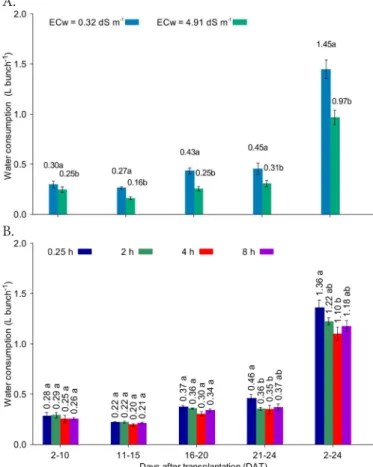
Due to the use of freshwater and brackish water, there was a significant effect on water consumption in all the evaluated periods, and the increasing frequencies of recirculation of nutrient solution had significant effect on water consumption only from 21 to 24 DAT and for the entire crop cycle from 2 to 24 DAT.
When brackish water (EC = 4.91 dS m-1) was used to replenish evapotranspiration, water consumption decreased in all evaluated periods, with accumulated (2-24 DAT) reduction estimated at up to 33.10%. Under saline stress conditions, the osmotic potential decreases, which compromises water absorption. Previous studies confirm the reduction in water consumption as a function of the increase in water salinity for lettuce in NFT hydroponics (Soares et al., 2010; Paulus et al., 2012).
The water volume necessary to produce a bunch of 12 plants of hydroponic coriander was equal to 1.45 L under EC of 0.32 dS m-1 and 0.97 L under EC of 4.91 dS m-1, during the period of 2-24 DAT (Figure 1A).
Regarding the effects of frequencies of recirculation of nutrient solution, from 21 to 24 DAT, the control frequency (0.25 h) favored higher consumption compared with the frequencies of 2 and 4 h. The reductions in water consumption at the frequencies of 2 and 4 h in relation to the control (0.25 h) were approximately 21.74 and 23.91%, respectively. The frequency of 8 h did not differ from the control with respect to water consumption; the accumulated consumption from 2 to 24 DAT in the control frequency was significantly higher than that at the frequency of 4 h, with variation of 19.12% (Figure 1B).
The higher water consumption of coriander plants under the control frequency is due to the better maintenance of nutrient solution level and its aeration in the cultivation A.
B.
Different letters in the same period indicate significant differences at 0.05 probability level Figure 1. Water consumption per bunch of hydroponic coriander under different of electrical conductivity of water (A) and frequencies of recirculation of nutrient solution (B) in the periods of 2-10, 11-15, 16-20, 21-24 and 2-24 days after transplantation (DAT)
channels, while with the other frequencies the interval for maintaining the solution in the cultivation channels was longer, with gradual reduction in the availability of nutrient solution, including oxygen, until the next recirculation event. Obviously, the lowering of the nutrient solution level in the channel leads to reduction in water osmotic potential, which compromises its absorption. This effect of concentration of solutes due to the frequency is observed in both types of solution in freshwater and brackish water.
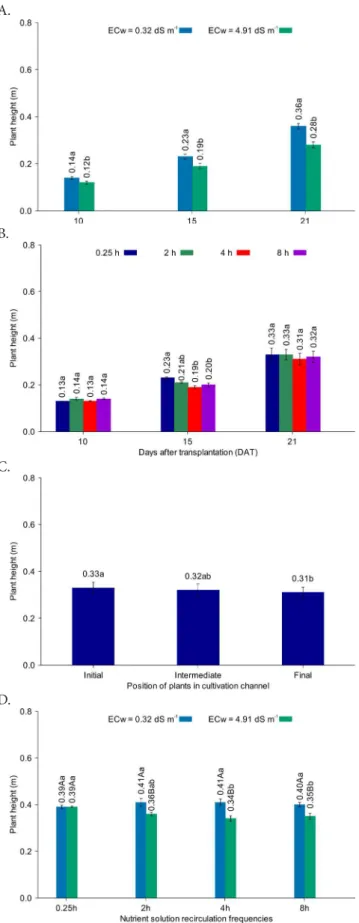
Plant height (PH) of coriander responded significantly to the isolated effects of EC at 10, 15, 21 and 25 DAT, frequencies of recirculation of nutrient solution at 15 DAT and plant position along the cultivation channel at 21 DAT. Significant effect (p < 0.05) was observed in the interaction between EC and recirculation frequencies, at 25 DAT; in all evaluated periods, the greatest growth in PH occurred under ECw of 0.32 dS m-1. When brackish water with EC of 4.91 dS m-1 was used, PH decreased and the effects of salts was more pronounced at 21 DAT, because the estimated PH reduction was 22.22% in relation to the use of freshwater (Figure 2A). This reduction was due to the increase in salt concentration, which makes the water increasingly less available to plants, consequently affecting their growth.
Regarding the significant effect of frequencies on PH at 15 DAT, the highest mean was observed in the control frequency (0.25 h) in relation to 4- and 8-h frequencies, with reductions of 17.39 and 13.04%, respectively (Figure 2B). As to the position of the bunches along the cultivation channel at 21 DAT, there were no significant differences (p > 0.05) between initial and intermediate positions regarding PH, which was reduced by 6.06% when coriander was cultivated in the final position compared with the initial position (Figure 2C).
Specifically at 25 DAT (Figure 2D), when there was significant effect of the interaction between the studied factors, no significant difference in PH was observed between the use of freshwater and brackish water at the control frequency, due to the great number of events of recirculation of nutrient solution, which minimized the effect of salinity on the plant root zone, consequently promoting greater growth in height. However, at the frequencies of 2, 4 and 8 h, the use of freshwater promoted greater PH in relation to brackish water, indicating that under saline conditions plants must be cultivated at higher frequency, i.e., shorter time intervals. In the follow-up analysis of recirculation frequencies at the ECw levels, for ECw of 0.32 dS m-1, there was no significant difference between the frequencies with respect to PH; while for 4.91 dS m-1, the control frequency promoted PH values 12.82 and 10.25% greater than those obtained at frequencies of 4 and 8 h, respectively.
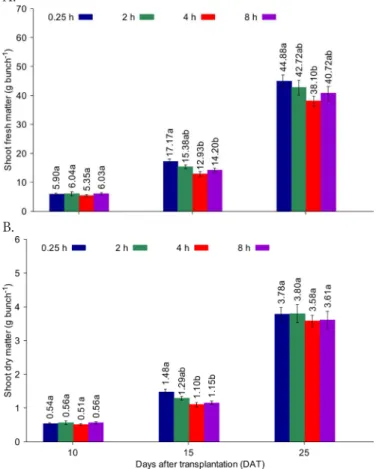
The highest mean values of ShFMbunch were observed for the use of freshwater (EC = 0.32 dS m-1): 6.64, 17.97, 37.91 and 50.33 g per bunch, at 10, 15, 21 and 25 DAT, respectively (Figure 3A). In a study conducted by Cazuza Neto et al. (2014) with NFT hydroponics, at 26 DAT, the production of fresh matter of the bunch of 8 plants of ‘Verdão’ coriander was equal to 92.66 g, for the control treatment (EC = 0.30 dS m-1). The results observed in the present study at 25 DAT were lower, and this difference is associated with characteristics of cultivation system, cycle and cultivation period, besides the strong effect of plant density along the cultivation unit, which may have led to competition between plants for light and nutrients, since plants were cultivated in plastic cups spaced at 30 cm, compared with the 7-cm spacing in the present study.
Compared with freshwater, the use of brackish water (EC = 4.91 dS m-1) promoted mean reductions of about 24.40, 33.95, 37.08 and 34.69% in ShFMbunch, at 10, 15, 21 and 25 DAT, respectively (Figure 3A).
The effect of salinity on plants was more pronounced from 15 DAT on, which does not prevent the use of this water considered as brackish, because it was possible to produce without the presence of deleterious symptoms that compromise the product under the cultivation conditions. This confirms the technical viability of hydroponic coriander cultivation using brackish water, corroborating the results reported by Cazuza Neto et al. (2014). According to these authors, the use of brackish water for the preparation of nutrient solution and
A.
B.
Different letters only in the period indicate significant differences at 0.05 probability level Figure 3. Means of shoot fresh matter (ShFMbunch) (A) and shoot dry matter (ShDMbunch) (B) of the bunch of hydroponic coriander under different electrical conductivity of water at 10, 15, 21 and 25 days after transplantation (DAT) Figure 2. Mean plant height of hydroponic coriander under
different electrical conductivity (ECw) of water (A) and frequencies of recirculation of nutrient solution (B) at 10, 15 and 21 days after transplantation - DAT; in function of position of plants along the cultivation channel at 21 DAT (C) and follow-up analysis (ECw x Recirculation frequency) at 25 DAT (D)
(A) and (B) Different letters in the period and (C) in the position indicate significant differences; (D) Different uppercase letters explain the effect of ECw at each frequency and different lowercase letters explain the effect of frequencies at each ECw level, at 0.05 probability level
D. A.
B.
replenishment of evapotranspiration promoted reduction in the production, but the entire production was considered as commercial, except plants produced under EC of 7.73 dS m-1, which showed symptoms of burnt edges on the older leaves.
The mean percent reductions in ShDMbunch with the use of brackish water (EC = 4.91 dS m-1) were approximately 16.95, 28.08, 26.04 and 23.02%, at 10, 15, 21 and 25 DAT, respectively (Figure 3B). According to Sá et al. (2013), high salt concentrations interact negatively with plant physiology, because they promote deleterious ionic, osmotic and nutritional interactions on the plants, although the effect occurs in different intensity levels depending on the tolerance of the species, with reflex in plant biomass production.
As to the significant effect of frequencies of recirculation of nutrient solution on the production of ShFMbunch at 15 DAT, there was no significant difference at the frequency of 2 h in relation to the control (Figure 4A).
At 25 DAT and only at the frequency of 4 h, the production of ShFMbunch was lower than that at the control frequency, but ShFMbunch did not differ significantly from that at the longer recirculation interval (8 h). Therefore, the longest intervals adopted between nutrient solution recirculation, with only 6 and 3 events per day, were adequate to maintain the solution in the cultivation channels, besides the advantage of reduction in energy consumption. Regarding the highest number of events of nutrient solution recirculation (control frequency),
the mean production of ShFMbunch was approximately 44.88 g bunch-1 against 40.72 g bunch-1 at low frequency (intervals of 8 h). With the frequency at intervals of 4 h, there were means of ShFMbunch of about 38.10 g bunch-1 with reduction of approximately 15.11% in relation to the control frequency.
According to the obtained results, it is a considerable advantage to use the hydroponic system with leveled channels, because plants do not suffer water stress, as observed in NFT hydroponics, in which the system remains idle after one event of nutrient solution recirculation (usually 15 min on and 15 min off). Thus, the intervals between nutrient solution recirculations become important due to the lowering of the nutrient solution level inside the cultivation channels and also to the oxygenation of the nutrient solution. However, one should be careful not to use extremely long intervals, because plants may suffer the lack of oxygenation and vital functions may be damaged. This is even more relevant when brackish water is used, because studies such as Tesi et al. (2003) show that this type of water should be associated with higher levels of dissolved oxygen; likewise, high levels of N for the greater aeration must be used under conditions of high temperatures.
At 15 DAT, ShDMbunch production was significantly reduced by 25.68 and 22.30% at the recirculation frequencies of 4 and 8 h, compared with the control. On the other hand, ShDMbunch production was uniform at 10, 21 and 25 DAT, i.e., at both high (0.25 h) and low (8 h) frequencies, the yield occurred at the same level (Figure 4B), showing that the intervals for nutrient solution recirculation used in the present study were able to meet crop water demand. The reduction in the number of irrigation events promoted lower energy consumption in the study of Luz et al. (2008); according to the authors, irrigation intervals did not promote significant differences in ShDM of lettuce plants under NFT hydroponics.
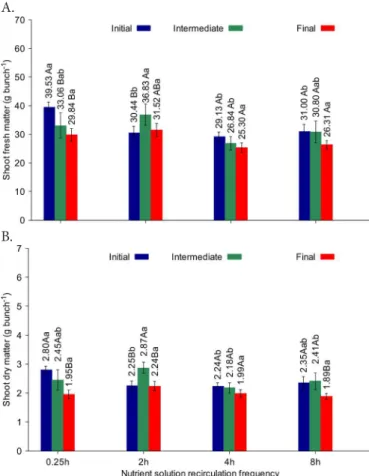
As to the follow-up analysis of the interaction of recirculation frequencies and position of plants along the cultivation channels, in general, there was higher production of ShFMbunch (Figure 5A) and ShDMbunch (Figure 5B) when plants were cultivated at the initial position at the control frequency (0.25 h); for plants cultivated at the final position, there were no significant differences for production variables at the frequencies of 0.25, 2, 4 and 8 h, respectively.
In the follow-up analysis of plant position at each recirculation frequency, under the control frequency, higher production of ShFMbunch of coriander at the initial position of the cultivation channel; at the same frequency, the highest productions of ShDMbunch occurred at the initial and intermediate positions. With the frequency of 8 h, the mean values of ShFMbunch did not differ statistically at the initial, intermediate and final positions. In the study of Luz et al. (2012), with NFT hydroponics and 4.5-m-long channels, the highest accumulation of ShFM was obtained at the initial position for coriander and intermediate position for curly parsley. Still according to these authors, the difference between the positions may be related to the lack of uniformity in the nutrient solution circulation along the hydroponic channel.
The higher production of coriander at the initial positions of the hydroponic channels may be associated mainly with the higher availability of nutrients at these positions, since the A.
B.
Figure 5. Follow-up analysis of the interaction of frequency of recirculation of nutrient solution and position of plants along the cultivation channel for shoot fresh matter (ShFMbunch) (A) and shoot dry matter (ShDMbunch) (B) of the bunch of hydroponic coriander at 21 days after transplantation (DAT)
Different uppercase letters compare the effect of position at each frequency and different lowercase letters explain the effect of frequency at each position, at 0.05 probability level by Tukey test
A.
B.
Acknowledgments
To the Bahia Research Support Foundation (FAPESB) for granting the scholarship to the first author; to the Coordination for the Improvement of Higher Education Personnel (CAPES) and the National Council for Scientific and Technological Development (CNPq) and the National Institute of Science and Technology in Salinity (INCTSal), for funding the hydroponic infrastructure.
Literature Cited
Alves, M. S.; Soares, T. M.; Silva, L. T.; Fernandes, J. P.; Oliveira, M. L. A.; Paz, V. P. S. Estratégias de uso de água salobra na produção de alface em hidroponia NFT. Revista Brasileira de Engenharia Agrícola e Ambiental, v.15, p.491-498, 2011. http://dx.doi. org/10.1590/S1415-43662011000500009
Bione, M. A. A.; Paz, V. P. S.; Silva, F.; Ribas, R. F.; Soares, T. M. Crescimento e produção de manjericão em sistema hidropônico NFT sob salinidade. Revista Brasileira de Engenharia Agrícola e Ambiental, v.18, p.1228-1234, 2014. http://dx.doi. org/10.1590/1807-1929/agriambi.v18n12p1228-1234
Cazuza Neto, A.; Soares, T. M.; Bione, M. A.; Freitas, F. T. O.; Melo, D. M.; Silva Filho, J. A. Qualidade do molho de coentro produzido em água salobra em sistema hidropônico NFT. In: Brazilian Symposium on Salinity, 2, e Brazilian Meeting on Irrigation Engineering 2014, Fortaleza. Anais… Fortaleza: Inovagri, 2014. p.3678-3684. http://dx.doi.org/10.12702/ii.inovagri.2014-a493 Furlani, P. R.; Silveira, L. C. P.; Bolonhezi, D.; Faquin, V. Cultivo
hidropônico de plantas. Campinas: IAC, 1999. 52p. Boletim Técnico, 180.
Lira, R. M.; Silva, E. F. F.; Silva, G. F.; Santos, A. N.; Rolim, M. M. Production, water consumption and nutrient content of Chinese cabbage grown hydroponically in brackish water. Revista Ciência Agronômica, v.46, p.497-505, 2015. http://dx.doi. org/10.5935/1806-6690.20150031
Luz, G. L.; Medeiros, S. L. P.; Manfron, P. A.; Borcioni, E.; Müller, L.; Amaral, A. D.; Morais, K. P. Consumo de energia elétrica e produção de alface hidropônica com três intervalos entre irrigações. Ciência Rural, v.38, p.815-818, 2008. http://dx.doi. org/10.1590/S0103-84782008000300036
Luz, J. M. Q.; Andrade, L. V.; Dias, F. F.; Silva, M. A. D.; Haber, L. L.; Oliveira, R. C. Produção hidropônica de coentro e salsa crespa sob concentrações de solução nutritiva e posições das plantas nos perfis hidropônicos. Bioscience Journal, v.28, p.589-597, 2012. Paulus, D.; Paulus, E.; Nava, G. A.; Moura, C. A. Crescimento,
consumo hídrico e composição mineral de alface cultivada em hidroponia com águas salinas. Revista Ceres, v.59, p.110-117, 2012. http://dx.doi.org/10.1590/S0034-737X2012000100016 Sá, F. V. S.; Pereira, F. H. F.; Lacerda, F. H. D.; Silva, A. B. Crescimento
inicial e acúmulo de massa seca de cultivares de mamoeiro submetidas à salinidade da água em cultivo hidropônico. Revista Brasileira de Ciências Agrárias, v.8, p.435-440, 2013. http://dx.doi.org/10.5039/agraria.v8i3a2663
Santos, A. N.; Silva, E. F. F.; Soares, T. M.; Dantas, R. M. L.; Silva, M. M. Produção de alface em NFT e Floating aproveitando água salobra e o rejeito da dessalinização. Revista Ciência Agronômica, v.42, p.319-326, 2011. http://dx.doi.org/10.1590/ S1806-66902011000200009
entry of the solution occurs at the beginning of the channel, which may cause lower availability of nutrients at the end, including dissolved oxygen; a viable option would be to evaluate multi-point injection of nutrient solution along the cultivation channel. The effect of the gradient become even more important in the present study, since the channel is only 6 m long. Commercial plantations can use longer channels, such as 24-m-long; different from the present study, in these cases, the production gradient may significantly interact with the type of water and/or recirculation frequency.
Conclusions
1. The use of freshwater (EC = 0.32 dS m-1) promoted greater plant height and productions of fresh and dry matter in shoots, leaves and stems, in comparison to brackish water (EC = 4.91 dS m-1), but with no depreciating effects on the visual quality of hydroponic coriander.
2. It is viable to adopt recirculation of nutrient solution every 8 h in coriander cultivation without production losses, obtaining gain with the reduction in electric energy consumption.
Santos, A. N.; Soares, T. M.; Silva, E. F. F.; Silva, D. J. R.; Montenegro, A. A. A. Cultivo hidropônico de alface com água salobra subterrânea e rejeito da dessalinização em Ibimirim, PE. Revista Brasileira de Engenharia Agrícola e Ambiental, v.14, p.961-969, 2010. http:// dx.doi.org/10.1590/S1415-43662010000900008
Soares, H. R.; Silva, E. F. F.; Silva, G. F.; Pedrosa, E. M. R.; Rolim, M. M.; Santos, A. N. Lettuce growth and water consumption in NFT hydroponic system using brackish water. Revista Brasileira de Engenharia Agrícola e Ambiental, v.19, p.636-642, 2015. http://dx.doi.org/10.1590/1807-1929/agriambi. v19n7p636-642
Soares, T. M.; Duarte, S. N.; Silva, E. F. F.; Jorge, C. A. Combinação de águas doce e salobra para produção de alface hidropônica. Revista Brasileira de Engenharia Agrícola e Ambiental, v.14, p.705-714, 2010. http://dx.doi.org/10.1590/S1415-43662010000700004 Tesi, R.; Lenzi, A.; Lombardi, P. Effect of salinity and oxygen level on
lettuce grown in a floating system. Acta Horticulturae, n.609, p.383-387, 2003. http://dx.doi.org/10.17660/ActaHortic.2003.609.58 Zanella, F.; Lima, A. L. S.; Silva Júnior, F. F.; Maciel, S. P. A.