A Work Project, presented as part of the requirements for the Award of a Master’s Degree in International Management from the Nova School of Business and Economics.
DIGITALIZATION OF THE WORKPLACE:
HOW OPENNESS OF EMPLOYEES MODERATES THE EFFECTS OF TECHNOSTRESS ON JOB SATISFACTION.
Melanie Krauss | 33353
Work project carried out under the supervision of:
Samantha Sim
Abstract
The present work project examines how openness as one of the Big Five Personality Traits moderates the relationship between technostressors and job satisfaction. Technostress is defined as stress experienced by employees through the use of information and communica-tion technologies (ICT). After conducting a survey a regression analysis was performed. The study suggests that openness positively moderates the relationship between techno-overload, -invasion, -complexity and -insecurity and job satisfaction, such that the corre-sponding technostressor affects job satisfaction weaker if the level of openness is high. No significant moderation could be found for techno-uncertainty. From these results practical recommendations for managers and HR departments are derived.
Keywords: Technostress, Openness, Job Satisfaction, Information and Communication Tech-nology
This work used infrastructure and resources funded by Fundação para a Ciência e a Tecnolo-gia (UID/ECO/00124/2013, UID/ECO/00124/2019 and Social Sciences DataLab, Project 22209), POR Lisboa (LISBOA-01-0145-FEDER-007722 and Social Sciences DataLab, Pro-ject 22209) and POR Norte (Social Sciences DataLab, ProPro-ject 22209).
1 Introduction
Information and communication technologies (ICT) are developing in an incomprehensi-ble speed (Boyer-Davis, 2019). By 2019, 293.6 billion e-mails (business and consumer) were sent per day and the number is estimated to increase up to 347 billion emails per day by 2023 (Radicati Group Inc., 2019). A massive amount of data of around 2.5 quintillion bytes (repre-senting a number with 18 zeros) is produced per day, creating high intensity of information (Jacobson, 2013). Meanwhile, changes in ICT also affect work environments and the way employees interact, communicate and collaborate. On the one hand, technology is a key suc-cess factor for companies in the future, as it meets companies’ need for flexibility and agility (Garca-Alcaraz et al., 2017). On the other hand, it arises the issue of technostress, defined as stress experienced by employees due to their use of ICT, since end-users suffer from e.g. in-creased workload, information density, the need to constantly adapt to changes or the inability to cope with technology’s complexity (Ragu-Nathan et al., 2008; Tarafdar et al., 2010). Con-sequences can be negative effects on employee’s job satisfaction, performance or well-being (Tarafdar et al., 2010). Not only is ICT a prerequisite for companies to stay relevant in the future. Employees also depend on ICT in order to efficiently perform their operational tasks and to collaborate on a daily basis (Dimensional Research, 2015). The dilemma of ICT being a key success factor and simultaneously a source of decreasing job satisfaction and health issues clearly shows the importance of understanding the phenomenon of technostress.
Technology eliminates repetitive tasks, creates complex solutions, and consequently changes job profiles and requirements (Schwarzmüller et al. 2018). Hence, problem-solving ability, curiosity and openness for new developments, creativity and a flexible mindset, atti-tudes which are summarized by one of the ‘Big Five’ personality traits ‘openness’, are charac-teristics companies highly value (Frenkel et al., 1995; S. Parker et al. , 2001). As companies are seeking for human resources high in openness in the future, it would be important to
un-derstand how these employees react to technostress, whether they are more affected by it or whether openness might protect them from negative effects on job satisfaction. However, re-search has never examined the relationship of openness, technostress and job satisfaction. Therefore, this master thesis aims to fill this gap. The research question of this study therefore is how openness moderates the relationship of technostress and job satisfaction.
In order to answer this research question, a detailed literature review of stress- and technostress literature was undertaken. Based on the insights, a survey with professionals whose work depends on ICT was conducted. Afterwards the hypotheses were tested running a regression analysis with moderator. Finally, practical recommendations for companies were derived. The results of this study enable HR departments and managers to get detailed in-sights into the effects of technostressors on employees with certain levels of openness and allow them to find solutions and prevention strategies against it.
2 Literature overview and theory
2.1 The concept of stress
Although stress has been an extensively studied phenomenon, conceptual and perspec-tival issues impeded researchers to finally define the ‘concept’ of stress. From the conceptual point of view, stress can be treated as a stimulus (Elliot & Eisdorfer, 1982), a psychological dysfunction (Ivancevich & Matteson, 1980) or a response (Hobfoll et al., 1988) to name just a few examples. From a research perspective, stress can be understood as individual appraisal, as an environmental factor, or a mix of both (D. F. Parker & DeCotiis, 1983).
The present study follows the definition of stress of McGrath (1976), who defined stress as a ‘imbalance’ experienced by a person in an “environmental situation that is perceived as presenting a demand which threatens to exceed the person’s capabilities and resources for
meeting it, under conditions where he or she expects a substantial differential in the rewards and costs from meeting the demand versus not meeting it” (McGrath, 1976, p. 1352). It is important to note that in this definition stress is seen as a response of an individual’s appraisal of external demands, while the consequences of not meeting these demands play an important role for the individual (D. F. Parker & DeCotiis, 1983).
Consistent with McGrath’s imbalance definition, Lazarus & Folkman (1984) defined the transactional model of stress and coping (TMSC). This model describes how an individual evaluates a situation or the posed external demands according to his/her sense of importance. Consequently, a situation can be perceived as positive, irrelevant or stressful. Afterwards, an evaluation of the resources and coping mechanism available to fulfill external requests fol-lows, which in turn can influence the perception of the situation.
In accordance with Lazarus’ and Folkman’s (1984) idea of external demands and inter-nal resources, the ‘job demands-resources model’ (JD-R model, Demerouti et al., 2001) as-sumes that job demands, such as work conditions (e.g. time pressure) lead to exhaustion, whereas lacking resources, such as rewards, security or support, may lead to disengagement. Both exhaustion and disengagement can lead to job burnout. While the JD-R model allows for an objective consideration of demands and resources, the concept of imbalance acknowledges the importance of individual appraisal. Both models are helpful frameworks, which provide the theoretical foundations to explain how technostress, job satisfaction and an individual’s personality traits are linked, as explained in the following sections.
2.2 ICT and technostress
Technostress can be defined as stress, experienced by employees due to the use of ICT, which is caused by an employee’s attempt to meet the demands arising from new technolo-gies, e.g. evolving cognitive and social abilities in order to adapt to their use (Ragu-Nathan et al., 2008). In this study, ICT are defined as all technologies (hardware, software, tools, etc.)
which support the collaboration, interaction and communication of employees as well as the sharing of information and knowledge in companies (Antonelli et al., 2000). Technostress is a result of various technostressors, also called technostress creators (Tarafdar et al., 2010). Technostressors can be seen as a new category of job-stressors, or in the wording of the JD-R model, job-demands through the use of ICT. Although the technostressors may differ from previously defined job-stressors (e.g. shift work or time pressure, Demerouti et al., 2001), the effects are the same: Explained by the TMSC, technostressors create stress from the perceived imbalance of demands and resources, for example due to constant connectivity or job related insecurity. This in turn can lead to second-level outcomes, e.g. decreasing job satisfaction or health issues (Ragu-Nathan et al., 2008).
While recent researchers, such as Ragu-Nathan et al. (2008), take into account the mul-tifaceted shape of ICT which creates technostress, earlier studies focused on computers in general when defining the term. Brod (1984) for example defined technostress as “a modern disease of adaption caused by an inability to cope with new computer technologies in a healthy manner” (p. 16). Also Arnetz (1997) saw technostress as “a state of arousal observed in certain employees who are heavily dependend on computers in their work” (p. 36). Howev-er, nowadays technostress does not only evolve from the unfamiliar use of computers but spe-cifically from ICT. Considering the unimaginable speed ICT evolves, examining the effect of technostress also implies examining new ICT, which contributes to technostress studies. The types of ICT included in the survey and definitions can be found in appendix 1 and 2.
The technostress model (Ragu-Nathan et al., 2008) comprises five different tech-nostressors. Techno-overload refers to the perception that the employee needs to work more and faster due to new technologies. Techno-invasion describes the development of blurring lines between leisure and working time and the feeling of constant connectivity with their work. Techno-complexity is associated with the feeling of the employee being unable to
handle the new technology due to lacking skills and knowledge as well as lacking time and understanding. Techno-insecurity describes the perception of a constant threat through new ICT, either because the employee fears being replaced by automation or by other employees with a better understanding of the new technology. Techno-uncertainty refers to the constant change and development of the implemented ICT, leading to the necessity of continuously adapting to the new technology (Ragu-Nathan et al., 2008).
The phenomenon of technostress is already known for decades. However, as ICT in-creasingly influences work environments, researcher’s interest in technostress is growing. As one important contribution, the effects of technostress on various job-related outcomes were studied. Among these, health-related problems, turnover, decrease in productivity and per-formance, engagement or job satisfaction were examined (Barber & Santuzzi, 2015; Boyer-Davis, 2019; Ragu-Nathan et al., 2008; Srivastava et al., 2015; Tarafdar et al., 2010). Howev-er, among all job-related outcomes which are affected by technostress, job satisfaction has the highest importance, which is why it was chosen as dependent variable (DV) in this study. Firstly, job satisfaction is important, because it is often related to other outcomes, such as health issues, performance (Judge et al., 2001), extra-role behavior (Bowling, 2010), engage-ment and turnover (Ragu-Nathan et al., 2008). Secondly, lack of job satisfaction has serious effects on organizations as health problems and turnover increase costs. Low job satisfaction also decreases innovation, performance or revenue, hence job satisfaction can be seen as the backbone of a company’s success (Diaz & Rhodes, 2018). The strong link of job satisfaction to other job-related outcomes and the high relevance for a company’s success clearly justify the choice of job satisfaction in this study.
Furthermore, research examined technostress in the context of organizational and job factors, for example how it affects employees in different functions and industries (e.g. in accounting (Boyer-Davis, 2019) or in sales (Tarafdar et al., 2014)) or how it might be
moder-ated by a high leadership and low competition culture (Turel & Gaudioso, 2018). Meanwhile, less research analyzed the link of individual differences and technostress. It was examined, how individual differences might change the perception of technostress (e.g. Diaz & Rhodes, 2018; Heller et al., 2002; Marchiori et al., 2019) or how openness influence the effects of technostress on job engagement (Srivastava et al., 2015). Nevertheless, there is still a gap in research regarding the research of technostress in the context of individual traits. This study aims to fill this gap as described in the following section.
2.3 The Big Five Personality Traits and Openness
The TMSC acknowledges the existence of varying reactions to technostress depending on an individual’s personal perception and weighting of the situation. In this context, the pre-sent study explores how personality traits, especially openness, influence the relationship be-tween technostress and job satisfaction. Personality traits can be defined as a person’s disposi-tion, which may relatively stable and resistant to transformation over time (Ajzen, 1988). The five-factor model of personality, also called the Big Five model of personality traits, allows to capture the most salient personality traits of an individual through a five-dimensional struc-ture (Heller et al., 2002; McCrae & Costa, 1991). The five factors the model comprises are extraversion, agreeableness, conscientiousness, neuroticism and openness (Goldberg, 1992). However, the present study only focuses on openness1, which will be justified in the follow-ing section. Individuals who have a high level of openness can be characterized by their un-conventional, flexible and divergent way of thinking and their curiosity towards new ideas (McCrae & Costa, 1991). Furthermore, open people tend to have imaginative mind-sets and a high creativity (Feist, 1998). Their openness makes them fast learners who enjoy broadening their horizons and who are willing to experience changes (Barrick et al., 2001).
1
The study also collected data for the other four of the big five personality traits. If interested, the author can provide the information via e-mail. Please contact [email protected].
In the past, openness was already studied in various forms, for example how it influ-ences attitudes like support for creativity (Baer & Oldham, 2006). Today openness is an im-portant personality trait which will gain relevance in the future. In the context of evolving job profiles and work environments due to ever-changing technologies, competencies of people high in openness are sought by companies (S. Parker et al., 2001). Considering that technolo-gy replaces repetitive tasks and allows for complex solutions, companies seek for special problem-solving skills (S. Parker et al., 2001), flexible thinkers which are open for new de-velopments and creative employees (Frenkel et al., 1995).
Although openness gained high relevance for the future and also understanding tech-nostress and its effects on job satisfaction are very important as shown in advance, research never linked these three topics. This study therefore aims to fill this research gap and ex-plores, how openness influences the effects of technostressors on job satisfaction. This re-search question not only allows to understand how openness influences job satisfaction, it also accounts for the circumstances of evolving work-environments and the changing competen-cies sought by employers, as ICT influence companies and the way employees work. Moreo-ver, the presented research question allows for an update on technostress study, as existing literature which is based on former ICT appears to be outdated (Arnetz, 1997; Brod, 1984).
2.4 Research question, hypotheses and conceptual model
Thus, the research question of this study is, whether openness has a moderating effect on the relationship between technostress and job satisfaction. To answer this question, in the first step it needs to be confirmed that technostress has a negative influence on job satisfaction as explored by existing literature (e.g. Ragu-Nathan et al., 2008; Tarafdar et al., 2010).
H1: Technostress has a negative relationship with job satisfaction.
In the second step, several hypotheses regarding separate technostressors and job satis-faction were formulated. The above stated theory rises the expectations that open individuals
do not feel threatened by ICT but are curious to try out new technologies. This behavior leads to the assumption that openness functions as a protective mechanism and people high in openness perceive technostress as less stressful as other individuals. The study consequently assumes that openness moderates the effects of a certain technostressor in a way that its nega-tive influence on job satisfaction is weaker the more open an individual is. Additionally, some specificities need to be considered for each technostressor.
As the first hypothesis, techno-overload will be examined, assuming that people high in openness would perceive overload less negative. Nevertheless, people high in openness would still experience technostress as literature also suggests that open individuals are characterized by enthusiasm which may lead to an undesirable amount of work (Ragu-Nathan et al., 2008). H2: Openness positively moderates the relationship between techno-overload and job satis-faction, such that overload affects job satisfaction weaker when the level of openness is high.
Techno-invasion arises through blurring lines between private and work life. However, it would be plausible that people high in openness do not perceive invasion as stressful, as they may be open to flexible work arrangements and would enjoy the temporal and spatial flexibility ICT brings, while being less sensitive to spillover-effects of work to private life. H3: Openness positively moderates the relationship between techno-invasion and job satisfac-tion, such that invasion affects job satisfaction weaker when the level of openness is high.
Concerning techno-complexity, a high level of complexity may have a demotivating and frustrating effect on individuals. Nevertheless, it will be assumed, that open people are more enthusiastic and curious to deal with new and complex tasks.
H4: Openness positivelymoderates the relationship between techno-complexity and job satis-faction,suchthatcomplexityaffectsjob satisfactionweakerwhen the level of openness is high.
It would be plausible that employees high in openness do not perceive techno-insecurity as stressful, since their openness towards changes, flexibility and willingness to
adapt would easily enable them to cope with future changes arising through ICT. Since they do not see ICT as a threat, a lack of clarity about the future does not arouse worries. Further-more, techno-insecurity measures how people feel threatened by new hires or colleagues with better ICT skills. People high in openness are willing to adapt to changes to ICT, therefore they do not need to fear differences in competencies. Therefore, it will be assumed that: H5: Openness positively moderatestherelationshipbetween techno-insecurity and job satis-faction,such that insecurity affects job satisfaction weakerwhen the level of openness is high.
Finally, techno-uncertainty leads to a disruption of an employee’s daily operational doing because of ICT updates, which in turn destroy routines and working habits. It will be assumed, that people high in openness have a higher flexibility and open mindset and there-fore perceive these interruptions as less negative.
H6:Opennesspositively moderates the relationshipbetween techno-uncertaintyand job satis-faction,such that uncertaintyaffectsjobsatisfactionweakerwhenthelevelof opennessis high.
Figure 1 allows a graphic visualization of the underlying model of this thesis.
3 Method
3.1 Participants and procedures
In order to test the proposed hypotheses, a quantitative survey was conducted and then analyzed with IBM SPSS Statistics. To carry out the survey, the SAP Qualtrics tool was used by distributing the survey link with the snowball method (Orgegon State University, 2019) via social media and the author’s private network. After four weeks, 262 responses were collected whereof 52 answers due to incompleteness were deleted. To avoid the responses being affect-ed by cultural differences as suggestaffect-ed by Hofstaffect-ede (2001), only participants from Germany,
Austria and Switzerland were taken into consideration2. Therefore, five more responses were dropped. Finally, 205 responses were analyzed. The demographics of the survey participants are presented in table 1 and 2. The data shows that 59.5% of the participants were male and 49.5% female (gender was coded as a dummy variable). The average age in the sample is 33.53 years (SD = 10.921), with a range from 18 to 66 years. The average number of years the respondents already worked for the current employer (control variable called employ-ment) amounted to 7.6 years (SD = 9.169), ranging from 0 to 35 years.3
3.2 Measures and reliability measures
Several existing and validated scales were used to build the survey (appendix 1 and 2).
Technostress: In order to measure the different technostressors, the technostress-scales
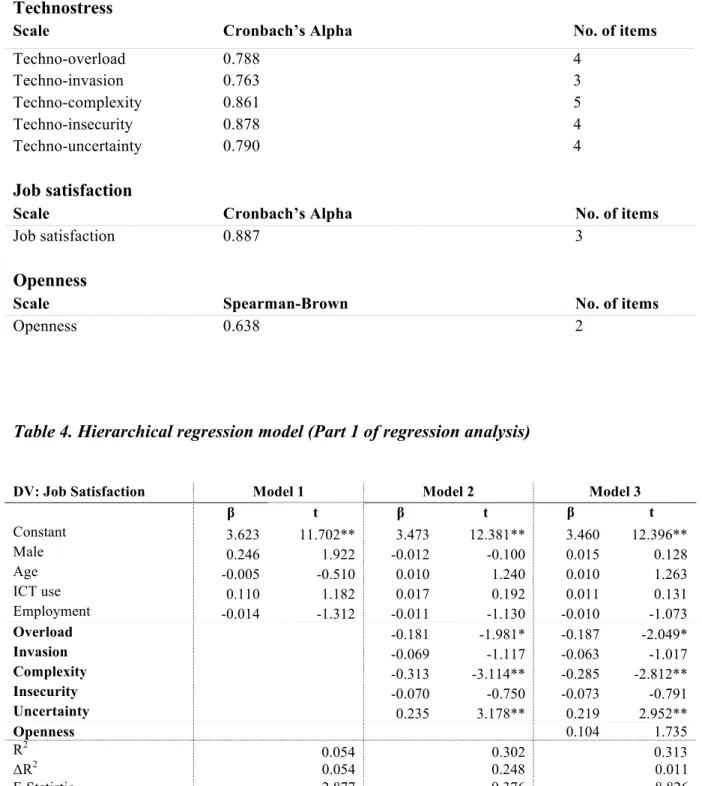
from Ragu-Nathan et al. (2008) were used, consisting of 5-point Likert scales ranging from (1) ‘Strongly disagree’ to (5) ‘Strongly agree’. As they were in English, the translations of Kaufmann (2015) were used for this study. The scales were translated in German and back translated by a native speaker following the guidelines of Brislin (1981). Cronbach’s alpha was calculated: αtechno-overload = 0.79, αtechno-invasion = 0.76, αtechno-complexity = 0.86, α techno-insecurity = 0.88,αtechno-uncertainty = 0.79.
Job satisfaction: To assess job satisfaction, a 5-point Likert scale ranging from
(1) ‘Strongly disagree’ to (5) ‘Strongly agree’ was taken from Ragu-Nathan et al. (2008). Cronbach’s alpha amounts to αjob satsifaction = 0.89.
Openness: The Big Five Inventory-10 (BFI-10) scale from Rammstedt et al., (2013)
was used in order to measure the personality traits of an employee. The scale is a 5-point
2 The six cultural dimensions of the three countries show similar scores, this proves their cultural similarity (the
scores for each dimension will be presented in the order of Austria (A), Germany (G) and Switzerland (S)): Power distance: (A: 11, G: 35, S: 34), Individualism: (A: 55, G: 67, S: 68), Masculinity: (A: 79, G: 66, S: 70), Uncertainty Avoidance: (A: 70, G: 65, S: 58), Long Term Orientation: (A: 60, G: 83, S: 74), Indulgence: (A: 63, G: 40, S: 66) (Hofstede Insights, 2019).
3 In a pre-test phase eight test participants reviewed the survey. Three sentences in the German translation were
ert scale, available in English and German, and ranges from (1) ‘Strongly disagree’ to (5) ‘Strongly agree’. Spearman-Brown coefficient = 0.644.
Despite the hypothesized effects, it is also possible that the variables may be affected by other influences (Hayes, 2018). Therefore, control variables were included in the model in order to account for alternative variances. The control variables are (1) age, (2) gender, (3) ICT use, defined as extend of ICT use for the operational work (see Q3 in appendix 2) and (4) employment (number of years the respondent already works in the actual company, see Q1 in appendix 2). In order to measure ICT use, the participants were asked to state how often they use certain ICT means for their work and could state other tools and their extent of use. A German 5-point Likert scale (1 = ‚Never’, 5 = ‚Every time’) from existing literature was used (Vagias, 2006). As only participants from Germany, Austria and Switzerland were taken into consideration, no control variable for culture was incorporated.
A summary of the calculated reliability measures is given table 3. The English version of the survey in appendix 2 provides additional information and describes which questions include the scales and variables presented above.
4 Results
4.1 Descriptive statistics
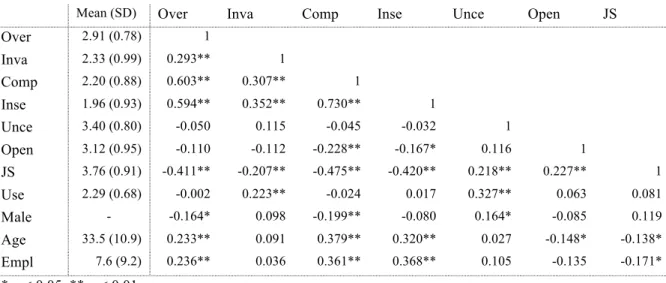
As shown in table 2, the standard deviations and correlations for the main variables of this study were calculated. The respondents stated an ICT use of M = 2.29 (SD = 0.678), while the meaning of 2 equals ‘Occasionally/Sometimes’ and 3 equals ‘Almost every time’. This shows that the use of ICT is a crucial part of today’s work environment. The average job satisfaction amounts to M = 3.76 (SD = 0.91), indicating a generally high job satisfaction of
4 The Spearman-Brown coefficient of 0.64 is below the recommended minimum level of 0.7 (Nunnally, 1978).
However, it was necessary to find a short, time efficient scale to increase the number of survey participants, which justifies the choice of this 2-item openness scale.
the test participants. The means of the five technostressors differ strongly from each other, ranging from M = 1.96 (insecurity, SD = 0.93) to M = 3.40 (uncertainty, SD = 0.80). These observations allow for important insights which stressors have higher presence in the test par-ticipants’ work environments. Lastly, the test participants describe themselves as rather open, indicated by the high average of openness (M = 3.12, SD = 0.95).
4.2 Inferential statistics and hypothesis testing
In the next step, a correlation analysis was conducted with the use of Pearson’s r to ac-count for linear association of the different quantitative variables (Hayes, 2018) and to test for H1 (table 2). The analysis included the five technostressors, openness, job satisfaction, and
the four control variables stated above. Four technostressors correlate negatively with job satisfaction, while techno-uncertainty correlates positively (r = 0.218, p < 0.01). Thus, it can be stated that technostress is negatively related to job satisfaction and H1 is partly supported
in four of the five cases explored.
Regarding the correlations of openness with other variables, relevant insights were found. Openness correlates negatively with the technostressors complexity (r = -0.228, p < 0.01) and insecurity (r = -0.167, p < 0.05) implying that a higher amount of openness leads to a lower complexity and insecurity. This meets the expectations that people high in openness feel less stressed by technostressors, which will be further explored in the following sections. Moreover, openness correlates positively with job satisfaction (r = 0.227, p < 0.01), indicating that openness predicts the level of job satisfaction and delivering important insights for future studies. However, as the independent and control variables should be distinct from each other, the correlations between openness and the technostressors should be considered as a limitation when interpreting the results (Hayes, 2018). Age negatively correlates with job satisfaction (r = -0.138, p < 0.01), in that job satisfaction is lower the higher the age of the employee. Furthermore, also employment (number of years at current employer) negatively
correlates with job satisfaction (r = -0.171, p < 0.01), which signifies that with increasing number of years of employment, job satisfaction decreases. The other two control variables, ICT use and gender, are not significantly associated.
In order to test H2 – H6, a regression analysis was conducted. The regression model
ex-amines the effects of openness on the relationship of technostress and job satisfaction. The regression analysis was split into two parts. In the first part of the regression analysis a hierar-chical model was used to account for the direct effects of all variables, namely the four pre-sented control variables, the five technostressors as the independent variables (IV), openness as the moderator, and job satisfaction as the dependent variable (DV). Firstly, the control var-iables were introduced, followed by the technostressors in the second and openness in the third step of the hierarchical model. Table 4 shows that control variables explain 5.4 % (R2) of the effect on job satisfaction in the given regression model (Adjusted R2 = 3.5 %), while none of the control variables are significant. The low explained variance and insignificance of vari-ables show that the choice of the control varivari-ables should be improved in future models. In-troducing the technostressors, a high change in R2 can be observed, as it amounts to R2 = 30.2 % (adjusted R2 = 27.0 %) now. Introducing openness increases the R2 to 31.3 % (adjusted R2 = 27.7 %) (table 4).
As the second part of the regression model, the interaction terms (which are the prod-uct of openness and each technostressor) were added to the model. In this way, the hypothe-sized moderating influence of openness on the different technostressors was tested. Addition-ally, a regression analysis with moderator was conducted in SPSS PROCESS 26. To avoid collinearity when SPSS multiplies the technostressor and openness to create the interaction term, the data was mean-centered in advance (Hayes, 2018). Firstly, it was observed
wheth-er β35 is significant and β3 ≠ 0. In order to probe the interaction, for the models with
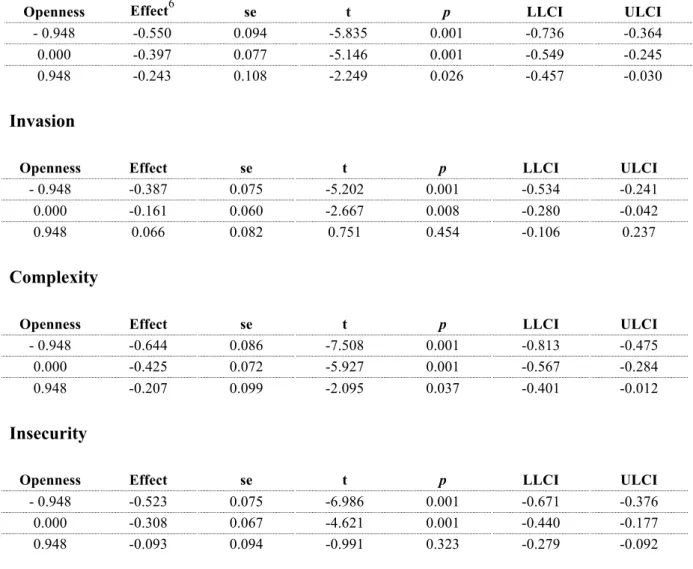
signifi-cant interactions the conditional effects of the moderator (-1 SD, mean, +1 SD) were tested for significance (table 5). Afterwards, to better understand the interaction, a graph was plotted using -1 SD, mean and +1 SD of the focal and moderating predictor according to the guide-lines of Hayes (2018). The results are presented in the following.
H2: Openness positively moderates the relationship between techno-overload and job satis-faction, such that overload affects job satisfaction weaker when the level of openness is high. The results of this model (table 6) show that openness significantly moderates the relationship between techno-overload and job satisfaction (β3 = 0.162, p < 0.05, ΔR2 = 0.021, F (1, 197)
= 5.405, p < 0.05). The overall model fit is R2 = 0.237, F (7, 197) = 8.761, p < 0.001. Probing the interaction (figure 2 and table 5) shows that the slope is significantly different from zero in all three levels of openness, being more negative for a mean level of openness and the most negative for a low level of openness. The graph shows that techno-overload affects job satis-faction more negatively, when openness is low. Therefore, H2 is supported. Meanwhile, also
H1 is supported for techno-overload because it negatively correlates with job satisfaction
(r = -0.411, p < 0.01) in that techno-overload affects job satisfaction more negatively the higher the amount of overload (table 2).
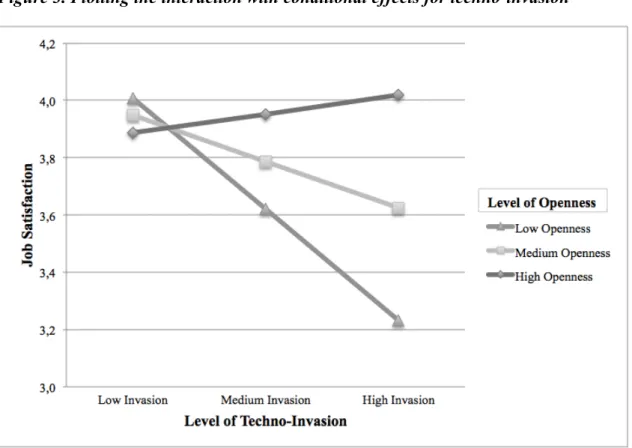
H3: Openness positively moderates the relationship between techno-invasion and job satis-faction, such that invasion affects job satisfaction weaker when the level of openness is high. In the next model (table 7) it can be observed that openness significantly moderates the rela-tionship between techno-invasion and job satisfaction (β3 = 0.239, p < 0.001, ΔR2 = 0.069,
F (1, 197) = 17.502, p < 0.001). The overall model fit is R2 = 0.214, F (7, 197) = 7.642,
5
β3 represents the coefficient of the interaction term, while β1 stands for the coefficient of the certain
p < 0.001. Whilst a high level of openness in this model is not significant, the mean and lower levels of openness are significant. As also shown in figure 3, openness positively moderates the effect of techno-invasion. The lower the level of openness, the more negative is the effect of invasion on job satisfaction. Hence, H3 is supported. Furthermore, also H1 is supported for
techno-invasion because it negatively correlates with job satisfaction (r = -0.207, p < 0.01) and techno-invasion affects job satisfaction more negatively the higher the amount of invasion (table 2).
H4: Openness positively moderates the relationship between techno-complexity and job satis-faction,suchthatcomplexityaffects job satisfaction weaker when the level of openness is high. As hypothesized, openness positively moderates the relationship between techno-complexity and job satisfaction as β3 = 0.231, p < 0.001 with ΔR2 = 0.050, F (1, 197) = 14.120, p < 0.001
(table 8). The overall model fit is R2 = 0.299, F (7, 197) = 12.053, p < 0.001. The data shows
that the coefficient of openness is not significant (β2 = 0.103, n.s.), indicating that openness
does not have a direct effect on job satisfaction. Probing the interaction (figure 4 and table 5) reveals that all three levels of openness differ significantly from zero, with increasingly nega-tive slope the lower a person is in openness. From these observations the support of H4 is
de-rived. Also H1 is supported for techno-complexity because it negatively correlates with job
satisfaction (r = -0.475, p < 0.01) in that techno-complexity affects job satisfaction more neg-atively the higher the amount of complexity (table 2).
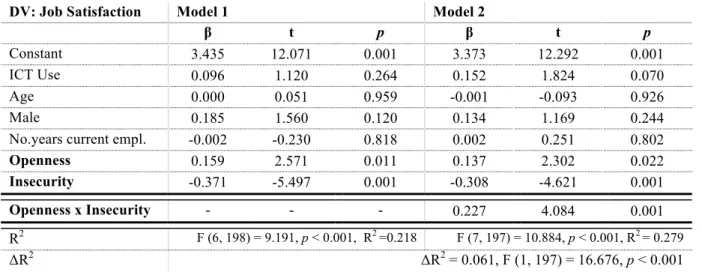
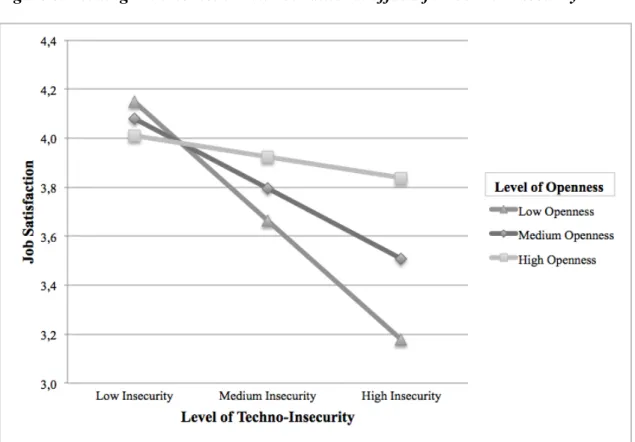
H5: Openness positively moderates the relationship between techno-insecurity and job satis-faction, such that insecurity affects job satisfaction weaker when the level of openness is high. From table 9 it can be observed that openness positively moderates the relation between inse-curity and job satisfaction (β3 = 0.227, p < 0.001, ΔR2 = 0.061, F (1, 197) = 16.676,
p < 0.001). The overall model fit R2 = 0.279, F (7, 197) = 10.884, p < 0.001. Figure 5 and the conditional effects in table 5 shows that insecurity affects job satisfaction weaker, if the level of openness is higher. However, a high level of openness was not significant, therefore at a high level of openness, techno-insecurity has no effect on job satisfaction. Nevertheless, from these results it can be concluded that H5 is supported. Additionally, H1 is supported for
tech-no-insecurity because it negatively correlates with job satisfaction (r = -0.420, p < 0.01) in that techno-insecurity affects job satisfaction more negatively the higher the amount of inse-curity (table 2).
H6: Opennesspositivelymoderates therelationship between techno-uncertainty andjob satis-faction,such that uncertainty affects job satisfactionweakerwhenthe levelof openness is high The overall model fit for H6 is R2 = 0.133, F (7, 197) = 4.332, p < 0.001. However, contrary to
the hypothesized expectations, openness does not significantly moderate the relationship be-tween techno-uncertainty and job satisfaction (β3 = 0.062, p = n.s, ΔR2 = 0.003,
F (1, 197) = 0.747, n.s) (table 10). Although both openness and uncertainty have direct, sig-nificant effects, no sigsig-nificant interaction effect was found. From this it can be derived that H6
is not supported. Moreover, H1 is not supported for techno-uncertainty. Contrary to the other
four technostressors, techno-uncertainty correlates positively with job satisfaction (r = 0.218, p < 0.01) (table 2). This signifies that job satisfaction is stronger the higher the amount of techno-uncertainty.
5 Discussion
5.1 Discussion of results
The results show that in almost all cases technostress affects job satisfaction negatively, there-fore H1 is partly supported in four of the five cases tested. Furthermore, the results show
that openness moderates the relationship between all but one technostressors and job satisfac-tion (results of hypothesis testing summarized in table 11). These observasatisfac-tions match the ex-pectations that open individuals do not feel threatened and stressed by ICT but are curious to try out new things and enjoy the advantages arising through new technologies. Openness moderates the effects of techno-overload on job satisfaction as the interaction’s coefficient is significant, therefore H2 is supported. It is plausible that people high in openness still
experi-ence technostress, as literature suggests that open individuals are characterized by enthusiasm which in turn may lead to an undesirable amount of work (Ragu-Nathan et al., 2008). Effects were also found for techno-invasion due to a significant coefficient, therefore H3 is
support-ed. While probing the interaction with conditional effects in the case of invasion the data
showed that a high level of openness was not significant, confirming the expectation that peo-ple high in openness enjoy flexible work arrangements arising through ICT. Openness also significantly influences the relationship of techno-complexity and job satisfaction, which
supports H4. Furthermore, a significant moderation was found in the case of
techno-insecurity, thus H5 is supported. However, the high conditional effect of openness was not
significant in this case, which is plausible as people high in openness might not perceive inse-curity as stressful due to their flexibility and willingness to adapt to changes. In contrast to the hypothesized expectations H6 is not supported, since openness has no significant moderating
effect on the relationship between uncertainty and job satisfaction. Indeed, techno-uncertainty positively correlates with job satisfaction (r = 0.218, p < 0.01) (table 2), and un-certainty has a positive coefficient (β1 = 0.227, p < 0.01) (table 10), while all other stressors
show negative correlations (table 2) and negative coefficients (tables 6 - 9). Also other studies already identified that techno-uncertainty is an isolated technostressor, in that the association with the underlying outcomes was weaker or non-significant (Kanliang et al., 2008; Maier et al., 2015; Srivastava et al., 2015). One plausible explanation could be that nowadays ICT is changing in an enormous speed (Schwarzmüller et al., 2018). This does not necessarily mean that big changes occur occasionally. It would be also plausible that constant small changes happen on a regular base. The high mean of techno-uncertainty of M = 3.4 (table 2) (before mean-centering, considering a 5-point Likert scale) shows that many survey participants expe-rience changes of ICT in everyday job routine. However, the scale for measuring uncertainty does not ask for the intensity of disruption when ICT change. This arises one possible expla-nation that small changes happen regularly and hence do not disturb an individual’s job rou-tine intensively. As ICT is highly dynamic nowadays, employees may be used to regular small adaptions. The positive correlation with job satisfaction may arise from new possibili-ties ICT based changes create or technical issues which might be solved by frequent updates. The result opens further research need.
Lastly, the results show a positive correlation between openness and job satisfaction (r = 0.227, p < 0.01), which has never been discovered by research before and which indicates the positive influence of openness on job satisfaction. The finding therefore provides im-portant insights for job satisfaction research and offers opportunities for future research.
5.2 Recommendations for practice
The study clearly shows how openness affects the perception of stress. These results allow HR departments and managers to derive solutions and prevention strategies to avoid decreas-ing job satisfaction through techno-overload, -invasion, -complexity and -insecurity. While on the one hand Srivastava et al. (2015) suggests to hire employees who are more open to ICT and less susceptible, this approach is not appropriate, as employees low in openness may have
other strong characteristics and competencies which suit the job profile. Furthermore person-ality traits are a relatively stable disposition, which means that people are still adaptable to various environments (Ajzen, 1988). Therefore, this study derives recommendations for HR departments and managers for already hired employees low in openness.
As discussed in chapter 2.3 people low in openness perceive technostressors as more stressful because their perception about ICT is more negative and less open-minded. They see ICT rather as a threat than as an opportunity, hence they are not willing to adapt to them. Therefore, as a first step it is important to reframe the situation about the use of ICT and en-hance their perception. This way, the first appraisal of the situation according to the TMSC will be more positive as ICT are not perceived as a threat or obstacle anymore. As a second step, situational factors can be used in order to improve work conditions. Situational factors can be various, e.g. in form of organizational mechanisms, conditions or structures (Ragu-Nathan et al., 2008). In the context of the TMSC, these factors function as coping mecha-nisms and provide resources which in turn influence the two steps of appraisal of a situation and hence prevent the translation of technostressors to technostress (Turel & Gaudioso, 2018). These factors can improve the first appraisal step, but it can also help people, whose first im-pression is negative to better cope with the situation.
A first situational factor which can help to enhance the two appraisal steps for people of all levels of openness is technical support for end-users (Nelson, 1990). Especially to avoid effects of techno-complexity, it is important to provide assistance e.g. in form of IT-helpdesks or training and workshops. Also the effects of techno-overload can be improved this way, as people who suffer from this stressor have a more intense workload because of increased tech-nology complexity which they cannot handle. Other situational factors are stress management trainings, wellness programs and counseling programs which can additionally help to cope with all forms of technostressors (Davis & Gibson, 1994). Furthermore, job redesign and role
restructuring for certain employees are mechanisms to avoid technostress through overload or complexity (Burke, 1993). As this mean implies very specific adaptations for a single em-ployee and hence presents high organizational effort, it would be important to clearly identify what stresses the employee the most to change his or her role or position specifically.
Beside these general situational factors, Turel & Gaudioso (2018) suggest that manag-ers have a responsibility for implementing a high leadmanag-ership culture. High leadmanag-ership culture can serve as an inhibitor with indirect (moderating) and direct effects on job satisfaction. A high leadership culture would provide support for an employee and consequently reframe the situation of ICT use. Through the adaptation of a high leadership culture not only the first appraisal step would fall out better, also the second appraisal step could be enhanced as the supportive atmosphere and relationship offers additional resources. Managers therefore should adapt their leadership techniques. A high leadership culture can be achieved when leaders aim for a supportive, positive and relationship-based environment, with clear and open communication towards all employees (Turel & Gaudioso, 2018). A good relationship and clear communication between employee and manager will increase the feeling of psychologi-cal safety, and therefore empower people low in openness to express their issues and ask for additional resources to cope with technostress. The employee suffering from
techno-complexity hence would be willing to ask for trainings or additional time to adapt to changes
e.g. by lowering day-to-day work scope (Jackson, Yates, & Orlikowski, 2007). Another mean to tackle techno-complexity is help from co-workers. Paroutis & Saleh (2009) suggest, that a knowledge-sharing environment needs to be created, in which employees help each other as they are willing to sacrifice their time and put effort in team relationships. Again it would be the manager’s responsibility to create the supportive atmosphere and low competition envi-ronment (Turel & Gaudioso, 2018). Additionally, to establish a knowledge-sharing environ-ment, managers need to calculate additional and sufficient work time for their employees
which they would need when they want to help each other rather than fulfilling operational work. Furthermore, instead of individual employee goals, team goals should be established, which in turn would increase the willingness to share knowledge (Paroutis & Saleh, 2009). Implementing these means would provide employees low in openness additional resources and would enhance their first appraisal of (new) ICT as they knew that they do not solely have to cope with new challenges by their own.
Meanwhile, by tackling techno-complexity with these means, also techno-overload can be avoided, as people have a higher workload when they are not able to efficiently cope with new ICT. Another mean to avoid negative effects from overload is to clearly control the information flow via e-mails, which overstrains employees through information density. Managers as well as HR departments should direct the flow of knowledge to people who nec-essarily need them rather than spreading e-mails just for the purpose of information. For hu-mans it is hard to prioritize and filter important data, consequently overload of information can lead to stress (Barber & Santuzzi, 2015). Furthermore, leaders should be aware of the high speed of today’s work environments. As e-mails or any kind of tools allow for fast communication, also fast results are expected (Schwarzmüller et al., 2018). However, the speed of work may lead to techno-overload, because fast speed leads to an increased scope of work. Managers therefore need to be aware of the workload an employee is supposed to fulfill and consider the defined scope of an employee’s job profile. Hence, being interested in an employee’s work environment as well as attentive and careful are necessary requirements for a manager.
The above given means also allow to eliminate techno-insecurity. This stressor com-prises the anxiety of employees to be replaced by colleagues or new hires with newer knowledge in ICT. Introducing a knowledge-sharing and low competition environment can help people low in openness to cope better with techno-insecurity. Additionally, to tackle
techno-insecurity it is important to provide information about job procedures as well as planned changes in the future (Jimmieson & Terry, 1998). It should be clearly communicated, what a company expects from its employees in the future, which vision the company follows and which consequences this will have on an employee’s job profile and tasks. This different framing of the situation – in combination with psychological safety – switches the perception of ICT from threat to opportunity, leading to fewer techno-insecurity. Additionally, employ-ees low in openness should be included in the decision-making processes and the develop-ment of ICT-based changes, which affect their future job profiles (Schwarzmüller et al., 2018). This not only yields in a better understanding of how ICT changes the future, but also enhances the feeling of perceived job control (van der Doef & Maes, 1999). Job control can be defined as the ability of a person to influence and decide about the matters in his/her envi-ronment. A high level of perceived job control again lowers the level of techno-insecurity in that employees feel that they have an influence and power on the design of the future and achieve higher awareness about how the future changes. Furthermore, employees have a higher scope of action to cope with different types of technostress. To sum up, again the man-ager with his actions and communication plays an important role to prevent this stressor.
Lastly, people low in openness also suffer from techno-invasion in that blurring lines between work and private life create technostress. As suggested above, a high leadership cul-ture with clear communication can provide information about the fucul-ture. Additionally, it is also a good mean to clarify today’s expectations. What makes people low in openness per-ceive these blurring lines as stressful is that they feel threatened by ICT in that they fear the need to sacrifice their free time (De Wet & Koekemoer, 2016). Being clear about expectations towards an employee at which time and how often he/she is supposed to be connected to the ICT and to reply to messages and being clear about the scope of work he/she needs to fulfill remotely allows to reframe the situation. It enables people low in openness to focus more on
the advantages of ICT, such as spatial and temporal flexibility, instead the disadvantages. To reinforce this mean, managers should act as role models and not contact employees in their free time to avoid subliminal pressure to be constantly connected (De Wet & Koekemoer, 2016).
5.3 Implications for future research
The present study gives insights how openness influences the perception of tech-nostress. Several mechanisms to cope with technostress were derived as implications for HR and managers. However, an interesting insight would be to find out how people low in open-ness exactly react to these mechanisms and how efficient they are in practice. Furthermore, the results showed that techno-uncertainty is not moderated by openness (chapter 4). Also in several previous studies no significant interaction between uncertainty and job outcomes could be found, which was shown in chapter 4. Therefore, it would be a long overdue out-come to review the 5-factor structure of technostress and the topicality of techno-uncertainty. Moreover, during the literature research for this study, an emerging trend in the use of ICT was identified. Timonen & Vuori (2018) examined how digitalization affects work visibility and concluded that new technologies increase visibility towards colleagues. Also, Schwarz-müller et al. (2018) observed that ICT applications, such as collaboration or other tools, allow for higher output transparency. According to them, these tools enable managers and col-leagues to see and measure each employee’s contribution (quantity and quality) in a given time frame. Hence, employees might perceive it as stressful that their performance becomes comparable and measurable, while also perceived control and pressure might be consequenc-es. The examination of this trend, possibly as a new technostressor which could be named ‘techno-visibility’, would be an important achievement. As the scope of this thesis did not allow for deeper understanding of this factor, future research could conduct a survey and run a factor analysis. Lastly, this study demonstrated at the beginning, how ICT constantly changes
and hence outdates the definition of technostress. The survey of this study bases on ICT cur-rently used in companies. However, due to the high dynamic of ICT, it would be important in the future to constantly review and update the concept of technostress on the basis of newly developed technologies.
5.4 Reflections and limitations
Although the study delivers important insights, several limitations need to be consid-ered. It needs to be acknowledged that conducting an online survey, which was sent by pri-vate messengers and e-mails, might have an additional negative effect on employees. It is not clear whether the level of technostress was influenced by the message to conduct the survey. However, in consideration of the practicability of online surveys and the intent to reach peo-ple from different geographical parts, various firms and age levels, the approach is justifiable. Furthermore, it is important to consider the problem of causality. Although a relation between the variables of the underlying study concept was found, a regression analysis is not the ap-propriate approach to guarantee causality between the variables. The method is an examina-tion at a single point in time and does not give the possibility of experimental manipulaexamina-tion. Instead, an experimental approach over a long-term period (e.g. one year) would be appropri-ate (Hayes, 2018). However, due to the given scope of the thesis and the limitations in time and resources, the chosen method is justifiable. As mentioned before, other limitations to con-sider are correlations between the dependent and control variables (including the moderator). As they usually should be distinct from each other (Hayes, 2018), the described correlations should be considered as a limitation for significance when interpreting the results. Further-more, a Spearman-Brown coefficient below 0.7 for openness limits the interpretation. Never-theless, the short scale allowed for time efficient measurement, which was important to in-crease the number of survey participants. Lastly, it is necessary to consider that the TMSC, as one important underlying theoretical framework to explain the concept of technostress, bases
on the assumption of individual perception. This makes it difficult for researchers and compa-nies to objectively measure stress, as conditions may change. The perception of a certain stressor might differ in time, context and – as the study shows – personality traits. Moreover, ever-changing underlying conditions make it difficult to replicate studies and even triggered a crisis, the so-called replication crisis (American Psychological Association, 2015). Neverthe-less, this does not signify that previous studies are flawed. The TMSC model still is an appro-priate and justifiable approach for stress measurement, as it acknowledges individual differ-ences in the perception of stressors.
6 Conclusion
While ICT are a key success factor for companies in the future, they create technostress and negatively influence job satisfaction. Therefore, understanding technostress and its influences on job-related outcomes is highly important. Also openness is insufficiently investigated. The present study therefore provides important insights for technostress and personality traits re-search. The study contributes in that it found new results on how openness moderates the rela-tionship between technostressors and job satisfaction. Additionally, the study bases on new ICT which again delivers contribution, since existing technostress literature bases on outdated technologies while work environments constantly change due to new technologies. Lastly, interesting insights for job satisfaction research was found, as the results show a positive rela-tionship between openness and job satisfaction. The derived practical recommendations clear-ly show the responsibility of managers to create a high leadership culture in order to provide necessary resources and create an environment that allows for support, knowledge sharing, psychological safety, open communication and clear expectations.
7 Bibliography
• Ajzen, I. (1988). Attitudes, personality, and behavior. Milton Keynes: Open University Press.
• American Psychological Association. (2015). A reproducibility crisis? The headlines were hard to miss: Psychology, they proclaimed, is in crisis. Monitor on Psychology, 46(9), 39. • Antonelli, C., Geuna, A., & Steinmueller, E. (2000). Information and communication
technologies and the production, distribution and use of knowledge. International Journal of Technology Management, 20 No.1/2, 72–94.
• Arnetz, B. (1997). Technological stress: Psychophysiological aspects of working with modern information technology. Scandinavian Journal of Work, Environment & Health, 23, 97–103. Retrieved from JSTOR.
• Baer, M., & Oldham, G. (2006). The Curvilinear Relation Between Experienced Creative Time Pressure and Creativity: Moderating Effects of Openness to Experience and Support for Creativity. The Journal of Applied Psychology, 91, 963–970.
https://doi.org/10.1037/0021-9010.91.4.963
• Barber, L. K., & Santuzzi, A. M. (2015). Please respond ASAP: Workplace telepressure and employee recovery. Journal of Occupational Health Psychology, 20(2), 172–189. https://doi.org/10.1037/a0038278
• Barrick, M., Mount, M., & Judge, T. A. (2001). Personality and Performance at the Be-ginning of the New Millennium: What Do We Know and Where Do We Go Next? Inter-national Journal of Selection and Assessment, 9(1‐2), 9–30. https://doi.org/10.1111/1468-2389.00160
• Bowling, N. A. (2010). Effects of Job Satisfaction and Conscientiousness on Extra-Role Behaviors. Journal of Business and Psychology, 25(1), 119–130.
https://doi.org/10.1007/s10869-009-9134-0
• Boyer-Davis, S. (2019). Technostress in Accounting Professionals: A Quantitative Exa-mination of the Differences Between Managers and Non-Managers. Journal of Ac-counting and Finance, 19(2). https://doi.org/10.33423/jaf.v19i2.1384
• Brislin, R. W. (1981). Translation and content analysis of oral and written material. In Handbook of cross-cultural psychology: Methodology (pp. 389–444). Boston: Allyn and Bacon.
• Brod, C. (1984). Technostress: The human cost of the computer revolution. Reading, Mass: Addison-Wesley.
• Burke, R. J. (1993). Organizational-level interventions to reduce occupational stressors. Work & Stress, 7(1), 77–87. https://doi.org/10.1080/02678379308257051
• Davis, A., & Gibson, L. (1994). Designing employee welfare provision. Personnel Re-view, (23(7)), 33–45.
• De Wet, W., & Koekemoer, E. (2016). The increased use of information and communica-tion technology (ICT) among employees: Implicacommunica-tions for work-life interaccommunica-tion. South Af-rican Journal of Economic and Management Sciences, 19(2).
https://doi.org/10.4102/sajems.v19i2.1328
• Demerouti, E., Nachreiner, F., & Schaufeli, W. (2001). The Job Demands–Resources Mo-del of Burnout. The Journal of Applied Psychology, 86, 499–512.
https://doi.org/10.1037/0021-9010.86.3.499
• Diaz, L., & Rhodes, R. (2018). Job Satisfaction: Influencing Factors, Gender Differences and Improvement Strategies. New York: Nova Science Publishers, Inc. nlebk.
• Dimensional Research. (2015). Collaboration trends and technology—A survey of know-ledge workers. Retrieved from
https://www.alfresco.com/sites/www.alfresco.com/files/dimesional-research-collab-survey-findings-report-082415.pdf
• Elliot, G. R., & Eisdorfer, C. (1982). Stress and human health. New York: Springer. • Feist, G. J. (1998). A Meta-Analysis of Personality in Scientific and Artistic Creativity.
Personality and Social Psychology Review, 2(4), 290–309. https://doi.org/10.1207/s15327957pspr0204_5
• Frenkel, S., Korczynski, M., Donoghue, L., & Shire, K. (1995). Re-Constituting Work: Trends towards Knowledge Work and Info-Normative Control. Work, Employment and Society, 9(4), 773–796. https://doi.org/10.1177/095001709594008
• Garca-Alcaraz, J. L., Maldonado-Macas, A. A., Alor-Hernandez, G. B., & Sanchez-Ramirez, C. (2017). The impact of information and communication technologies (ICT) on agility, operating, and economical performance of supply chain. ADVANCES IN PRO-DUCTION ENGINEERING & MANAGEMENT, 12(1), 29–40.
https://doi.org/10.14743/apem2017.1.237
• Goldberg, L. (1992). The development of markers for the Big-five factor structure. Psy-chological Assessment, 4, 26–42. http://dx.doi.org/10.1037/1040-3590.4.1.26
• Hayes, A. F. (2018). Introduction to Mediation, Moderation, and Conditional Process Analysis, Second Edition: A Regression-Based Approach. New York: The Guilford Press. nlebk.
• Heller, D., Mount, M. K., & Judge, T. A. (2002). Five-factor model of personality and job satisfaction: A meta-analysis. Journal of Applied Psychology, 87(3), 530–541.
https://doi.org/10.1037/0021-9010.87.3.530
• Hobfoll, S., London, P., & Orr, E. (1988). Mastery, Intimacy, and Stress Resistance during War. Journal of Community Psychology, 16(3), 317–331.
• Hofstede, G. (2001). Cultures consequences: Comparing values, behaviors, institutions, and organizations across nations (2nd ed.). Retrieved from
http://widgets.ebscohost.com/prod/customerspecific/ns000558/fakeproxy/index.php?url=h ttp%3a%2f%2fsearch.ebscohost.com%2flogin.aspx%3fdirect%3dtrue%26db%3dcat0255 4a%26AN%3dbiblion.NSBE2015040114213116652%26lang%3dpt-pt%26site%3deds-live%26scope%3dsite
• Hofstede Insights, H. (2019). Cultural Dimensions (Culture Compass)—Compare Count-ries. Retrieved December 21, 2019, from Cultural Dimensions (Culture Compass)— Compare Countries website: https://www.hofstede-insights.com/product/compare-countries/
• Ivancevich, J. M., & Matteson, M. T. (1980). Stress and work: A managerial perspective. Illinois: Scott Foresman - Glenview.
• Jackson, A., Yates, J., & Orlikowski, W. (2007). Corporate Blogging: Building Communi-ty through Persistent Digital Talk. https://doi.org/10.1109/HICSS.2007.155
• Jacobson, R. (2013, April 24). Industry Insights—2.5 quintillion bytes of data created every day. How does CPG & Retail manage it? Retrieved November 20, 2019, from IBM Consumer Products Industry Blog website: https://www.ibm.com/blogs/insights-on- business/consumer-products/2-5-quintillion-bytes-of-data-created-every-day-how-does-cpg-retail-manage-it/
• Jimmieson, N., & Terry, D. (1998). The role of informational control in the stress strain relationship. The 13th Annual Conference of the Society for Industrial and Organizational Psychology, Dallas, Texas.
• Judge, T. A., Thoresen, C. J., Bono, J. E., & Patton, G. K. (2001). The job satisfaction–job performance relationship: A qualitative and quantitative review. Psychological Bulletin, 127(3), 376–407. https://doi.org/10.1037/0033-2909.127.3.376
• Kanliang, W., Qin, S., & Qiang, T. (2008). Technostress under different organizational environments: An empirical investigation. Computers in Human Behavior, (24), 3002– 3013.
• Kaufmann, I. (2015). Chancen und Risiken der Digitalisierung—Der Einfluss von Infor-mations- und Kommunikationstechnologien auf die Folgen von Stress am Arbeitsplatz (Bachelorarbeit). Fachhochschule Nordwestschweiz Hochschule für Angewandte Psycho-logie, Windisch, Switzerland.
• Lazarus, R. S., & Folkman, S. (1984). Stress, appraisal and coping. New York: Springer. • Maier, C., Laumer, S., Weinert, C., & Weitzel, T. (2015). The effects of technostress and
switching stress on discontinued use of social networking services: A study of Facebook use. Information Systems Journal, 25(3), 275–308. https://doi.org/10.1111/isj.12068 • Marchiori, D., Mainardes, E., & Rodrigues, R. (2019). Do Individual Characteristics
In-fluence the Types of Technostress Reported by Workers? International Journal of Hu-man–Computer Interaction, 35(3), 218–230.
https://doi.org/10.1080/10447318.2018.1449713
• McCrae, R., & Costa, P. (1991). Adding Liebe und Arbeit: The Full Five-Factor Model and Well-Being. Personality and Social Psychology Bulletin, 17, 227–232.
https://doi.org/10.1177/014616729101700217
• McGrath, J. E. (1976). Stress and behavior in organizations. In M. D. Dunnette, Ed. Handbook of Industrial and Organizational Psychology (pp. 1351–1395). Chicago: Rand-McNally.
• Nelson, D. L. (1990). Individual Adjustment to Information-Driven Technologies: A Cri-tical Review. MIS Quarterly, (14), 79–98.
• Nunnally, J. (1978). Psychometric theory. New York: McGraw-Hill.
• Online-Marketing Praxis. (2019). Definition CRM. Retrieved December 2, 2019, from Definition CRM website: https://www.onlinemarketing-praxis.de/glossar/crm-systeme-customer-relationship-management-systeme
• Orgegon State University, O. (2019). Snowball Sampling. Retrieved December 2, 2019, from Snowball Sampling website: https://research.oregonstate.edu/irb/policies-and-guidance-investigators/guidance/snowball-sampling
• Parker, D. F., & DeCotiis, T. A. (1983). Organizational determinants of job stress. Orga-nizational Behavior and Human Performance, 32(2), 160–177.
https://doi.org/10.1016/0030-5073(83)90145-9
• Parker, S., Wall, T., & Cordery, J. (2001). Future work design research and practice: To-wards an elaborated model of work design. Journal of Occupational and Organizational Psychology, 74(4), 413–440. https://doi.org/10.1348/096317901167460
• Paroutis, S., & Saleh, A. (2009). Determinants of knowledge sharing using Web 2.0 tech-nologies. J. Knowledge Management, 13, 52–63.
https://doi.org/10.1108/13673270910971824
• Radicati Group Inc., R. (2019). Statistics Report Email Market, 2019-2023 Executive Summary. Retrieved from The Radicati Group, Inc. website:
https://www.radicati.com/wp/wp-content/uploads/2019/01/Email_Market,_2019-2023_Executive_Summary.pdf
• Ragu-Nathan, T. S., Tarafdar, M., Ragu-Nathan, B. S., & Tu, Q. (2008). The Conse-quences of Technostress for End Users in Organizations: Conceptual Development and Empirical Validation. Information Systems Research, 19(4), 417. Retrieved from edsjsr. • Rammstedt, B., & John, O. (2007). Measuring personality in one minute or less: A
10-item short version of the Big Five Inventory in English and German. Journal of Research in Personality, 41(1), 203–212. https://doi.org/10.1016/j.jrp.2006.02.001
• Rammstedt, B., Kemper, C., Klein, M., Beierlein, C., & Kovaleva, A. (2013). A Short Scale for Assessing the Big Five Dimensions of Personality—10 Item Big Five Inventory (BFI-10). Methoden – Daten – Analysen, 7, 233–249.
• Riemer, K., Steinfield, C., & Vogel, D. (2009). eCollaboration: On the nature and
emergence of communication and collaboration technologies. Electronic Markets, 19(4), 181. https://doi.org/10.1007/s12525-009-0023-1
• Schwarzmüller, T., Brosi, P., Duman, D., & Welpe, I. M. (2018). How does the digital transformation affect organizations? Key themes of change in work design and leadership. Management Revue, 29(2), 114–138. https://doi.org/10.5771/0935-9915-2018-2-114 • She, W., & Thuraisingham, B. (2007). Security for enterprise resource planning systems.
Information Systems Security, 16(3), 152–163. https://doi.org/10.1080/10658980701401959
• Srivastava, S., Chandra, S., & Shirish, A. (2015). Technostress creators and job outcomes: Theorising the moderating influence of personality traits. Information Systems Journal, 25(4), 355–401. https://doi.org/10.1111/isj.12067
• Tarafdar, M., Bolman Pullins, E., & Ragu-Nathan, T. S. (2014). Examining impacts of technostress on the professional salesperson’s behavioural performance. Journal of Per-sonal Selling & Sales Management, 34(1), 51–69.
https://doi.org/10.1080/08853134.2013.870184
• Tarafdar, M., Tu, Q., & Ragu-Nathan, T. S. (2010). Impact of technostress on end-user satisfaction and performance. Journal of Management Information Systems, 27, 303–334. • Timonen, H., & Vuori, J. (2018). Visibility of Work: How Digitalization Changes the
Workplace. https://doi.org/10.24251/HICSS.2018.634
• Turel, O., & Gaudioso, F. (2018). Techno-stressors, distress and strain: The roles of lea-dership and competitive climates. Cognition, Technology & Work, 20(2), 309–324. https://doi.org/10.1007/s10111-018-0461-7
• Vagias, W. (2006). Likert-type scale response anchors. Clemson International Institute for Tourism & Research Development, Department of Parks, Recreation and Tourism, Clem-son University.
• van der Doef, M., & Maes, S. (1999). The Job Demand-Control (-Support) model and psychological well-being: A review of 20 years of empirical research. Work & Stress, 13(2), 87–114. https://doi.org/10.1080/026783799296084
8 Tables
Table 1. Demographics of survey participants
Variable Value Abs. (Rel.)
Gender Male: 122 (59.5 %), Female: 83 (49.5%)
Age 18 to 24 years 31 (15.1 %) 25 to 34 years 109 (53.1 %) 35 to 44 years 26 (12.8 %) 45 to 54 years 27 (13.2 %) 55 to max. (66 years) 12 (5.8 %) Employment 0 to 9 years 151 (73.6 %) 10 to 19 years 23 (11.4 %) 20 to 29 years 22 (11.8 %) 30 to max. (35 years) 9 (4.4 %) N = 205
Table 2. Correlations, mean and standard deviation of key variables
Mean (SD) Over Inva Comp Inse Unce Open JS
Over 2.91 (0.78) 1 Inva 2.33 (0.99) 0.293** 1 Comp 2.20 (0.88) 0.603** 0.307** 1 Inse 1.96 (0.93) 0.594** 0.352** 0.730** 1 Unce 3.40 (0.80) -0.050 0.115 -0.045 -0.032 1 Open 3.12 (0.95) -0.110 -0.112 -0.228** -0.167* 0.116 1 JS 3.76 (0.91) -0.411** -0.207** -0.475** -0.420** 0.218** 0.227** 1 Use 2.29 (0.68) -0.002 0.223** -0.024 0.017 0.327** 0.063 0.081 Male - -0.164* 0.098 -0.199** -0.080 0.164* -0.085 0.119 Age 33.5 (10.9) 0.233** 0.091 0.379** 0.320** 0.027 -0.148* -0.138* Empl 7.6 (9.2) 0.236** 0.036 0.361** 0.368** 0.105 -0.135 -0.171* * p < 0.05, ** p < 0.01
Note: Use = extent of ICT use at work, Male = Gender/Male, Empl = Employment/Number of years working for the current employer, Over = Overload, Inva = Invasion, Comp = Complexity, Inse = Insecurity, Unce = Uncertainty, Open = Openness, JS = Job Satisfaction (dependent variable)