Mobility and Family
in Transnational Space
Mobility and Family
in Transnational Space
Edited byMobility and Family in Transnational Space
Edited by Marzia Grassi and Tatiana Ferreira
This book first published 2016
Cambridge Scholars Publishing
Lady Stephenson Library, Newcastle upon Tyne, NE6 2PA, UK
British Library Cataloguing in Publication Data
A catalogue record for this book is available from the British Library
Copyright © 2016 by Marzia Grassi, Tatiana Ferreira and contributors
All rights for this book reserved. No part of this book may be reproduced, stored in a retrieval system, or transmitted, in any form or by any means, electronic, mechanical, photocopying, recording or otherwise, without the prior permission of the copyright owner.
ISBN (10): 1-4438-8601-7 ISBN (13): 978-1-4438-8601-7
T
ABLE OF
C
ONTENTS
List of Tables and Figures ... ix
Acknowledgements ... xi
List of Abbreviations ... xiii
Introduction ... 1
Marzia Grassi Part I: Mobility and couple relationships Chapter One ... 7
Transnationalism and Conjugality: The Angola/Portugal Case Marzia Grassi Chapter Two ... 31
Illegalization and Social Inequality in the Regulation of Marriage and Migration Control in Portugal Marianna Bacci Tamburlini Chapter Three ... 55
Day to Day Life of Transnational Couples Tatiana Ferreira Chapter Four ... 79
Marriage and Migration in Portugal: Exploring Trends and Patterns of Divorce in Exogamous and Endogamous Couples Ana Cristina Ferreira, Madalena Ramos and Sofia Gaspar Part II: Kinship and care Chapter Five ... 103 Transnational Mothers and Development: Experiences of Salvadoran Migrants in the United States
Table of Contents vi
Chapter Six ... 117 Intergenerational Solidarity in Transnational Space:
The Case of Elderly Parents Left Behind in Lithuania Margarita Gedvilaitè-Kordusiené
Chapter Seven ... 141 Parenting from afar: Parental Arrangements After Migration—
The Angola/Portugal Case Luena Marinho
Chapter Eight ... 161 Migrations, Women and Kinship Networks in the Western Indian Ocean: A Comparative Perspective
Francesca Declich
Part III: Gender and generations across borders
Chapter Nine ... 179 Veracruz Migrants Travelling North: Transnationalism from Internal and International Migrations in Mexico
Blanca D. Vásquez Delgado
Chapter Ten ... 199 Courageous Women Crossing the Eastern Border between Mexico and the United States
Teresa Cueva-Luna
Chapter Eleven ... 217 A Gender Approach in Brain Drain: The New Labor Precariousness of Highly Skilled Portuguese Women
Maria de Lourdes Machado-Taylor, Rui Gomes, João Teixeira Lopes, Luísa Cerdeira and Henrique Vaz
Chapter Twelve ... 237 A Metaphorical Representation of the Children of Cape Verdean
Immigrants’ Transition to Adulthood: An Analysis of the Plot Structure and Character Constellation in the Feature Film Até Ver a Luz (2013) Rosemarie Albrecht
Mobility and Family in Transnational Space vii
Chapter Thirteen ... 257 The Individualization of Kinship Ties in a Transnational Context:
Bahian-Capoeira Collectivities and Afro-Venezuelan Religious Groups Roger Canals and Theodora Lefkaditou
Contributors ... 271 Index ... 279
L
IST OF
T
ABLES AND
F
IGURES
Tables
Table 1.1: Evolution of legally resident Angolans in Portugal by gender (2000-2012)
Table 1.2: Portuguese flows by main destinations Table 1.3: Socio economic characteristics Table 1.4: Representations and feelings Table 1.5: What is home for you? Table 1.6: The place of Home
Table 3.1: Main day to day differences after migration Table 3.2: Performance of domestic tasks
Table 6.1: Significant Predictors of Frequent Virtual Contacts for Men and Women
Table 6.2: Significant Predictors of Very Good Evaluation of Relationships for Men and Women
Table 6.3: Significant Predictors of Frequently Received Emotional Support.
Table 6.4: Significant Predictors of Frequently Provided Emotional Support.
Table 6.5: Significant Predictors of Received Financial Support
Table 6.6: Significant Predictors of Provided Financial Support by Women Table 7.1: Frequency of contacts between migrant parents and their child Table 7.2: Means used to communicate with the family
Table 9.1: Acuña´s household characteristic
Table 9.2: Period of immigration to Acuña (veracruzano households) Table 9.3: Immigrant household heads (veracruzano)
Table 10.1: Migrant women sent back by U.S. immigration authorities, classified according to their travel situation and household status. Frontera Norte de México, 1995 and 2010
Table 10.2: Migrant women sent back by U.S. immigration authorities. Table 10.3: Locating the interview subject at a point on her journey Table 10.4: A statement of resilience among women traveling north-south Table 10.5: Age groups among women traveling north-south
Table 11.1: Country of residence, by academic qualifications and gender (%)
List of Tables and Figures x
Figures
Figure 1.1: Time of Migration Figure 1.2: Social Networks
Figure 1.3: What makes you feel at home in Angola?
Figure 4.1: Legal foreign residents in Portugal by nationality (2000 to 2014)
Figure 4.2: Non-Catholic marriages (1960 to 2013)
Figure 4.3: Average age of Portuguese divorcees (1995, 2001, 2010, and 2013)
Figure 4.4: Average age of divorce (1995, 2001, 2011, and 2013) Figure 4.5: Catholic and civil marriages (1995, 2001, 2011, and 2013) Figure 4.6: Work situation (1995 to 2013): Portuguese; Work situation
(1995 to 2013): Foreign
Figure 4.7: Occupational status (1995-2013) Figure 4.8: Types of divorce
Figure 9.1: History of mobility from birthplace in Veracruz Figure 9.2: Veracruzanos: international migration from Acuña
Figure 11.1: Breakdown of Responding Emigrants by Academic Qualifications (%)
Figure 11.2: Degree areas by gender (%) Figure 11.3: Emigration Reasons by gender (%) Figure 11.4: Type of connections by gender (%) Figure 11.5: Employment situation by gender Figure 11.6: Satisfaction and Happiness by gender
Figure 12.1: Até Ver a Luz. Prod.: Elena Tatti. D.: Basil da Cunha. CH 2013. TC: 00:13:55
Figure 12.2: Character Constellation of Até Ver a Luz. Prod.: Elena Tatti. D.: Basil da Cunha. CH 2013.
A
CKNOWLEDGEMENTS
We would like to acknowledge all the authors for their enthusiasm and encouragement in producing this volume. Many thanks to Cambridge Scholar Publishers, who offered us their technical support and experience in editing skills; to our University (Institute of Social Sciences, University of Lisbon—ICS-ULisboa, Instituto de Ciências Sociais, Universidade de Lisboa) for its help in the success of the International Conference “Places and Belongings: gender and family relations in transnational space” between 19 and 20 February 2015, in Lisbon, which resides at the core of this volume, and to our contributors.
The editors of this book have chosen to refer to “we” at the beginning, since the task of editing such a considerable book cannot be due to the labor of only one, but to a team of hard-working researchers. We would like to especially thank John Huffstot whose proofreading work has been a vital component in the production of this book.
L
IST OF
A
BBREVIATIONS
ACM Alto Comissariado para as Migrações (Portuguese High Commission for Migration)
CAFTA_DR Central American Free Trade Agreement with the United States
DIGESTYC Dirección General de Estadística y Censos EC European Commission
ECC European Economic Community
EMIF Encuesta sobre Migración en las Fronteras Norte y Sur de México
EMN European Migration Network EU European Union
FCT Fundação para a Ciência e Tecnologia (Portuguese Foundation for Science and Technology)
FEINPT
Fundo Europeu para a Integração de Nacionais de Países Terceiros (European Fund for the Integration of Third-Country Nationals)
GDP Gross Domestic Product GGS Gender and Generations Survey ICS-ULisboa
Instituto de Ciências de Sociais, Universidade de Lisboa (Institute of Social Sciences, University of Lisbon)
ICT Information and Communications Technology INAMI Instituto Nacional de Migración (Mexico’s National
Immigration Institute)
INE Instituto Nacional de Estatística (Portuguese National Statistics Institute)
IRCA Immigration Reform and Control Act
MCA Multiple Correspondence Analysis MPLA Movimento Popular de Libertação de Angola (Popular
Movement for Liberation of Angola) NGO Non-Governmental Organization
OECD Organization for Economic Co-operation and Development
PALOP Países Africanos de Língua Oficial Portuguesa (Portuguese-speaking African Countries) PI Principal Investigator
List of Abbreviations xiv
SEF Serviço de Estrangeiros e Fronteiras (Portuguese Immigrations and Borders Service)
TLM&G Transnational Lives, Mobility, and Gender (research network)
U.K. United Kingdom U.S. United States
UNESCO United Nations Educational Scientific and Cultural Organization
UNITA
União Nacional para a Independência Total de Angola (National Union for the Total Independence of Angola)
I
NTRODUCTION
M
ARZIA
G
RASSI
The aim of this book “Mobility and Family Relations in Transnational Space” is to gather a set of contributions on transnational lives, mobility, and gender studies from different disciplinary perspectives, counting with case studies from European, African, and American countries. In its chapters and with the contribution of scholars who are experts in different geographical contexts we explore the impact of mobility on individuals’ lives, considering family and household relationships. Contemporary mobility in transnational spaces modifies families’ relationships between individuals—both in sending and in host countries. Taking into account how integration experiences are especially affected by gender representations and reproduced generationally, this book will be an input to transnational migration and family studies, reinforcing the scholarly background in this area. All the contributions offer a renewed theoretical approach on the differentiated conditions in migration access in the origin society as well as a differentiated scope of social inclusion in the host society.
The diversity of authors’ background and the geographical contexts of the research will allow a new general understanding of the family in transnational space, considering mobility as a contemporary dynamic for individuals grounded in the developmental model, whose consequences in human life have not yet been deeply studied in the contemporary world. We expect that this book will open new research directions to build a concrete comprehension of contemporary mobility and long distance relationships.
Unquestionably it offers an organized collection of case studies and situations that researchers and advanced students can turn to. Approaching different forms of transnational migration, the contributions will allow reflecting on how much is new about transnationalism today. Obviously there are many parallels with international migrations of the past, but the technology of our days allows migrants to easily maintain ties and close relationships with individuals in the country of origin. Some authors mention that this reduces some of the differences between origin and host country. If this is true it is crucial to ask about the forms taken by human
Introduction 2
relationships when they are managed at a distance. Transnational families are not new but what is certainly revolutionary is the way in which migrant members of a family can stay in touch with those who remained in the home of origin.
This book looks at cross-border relationships and their effects on individuals and institutions like family, conjugality, parenthood, and caring. How does moving to another country affect the workings of intimate relationships? How do children living separated from their parents manage their material well-being and their emotional and psycho-social equilibrium? What kinds of families and intimate relationships are constructed across borders?
Starting from the geographical contribution which crosses three continents, in the 13 chapters that follow themes emerge that are common to all of the contributions, including the importance of organizing care for children and older people, and the interference of child-bearing and parenthood in the equilibrium of the conjugal couple. We can also appreciate gender as a common analytical frame linking all the contributions. Using gender as a general category of analysis for interpreting the social change in relationships across borders allows for better insight into the construction of contemporary human society and its institutions.
This book is divided into three parts, each hosting transnational case-studies from a wide spectrum of contexts. The first part, “Trajectories of couple relationships,” focuses mostly on the conjugal dynamics in transnational relationships. We find in Chapters 1, 2, and 3 the case-study output and contributions of the project “Places and Belongings: conjugality between Angola and Portugal” (Grassi 2010-2014).
The second part, “Kinship and care,” is a collection of case studies on transnational care arrangements of children and elderly in transnational families, in four different geographical contexts, Salvador/United States of America (U.S.), Lithuania/Central Europe, Western Indian Ocean, and Angola/Portugal.
The third part, “Gender and generations across borders,” presents five different geographical-context case studies exploring the importance of gender and generations in transnational ties and family in the contexts of Mexico/U.S., Cape Verde/Portugal, and Venezuela/Spain/Africa.
All chapters build on papers pertaining to the Project Conference “Places and Belongings: Conjugality between Angola and Portugal” (PTDC/AFR/119149/2010). The project and the conference are part of the Research Group Program of the network Transnational Lives, Mobility and Gender (www.tlnetwork.ics.ul.pt), hosted at the Institute of Social
Mobility and Family in Transnational Space 3
Sciences, University of Lisbon (ICS-ULisboa), under my coordination. In recent years the research group has been developing multidisciplinary scientific investigations into the multiple forms of transnational organization of contemporary society in terms of space, time, and movement.
PART I
C
HAPTER
O
NE
T
RANSNATIONALISM AND
C
ONJUGALITY
:
T
HE
A
NGOLA
/P
ORTUGAL
C
ASE
M
ARZIA
G
RASSI
Introduction
This chapter explores the main results of the research project “Places and Belongings: conjugality between Angola and Portugal”1 which in the
context of contemporary studies on families and transnational lives, analyzes the emergence of new forms of conjugality in heterosexual couples who live “apart together” in and between Portugal and Angola.
Based on empirical evidence substantiating a recent upturn in migration flows from Portugal to Angola—which is twice that going in the other direction—this project examines the belief that labor-driven migration is a phenomenon that runs from developing to developed countries.
Furthermore, challenging the use and utility of sociological categories connected to the nation-state, it is to provide support for the alternative transnational approach (Bash, Glick-Schiller, and Szanton-Blanc 1994; Guarnizo and Smith 1998) considering it to be more appropriate for understanding the changes imposed in the conjugal/partner relationships and lives of the migrants.
On the other hand, considering the importance of gender stratification when the domestic space is transnational rather than shared (Lubkemann 2008), is crucial to be aware of how the construction of masculinity is reformulated in the couple when the man migrates to the other country to look for a job. The data gathered capture the repercussions of mobility on
1 The project "Places and Belonging: Conjugality between Angola and
Portugal"(PTDC/AFR/119149/2010), Marzia Grassi (coord.) at Institute of Social Sciences, University of Lisbon (ICS-ULisboa) has been funded by Portuguese Foundation for Science and Technology (FCT—Fundação para a Ciência e
Chapter One 8
conjugality as well as the self-perception and representations of those involved in the domestic space—here understood in its physical, affective, and social dimensions. When a conjugal pair separates as a result of the migration of one person, fluid forms of conjugality arise, demanding realignment of gender roles. As few studies have addressed masculinity and migrations between Angola and Portugal, this project fills a gap in the investigation into historic, identity, and symbolic relationships, which since the 16th century have characterized the migrations between these two countries.
All of these issues are closely linked to reconstructions of the sense of “home” in the thoughts of individuals involved. The beforementioned research seeks to investigate the process of (re)constructing the “home” in both city of origin and city of destination of the male migrant, as well as the repercussions on the conjugal relationship of the couple, of its representations, and experiences (Collignon and Staszak 2004).
Despite the recent reversal of migration flows in these two countries as a result of the European crisis, the number of Angola-to-Portugal migrants—the older of the trends–remains strong, and according to data from the Portuguese Immigration and Borders Service (SEF, Serviço de Estrangeiros e Fronteiras), in 2013 Angola accounted for the fifth largest number of foreign citizens in Portugal (SEF 2014). These migrants are often denied access to resources and citizenship rights, as revealed in the recent project on “illegal” immigration coming from the Portuguese-speaking countries to Portugal (Grassi 2009, 2010).
Present-day flows, which are addressed in the current chapter, call into question the belief that job-seeking migrants flow only from countries of origin that are less developed to those that are more developed (Grassi 2009). At the same time, when speaking about a society that is undergoing change, relationships between individuals and in families at a distance tend to emerge in forms that have not yet been studied. In today’s world in which more and more Portuguese youth are migrating to Angola in search of jobs (Ferreira and Grassi 2012) and the number of Angolans coming to Portugal for education remains strong, the issue of “what a developed country is” is indeed a penetrating question. The notion that economic growth should be the yardstick by which development is measured is profoundly challenged by these facts (Grassi 2009). Studying the impact of mobility on persons’ lives and in the relationships in transnational families, which is not high on the European political agenda, is indispensable to understanding the social (re)alignments underway in contemporary society and the consequences of the way(s) in which development is modeled.
Transnationalism and Conjugality. The Angola/Portugal Case 9
The project was developed under the Transnational Lives, Mobility and Gender Network (TLM&G)2 research group. As in previous projects,
developed in the research group, both quantitative and qualitative features have been used, proposing a methodological challenge that consists of collecting original data in both the countries involved in the migratory flows and both countries are considered either as country of origin or country of destination and both members of the couple are interviewed on the reformulation of masculinity and its repercussion in their lives. The case study will focus on hetero-couples inside which the male is a migrant. The target group is formed by men of age 25-50, residing for at least two years in Portugal or Angola living “apart together” with their partners living in Angola or Portugal and whose conjugal partner remained in the couple’s country of origin, and who have spent at least two years working in the destination country.
Results of earlier projects (Grassi 2010, 2012; Salvador 2006; Vivet 2010)3 point to the existence of gender differences in access to migration. This
is revealed both quantitatively, in two sets of questionnaires—one in Portugal and one in Angola—and qualitatively, through 30 interviews in the two countries. The Portuguese migrants were selected to receive questionnaires through contacts with Portuguese companies operating in Angola.4
Our results5 provide information on the socio-economic characteristics
and migration paths of respondents, their conjugal experience, the view of the conjugal relationship with their partner—living apart together, sexuality and parenthood at a distance, as well as managing the domestic economics and sense of belonging exemplified in the concept of “home”.
Although our data are not representative in terms of statistics, the analysis can be considered to be fairly generalizable in that it is documented
2 To consult the projects and publications developed under the coordination of the
principal investigator visit the webpage of the “TLM&G” at www.tlnetwork.ics.ul.pt
3 See publications in www.tlnetwork.ics.ul.pt
4 The questionnaire was organized on Lime Survey, an open access application and
was active from July to December 2013. Online data were analyzed with SPSS software, coded, and grouped. Data included 156 questionnaires (99 complete and 57 invalid, which were excluded from the sample).
5 Questionnaire responses were statistically analyzed in two ways: univariate
descriptive statistics, by purifying frequencies; modeling to compare variable pairs, in order to detect differences that are statistically significant. The result of this test (the X-squared) is presented only when robust, namely when the expected frequencies are greater than 1 and no more than 20% of the expected frequencies are less than 5. When these conditions are not met, they have to be considered only trends and never of statistical significance.
Chapter One 10
and complemented by information deriving from qualitative interviews realized during the years 2013 and 2014 in Angola (in Luanda) and in Portugal (in the greater Lisbon area), and because of the field work experience of the research team.
Migration contexts
The migration flows between Angola and Portugal are quite different in time and dimension. Portuguese migration to Angola is more recent than the Angola to Portugal migration flow.
Longstanding relationships, cultural proximity, and the existence of strong social networks in Portugal are important factors to explain the Angolan migration to Portugal. The war also has had a major impact on migration decisions. Five thousand Angolans asked for asylum in 1992-1993 but this flow fell dramatically after 1992-1993 (in the year 2000 it stood at 2,500 applicants, Organisation for Economic Co-operation and Development (OECD). Data show the most intensive period of migration during the 1990s and in 2000, following the breakdown in the Bicesse and Lusaka peace processes (OECD 2013). The war is not to be seen as the only determinant for migration, however. Consequences of instability, limited labor and education opportunities, and the decline of living standards may have played their part in migration decisions. At the end of the 1990s and beginning of the 21st century, migrants were either young
students from relatively well-off families or unqualified young people, some of whom sought work in civil construction, housecleaning, and other low-skilled positions. In 2006 there were more than 33,000 Angolans settled in Portugal. This number fell sharply to reach 23,500 in 2010 (INE 2014; SEF 2014). This decrease can be explained by different factors. First, some Angolans went back to Angola, where they had more opportunities or migrated to another country, and second, many of them acquired Portuguese nationality in the meantime as a consequence of the new Portuguese law on nationality from 2006 (see Table 1.1).
Table 1.1 – Evolution of legally resident Angolans in Portugal by gender (2000-2012)
N/Year 2000 2005 2010 2011 2012 2013 Men 11,845 14,954 11,534 10,331 9,639 9,417 Woman 8,623 12,743 11,960 11,232 10,727 10,760
Total 20,468 27,697 23,494 21,563 20,366 20,177 Source: adapted from Grassi (2010); INE and SEF (2000-2014)
Transnationalism and Conjugality. The Angola/Portugal Case 11
Portuguese migration to Angola is more recent than the Angola to Portugal migration flow.
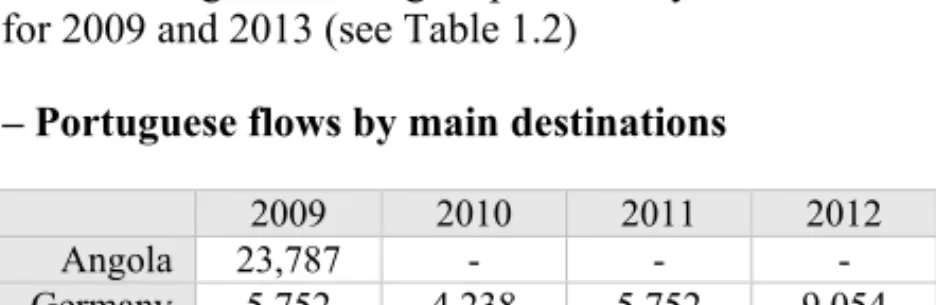
Data for the Portuguese in Angola provided by countries of destination exist only for 2009 and 2013 (see Table 1.2)
Table 1.2 – Portuguese flows by main destinations
2009 2010 2011 2012 2013 Angola 23,787 - - - 4,651 Germany 5,752 4,238 5,752 9,054 11,401 Brazil 708 798 1,564 2,247 2,913 Spain 9,739 7,678 7,424 6,201 5,302 Luxembourg 3,844 3,845 4,977 5,193 4,509 United Kingdom 12,230 12,080 16,350 20,443 30,121 Switzerland 13,601 12,720 11,972 14,388 20,039 France - - - 18,000 -
Source: Center for emigration - accessed 06/05/2015
Note: Compilation of data from national statistical institutes in the destination countries http://www.observatorioemigracao.secomunidades.pt, accessed 06/05/2015).
The number Portuguese leaving for Angola can be estimated by two other indicators: indirect data such as remittances and consular records. The most recent census data (2014) do not include information on foreign residents in Angola, meaning that the most recent data come from 1975. It is thus very difficult to estimate the number of Portuguese working in Angola. Also confounded are analyses of variables such as gender, age, and area of employment.
Consular data provide a better opportunity, however. It has been used figures from the Direcção Geral dos Assuntos Consulares e das Comunidades Portuguesas of Portuguese citizens registered with the consular office in Angola; note, however, that this registration is not mandatory. In 2008 there were 72,706 Portuguese citizens registered, and in 2013 the number had risen to 126,356 (Pires et al. 2014). Another indicator that points to a sharp rise of Portuguese migrants in Angola is the rising amount of remittances from Angola to Portugal in recent years. According to information from the World Bank, from 2009 to 2013 these remittances grew by 200%, from 103,126,000 € to 304,328,000 €. As a result of the drop in the price of oil, remittances have fallen since March 2014, but have shown signs of a rebound during the last three months. In February 2015 the volume of remittances from Angola to Portugal was above the figure for September 2014 (Banco de Portugal 2015).
Chapter One 12
Socioeconomic features of the migration flows
Contemporary Portuguese migration is dominated by young men who are well educated. In the past the typical Portuguese emigrant was a young adult, coming from a rural area, without specialized skills, and illiterate (Pires 2010). According to Portuguese National Statistics Institute (INE, Instituto Nacional de Estatística) data, however, for the years 2008 and 2010 the profile of the Portuguese emigrant has changed in the direction of greater qualifications, and already in the year 2000 13% of the Portuguese job-seeking emigrants possessed a higher-education degree (Pires 2010; Peixoto 2004).
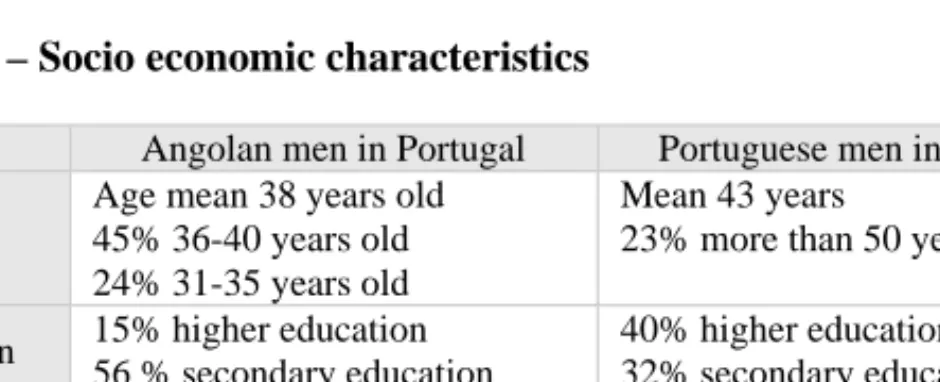
Data from the survey questionnaires6 in our project confirm this trend,
as well (see Table 1.3): Portuguese men in Angola are mainly adults more than 36 years old, having a more or less homogeneous distribution, with 26.3% 36-40 years old; 21% 41-45 years old; 10% 46-50 years old; and 25.3% over 50 years old. Most of them are educated (secondary school diploma (32%) or higher education—Bachelor Degree, or Master (39%), compared to Angolan men in Portugal (secondary school diploma (56%) or Elementary education (29%). According to their education level, most of the Portuguese men in Angola occupy jobs that require higher education levels, such as senior officials and managers (12%), Professionals (30%), and Technicians and associate professionals (27%). In contrast, most Angolan men in Portugal occupy jobs that require lower levels of education, such as craft and related trades workers (58%). It must be highlighted that 23% of Angolan men are Professionals (14%) and Technicians and associate professionals (9%). These are the ones having higher and secondary education. A cross-table analysis between education and professional background reveals that only 65% of Angolan men in Portugal are economically active, and many of them are unemployed (29%).
6 Questionnaire responses were statistically analyzed in two ways: univariate
descriptive statistics, by purifying frequencies; modeling to compare variable pairs, in order to detect differences that are statistically significant. The result of this test (the X-squared) is presented only when robust, namely when the expected frequencies are greater than 1 and no more than 20% of the expected frequencies are less than 5. When these conditions are not met, they show only trends and never of statistical significance.
Transnationalism and Conjugality. The Angola/Portugal Case 13
Table 1.3 – Socio economic characteristics
Angolan men in Portugal Portuguese men in Angola Age
Age mean 38 years old 45% 36-40 years old 24% 31-35 years old
Mean 43 years
23% more than 50 years old
Education 15% higher education 56 % secondary education 29% elementary education 40% higher education 32% secondary education Professional background
58% craft and related trades workers
14% professionals
30% professionals
29% techinicans and associate professionals
23% craft and related trades workers
Source: Grassi (2015) Research project “Places and belongings: Conjugality between Angola and Portugal”(PTDC/AFR/119149/2010), ICS-ULisboa
Family situation
Our project’s target group is men in a transnational conjugal relationship whose partner has remained behind in the country of origin. Conjugal relationships at a distance–when the cause of separation is migration–demand a redefinition of the roles of the couple and of the family. The impact on these relationships largely depends on a number of specific circumstances including social position, existence (or not) of children, the reason(s) underlying the migration, and the adaptive abilities of the individuals involved. Many authors who see migration as a threat to the destination country also see marriage and migration as arrangements of convenience, forced marriage, or traficking. Others are more inclusive (Williams 2010; Bryceson and Vuorela 2002; Levin 2004; Levin and Trost 1999; Boyd and Grieco 2003; Mahler and Pessar 2006; Wilding 2006), and address the challenges and stereotypes of transnational marriage, describing the ways that couples (re)define their roles, relationships, and family life; as they learn and live side-by-side (Pribilsky 2004).
The unit of analysis of aggregate family, which is most commonly used for capturing information about the individual and the people with whom (s)he lives, was replaced in our study by a broader concept, the aggregate of residents, allowing us to include not only family members, but also persons close to them and who reside with them (Grassi 2009).
Before migrating, most of those responding to our questionnaire had lived with their partner and children (62%) or with their partner only (22%). Following their migration about 41% of respondents lived alone or
Chapter One 14
with work colleagues (43%). About 8% of respondents lived with a new partner following migration.
Migration path
The paths of migration to and from Portugal have been studied by many authors since the Second World War, including flows between Portugal and its former colonies (e.g., Peixoto 2009; Machado 2009: Grassi 2009, 2010, 2012; Pires 2003; Malheiros 2010, among others). The recent wave of migration from Portugal, which is primarily driven by the economic crisis in Europe, includes a flood of highly-educated youth examined in our study. Most of those studying migrations to and from Portugal have focused on international flows in recent years. Note that even though most Portuguese migrants are bound for European destinations, there is a marked increase in the number of Portuguese emigrants headed for Portuguese-speaking countries in Africa (Malheiros 2011; Peixoto 2012; Ferreira and Grassi 2012). The principal destinations in that continent are Angola (in fifth place as a country of destination) and Mozambique (in seventh place) (Pires et al. 2014, 17). According to estimates of the United Nations and the World Bank, between 2,000,000 and 2,300,000 Portuguese are living abroad–a number that is 20% of the country’s population.
Although migration flows from Angola to Portugal are traditionally older, most Angolan men arrived in Portugal less than 10 years ago. Figure 1.1 illustrates the migration years of our respondents. Portuguese migration in Angola is more recent, in which 69% have been in Angola for 1-5 years.
Regarding the reasons for migrating, as you can see below, most respondents indicated that they went for economic reasons (50%) and for career oportunity (40%).
The existence of family and friends in the destination country is a constant factor in the case of both countries. Interpersonal reasons outweigh historical circumstances, which vary from one era to another. The colonial period, for example, was very complex and the social issues related to colonizer/colonized, economic superiority, and political supremacy were of great importance. For this reason and in light of the current fow from Portugal to Angola, looking to economic migration between these two countries, it forces us to rethink the concept of north-south development. There remains an apparently favorable and permanent relationship between Portugal and Angola that continues to shape the population flows between. Data from our questionnaires confirm
Tra considerable countries, in migrated an networks ar demonstrate it is often th because of earlier empl Figure 1.1 – T Source: Gras between Ang Compara (46%) in P difference c Angola to P Portugal. On to Portugue explain that had friends/c ansnationalism e strength in n which 23% a nd 73% had fr re also power ed in our samp he case that Po a job oportun oyers. Time of Migrat ssi (2015) Res ola and Portuga atively, Ango Portugal and
an be explain Portugal is an n the other han ese men in A t most Portug colleagues the and Conjugalit the family an already had fa iends or work rful determina ple of respond ortuguese who nity arranged ion search project al”(PTDC/AFR olan men hav a lower pe ned on the one
n older one, a nd, the fact th Angola, workin
guese men tha ere.
ty. The Angola/
nd friendship amily member k colleagues ( ants in the d dent. As revea o are currently by earlier w “Places and R/119149/2010) ve a higher p ercentage of e hand by the
and most Ang hat the survey
ng in a Portu at have migra /Portugal Case ties between rs in Angola w see Figure 1.2 decision to mi aled in our in y in Angola w work colleague belongings: C ), ICS-ULisboa percentage of friends (50% fact that the f golans have in Angola wa uguese enterp ated to Angol 15 n the two when they 2). Social igrate, as nterviews, went there es and/or Conjugality f relatives %). This flow from family in as applied prise, can a already
16 Figure 1.2. – Source: Gras between Ang The deci half of the reported tha decision ma (35%). Half alone indica or for othe “conditions” inadequate t Approxim family (par respondents Regardin important to society. Th reasons, as mention har of destinatio living far geographic/p some respon Social Network ssi (2015) Re ola and Portuga ision to migra
cases, with o at the migratio ade alone occu f of the respon ated that it wa er reasons, a ” for the fam to accommoda mately 69% rtner/children) considered th ng the condi o consider the he migrants— is the case rdships and re on. Principal from their physical separ ndents point Chapter ks esearch project al”(PTDC/AFR ate was made j only 20% ma on was impos urred mostly w ndents who m as due to scho among which mily, i.e., be ate the childre
of the respon ) in Angola he migration to itions and ad e forms of inte —especially th of those con estrictions that among these children (66 ration from th out “other” d r One t “Places and R/119149/2010) jointly with th aking the deci sed on them b with regard to mentioned hav oling for their h the most c ecause the h en and partner ndents had no , confirming o be a tempor daptation to egration/inclu hose who m nsidered at th t they must ov e for the Port 6%) and par heir nuclear fa difficulties in belongings: C ), ICS-ULisboa he partner in m ision alone, w by their emplo o a temporary ving made the r child/childre common was home was co r. o plans to rej g the belief rary event. the destinati usion in the de migrated for e he moment— vercome in th tuguese in An rtner (69%) amily. In the in adapting to t Conjugality more than while 6% oyer. The y situation e decision en (29%), lack of onsidered join their that the ion, it is estination economic —routinely e country ngola are and the nterviews their new