Universidade de Aveiro
2016
Departamento de Ciências Sociais, Políticas e do Território
Koulutuksen tutkimuslaitos
Finnish Institute for Educational Research
Sara Margarida
Alpendre Diogo
CHANGES IN FINNISH AND PORTUGUESE HIGHER
EDUCATION GOVERNANCE: COMPARING
RESPONSES TO THE BOLOGNA PROCESS AND NEW
PUBLIC MANAGEMENT
MUDANÇAS NA GOVERNAÇÃO DO ENSINO
SUPERIOR FINLANDÊS E PORTUGUÊS:
COMPARAÇÃO CENTRADA NO PROCESSO DE
BOLONHA E NOVA GESTÃO PÚBLICA
MUUTOKSIA SUOMALAISEN JA PORTUGALILAISEN
KORKEAKOULUTUKSEN HALLINNOSSA JA
JOHTAMISESSA: VERTAILEVA TUTKIMUS
BOLOGNAN PROSESSIA JA UUTTA
Universidade de Aveiro
2016
Departamento de Ciências Sociais, Políticas e do Território
Koulutuksen tutkimuslaitos
Finnish Institute for Educational Research
Sara Margarida
Alpendre Diogo
CHANGES IN FINNISH AND PORTUGUESE HIGHER
EDUCATION GOVERNANCE: COMPARING
NATIONAL AND INSTITUTIONAL RESPONSES TO
THE BOLOGNA PROCESS AND NEW PUBLIC
MANAGEMENT
MUDANÇAS NA GOVERNAÇÃO DO ENSINO
SUPERIOR FINLANDÊS E PORTUGUÊS:
COMPARAÇÃO DAS RESPOSTAS NACIONAIS E
INSTITUCIONAIS AO PROCESSO DE BOLONHA E
NOVA GESTÃO PÚBLICA
Tese apresentada à Universidade de Aveiro para cumprimento dos requisitos necessários à obtenção do grau em regime de cotutela de Doutor em Estudos de Ensino Superior, realizada sob a orientação científica do Doutor Alberto Amaral, Professor Emérito da Universidade do Porto e Director da Agência de Avaliação e Acreditação do Ensino Superior, da Doutora Teresa Carvalho, Professora Auxiliar do Departamento de Ciências Sociais, Políticas e do Território da Universidade de Aveiro e do Doutor Jussi Välimaa, Professor Catedrático e Investigador no Finnish Institute for Educational Research da Universidade de Jyväskylä, Finlândia.
Financial support by QREN - POPH Programme - Typology 4.1 - Advanced Training, funded by the European Social Fund and FCT [grant number SFRH/BD/62793/2009].
Apoio financeiro através do Programa QREN POPH -Tipologia 4.1 - Formação
Avançada, comparticipado pelo Fundo Social Europeu e pela FCT [referência
For my Mum and Dad. They gave me unconditioned love and taught me the sense of duty as well as to always find the reasons and motivations to keep working hard. They are the examples that I can only aim at never disappoint. I cannot remember a time that they did not allow me to pursue my dreams, or to incentive me to be whatever I would like to be. They were always there, more interested in listening me than I was to talk with them. It was naturally my loss. When I needed most, when I doubted of why I would be doing something like this. When I even doubt about myself. They keep reminding me, embraced me in silence, sooth me and enlighten my days and soul, especially when they were completely upside down.
And for my sister. Because besides being an example of doggedness, at some point during this journey she offered me the best gift I could ever dream of: my precious niece, Diana.
Para os meus Pais. Deram-me amor incondicional e ensinaram-me o sentido de responsabilidade bem como a encontrar sempre motivações para trabalhar arduamente. São os exemplos que espero nunca vir a desapontar. Não existiu nenhum momento em que eles não me tivessem incentivado a seguir os meus sonhos e ambições. Estiveram sempre lá. Mais interessados em me ouvir do que eu em escutá-los. A perda foi, naturalmente, minha... Quando mais precisei, quando duvidei sobre tantos porquês e me esqueci das razões pelas quais estava a fazer isto. Quando duvidei de mim própria. Eles continuaram a lembrar-me, abraçaram-me silenciosamente, acalmando-me e iluminado aqueles dias especialmente difíceis. Obrigada.
E para a minha irmã. Porque, para além de ser um exemplo de persistência, a determinada altura desta jornada ofereceu-me o melhor presente que poderia imaginar: a minha sobrinha, Diana.
o júri
presidente Prof. Doutor Jorge Ribeiro Frade
professor catedrático, Departamento de Engenharia de Materiais e Cerâmica, Universidade de Aveiro
Prof. Doutor Guy Richard Neave professor emérito, Universidade de Twente
Prof. Doutor Jussi Välimaa
professor catedrático, Finnish Institute for Educational Research, Universidade de Jyväskylä (coorientador)
Prof. Doutor António Manuela Magalhães Evangelista de Sousa professor associado, Faculdade de Psicologia e de Ciências da Educação, Universidade do Porto
Prof. Doutor Pedro Nuno de Freitas Lopes Teixeira professor associado, Faculdade de Economia, Universidade do Porto
Prof. Doutora Ana Maria Magalhães Teixeira de Seixas
Professora auxiliar, Faculdade de Psicologia e de Ciências da Educação, Universidade de Coimbra
Prof. Doutor Carlos José de Oliveira e Silva Rodrigues
professor auxiliar, Departamento de Ciências Sociais, Políticas e do Território, Universidade de Aveiro
Prof. Doutora Maria Teresa Geraldo Carvalho
professora auxiliar, Departamento de Ciências Sociais, Políticas e do Território, Universidade de Aveiro (orientadora)
acknowledgments “It is good to have an end to journey toward; but it is the journey that matters, in the
end” (Ursula K. Le Guin). And this journey would not be possible without the people to whom I have a priceless gratitude debt…
First and foremost, I would like to thank to my supervisors. It cannot be put in words the privilege I feel to be guided by the best people in Portugal and in Finland and to be able to conduct this research in both countries, under their wisdom, counselling and intellectual stimuli. Without their help, it would not have been possible to pursue my dreams of conducting international research and my doctoral studies in Finland. Since the very beginning of this journey, I had the privilege to have the support, help, time and constructive advice of Professor Dr. Alberto Amaral. It has been a truly enriching experience that made me grown in interest and knowledge on higher education policies. Furthermore, the extensive list of Portuguese key contributors interviewed was only possible thanks to his help. I am mostly indebted to Professor Dr. Teresa Carvalho. For her friendship, guidance, invaluable support, trust and attention in those moments when I need that lever to go on with the writing process and to focus on the core research object. I am glad to have shared this journey with her and to have been inspired by her work and her strength. Her role in this research went much beyond as that of a supervisor, and I can only hope for more comparative studies to come! I have a lifetime mortgage to Professor Dr. Jussi Välimaa. I own him my passion for Finland, my Finnishness and the interest to ground facts on cultural and historic developments. He also had a profound impact on my motivation and willingness to explore, try and apply different perspectives to the same subject. During our conversions, not only I had the privilege to get to know and chose the most suitable interviewees for this study, to improve my dissertation, but also to understood Finnish culture and Finnish higher education in an enthusiastic and humoured way. Thank you for the paths showed and alternatives provided, for listening me and for all your help and advice. Despite being in a foreign country, apparently so different from Portugal, I have felt at home in my Finnish working place. In Jyväskylä, Opinkivi (where the Finnish Institute for Educational Research is settled) was my second home. With this, I would like to extent my acknowledgments list to the people working there, especially to the research group of Jussi, and to all the people I had the privilege to meet during my stay there. Thank you David Hoffman, Jani Ursin and Terhi Nokkala for all the interesting discussions, suggestions, critics and contributions to my development as a researcher.
To Professor Dr. Rui Santiago. For being such a wonderful and inspiring person and a great Professor who always shared his wisdom and advise. For always sweetening the CIPES office in Aveiro with candies and food for thought. Thank you for all your support! A warm acknowledgement to Sofia Brückmann, MJ Manatos and Kata K. for being the best PhD office mates! The development of the case studies presented here could not be possible without the cooperation, friendship, help, kindness, of a large number of people. I need to acknowledge those academic and administrative staff of the University of Jyväskylä and the University of Aveiro who made the academic and bureaucratic journey possible.
My sincere gratitude to Dr. Rui Martins, my ophthalmologist, and her wife Dr. Lurdes Martins.
To my dear Masa and his amazing family: thank you to your love. To my beloved chosen family in Portugal, Finland and a bit all over the world. My dearest friends from the HEEM programme – the saga goes on. To Joana, because you have been there since I remember to be a human being. Isa, Ina, João, Kelita, Cátia, Sónia, Dora, the super girls, Nuno, Vasco, Matti, Jaakko and Noora, Lease and Charles, Steph - the best roomie I could ever had! To Ana Maria and her family. Among many things, thank you all for your patience and time for me. For your words and shoulders. Thank you for being the family I chose, and for years now, with whom I share a large set of great moments and memories, and the certainty that many more are yet to come. The deepest, warmest and biggest acknowledgement to my parents and sister. For everything.
palavras-chave
resumo
Ensino Superior Português, Ensino Superior Finlandês, Mudança Insitutucional, Implementação política, Governação, Nova Gestão Pública, Processo de Bolonha.
Esta dissertação compara as mudanças governamentais e políticas nos sistemas de ensino superior (ES) português e finlandês, que emergem de pressões externas similares. Exemplos destas pressões externas são o processo de Bolonha e as manifestações legislativas mais recentes da Nova Gestão Pública (NGP), nomeadamente o novo regime jurídico das instituições de ensino superior (IES) portuguesas (RJIES) e finlandesas (Novo Acto Universitário), visando alterar não só as estruturas de governação institucional, como também as práticas de tomada de decisão.O estudo fornece uma descrição histórica e cultural abrangente dos sistemas de ES português e finlandês, a fim de dar a conhecer a forma como os governos destes países e as suas IES reagem a movimentos de mudança similares. Embora Portugal e Finlândia difiram significativamente em termos geográficos, históricos, culturais e económicos, ambos os países empreenderam recentemente reformas legislativas semelhantes nos seus sistemas de ES, tornando esta comparação relevante no âmbito das políticas de ES. Além disso, apesar de divergirem na sua natureza, carácter, objectivos e nível de aplicação, estas políticas foram implementadas simultaneamente, com o objectivo de melhorar a eficiência e qualidade do desempenho institucional, bem como a visibilidade e competição nacional. Argumenta-se que a crescente internacionalização do ES, a política de soft law da União Europeia (UE) bem como a ideologia managerialista – também disseminada por relatórios e discursos de organizações internacionais como a Organização para a Cooperação e Desenvolvimento Económico (OCDE) e a UE oferecem explicações para semelhanças em contextos nacionais. No entanto, as especificidades históricas e culturais, e as características estruturais destes sistemas político-administrativos explicam as diferenças nos processos de implementação de políticas e, consequentemente, nos resultados obtidos a nível nacional.
Juntamente com uma vasta análise documental, o estudo é baseado na análise qualitativa estratégica e é suportado empiricamente por 61 entrevistas semiestruturadas a actores-chave, a nível sistémico e institucional, em ambos os países, e em ambos os tipos de instituições de ES realizadas durante os anos de 2011e 2012. Estes actores foram escolhidos devido às suas funções e grau de envolvimento no objecto de estudo: as últimas reformas de governação das IES impulsionadas pela Yliopistolaki 558/2009, pela Lei 62/2007 e pelo processo de Bolonha. Assim, os resultados aqui apresentados espelham as vozes dos praticantes que se envolveram nessas reformas, tanto ao nível do sistema quanto ao nível institucional. Resumidamente, é possível observar que, frequentemente, a aplicação da legislação nacional em IES é alcançada através de processos top-down (principalmente no caso Português) e um misto de estratégias bottom-up e top-down (mais na Finlândia). Estas estratégias visam alterar a estrutura organizacional das instituições, os órgãos de governação, os processos de tomada de decisão e as condições de trabalho dos profissionais académicos. O estudo revela que actores dentro do mesmo grupo de funções tendem a ter opiniões semelhantes em Portugal e na Finlândia, o que significa que independentemente da nacionalidade, as percepções convergem de acordo
keywords Portuguese higher education, Finnish higher education, Institutional change, Policy implementation, Governance, New Public Management, Bologna process.
abstract This research compares governmental and political changes in Portuguese and Finnish higher education (HE) systems, emerging from similar external pressures. Examples of these external pressures are the Bologna process and the recent legislative expressions of New Public Management (NPM), including the new legal framework for Portuguese (RJIES) and Finnish (New University Act) higher education institutions (HEIs) which aims at changing not only institutional governance structures but also institutions’ management and decision-making practices. The study provides a comprehensive historical and cultural description of the Portuguese and Finnish HE systems in order to build a framework for the advancement of knowledge on how Finnish and Portuguese governments and their HEIs react towards similar movements of change. Although Portugal and Finland differ significantly in their geography, history, culture, and economic status, both countries undertook similar HE legislative reforms, making the comparison focused and relevant for the study field of HE policy. Moreover, albeit different in character, goals and enforcement level, the policies were implemented concurrently, and both intend to improve efficiency and quality of institutional performance and to enhance national visibility and competition. It is argued that the incremental internationalisation of HE, the European Union (EU) soft law, as well as the NPM ideology – also disseminated by reviews and discourses of international organisations like the Organisation for Cooperation and Economic Development (OECD) and the EU offer an explanation for similarities in national contexts. Nevertheless, historical and cultural specifics and structural characteristics of political-administrative systems are considered explanatory factors for differences in policy implementation processes and therefore in national outcomes.
Together with document analysis, the study is based on qualitative analysis and finds empirical evidence on 61 semi-structured interviews to key actors of system and institutional levels in both countries and in both types of HEIs conducted during the years 2011 and 2012. These actors were chosen due to their roles and degree of involvement in the study object: the latest institutional governance reforms driven by the Yliopistolaki 558/2009 and the Law 62/2007. Thus, the findings presented here rely much on the voices of the practioners who engaged in these reforms, both at the system and institutional levels.
Briefly, it is possible to observe that frequently, the application of national legislation in HEIs is achieved through top-down processes (mainly in the Portuguese case) and a mix between top-down and bottom-up strategies (more in Finland). These strategies aim at changing institutions’ organisational structure, their governance bodies, decision-making processes and professionals working conditions. This study shows that the same group of actors tend to have similar opinions both in Portugal and in Finland, which means that regardless nationality, perceptions converge according interviewees’ roles.
asiasanat Portugalin korkeakoulutus, Suomen korkeakoulutus, institutionaalinen muutos, politiikan toimeenpano, hallinnoiminen,uusi julkishallinto, Bolognan prosessi
abstrakti Tässä tutkimuksessa verrataan hallinnollisia ja poliittisia muutoksia Portugalin ja Suomen korkeakoulujärjestelmissä, joihin molempiin on kohdistunut samankaltaisia ulkoisia paineita. Esimerkkejä näistä ulkoisista paineista ovat Bolognan prosessi ja viimeaikaiset New Public Managementin (NPM, uuden julkishallinnon) inspiroimat lakitekstit. Näitä ovat Portugalissa säädetty korkeakoulujen uusi juridinen viitekehys (RJIES) ja Suomessa vuoden 2009 yliopistolaki, joilla kummallakin pyritään muutamaan sekä yliopistojen hallinnon rakenteita että johtamisen ja päätöksenteon käytänteitä. Tutkimuksessa luodaan kokonaisvaltainen historiallis-kulttuurinen kuvaus Portugalin ja Suomen korkeakoulujärjestelmistä, jotta voitaisiin rakentaa viitekehys, jolla edistetään tietoa siitä, miten Suomen ja Portugalin hallitukset ja maiden korkeakoulut reagoivat samanlaisiin muutoksen suuntiin.
Siitä huolimatta, että Portugali ja Suomi eroavat merkittävästi toisistaan sekä maantieteen, historian, kulttuurin että taloudellisen asemansa suhteen, molemmissa maissa tehtiin samankaltaisia korkeakoululainsäädännön muutoksia. Tämä auttaa vertailuaseman fokusointia ja tekee tutkimuksesta relevantin korkeakoulupolitiikan tutkimuksen kentällä. Tämän lisäksi politiikat toimeenpantiin samaan aikaan, vaikkakin ne olivat erilaisia luonteeltaan, päämääriltään ja toimeenpanon voimakkuudeltaan. Molemmissa maissa pyrittiin kuitenkin parantamaan korkeakoulujen suorityskyvyn laatua ja tehoa sekä edistämään kansallista näkyvyyttä ja kansainvälistä kilpailukykyä. Kansallisten kontekstien samankaltaisuutta on selitetty lisääntyvällä korkeakolutuksen kansainvälistymisellä, Euroopan unionin (EU) pehmeällä lailla (soft law) sekä NPM:n ideologialla, jota ovat levittäneet sekä arvioinnit että kansainvälisten organisaatioiden kuten OECD:n ja EU:n diskurssit. Tästä huolimatta historiallisia ja kulttuurisia erityispiirteitä sekä poliittis-hallinnollisten järjestelmien rakenteellisia ominaisuuksia voi käyttää eroja selittävinä tekijöinä politiikan toimeenpanossa ja siksi kansallisissa tuloksissa.
Tutkimus perustuu dokumenttien analyysin ohella strategiseen laadulliseen analyysiin ja se tukeutuu empiirisiseen tutkimusaineistoon, joka koostuu 61:stä puolistrukturoidusta teemahaastattelusta, joissa haastateltiin järjestelmä- ja korkeakoulutason keskeisiä toimijoita sekä yliopistoissa että ammattikorkeakouluissa molemmissa maissa vuosina 2011 ja 2012. Haastateltavat henkilöt valittiin ottaen huomioon sekä heidän roolinsa että sitoutumisensa tutkimuskohteeseen, eli Suomessa yliopistolain (558/2009) ja Portugalissa (lain 62/2007) tuomiin korkeakoulujen hallinnon ja johtamisen muutoksiin. Tästä syystä tutkimuksessa saadut tulokset perustuvat paljolti näihin lakiuudistuksiin järjestelmän ja korkeakoulujen tasolla sitoutuneiden käytännön toimijoiden käsityksiin.
Tiivistetysti sanoen voidaan havaita, että usein kansallisten lakimuutosten soveltaminen korkeakouluissa pannaan toimeen ylhäältä alaspäin suuntautuvana prosessina (pääasiassa Portugalin tapauksessa) ja ylhäältä-alaspäin ja alhaalta-ylöspäin toimeenpanostrategian yhdistelmänä (enemmän Suomen tapauksessa). Näiden strategioiden tavoitteena on muuttaa korkeakoulujen organisaatiorakenteita, niiden hallinto- ja päätöksentekotoimielimiä, päätöksenteon prosesseja ja korkeakoulun työntekijöiden työehtoja. Tutkimus osoittaa, että samoilla toimijaryhmillä on taipumus jakaa samankaltaiset mielipiteet sekä Portugalissa että Suomessa. Tämä tarkoittaa sitä, että käsitykset riippuvat enemmänkin haastateltavien
List of Abbreviations
APESP - Portuguese Association of Private HE
ARENE - Rectors Conference of Finnish Polytechnics/Universities of Applied Sciences A3ES - Agency for Assessment and Accreditation of HE
BFUG - Bologna Follow-Up Group
CCISP - Coordinating Council of the Portuguese Polytechnic Institutes CHEPS - Centre for Higher Education and Policy Studies
CIMO - Centre for International Mobility
CIPES - Centre for Research in HE Policies CNAVES - National Council for Evaluation of HE CRE - Conference of European Rectors
CRUE - Confederation of European Union Rectors’ Conference CRUP - Council of Rectors of Portuguese Universities
DEG - Digital Era Governance DGES - General Directorate of HE
EAIE - European Association for International Education EC - European Commission
ECTS - European Credit Transfer System
ECVET - European Credit System for Vocational Education and Training EFSM - European Financial Stabilisation Mechanism
EHEA - European HE Area
ENQA - European Network of Quality Assurance in HE EQF - European Qualifications Framework
ERA - European Research Area
ESG - European Standards and Guidelines for Quality Assurance ESIB - National Unions of Students in Europe
EU - European Union
EUA - European University Association
EURASHE - European Association of Institutions in HE ESU - European Students’ Union
FCUR - Finnish Council of University Rectors FCT - Foundation for Science and Technology
FINHEEC - Finnish HE Evaluation Council
FU - Unions of Professors, Lecturers & other employers GATS - General Agreement on Trade in Services
GC - General Council
GPEARI - Office for Planning, Strategy, Evaluation and International Relations) HE - HE
HEIs - Higher Education Institutions IMF - International Monetary Fund
KOTA - A Statistical Database Maintained by the Finnish Ministry of Education Containing Data on Universities
LLL - Life Long Learning
MCTES - Ministry for Science, Technology and HE MEC - (Finnish) Ministry of Education and Culture NPM - New Public Management
NPS - New Public Service
OECD - Organisation for the Economic Cooperation and Development OMC - Open Method of Coordination
OKM - Finnish Ministry of Education and Culture PISA - Programme of Student International Assessment PMES - Portuguese Ministry of Education and Science QA - Quality Assurance
RJIES - New Legal Framework for HE Institutions [Regime Jurídico das Instituições de Ensino Superior]
SFSF - Security Financial Stabilisation Fund SNESup - National Union of Higher Education SYL - National Union of Students in Finland
UNESCO - United Nations Educational, Scientific, and Cultural Organisation UNIFI - Finnish Council of University Rectors
WB - World Bank
Table of Contents
List of Abbreviations ... x
Table of Contents ... 1
Introduction ... 6
Background and Research Interest ... 9
Research Problem and Research Questions ... 11
Research Approach – Why to Compare? ... 12
Relevance to Research and Practice ... 15
Structure of the Study ... 16
Part I - Steps towards a Conceptual and Theoretical Framework: interconnectedness of concepts and ideologies ... 17
I Globalisation, Internationalisation and Europeanisation of HE ... 18
1.1 Europeanisation and European Integration ... 26
1.2 Convergence in Higher Education Policy ... 31
1.3 Higher Education Policy in Europe ... 33
1.4 The Bologna Process: origins and developments ... 38
1.4.1 The Bologna Process and the Lisbon Educational Strategy ... 46
1.5 The Open Method of Coordination as a Governance Tool ... 49
II Governing in a Governance Change Environment ... 55
2. The Meaningfulness of the Governance Concept ... 55
2.1 The Traditional Role of the State in the Public Sector ... 61
2.2 The Rise of a New Ideology ... 68
2.3 The Managerial State ... 74
2.4 The First Wave of Reforms: Managerialism as an Ideology... 76
2.5 The Second Wave of Reforms: from Ideology to Pragmatism ... 80
2.6 From Government to Governance – the Evaluative State: broad trends affecting HE ... 89
2.7 Shifts in European HE Governance: a new context for universities ... 95
2.8 Modes of Governance ... 104
2.8.1 The Sovereign, Rationality-Bounded State Model ... 109
2.8.2 The Institutional State Model ... 110
2.8.3 The Corporate-pluralistic State Model ... 111
2.8.4 The Supermarket State Model ... 112
2.9 The Bologna Process and the NPM: Linking a Blurring Boundary ... 115
III Making Sense of Organisational Change ... 121
3.1 Policy Change and Policy Diffusion ... 121
3.2 Institutionalism and Organisational Change ... 128
3.3. The New Institutionalism ... 135
3.3.1 The Three Approaches to New-Institutionalism ... 138
Historical Institutionalism ... 139
Sociological institutionalism... 144
3.4 Institutional Change and Isomorphism ... 151
3.5 Location of the Study ... 157
3.6 The nature of HEIs as important factors in organisational change ... 160
To sum up… ... 164
Part II - The Diversity of the Research Contexts. Methodology. ... 167
IV The National Contexts: Finland and Portugal ... 168
4.1 Overview of the Portuguese and Finnish HE Systems ... 168
4.2 Origins and Development of the Portuguese University System ... 177
4.2.1 International Organisations in the Portuguese HE system ... 182
4.3 Institutional Autonomy ... 186
4.4 Origins and Developments of the Finnish University System ... 188
4.4.1 The support of International Organisations in the Finnish HE system ... 199
4.5 Diversification of the system: creation and development of the vocational sector in Portugal .... 200
4.6 Diversification of the System: creation and development of the vocational sector in Finland ... 211
4.7 Institutional Governance, Management, Ownership and Decision-Making of Finnish Polytechnics ... 216
4.8 NPM in the Portuguese HE ... 220
4.9 NPM in the Finnish HE landscape ... 226
V Methodology and Operationalisation ... 236
5.1 Research Design – The Methodological Process ... 239
5.1.1 (Individual) Case Studies ... 240
5.2 Rationale for a comparative research approach – Why to compare ... 243
5.2.1 Countries Selection – Why Portugal and Finland? ... 247
5.2.2 The Selection of HEIs ... 249
5.3 Period Studied and Scope of Analysis ... 250
5.4 Data Collection... 252
5.4.1 Document Analysis and Literature Review ... 254
5.4.2 Interviews ... 255
5.5 Content Analysis Categories ... 262
Part III - Data Presentation and Comparative Analysis. ... 267
VI National and Institutional Reforms ... 268
I DIMENSION - National Reforms (with)in an International Landscape: Change at the System Level - State Regulation ... 269
1. Internationalisation at Home: implementing the Bologna Process in Portugal and in Finland ... 269
1.1 Political organisation of the Bologna process in Portugal – Context, Processes and Mechanisms of Policy Implementation ... 270
1.2 Political organisation of the Bologna process in Finland - Context, Processes and Mechanisms of Policy Implementation ... 279
2. Reforming at Home: Implementing the RJIES in Portugal and the New Universities Act in Finland ... 293
2.1 Implementing the Law 62/2007 (RJIES) in Portugal ... 293
2.2 Implementing the Yliopistolaki 558/2009 (New Universities Act) in Finland ... 304
To sum up… ... 312
II DIMENSION: Change at the Institutional Level - Institutionalisation of NPM ideology and practice. Stakeholder Guidance, Academic and Managerial Governance: Internal Governance ... 318
I Category – Structures and Processes: Institutionalisation of NPM ideology and practice ... 319
2.1 Transformations in the organisational structure - The Portuguese Case ... 319
2.1.1 Public Foundations Under Private Law ... 319
2.2 Transformations in the organisational structure - The Finnish Case ... 328
2.3 Changes in Portuguese Universities’ Governance Model... 329
2.3.1 (Re)composition of the Governing Bodies and Election - The Portuguese Case ... 334
2.4 Changes in Finnish Universities’ Governance Model ... 346
To sum up… ... 357
2.5 Academic Careers and Working Conditions ... 361
2.5.1 The Finnish Case ... 361
2.5.2 The Portuguese Case... 370
To sum up… ... 376
III DIMENSION ... 378
3.1 Significance attributed to the Bologna process and to the new legal framework for Portuguese and Finnish HEIs ... 378
3.2 Different Cultures + Same Roles = Different Perceptions? ... 385
VII Conclusions and Topics for a further Research Agenda ... 389
References ... 397
Annexes ... 437
List of Tables
TABLE 1 - DOCTRINAL COMPONENTS OF NPM ... 81TABLE 2 – OLSEN’S (1988) TYPOLOGY OF GOVERNANCE MODELS ... 113
TABLE 3 - MECHANISMS OF POLICY DIFFUSION ELABORATED BY SHIPAN AND VOLDEN (2008) ... 124
TABLE 4 - TYPOLOGY OF INSTITUTIONAL CHANGE: PROCESSES AND RESULTS ... 125
TABLE 5 - MAIN FEATURES OF THE THREE NEW INSTITUTIONALISTS APPROACHES ... 148
TABLE 6 - CATEGORISATION OF PORTUGUESE AND FINNISH HEIS ... 177
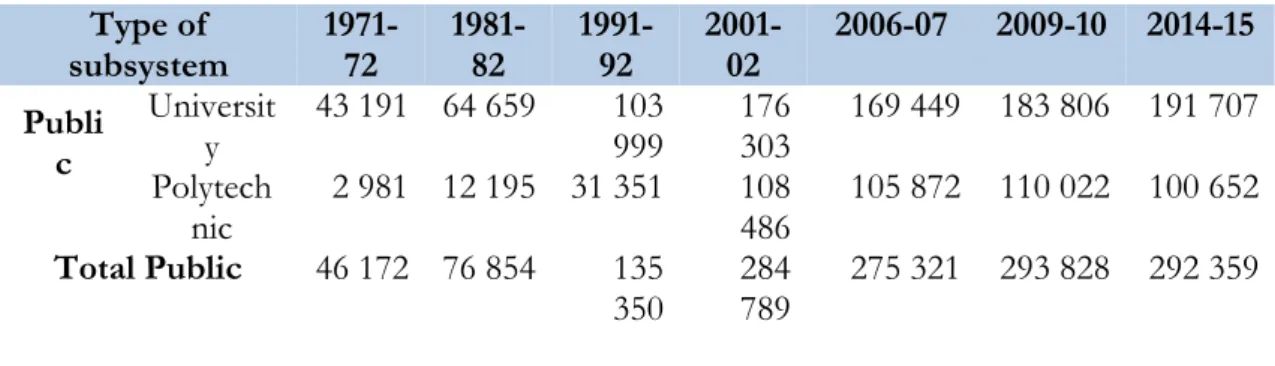
TABLE 7 - EVOLUTION OF ENROLMENTS BY TYPE OF SUBSYSTEM IN PORTUGUESE HE ... 184
TABLE 8 – NUMBER OF STUDENTS ATTENDING FINNISH HE FROM 2001 TO 2014 ... 191
TABLE 9 - SUMMARY OF FINNISH HE SYSTEM MOST IMPORTANT PERIODS .. 199
TABLE 10 - EVOLUTION OF THE NUMBER OF ACCESS VACANCIES AND NEW ENROLMENTS BY TYPE OF HE SUBSYSTEM ... 208 TABLE 11 - METHODOLOGICAL AND PRACTICAL ISSUES OF COMPARATIVE
RESEARCH ON HE ... 246 TABLE 12 - INTERVIEWED KEY ACTORS IN BOTH PORTUGUESE AND FINNISH
HE SYSTEMS AND INSTITUTIONS ... 256 TABLE 13 – INTERVIEWEES’ ANATOMY ... 259 TABLE 14 - DIFFERENCES BETWEEN DISCOURSE ANALYSIS AND
QUALITATIVE CONTENT ANALYSIS. ... 263 TABLE 15 - CONCEPTUAL AND DATA DRIVEN CONTENT ANALYSIS TABLE .. 265 TABLE 16 - CATEGORIES AND THEMES THAT BUILD UP THE SECOND
DIMENSION ... 318 TABLE 17 - GOVERNANCE BODIES OF PORTUGUESE PUBLIC HEIS BEFORE
AND AFTER LAW 62/2007 ... 336 TABLE 18 - GOVERNANCE BODIES OF FINNISH HEIS BEFORE AND AFTER
THE YLIOPISTOLAKI 558/2009 ... 348 TABLE 19 - CATEGORIES AND THEMES THAT BUILD UP THE THIRD
DIMENSION ... 378 TABLE 20 - THE MAIN DRIVERS OF CONVERGENCE AND DIVERGENCE IN
PORTUGUESE AND FINNISH HE SYSTEMS AND INSTITUTIONS ... 388
List of Figures
FIGURE 1 - DIFFERENT METAPHORS OF CHANGE IN HE POLICY: THE CASE OF THE BOLOGNA PROCESS. ... 126 FIGURE 2 – CONTINUUM OF INSTITUTIONAL BEHAVIOURAL IMPACT ... 150 FIGURE 3 - PATTERNS THAT CHARACTERISE INSTITUTIONS’ BEHAVIOUR IN
THE PROCESS OF EUROPEAN COLLABORATION ... 156 FIGURE 4 - GEOGRAPHICAL DISTRIBUTION OF THE PUBLIC AND PRIVATE
NETWORK OF PORTUGUESE HEIS ... 172 FIGURE 5 - EVOLUTION OF THE GEOGRAPHICAL DISTRIBUTION OF FINNISH
HEIS NETWORK ... 175 FIGURE 6 - STUDENTS ATTENDING HE 1920-2005 ... 190 FIGURE 7 – DISTRIBUTION OF PORTUGUESE STUDENTS’ PREFERENCES
ACCORDING TO THE TYPE OF SUBSYSTEM ... 205 TABLE 8 - FINNISH POLYTECHNIC APPLICANTS, ENTRANTS AND STUDENTS
1998-2008. ... 215 FIGURE 9 - POLYTECHNIC STUDENTS BY FIELD OF STUDY 2008 ... 216 FIGURE 10 - CASE STUDY: LAYERS OF POSSIBLE ANALYSIS ... 241 FIGURE 12 - POLITICAL ORGANISATION OF THE IMPLEMENTATION OF THE
BOLOGNA PROCESS IN FINLAND SOURCE ... 290 FIGURE 13 – TEMPORAL CONTEXT OF RJIES AND MAIN CHANGES BROUGHT
BY THE LAW 62/2007. ... 303 FIGURE 14 - TEMPORAL CONTEXT OF THE NEW UNIVERSITIES ACT AND
MAIN CHANGES BROUGHT BY THE LAW 558/2009. ... 311 FIGURE 15 - GOVERNANCE STRUCTURES OF PORTUGUESE AND FINNISH
UNIVERSITIES AFTER THE NEW LEGAL FRAMEWORK FOR HEIS ... 353 FIGURE 16 – FACTORS THAT INFLUENCE HIGHER EDUCATION REFORM ... 360 FIGURE 17 - DIFFERENT METAPHORS OF CHANGE IN HE POLICY: THE CASE
OF THE BOLOGNA PROCESS ACCORDING TO THE PERCEPTIONS OF FINNISH AND PORTUGUESE INTERVIEWEES ... 379
Introduction
Over the last decades, it has been widely acknowledged the growing importance of Higher Education (HE) on political agendas. Perhaps because no area of public policy has been subjected to such radical changes as HE (M. Kogan & Hanney, 2000). This needs to be understood bearing in mind not only social transformations resulting from the massification of HE, but also from new economic, regulatory and social pressures at the global level that have dictated a new era for HE systems, where policy design and implementation processes are no longer exclusively under nation-states’ responsibility. Generally speaking, one can say that governments have been losing their exclusivity in the design of educational policies, providing the redefinition of powers and responsibilities of different actors, and also due to the emergence of new levels of governance in this field.
Gradually, the dispersion of authority from the central government combined with a greater awareness of the need to interact with other societal actors (J. Kooiman, 2003) resulted in a reallocation of powers. Consequently, the old social contract between society and HEIs evolved to a redefinition of responsibilities and to the development of the notion of multi-level governance in the HE sector, a movement that cannot be separated from a general rebalancing of Europe’s political and economic institutional order (Olsen, 2005). This process is accompanied by an increasing awareness of the importance of knowledge in order to pursue economic development and competitiveness, as well as to improve populations’ wellbeing through social cohesion, cultural richness, critical reflection and technological progress. In this way, the integration of educational policies on the social and economic structures of modern societies and vice-versa raised the well-known buzzword of the knowledge society.
At the same time, European HEIs face pressures for reform in order to more efficiently and rapidly answer to the challenges posed by the environments surrounding them and to a better integration and interaction with society. The message entailed in the political and academic discourses is straightforward, especially for universities:
“Europe has to prioritize university modernization because her universities are lagging behind the best universities in the USA and because upcoming China and India will make competition among universities and economies even stiffer” (Olsen and Maassen 2007: 3).
Nevertheless, the solutions, visions and methods proposed to enhance European universities’ competitiveness and attraction vary according to the multiplicity of actors involved and the ideologies and interests they represent. In this sense, the “Europe of knowledge” idea, raised during the Lisbon Process in the year 2000 needs a new pact (Figel, 2006) or, as Olsen (2005a) refers, a deeper reflection upon the question “what kind of University for what kind of society” is needed.
The problem with such a seemingly simplistic approach lies on the fact that universities seem to be experiencing a loss of their cultural, ideological and political distinctiveness as exemplified in their rapidly changing codes of governance and management structures (Reed, Meek and Jones 2002: xx).
Although the HE sector has been undergoing reforms over the past fifty years, it is since the late 1990s that European HE changed significantly (Ferlie, Musselin, & Andresani, 2008), largely driven by the Bologna Declaration (1999), the European Union’s (EU) Lisbon Strategy (2000), and
changes created by the Lisbonisation of Bologna (Harmsen 2013), namely the emergence of the knowledge society and increased competitive pressures from globalisation and internationalisation of HE. In parallel, changes in HE should be contextualised with public sector reforms framed by neoliberalism. After all, both follow similar administrative practices, sponsored by the NPM ideology (Pollitt, Thiel and Homburg 2007). The ultimate objective is “(…) to reform the continent’s still fragmented HE systems into a more powerful and more integrated, knowledge-based economy” (CHEPS 2006: 9).
As societies grow in complexity – due to the growing fragmentation of political power, the preoccupation with efficiency as the major criteria for public action and concerns regarding financial constraints, etc. (Salamon 2002: 37) – governments have been “reinvented” and elaborated tools to deal with a multiplicity of scenarios. Thus, new governance approaches aim at governing problems of complex societies, in which attention has shifted “from hierarchic agencies to organisational networks” (ibid: 11). This shift makes necessary to study the (relative) and sometimes conflicting influence of NPM and network governance and their interplay in order to understand recent national HE reforms (Bleiklie and Michelsen 2012: 116).
Politically, the Bologna process represents the most far-reaching reform of HE and it traduces the growing geographical and political expansion of the EU. This is probably one of the main reasons explaining why the process has been given so much attention and importance. By involving 48 countries (plus the European Commission), willing to undertake a series of institutional reforms in the common ambition of increasing the competitiveness of their HE systems, the Bologna process also reflects the growing internationalisation of this sector.
In order to accomplish international, national, and institutional targets, soft law was used to implement national policies’ goals. The Bologna process cannot therefore be separated from the new European methodology of policy implementation based on soft law, namely the Open Method of Coordination (OMC). However, although promoting change, it does not guarantee complete convergence, at least at the lowest levels of implementation due to a lack of coordination emerging from different national agendas (Alberto Amaral & Neave, 2009; G. Neave & Maassen, 2007).
Portugal and Finland provide a natural “laboratory” for a case study to analyse recent changes in HE policies. Despite clear historical, geographical, cultural and economic contrasts, they recently implemented similar HE legislative reforms and received similar feedback from the OECD review teams (Kauko and Diogo 2011). Additionally, both HE systems are similar enough being binary systems – universities and polytechnics – to allow comparisons, and where the Humboldtian model of HE organisation still prevails. Furthermore, both are relatively small and peripheral European countries, albeit with different economic structures and international status (ibidem). Portugal and Finland have embarked on changes supported by an international context, e.g. assessments from international organisations, e.g. OECD, European Network of Quality Assurance in HE (ENQA,) reports and discourses of the EU, the United Nations Educational, Scientific, and Cultural Organisation (UNESCO) and the World Bank (WB). These international organisations have been powerful agents in the diffusion and convergence of national policies for HE (Martens et al. 2004).
After the implementation of the Bologna process, Portugal and Finland have been introducing relevant changes of the governance bodies of their HEIs. In Portugal, implementing the Bologna process coincided with HEIs’ governance and management reform enacted by Law 62/2007 (RJIES) of 10th September, which stipulates the new legal framework for HEIs. In Finland it is easier to separate these events, at least chronologically. The Bologna process was officially implemented during the academic year of 2005/2006 (OKM 2005), and the New Universities Act (Uusi Ylipistolaki 558/2009) was enforced in January 2010. Briefly, these changes seek to increase HEIs autonomy, to change HEIs’ organisational structures, to change the way funds are allocated and to change the decision-making processes, as well as policies concerning working conditions and human resources’ practices.
Despite clear differences of goal ambition and nature, contexts and rationales of both policies, there are overlapping elements that deserve attention, namely the influence of managerialism in these reforms. As Bleiklie et al. (2011: 168) claim, “While the reforms aimed by the Bologna agenda as such have little to do with NPM, its goals of efficiency (and student mobility) are easily associated with NPM”. Also Dobbins, Knill, and Vögtle (2011: 665) point to the Bologna process and the spread of NPM as “convergence-promoting processes” which increasingly subject HEIs to competing visions of how university systems and HEIs should be governed. A strong tendency has in fact emerged in which ‘Bologna’ is equated with predominantly neoliberal or NPM inspired programmes of university reform (Harmsen 2013). Indeed, as Meek (2003: 7) referred, any discussion of HE management needs to be set within the broader context of NPM. Such shift owes much to the financial and logistical resources that the European Commission (EC) has been using
to gain legitimacy, sympathy and freedom of maneuvre to introduce a “neoliberal modernisation” agenda in HE systems (Hermsen 2013).
In the signatory countries of the Bologna declaration, the process has played a key role in stoking national reforms of HE (Amaral and Neave 2009; Štech 2011) and there are strong reasons to believe that Bologna is likely to foster changes in national governance structures (Dobbins et al. 2011: 666). In turn, these changes are much due to the EC’s ideas on the modernisation (i.e. professionalisation of governance) of European universities by means of increased performance, efficiency and profitability, diversification of funding sources, intensification of ties between universities and industries and a closer match between the supply of qualifications and labour market demands (COM 2011).
It was this context that instigated curiosity in a comparative analysis of both Portuguese and Finnish HE systems, assuming that both the Bologna process and governance (and management) reforms are mediated by different national realities. Bearing this in mind, the general research question driving this study aims at understanding how different HE systems and HEIs implement similar political changes as the Bologna process and governance reforms. And why there have been similar HE reforms in Portugal and in Finland? What does explain convergence and divergence in (Portuguese and Finnish) HE?
It should be mentioned that the study does not intend to assess the impact of reforms in the HE sector. Reform processes correspond to a long and intensive learning cycle. Implementation takes several years before one can truly assess its impact, if ever this is completely possible (Carvalho 2009: 20). And, as Carvalho refers, it is not always theoretically and empirically viable to separate this impact from other changes, which occur simultaneously in the same political, institutional and organisational environment.
Background and Research Interest
Driven by the ambition of transforming Europe in the knowledge economy through the promotion of the European Higher Education Area (EHEA) first, and later through the European Research Area (ERA), the Bologna process has been successful at the international and national levels, although implementation is so far incomplete at the institutional level (Trends Report V 2007; Eurydice 2010). However, it can also be argued that since 2010, other themes have been focused on the Bologna agenda and with the latest Communiqué adopted in Yerevan (2015), the scope has included the basic processes of HE: teaching, learning and research. Furthermore, both the common learning spaces of the EHEA and ERA continue to miss a connection between them, being this presented as one of the challenges for the following decade (Froment 2010). In this
context, and as HE became increasingly recognised as the main driver for the creation of knowledge societies, the Bologna process is seen as a kind of “flag”, an essential vehicle of HEIs modernisation, i.e. professionalisation, once institutions do not live insulated from outside influence, and consequently Bologna works as a lever for national reforms (Veiga & Amaral, 2009).
In order to achieve the objectives agreed in the Bologna declaration, the process uses soft law mechanisms aimed at converging the EHEA, making it a more competitive, comparable and consistent learning and research space, not only for citizens of the signatory countries, but also for those who wish to study and/or work in this space. Nevertheless, the different forces that shape the Bologna process, harmonisation vs. diversity, and convergence vs. divergence, can create tensions in governance arrangements of the signatory HE systems, given the changes and purposes the process requires. Furthermore, in terms of (political and social) organisation, European universities are divided between the British and the Continental models. The latter includes the Napoleonic and the Humboldt models, which despite their differences, both converge in the positioning of the state as the guarantor of citizens’ education as well as the main entity providing the necessary resources to achieve this. However, at the system level, one observes a greater reluctance to use public money for financing public services (Deem, 2001), a fact that changes HEIs’ management practices and the way institutions deliver their mission. This shift is also understood in the light of the NPM normative principles of promoting private-sector practices within HEIs, i.e. management and contractualisation upon objectives, value-for-money, efficiency, customer-orientation service, quality management, steering at a distance, etc. (S Diogo, 2014).
In addition to the international influence on policy design and implementation of HE systems’, and the increasing Europeanisation of HE, other drivers of change, namely national and ideological aspects, are also identified in the literature. In Portugal, changes in HEIs governance structures and management practices have been enforced and legitimised by the RJIES, Law 62/2007 of 10th September, which defines the new legal framework for HEIs.
Also the Finnish HE system went through important legislative changes in 2008-2009, culminating in the New Universities Act (Uusi Yliopistolaki 558/2009), which entered into force in August 2009. The New Universities Act replaced the Universities Act of 1997, further extending the autonomy of universities. Other changes brought by this Law concern to the status of academia staff who no longer are civil servants and became employed by the HEI where they work (Law 558/2009). Both documents, the Portuguese RJIEs and Finnish Universities Act, allow the transformation of HEIs into public foundations operating under private law or as independent legal personalities.
The integration of these arrangements in the HE sector, not only as a result of the Bologna process, but also due to an ideology borrowed from the corporate sector (Santiago, et al. 2006), reflects the new HE dynamics where business terms such as customers, markets, mergers, efficiency, etc. are assuming increasing importance in contemporary professional organisations, such as universities and polytechnics. At the same time, the Bologna process has had more focus on the structural aspects of HE systems, somehow shifting the Bologna agenda direction, which some argue is necessary to create new enthusiasm for the process.
Through a comparative study of both countries and both HE systems, and bearing in mind that the impact of the Bologna process and governance reforms enacted by these pieces of national legislation may be mediated by other variables, this dissertation sheds some light on the process of systemic and institutional change. More specifically, this dissertation compares changes in governance and policy dynamics in Portuguese and Finnish HE by analysing the formulation and implementation processes and instruments shaped by similar external pressures in both countries. Albeit different in character, goals and enforcement level, the policies of this study were implemented concurrently, and both intended to improve efficiency and quality of institutional performance and to enhance national visibility and competition. It is argued that the incremental internationalisation of HE, the EU soft law as well as the NPM ideology – also disseminated by reviews and discourses of international organisations offer an explanation for similarities in national contexts. Nevertheless, historical and cultural specifics and structural characteristics of politico-administrative systems (Bleiklie and Michelsen 2012) are considered powerful factors in explaining differences in policy design and implementation processes, as well as national outcomes. While searching for the main drivers of convergence and divergence in both Portuguese and Finnish HE systems, it is expected to understand whether HE reforms in these countries can be labelled as part of the NPM framework, or whether they overlap with other change movements, directly or indirectly linked to international developments and/or globalisation, multi-level governance, etc.
Research Problem and Research Questions
This research aims at building up a comparative model, based in in-depth case studies that explore both Portuguese and Finnish HE policy design and implementation processes at the system and institutional levels. It takes as examples the Bologna process and the latest legislative expressions of NPM in said countries. This is achieved by analysing the contexts that allow change to happen, as well as the instruments and mechanisms used to implement and cope with change. The dissertation follows with the institutional level of analysis in order to understand changes in HEIs organisational
structure and in the work organisation of academic communities, which means analysing change in a multidisciplinary environment such as HEIs.
In order to limit “(…) the range in which the researcher must work without rendering his work less comparative” and considering that “the problem approach is more modest than the total approach; it is nonetheless comparative” (Välimaa 2008: 142, quoting Bereday 1957: 14), the following research problem was elaborated:
How do different national HE systems and HEIs implement similar political changes as the Bologna process and governance reforms?
In order to explore the research problem, the following research questions (RQ) have been designed to better guide the research process and analysis:
R. Q. 1 - How did different national HE systems and HEIs in Portugal and in Finland cope with similar external pressures as the Bologna process and the NPM? How both policy processes have been designed and implemented in both countries?
R. Q. 2 - Which major changes happened within the organisational structure of HEIs? How did HEIs change their governance and management practices to cope with external pressures?
R. Q. 3 - Is it possible to evidence changes in the way work is organised within HEIs? And in the way decision-making processes are made? How these external pressures/processes influence the way academic work is carried out and in the way academics participate in decision-making practices? In sum, by operationalising the concept of governance and convergence, the study understands and interprets how changes introduced by the NPM and the Bologna process interfere with the organisational dynamics that shape the organisation and management processes of HE and the performance of the professionals/staff working within these institutions. Furthermore, this interpretation is enriched by the visions that actors in both countries have on the impact of these reforms in their HE systems and HEIs.
Briefly, change is understood here as the result of the policy design and implementation processes of the Bologna process and both Laws redefining the legal framework of Portuguese and Finnish HEIs, i.e. Law 62/2007 and Law 558/2009 respectively. Change is thus being intrinsic to policy making (Saarinen and Välimaa 2012).
Research Approach – Why to Compare?
Due to the nature of this study, a comparative approach as a method of inquiry and as a frame of analysis is used. It shares Nóvoa and Yariv-Mashal’s opinion (2003: 426) who explain that the recent popularity of comparative education must be seen in the light of increasing
internationalisation of educational policies which leads to the diffusion of global patterns. As such, national governments seek “international educational indicators” in order to build educational plans that are legitimised by a kind of “comparative global enterprise” which helps to justify their decisions (2003: 425).
A qualitative case(s)-study is being used to understand how such different countries have developed their paths of policy implementation in HE, bearing in mind their specific cultural and time-space contexts. It is acknowledged the importance to leave sufficient leeway for each country specific characteristics. Additionally, the greatest richness and complexity in trying to grasp the Bologna process and its (hypothetical) impact in any of the signatory countries’ governance structures and procedures is its multiplicity of levels and actors as well as their inseparability of a global context in which HE systems operate.
At the present moment, several political entities and organisations define and implement educational policies at global, European, national, regional and local levels, conferring special interest and complexity to the study of HE systems, where the interaction between HEIs, national governments and intermediary institutions play a crucial role within these dynamics. The value of a multi-level and multi-actor analysis is simultaneously a challenge and an asset to this comparative study. Indeed, providing the complex nature of the Bologna process, methodologically, comparison appears naturally as the most appropriate approach to this type of research: a comparative design with case studies covering the evolution of governance structures of both Portuguese and Finnish HEIs. As can be read in Goedegebuure and Van Vught (1996: 371), quoting Swanson (1971: 145): “Thinking without comparison is unthinkable. And in absence of comparison, so is all scientific thought and scientific research”. Nevertheless, although many authors believe in the relevance of comparison as the ideal methodological approach for the advancement of knowledge in several fields of study, namely in social sciences, it is important to specify what is meant by comparative studies and comparative approach. Based on the previous work of Goedegebuure and Van Vught (1996), comparative studies are defined as “… studies using comparable data from at least two societies (Armer 1973, p.49) or as a form of multilevel research (implying comparative analysis both within and across systems) (Przeworski and Teune 1970, pp.50-51) (1996: 371)”.
Following Goedegebuure and Van Vught (1996), and looking at the comparison approach within the education field, Välimaa (2008) considers another classification able to give causal explanations to educational phenomena. This is provided by Rossello (1960), who distinguished between descriptive comparative education (documents’ collection, observation, and comparison of facts in order to describe differences and similarities), and explanatory comparative education, which involves investigation of the causes of the comparative phenomena and, if possible, prediction as
to their future development. As mentioned before, it is our aim to pursue an explanatory study, which according to Rossello, and as explained by Välimaa (2008), is academically more demanding and also more useful, once causal explanations can be used by decision-makers (2008: 153).
Complementing these ideas, and also focused on the nature of the object of the study and aims of the research, Mark Bray (2005) wrote more recently that comparative education research relates to cross-national analyses, encouraging its participants to be outward-looking, responding to changes at a global level. Furthermore, as defended by several authors (Rothblatt and Wittrock 1993; Teichler 1996; Bray 2005), one of the greatest benefits of comparative studies is that they allow us to define and even prioritise different dimensions to be studied, making it easier to understand their social dynamics (Välimaa 2008).
That being said, and after analysing each country’s historical and social background, especially focusing on their HE paths, as well as their political-administrative structure to better grasp the role of the state in the public sector, two main dimensions of analysis will be contrasted. These dimensions cover both the system and institutional level of analysis: i) the organisation and implementation processes of the Bologna declaration and the legislative framework aiming at changing HEIs’ governance at the national level, and ii) the translation of theses processes at the institutional level (i.e. changes in the way HEIs are steered and in their organisational structure; governance instruments; changes in decision-making practices and in the academia working conditions). The study of these aspects confirm the idea highlighted by Bray (2005: 37) that comparative education is, by nature, an interdisciplinary field, providing simultaneously a valuable meeting point for disciplinary perspectives (Bray 2005: 37).
Following recent developments in the EHEA architecture, promoted through the Bologna process and governance reforms, a comparative methodology provides a method of analysis which allows to evidence similarities and contrasts in relation to a specific issue or several objects of study (Rothblatt and Wittrock 1993). “(…) by merely posing the question does focus attention on comparison, and this in turn leads us toward new questions, new puzzles, new sequences, and perhaps new data” (ibidem: 7).
Within the sphere of comparison studies, and of particular importance for this research, one finds comparative policy studies. These aim at understanding the rationale and the procedures that different governments use to steer and simultaneously to legitimise their actions, e.g. they aim at clarifying the (possible) consequences and ambitions of governments taking particular measures of action (or inaction) (Goedegebuure and Van Vught 1996). According to Goedegebuure and Van Vught (1996), comparative policy studies have been of most importance since mid 1970s and knew great development in those sectors where governments play a key role in terms of decision making
concerning areas such as education, health and housing (ibidem: 377). This is certainly the case of HE, in which comparative policy analysis has only been developed quite recently – from the mid 1970s. The analysis of both dimensions of action will then allow for building up a comparative framework, where each country’s differences and similarities will be mapped.
Relevance to Research and Practice
This study seeks to make a relevant contribution to comparative HE research, both theoretically and empirically. It aims to put forward a framework for the study of (policy) change in the HE sector and to advance knowledge on how Finnish and Portuguese governments and their HEIs react towards similar pressures and movements of change. As Amaral, Jones and Karseth (2002) refer, “there is much that can be learned by stepping outside national boundaries in order to look at common issues and contrasting experiences through cross-national analyses” (2002: 279).
Through comprehensive historical and cultural descriptions of the Portuguese and Finnish HE systems (solid grounded in an extensive literature review) and four HEIs, this comparative study intends to look across specific national perspectives in order to identify convergent and divergent factors capable of explaining why such different countries implemented reforms in an apparent similar way. What does explain similarities and differences in different HE governance and management settings? Thus, both theoretically and empirically, this research provides a conceptual map to explore common issues and unique phenomena, as well as to find causal relationships.
The Bologna process and both the Law 62/2007 and Law 558/2009 are used as examples of policy changes, originated from different sources and levels of action, but that ultimately had to be implemented and institutionalised at the different hierarchies of HEIs. To focus on both levels of analysis – systemic and institutional – allows us to better understand and ground the conditions of policy (in)effectiveness that are common to other countries (Enders 2004: 372), as well as to identify differences and best practices of both countries. Thus, following Bleiklie and Michelsen’s (2012: 113) argument that there is a study gap on “questions about policy making, such as how and by whom HE policies are designed”, this study contributes to the field of HE research by interlinking two reform processes apparently very distinct, although the researcher considers both of them as NPM expressions. Concurrently, by analysing policy trends in Portuguese and Finnish HE systems, this research is also relevant due to the relationship it establishes among different layers of institutional governance.
Focusing on the institutional level after a system level analysis, and bearing in mind that HEIs
are organisations with deeply embedded values, cultures and traditions, allows grasping institutions’ behaviour and actions when national policy-making meets the multidimensionality of HEIs (Enders
2004; Stensaker et al. 2008). In this case, a ground study is provided on how Portuguese and Finnish HE systems and HEIs change under internationalisation pressures and convergent movements.
Ultimately, there are personal motivations and hopes with this dissertation. In the last decades, Finland has became a model in educational policies. It was a privilege to have had the possibility of living, studying and analyse the Finnish HE system. It is an ambition to be able to contribute to discussion on HE policies of the researcher’s home country.
Structure of the Study
The study is organised around seven chapters structured as follows: after a general introduction to the research topic, motivations and rationale for this research, the first chapter approaches the macro context where HEIs and HE systems act: global, international and Europeani. Chapter two continues with the analysis of change contexts, although the focus is on the operationalisation of the governance concept and governance theory. These two chapters portray the evolution of the role of the State in HE and they are essential to make sense of organisational change and HEIs’ behaviour. Institutionalism is then presented in the third chapter and serves as an analytical tool, i.e. as spectacles to interpret the behaviour and visions of system level and institutional level actors about the processes of change analysed here. In chapter 4 both Portuguese and Finnish HE realities and traditions are described in order to contextualise the reader on the cases selected and on the findings extracted and presented in this manuscript. Chapter 5 outlines the methodological approach and discusses the research process travelled to obtain answers for the research questions. After this journey, chapter VI presents the data obtained and treated and discusses the findings retrieved as well as the national and intuitional contexts where change was accommodated. An international comparative analysis is then presented. The last chapter of the study presents the conclusions and reflections about the study while it suggests topics and questions for further research.
The appendices present the empirical background material essential for a “complete vision” of the change processes discussed here.
Part I
Steps towards a Conceptual and
Theoretical Framework:
interconnectedness of concepts and
ideologies
I
Globalisation, Internationalisation and Europeanisation of HE
Globalisation and internationalisation have become two key concepts widely used in academic and policy discourses describing European HE, especially since the 1990s. As part of this development, the concept of Europeanisation has been extensively applied, denoting a change in HE dynamics, and the geographical expansion of the EU. European boundaries are increasingly wider, and with the Bologna declaration the definition of the EHEA is even larger (Olsen 2002: 927). As with all three concepts, globalisation, internationalisation and Europeanisation, the general problem seems to be that the interpretation in use is left unclear. Indeed, as the process of internationalisation of HE became clearer over the past decades, both in response to and in conjunction with the broader process of globalisation (Santiago et al. 2008), the confusion in the terminology of both concepts also started to be evident.
Although their meaning is often unclear and there are several interpretations and dimensions for them, it is of relevance to understand how they impact on international, national and regional coordination and policy convergence. HE policy design increasingly takes into account the global, international and the European levels as fields of action and, internationalisation policies have been studied and discussed from several perspectives, according to the different objectives they aim at. It is thus intended to give a focused view on these concepts based on a comparison between Finnish and Portuguese HE legal reforms in order to build theoretical leverage and focus. It seems thus more complex to draw a distinction line between globalisation and internationalisation, once there are not ideal forms of these processes and the distinction between them is “... a dualistic over-simplification, that obscures from view both the differences between the two processes and the manner in which they feed each other (Marginson and Wende 2007: 11).
With respect to “globalisation”, Enders (2004) frames this process after the 1970s, by referring to the main changes that happened since then:
“(…) advances in information technology, greater capital flow across borders, international mobility of labour or of students, new public management and the weakening power of nation states, credit transfer in HE and international recognition of degrees” (2004: 367).
Nevertheless, as Marginson and Wende (2007) point out, although this process apparently refers to a broader concept than “internationalisation”, the “globalisation” phenomenon is not universal, once it acts differently according to the region, language and academic culture in question (2007: 5). In this sense, globalisation can be explained as a more “active”, a more “transformative” process than internationalisation once it interferes directly with the economic, culture and political core of nations (2007: 11). Also Enders (2004) takes into account the redefinition of economic relationships