2 Abstract
Title: Skyr Yogurts: The Future of this Emerging Market. Analysis of consumers’ perceptions and brand awareness. Author: Joana Afonso
The aim of this dissertation is to analyse the possibilities of improving the Skyr yogurts market, by investigating the attitudes towards its consumption and consumers’ perceptions of this dairy. Therefore, the reasons why people are changing their concerns for their lifestyle, towards a healthier way of living, focusing mainly on their diets, are evaluated. The Functional Food category is, as such, used as a starting point, to assess the areas of study, namely: attitudes, acceptance and attributes.
This study’s methodology consists of qualitative and quantitative research, and data was collected firstly through in-depth interviews with key opinion leaders in this area, Skyr consumers and non-consumers. Then, an online questionnaire was shared, which enabled the collection of 405 answers for further analysis.
Concerning results, it is possible to find that people are concerned with living a healthier lifestyle, with special care for their diet and the practice of physical activities. Additionally, it is feasible to understand which attributes of Skyr yogurts positively influence the overall satisfaction of consumers, and analyse its consumption with the distinction of different socio-demographic characteristics. Therefore, it is possible to discover this emerging market, in particular its consumers and different competitors, considering Portugal.
This research study, focused on Skyr yogurts, is a reasonable source for organizations in the food sector, to understand consumers’ preferences and the need for possible innovations in this area.
3 Resumo
Título: Iogurtes Skyr: O Futuro deste Mercado Emergente.
Análise das perceções dos consumidores e reconhecimento das marcas. Autor: Joana Afonso
O objetivo deste estudo é analisar as possibilidades de favorecer o mercado dos Iogurtes Skyr, investigando as atitudes que levam ao seu consumo, e as perceções dos consumidores relativamente a este lacticínio. Assim, as razões que têm levado as pessoas a alterarem o seu estilo de vida, para uma atitude mais saudável, principalmente focada na alimentação, são analisadas. Desta forma, a categoria de alimentos com benefícios funcionais é utilizada como ponto de partida, de forma a determinar as áreas de estudo, nomeadamente: atitudes, aceitação e atributos.
A metodologia deste estudo consiste numa pesquisa qualitativa e quantitativa, em que os dados foram recolhidos primeiramente através de entrevistas com líderes de opinião nesta área, consumidores e não-consumidores de Skyr. Seguidamente, um questionário foi partilhado, onde foi possível recolher 405 respostas para serem analisadas posteriormente.
Considerando os resultados, é possível perceber que as pessoas estão a preocupar-se mais com o seu estilo de vida, especialmente com a alimentação e com a prática de exercício físico. Para além disso, é possível entender quais os atributos dos iogurtes Skyr que influenciam positivamente a satisfação global dos consumidores, e analisar o consumo considerando as diferentes características sociodemográficas. Deste modo, é possível descobrir este mercado emergente, especialmente os seus consumidores e diferentes concorrentes, considerando Portugal.
Este estudo, focado nos iogurtes Skyr, é uma fonte plausível para as organizações que atuam no sector alimentar, de forma a perceberem as preferências e necessidades dos consumidores para possíveis inovações nesta área.
4 Acknowledgements
Firstly, I wish to thank Professor Miguel Rita, for all the patience during the months in which I developed my dissertation, and for all the precious insights and advice that enhanced the present study.
I would also like to thank António Valente, Professor Catarina Marques dos Santos and Professor Isabel Moreira, for all the support in the final stages of my thesis, and whose knowledge and experience were imperative for the conclusion of this study.
Lastly, I want to thank my family and friends for all the encouragement throughout the last four months, especially my father for this enriching academic opportunity.
5 Table of Contents Abstract ...2 Resumo ...3 Acknowledgements ...4 List Of Tables ...7 List Of Figures ...9 Chapter 1. Introduction ...10 1.1 BACKGROUND ...10
1.2 PROBLEM STATEMENT AND RESEARCH QUESTIONS ...11
1.3 RESEARCH METHODS ...11
1.4 MANAGERIAL AND ACADEMIC RELEVANCE ...12
1.5 DISSERTATION STRUCTURE ...12
Chapter 2. Literature Review ...14
2.1 HEALTHY LIFESTYLE ...14
2.1.1 Eating Habits ...14
2.2 FUNCTIONAL FOOD ...15
2.2.1 Concept ...15
2.2.2 Consumer’s Attitude To And Acceptance Of Functional Food ...16
2.2.3 Functional Food Products’ Attributes ...18
2.3 DAIRY PRODUCTS ...20 2.3.1 Yogurts ...20 2.4 PROTEIN FOOD ...21 2.5 SKYR ...23 2.5.1 History ...23 2.5.2 About Skyr ...23 2.5.3 Market Analysis ...25 Chapter 3. Methodology ...28 3.1 RESEARCH METHOD ...28 3.2 RESEARCH INSTRUMENTS ...28 3.2.1 In-Depth Interviews ...28 3.2.2 Online Survey ...30
6
3.3 MEASUREMENT SCALES ...31
Chapter 4. Analysis Of Results ...32
4.1 DATA COLLECTION ...32
4.2 SAMPLE CHARACTERIZATION ...32
4.3 EXPLORATIVE ANALYSIS ...33
4.3.1 Descriptive Statistics ...33
4.3.1.1 Descriptive Statistics Of Non-Consumers ...35
4.3.2 Hypotheses Testing ...36
Chapter 5. Discussion And Conclusion ...48
Chapter 6. Limitations And Future Research ...52
Appendices ...54 References ...73
7 List of Tables
Table 1 – Pearson Correlation of Hypothesis 1………...36
Table 2 – Linear Regression Model 1 Summary………...36
Table 3 – Linear Regression Model 1 ANOVA………...36
Table 4 – Coefficients Significance of Model 1………...37
Table 5 – Independent Sample T-test of Hypothesis 2.1………...37
Table 6 – Group Statistics of Hypothesis 2.1………...37
Table 7 – ANOVA of Hypothesis 2.2………...38
Table 8 – Independence Sample T-test of Hypothesis 2.2………...39
Table 9 – Group Statistics of Hypothesis 2.2………...39
Table 10 – ANOVA of Hypothesis 2.3………...40
Table 11 – Independence Sample T-test of Hypothesis 2.3………...40
Table 12 – Group Statistics of Hypothesis 2.3………....41
Table 13 – Descriptive Statistics of Hypothesis 3………...41
Table 14 – ANOVA of Hypothesis 3………...41
Table 15 – Multiple Regression Model 2 Summary………...43
Table 16 – Multiple Regression Model 2 ANOVA………...43
Table 17 – Coefficients Significance Model 2………43
Table 18 – Multiple Regression Model 3 Summary ………...44
Table 19 – Multiple Regression Model 3 ANOVA ………...44
Table 20 – Coefficients Significance Model 3……….………44
Table 21 – Multiple Regression Model 4 Summary ………...45
Table 22 – Multiple Regression Model 4 ANOVA ………...45
8
Table 24 – Multiple Regression Model 5 Summary ………...46
Table 25 – Multiple Regression Model 5 ANOVA ………...46
Table 26 – Coefficients Significance Model 5………...46
Table 27 – Brand Awareness of Skyr Yogurts ………...47
Table 28 – Portuguese Market Analysis of Skyr Yogurts………...54-57 Table 29 – Descriptive Statistics of Hypothesis 2.2 ………...71
Table 30 – Descriptive Statistics of Hypothesis 2.3 ………...71
Table 31 – Multicollinearity Analysis 1 …………...………...72
Table 32 – Multicollinearity Analysis 2 …………...………...72
Table 33 – Multicollinearity Analysis 3 …………...………...72
9 List of Figures
Figure 1 – Gender ………...33
Figure 2 – Age……….33
Figure 3 – Education Level……….33
Figure 4 – Monthly Consumption of Skyr Yogurts (Mean per Group Age)………...38
Figure 5 – Monthly Consumption of Skyr Yogurts (Mean per Education Level)………...40
Figure 6 – Brand Awareness of Skyr Yogurts……….47
10 Chapter 1. Introduction
1.1 Background
Nowadays there is an increasing awareness of the need for a healthier lifestyle for the improved well-being of individuals, the major predictor of a healthy lifestyle (Talan & Ansari, 2017). This change in the standards of living of people came for different reasons, such as the obesity epidemic faced in many countries around the world (Shah, 2017), and due to the higher levels of education of people observed in recent years. The shift regarding a better lifestyle is mainly focused on a higher awareness of eating habits and progress in physical activities (Talan & Ansari, 2017).
Companies within the food industry have high expectations of the food products which will meet consumers’ demand for a healthier lifestyle (Menrad, 2001), therefore, alongside this modification in the way of living, new food categories, such as Functional Food, have emerged. Functional food is a category with high potential for product innovations since it is essentially based on new scientific findings concerning specific ingredients and their nutritional effects (Sparke & Menrad, 2009).
Diverse definitions have been given to this concept. However, the explanation from the European Commission’s Concerted Action on Functional Food Science in Europe (FuFoSE), is able to convey the main idea – “a food product can only be considered functional if, together with the basic nutritional impact, it has beneficial effects on one or more functions of the human organism thus either improving general and physical conditions and/or decreasing the risk of the evolution of diseases” (Kápolna et al, 2008).
Furthermore, there are different products within the diverse food categories that can be considered functional. The category studied in this paper encompasses dairy products. Currently, consumers are demanding dairy products with specific characteristics that are compatible with their health concerns, namely low-fat or fat-free products (Isleten & Karagul-Yuceer, 2007).
This study is focused on the Skyr yogurt, a functional dairy product from Iceland. Even though Skyr is a yogurt, its consistency makes it more similar to a cheese. Moreover, this yogurt
11 presents good nutritional values, due to its characteristics, namely fat-free, high protein and reduced sugar (Diaries, MS Iceland, n.d.).
1.2 Problem Statement and Research Questions
The problem that this research aims to solve is “How to improve the emerging market of Skyr Yogurts, from a Functional Food perspective”.
Therefore, the following research questions are addressed:
Research Question #1: What is Functional Food? What leads consumers towards the consumption of this food with functional benefits? And how are consumers accepting this food? The first research question is addressed to understand what has been changing in consumers’ minds, leading them to a healthier lifestyle which incorporates the consumption of food with functional benefits. Consequently, these foods’ attributes are decisive. Hence, the second research question is formulated:
Research Question #2: What are the attributes that will influence consumers the most when taking into consideration the purchase of Functional Food?
The first and second research questions are addressed to analyse the Functional Food category, which is used as starting point, to gather the necessary data to be applied to the market of Skyr yogurts.
Furthermore, to analyse the emerging market of this study, the Skyr yogurts, the third research question is addressed:
Research Question #3: What are consumers’ perceptions of the Skyr yogurt and of the respective competitors in the market?
1.3 Research Methods
The data gathered from qualitative and quantitative research – in-depth interviews and online survey, respectively – was assembled and statistically analysed with the assistance of SPSS
12 software. Thus, descriptive and inferential statistics were developed, which incorporated both the analysis of the hypotheses formulated from the literature and additional tests that evaluated overall satisfaction of consumers of Skyr yogurts and brand awareness.
1.4 Managerial and Academic Relevance
Currently, the pursuit of a healthier life has been established as a main goal in many people’s lives. This recent awareness is mainly due to the manifestation of chronic diseases related to diet and nutrition (which reached global levels of 46% in 2001 and are expected to increase to 57% by 2020) (World Health Organization, n.d.).
In light of the above, the Functional Food concept might be a key factor towards the improvement of people’s lives. Being estimated between the range of thirty to sixty billion euros (J. Stein & Rodríguez-Cerezo, 2008), the global market of Functional Food is still expected to increase its market volume throughout the coming years. Moreover, it is a growth opportunity for the food industry, though diverse improvements are needed in the field of ingredients suppliers, food retailers and companies. Plus, this emerging category in the food industry is a sustainable trend since it is in line with current socio-demographic patterns (Menrad, 2001).
Furthermore, this specific case, the Skyr yogurt, has been introduced recently in Portugal and has become a success within the dairy category. Hence, this study brings new perceptions on this innovative product since there are no academic studies concerning Skyr yogurts yet, conveying the areas of improvement. Also, it is a great resource for marketers to understand what consumers’ perceptions and preferences are regarding the diverse attributes of this product, and to recognise which attributes require alterations in order to contribute to consumer satisfaction. Moreover, it studies the recognition of the different brands by the participants on this study.
1.5 Dissertation Structure
This dissertation is structured in five different chapters. The first chapter is the Introduction where a brief overview is provided regarding each topic studied, the description of the problem statement and respective research questions. Additionally, there is also an explanation of why
13 this topic is relevant in an academic and managerial sense. In the second chapter a literature review is presented concerning healthy lifestyle, the Functional Food category, dairy products, protein food and the Skyr yogurt. Successively, chapter number three explains the methodology used to study the problem statement and to provide the appropriate answers to the research questions formulated, as well as to the hypotheses addressed from the literature. The last two chapters, fourth and fifth, argue the results obtained and suggest some future research and limitations arising from this study.
14 Chapter 2. Literature Review
2.1 Healthy Lifestyle
The awareness that to live longer it is crucial to adopt a healthy lifestyle is present in current society, for example: do not eat above the number of calories designated for a day, drink in moderation, exercise, eat fruits and vegetables and do not smoke (Health, n.d.).
People are becoming more and more conscious of the need to change bad ways of living, turning to a life with physical activity and eating food with rich ingredients and nutrients, prompting their well-being. Moreover, there are other factors behind this shift towards a new way of living, namely: economic growth and financial stability, which enables people to spend more time and money on their health; and common diseases of the 21st century such as obesity, anxiety and
depression, and high blood pressure, for example. Another factor which is important to consider is the higher level of education of consumers, who are questioning the trustworthiness of the food that they consume (Talan & Ansari, 2017).
2.1.1 Eating Habits
Shah (2017), in her study concerning eating habits of people, insists that interventions in this regard are needed to discourage people from the consumption of non-healthy food (Shah, 2017). We are living in a world where obesity is considered an epidemic, with obesity rates higher than 35% in 5 states of the US, and where 1 adult in 6 is considered obese in Europe (The State of Obesity, 2017) (Eurostat, 2016).
Consequently, it is vital to change these habits and give more information to consumers regarding the core nutrients that must be integrated in their meals. Thus, some suggestions of policies that are likely to reduce the consumption of non-healthy food are given, such as an unhealthy label advising consumers of the problems that might arise from the consumption of such ingredients, and a surcharge which consists of putting an extra tax on these adverse products. However, these strategies can have the opposite effect. On the one hand, consumers may look at taxed products as “higher quality products” due to the higher prices, and, on the
15 other hand, it can bring “gender stereotypes” since a preference for healthy food is associated with women, decreasing the consumption of labelled products by men. (Shah, 2017).
2.2 Functional Food
2.2.1 Concept
The Functional Food segment is considered a promising market segment, which has been growing continuously worldwide (Annunziata & Vecchio, 2010). It has become commonplace to hear quotes such as “You are what you eat” and “Let your food be your medicine, and your medicine be your food” by Brillat-Savarin and Hippocrates, respectively, which were not quoted for the first time recently, however have a lot of meaning today. This means that nowadays people are shifting their ways of living towards the consumption of certain food which can bring benefits to their health (Azzurra & Paola, 2009). Being characterized as highly dynamic and innovative (Annunziata, Vecchio, & Kraus, 2016), the Functional Food category has a lot of potential for product innovations such as discoveries of specific ingredients and the respective nutritional positive effects (Sparke & Menrad, 2009).
The concept of Functional Food came to Europe in the mid 1990s (Sparke & Menrad, 2009), where it is already considered one of the most developed consumer markets (V. Dobrenova, Grabner-Kräuter, & Terlutter, 2015). The notion of food with an additional health value is growing in consumers’ minds, however there is still a lot of misunderstanding regarding Functional Food because different definitions have been given to this concept (Annunziata & Vecchio, 2010). Thus, it is important to establish a clear definition, since one of the factors influencing the success of this food category is the level of familiarity with the concept for consumers (Annunziata, Vecchio, & Kraus, 2016), and to disassociate it from other categories such as dietetic and light products (Azzurra & Paola, 2009). Nevertheless, the idea to capture is that Functional Food is the “relation between nutrition, sensory satisfaction and fortification” as it is the foundation of the development of this concept, which took place in Japan (V. Dobrenova, Grabner-Kräuter, & Terlutter, 2015).
16 2.2.2 Consumer’s Attitude to and Acceptance of Functional Food
Consumers’ acceptance of Functional Food is one of the key factors for the success of this food category, and there are distinct reasons behind the approval of this distinctive food (Annunziata & Vecchio, 2010).
One of the reasons is associated with the interest that has been demonstrated by consumers regarding the relationship between diet and health, since the consumption of this kind of food is, in general, a pursuit of health benefits (Annunziata & Vecchio, 2010). However, sometimes, this factor of success occurs in the opposite way due to the lack of knowledge of some consumers concerning the health effects of such products and the unfamiliarity with certain ingredients (Sparke & Menrad, 2009). Therefore, it is important that manufacturers choose products’ ingredients taking into consideration the level of familiarity of consumers with those ingredients, or choose a carrier product which is already positively recognized by consumers (Annunziata & Vecchio, 2010). To illustrate, participants in a study considered yogurt to be the healthiest product due to this product’s positive image, despite the enrichment that would be chosen (Ares & Gámbaro, 2007). Likewise, ingredients such as vitamins and fibre, which are commonly recognized by consumers, are easily accepted when compared to ingredients not so common in consumers’ minds (Menrad, 2001).
Consequently, improvements on the health image of Functional Food products must be made to increase the awareness of the health effects of these specific ingredients, by providing more information or doing communication activities to consumers in this regard (Menrad, 2001). Considering the preceding literature, the following hypothesis will be tested:
Hypothesis 1: The following of a healthy lifestyle predicts the monthly consumption of Skyr yogurts.
The acquisition of Functional Food is habitually a search for well-being improvement, or it can be a consequence of some disease – personal or of relatives (Krystallis, Maglaras, & Mamalis, 2008) (Annunziata & Vecchio, 2010) (Gagliardi, 2015). Several analyses found that one of the central motivations concerning the approval of this food is the occurrence of some illness in the household, for example those related to gastrointestinal function, immune system, and diseases associated with non-appropriate food consumption (Azzurra & Paola, 2009) (Annunziata, Vecchio, & Kraus, 2016). As such, it is possible to characterize some of these consumers as
17 “benefit believers, who faced illness among relatives” or “individuals who want to control everything they ingest and also the risk of falling ill” (Verbeke, 2004) (Landström, Hursti, & Magnusson, 2009).
Furthermore, the trustworthiness of health claims is a reason that is going to greatly influence consumers’ acceptance of Functional Food. Health claims have been used by the food industry as a response to this trend, informing consumers of the potential health benefits of such products (Annunziata & Vecchio, 2010) (Azzurra & Paola, 2009) (Agriculture and Agri-Food Canada, 2009) (Oliveira et al, 2015) (Verbeke, 2005).
Functional Food might not be easily accepted by every people, though, the acceptance can be related to certain socio-demographic characteristics (Annunziata & Vecchio, 2010).
Different studies discuss these characteristics, and age, gender and education are considered the most significant (Krystallis, Maglaras, & Mamalis, 2008) (Ares & Gámbaro, 2007). On the one hand, taking into consideration gender aspects, females are considered to have a higher probability of positively receiving Functional Food (Ares & Gámbaro, 2007) (Annunziata & Vecchio, 2010) (Verbeke, 2004). On the other hand, with respect to age some controversy exists. Often, studies in this regard state that young consumers have greater knowledge and positive attitude, considered a promising segment regarding this food category (V. Dobrenova, Grabner-Kräuter, & Terlutter, 2015) (Marina, Marija, & Ida, 2014). However, other authors considered “middle-aged” and “elderly” consumers to be those with the most positive approach (Ares & Gámbaro, 2007), and Annunziata and Vecchio (2010) quote further literature which states that “older consumers” are those that demonstrated the higher intention to buy Functional Food (Annunziata & Vecchio, 2010). Likewise, people with higher levels of education have been associated with the consumption of this food (Marina, Marija, & Ida, 2014).
Considering the previous information, the following hypotheses are formulated:
Hypothesis 2.1: The monthly consumption of Skyr yogurts differ based on gender – females are the group gender that is more likely to receive Functional Food, thus with higher levels of Skyr yogurt consumption.
Hypothesis 2.2: The monthly consumption of Skyr yogurts differ based on age – younger consumers vs. older consumers.
18
Hypothesis 2.3: The monthly consumption of Skyr yogurts differs based on the level of education – people with higher levels of education are those with the most positive attitude to Functional Food, thus with higher levels of Skyr yogurt consumption.
2.2.3 Functional Food Products’ attributes
When choosing what to eat, consumers make certain trade-offs between different products and each product’s attribute is considered, with the same occurring in Functional Food.
Taste is one of the attributes that can highly affect consumers’ choice when buying food (Azzurra & Paola, 2009), plus it is crucial when taking into consideration repurchase (Annunziata, Vecchio, & Kraus, 2016). As one of the most important Functional Food’s attributes, taste expectations aligned with bad taste are one of the core reasons for refusal (Sparke & Menrad, 2009) (Marina, Marija, & Ida, 2014). In fact, taste expectations are normally associated with bad taste since healthy food is considered to taste worse or even tasteless than other types of food (Landström, Hursti, & Magnusson, 2009). Thus, many consumers assumed that they would prefer to compromise on the potential health benefits instead of compromising on the expected taste (Annunziata, Vecchio, & Kraus, 2016) (Krystallis, Maglaras, & Mamalis, 2008) (Verbeke, 2005), which could be a problem for food manufacturers that must try to find pleasing taste solutions for their new product launches (Agriculture and Agri-Food Canada, 2009). However, health-orientation equally plays a strong role in decision-making, thus other studies note that consumers are truly willing to compromise on taste. This disposition to compromise on taste can be due to the strength of the health claim or the product itself, and due to the recognition that a trade-off should not be made between health and good taste (Verbeke, 2005) (Annunziata, Vecchio, & Kraus, 2016).
Another factor which influences many consumers’ food choices is price (Landström, Hursti, & Magnusson, 2009) (Marina, Marija, & Ida, 2014). Taking into account Functional Food, the high cost of these products is sometimes thought to be a key reason for refusing this kind of products (Marina, Marija, & Ida, 2014) (Annunziata & Vecchio, 2010) (Sparke & Menrad, 2009), as occurs with healthy food in general where the price is perceived to be “premium” (Verbeke, 2004) (Annunziata, Vecchio, & Kraus, 2016).
19 The brand of the product is another attribute that captures consumers’ attention (Azzurra & Paola, 2009). As with bad taste, the same happens concerning unknown brands, since consumers are not willing to risk consuming products with functional characteristics, which are consumed to prompt their well-being, without knowing the brand (Krystallis, Maglaras, & Mamalis, 2008).
It might not be the first factor that people think of when it comes to Functional Food attributes, which will influence consumers’ purchases, but, the country of origin is considered to be one of the attributes to which consumers pay a lot of attention (Marina, Marija, & Ida, 2014). Literature mentions that there is a positive relationship between healthiness evaluations and purchase intentions, and the perception of the country of origin. Therefore, if a country is known for its healthy food, the purchasing intention of these products will increase, as occurs in Japan with its Shirota-fortified food1, for example. Hence, the country of origin positive perception
can be used not only in the promotion of these distinct ingredients, but also when the ingredient familiarity is low since, when the two are combined, the healthiness perception of such an ingredient will increase. Additionally, this specific attribute has been classified as a halo effect2,
because it will positively influence further purchasing intentions of Functional Food that has this country of origin attractiveness (V. Dobrenova, Grabner-Kräuter, & Terlutter, 2015). Considering the aforementioned literature, the following hypothesis will be tested:
Hypothesis #3: The monthly consumption of Skyr yogurts differs based on the level of impact of the recognition of the country of origin (Presence of a Halo Effect).
As literature shows, information presented on the label and respective nutritional aspects are essential attributes for Functional Food consumers (Annunziata, Vecchio, & Kraus, 2016), as the benefit cannot be directly identified from the product (Annunziata & Vecchio, 2010). With the move from “adequate nutrition” to “optimal nutrition” (British Journal of Nutrition, 1999), consumers’ interest in the nutritional information on the labels has increased (Annunziata & Vecchio, 2010) (Azzurra & Paola, 2009), as they can communicate the potential health benefits
1 Shirota is a bacterium (Lactobacillus casei Shirota), used to produced Yakult – a probiotic
dairy product – which promotes intestinal health and treats other health conditions (Singleton, 2017).
2 Halo Effect: The recognition that if a specific product came from a good country, the product
20 of each product (Oliveira et al, 2015) and raise the probability of its consumption (Krystallis, Maglaras, & Mamalis, 2008). Authors who have been studying this subject suggest that labels must be improved to direct consumers’ attention to the supposed health benefits through the introduction of a logo/symbol (Annunziata & Vecchio, 2010) (Azzurra & Paola, 2009), as this will differentiate these products from conventional ones (Oliveira et al, 2015), and because consumers seek more information on Functional Food (Azzurra & Paola, 2009).
2.3 Dairy Products
Dairy products are those which consist mostly of milk and most of these products can be included in a healthy diet, as one of the core components in European consumers’ diets (Krystallis & Chrysochou, 2011). Furthermore, this type of food can augment the levels of nutrients ingested by dairy consumers because they are composed of good quantities of calcium, vitamin D and protein (Dairy Council of California, n.d.).
Companies belonging to this category of food have launched new dairy products focusing mainly on low-fat and health claims. A health claim is an important tool which will communicate the healthy benefit of a certain product to consumers, and in the last years there has been a prominence on low-fat health claims. The emphasis on these strategies has been used by companies in the dairy food industry since, typically, brands associated with low-fat claims accomplish better results in the market compared with products with high levels of fat in their composition. Additionally, the significance that is given to these health claims on dairy products is a consequence of the increasing levels of their consumption alongside the rising number of diseases such as cardio-vascular, for example (Krystallis & Chrysochou, 2011).
2.3.1 Yogurts
One of the most consumed products within the dairy food category is yogurt, which is the segment with the largest growth, reaching a 7.4% growth in sales from 2015 to 2016 (Johnson, 2017). Yogurt is a kind of food that is full of nutrients that can also provide a great quantity of protein. As a product that comes from milk, it needs to be soured and thickened until it gains the recognized yogurt consistency (Dairy Council of California, n.d.).
21 Yogurts are considered healthy food not only due to their components, but also because of their positive results in helping in the reduction of the levels of some diseases (e.g. blood pressure) and even decreasing the probabilities of the manifestation of illnesses like these (Dairy Council of California, n.d.). Despite the nutrients normally found in yogurts, in the current days it is also common to find probiotics3 which augment health effects (Dairy Council of California,
n.d.). With the increasing number of dairy products having probiotics entering the market, consumers are more aware of supplements like “bifidobacte” and “lactococcus paracasei”, since these are frequently found in numerous lines of yogurts (Sanders et al, 2017) (Dairy Council of California, n.d.).
2.4 Protein Food
One of the main groups from the well-known food wheel is protein, which is a very important source that must be included in a balanced nutrition plan and which is an indispensable component in a sustainable diet (Rusu & Popa, 2016) (Henchion et al, 2017). A protein is a macromolecule (Kapoor, Rafiq, & Sharma, 2017), which can be found in food such as meat, eggs or seeds, for example (Havemeier, Erickson, & Slavin, 2017). In 2050, it is expected that the levels of animal protein will increase twice as much as the quantity that is consumed today (Lafarga & Hayes, 2016) (Schraeder, 2016), since the consumption of protein can bring diverse benefits, such as: improving the immune system, helping in muscle fatigue and injury, stimulating satiety and reducing food intake. Plus, the consumption of protein will help in decreasing the consumption of another macronutrient considered undesirable – fat – and it will help in the prevention of some diseases, such as hypertension (Rusu & Popa, 2016) (M.S. Chungchunlam et al, 2017) (Lafarga & Hayes, 2016).
An alternative to conventional protein foods are protein supplements: consumed to augment the levels of protein which stimulate muscle hypertrophy4 and strength, and can be a solution when
there is no time for rich meals or when access to quality food is limited. Moreover, protein
3 Probiotics: microorganisms (e.g. bacteria) that are included in some food to improve body
function such as the digestive system, for example (Robinson, 2017).
22 supplements are mostly consumed by athletes, who want to maintain or construct muscle mass, recover after a sports activity, increase energy and/or improve nutrition (Rusu & Popa, 2016). Furthermore, athletes should maintain a “well-balanced diet”, where the ingestion of protein food should be higher than the recommendation for an ordinary adult5, due to athletes’ need for
muscle stimulation. Besides physical activity relation, the consumption of protein is also associated with diets for weight loss. Even though the main goal is to lose weight, there is still the need to augment and strengthen muscles, thus protein can be an advantage because of its thermic effect, as it will preserve lean mass (Rusu & Popa, 2016).
There are different kinds of protein, which vary in terms of nutritional composition, digestibility, possible implications for the environment and consumer acceptance (Henchion et al, 2017). A kind of protein that is considered best when contemplating satiety, and one with great positive effects regarding muscle development, is whey. This kind of protein is the result of a combination of different soluble proteins, and it is considered a better source than other notorious proteins as eggs, meat or fish, for example (M.S. Chungchunlam et al, 2017) (Rusu & Popa, 2016). Another type of protein, which is considered inferior to whey, is casein. Casein is a “high-quality supplemental protein”, normally found in mammalian milk, which will also help to improve muscle mass (Rusu & Popa, 2016). Additionally, global protein supply is today controlled by vegetal source (57%), followed by meat and dairy with 18% and 10% of the market, respectively (Henchion et al, 2017).
This growing demand for products with high values of animal protein that has been recorded may be due to the higher levels of income, increased urbanization and the higher percentage of elderly people, since protein has been recognized as a positive contributor to “healthy aging”. In addition, this development of economies with increasing income is a reason for the enlarged demand for dairy proteins. Therefore, with the projections for higher demand of protein in the future (advances already observed, by the increase of 4.8% in food items with protein claims, in 2016), it is important that stakeholders give emphasis to the food system, to deliver “authentic food” that will promote the healthy lifestyles which consumers are searching for (Henchion et al, 2017) (The Nielsen Company, 2016). This emphasis on the food system is also imperative because there are approximately one billion people in the world who do not consume sufficient levels of protein, which brings the need for protein food with excellent quality (Wu et al, 2014).
23 Hence, the development of this type of food must be made by focusing on convenience (“protein options on the go”), in different choices of protein sources available, and in transparency regarding nutritional components (Schraeder, 2016).
2.5 Skyr
2.5.1 History
Skyr is a yogurt somehow different to others that consumers are used to, mainly due to its thickness and the higher levels of protein (McIndoo, 2017).
This concentrated fermented milk product (Y Tamime, Hickey, & D Muir, 2014), is an innovation in some countries of Europe, Asia and in US, but it is a tradition of many years in the Nordic countries of Europe, as it is from Iceland (Diaries, MS Iceland, n.d.). There is a reason behind the production of this product being based in Iceland: since this country is characterized by its unique (adverse) climate and environment, the production of fresh food is not common. Then, Iceland’s habitants were forced to find a way to consume indispensable nutrients, hence, instead of fresh food, the population found the solution in dairy and seafood (Boyd, 2016). Skyr’s production began to preserve milk’s value through the process of straining the liquid (Reykdal et al, 2011).
The success of Skyr is today a certainty, and one of the reasons behind this accomplishment is Iceland’s recognition as one of the healthiest countries in the world, with no fast food culture, where this special yogurt is a crucial factor regarding the success of this Nordic diet (Boyd, 2016).
2.5.2 About Skyr
Skyr is considered a “superfood”, worth almost eight billion dollars a year (Oliver, 2016). Being associated with the practice of physical activities and nutritional plans towards weight loss (Pingo Doce, n.d.), this innovative product is a wise choice, when the aspiration is to promote a healthy lifestyle (Johnson, 2017), due to its special characteristics (Diaries, MS Iceland, n.d.).
24 The high levels of protein present in Skyr make this a yogurt equivalent to two and a half portions of dairy, which can substitute meat, fish or eggs, even though it lacks some important vitamins and minerals found in these foods (Pingo Doce, n.d.).
Skyr’s production is distinctive from typical yogurts, because two bacteria and an enzyme are added to pasteurized skimmed milk, and it requires four times more milk than the normal quantity. Afterwards, only the solid part is used, becoming a thicker texture with high nutritional components (Guerreiro, 2017), with a soft flavour though slightly sour, as it is described by the nutritionist Ana Rita Lopes (Noronha, n.d.). Therefore, comparing the usual yogurts with Skyr, it is possible to say that the latter has three and a half times more protein, and two and a half times more than Greek yogurt (Guerreiro, 2017).
This yogurt can be consumed by most type of consumers, depending on the protein needs in the different stages of life. Skyr can be an ally to the elderly, because it will help in preserving strength and reinforcing muscle mass. Regarding children, this product might be consumed with caution since those in the early stages of life do not need such high levels of protein in their eating habits (Pingo Doce, n.d.), in contrast with those who practice sports or want to lose weight, since a product with high protein content (and low in fat) will help in achieving their goals of increasing muscle mass or the satiety effect after ingestion (Oliveira, 2017) (Pingo Doce, n.d.) (Guerreiro, 2017).
Those who incorporate Skyr into their diet are increasing the probabilities of taking advantage of the benefits mentioned below. Firstly, as already stated, the high nutritional components (no fat, high protein, reduced sugar) can bring advantages since it might help in decreasing the risk of osteoporosis, due to its high calcium content, and increases the absorption of minerals and vitamins (Guerreiro, 2017). Secondly, it helps in regulating intestinal movement and in reducing the activity of the bacteria helicobacter pylori, which may cause stomach infections. Plus, it comprises the probiotic effect, meaning that this yogurt will stimulate the appearance of bifid bacterium which are going to be responsible for destroying the other toxic and dangerous bacterium. Finally, Skyr is also associated with the improvement of the immune system, decreasing levels of cholesterol and diminishing the risk of colon cancer (Guerreiro, 2017) (Noronha, n.d.).
Although there are several benefits, some disadvantages might appear because of one component – aspartame. Aspartame is an artificial sweetener, used as an alternative to sugar, that can be found in some food and beverages (American Cancer Society, 2014), as is the case
25 in Skyr yogurts with flavour added. This artificial sweetener is not a beneficial component (used to decrease the number of calories and carbohydrates), because it increases the production of insulin (levels of sugar in the blood), which might induce the development of diabetes, as advises the nutritionist Bárbara de Almeida de Araújo (Guerreiro, 2017). This disadvantage found in the flavoured versions of Skyr, brings the awareness that consumers must opt for the natural version, adding dry fruits or honey (for example) if desired, also because of the lower levels of sugar and higher protein when compared to those with flavour added (Guerreiro, 2017).
2.5.3 Market Analysis6
Today there are different brands around the world selling yogurts with similar or identical compositions as the original Skyr, for instance: “Siggi’s”, manufactured in USA (Y Tamime, Hickey, & D Muir, 2014) which appeared in 2004, is the largest brand today selling Skyr yogurts; “MS”, which is characterized by using the unique Skyr cultures; “Arla”, which is currently produced in Germany; among others.
When it comes to Portugal, Skyr first appeared on the shelves of “Lidl” but is now available in other supermarkets like “Continente”, “Intermarché”, “Jumbo”, “Supercor”, “Pingo Doce” and “Aldi”. This new product’s launch in Portugal has been a great success, possibly due to the strong consumer demand for dairy products alongside the “nutrition transition” that people have undertaken in recent years (Johnson, 2017) (Boyd, 2016).
When Skyr started to be sold at the stores of “Lidl” in Portugal it was a huge success, with missing stock on shelves almost every day (Arsénio, 2017). With yogurts of the brand “Milbona”, “Lidl” offers six different flavours for about five euros per kilogram for the yogurts with fruit flavours, and around four euros for the natural version. Plus, this food retailer also offers an ice cream version of Skyr from the brand “Gelatelli”, but it contains higher values of sugar and lower values of protein, making it a less healthy option.
6 Information extracted from Appendix 1 (collected as primary data, in different national
26 Recently, other brands in the dairy category have started to realize the success of this product and launched new lines similar to Skyr, focused on high protein values. “Danone” was one of those brands, which launched a new line in October 2017 – “Corpos Danone + Proteína” – to cope with the “trend of the year”, offering diverse flavours. This brand provides one of the best solutions on the market (the natural version), with the lowest amounts of lipids and carbohydrates, and the lowest amounts of calories (54kcal per 100 grams). Though the price is not the most accessible, with an average of €6.31 per kilogram (Costa, 2017).
In addition to “Danone”, “Adagio” is another brand that launched a yogurt with the same name – “Adagio Skyr” – which is presented as a reinvention of the traditional recipe from Iceland. This brand suggests diverse recipes with Skyr on its website, which are designed to enhance the natural flavour of this yogurt (e.g. milkshakes or bowls with dried fruits), since this product is considered to have a “special taste” (Adagio, n.d.). Furthermore, “Adagio” also offers two more flavours in this line – “Quinoa, hazelnut and seeds” and “Pomegranate, goji, oat, red quinoa and poppy seeds” – which are sold for approximately two euros per pack of 2x125 grams.
A further three food retailers in Portugal, “Sonae”, “Jerónimo Martins” and “Grupo Os Mosqueteiros”, have their own brands of Skyr. “Pingo Doce” supermarkets have the Skyr yogurt available in two flavours, sold in individual packages. The natural version from “Pingo Doce” is another suitable solution from the market with positive amounts of carbohydrates, lipids and a reasonable price, and because it does not have sweeteners added (as all the natural versions on the market). Regarding “Continente”, the Skyr Equilíbrio line has single and family packages with 150 and 500 grams available, respectively, with the family packages being one of the best offers taking price into consideration (€1.59 per package). In addition, it was the first brand to launch a liquid version of Skyr (Monteiro, 2017). Additionally, it sells Skyr yogurts from the well-known “Arla” brand, available in peach, blueberry and natural versions. The other supermarket is “Intermarché”, which now has their own Skyr line available within their dairy brand: “Páturages”. The “En-K” line is accessible in strawberry, blueberry and passion fruit, for €1.39 per package with four individual portions.
There are further brands offering Skyr which are available in different supermarkets in Portugal. “Ehrmann”, the German brand, has their five different flavours for sale at “Continente”, “Jumbo”, “Supercor” and “Aldi”, and it is one of the few brands which does not have sweeteners added to the fruit flavour versions, making it a healthier choice than those with
27 aspartame added. Also, “Biedermann” sells a different version, with the biological feature – “Bio JO-PRO Skyr”. This variation of Skyr is sold at “Continente” and “Jumbo”, and it also does not have sweeteners added, though there has a stark difference in the levels of sugar (around thirteen grams per 100 grams) compared to other Skyr yogurts with levels of sugar near four grams. At “Aldi”, consumers can find the “Milsani” Skyr yogurts, with family and individual packages, for around two euros per kilogram. Lastly, it is possible to find other products associated with Skyr origins: the cottage cheese of the brand “Santiago” and Skyr of the brand “San Tonelli” (both products can be found at “Continente”).
28 Chapter 3. Methodology
3.1 Research Method
A research method is a process used to investigate a subject, answering specific questions and/or problems, that can be done through several methods. In this specific case, qualitative and quantitative research have been conducted to understand consumers’ acceptance and attitudes towards Skyr yogurt, as well as their concerns with their lifestyle. As Barnham (2015) implies, on the one hand, a qualitative research is used to better understand the attitudes, incentives and actions of consumers, by recognizing what consumers think and do regarding a specific subject. On the other hand, quantitative research must be performed when the objective is to measure product preferences, by establishing a representation of what has been found in the qualitative research, regarding consumers’ opinions (Barnham, 2015).
Particularly, in-depth interviews and an online survey were executed with the purpose of answering the hypotheses formulated from literature, to gather new perceptions of the market of Skyr yogurts, to understand the overall satisfaction of consumers considering the different attributes, in order to analyse which ones must be improved, and to analyse the awareness of the different competitors.
3.2 Research Instruments
3.2.1 In-depth Interviews
Qualitative research has been pursued to generate ideas and to assemble important insights to be used afterwards in the online survey. Hence, some crucial open-questions have been asked to a target-group to find characteristics of people who are concerned with their health and diet, and people who are familiar with Skyr yogurts, consequently exploring their perspectives on the different subjects in this study.
Eleven in-depth interviews were conducted of people with different characteristics. Firstly, in the subject of diet and health, nutritionists and personal trainers are considered key opinion leaders, having a lot of influence on people’s habits. Thus, two persons from these different
29 fields were interviewed. Secondly, the target was Skyr consumers, to apprehend perceptions and patterns of consumption. Lastly, four persons, who had already tried Skyr yogurts but did not become consumers, were interviewed (non-consumers), to understand which characteristics contributed to the non-consumption of this dairy.
The interview has been structured into three main subjects, namely: lifestyle, health and diet concerns, and questions related to Skyr (experience, consumption, attributes). In Appendix 2 it is possible to find the list of questions and respective answers from the interviewed.
However, from the interview’s content, there are significant points to highlight for the present study. In general, the interviewed are persons who care for their lifestyle, specifically their diet and the practice of physical activities. Therefore, there is special attention paid to food (non-processed) and other factors, for instance: drinking water and sleeping time. Additionally, it is believed that these aspects can reduce, or even prevent, the appearance of diseases such as diabetes or cancer, for example.
From the key opinions leader’s perspective, Skyr yogurts are considered a positive dairy to include in people’s diets mainly because of its high protein content combined with the feeling of satiety which lasts longer, when compared to other yogurts. Thus, this product is considered an ally for people who seek to lose weight as well as to athletes, who want to gain muscle mass and achieve better results in their physical activities.
Regarding the consumers’ standpoint, the most crucial attribute is taste. On the one hand, there is a consensus, since all the consumers interviewed consider the taste of this yogurt to be “tasteless” or “bitter”. On the other hand, several consumers opt for the flavour added versions which are tastier than the natural versions, or opt for the natural version but with an accompaniment (e.g. cinnamon, seeds). Moreover, consistency is also a typical aspect that have an influence on consumers, as this kind of yogurt is even considered a cheese due to its high consistency and low creaminess. Still, it is perceived that the benefits surpass the less pleasant taste, and high consistency. Furthermore, there is a consensus that the main reasons that lead them to the consumption of Skyr are its characteristics of high protein and low fat.
Considering the side of non-consumers, one of the reasons for refusing these yogurts is taste, as it is not considered pleasant to them. In fact, three of the interviewed tried a flavour added version, and one the natural version. Similarly, consistency is also mentioned as a constraint, since it is too dense, and not as creamy as the yogurts that these persons are used to. Moreover,
30 other reasons are presented, for instance: one interviewed mentioned that usually dairy products are not included in his diet, since milk and yogurts are not considered to be enjoyable, but Skyr was tried because of its special characteristics.
3.2.2 Online survey
The procedure chosen to collect data was an online survey, in this case a questionnaire. A questionnaire is composed of a sequence of questions which have some advantages, for instance: not too expensive, reasonably quick method of collecting answers and can avoid bias that might be incurred during personal interviews when questions are asked “face-to-face”. Conversely, some disadvantages may occur when questions are too simple or the answer is not spontaneous. (White & Rayner, 2014).
The research software Qualtrics (www.qualtrics.com) was used to create the questionnaire and to guarantee data protection.
To ensure that there were no ambiguous questions, problems or that the questions were clear enough for the respondents, a pilot test was conducted with five volunteers (Skyr consumers). Afterwards, the questionnaire was shared throughout social media (Facebook, WhatsApp), sent via e-mail or private messages. Since this is a study concerning health and food, some nutritionists and people focused on a healthy lifestyle have also been contacted to answer the questionnaire. Plus, Facebook research has been done on pages from brands selling versions like Skyr (e.g. Adagio, Corpos Danone, Lidl) to find possible participants for the survey (Skyr consumers), who were contacted by private message afterwards. The layout of this research instrument is presented in Appendix 3.
The questionnaire contained five different groups, namely: lifestyle and health concerns; awareness of Functional Food; perceptions of Skyr yogurt; practice of physical activities and ingestion of food supplements; and personal data.
The questions presented have been updated from the output of the interviews, hence, it was possible to construct the set of reasons presented – reasons to adopt a healthy lifestyle and reasons to consume Skyr yogurts. Likewise, the questionnaire includes variables that allow for the testing of spontaneous and assisted awareness of the brand, as well as the development of a linear regression model to test the overall satisfaction of Skyr taking into consideration different
31 attributes (price, taste, consistency, …). Moreover, the list of diseases, types of accompaniments, the different brands of Skyr yogurts, and other significant intuitions (e.g. country of origin relevance) have been obtained from the interviews, previous literature and market analysis.
3.3 Measurement Scales
In this study, Likert scales have been used, allowing respondents to classify their opinion in the different questions, understanding the level of agreement or disagreement with each sentence. Plus, in this research study diverse scales were used which allow for further statistical analysis, for instance: a five-point scale of level of consumption intention (“I am sure that I will not try it, 0% probability” to “I am sure that I will try it, 100% probability), level of satisfaction (“very dissatisfied” to “very satisfied”), and the impact of the awareness of Skyr’s origin (“very negative impact” to “very positive impact”).
Since the target of the questionnaire had no restrictions regarding nationalities, it was formulated in two languages (Portuguese and English), allowing non-Portuguese respondents to be part of the survey.
32 Chapter 4. Analysis of results
4.1 Data Collection
As mentioned in the previous chapter, an online questionnaire was the chosen method for data collection. The data was collected between the 28th of November and 3rd of December. With
the assistance of the Qualtrics software, it was possible to calculate that the questionnaire had been started by 535 people, of which 405 finished it. Taking into consideration the time of collection and the accessibility for reaching participants, an 76% conclusion rate is considered sufficient for this study’s purpose. The data collected was analysed through the statistical software SPSS 23.0.
4.2 Sample Characterization
To understand how the sample is characterized, the demographic characteristics of the participants were considered.
Most of the participants of the sample are females (70%), comparing with a lower percentage of males (30%).
Regarding age, the majority are people within the range of 25-34 (25.9%), followed by people aged between 45-54 (23.2%). The remaining respondents are in the ranges of 35-44 (22.2%), 18-24 (18.3%), and over 55 years old (10.4%).
Concerning the education level of the participants, the predominance are people holding an undergraduate degree (44.2%), followed by people who have competed high school (24.7%) and people with a master’s degree (23.2%). The percentage of people who did not complete high school is 2.7% and with a PhD is 2.2%. The remaining percentage, 3%, belongs to the respondents that answered “other” to their education level.
34 With regard to Functional Food, around 95% of the participants have already heard about of this food with extra benefits for their health, and 64.6% are consumers.
Furthermore, considering health problems, cancer was considered the disease that worries people the most (in accordance with the answers from the in-depth interviews), since 58.3% of the respondents ranked it in first place, followed by cardiovascular diseases that was ranked by 22.2% of the participants as the disease that worries them most. Also, 51.9% and 34.1% of the participants “agree” or “strongly agree”, respectively, that the health problems which worry them most can be prevented or minimized with the inclusion of Functional Food in their diet. Regarding Skyr yogurts, 77.8% of respondents had already heard of this type of dairy product, of whom 78.1% had previously tried it. Those who had not heard of Skyr yogurts were asked of the likelihood of trying it in the future, after being aware of its mains characteristics, and most of them said that there was a 50% chance.
According to the results, most Skyr yogurt consumers consume it as a snack (64.2%), and at breakfast (34.8%). As an accompaniment, dry and fresh fruit are the most chosen by consumers (46.1% and 43.1%, respectively), but the majority (46.6%) consumes Skyr yogurts without any accompaniment.
With respect to the reasons that lead the respondents towards the consumption of Skyr, around 38% of the 204 participants who are Skyr consumers agree that the consumption is to include at least one healthy food in their diets, and 73% affirms that it is to promote a healthy lifestyle. Approximately 88% of the participants consume Skyr because of its main characteristics, 64% because of the feeling of satiety for a longer time, and 54.9% because it is easy to transport. However, 75% of consumers disagree that their consumption is because of the popularity (trend) of this dairy, and 86.3% disagree that it is because of having a chronic disease. Regarding sports and weight loss, most of the participants, 43% and 47% (respectively), affirm that these are reasons why they consume Skyr yogurts.
Furthermore, 51% of participants who had already heard of Skyr, “agree” that Skyr yogurts are associated with the practice of physical activities and 18% “strongly agree”. Plus, this dairy product is also associated by most participants with persons who follow a balanced diet (49.8% “agree”) and with a trend (40% “agree”).
35 Finally, regarding the practice of physical activities, 47.26% of the participants practice it at least three times in a week. Plus, only 15.67% affirm that they include a food supplement in their diet. Considering only Skyr consumers, 59.3% practice physical activities at least three times in a week, and 20.6% takes food supplements.
4.3.1.1 Descriptive Statistics of Non-Consumers
From the sample, extra analysis was performed to understand the profile of people who tried Skyr yogurts but are not consumers – 40 participants are considered. Considering socio-demographic characteristics, these non-consumers are mostly females (90%), diverging in ages (“18-24” – 15%; “25-34” – 17.5%; “35-44” – 35%; “45-54” – 27.5%; “>55” – 5%), and typically with an undergraduate (42.5%) or master’s degree (22.5%).
The majority (55%), agree/strongly agree that they follow a healthy lifestyle. Concerning Functional Food, 95% are aware of this food with extra benefits for health, and 71% are consumers.
Regarding Skyr yogurts, results show that 57.5% of non-consumers are not willing to pay more for this type of yogurt, since those disagreed with the statement that affirms the willingness to pay more for a Skyr yogurt (comparing with the price of a natural “normal” yogurt). Moreover, almost 60% confirm that the importance of the brand at the moment of purchase of a Skyr yogurt is “not important at all” or “slightly important”, and only 26.3% affirm that it is “important, but not fundamental”. Considering the level of influence of the description of the nutritional components, 30% believe that this information on Skyr yogurts is important, and 35% says that this information is fundamental, since it will be decisive for the purchase. Finally, most of these non-consumers agree that Skyr yogurts are associated with the practice of physical activities (65%), with people who follow a balanced diet (62.5%), and that Skyr yogurts are a trend (52.5% agree and 40% strongly agree).
36 4.3.2 Hypotheses Testing
According to the hypotheses formulated from the above literature, which aim is to give answers to the research questions, the following analysis was conducted.
Hypothesis #1: Test whether following a healthy lifestyle predicts the monthly consumption of Skyr yogurts.
Firstly, a correlation analysis was made to investigate the relationship between the monthly consumption of Skyr yogurts (dependent variable) and the following of a healthy lifestyle (independent variable). The Pearson correlation coefficient indicates a weak positive relation between these two variables (τ = .15), with a statistically significant level (p-value = .028 < .05) – Table 1.
Correlations
Pearson Correlation Sig. (2 - tailed) N
.154* .028 204
Table 1 - Pearson Correlation Hypothesis 1
Afterwards, a linear regression analysis was performed. As shown in Table 2, the following of a healthy lifestyle accounts for only 1.9% of the variation in monthly consumption of Skyr yogurts (adjusted R square = .019). However, results show that the following of a healthy lifestyle predicts the monthly consumption of Skyr yogurts positively and significantly well (F = 4.901, β = 1.814, t = 2.214, p-value = .028 < .05) – Table 3 and 4.
Thus, the results support Hypothesis 1, meaning that an increase in the following of a healthy lifestyle is associated with an increase in the monthly consumption of Skyr yogurts.
Model R R Square Adjusted R Square Standard Error
1 .154 .024 .019 8.47
Table 2 - Linear Regression Model 1 Summary Model 1 Sum of Squares F P-value Regression 351.626 4.901 .028
Residual 14491.369 Total 14842.995
37
Model 1 β Standard Error t P-value
Constant 1.961 3.311 .592 .554
Following of a Healthy Lifestyle 1.814 .819 2.214 .028 Table 4 - Coefficients Significance of Model 1
Furthermore, considering the socio-demographic characteristics from the literature of Functional Food, the following three hypotheses were tested to evaluate if these characteristics apply to the profile of Skyr yogurt consumers.
Hypothesis #2.1: Test whether monthly consumption of Skyr yogurts differs based on gender.
An independent sample t-test was conducted to determine if there were differences in the monthly consumption between females and males. As shown in the following tables, on average, females have a higher monthly consumption (M = 9.28) than males (M = 8.77), with a non-statistically significant difference, t = .349, p-value = .728. Therefore, Hypothesis 2.1 is rejected.
T-test for Equality of Means Monthly consumption of Skyr
yogurts Equal variances assumed t P-value Mean difference .349 .728 .50852 Table 5 - Independent Samples T-test of Hypothesis 2.1
Gender N Mean Consumption Monthly consumption of Skyr yogurts Female 160 9.2813
Male 44 8.7727
Table 6 - Group Statistics of Hypothesis 2.1
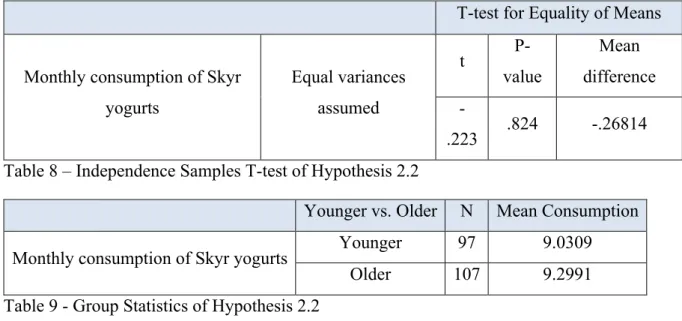
Hypothesis #2.2: Test whether the monthly consumption of Skyr yogurts differs based on age – younger consumers vs. older consumers.
To analyse this, a one-way analysis of variance (one-way ANOVA) was performed. The group age of “18-24” (n = 33, M = 8.42, SD = 8.71) and “25-34” (n = 64, M = 9.34, SD = 7.99)
39 T-test for Equality of Means
Monthly consumption of Skyr yogurts Equal variances assumed t P-value Mean difference -.223 .824 -.26814 Table 8 – Independence Samples T-test of Hypothesis 2.2
Younger vs. Older N Mean Consumption Monthly consumption of Skyr yogurts Younger 97 9.0309
Older 107 9.2991
Table 9 - Group Statistics of Hypothesis 2.2
Hypothesis #2.3: Test whether the monthly consumption of Skyr yogurts differs based on the level of education.
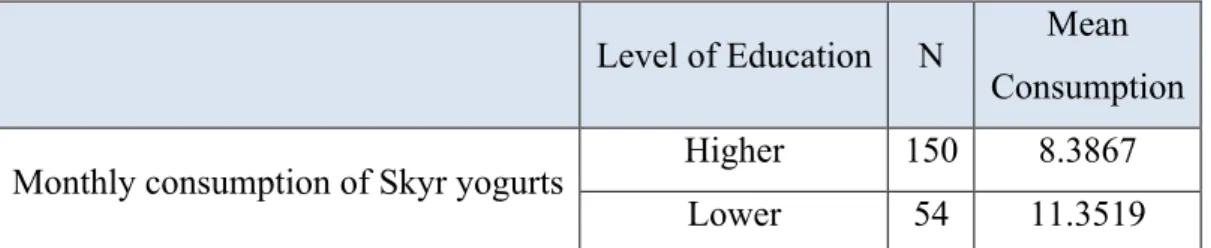
To examine this, a one-way analysis of variance (one-way ANOVA) was performed. As exhibited in Figure 5 and in Appendix 5, the persons who consume more Skyr yogurts in a month belong to the group of “High School Complete” (n = 44, M = 12.41, SD = 10.52), on average, and “PhD” (n = 1, M = 20), but only one person is considered at this level. Plus, the groups “Master” (n = 52, M = 8.13, SD = 7.55) and “Undergraduate” (n = 97, M = 8.40, SD = 8.12) do not differ much in the level of consumption of Skyr yogurts per month, and the groups “High School Incomplete” (n = 4, M = 6.5, SD = 3.00) and “Other” (n = 6, M = 6.83, SD = 3.60) are the ones that have the lowest levels of consumption. However, the results show that there is not a statistically significant difference between the six groups (F = 2.117, p = .065) – Table 10. Consequently, Hypothesis 2.3 is rejected.
41 Level of Education N Mean
Consumption Monthly consumption of Skyr yogurts Higher 150 8.3867
Lower 54 11.3519
Table 12 - Group Statistics of Hypothesis 2.3
Hypothesis #3: Test whether the monthly consumption of Skyr yogurts differs based on the level of impact of the recognition of the country of origin (Presence of a Halo Effect).
In this case, a one-way analysis of variance was performed (one-way ANOVA) to understand if people’s awareness of Iceland as Skyr’s country of origin would have an impact, since this is a country recognized for its healthy lifestyle. As observed in Table 13, people who selected a “very positive impact” are those with the higher consumption of Skyr yogurts per month (n = 39, M = 11.36, SD = 8.75), on average. There are not significant differences among the other three groups, and the level “very negative impact” does not include any observation. Therefore, the results show that there is not a statistically significant difference between groups (F = 1.817, p > .05) – Table 14. Consequently, Hypothesis 3 is not supported.
Level of Impact N Mean Consumption Standard Deviation
1 – Very negative 0 0 0 2 - Negative 1 10.0000 - 3 – Neither positive nor negative 73 9.7534 9.78630 4 - Positive 91 7.7582 7.18539 5 – Very positive 39 11.3590 8.74639 Total 204 9.1716 8.55092
Table 13 - Descriptive Statistics of Hypothesis 3 Sum of
squares Consumption Mean square F P-value Between
groups 393.778 131.259 1.817 .145
Within
groups 14449.217 72.246 Total 14842.995