MI
NE
RV
A
ME
DI
CA
CO
PY
RI
GH
T
®
Creative dance can enhance proprioception in older adults
Aim. It has been shown by many authors that proprioception declines with age. However, few studies have examined the effects of exercise interventions on proprioception. The purpose of this study was to investigate the effects of a creative dance program on proprioception of older adults.
Methods. Thirty-seven men and women between 55 and 80 years of age, who were not engaged in any exercise program for at least one year, were randomly assigned to an experimental (63.6±5.7 years) or a control group (65.3±7.6 years). The exper-imental group participated in a creative dance program for 12 weeks with a periodicity of 3 sessions of 90 minutes per week. Measures of knee kinesthesia, knee joint position sense and arm positioning were taken before and after the program. Results. After 12 weeks, knee joint position sense (P=0.005) knee kinesthesia (in flexion) (P=0.04), and arm positioning (P=0.008) significantly improved within the creative dance training group. At 12 weeks follow-up, arm positioning per-formance was significantly better for the creative dance group when compared with the control group (P=0.043). The control group did not show any significant improvement in proprio-ception.
Conclusion. This study showed that a creative dance program emphasising body awareness can improve proprioception in older adults.
KEY WORDS: Proprioception - Creative dance - Aging.
P
roprioception is conveyed to all levels of the cen-tral nervous system, where it provides a unique sensory component to optimize motor control.1Proprioceptive information is provided by specialized sensory receptors called mechanoreceptors - primar-ily found in muscle, tendon, ligament, and capsule,2 which are responsible for quantitative transducement of mechanical events occurring in their host tissues into neural signals.3, 4
The importance of proprioception to balance, walk-ing stability and trajectory, sit to stand performance, and stair walking ability has been consistently reported in older adults.5-8Postural equilibrium requires proprio-ceptive acuity and precise neuromuscular control.8, 9 Impaired proprioception increases fall risk in older adults,8which have a marked negative impact on old-er pold-ersons´ health, function, and independence.10, 11
Most proprioceptive information travels to higher central nervous system levels through either the spin-ocerebellar tracts or the dorsal lateral tracts.2The spin-ocerebellar tracts are believed to be responsible for “nonconscious proprioception” used for reflexive, automatic and voluntary activities.12The dorsal later-al tracts convey the signlater-als to the somatosensory cor-tex, where proprioceptive information is processed resulting in conscious awareness of movement and position.4There are three submodalities of conscious proprioception: joint position sense (JPS), kinesthesia and sense of tension or force.13
Many studies reported that proprioception declines with age.14-18Ribeiro & Oliveira 19 concluded in a lit-Department of Sport and Health, University of Évora, Portugal
Received on September 11, 2008. Accepted on October 29, 2009.
Corresponding author: J. F. Marmeleira, Pavilhão Gimnodesportivo da Universidade de Évora, Prolongamento da Rua de Reguengos de Monsaraz, 14, 7000-727 Évora, Portugal.
E-mail: [email protected]; [email protected]
MI
NE
RV
A
ME
DI
CA
CO
PY
RI
GH
T
®
erature review that regular physical activity can atten-uate age-related decline in proprioception. However, there is a deficit of experimental designs able to estab-lish a cause-effect relationship between exercise and proprioception.
Creative dance (CD) is a particular form of dance that, unlike other dance forms, does not require years of training and is characterized by an absence of pre-determined performance standards.20, 21 CD stimu-lates creativity through a positive learning environment resulting from a friendly, informal and open atmos-phere.22 It is believed that the CD expression adds extra dimensions such as an individual self-mastery through allowing the subjects to be consciously in charge of their body.23 Previous reports suggested that CD could increase mobility, spatial orientation, coor-dination and balance in older adults.24, 25It was also reported that CD can enhance balance in children with disabilities.26CD is based in activities that empha-size conscious awareness of body position and move-ment; the increase of attention directed to proprio-ceptive cues seems to contain the characteristics of pro-prioceptive exercise.4, 27
Although several studies have concluded that there is a beneficial role of physical activity in the mainte-nance or improvement of diverse physiological sys-tems among older people, few have examined the effects of physical activity in proprioception. Moreover, to our knowledge, none have examined particularly the effects of CD in the proprioception of older adults, and few have followed a prospective, controlled experi-ment involving the training of subjects. Therefore, the aim of this study was to investigate the effects of a CD training program on proprioception of older adults.
Materials and methods
Subjects
Participants were recruited in the city of Évora (Portugal) by posted flyers and local newspaper announcements. Forty-four potentially eligible sub-jects, living independently in the community, respond-ed and sought more information. The exclusion crite-ria included the presence of any serious cardiovascu-lar or musculoskeletal diseases, having less then 55 years of age, and have been engaged in any exercise program within the previous year. Exercise program was defined as any type of physical activity that is
planned, structured and supervisioned, occurring at least one day per week. This information was gath-ered by means of a questionnaire with a complemen-tary interview concerning exercise participation.
Seven subjects were excluded according to the cri-teria: be engaged in exercise programs (N=2), poor health condition (N=1), or refused to participate (N=4). The remaining 37 subjects were then randomly assigned to either the experimental group (N=19) or the control group (N=18). All thirty-seven eligible par-ticipants signed a written informed consent prior to participate in the study. Three women of the control group did not complete the postmeasurements and were excluded from the final analysis. No significant difference was found in gender, age, height, or weight across the two groups (Table I). The minimum age was 55 years in both groups, and the maximum age was 75 and 80 years in the experimental and the control group, respectively.
The present study was approved by the institution-al Human Research Ethics Committee. All procedures were followed according to the declaration of Helsinki.
Procedures
LOWER LIMB
Knee proprioception was assessed through JPS and kinesthesia, two important and common evaluation techniques,13, 28using a computerized dynamometer, the Biodex System 2 (Biodex Medical Systems, Shirley, New York). The test subjects were seated on the dynamometer at a 105° trunk angle, with the back sup-ported and the knee hanging over the edge of the seat. The axis of rotation of the knee joint was aligned with the axis of rotation of the frame. Subjects were blind-folded to eliminate visual stimuli and during the kines-thesia protocol they additionally wore headphones (containing whitenoise) to eliminate auditory from the testing procedure apparatus. They wore shorts to negate any extraneous skin sensation from clothing touching the knee area. Each person used an inflatable splint to TABLEI.—Demographic and anthropometric data of the
experimen-tal and control group. Data are means (SD).
Group N. Gender Age (years) Weight (kg) Height (cm)
Experimental 19 4M, 15F 63.6 (5.7) 72.3 (13.5) 158.0 (0.1) Control 15 5M, 10F 65.3 (7.6) 73.0 (14.4) 159.0 (0.1)
MI
NE
RV
A
ME
DI
CA
CO
PY
RI
GH
T
®
eliminate any sensation cues from skin or ankle posi-tion by immobilizing the foot.29The inflatable splints were attached to the lever arm of the Biodex. The eval-uations were conducted on the dominant leg.
JPS.—The data were collected using similar instru-mentation and procedures described by other authors.29, 30Each subject had one practice trial to become familiar with the test process, and then per-form nine test trials (three for each target angle). During the test trials, the lever arm of the dynamometer was passively moved from 90° (0°=knee fully extended) to 1 of 3 allocated target angles of 20, 45 and 70° of knee flexion, using a speed of 5°·s-1. Each target position was maintained by the Biodex for 10 seconds. Then the participants’ legs were passively returned to the start position (90° of flexion) and, after a 5-second rest, sub-jects attempted actively to reproduce the previously attained target angle (speed of 5°·s-1), clicking a button when perceived that they have replicated the angle. The same sequence of test target angles (randomly estab-lished by the researchers) was performed by all sub-jects. No feedback regarding performance was provid-ed during the test. The outcome measurement was an error score calculated as the mean absolute difference between the target and replicated angle (in degrees), and averaged over the 9 target angle replication attempts. Kinesthesia.—With the subjects’ knees in 45° of flexion, the Biodex dynamometer extended or flexed the knees at 0.5°·s-1. The lever arm motion of the dynamometer was initiated in a random time interval between 2 and 10 seconds. Once each subject detect-ed motion of the leg, they pressdetect-ed a hand held stop button and confirmed the direction of the motion. The rotation angles of the frame were defined as the thresh-old of detection for the knee joint. No feedback regard-ing performance was provided durregard-ing the test. After one practice trial, subjects completed 6 consecutive test trials, three for flexion and three for extension. The same sequence of extension/flexion trials (randomly established by the researchers) was performed by all subjects. The mean values in degrees were calculated for flexion and extension.
UPPERLIMB
A linear movement device (Model 31202, Lafayette Instruments, Lafayette, IN) was used to measure arm positioning. During the test the subjects were blind-folded and seated on a chair with the linear
position-ing device placed directly in front of them. The sub-jects’ task was to attempt to replicate the end point of a passive linear movement by grasping the vertical rod with the dominant hand and moving it from right to left (right handed) or from left to right (left handed). The rod was slowly moved by one of the researchers to the allocated target position, and that position was maintained for 5 seconds. Then the participants’ hands (still grasping the rod) were passively returned to the start position. After a 5-second rest, the participants attempted actively to reproduce the previously attained target angle, stopping the arm movement and inform-ing the researcher when perceived that the position had been replicated. One practice trial was performed. The actual test consisted of 4 distances (15, 30, 45, 60 cm) presented to the blindfolded subject, three times each for a total of 12 trials. The same sequence of test target positions (randomly established by the researchers) was performed by all subjects. No feed-back regarding performance was provided during the test. The outcome measurement was an error calculated as the mean absolute difference between the target and replicated point (in cm), and averaged over the 12 target replication attempts.
CD Program
After the baseline evaluation, the experimental group participated in the CD program 3 days a week during 12 weeks. Each session took approximately 90 minutes and was conducted by a physical education teacher with specific formation in CD. Warm-up consisted on a general mobilization that intended to activate phys-iological systems, and introduced some features of CD which were developed further in the main phase. In this phase, the exercise intensity was higher and music was always present, with different rhythms and paces. The intervention program was carefully planned, and the solicited tasks were directed to body commu-nication through movement, emphasising body aware-ness and postural control. Frequently, particular ideas were proposed to the participants, who creatively trans-lated them to body expression through movement. Finally, the cool-down phase consisted especially on relaxation exercises.
Statistical Analyses
Kolmogorov-Smirnov test showed that the data did not present a normal distribution. The
Mann-MI
NE
RV
A
ME
DI
CA
CO
PY
RI
GH
T
®
Whitney test was used to examine the differences between the values from both the groups. Wilcoxon signed-rank test was used to compare the values with-in each group before and after CD with-intervention. Significance level was set at 0.05 (P<0.05). Statistical analysis was carried out using SPSS 15.0 (SPSS, Chicago, IL).
Results
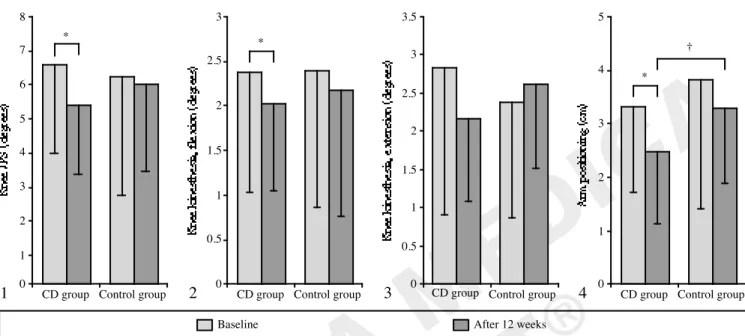
Measures of proprioception at baseline and after 12 weeks are presented in Figures 1-4.
Inter-group analysis
At baseline there were no significant differences between the experimental and the control groups in any proprioception variable studied: Knee JPS (P=0.354); knee kinesthesia in flexion (P=.835); knee kinesthesia in extension (P=0.415); arm positioning (P=0.607).
At week 12 follow-up, arm positioning performance was significantly better (P=0.043) for the
experimen-tal group (2.5±1.4 cm) when compared with the con-trol group (3.3±1.3 cm). At the same moment, despite the lack of statistical significance, knee JPS (P=0.471), knee kinesthesia in flexion (P=0.732), and knee kines-thesia in extension (P=0.147) were better in the exper-imental group (5.4±2.1º; 2.0±1.0º; 2.2±1.1º, respec-tively) than in the control group (6.0±2.6º; 2.2±1.4º; 2.6±1.1º, respectively).
Intra-group analysis
Within the experimental group, significant enhance-ments were shown in proprioception variables after 12 weeks of the CD program: knee JPS improved 18.4% (P=0.005), knee kinesthesia in flexion 14.4% (P=0.04) and arm positioning 25.0% (P=0.008). Knee kinesthesia in extension was enhanced (23.2%), but not with statistic significance (P=0.059).
Regarding the control group, proprioception did not show any significant improvement between the pre- and post-measurements: knee JPS (3.2%, P=0.842), knee kinesthesia in flexion (9.2%, P=0.363) and arm posi-tioning (13.6%, P=0.733). Knee kinesthesia in exten-sion showed a deterioration of 9.7% (P=0.053).
8 7 6 5 4 3 2 1 0
CD group Control group * 1 3 2.5 2 1.5 1 0.5 0
CD group Control group *
2
Baseline After 12 weeks 3.5 3 2.5 2 1.5 1 0.5 0
CD group Control group
3 5 4 3 2 1 0
CD group Control group *
4
†
Figure 1.—Mean (SD) knee JPS at baseline and after 12 weeks. *P<0.01 compared with baseline values. Figure 2.—Mean (SD) knee kinesthesia in flexion at baseline and after 12 weeks. *P<0.05 compared with baseline values. Figure 3.—Mean (SD) knee kinesthe-sia in extension at baseline and after 12 weeks. Figure 4.—Mean (SD) arm positioning at baseline and after 12 weeks. *P<0.01 com-pared with baseline values; †P<0.05 between groups after 12 weeks.
MI
NE
RV
A
ME
DI
CA
CO
PY
RI
GH
T
®
DiscussionFew studies have examined the effects of exercise on proprioception of older adults. The present study demonstrates that a CD training program is capable of improving proprioception, namely knee JPS, knee kinesthesia (in flexion), and arm positioning. These findings are encouraging, considering the importance of proprioception to optimize motor control, and its rel-evance to the postural control system.
It is difficult to compare the results from this study with relevant literature about CD, since, to our knowl-edge, there have not been similar investigations using this form of physical activity. However, previous stud-ies have evidenced the role of other types of physical activity in the attenuation of age-related declines in proprioception. For instance, Petrella et al.16measured knee JPS in 16 young subjects (19-27 years) and 24 elderly subjects (60-86 years). Elderly group was sep-arated into active and sedentary subgroups based on their level of activity during the previous year. Significant differences were observed in the absolute angle error between active-old and sedentary-old sub-jects (P<0.03), with the first group showing better results. Gauchard et al.31have studied the influence of regular proprioceptive (yoga or soft gymnastics) and bioenergetic physical activities (swimming, jogging or cycling) on the balance control of elderly women (over 60 years), and concluded that proprioceptive exercise appears to have a good influence on balance regulation.
The effects of Tai Chi in proprioception have been investigated. It was demonstrated that elderly people (mean age 66.1 years) who regularly practiced Tai Chi showed better proprioception at the ankle and knee joints than sedentary controls, and also better ankle kinesthesis than swimmers/runners.9Tsang and Hui-Chan 32showed that long-term Tai Chi practitioners (mean age 69.4 years) improved knee joint proprio-ception and expanded their limits of stability during weight shifting in stance. Another study concluded that both long Tai Chi practitioners (1-3 years of prac-tice; participants mean age 53.8 years) and short-term Tai Chi practitioners (3 months of practice; partici-pants mean age 52.9 years), have significantly improved their knee JPS.33
A study conducted to analyse the differences in the hip JPS between young (mean age 21.7 years) and older adults (mean age 75 years), also supported the
positive impact of exercise on proprioception.17 Curiously, contrary to what could be expected, no sig-nificant differences in proprioception were found between young and older adults. The authors sug-gested that this could be related to the high level of exercise participation that characterized the older group (mean 10 hours each week), and its possible role in maintaining or enhancing hip proprioceptive acuity. However, despite some studies reporting benefits of physical activity in proprioception, there have been difficulties in concluding that prescribed exercise can improve proprioception. First of all, there is a lack of experimental studies capable of establishing that ben-eficial effect, whilst other studies have failed to improve proprioception following a training program.34On the other hand, while exercise seem capable of increasing coordination and balance, these cannot be compared to proprioception in terms of the two classic proprio-ceptive modalities: accuracy of JPS or the threshold for detecting joint movement.27
The present study gives evidence that a physical activity program, which emphasises conscious aware-ness of body position and movement, can contribute to develop proprioception. Both central and peripheral levels have been pointed out to mediate the improve-ments in proprioception that results from the practice of physical activity. With respect to the peripheral lev-el, great importance has been attributed to morpho-logical alterations in muscle spindle, the peripheral receptor whose gain can be modulated by the central nervous system.19, 27Regarding the central mecha-nisms, it is possible that proprioceptive exercises increase the attention paid to proprioceptive cues by the brain; early in the training at the conscious level, then later, after further training, at the autonomous level.27, 35Also, at a central level, physical activity might mod-ify proprioception by inducing plastic changes in the central nervous system,19, 27such as an increased strength of synaptic connections and/or structural changes in the organization and number of connec-tions among neurons.36
Conclusions
In the present study, after 12 weeks of CD practice it was possible to achieve significant improvements on proprioception of older adults, namely in arm posi-tioning, knee JPS and knee kinesthesia in flexion. Knee kinesthesia in extension did not show a
signifi-MI
NE
RV
A
ME
DI
CA
CO
PY
RI
GH
T
®
cant gain as a result of the participation in the CD pro-gram; however, it is important to point out that the experimental group showed marked progressions along the intervention while the control group deteriorated compared to the baseline level. It is reasonable to expect further improvements if the CD program had been extended in time.
In conclusion, this study showed that a CD program emphasising body awareness and communication through movement, can promote improvements on proprioception in older adults.
References
1. Riemann BL, Lephart SM. The sensorimotor system, part II: the role of proprioception in motor control and functional joint stability. J Athl Train 2002a;37:80-4.
2. Riemann BL, Lephart SM. The sensorimotor system, part I: the phy-siologic basis of functional joint stability. J Athl Train 2002b;37:71-9.
3. Grigg P. Peripheral neural mechanisms in proprioception. J Sport Rehabil 1994;3:2-17.
4. Irrgang JJ, Neri R. The rationale for open and closed kinetic chain acti-vities for restoration of proprioception and neuromuscular control following injury. In: Lephart SM, Fu FH, editors. Proprioception and Neuromuscular Control in Joint Stability. Champaign, IL: Human Kinetics; 2000. p. 363-74.
5. Huitema RB, Brouwer WH, Mulder T, Dekker R, Hof AL, Postema K. Effect of ageing on the ability to adapt to a visual distortion during walking. Gait Posture 2005;21:440-6.
6. Lord SR, Murray SM, Chapman K, Munro B, Tiedemann A. Sit-to-stand performance depends on sensation, speed, balance, and psy-chological status in addition to strength in older people. J Gerontol A Biol Sci Med Sci 2002;57:M539-M543.
7. Marks R. An investigation of the influence of age, clinical status, pain and position sense on stair walking in women with osteoarthrosis. Int J Rehabil Res1994;17:151-8.
8. Westlake KP, Culham EG. Influence of testing position and age on mea-sures of ankle proprioception. Adv Physiother 2006;8:41-8. 9. Xu D, Hong Y, Li J, Chan K. Effects of Tai Chi exercise on
proprio-ception of ankle and knee joints in old people. Br J Sports Med 2004;38:50-4.
10. Close JC. Prevention of falls in older people. Disabil Rehabil 2005;27:1061-71.
11. Tinetti M, Speechley M, Ginter S. Risk factor for falls among elderly living in the community. N Engl J Med 1988;319:1701-7.
12. Matthews GG. Brain motor mechanisms. In: Matthews GG, editor. Neurobiology: molecules, cells & systems. Malden, MA: Blackwell Science Inc; 1997. p.
13. Riemann BL, Myers JB, Lephart SM. Sensory system measurement techniques. J Athl Train 2002;37:85-98.
14. Adamo DE, Martin BJ, Brown, HB. Age-related differences in upper limb proprioceptive acuity. Percept Mot Skills 2007;104:1297-309. 15. Pai YC, Rymer WZ, Chang RW, Sharma, L. Effect of age and
osteoarthritis on knee proprioception. Arthritis Rheum 1997;40:2260-2265.
16. Petrella RJ, Lattanzio PJ, Nelson MG. Effect of age and activity on knee joint proprioception. Am J Phys Med Rehabil 1997;76:235-41. 17. Pickard CM, Sullivan PE, Allison GT, Singer KP. Is there a
differen-ce in hip joint position sense between young and older groups?. J Gerontol A Biol Sci Med Sci 2003;58:M631-635.
18. Skinner HB, Barrack RL, Cook SD. Age-related decline in proprio-ception. Clin Orthop Relat Res 1984;184:208-11.
19. Ribeiro F, Oliveira J. Aging effects on joint proprioception: The role of physical in proprioception preservation. Eur Rev Aging Phys Activ 2007;4:71-6.
20. Bergmann S. The process/product dichotomy and its implications for Creative Dance. J Aesthetic Educ 1992;26:103-8.
21. Lewis RN, Scannell ED. Relantionship of body image and creative dan-ce movement. Perdan-cept Mot Skills 1995;81:155-60.
22. Gilbert AG. Creative dance for all ages: A conceptual approach. Reston, VA: American Alliance for Health, Physical Education, Recreation, and Dance; 1992.
23. Hanna JL. Dance and stress. Resistance, reduction, and euphoria. New York: AMS Press Inc.; 1988.
24. Lindner EC, Harpaz L. Shared movement programs. Children and older adults. J Phys Education Recreation Dance 1983;54:49. 25. Pruett DM. Dance for older adults. J Phys Education Recreation
Dance 1983;54:43-51.
26. Boswell, B. Effects of movement sequences and creative dance on balance of children with mental retardation. Percept Mot Skills 1993;77:1290.
27. Ashton-Miller JA, Wojtys EM, Huston LJ, Fry-Welch D. Can Proprioception really be improved by exercises? Knee Surg Sports Traumatol Arthrosc 2001;9:128-36.
28. Beynnon BD, Renstrom PA, Konradsen L, Elmqvist L, Gottlieb D, Dirks M. Validation of techniques to measure knee proprioception. In: Lephart SM, Fu FH, editors. Proprioception and Neuromuscular Control in Joint Stability. Champaign: Human Kinetics; 2000. p.127-38.
29. Koralewicz LM, Engh GA. Comparison of proprioception in arthri-tic and age-matched normal knees. J Bone Joint Surg 2000;82A:1582-8.
30. Sekir U, Gur H. A multistation proprioceptice exercise program in patients with bilateral knee osteoarthrosis: functional capacity, pain and sensorimotor function. A randomized controlled trial. J Sports Sci Med 2005;4:590-603.
31. Gauchard GC, Gangloff P, Jeandel C, Perrin PP. Influence of regular proprioceptive and bioenergetic physical activities on balance control in elderly women. Journals of J Gerontol A Biol Sci Med Sci 2003;58A:M846-M850.
32. Tsang WWN, Hui-Chan CWY. Effects of Tai Chi on joint proprio-ception and stability limits in elderly subjects. Med Sci Sports Exerc 2003;35:1962-71.
33. Fong S-M, Ng GY. The effects on sensorimotor performance and balance with Tai Chi training. Arch Phys Med Rehabil 2006;87:82-7. 34. Bernier JN, Perrin DH. Effect of coordination training on proprio-ception of the functionally unstable ankle. J Orthop Sports Phys Ther 1998;27:264-75.
35. Lephart SM, Pincivero DM, Giraldo JL, Fu FH. The role of proprio-ception in the management and rehabilitation of athletic injuries. Am J Sports Med 1997;25:130-7.
36. Shumway-Cook A, Woollacott M. Motor control: theory and practi-cal applications. Baltimore: Williams & Wilkins; 2001.