PORTUGUESE JOURNAL OF MANAGEMENT STUDIES, VOL. XIV, NO. 3, 2009
School of Economics and Management
TECHNICAL UNIVERSITY OF USBON
AN ANALYSIS OF THE PORTUGUESE VENTURE CAPITAL MARKET:
PARTIAL EXITS VERSUS TOTAL EXITS
Elisabete Gomes Santana Felix
Department of Management and CEFAGE- UE:, University of Evora Jose Paulo Esperam;a
Department of Finance and Accounting, ISCTE Mohamed Azzim Gulamhussen
Department of Finance and Accounting, ISCTE Cesaltina Pacheco Pires
Department of Management and CEFAGE- UE, University of Evora
Abstract
This article analyzes Portuguese venture capital exits, exploring the relationship between the type of exit and the asymmetry of information of the venture capital investments. The central hypothesis being tested is that the occurrence of partial exits is associated with signalling the investment quality and with the reduction of the degree of informational asymmetry.
The data resulted from a study elaborated by Small Business Investment, SA and Price WaterHouse Coopers, for the Associac;ao Portuguesa de Capital de Risco e de Desenvolvimento (APCRI), by way of questionnaire sent to the resident Portuguese venture capital companies.
We used Logit models in which the dependent variable is a dummy indicating if a partial exit occurred and the independent variables are all dummies referring to investment and divestment charac-teristics.
We conclude that when the exit occurs through I PO, this increases the probability of a partial exit occurring and that the longer the duration, the smaller is the probability of a partial exit. Both results support the hypothesis that the higher the degree of informational asymmetry, the higher the probability of a partial exit.
Key words: Venture capital; Partial exits; I PO; Trade sales; Write-offs; Information asymmetry. JEL Classification: G24, G31, G32.
Correspondence Address: Elisabete Gomes Santana Felix - Departament of Management and CEFAGE-UE, University of Evora, Largo dos Colegiais, n.0 2, 7000-803 Evora, Portugal. E-mail:
PORTUGUESE JOURNAL OF MANAGEMENT STUDIES, VOL. XIV, NO. 3, 2009
1. INTRODUCTION
With this work we intend to analyze the exits that occurred in the Portuguese venture capital market and, at the same time, replicate part of the work carried out by Cumming and Macintosh (2003). These authors analyzed the existing relation between the various venture capital investments exit vehicles and the informational asymmetry associated with them. The analysis revealed the occurrence of partial exits instead of total exits as forms of signalling the quality of the investment and reducing the level of informational asymmetry.
We use Logit models, in which the dependent variable is a dummy indicating whether a partial exit occurred or not, and the independent variables are all dummies indicating: if the investment was of the start-up type; if the investment was of the expansion type; if the investment was of the high-tech type; if the exit was of the acquisition type; if the exit was of IPO type; and if the exit was of write-off type.
There have been very few published works studying the Portuguese venture capital market. It is a small and relatively recent market, so with little available information for analysis. Subachi (2001) and Tejeda (2003) have carried out a characterization of the Portuguese venture capital market. Tejeda (2003) refers that the Portuguese venture capital market is characterized by expansion investments and in manufacturing industries (predominantly in consumption goods).
In the past, some governmental programs occurred that were basically vehicles for investments in European structural funds, discouraging potential private investors. More recently, with the introduction of a new legislation about this matter and a plan attempting the leverage of private funds for the venture capital market, we expect the occurrence of a stimulus in the activity of the Portuguese venture capital. However, a lot needs to be done to foster new entrepreneurs, and to create a new less risk-averse investment culture that explores the benefits of the flows of international venture capital.
Jeng and Wells (2000) dedicate part of their analysis to the Portuguese case, carrying out a detailed analysis, for the period of 1986 to 1995, for the role that the governmental programs had in the Portuguese venture capital market. The existence of the correct legal structure and tax rates appear to be very important factors for the development of venture capital funds, as seems to be the case in the U.S.A. and United Kingdom. However, there are also countries without these environments that have a strong venture capital market, as in Austria. The authors refer that Portugal is a country in which the existence of adequate legal structure and taxes will eventually become important factors for the development of the venture capital market. However, Portugal has some specificities due to the creation of a new form of business structure (the venture capital society) that possesses a certain number of fiscal benefits. Beyond that, the growth verified in the Portuguese
PORTUGUESE JOURNAL OF MANAGEMENT STUDIES, VOL. XIV, NO. 3, 2009
venture capital market is due in large part to the direct governmental financing by several governmental agencies.
This paper is organized as follows: section 2 reviews the relevant literature for our analysis. Section 3 describes the various venture capital investments exit forms. Section 4 presents the several hypotheses regarding the occurrence of partial exits versus total exits. Section 5 presents and analyzes the data. Section 6 describes the variables and the methodology used in the study. Section 7 presents and discusses the empirical results. Finally, Section 8 concludes the article.
2. EARLIER RESEARCH
To the best of our knowledge, only Cumming and Maclnstosh (2003) analyze the issue of partial versus total exits for the several divestment alternatives. In this work the authors reflect about the determinants of the choice between a partial exit and a total exit for the five usual forms of venture capital investment exit. They suggest that a venture capital investor will opt for a partial exit when the informational asymmetry (between insiders and outsiders of the participated company) is great, with the intent of signalling the quality of the investment for potential buyers. They also suggest that the venture capital investor will opt for a partial exit in order to bring to the board of the company a new active investor with specific capacities that the current investors do not possess.
They conclude that the higher the rank of informational asymmetry between the venture capital investor and the buyer, the higher the probability of occurrence of a partial exit as a signal of quality. In addition, they show that there are differences between the American venture capital market and the Canadian one which reflect the impact of institutional and legal factors in the two countries.
Informational asymmetry occurs when there is information relevant for a certain market transaction or contract which is not known by all the agents involved in the transaction. The existence of informational asymmetries give rise to two well known problems in the relations between economic agents: adverse selection and the moral hazard problem.
Venture capital investors perform a similar role to financial intermediaries, although each one has some singularities, trying to diminish the informational asymmetry and its associated problems. As referred by Wang and Zhou (2004), very little research exists with regard to the venture capital, particularly about the problems due to informational asymmetry.
Sahlman (1990) approaches several aspects related with venture capital, including agency problems. He places a special emphasis on legal definitions, in the organizational forms, and in the relations between venture capital investors, potential investors and businessmen. Sahlman shows that in venture capital
PORTUGUESE JOURNAL OF MANAGEMENT STUDIES, VOL. XIV, NO. 3, 2009
investments the utilization of stage financing is the best mechanism that a venture capital investor can use to deal with the agency problems. This conclusion is reinforced by other authors such as Lerner (1994), Gompers (1995), Bergemann and Hege (1998) and Wang and Zhou (2004).
Admati and Perry (1991), concerning the role of stage financing in reducing agency problems, analyze the situation of investments in which enforceable contracts are not possible and in which the realized capital expenses do not possess recuperation to show that stage financing can diminish the costs with the capital obligations. Hellmann (1994) argues that the venture capital investors use stage financing in order to reduce risk, but that such kind of financing obliges the businessman to be concerned with his short term performance. In the Gompers (1995) case, he supplies one of the first and more intensive empirical studies on venture capital when agency costs exist and on monitoring. Repullo and Suarez (1998) study the problem of the contracts associated with the venture capital, presenting a model in which moral hazard problems exist and financing is performed in stages (in the model they considered only two stages). Beyond the previously mentioned authors, others have addressed the question of informational asymmetry and venture capital, Noe and Rebello (1996), Bergemann and Hege ( 1998), Lerner (1998), Trester (1998), Thakor (1998), Bias and Casamatta (1999), Manigart et
a/ (2000), Casamatta (2002) and Casamatta and Haritchabalet (2003).
The questions related with informational asymmetry and the role of venture capital have also been approached in the context of the exits from these kinds of
investment, with particular emphasis on Initial Public Offering (I PO). Barry eta/
(1990) and Megginson and Weiss (1991) focus on the capacity of the venture capital investors to solve IPO problems of informational asymmetry. The market interprets the presence of venture capital investors as a sign of the quality of the participated company. Barry eta/ ( 1990) argue that the venture capital involvement in a company gives credibility and certifies the firm, facilitating its access to external financing and leading to higher sustained growth rates. Brealey and Myers (1998) also highlight the importance of the equity capital as a signal to everybody who is related to the company who has a direct or indirect interest in its existence.
Brav and Gompers (1997) analyze the long term performance of IPO supported and not supported by venture capital investors, and they conclude that, in agreement with the hypothesis of informational asymmetry, IPOs supported by venture capital investors achieve better performances in the long term. The question of the signalling effect in the companies' performance after the occurrence of an I PO has also been approached by Kraus and Burghof (2003).
Black and Gilson (1998), Bradford and Smith ( 1997) and Mull ( 1994) studied the impact of the venture capital investors' intervention in transmitting a positive signal to the financial market. They show that the intervention can increase the potential of success in a future IPO operation of the company.
PORTUGUESE JOURNAL OF MANAGEMENT STUDIES, VOL. XIV, NO. 3, 2009
However, the work carried out by Cumming and Macintosh (2003) is considered a distinctive and interesting approach with regard to the importance that venture capital investors possess to signal the quality of the participated companies.
3. TYPES OF EXITS USED BY VENTURE CAPITAL INVESTORS
There are several types of exit from the participated companies for venture capital investors. We consider some of these forms: buyback; secondary sale or trade sale; IPO; write-offs; and acquisition.
A Buyback can happen in a spontaneous way or through pre-negotiated agreements - at the investment date - with the partners of the participated companies in which the exit conditions are established (terms, form of value determination, etc.), often executed by the exercise of calls and puts. Sometimes the venture capital exit assumes the figure of a Management Buy Out (MBO).
A Secondary Sale or Trade Sale can be partial or total. Usually the venture capital investor sells his part to a strategic buyer or to another venture capital investor. In this type of exit it is only the venture capital investor that sells his participation; the businessman and others investors sustain their participation. However, this type of exit is not always possible because the entrance of new partners in the company is often conditioned by agreements.
An IPO is a type of exit that allows the number of potentially interested investors to be broadened, minimizing the exit costs. In this exit, the venture capital investor does not usually sell his whole participation immediately. Instead, the sale process might be spread out over months or even years. In an efficient market the shares would be traded by their real market value, facilitating the achievement of the gain generated since the entrance of the venture capital in the company. In some countries (as is the case of Portugal), this form of exit finds-itself conditioned by several aspects, namely:
• the absence of or poor function of a capital market designed for small and medium-size enterprises (SME);
• the need for better information and transparency in the company's accounts;
• the resistance that some stockholders have in selling part of the capital, even in the case of a minority participation (for example companies of the family type).
Liquidation of the company (Write-off) is the last exit hypothesis for bad investments.
PORTUGUESE JOURNAL OF MANAGEMENT STUDIES, VOL. XIV, NO. 3, 2009
In the case of an exit by Acquisition, the entire participated company is sold to a third party. There are several ways of performing this kind of exit; through a shares sale, a merger or the sale of the company assets. In any case, the potential buyer will be able to assume several identities. Sometimes it is another venture capital investor interested in the technology that the participated company holds, that is, interested in obtaining profits with synergies. Such a buyer is usually a strategic buyer and is always larger than the company it acquires. In this kind of exit, the company that buys may decide to leave the company as its subsidiary, or as its subdivision (maintaining the previous management team because they where responsible for the success of the company), or they may decide to integrate the technology of the acquired firm into their own company.
It is worthwhile specifying what is understood by a strategic buyer. Cumming and Macintosh (2002, p. 20) define a strategic buyer as "a large company in the same or similar business as the purchased firm, either as competitor, supplier, or customer, and will often integrate the company's technology with its own following the acquisition.".
4. THE CHOICE BETWEEN TOTAL AND PARTIAL EXITS
The choice between a total or a partial exit of venture capital investments is influenced by several factors that can change according to the exit vehicles used.
The risk and return of the venture capital investments differ according to the exit dimension for each exit vehicle. Partial exits are traditionally associated with higher risks and returns, which is consistent with the proposition that partial exits are more common when the informational asymmetries are more pronounced. Remember that a justification for a partial exit is to diminish the informational asymmetries between the venture capital investor as the salesperson and the external buyer of the participated company. We pointed out as possible exit vehicles: buyback; trade sale; I PO; write-off; and acquisition. Any one of these exit forms can be carried out completely or partially. It may seem a bit strange to consider partial exits in the case of write-offs and acquisitions. However, as referred by Cumming and Macintosh (2003), the Canadian Venture Capital Association and the Venture Economics define a partial write-off as a situation where the investor carries out a write-down of the investment. In the case of an acquisition, the perception of a
partial exit will depend on what kind of acquisition is performed.1
We will test the theory of the importance of the level of informational asymmetry on the probability of partial exits. In order to do this, we consider in 1 For a deeper look at this question we recommend reading the work of Cumming e Macintosh
(2003). 244
PORTUGUESE JOURNAL OF MANAGEMENT STUDIES, VOL. XIV, NO. 3, 2009
our analysis some variables that are expected to be associated with the level of informational asymmetry between insiders and outsiders of the company: whether the investment is of the high-tech type, whether the investment is early-stage, and the duration of the investment. These three variables were also considered by Cumming and Macintosh (2003).
In this work we intend to test if a higher level of informational asymmetry leads to a higher probability of a partial exit taking place. However, to analyse this hypothesis we make several assumptions regarding the degree of informational asymmetry involved in the various exit vehicles and in the several types of venture capital investments.
Regarding the exit vehicle, we assume that the level of information asymmetry between the venture capitalist and the buyer of the venture capitalist participation is ranked in decreasing order: IPO, trade sale, acquisition, buyback and write-off.
With respect to the characteristics of the venture capital investment we make the following assumptions: (i) informational asymmetry is higher in companies of the technological type; (ii) informational asymmetry is smaller in investments with longer durations; (iii) informational asymmetry is higher in companies of the early stage type.
If we accept the previous assumptions, then both the exit type and the investment characteristics are informative with respect to the level of informational asymmetry. Consequently one can test the theory that a higher level of informational asymmetry leads to a higher probability of occurrence of a partial exit, using the previous factors as explanatory variables. Based on the previous assumption this theory can be tested through the following hypotheses:
H 1: The probability of a partial exit is higher when the exit occurs through an IPO or a Trade Sale than in the remaining exit forms;
H 2: The probability of a partial exit is higher for high-tech investments than for non high-tech investments;
H 3: The probability of a partial exit decreases with the duration of the investment;
H 4: The probability of a partial exit is higher in early stage investments.
5. DATA
The data were obtained from a study performed by Small Business Investment, SA and Price WaterHouse Coopers, for the APCRI, by way of a questionnaire sent to the venture capital companies resident in Portugal. The study was carried out for the years 1998 to 2000 in Portugal and includes 11 Portuguese venture capital companies and 240 participated companies.
PORTUGUESE JOURNAL OF MANAGEMENT STUDIES, VOL. XIV, NO. 3, 2009
As can be observed in Table 1, when we apply questionnaires to collect information there is always the risk of not obtaining answers to some questions. That explains why the number of observations for some variables is not equal to the universe of answers. Our analysis omits the observations with missing values. Let us analyze the collected information, which is summarized in Ta-ble 1.
Observing the exit vehicle used we verify that, in Portugal for the period in analysis, acquisition was the most common vehicle used to perform the divestment. This exit type is followed by the write-off and by other types of exits. Exits through IPO or Trade Sale are not very expressive in Portugal. This may be explained by the fact that Portugal is a country with a very recent capital market and with little liquidity, which does not facilitate potential transactions in this market. Note that, according to Black and Gilson (1998), one expects a positive relation between the venture capital market's performance and the capital market's development. These results differ from the American and Canadian case, where exits through IPO are the most expressive (Cumming and Macintosh, 2003).
Analyzing the average duration, in global terms, the value achieved is similar to that of the American and Canadian markets. It is longer than the American (as expected) and a little shorter than the Canadian.
Crossing the exit vehicle with the duration, we verify that it is the exit through IPO that presents the smallest duration. This evidence is consistent with the literature, that is, the IPO is one of the most desirable exits given the speed of the process and its final profit value.
When we analyze the investments where exit already occurred by industry type, we observe that it is the non high-tech industries that predominate in the Portuguese case. By contrast, in the American and the Canadian cases, high-tech companies
rec~ived more venture capital financing and registered a larger volume of exits, although in the Canadian case the difference between the high-tech companies' exits and the non high-tech companies exits is relatively small. In the Portuguese case, we see that for non high-tech companies the form of exit chosen most frequently is acquisition, followed by write-off and other not specified types.
For high-tech companies, exits by write-off predominate, followed by acquisition and others. This pattern of exits according to the industry type is similar in general terms to what happens in the U.S.A. and in Canada.
With regard to the exit dimension, we verify that most exits are total exits and that the most frequent exit route is acquisition. In the American and Canadian cases analyzed by Cumming and Macintosh (2003), total exits are also the most expressive exit dimension. While; in the American case the most frequent type of exit is write-off, followed by acquisition and lPO, in the Canadian case the type of exit used most often is the buyback, followed by write-off and, subsequently, acquisition and IPO.
PORTUGUESE JOURNAL OF MANAGEMENT STUDIES, VOL. XIV, NO. 3, 2009
In Table 1 we present the average investment values, exit values, average return and return variance for both the complete sample and the sample divided into partial and total exits.
6. VARIABLES AND METHODOLOGY
Our dependent variable is a binary variable type that captures the occurrence of a partial exit or of a total exit. From the information collected we elaborated the variable Partial Exit, which assumes the value 1 when a partial exit occurred and the value 0 when a total exit occurred.
Our explanatory variables are the investment type, the industry type, the duration of the investment, and the exit route that was used. All these variables, except duration, are categorical variables.
In order to incorporate categorical variables in the regression, one needs to choose a reference category and define dummy variables for each one of the
remaining categories. In other words, if a categorical variable has k categories,
one needs to define k-1 dummy variables. Exclusion of one of the categories is
necessary to avoid problems of multicollinearity. It is worth mentioning that the interpretation of the coefficients associated with a dummy variable should always be done with respect to the excluded category.
The variable investment type can be divided into the following categories: seed investments, start-up investments, early investments, expansion
investments and others.2 The first three types of investments (seed, start-up
and early) are often classified as early-stage investments whereas the remaining ones are considered late-stage investments. In Portugal, for the period under analysis, there were no see.d and early venture capital investments. Therefore, only three categories (start-up, expansion and others) were observed. Choosing Otherslnvt as the reference category, we just need to define two dummy variables.
The variable Startup is a binary variable that assumes the value 1 when the
investment carried out was of the start-up type and 0 otherwise. The variable Expansion assumes the value 1 when the investment was of the expansion type and 0 otherwise.
Regarding the industry type we only distinguish between investment in high-tech industries and investments in non high-high-tech industries. As a consequence we just need to consider a dummy variable. The variable High Tech assumes the value 1 whenever the venture capital investment occurs in a high-tech industry and 0 otherwise.
2 In this category we include restructure investments, management buy-in investments, manage-ment buy-out investmanage-ments, substitution investmanage-ments, and so on.
N ~ co !PO Acquisition Trade Safe Write-Off Other Number of Participated Companies 9 84 2 41 36 172 TABLE 1
Summary of the data for partial and total exits of the-venture capital investments by vehicle of exit
Techonofogy Industry Extend of Exit Complete sample Partial exits
Average
High-tech High-tech Partial Full Average Average Exit Average Real Variance Real Average Real Variance Real
Duration
(Years) (Yes) (No) Exit Exit Investment Value Return Return Return Return
4.667 2 7 1 N/A 1222611.84 2995592.29 86.10% 120.47% 205.83% N/A
5.321 5 79 2 30 1122784.80 1057567.63 31.11% 19.63% 15.98% N/A
6.000 1 1 N/A N/A 304266.72 74196.19 -98.14% 0.063% N/A N/A
5.146 6 35 1 8 786680.81 2001072.42 120.53% 192.38% N/A N/A
5.667 5 31 4 22 1068464.14 N/A N/A N/A N/A N/A
5.291 19 153 8 60 L_1000654.36 1368175.75 35.85% 71.20% 110.91% 180.22%
-Total exits
Average Real Variance Real Return Return 26.24% 25.91% 32.62% 21.53% -98.14% 0.063% 120.53% 192.38% N/A N/A 26.47% 60.22% Source: From the authors
~
§
m
m ~ ~ ~ r-~ ~ ~ Gl~
-; (I)§
~~
~ ~ ~ S.o> 1\) 0 0 coPORTUGUESE JOURNAL OF MANAGEMENT STUDIES, VOL. XIV, NO. 3, 2009
Finally, with regard to the type of exit, we consider the following types: I PO, Acquisition, Trade Sales, Write-off and Others. We defined the category «Others» as the reference category and built four binary variables, according to the exit vehicle used, which assume the value 1 when a given vehicle was used and 0 on the contrary. As such we have the dummy variables Acquisition, /PO, WriteOff and TradeSale. However in our regressions the dummy TradeSale is not included because in the trade sales that occurred in the period under analysis there is no information on whether the exit was partial or total.
Like Cumming and Macintosh (2003), we use Logit Models because these are adequate models to study a binary dependent variable. For details on the Legit Models see, for instance, Wooldrige (2003).
7. DESCRIPTIVE ANALYSIS AND RESULTS
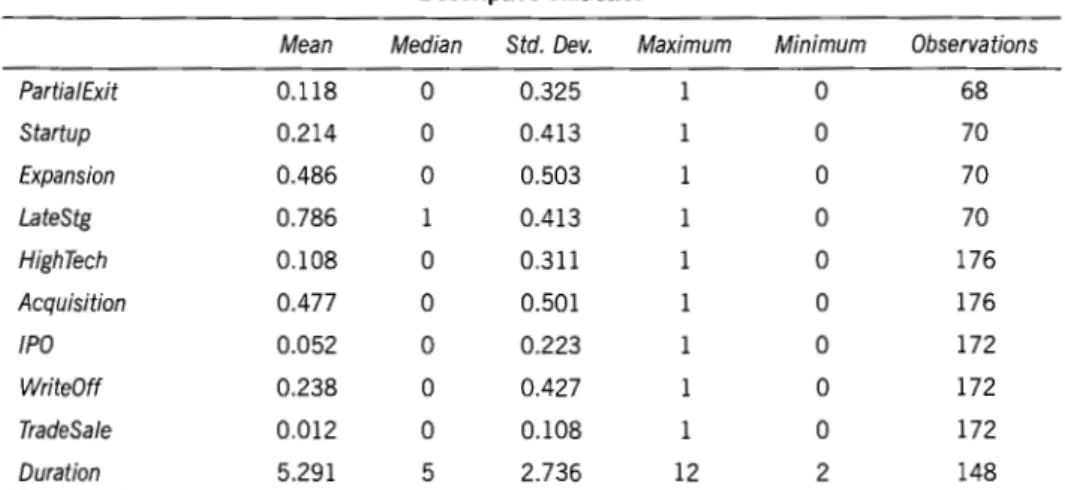
Tables 2 and 3, in appendices, present the descriptive statistics and the correlation matrix for the variables, respectively. Table 4 presents the logit regressions results.
It is important to mention that because we have defined the dependent
variable Partial Exit such that Y
=
1 corresponds to the occurrence of a partial exitand Y
=
0 to a total exit, then significantly positive coefficients indicate a higherprobability of a partial exit, whereas significantly negative coefficients indicate a higher probability of a total exit.
Let us analyze the three regressions presented (Model 1 to 3). Modell includes in the analysis the exit type and the duration. Model 2 includes as explanatory factors the type of exit, the investment type and the industry type. Finally, Model
3 includes the exit type and the investment type.3
In the first model, there are only two significant variables: IPO and investment duration. These results are consistent with our hypotheses that partial exits are more likely to be observed when exit occurs through IPO and that the longer the duration, the smaller the probability of occurrence of a partial exit. In addition, for Acquisition and WriteOff the partial exit probability does not differ significantly from the excluded exit form (Others). This is also in accordance with our expectations.
3 There may be some possibility of endogeneity problems, in particular, with respect to type of exit, since the decisions on the extent of exit and form of exit are likely to be simultaneous. However, taking into account our data, it is very hard (if not impossible) to test whether that problem is empirically relevant in our case. The lack of valid instrumental variables does not allow us to do an endogeneity test (Durbin-Wu-Hausman test). It is worth mentioning that Cumming and Macintosh (2003) did not find significant evidence of endogeneity.
PORTUGUESE JOURNAL OF MANAGEMENT STUDIES, VOL. XIV, NO. 3, 2009
In Model 2 we analyzed the impact of three factors: the exit type; the industry type; and, the venture capital investment type. In this model, only the exit type is statistically relevant. As in the previous model, when the exit vehicle is an I PO, the probability of a partial exit is higher.
Although the remaining variables are not statistically significant, it is worth mentioning that the coefficient of the High Tech variable is positive, which is the expected sign. Recall that, as we have seen in Table 1, the majority of the venture capital investments did not occur in high-tech companies, which may explain the lack of significance of the coefficient.
Finally for this model, we have the variables regarding the investment type carried out, Startup and Expansion. The two variables are not statistically significant, which means that the probability of a partial exit in these two types of investments does not differ significantly from the probability of a partial exit in other investments (Otherslnvt). It should be noted that the coefficients of the variables Startup and Expansion are both positive. Considering our fourth hypothesis, the sign of the coefficient associated with Startup is the expected one. However, the same hypothesis leads us to expect a smaller coefficient for Expansion than for Startup, which is not the case. Thus the evidence regarding the investment type is not supportive of our hypothesis that earlier stage investments have higher probability of partial exits. If we compare these results with the ones reported in the literature (see Table 5), a similar situation was verified (both in terms of lack of significance as well as in terms of the signs of the coefficients).
In Model 3 we considered two factors: the exit type and the investment type.
Again we only obtain coefficients with statistical significance for the /PO variable. The
remaining variables are not statistically significant but they have the same signs as in Model 2, thus our previous comments for Model 2 are valid for Model 3 as well.
It is interesting to compare our results with the ones obtained by Cumming and Macintosh (2003). Table 5 in the appendix summarizes this comparison. It should be noted that our dependent variable takes the value 1 when a partial exit occurred and the value 0 when a total exit occurred whereas Cumming and Macintosh (2003) consider the contrary. As a consequence our results are consistent with theirs if the signs of the coefficients are opposite. Table 5 reveals that our results are quite similar in qualitative terms to the ones obtained by Cumming and Macintosh (2003). The impact of IPO is significant in both studies and it is in accordance with the hypothesis that when the exit is through I PO, it is more likely that partial exit is used as a form of signalling the quality of the participated firm. Moreover, although in our model, the high-tech dummy is not statistically significant, its sign is in accordance with the ones obtained by Cumming and Macintosh (2003) and with our informational asymmetry hypothesis.
Our results differ from Cumming and Macintosh (2003) with respect to the impact of the duration on the probability of a partial exit. Since the asymmetry of
PORTUGUESE JOURNAL OF MANAGEMENT STUDIES, VOL. XIV, NO. 3, 2009
information is likely to decrease as the duration of the investment increases, our results support the hypothesis that the partial exit probability increases with the degree of information asymmetry.
8. CONCLUSIONS
This article analyzes Portuguese venture capital exits. The main hypothesis being tested is that the higher the degree of asymmetric information between the venture capitalist and the buyer of the participated company, the higher the probability of occurrence of a partial exit. This hypothesis is based on the idea that partial exits may be used to signal the quality of the participated firm.
The article provides two interesting contributions to the literature. One the one hand it contributes to a better knowledge of the Portuguese venture capital market through the descriptive analysis of the data used. On the other hand the article contributes to the small empirical literature on partial venture capital exits.
The Portuguese venture capital market in the period under analysis, 1998-2000, was a market where the majority of investments occurred in the non high-tech industries, the average duration of the investments was of 5.291 years, and where the most frequent exit type was acquisition followed by write-offs.
The result of our logit models are, to a large extent, supportive of the hypothesis that partial exits may be used as a signal of the quality of the participated firm and to reduce the informational asymmetry between the venture capitalist and the buyer of his participation. We expect the informational asymmetries to be higher when exit occurs through IPO, when the participated company is in a high-tech industry, when the investment is of the early-stage type, and when the duration of the investment is smaller. Our results showed that the probability of a partial exit is higher when the exit occurred through an IPO and that the probability of a partial exit decreases with the investment duration. These two results are consistent with the informational assumption being tested. Moreover, although the impact is not statistically significant, the sign of the coefficient associated with high-tech investments is also in accordance with the theory.
One of the limitations of this study is that the information available was incomplete and restricted to a short period of time. It would be important to carry out efforts to collect information about the Portuguese venture capital market from 2000 up till now. This would allow the analysis of the evolution of the market and permit a comparative analysis with other venture capital markets.
PORTUGUESE JOURNAL OF MANAGEMENT STUDIES, VOL. XIV, NO. 3, 2009
ACKNOWLEDGMENTS
We are grateful to two anonymous referees for their comments and suggestions.
We gratefully acknowledge partial financial support from FCT (Funda~ao para a
Ciencia e Tecnologia), program POCTI and FCT financial support to the project PTDC/GES/72859/2006.
PORTUGUESE JOURNAL OF MANAGEMENT STUDIES, VOL. XIV, NO. 3, 2009
References
Admati, A.R. and Perry, M. (1991). Joint projects without commitment, The Review of Economic Studies, Vol. 58 (2), pp. 259-276.
Barry, C. B., Muscarella, C.J., Peavy, J.W. and Vetsuypens, M.R. (1990). The role of venture capital in the creation of public companies: Evidence from the Going Public Process, Journal of Fi-nancial Economics, Vol. 27 (2), pp. 447-471.
Bergemann, D. and Hege, U. (1998). Venture capital financing, moral hazard, and learning, Journal of Banking & Finance, Vol. 22 (6-8), pp. 703-735.
Bias, B. and Casamatta, C. (1999). Optimal leverage and aggregate investment, The Journal of Finance, Vol. 54 (4), pp. 1291-1323.
Black, B.S. and Gilson, R.J. (1998). Venture capital and the structure of capital markets: banks versus stock markets, Journal of Financial Economics, Vol. 47 (3), pp. 243-277.
Bradford, T. and Smith, R.C. (1997). Private equity: sources and uses, Journal of Applied Corporate Finance, Vol. 10 (1), pp. 89-97.
Brav, A. and Gompers, P.A. (1997). Myth or reality? The long-run underperformance of initial public offerings: evidence from venture and nonventure capital-backed companies, The Journal of Finance, Vol. 52 (5), pp. 1791-1821.
Brealey, R.A. and Myers, S.C. (1998). Princfpios de Finanr;;as Empresariais (Translation of the 58 American edition, The McGraw-Hill Companies, Inc., EUA).
Casamatta, C. and Haritchabalet, C. (2003). Learning and syndication in venture capital invest-ments. Cahier de recherche n° 2003 - 157, Centre de Recherche en Gestion, IAE de Toulouse.
Casamatta, C. (2002). Financing and advising: optimal financial contracts with venture capitalists, Cahier de recherche n° 2002- 154, Centre de Recherche en Gestion, IAE de Toulouse. Cumming, D.J. and Macintosh, J.G. (2002). Venture capital exits in Canada and the United States,
Research Paper N° 01-01 of University of Toronto, Faculty of Law.
Cumming, D.J. and Macintosh, J.G. (2003). A cross-country comparison of full and partial ven-ture capital exits strategies, Journal of Banking & Finance, Vol. 27 (3), March 2003, pp. 511-548.
Gompers, P.A. (1995). Optimal investment, monitoring, and the staging of venture capital, The Journal of Finance, Vol. 50 (5), pp. 1461-1489.
Hellmann, T. (1994). Financial structure and control in venture capital, Chapter 2 of the PhD Thesis (Stanford University).
Jeng, L.A. and Wells, P.C. (2000). The determinants of venture capital funding: Evidence across countries, Journal of Corporate Finance, Vol. 6 (3), pp. 241-289.
Kraus, T. and Burghof, H.P. (2003). Post-IPO performance and the exit of venture capitalists, Working paper presented at University of Munich, Seminar fUr Kapitalmarktforschung, January of 2003. Lerner, J. (1994). Venture capitalists and the decision to go public, Journal of Financial Economics,
Vol. 35 (3), pp. 293-316.
Lerner, J. (1998). Comment on Bergemann and Hege, Journal of Banking and Finance, Vol. 22 (6-8), pp. 736-740.
Manigart, S., Waele, K.D., Wright, M., Robbie, K., Desbrieres, P., Sapienza, H. and Beekman, A. (2000). Venture capitalists, investment appraisal and accounting information: a comparative study of the USA, UK, France, Belgium and Holland, European Financial Management, Vol. 6 (3), pp. 389-403.
Megginson, W.L. and Weiss, K.A. (1991). Venture capitalist certification in initial public offerings, The Journal of Finance, Vol. 46 (3), pp. 879-903.
Mull, R. (1994). Venture Capital, Private firms, and the capital acquisition process, The Journal of Small Business Finance, Vol. 3 (3), pp 229-248.
Noe, T.H. and Rebello, M.J. (1996). Asymmetric information, managerial opportunism, financing, and payout policies, The Journal of Finance, Vol. 51 (2), pp. 637-660.
PORTUGUESE JOURNAL OF MANAGEMENT STUDIES, VOL. XIV, NO. 3, 2009
Repullo, R. and Suarez, J. (1998). Venture capital finance: a security design approach, CEMFI Working paper N° 9804.
Sahlman, W.A. (1990). The structure and governance of venture-capital organizations, Journal of Financial Economics, Vol. 27 (2), pp. 473-521.
Subachi, P. (2001). Portugal: A growing venture market at the edge of Europe, European Venture Capital Journal.
Tejeda, R. (2003). Venture capital policy review: Portugal, OCDE-Directorate for Science, Technol-ogy and Industry, STI Working Paper 2003/18, Industry Issues.
Thakor, A.V. (1998). Comment on Trester, Journal of Banking and Finance, Vol. 22 (6-8), pp. 700-701.
Trester, J.J. (1998). Venture capital contracting under asymmetric information, Journal of Banking and Finance, Vol. 22 (6-8), pp. 675-699.
Wang, S. and Zhou, H. (2004). Staged financing in venture capital: moral hazard and risks, Journal of Corporate Finance, Vol. 10 (1), pp. 131-155.
Wooldridge, J.M. (2003). Introductory Econometrics, A Modern Approach, South-Western College Publishing, a division of Thomson Learning, USA.
PORTUGUESE JOURNAL OF MANAGEMENT STUDIES, VOL. XIV, NO. 3, 2009
APPENDIX
TABLE 2
Descriptive statistics
Mean Median Std. Dev. Maximum Minimum Observations
Partial Exit 0.118 0 0.325 0 68 Startup 0.214 0 0.413 0 70 Expansion 0.486 0 0.503 0 70 LateStg 0.786 0.413 0 70 High Tech 0.108 0 0.311 0 176 Acquisition 0.477 0 0.501 0 176 !PO 0.052 0 0.223 0 172 Write Off 0.238 0 0.427 0 172 TradeSale 0.012 0 0.108 0 172 Duration 5.291 5 2.736 12 2 148 TABLE 3 Correlation Matrix {1) (2) (3) (4) (5) (6) (7) (8) (9) (10) (1) Partial Exit 1.000 (2) Startup -0.061 1.000 (3) Expansion 0.165 -0.508 1.000 (4) LateStg 0.061 -1.000 0.508 1.000 (5) High Tech 0.027 -0.058 0.057 0.058 1.000 (6) Acquisition -0.161 -0.060 -0.031 0.060 -0.149 1.000 (7) /PO 0.335 -0.064 0.128 0.064 0.084 -0.230 1.000 (8) WriteOff -0.008 0.118 -0.121 -0.118 0.064 -0.547 -0.132 1.000 (9) TradeSa/e NA NA NA NA 0.135 -0.106 -0.026 -0.061 1.000 ( 1 0) Duration -0.040 -0.082 0.080 0.082 -0.034 0.012 -0.060 -0.037 0.030 1.00 255
PORTUGUESE JOURNAL OF MANAGEMENT STUDIES, VOL. XIV, NO. 3, 2009
TABLE 4
Results of the Logit Models explain for the probability of partial exits
Modell Model 2 Model3 Variable
c
-0.214 -2.697*** -2.643*** (-0.138) (-2.575) (-2.708) Acquisition -1.164 -0.597 -0.651 (-0.804) (-0.607) (-0.676) /PO 46.052*** 45.213*** 45.150*** (33.670) (37.599) (37.750) WriteOff -0.939 0.077 0.045 (-0.608) (0.059) (0.035) High Tech 0.234 (0.201) Duration -0.294* (-1.800) Startup 0.308 0.302 (0.204) (0.202) Expansion 1.023 1.031 (0.941) (0.947) Log likelihood -12.257 -19.061 -19.077 LR statistic 6.147 6.295 6.261 McFadden R-squared 0.200 0.142 0.141 Number of observations: 176Note: In parentheses we present the values ofthe !-statistic for each variable. The tests statistics are significant at the following levels: • significant at 10%; **significant at 5%; ***significant at 1%.
PORTUGUESE JOURNAL OF MANAGEMENT STUDIES, VOL. XIV, NO. 3, 2009
TABLE 5
Comparison between our results and the ones of Cumming and Macintosh
Y = 1 ~Total Exit Y = 0 ~ Total Exit Y = 0 ~ Partial Exit Y = 1 ~ Partial Exit C&M for the C&M for the C&M for the
Model 1 Model2 Model3
EUA Canada Total
Variable
c
+* +* +** *** *** !PO ** ** +*** +*** +*** Secondary Sale ** * Buyback ** * Acquisition WriteOff +* + +* + + TradeSale High Tech ** + * + Duration * * Startup + + + + + Expansion + + + + + ResumoEste artigo ana lisa as saidas de investimentos de capital de risco em Portugal, abordando a rela~ao existente entre as formas de saida e a assimetria de informa~ao a elas associadas. A hip6tese central
e
a de que a ocorrencia de saidas parciais esta associada a sinalizagao da qualidade do investimento e a redugao do grau de assimetria.Os dados resultaram de um estudo elaborado pelas empresas Small Business Investment, S.A. e Price WaterHouse Coopers, para a Associagao Portuguesa de Capital de Risco e de Desenvolvimento (APCRI), mediante questionario enviado as empresas de capital de risco residentes em Portugal.
Utilizaram-se modelos Logit, nos quais a variavel dependente e uma dummy que indica se ocorreu uma saida parcial e as variaveis independentes sao todas dummies relativas a caracteristicas do investi-mento e do desinvestiinvesti-mento.
Concluimos que quando a sa ida ocorre par via de uma IPO au menta a probabilidade de ocorrencia de uma saida parcial e que quanta maior for a duragao menor
e
a probabilidade de ocorrencia de uma said a parcial. Ambos os resultados suportam a hip6tese de que quanta maior foro nfvel de assimetria de informagao maiore
a probabilidade de ocorrencia de uma said a parcial.Palavras-Chave: Capital de risco; Saidas Parciais; I PO; Vendas a Terceiros; Liquidag6es; Assimetria de I nformagao.
JEL Classification: G24, G31, G32.