i
Universidade de Lisboa
Faculdade de Ciências
Departamento de Química e Bioquímica
AN INNOVATIVE STRATEGY FOR THERAPEUTIC
ANGIOGENESIS: LOW DOSES OF IONIZING
RADIATION
Versão Pública
Mestrado em Bioquímica
Especialização: Bioquímica
Andreia Alexandra Santos de Areosa Pena
Dissertação orientada por:
Susana Constantino Rosa Santos
António Eduardo do Nascimento Ferreira
ii
ACKNOWLEDGEMENTS
Em primeiro lugar, gostaria de agradecer à minha orientadora Professora Doutora Susana Constantino por me ter recebido na Unidade de Angiogénese e por me ter orientado, ensinado e apoiado ao longo deste ano.
Ao meu orientador interno, Professor Doutor António Ferreira, um muito obrigado. Quero também agradecer a todos os membros da Unidade de Angiogénese. Um obrigado muito especial à Paula que me acompanhou ao longo de todo o projeto e que se mostrou sempre disponível para me ajudar em tudo o que eu precisasse. Obrigado Augusto por todos os procedimentos que realizaste nos ratinhos e por os teres feito sempre com permanente boa disposição. Muito obrigada Adriana e Rita pela total disponibilidade que sempre demonstraram ter para me ajudarem. Muito obrigada Liliana, Filipa e Carolina por todo o vosso apoio! Por fim, quero agradecer aos meus colegas Teresa e Telmo por me terem apoio e proporcionado grandes momentos de diversão (sejam eles com a escrita de um livro/novela ou a tentar incutir “bons gostos musicais”).
Agradeço também a toda a Unidade de Morfogénese Vascular do Instituto de Medicina Molecular, em especial ao Doutor Cláudio Areias Franco, pela colaboração e toda a ajuda prestada com o modelo de neoangiogénese da retina nos ratinhos neonatais. Quero também agradecer à Professora Doutora Raquel Soares da Faculdade de Medicina da Universidade do Porto por toda a ajuda e discussão que existiram ao longo deste projeto.
Agradeço ainda aos serviços de Radioterapia do Hospital de Santa Maria; ao departamento de Anatomia da Faculdade de Ciências Médicas da Universidade Nova de Lisboa e ao Laboratório de Histologia e Patologia Comparada, à unidade de BioImagem e ao Biotério do Instituto de Medicina Molecular, sem os quais não teria sido possível executar este trabalho.
Um obrigado a toda a minha família, em especial aos meus pais e à minha irmã, por todo o apoio que me deram ao longo deste ano.
Por fim queria ainda agradecer a todos os meus amigos e colegas. Muito obrigada Carolina, Rita, Catarina e Rafa, por ao longo destes últimos 5 anos me acompanharam em bons e maus momentos e por sempre me ajudarem a ultrapassar os meus “mas, mas, mas, …” existenciais. Fadhil e Susana muito obrigada pela permanente boa disposição e otimismo para com tudo e todos. Nádia, Romina e Ricardo muito obrigada por continuarem a apoiar-me mesmo à distância!
iii
ABBREVIATIONS ALK - Activin receptor like kinase
ANG - Angiopoietin BW – Body weight
CLI - Critical limb ischemia CVD - Collateral vessel density Dll - Delta like ligand
DM – Diabetes mellitus EC - Endothelial cell ECM – Extracellular matrix ENGR - Endoglin receptor
EPC - Endothelial progenitor cell EphB - Ephrin type B receptor ESC - Embryonic stem cell FGF - Fibroblast growth factor FGFR - FGF receptor
FZD - Frizzled
HIF - Hypoxia inducible factor HMGB – High mobility group box iPC - Induced pluripotent stem cell LDIR – Low doses of ionizing radiation MMP - Metalloproteinase
NRP - Neuropilin PD - Postnatal day
PAD - Peripheral arterial disease PDGF - Platelet-derived growth factor PlGF - Placental growth factor
PPAR – Peroxisome proliferator activated receptor RAGE – Receptor advanced glycation end product ROI - Region of interest
iv RT - Room temperature
SD – Standard deviation SMC - Smooth muscle cell STZ - Streptozotocin
TGF - Transforming growth factor
TIE - tyrosine kinase with immunoglobulin-like and EGF-like domains VEGF - Vascular endothelial growth factor
VEGFR- VEGF receptor
VPF - Vascular permeability factor vSMC - Vascular smooth muscle cell
v INDEX
1. INTRODUCTION ... 1
1.1. Angiogenesis... 1
1.2. Angiogenic mechanisms ... 2
1.2.1. Mouse retina model of angiogenesis ... 6
1.3. Regulation of angiogenesis ... 8
1.3.1. Angiopoietin family ... 8
1.3.2. Vascular Endothelial Growth Factor family ... 9
1.3.3. Transforming Growth Factor family ... 10
1.3.4. Fibroblast Growth Factor family ... 11
1.3.5. Platelet-Derived Growth Factor family ... 12
1.3.6. Notch and Wnt family ... 12
1.4. Physiological versus Pathological angiogenesis ... 14
1.4.1. Peripheral arterial disease ... 15
1.5. Therapeutic Angiogenesis ... 17
1.5.1. Pro-angiogenic Therapy ... 18
1
1. INTRODUCTION 1.1. ANGIOGENESIS
During embryogenesis and adulthood, vertebrate blood vessels have essential functions. The circulatory system (blood and lymphatic vessels) is responsible for the distribution of oxygen and nutrients through the tissues and for the filtration of metabolites and waste products like carbon dioxide 1. This system permits the communication between distant tissues and plays a role in the regulation of body temperature and of pH 1,2. The structure and different levels of permeability of vessels vary on their size because of their location and function. They can be formed and remodelled by three distinct mechanisms: vasculogenesis, angiogenesis and arteriogenesis 3.
Vasculogenesis consists in the de novo formation of blood vessels by recruitment and differentiation of multipotent mesodermal cells into the endothelial lineage and occurs especially during embryo development, but also in adulthood, in tumor vascularization 4. This process is completed with formation of the primary vascular plexus (Figure 1) 3,5.
In angiogenesis, new vessels are formed from the existing vasculature in a complex and extremely coordinated process driven by endothelial cell (EC) proliferation (Figure 1) 3. This is more relevant in adult life to maintain homeostasis and may occur by sprouting or non‐sprouting mechanisms. During sprouting, new vessels are formed by branching of pre-existing ones. On the contrary, in non‐ sprouting angiogenesis, the vessels are enlarged by the proliferation of ECs within the wall of a pre-existing vessel, followed by its splitting and fusion. This process requires a precise spatial and temporal coordination of multiple steps by a series of “on” and “off” regulatory switches. Angiogenesis is regulated by different pro- and anti-angiogenic factors and the balance between them determines if the ongoing angiogenesis will be brief (physiological) or prolonged (pathological). In adult organisms, angiogenesis is necessary for wound healing, growth and action of female reproductive organs including ovulation, follicular development and formation of a fully vascularized tissue for implantation and placentation during pregnancy 6.
2
Arteriogenesis or collateral growth is the organization of mature arteries from pre-existing arterioles after arterial obstruction of a major artery. After this occlusion, the distal arterial blood pressure falls resulting in a pressure gradient along pre-existent collateral vessels. Consequently, a unidirectional flow in these vessels will be established. In the proximal arteries feeding the collateral vessels flow will increase. In the receiving artery, the direction of blood flow may reverse and the arterial blood in these vessels is fully saturated with oxygen. This process is able to fully compensate a blocked artery because vessels can grow and proliferate enough even to take over the role of this occluded artery, improving local blood flow. This growth process goes along with a diameter and wall thickness increase in the blood vessels. Frequently, these vessels assume a gradually tortuous course. Today little is known about the triggers and mediators of this mechanism in ischemic vascular diseases 3,7,8.
The formation and maintenance of a complex, highly organized and functionally competent vascular system is therefore a key component to homeostasis 6.
1.2. ANGIOGENIC MECHANISMS
During angiogenesis, new vessels form from pre-existing ones and invade avascular ischemic areas, where tissues experience hypoxia and nutrient deprivation
9,10. This process is modulated by the secretion of various growth factors and the
endpoint of this phase is the formation of a highly branched and poorly perfused network of capillary connections 10,11. This process is responsible for the formation of
Figure 1- Development of the vascular system. During vasculogenesis, endothelial progenitors give rise
to a primitive vascular of arteries and veins. During angiogenesis, the network expands, pericytes (PCs) and smooth muscle cells (SMCs) cover nascent endothelial channels, and a stereotypically organized vascular network emerges. Lymph vessels develop via transdifferentiation from veins. (adapted from: Carmeliet, 2005)
3
an efficient vascular tree, containing defined arteries and veins and an optimized vascular capillary network 9,10.
The angiogenic process is composed by the following steps: (1) A structural alteration of the basement membrane occurs in a dilated mother vessel, followed by a partial degradation of the basement membrane at places where EC processes are projecting into the connective tissue; (2) migration of ECs, which are arranged in parallel, maintaining their basal-luminal polarity and forming a slit-like lumen, takes place continuously with the lumen of the mother vessel and sealed by intact inter-endothelial; (3) Basement membrane is deposited continuously by the polarized EC; (4) Pericytes proliferate and migrate along the basement membrane, resulting in a complete coverage of the new vessel (Figure 2) 10,12,13.
Initiation of sprouting requires the specification of two different EC states: tip and stalk cells, which have distinct phenotypes based on their gene expression profiles and the functional specifications of ECs within a newly formed sprout 14. Perturbations of any of these cell states compromise vessel development and function 15.
Tip cells occupy the leading position while new vessels grow regulated by a vascular endothelial growth factor – A (VEGF-A) gradient that specifies the direction of their migration, and move forward towards the capillary-free zone 14,16. These cells have low Notch activity, high vascular endothelial grow factor receptor – 2 (VEGFR-2) and low VEGFR-1 expression, which results in higher levels of delta-like ligand-4 (Dll4) expression and, hence through a higher production of Dll4 than in neighbouring cells, an increased ability to suppress its neighbouring cells from becoming tip cells 12,14-17. Tip cells are migratory and polarized and they have invasive properties and activate secreted or membrane-bound proteases for remodelling of adjacent basement membrane. Tip cells extend numerous filopodia that serve to guide the new blood vessel in a certain direction toward an angiogenic stimulus, proliferate minimally and adopt a highly branched shape while moving 15,18.
Stalk cells produce fewer filopodia, proliferate contributing to sprout elongation and form the nascent vascular lumen cells. However, this type of cell has high levels of Notch signalling activity and elevated expression of Jagged1. This antagonizes Dll4 activity, reducing the induction of Notch signalling in the adjacent tip cell, which therefore maintains its responsiveness to VEGF stimulation and migrates outward to establish a new branch 12,14-16,19.
During embryonic development, selection of tip and stalk cells is regulated by Notch signalling, through Notch family receptor (Notch1) and their transmembrane ligands (Jagged1, Jagged2, Dll1, Dll3, and Dll4) 20. In vascular ECs, these proteins are expressed on the surface of cell membranes. The interaction ligand-receptor
4
Notch/Dll4 permits the activation of an intracellular signalling cascade that determines the behaviour of ECs 19,21. Inhibition of the active state of ECs due to stimulation of Dll4/Notch-associated transduction of intracellular signal is evidently caused by lowering of their sensitivity to VEGF-A and thus restricts an excessive number of tip cells. On the other hand, lowering the levels of Dll4 expression or blocking Notch-dependent signalling cascade enhances tip cell formation, resulting in a significant enhancement in the activity of formation of the new vessels 22. In response to the action of VEGF-A, tip cells sprout in filopodia and begin to move forward. The direction and migration of these cells are regulated by the spatial distribution of VEGF-A in the tissue 20.
Angiogenesis initializes when a vessel senses a stimuli by an angiogenic factor released by a hypoxic, inflammatory or tumour cell. Pericytes first detach from the vessel wall (in response to angiopoetin-2 (ANG-2)) and release themselves, by matrix metalloproteinases (MMPs), from the basement membrane. ECs lose their junctions and the nascent vessel dilates. Next, VEGF increases the permeability of EC layer, which promotes the extravasation of proteins from plasma and lays down a temporary extracellular matrix (ECM) support. During this process, integrin signalling promotes the EC migration onto this ECM surface. Then, proteases release angiogenic factors stored in the ECM (VEGF, Fibroblast growth factor (FGF)) and remodel the ECM to allow ECs to escape from the original vessel walls. At this moment, tip cell is selected to lead the angiogenic sprouting in presence of VEGF receptors, neuropilins (NRPs) and the Notch ligands. In the neighbourhood, the other cells assume the position as stalk cells, responsible for the elongation process in presence of Notch, Wnts, placental growth factor (PlGF) and FGFs. Stalk cells are also responsible for the lumen formation and elongation mediated by VE-cadherin, CD34 and VEGF. During this process, ECs proliferate and migrate to form solid sprouts which connect with neighbouring vessels 10,20,23,24.
At this time, tip cells stop moving, the vessel lumen is formed and the blood flow contributes to stabilize the newly formed blood vessel, while oxygen supply by the blood flow lowers the local expression level of VEGF-A and other angiogenic factors induced earlier. The stalk cells proliferate even when a lumen is already formed, and because of this it is important that proliferation is tightly coordinated with EC junction formation in order to maintain patent and sealed vessels. During interactions of tip-stalk cells these sprouts form loops to establish a perfused neovessel. For this vessel to become functional, it must become mature and stable 9,23,24.
Vessel maturation occurs with a transition from actively growing vessel bed to the quiescent, fully formed and functional network. Inhibition of endothelium
5
proliferation and emergence of new capillaries take place, in this case, along with stabilization of already existing newly formed vascular tubules and incorporation of mural cells 23. Finally, in the vessel stabilization occurs the recruiting of mural cells (pericytes and vascular smooth muscle cells (vSMCs)) that have important functions because disturbance of the correct formation of the wall causes an increase in vessel wall permeability. Pericytes are in contact with ECs and form walls of capillaries and immature blood vessels. The factors involved in this recruitment include (ANG1)-TIE2, platelet-derived growth factor β (PDGF-β)-PDBFR-B, transforming growth factor-β1 (TGF-β1) - activin receptor-like kinase 5 (ALK5; TGFβ-R1) and Notch pathway components. They have a vessel stabilising effect on newly formed vessels and arrest their growth via inhibition of angiogenic sprouting in ECs. Recruitment of pericytes and accumulation of ECM proteins in the adjacent basement membrane contribute to vessel maturation and its transition to the quiescent state 25.
Some mature blood vessels with large diameter, such as arteries and veins, are formed by several layers of smooth muscle cells (SMCs) separated from endothelium by a layer of basement membrane. The stage of maturation, associated with formation of the newly formed vessel walls, is often distorted in various pathological situations 23.
Figure 2 - Molecular mechanism of angiogenesis. After stimulation with angiogenic factors, the
quiescent vessel dilates and an EC tip cell is selected to ensure branch formation. Tip cell formation requires degradation of the basement membrane, pericyte detachment and loosening of endothelial cell junctions. Increased permeability permits extravasation of plasma proteins to deposit a provisional matrix layer, and proteases remodel pre-existing interstitial matrix, all enabling cell migration. Then, tip cells navigate in response to guidance signals and adhere to the extracellular matrix to migrate. Stalk cells behind the tip cell proliferate, elongate and form a lumen, and sprout fuse to establish a perfused neovessel. Proliferating stalk cells attract pericytes and deposit basement membranes to become stabilized. Recruited myeloid cells such as tumour-associated macrophages and TIE-2-expressing monocytes can produce pro-angiogenic factors or proteolytically liberate angiogenic growth factors from the ECM. After fusion of neighbouring branches, lumen formation allows perfusion of the neovessel and the re-establishment of junctions, deposition of basement membrane, maturation of pericytes and production of vascular maintenance signals. (adapted from: Carmeliet and Jain, 2011a)
6
1.2.1 MOUSE RETINA MODEL OF ANGIOGENESIS
In humans, the retina begins to vascularize during embryogenesis. At week 40, the baby is born with fully developed retinal vessels and with regressed hyaloid vasculature 26.
In contrast to humans, the mouse retina is vascularized only after birth 27. The fact that vascularisation occurs postnatally, makes this model very commonly used, because it permits imaging the planar vascular plexus with different antibodies and contrasts at high resolution microscopes 13, and observe the different stages of angiogenic network formation. Importantly, it allows to investigate developmental and pathologic vessel growth in vivo.
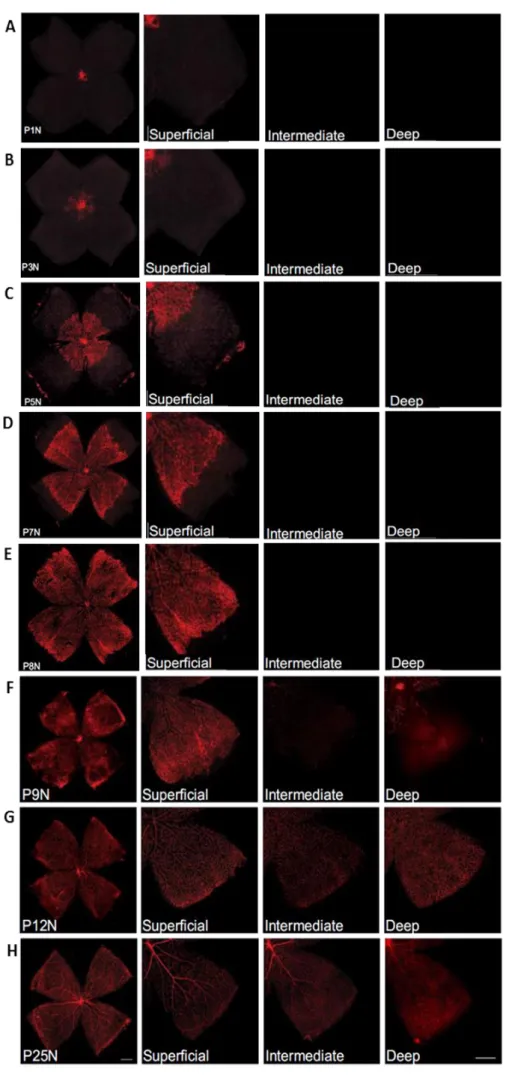
In mice, during embryonic periods, the retina has no proper vascular system 27. Around embryonic day 17, astrocytes migrate into the retina from the optic nerve and form a fine meshwork extending towards the periphery 27,28. Immediately after birth (Figure 3A), the retinal vascular system starts to develop as a sprout from the optic disc and initially forms a primitive vascular plexus, guided by the preformed astrocyte network 28,29. The superficial vascular plexus is formed until postnatal day 8 (PD 8) (Figure 3E), and during this time retinal vessels continue to extend radially over the superficial layer from the optic nerve into the periphery of the retina, to form a two-dimensional vascular structure. The superficial layer is composed by distinct arteries, veins, and capillaries. Some of the capillaries are pruned whilst others are strengthened. Pruning can occur via migration and relocalization or via selective EC apoptosis and it is evident in the vicinity of arteries where capillary-free zones exist. At PD 7 (Figure 3D) the superficial capillaries start sprouting downwards into the retina to form additional plexuses: first the deep and then the intermediate vascular plexus. The deep plexus is formed at approximately PD 12 (Figure 3G), localized in the outer plexiform layer and it is formed faster and develops independently of retinal astrocytes. The intermediate plexus in the inner plexiform layer is formed between PD 12- PD 25. All three vascular layers are totally formed and matured by the end of PD 25 (Figure 3H) and at this stage vessels are found to be predominantly arteriolar in the superficial layer and predominantly venular in the deep capillary bed. The vascular layers are interconnected with perpendicular branches, but have no direct communication with the choroidal vascular system 27-30.
After the completion of angiogenesis, retinal vasculature enters in quiescent stages.
7
Figure 3- Development of the superficial, deep and intermediate vascular plexus in C57Bl/6 mouse retinas. Retinal whole mounts from P1 to
P25 were stained for endothelial cells with isolectin B4-Alexa 594 (red). P signifies Postnatal day and N signifies normal development. A, B, C, D, E) At P1N, the mouse retina is almost completely devoid of blood vessels. The superficial vascular plexus can be seen originating from the optic nerve head. During the first week of postnatal development, the superficial plexus extends radially from the optic nerve head into the surrounding tissue, reaching the retinal periphery at P8N. F) At P9N, the superficial plexus has fully extended to the peripheral retina. The deep vascular plexus begins forming centrally from vertical vessels diving down from the superficial plexus. The intermediate vascular plexus has not yet begun to form. G) At P12N, the intermediate vascular plexus becomes visible on retinal whole mounts. The deep vascular plexus is nearly fully developed.
H) Between P21N and P25N, further
maturation of especially the intermediate plexus can be observed. (adapted from: Stahl et al., 2010)
8
Retina mouse model was used to study the VEGF 14,31 and its different isoforms expression 32, how this could influence this aspect of vascular network maturation 14 and how ECs respond to VEGF gradients by tip cell formation and guided migration of retinal vascular development. More recently, the important role of the Notch signalling pathway has also been extensively studied in this model. Also, it was seen that in retinal angiogenesis, most of the vascular sprouts are originated from venous vessels in the optic nerve and express ephrin type-B receptor 4 (EphB4). The expression of ephrinB2 is restricted to only a few vessels around the optic disc until PD 3 19.
This model is frequently used to study ischemic diseases and to mimic the aspects of human retinopathy of prematurity (ROP) and diabetic retinopathy 13,20. ROP is characterized by a temporal arrest in development of the retinal vasculature, followed by outgrowth of abnormal vessels in premature babies. On the other hand, in diabetic retinopathy, the retina’s eye presents damage in the blood vessels caused by diabetes
20
.
1.3. REGULATION OF ANGIOGENESIS
Angiogenesis requires a complex and precise coordination of multiple steps, which are regulated by a delicate balance between pro‐ and antiangiogenic factors.
1.3.1. ANGIOPOIETIN FAMILY
The ANG is a paracrine growth factor and consists of four members, ANG-1, ANG-2, ANG-3 and ANG-4, which bind to specific tyrosine kinase with immunoglobulin-like and EGF-immunoglobulin-like domains - 1 (TIE-1) and TIE-2 33,34. These factors maintain quiescence while still able to respond to angiogenic stimuli 23. Knockout experiments in mice suggest a role for these receptors in blood vessel maturation. Both ANG-1 and ANG-2, expressed by a broad variety of cell types (ECs, SMCs, fibroblasts, pericytes, some tumor cell lines), play a role in angiogenesis by binding to TIE-2, which is mainly expressed in ECs. ANG-1 is expressed by mural and tumoral cells and stimulates mural coverage and basement membrane deposition, thereby promoting vessel tightness; ANG-2 is related to tip cells in the angiogenic process 35.
The ligands (ANG-1 and ANG-2) for TIE-2 were discovered recently, but only ANG-1 results in a signal transduction leading to stabilization and regulation of blood vessel maturation 33,34. ANG-2 is an antagonist of ANG-1 that can block ANG-1 and induce autophosphorylation of TIE-2 in ECs. Overexpression of ANG-2 led to a fatal phenotype similar to ANG-1 and TIE-2 knockout mice. ANG-4 has not been as well studied but is thought to act like ANG1. In the presence of angiogenic stimulators,
9
sprouting ECs release ANG-2 which antagonizes ANG-1 and TIE-2 signalling to enhance mural cell detachment, vascular permeability and EC sprouting. Recently, it was proposed a complementary role between VEGF and ANG in vascular development and angiogenesis. During embryogenesis VEGF promotes differentiation and proliferation of ECs and the formation of immature vessels. ANG-1 bounds to TIE-2 receptor and induces the remodelling and stabilizing of the blood vessels in interaction with ECM. In an adult vessel, ANG-1 is associated with TIE-2 to keep the vessels in a stable state. In the presence of VEGF, ANG-2 is responsible for an increase in capillary diameter, migration and proliferation of ECs and sprouting of new blood vessels 33.
1.3.2. VASCULAR ENDOTHELIAL GROWTH FACTOR FAMILY
Initially VEGF was named Vascular Permeability Factor (VPF) because of its ability to induce vascular leakage and it is a heparin-binding homodimeric glycoprotein
36
. VEGF family in mammals includes VEGF -A, -B, -C, -D, -E (parapox virus VEGF) and PlGF 33,34. VEGF-A (commonly named VEGF) is the best characterized member and the major mediator of normal and tumour angiogenesis during migration and mitosis of ECs and in the creation of blood vessel lumen. Vegf-a gene has an alternative splicing and produces 6 isoforms of VEGF-A 34. VEGF-B is functional during embryonic angiogenesis in myocardial tissue and VEGF-C acts in lymphangiogenesis (the formation of new lymphatic vessels from pre-existing ones). VEGF-D is essentially for the development of lymphatic vasculature surrounding lung bronchioles and PlGF is dispensable for development but, in a disease situation of ischemia or cancer, it is important for vasculogenesis and angiogenesis 37.
VEGF is one of the most important angiogenic regulators for ECs in vivo and in vitro. In in vitro conditions, VEGF induces the expression of anti-apoptotic proteins and consequently prevents apoptosis of ECs 37.
This factor stimulates cellular responses by binding to transmembrane tyrosine kinase receptors (initial receptor names are given in parentheses): VERGFR-1 (FLT1), R-2 (Flk1/KDR) and -R3 (FLT4), expressed in ECs, and causing them to dimerize and become activated through transphosphorylation, although to different sites, times, and extents 34. The affinity of biding in VEGF/VEGFR-1 is higher than in VEGF/VEGFR-2. Although VEGFR-1 was identified first, its functions are still not quite clear, but it is thought to act like a negative regulator during embryonic development. However, in adult VEGFR-1 is important in activation of VEGFR-2 and in angiogenesis binding of PlGF. VEGFR-2 binds to VEGF-A, -C and –D and it is important during proliferation and migration processes during vasculogenesis and angiogenesis 33. Recent evidences suggest that the biological effect of this receptor signalling depends on its
10
subcellular localization. NRPs such as NRP1 and NRP2 are VEGF co-receptors and enhance the activity of VEGFR-2. VEGFR-1 and VEGFR-2 are abundantly expressed on blood ECs. VEGFR-3 is necessary for the formation of vasculature during early embryogenesis, but later is found in lymphatic endothelium to regulate lymphangiogenesis 23,37.
VEGF is expressed in different tissues and is induced by several factors like hypoglycaemia, shear and cell stress, growth factors, oncogenes and hormones 23,33,37. Importantly, VEGF levels are also regulated by tissue oxygen tension, since exposure to hypoxia induces VEGF expression (through hypoxia inducible factor 1, HIF1), while in normoxia a down-regulation of VEGF production is observed leading to regression of newly formed blood vessels. When overexpressed, this factor leads to diseases like cancer. Many of the human solid tumours express increased amounts of VEGF, stimulating the development of new vessels in the growing tumor tissue 33.
VEGF creates a gradient that is responsible for tip cells to upregulate Dll4 expression, which activates Notch pathway in stalk cells. Consequently this down-regulates VEGFR-2 expression, rendering stalk cells less responsive to VEGF and thereby ensuring that the tip cell takes the lead in the angiogenic sprouting process 37.
1.3.3. TRANSFORMING GROWTH FACTOR FAMILY
TGF family is composed by TGF-β and TGF-α and they are expressed in ECs, tumour cells and pericytes 23.
TGF is secreted in a biologically inactive form that can be activated in vitro by heat, acidification and proteases. In vivo the activation of this latent form by proteases could be a regulatory mechanism for mediating TGF-β activity 36.
TGF-β is a homodimeric polypeptide and include TGF-β1, -2, -3, -4 and -5 34
. It binds to two types of serine‐threonine kinase receptors: type 1 (TGF-βR1) and type 2 (βR2), interdependent. βR1 requires βR2 to bind to β and TGF-βR2 requires TGF-βR1 for signalling. ECs could also have another specific co-receptor (type 3 receptor), ENG, which is up‐regulated during angiogenesis 38.
This factor is not an EC mitogen, so it is possible that it promotes angiogenesis by differentiating ECs after their proliferative phase has ended. This could happen by inducing the synthesis of the matrix or by stimulating angiogenesis in an indirect way, in which inflammatory cells release pro‐angiogenic factors such as VEGF, FGF and PDGF 36. It was found that its signalling regulates cell growth, differentiation, migration, adhesion, and apoptosis. Depending upon the dose and surrounding environmental conditions, TGF-β may promote pro‐ or anti‐angiogenic functions 39.
11
TGF-β1 is the most well studied member of the TGFβ family. In vitro studies show that TGF-β1 activates upon making contact between ECs and pericytes progenitors. This activation results in inhibition of EC proliferation and migration and consequently inhibition of VEGFR-2 expression, inducing the differentiation of progenitor cells to pericytes to exert a stabilization effect on newly formed vessels and arrest their growth 23. It also acts in the accumulation of ECM proteins in the adjacent basement membrane that contributes to vessel maturation 37. Mouse studies have shown that the loss of the TGF-β receptors results in arteriovenous malformations, showing the importance of this factor to stimulate angiogenesis in vivo 36.
TGF-α is mitogenic for ECs and increases angiogenesis in an in vivo murine model. This binds to endoglin receptor (ENGR), decreasing apoptosis and inducing cell proliferation, angiogenesis and metastasis in cancer 34.
1.3.4. FIBROBLAST GROWTH FACTOR FAMILY
FGF family consists of at least 19 members of mitogenic polypeptides with high affinity for heparin 36. Heparin induces oligomerization of FGF molecules promoting FGF receptor (FGFR) dimerization and activation. Receptor activation will then trigger an intracellular signal cascade leading to multiple biological responses like EC proliferation, migration and differentiation, protease production and angiogenesis 33. One example of this process occurs in the heart where FGF stimulates angiogenesis indirectly by the release of hedgehog, ANG-2 and VEGF-B 23.
The most intensively studied are basic FGF (FGF-b or FGF-2) and acidic FGF (FGF-a or FGF-1). Both are potent angiogenic factors because they are chemotactic and mitogenic for ECs, acting directly in these cells 36. These factors commonly bind to high affinity tyrosine kinase FGFRs, FGFR-1 and R-2, on the surface of target cells. This results in control of the angiogenesis and arteriogenesis processes. FGFR-1 is required for the development and maintenance of the vasculature in the embryo and FGFR-2 is important for vascular tone and maintenance of normal blood pressure and its absence could lead to embryonic death before gastrulation 23.
FGF-b was one of the first to be characterized and studied. It has multiple isoforms and in vivo induces cell proliferation and chemotaxis in cultured ECs, stimulating these cells to product proteases capable of degrading basement membrane. It also induces capillary ECs to migrate into three-dimensional collagen matrices to form capillary-like tubes 36. Deficient mice develop normally without any evident phenotype, however, they present neuronal defects and delayed wound healing. This factor is produced by tumour cell lines in vivo and thought to play a role in the growth and revascularization of solid tumours 33.
12
FGF could be released during injury playing an important role in stimulating connective tissue growth and inducing angiogenesis. Low levels of this factor could maintain the vascular integrity, as inhibition of FGFR signalling in quiescent ECs causes vessel disintegration 23.
1.3.5. PLATELET-DERIVED GROWTH FACTOR FAMILY
The PDGF family has four members: PDGF -A, -B, -C and -D, binding with distinct selectivity to the receptor tyrosine kinases PDGFRα and PDGFRβ, expressed on ECs, fibroblasts and astrocytes. Initially, it was isolated from platelets and appears to be the major source of EC growth factor activity in those cells 37. However, this factor is not secreted by these cells, but instead is sequestered intracellularly and, unlike FGF and VEGF, this factor does not bind to heparin to potentiate its activity 36.
It was described that through the expression and release of PDGF-B, endothelial tip cells recruit PDGF-Rβ-expressing pericytes to angiogenic vessels stimulating vSMC development and leading to vessel maturation 23,37.
In PDGF-B-deficient mice, several defects were found in the capillary wall formation due to insufficient content of pericytes like vessel leakage, tortuosity and bleeding. Knockout of the genes encoding the PDGF-B protein results in tumour vessel fragility and hyperdilation and PDGFR inhibition decreases tumour growth by causing pericyte detachment, leading to immature vessels that are prone to regression 23,37.
PDGF-C promotes vascular development in the embryo and in wound healing, as well as angiogenesis in avascular tissues. PDGF-D is involved in tumour revascularisation 23.
1.3.6. NOTCH AND WNT FAMILY
Notch signalling is a cell-cell communication pathway that controls multiple cell fate decisions, stem cell renewal and differentiation during embryonic and adult life.
Notch family is composed by receptors and their transmembrane ligands. In mammals, four NOTCH receptors (NOTCH-1, NOTCH-2, NOTCH-3 and NOTCH-4) and five ligands (Jagged-1, Jagged-2, Dll1, Dll3, and Dll4) are found, which are expressed on the surface of cell membranes 37,40,41.
Activation of the NOTCH receptor by delta- or jagged-type ligands on neighbouring cells results in proteolytic cleavage of the receptor and induces the release of the intracellular domain of the NOTCH receptor, which activates the transcription of NOTCH target genes 37,41.
Notch signalling is known for the “lateral inhibition” process. Initially, in this process, all progenitor cells are equivalent and express both NOTCH ligands and
13
receptors. Owing to intrinsic or extrinsic factors, one cell adopts a particular fate and inhibits its immediate neighbours from acquiring the same fate, because it starts expressing higher levels of ligand than its neighbours. Lateral inhibition utilises a feedback mechanism in which the activation of the NOTCH receptor reduces ligand expression, thereby amplifying the small differences in levels of ligand expression between the cells 20.
This pathway is essential for embryo polarity and somitogenesis; in central nervous system development and function; in cardiovascular and endocrine development and also during arterial/venous specification. In this last process during the angioblast phase occurs differentiation into ECs that acquire either an arterial or venous identity based on their expression of EphrinB2 or EphB4, respectively 41.
Recent evidence from zebrafish and mouse models indicates that VEGF and Notch signalling pathways play critical roles in the angiogenic process 12. ECs use the Notch signalling pathway to coordinate cellular behaviours during blood vessel sprouting and these cells continuously compete for the tip-cell position by fine-tuning their expression of VEGFR-2 versus VEGFR-1, indicating that this signalling circuit is constantly re-evaluated as cells meet new neighbours 15.
During sprouting, VEGF up-regulates the expression of Dll4 in endothelial tip cells. Subsequently, Dll4/Notch signalling would induce the expression of VEGFR-1, including the soluble VEGFR-1 isoform that blocks VEGF signalling and thereby limit migration and/or proliferation. This provides an important mechanism to maintain the migratory activity of the leading tip cell in response to VEGF while reducing this response in the adjacent EC. In mural ECs, Dll4 is responsible for the stimulation of vessel maturation 12,23.
ECs also express various types of Wnt ligand and their frizzled (FZD) receptors, stimulating proliferation. Notch activates Wnt signalling in proliferating stalk cells during vessel branching and this process occurs in a reciprocal-feedback system 23.
Previous experiments show that Dll4 and its ligand of NOTCH-1 and NOTCH-4 receptors plays an important role in the regulation of angiogenesis 37. Consequently, inhibition of Dll4 and Notch signalling induces the formation of more numerous but hypoperfused vessels, resulting in tumour hypoxia and growth inhibition 42.
14
1.4. PHYSIOLOGICAL VERSUS PATHOLOGICAL ANGIOGENESIS
After birth, angiogenesis still contributes to organ growth, although in the adult most ECs of the blood vessels have long-half lives and remain quiescent 43.
Physiological angiogenesis can occur only in specific situations in response to some stimuli, when ECs are activated and keep their capacity to invade tissues. These stimuli may be hypoxia, wound healing (blood coagulation and inflammation, new tissue formation and tissue remodelling), female reproductive organs that are undergoing physiological growth of injured tissue, regeneration of the endometrium during the menstrual cycle or in the placenta during pregnancy and skeletal growth
43,44
.
Pathological angiogenesis happens when the dynamic equilibrium between pro- and antiangiogenic factors is disrupted.
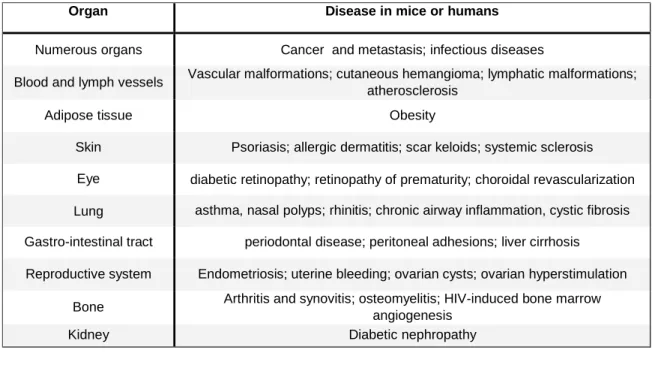
Some examples of diseases characterized or caused by excessive angiogenesis are summarized in Table 1 2.
Table 1- Diseases characterized or caused by excessive angiogenesis (adapted from: Carmeliet,
2005)
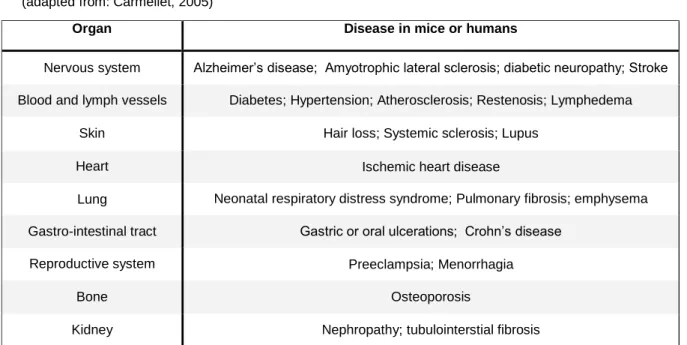
On the other hand, in other diseases such as ischemia heart disease hypertension, atherosclerosis, diabetes or preeclampsia, the angiogenic switch is insufficient causing EC dysfunction, vessel malformation or regression, or preventing revascularization, healing and regeneration (Table 2). In this situation there are more inhibitors than stimulating factors 2.
Organ Disease in mice or humans
Numerous organs Cancer and metastasis; infectious diseases
Blood and lymph vessels Vascular malformations; cutaneous hemangioma; lymphatic malformations; atherosclerosis
Adipose tissue Obesity
Skin Psoriasis; allergic dermatitis; scar keloids; systemic sclerosis Eye diabetic retinopathy; retinopathy of prematurity; choroidal revascularization Lung asthma, nasal polyps; rhinitis; chronic airway inflammation, cystic fibrosis Gastro-intestinal tract periodontal disease; peritoneal adhesions; liver cirrhosis
Reproductive system Endometriosis; uterine bleeding; ovarian cysts; ovarian hyperstimulation Bone Arthritis and synovitis; osteomyelitis; HIV-induced bone marrow
angiogenesis
15
Table 2- Diseases characterized or caused by insufficient angiogenesis or vessel regression
(adapted from: Carmeliet, 2005)
1.4.1. PERIPHERAL ARTERIAL DISEASE
Peripheral arterial disease (PAD) is characterized by an obstruction of the arterial tree of the lower limbs resulting in diminished blood supply to tissues required during exercise or even at rest 45-47.
PAD is a manifestation of systemic atherosclerosis and it is an independent predictor of increased cardiovascular death and also an important cause of morbidity and mortality 48. The prevalence for PAD is increasingly recognized as a health burden worldwide. The factors with the greatest impact for this disease are diabetes mellitus (DM), tobacco, age (>60/70 years), hyperlipidaemias and hypertension. Decreasing the level of any of these risk factors can improve the prognosis 45,48.
The severity of symptoms is dependent on the extent of the obstructive process and collateral circulation 48. It is known that after the patient is diagnosed with PAD, 25% of patients will have a worsening ischemic condition with 5 to 10% progressing to critical limb ischemia (CLI). CLI patients have chronic ischemic rest pain, ulcers or gangrene attributable to objectively proven arterial occlusive disease. It is the end-stage of PAD and occurs when blood flow and distal perfusion pressure are insufficient to satisfy the rest nutritive needs of the limb. CLI is associated to endothelial dysfunction, white blood cell activation and inflammation (Table 3) 46-48.
Organ Disease in mice or humans
Nervous system Alzheimer’s disease; Amyotrophic lateral sclerosis; diabetic neuropathy; Stroke Blood and lymph vessels Diabetes; Hypertension; Atherosclerosis; Restenosis; Lymphedema
Skin Hair loss; Systemic sclerosis; Lupus
Heart Ischemic heart disease
Lung Neonatal respiratory distress syndrome; Pulmonary fibrosis; emphysema Gastro-intestinal tract Gastric or oral ulcerations; Crohn’s disease
Reproductive system Preeclampsia; Menorrhagia
Bone Osteoporosis
16
Table 3- Pathophysiology of Critical limb ischemia (adapted from: Varu et al., 2010)
Treatment objectives in CLI include relieve of ischemic rest pain, limb salvage and improve patient function and quality of life, despite advances in surgery and interventional radiology. However, approximately 20%–30% of patients with CLI cannot be treated by conventional techniques and still require amputation 49. Actually, amputation continues to be the recommended solution to the disabling symptoms, even if it is associated to morbidity and mortality 47,48.
Almost 50% of patients with limb ischemia have DM and this factor increases the risk of PAD approximately three- to five-fold 50. PAD in patients with DM is more aggressive compared to non-diabetics, with early large vessel involvement coupled with distal symmetrical neuropathy. The need for a major amputation is five- to ten-times higher in diabetics than non-diabetics 48. In patients with CLI, progression to gangrene occurs in 40% of diabetic patients compared with 9% of nondiabetic patients
51
. Further, limb salvage rates in diabetic patients with CLI have been reported to be lower than in nondiabetic patients, and DM is an independent risk factor for postoperative amputation and complications in CLI 48.
DM is a metabolic disorder of multifactorial etiology characterized by chronic hyperglycemia and changes in the metabolism of carbohydrates, lipids and proteins resulting from absolute or relative impairment in insulin secretion and/ or reduction in its biological activity 52. This disease is also associated with a marked impairment in collateral formation and yet angiogenesis is markedly increased in several vascular beds in this disorder. The development of new vessels is significantly reduced in diabetic patients with coronary or PAD 53. DM is also correlated with peripheral neuropathy and decreased resistance to infection, which leads to an increased risk of foot ulcers and foot infections 48,52.
Macrovascular changes Microvascular changes
Atherosclerosis Decreased Nitric Oxide production
Arterial stenosis Increased Reactive Oxygen Species
Angiogenesis Increased platelet activation
Arteriogenesis Microvascular thrombosis
Increased VEGF Pre-capillary arteriole collapse
Arterial remodelling Impaired oxygen exchange
Decreased wall thickness Decreased cross-sectional area
17 1.5. THERAPEUTIC ANGIOGENESIS
The scientific advances achieved on the molecular mechanism that involves the angiogenic response, and develop disease, have triggered the path for the development of therapeutic strategies to promote or inhibit angiogenesis.
Actually, vasculogenesis and angiogenesis could be studied in numerous in vitro and in vivo research models. The in vitro models are best suited to examine specific aspects of particular processes involved in angiogenesis such as the biochemical interactions that regulate EC proliferation, motility, differentiation and apoptosis or lumen formation. However, these models are not able to recreate the microenvironment of an intact organism and the massive amount of influences on ECs in vivo. Thus, in vivo models have become crucial to understand the complex cellular interactions that enable the generation of functionally active blood vessel networks, capable of providing an appropriate blood supply and paracrine stimuli to organs. The full understanding of the angiogenic and vasculogenic processes would give us the ability to modulate blood vessels growth in a controlled manner 13.
Therapeutic angiogenesis includes pro- an angiogenic therapies. An anti-angiogenic therapy aims at the inhibition of the new blood vessel growth in the treatment of many diseases, such as arthritis and cancer. In this therapy drugs act by: i) inactivating the agents responsible to activate and promote cell growth, migration and survival; ii) upregulating inhibitors or iii) directly blocking the receptors and/or their downstream signalling 54.
On the other hand, in a pro-angiogenic therapy, blood vessels are induced and improved to grow in a controlled manner. This therapy is clinically indicated for chronic wounds (diabetic lower extremity ulcers, venous leg ulcerations, and pressure ulcers), PAD and ischemic heart disease. There are several approaches to induce angiogenesis. The most used is the direct use of angiogenic growth factors and the inhibition of anti-angiogenic factors, but gene therapy and stem cells were also used to recover perfusion 55.
18 1.5.1. PRO-ANGIOGENIC THERAPY
The concept of "therapeutic angiogenesis" has become widely accepted during the past few years. Stimulation of vascular growth in a controlled manner can be achieved by exogenous administration of pro-angiogenic factors: pro-angiogenic therapy (Figure 4).
The growth factors that have been more explored in this therapeutic option are members of the VEGF (VEGF-A, VEGF-B) 56,57 and FGF (FGF-2, FGF-1, FGF-4) 58 families. However many others have been studied, including PDGF (PDGFB) 59, HGF
60,61
and ANG (ANG-1) 62.
The potential of these therapies to revascularize tissues has been extensively studied in animal models of myocardial and peripheral ischemia.
Preclinical studies, using in vivo models and several individual angiogenic factors (VEGFs, FGFs, HIF-1α and HGF), showed significant improvements, with clinically relevant end points such as increased regional perfusion, improved exercise
Figure 4 - Post-ischemic vascular repair mechanisms and the growth factors involved. The top half
of the diagram shows angiogenic vascular repair processes that can take place after an ischemic insult (arterial occlusion), which is displayed in the bottom half of the diagram. Upon an arterial occlusion, arteriogenesis is induced by the redirection of blood flow, causing increased stress and subsequent cytokine production in the vascular endothelium. Factors such as VEGF and NO are responsible for the enlargement and growth of the collaterals, whereas factors such as PDGF and FGF mediate the stabilization of the vessels by recruiting pericytes. The hypoxic tissue distal to the occlusion (bottom half of the diagram) expresses transcription factors such as HIF, which enables the production of angiogenic proteins such as VEGF and ANG, which are involved in the modulation of the distal vasculature to make connections to the opening collaterals (angiogenesis). Angiogenesis can include sprouting, intussusception or capillary enlargement. Postnatal vasculogenesis might also contribute to post-ischemic vascular repair via the incorporation of circulating endothelial progenitor cells into the forming vascular structures. (adapted from: Dragneva et al., 2013)
19
tolerance and tissue energy metabolism, improved myocardial function and protection against ischemic damage 63.
Different animal models of peripheral ischemia were developed. For example, in ischemic rabbit hind limbs, administration of VEGF-a during neoangiogenesis, resulted in increased skeletal muscle perfusion 64,65. Additionally, VEGF-A was shown to induce the growth of the vascular tree, including collateral arteries 66. Furthermore, VEGF-A improved local perfusion, aerobic energy metabolism and exercise tolerance 65,67 and it was also reported that FGF-4 induces therapeutic angiogenesis and arteriogenesis in the local muscle perfusion 68.
Finally, proteins like HIF-1α and HGF that are responsible for recruiting an entire angiogenic response can simultaneously stimulate the expression of multiple growth factors involved in post-ischemic vascular response and tissue recovery 69,70. A recent study demonstrated that the combined Vegf and Hgf gene therapy leads to a robust angiogenic effect in ischemic skeletal muscle 71. Moreover, in diabetic mice it was demonstrated that pioglitazone, a peroxisome proliferator-activated receptor-γ (PPARγ) ligand, restores blood flow recovery and capillary density in ischemic muscle by using a hindlimb ischemia murine model. These data demonstrate that Akt-VEGF pathway is essential for the ischemia-induced angiogenic effect of pioglitazone and that pioglitazone exerts this effect in a PPARγ independent manner 72. Other study shows
that treatment with the receptor for advanced glycation end products (RAGE) significantly improved angiogenic response to ischemia in diabetic mice and was associated with increased high mobility group box-1 (HMGB-1) and VEGF levels in muscle tissues 73. In both of these works, diabetes was induced with Streptozotocin (STZ). STZ is particularly toxic to the Islets of Langherhans, insulin-producing beta cells of the pancreas, in mammals. In medical research, a large dose of STZ is used to produce an animal model of type 1 diabetes 74.
Many experimental studies performed in vitro and in vivo are encouraging, but most of these factors have been tested in clinical trials and the promising preclinical potential has thus far not been translated into clinical success clinical trials 75-77. Several factors could contribute to this failure: i) the maintenance of long lasting strong and functional vessels remains a challenge; ii) it is not clear if a single growth factor is sufficient to initiate the entire cascade of events leading to a mature, functional and stable vascular network. Moreover, proangiogenic therapy still raises some questions regarding long term side effects and it is crucial to understand if these therapies can indirectly contribute to trigger dormant tumours and and/or accelerate atherosclerosis
20
As an alternative to angiogenic factors administration, stem cell therapy is another promising therapeutic approach.
Of the available stem cell approaches, the induced pluripotent stem cell (iPSC) appears to have the greatest promise by reprogramming somatic cells. These cells can be easily accessible sources of tissue (donor’s skin, fat or hair) and have high replicative capacity. It has been shown that these cells could differentiate into each of the major cardiovascular components, including SMCs, ECs, vSMCs, and cardiomyocytes, so they are patient-specific stem cells that do not face the immunologic barrier that confront cells derived from the pluripotent embryonic stem cells (ESCs) 79,80.
ESCs are appealing in the pro-angiogenic therapy because of their pluripotency and replicative capacity. These cells are derived from the inner cell mass of the blastocyst and, unlike adult stem cells, can differentiate into any cell type or any organ of endodermal, mesodermal, or ectodermal lineage 81. However, this therapeutic option is not used due to ethical and immunologic concerns 82.
The use of “adult” stem cells, which include the endothelial progenitor cells (EPCs) is further along in clinical development than any of the other stem cell approaches. To date, therapies aimed at revascularization have included bone marrow– derived and circulating stem cells, since the mobilized EPCs enter the circulation and home to the site of ischemia 83,84. Also, it has been shown that EPCs incorporate into the vasculature, differentiating into ECs, pericytes, or SMCs. This therapeutic option could potentiate local angiogenesis by a paracrine mechanism 85.
The different forms of therapeutic angiogenesis for patients with CLI still have to prove safety and efficacy before one can conclude on its role as an additional limb saving strategy. Despite a considerable number of ongoing clinical trials, it is still a long way to run in order to achieve the patient’s benefit 46,86,87.
It is also relevant to note that ionizing irradiation has been shown to have angiogenic potential in multiple contexts, including the therapeutic one. Heissig B et al, show a novel mechanism of neovascularization and suggest that doses between 2 and 10 Gy of ionizing radiation may be used for therapeutic angiogenesis to augment vasculogenesis in ischemic tissues. However, long-term studies are needed to rule out negative side effects resulting from local ionizing irradiation administration, since potential adverse effects such as mast cell degranulation, increased melanization of the epidermis and allergic-like reactions might occur. To the best of our knowledge, to date the use of the high doses described has not been proposed for therapeutic angiogenesis 88.
21
Moreover, our research group found that low doses of ionizing radiation (LDIR), lower than 0.8 Gy, enhance EC migration without causing cycle arrest or apoptosis. These effects were shown in different in vitro and in vivo models: i) in human lung microvascular ECs, LDIR protect endothelium against cell death and promote EC migration inducing a rapid phosphorylation of VEGFR2 and VEGF production in hypoxia mimicking conditions; ii) in zebrafish, LDIR accelerate sprouting angiogenesis during development without causing excessive vessel formation and enhance the angiogenic response during caudal fin regeneration and iii) in different mice models, these LDIR promote angiogenesis and consequently accelerate tumour growth and metastasis 89.
22
2. REFERENCES
1 Lawson, N. D. & Weinstein, B. M. Arteries and veins: making a difference with zebrafish. Nature reviews. Genetics 3, 674-682, doi:10.1038/nrg888 (2002). 2 Carmeliet, P. Angiogenesis in life, disease and medicine. Nature 438, 932-936,
doi:10.1038/nature04478 (2005).
3 Semenza, G. L. Vasculogenesis, angiogenesis, and arteriogenesis: mechanisms of blood vessel formation and remodeling. Journal of cellular biochemistry 102, 840-847, doi:10.1002/jcb.21523 (2007).
4 Carmeliet, P. & Jain, R. K. Principles and mechanisms of vessel normalization for cancer and other angiogenic diseases. Nature reviews. Drug discovery 10, 417-427, doi:10.1038/nrd3455 (2011).
5 Gerhardt, H. & Betsholtz, C. Endothelial-pericyte interactions in angiogenesis. Cell and tissue research 314, 15-23, doi:10.1007/s00441-003-0745-x (2003). 6 Carmeliet, P. Angiogenesis in health and disease. Nature medicine 9, 653-660,
doi:10.1038/nm0603-653 (2003).
7 Helisch, A. & Schaper, W. Arteriogenesis: the development and growth of collateral arteries. Microcirculation 10, 83-97, doi:10.1038/sj.mn.7800173 (2003).
8 Hershey, J. C. et al. Revascularization in the rabbit hindlimb: dissociation between capillary sprouting and arteriogenesis. Cardiovascular research 49, 618-625 (2001).
9 Risau, W. Mechanisms of angiogenesis. Nature 386, 671-674, doi:10.1038/386671a0 (1997).
10 Lamalice, L., Le Boeuf, F. & Huot, J. Endothelial cell migration during
angiogenesis. Circulation research 100, 782-794,
doi:10.1161/01.RES.0000259593.07661.1e (2007).
11 Potente, M., Gerhardt, H. & Carmeliet, P. Basic and therapeutic aspects of angiogenesis. Cell 146, 873-887, doi:10.1016/j.cell.2011.08.039 (2011).
12 Siekmann, A. F. & Lawson, N. D. Notch signalling and the regulation of angiogenesis. Cell adhesion & migration 1, 104-106 (2007).
13 Simons, M. et al. State-of-the-Art Methods for Evaluation of Angiogenesis and Tissue Vascularization: A Scientific Statement From the American Heart
Association. Circulation research 116, e99-132,
doi:10.1161/RES.0000000000000054 (2015).
14 Gerhardt, H. et al. VEGF guides angiogenic sprouting utilizing endothelial tip cell filopodia. The Journal of cell biology 161, 1163-1177, doi:10.1083/jcb.200302047 (2003).
15 Jakobsson, L. et al. Endothelial cells dynamically compete for the tip cell position during angiogenic sprouting. Nature cell biology 12, 943-953, doi:10.1038/ncb2103 (2010).
16 Zachary, I. & Gliki, G. Signaling transduction mechanisms mediating biological actions of the vascular endothelial growth factor family. Cardiovascular research 49, 568-581 (2001).
17 Stenzel, D. et al. Endothelial basement membrane limits tip cell formation by inducing Dll4/Notch signalling in vivo. EMBO reports 12, 1135-1143, doi:10.1038/embor.2011.194 (2011).
23
18 Small, J. V. & Resch, G. P. The comings and goings of actin: coupling protrusion and retraction in cell motility. Current opinion in cell biology 17, 517-523, doi:10.1016/j.ceb.2005.08.004 (2005).
19 Blanco, R. & Gerhardt, H. VEGF and Notch in tip and stalk cell selection. Cold Spring Harbor perspectives in medicine 3, a006569, doi:10.1101/cshperspect.a006569 (2013).
20 Geudens, I. & Gerhardt, H. Coordinating cell behaviour during blood vessel formation. Development 138, 4569-4583, doi:10.1242/dev.062323 (2011). 21 Hellstrom, M. et al. Dll4 signalling through Notch1 regulates formation of tip
cells during angiogenesis. Nature 445, 776-780, doi:10.1038/nature05571 (2007).
22 Williams, C. K., Li, J. L., Murga, M., Harris, A. L. & Tosato, G. Up-regulation of the Notch ligand Delta-like 4 inhibits VEGF-induced endothelial cell function. Blood 107, 931-939, doi:10.1182/blood-2005-03-1000 (2006).
23 Carmeliet, P. & Jain, R. K. Molecular mechanisms and clinical applications of angiogenesis. Nature 473, 298-307, doi:10.1038/nature10144 (2011).
24 Ribatti, D. & Crivellato, E. "Sprouting angiogenesis", a reappraisal. Developmental biology 372, 157-165, doi:10.1016/j.ydbio.2012.09.018 (2012). 25 Scehnet, J. S. et al. Inhibition of Dll4-mediated signaling induces proliferation of
immature vessels and results in poor tissue perfusion. Blood 109, 4753-4760, doi:10.1182/blood-2006-12-063933 (2007).
26 Xu, Q. et al. Vascular development in the retina and inner ear: control by Norrin and Frizzled-4, a high-affinity ligand-receptor pair. Cell 116, 883-895 (2004). 27 Fruttiger, M. Development of the retinal vasculature. Angiogenesis 10, 77-88,
doi:10.1007/s10456-007-9065-1 (2007).
28 Stahl, A. et al. The mouse retina as an angiogenesis model. Investigative ophthalmology & visual science 51, 2813-2826, doi:10.1167/iovs.10-5176 (2010).
29 Fruttiger, M. Development of the mouse retinal vasculature: angiogenesis versus vasculogenesis. Investigative ophthalmology & visual science 43, 522-527 (2002).
30 Provis, J. M. Development of the primate retinal vasculature. Progress in retinal and eye research 20, 799-821 (2001).
31 Dorrell, M. I., Aguilar, E. & Friedlander, M. Retinal vascular development is mediated by endothelial filopodia, a preexisting astrocytic template and specific R-cadherin adhesion. Investigative ophthalmology & visual science 43, 3500-3510 (2002).
32 Stalmans, I. et al. Arteriolar and venular patterning in retinas of mice selectively expressing VEGF isoforms. The Journal of clinical investigation 109, 327-336, doi:10.1172/JCI14362 (2002).
33 Liekens, S., De Clercq, E. & Neyts, J. Angiogenesis: regulators and clinical applications. Biochemical pharmacology 61, 253-270 (2001).
34 Tahergorabi, Z. & Khazaei, M. A review on angiogenesis and its assays. Iranian journal of basic medical sciences 15, 1110-1126 (2012).
35 Nussenbaum, F. & Herman, I. M. Tumor angiogenesis: insights and innovations. Journal of oncology 2010, 132641, doi:10.1155/2010/132641 (2010).
24
36 Klagsbrun, M. & D'Amore, P. A. Regulators of angiogenesis. Annual review of physiology 53, 217-239, doi:10.1146/annurev.ph.53.030191.001245 (1991). 37 Karamysheva, A. F. Mechanisms of angiogenesis. Biochemistry (Moscow) 73,
751-762, doi:10.1134/s0006297908070031 (2008).
38 Fonsatti, E., Nicolay, H. J., Altomonte, M., Covre, A. & Maio, M. Targeting cancer vasculature via endoglin/CD105: a novel antibody-based diagnostic and therapeutic strategy in solid tumours. Cardiovascular research 86, 12-19, doi:10.1093/cvr/cvp332 (2010).
39 Distler, J. H. et al. Angiogenic and angiostatic factors in the molecular control of angiogenesis. The quarterly journal of nuclear medicine : official publication of the Italian Association of Nuclear Medicine 47, 149-161 (2003).
40 Artavanis-Tsakonas, S., Rand, M. D. & Lake, R. J. Notch signaling: cell fate control and signal integration in development. Science 284, 770-776 (1999). 41 Kofler, N. M. et al. Notch signaling in developmental and tumor angiogenesis.
Genes & cancer 2, 1106-1116, doi:10.1177/1947601911423030 (2011).
42 Thurston, G., Noguera-Troise, I. & Yancopoulos, G. D. The Delta paradox: DLL4 blockade leads to more tumour vessels but less tumour growth. Nature reviews. Cancer 7, 327-331, doi:10.1038/nrc2130 (2007).
43 Chung, A. S. & Ferrara, N. Developmental and pathological angiogenesis. Annual review of cell and developmental biology 27, 563-584, doi:10.1146/annurev-cellbio-092910-154002 (2011).
44 Brock, T. A., Dvorak, H. F. & Senger, D. R. Tumor-secreted vascular permeability factor increases cytosolic Ca2+ and von Willebrand factor release in human endothelial cells. The American journal of pathology 138, 213-221 (1991).
45 Gornik, H. L. & Beckman, J. A. Cardiology patient page. Peripheral arterial disease. Circulation 111, e169-172, doi:10.1161/01.CIR.0000160581.58633.8B (2005).
46 Kobayashi, N. et al. Prognosis of critical limb ischemia patients with tissue loss after achievement of complete wound healing by endovascular therapy. Journal of vascular surgery 61, 951-959, doi:10.1016/j.jvs.2014.11.065 (2015).
47 Jones, W. S. et al. Comparative effectiveness of endovascular and surgical revascularization for patients with peripheral artery disease and critical limb ischemia: systematic review of revascularization in critical limb ischemia. American heart journal 167, 489-498 e487, doi:10.1016/j.ahj.2013.12.012 (2014).
48 Norgren, L. et al. Inter-Society Consensus for the Management of Peripheral Arterial Disease (TASC II). Journal of vascular surgery 45 Suppl S, S5-67, doi:10.1016/j.jvs.2006.12.037 (2007).
49 Varu, V. N., Hogg, M. E. & Kibbe, M. R. Critical limb ischemia. Journal of vascular surgery 51, 230-241, doi:10.1016/j.jvs.2009.08.073 (2010).
50 Wahlberg, E. Angiogenesis and arteriogenesis in limb ischemia. Journal of vascular surgery 38, 198-203, doi:10.1016/s0741-5214(03)00151-4 (2003). 51 Kannel, W. B. Risk factors for atherosclerotic cardiovascular outcomes in
different arterial territories. Journal of cardiovascular risk 1, 333-339 (1994). 52 Kolluru, G. K., Bir, S. C. & Kevil, C. G. Endothelial dysfunction and diabetes:
effects on angiogenesis, vascular remodeling, and wound healing. International journal of vascular medicine 2012, 918267, doi:10.1155/2012/918267 (2012).
25
53 Tamarat, R. et al. Blockade of advanced glycation end-product formation restores ischemia-induced angiogenesis in diabetic mice. Proceedings of the National Academy of Sciences of the United States of America 100, 8555-8560, doi:10.1073/pnas.1236929100 (2003).
54 Carmeliet, P. & Jain, R. K. Angiogenesis in cancer and other diseases. Nature 407, 249-257, doi:10.1038/35025220 (2000).
55 Dragneva, G., Korpisalo, P. & Yla-Herttuala, S. Promoting blood vessel growth in ischemic diseases: challenges in translating preclinical potential into clinical success. Disease models & mechanisms 6, 312-322, doi:10.1242/dmm.010413 (2013).
56 Ferrara, N. Vascular endothelial growth factor: basic science and clinical progress. Endocrine reviews 25, 581-611, doi:10.1210/er.2003-0027 (2004). 57 Yla-Herttuala, S. & Alitalo, K. On the relationship of LDL and VEGFR1: not just
a family affair. EMBO reports 8, 1127-1128, doi:10.1038/sj.embor.7401124 (2007).
58 Murakami, M. & Simons, M. Fibroblast growth factor regulation of neovascularization. Current opinion in hematology 15, 215-220, doi:10.1097/MOH.0b013e3282f97d98 (2008).
59 Fredriksson, L., Li, H. & Eriksson, U. The PDGF family: four gene products form five dimeric isoforms. Cytokine & growth factor reviews 15, 197-204, doi:10.1016/j.cytogfr.2004.03.007 (2004).
60 Aoki, M., Morishita, R., Taniyama, Y., Kaneda, Y. & Ogihara, T. Therapeutic angiogenesis induced by hepatocyte growth factor: potential gene therapy for ischemic diseases. Journal of atherosclerosis and thrombosis 7, 71-76 (2000). 61 Rissanen, T. T. & Yla-Herttuala, S. Current status of cardiovascular gene
therapy. Molecular therapy : the journal of the American Society of Gene Therapy 15, 1233-1247, doi:10.1038/sj.mt.6300175 (2007).
62 Davis-Smyth, T., Chen, H., Park, J., Presta, L. G. & Ferrara, N. The second immunoglobulin-like domain of the VEGF tyrosine kinase receptor Flt-1 determines ligand binding and may initiate a signal transduction cascade. The EMBO journal 15, 4919-4927 (1996).
63 Lahteenvuo, J. E. et al. Vascular endothelial growth factor-B induces myocardium-specific angiogenesis and arteriogenesis via vascular endothelial growth factor receptor-1- and neuropilin receptor-1-dependent mechanisms. Circulation 119, 845-856, doi:10.1161/CIRCULATIONAHA.108.816454 (2009). 64 Takeshita, S. et al. Therapeutic angiogenesis following arterial gene transfer of
vascular endothelial growth factor in a rabbit model of hindlimb ischemia. Biochemical and biophysical research communications 227, 628-635, doi:10.1006/bbrc.1996.1556 (1996).
65 Korpisalo, P. et al. Therapeutic angiogenesis with placental growth factor improves exercise tolerance of ischaemic rabbit hindlimbs. Cardiovascular research 80, 263-270, doi:10.1093/cvr/cvn195 (2008).
66 Rissanen, T. T. et al. Blood flow remodels growing vasculature during vascular endothelial growth factor gene therapy and determines between capillary arterialization and sprouting angiogenesis. Circulation 112, 3937-3946, doi:10.1161/CIRCULATIONAHA.105.543124 (2005).