ABSTRACT
BACKGROUND AND OBJECTIVES: Compare
anesthe-sia techniques with sufentanil and intraoperative infusion of remifentanil or dexmedetomidine, and to then analyze their as-sociations with the incidence of pain and other complications in the post-anesthesia care unit.
METHODS: A retrospective analytical observational study con-ducted in a reference center for bariatric surgery in São Paulo, São Paulo State, Brazil. Patients (n=120) included in the study were randomly selected using this site’s anesthesia records for bariatric surgery. Four 30-patient groups were established: G1 - induction with 0.5 µg.kg-1 sufentanil associated with the
con-tinuous infusion of remifentanil; G2 - induction with 0.7 µg.kg-1
sufentanil associated with the continuous infusion of remifent-anil; G3 - induction with 0.5 µg.kg-1 sufentanil associated with
the continuous infusion of dexmedetomidine; and G4 - induc-tion with 0.7 µg.kg-1 sufentanil associated with the continuous
infusion of dexmedetomidine. Significance was set at p<0.05. RESULTS: The incidence of pain in the post-anesthesia care unit was 52.5% (n=63). It was considered intense in 36.11% of these cases. The incidence of pain in the post-anesthesia care unit was lower in patients receiving a continuous infusion of dexmedetomi-dine relative to those who received remifentanil infusion. Sufent-anil dosage in anesthesia induction did not influence the incidence of pain (G1=G2>G3=G4; p<0.05). The occurrence of respiratory complications did not differ significantly between the groups. CONCLUSION: The use of dexmedetomidine proved to be better for analgesia in the post-anesthesia care unit, and it did not increase the risk of respiratory complications when com-pared to the continuous infusion of remifentanil, regardless of the sufentanil dose used for induction.
Keywords: Anesthesia, Bariatric surgery, Complications, Pain, Safety.
Comparative analysis of remifentanil versus dexmedetomidine in the
incidence of pain in a post-anesthesia care unit after bariatric surgery
Análise comparativa de remifentanil versus dexmedetomidina na incidência de dor na unidade
de recuperação pós-anestésica após cirurgia bariátrica
Leopoldo Muniz da Silva1, Saullo Queiroz Silveira1, Arthur de Campos Vieira Abib1, Wilson Porfírio de Medeiros Nunes1, Otto
Mittermayer1, Daniel Rodrigues de Oliveira1
1. Hospital São Luiz, Rede D’or, Departamento de Anestesiologia, São Paulo, SP, Brasil.
Submitted in March 07, 2018.
Accepted for publication on June 28, 2018. Conflict of interests: none – Sponsoring sources: none.
Correspondence to:
Rua Dr. Alceu de Campos Rodrigues, 229, Conj. 403 - Itaim Bibi 04544-000 São Paulo, SP, Brasil.
E-mail: [email protected]
© Sociedade Brasileira para o Estudo da Dor
RESUMO
JUSTIFICATIVA E OBJETIVOS: O objetivo deste estudo foi comparar técnicas anestésicas com sufentanil em diferentes doses na indução anestésica e infusão contínua de remifentanil ou dex-medetomidina no intraoperatório para manutenção da anestesia, relacionando tais fatores à incidência de dor, náuseas e vômitos no pós-operatório e demais complicações na sala de recuperação pós-anestésica.
MÉTODOS: Estudo observacional analítico retrospectivo reali-zado em pacientes obesos (n=120). Os pacientes incluídos foram selecionados aleatoriamente e constituíram 4 grupos de 30 pa-cientes cada: G1 - indução com sufentanil 0,5 µg.kg-1 associado
à infusão continua de remifentanil; G2 - indução com sufentanil 0,7 µg.kg-1 associado à infusão contínua de remifentanil; G3 -
indução com sufentanil 0,5 µg.kg-1 associado à infusão contínua
de dexmedetomidina; G4 - indução com sufentanil 0,7 µg.kg-1
associado à infusão contínua de dexmedetomidina. Considerou--se como critério de significância valor de p<0,05.
RESULTADOS: A incidência de dor na sala de recuperação pós--anestésica foi de 52,5% (n=63) e, entre esses, em 36,11% dos casos foi considerada intensa. A incidência de dor foi menor nos pacientes que receberam infusão de dexmedetomidina compara-do àqueles que receberam infusão de remifentanil. A compara-dose de su-fentanil na indução anestésica não influenciou na incidência de dor (G1=G2>G3=G4) (p<0,05). A ocorrência de complicações respiratórias não apresentou diferença estatisticamente significa-tiva entre os grupos.
CONCLUSÃO: O uso de dexmedetomidina apresentou vanta-gem em relação à analgesia na sala de recuperação pós-anestésica, sem aumento no risco de complicações respiratórias, quando comparado à infusão contínua de remifentanil, independente-mente da dose de sulfentanil utilizada na indução.
Descritores: Anestesia, Cirurgia bariátrica, Complicações, Dor, Segurança.
INTRODUCTION
In obese patients, adequate postoperative analgesia aims to provide comfort, early mobilization, and improved respirato-ry function. Anesthesia in obese patients requires special care and knowledge of the physiological alterations and their reper-cussions on the pharmacokinetics and pharmacodynamics of anesthetics.
Postoperative pain, nausea, and vomiting are relevant events since they lead to discomfort and contribute to greater morbidity1-3. In
the post-anesthesia care unit (PACU), managing postoperative pain is essential for the respiratory system to be able to adapt after the de-flation of the pneumoperitoneum, as well as for more comfortable, safer, and earlier patient recovery. The choice of anesthesia technique and the types of drugs used may be important for better managing postoperative pain. Administering sufentanil as the anesthesia in-duction opioid in morbidly obese patients has not been associated with respiratory complications, decreased oxygen saturation in pulse oximetry, or postoperative nausea and vomiting (PONV) in the PACU, and it has been found to reduce the incidence of pain when compared with other opioids used in general anesthesia4.
Dexmedetomidine is an innovative drug regarding sedation and an-algesia. Its main qualities are faster onset and the ability to allow for rapid titration, enabling the variation in the depth of analgesia and sedation. In addition, it is synergistic with other commonly used anesthetics and exhibits a low incidence of side effects and minimal respiratory depression. Anesthesia with dexmedetomidine is indi-cated for patients with morbid obesity because it decreases the con-sumption of anesthetics, contributes to cardiovascular stability, and decreases the incidence of pain, thus promoting early postoperative recovery5. However, the difference between the continuous infusion
of dexmedetomidine and the infusion of remifentanil intraopera-tively and its relationship with the incidence of pain and respiratory complications in the PACU has yet to be assessed.
Thus, the objectives of this study were to compare anesthesia techniques with sufentanil at different doses at anesthesia induc-tion and continuous intraoperative infusion of remifentanil or dexmedetomidine for maintenance of anesthesia, and to then analyze their associations with the incidence of pain, PONV, and other complications in the PACU.
METHODS
A retrospective analytical observational study was conducted by the Anesthesiology Department of São Luiz Hospital, in São Paulo, Brazil, a reference center for obesity surgery.
The patients included in this study (n=120) were randomly select-ed using the above mentionselect-ed department’s anesthesia records on video-laparoscopic bariatric surgery, in which data on the anesthe-sia technique and pharmaceuticals used were recorded. The cases were analyzed using medical charts identified only by their num-bers. Information on anesthesia techniques was obtained from the anesthesia chart in order to form the groups, while the outcomes involving pain, nausea, vomiting, and complications in the PACU were obtained from the PACU patient records. Case numbers were randomly selected from the surgeries performed between Oc-tober 2016 and May 2017. The cases were divided into 4 groups according to anesthesia technique reported. Each group had 30 randomly selected patients, for a total sample of 120 patients.
Standard institutional anesthesia protocol
All patients were assessed in a preanesthesia consultation, when data on their weight (kg) and height (cm) were collected to esti-mate the body mass index (BMI) (kg/m2).
The anesthesia technique adopted and included in the study was general balanced anesthesia with sevoflurane in a concentration sufficient to maintain the bispectral index (BIS) between 40 and 60. The minimum alveolar concentration (MAC) for sevoflurane required was 1.5%. As part of a previously established routine of the anesthesiology department, the patients were administered 40 mg parecoxib, 40 mg pantoprazole, and dexamethasone at a dose of 0.1 mg.kg-1 of adjusted body weight (ABW) up to a
maximum of 10 mg, intravenously.
In the operating room, monitoring consisted of electrocardioscope, pulse oximeter, automated non-invasive blood pressure measure-ment with an appropriate cuff covering 75% to 100% of the arm, and capnograph with a gas analyzer and BIS values. Patients were in a supine position on the operating table with a discreet 10-de-gree head elevation. All patients received mechanical prophylaxis for venous thromboembolism during surgery and pharmacological prophylaxis postoperatively. After peripheral puncture and preoxy-genation with 100% oxygen, anesthetic induction was conducted. Controlled ventilation was performed in a closed loop with a flow rate of up to 2 L.min-1, tidal volume of up to 8 mL.kg-1 ABW, up to
50% FiO2, and a respiratory rate sufficient to maintain the expired CO2 fraction between 35 and 40 mmHg.
Study groups
The entire healthcare routine was identical for all patients in the four groups since it followed a previously established protocol. Monitoring and anesthesia techniques were also the same except for the continuous infusion of dexmedetomidine or remifentanil to keep the patient under anesthesia, which varied according to the doses of sufentanil used in anesthesia induction.
Induction initiated with oxygenation with a face mask, followed by intravenous induction with the sequential administration of the following drugs: 0.5 or 0.7 µg.kg-1 (actual weight) sufentanil,
propofol (2 to 3 mg.kg-1), and rocuronium (1 mg/kg of ideal
weight). Both doses of sufentanil were included in the institu-tional protocol, and the choice was made by the anesthesiologist and then duly registered in the anesthesia chart. All patients were monitored with a TOF watch in order to keep a post-tetanic count under 5 (deep neuromuscular block). Blocker follow-up administration was gauged according to TOF results. Additional doses corresponded to 15% of the initial dose until reached deep block. Neuromuscular block was reverted with sugammadex for all patients according to TOF results. The study groups for com-parison were as follows:
• Group 1 - induction with 0.5 µg.kg-1 (actual weight) sufentanil
and continuous infusion of remifentanil hydrochloride at doses sufficient to maintain adequate anesthesia and individualized for each case (0.1 to 0.3 µg.kg.min-1) without the use of boluses of
other opioids;
• Group 2 – induction with 0.7 µg.kg-1 (actual weight)
sufen-tanil and continuous infusion of remifensufen-tanil hydrochloride at doses sufficient to maintain adequate anesthesia and customized for each patient (0.1 to 0.3 µg.kg.min-1) without the use of
bo-luses of other opioids;
• Group 3 – induction with 0.5 µg.kg-1 (actual weight)
1 µg.kg-1 administered over 10 min, followed by maintenance of
0.4 to 0.7 µg.kg-1.h-1 based on adjusted body weight;
• Group 4 – induction with 0.7 µg.kg-1 (actual weight)
sufentan-il and continuous infusion of dexmedetomidine: initial bolus of 1 µg.kg-1 administered over 10 min, followed by maintenance of
0.4 to 0.7 µg.kg-1.h-1 based on adjusted body weight.
The continuous infusion of both solutions was turned off 10 minutes before the end of the pneumoperitoneum.
Adjusted body weight was estimated with the following formula: ideal weight plus (0.4 x overweight). Ideal weight was estimated us-ing height (m) (m2) subtracted from 100 for men or 105 for women.
The variables studied were age, sex, weight, height, BMI, heart rate (HR), non-invasive blood pressure (NIBP), oxygen satura-tion (SO2), axillar temperature (°C), PETCO2 values by capnog-raphy, anesthesia time (time between anesthesia induction and extubation in min), awakening time (time between the end of surgery and extubation in min) and postoperative complications (pain, PONV, and respiratory repercussions in the PACU). Data regarding the variables HR, NIBP, PETCO2, temperature, and SpO2 were examined before starting the induction, and every 10 min until the end of the anesthesia procedure.
Near the end of the procedure (20 minutes prior), all patients re-ceived dipyrone 2000 mg, ondansetron hydrochloride dihydrate at a dose of 0.1 mg.kg-1 of ABW up to the dose of 8 mg, and
morphine at a dose of 100 µg.kg-1 of ABW, intravenously.
Be-fore the anesthesia induction, previous hydration was conducted with 10 mL.kg-1 Ringer’s lactate solution for all patients.
Intra-operatively, the infusion of liquids was 5.0 mL.kg-1.h-1.
Post-anesthesia recovery
In the PACU, all patients were monitored with an electrocardio-scope, pulse oximeter, thermometer and automated non-invasive blood pressure measurement. Patients in the PACU were assessed at four different 15-minute intervals: M1 – PACU admission; M2 – 15 min after admission; M3 – 30 min after admission; and M4 – 45 min after admission. At all intervals, patients were assessed regarding the occurrence of pain and its intensity (using a 0-10 numeric rating scale) as well as PONV and its intensity (1-4 scale). O2, HR, and NIBP were also assessed by the medical and nursing team at all intervals. Numeric Rating Scale (NRS), 11 points (zero to 10), with point zero representing no pain and point ten (10) the worst possible pain. The remaining numbers represent intermedi-ate intensities of pain (1, 2, 3 and 4 = mild (25); 5 and 6 = mod-erate; 7, 8 and 9 = strong. Sedation scales have not been evaluated. Upon admission to the PACU, patients were assessed to deter-mine their need for supplemental oxygen. M1 comprises the as-sessment of pulse oximetry without supplemental oxygen. All patients presenting pulse oximetry results of less than 94% re-ceived supplemental oxygen through a face mask with oxygen flow (5 L/min). The rescue morphine dose in case of pain in the PACU was 30-50 µg.kg-1 according to the assessment by the
PACU anesthesiologist assistant. For patients presenting PONV in the PACU, dimenhydrinate 30 mg was used as a supplemen-tary drug. All patients were classified as high risk for venous thromboembolism and received chemoprophylaxis medications in the postoperative period and antithrombotic device during
the surgery. Aldrete-Kroulik index was measured on admission and at discharge from PACU.
Exclusion criteria
This study did not include chronic opioid users, reoperations, patients allergic to any of the analgesics/anesthetics analyzed, drug users, surgery combined with other surgical procedures, total intravenous anesthesia, anesthesia combined with neuraxial blockades, and patients anesthetized with adjuvant postoperative analgesia medications not included in the standard institutional protocol. All patients included whose charts were not completely or clearly filled out were replaced by the following patient (based on case number).
This study was approved by the Research Ethics Committee (CEP - 72405417.7.0000.0087/2017) and is in compliance with the Declaration of Helsinki.
Statistical Analysis
Statistical analysis was performed with the Stata/SE software for Windows, version 9.0 (Stata Corp., College Station, Texas, USA). The sample (n=120/ 4 groups) was estimated to detect a differ-ence of at least 15% in the inciddiffer-ence of pain among the groups studied considering a test power of 80%, alpha 0.05%. The bi-nomial test for two proportions was used to calculate the study size based on Silva et al.3. Categorical variables were presented
as absolute values and percentages, while numeric variables were represented as average and standard deviation or median and 25-75th percentiles, as indicated. Histograms and the Shapiro-Wilk
test were used to analyze the symmetry of the distribution of the data. Comparisons between groups’ pain scores and scales were made using the nonparametric Kruskal-Wallis test, followed by Dunn’s post-test if the p-value<0.05. The Chi-square test was used for categorical variables, and Chi-square partitioning was adopted when the p-value was less than 0.05. Significance was set at p<0.05, with a 95% confidence interval.
RESULTS
Patients in the study had a mean age of 31.18±11.15 years. The mean BMI was 41.26±9.19 kg/m2. Of all cases, 72.5% were
fe-male. The average anesthesia time was 76.92±31.36 min, and the average time between the end of surgery and extubation was 15.18±8.26 min. Most patients underwent gastric bypass (86.67%), while the others underwent gastric sleeve surgery. No statistically significant difference between the groups was found in relation to weight (kg), age (years), BMI (kg/m2), temperature
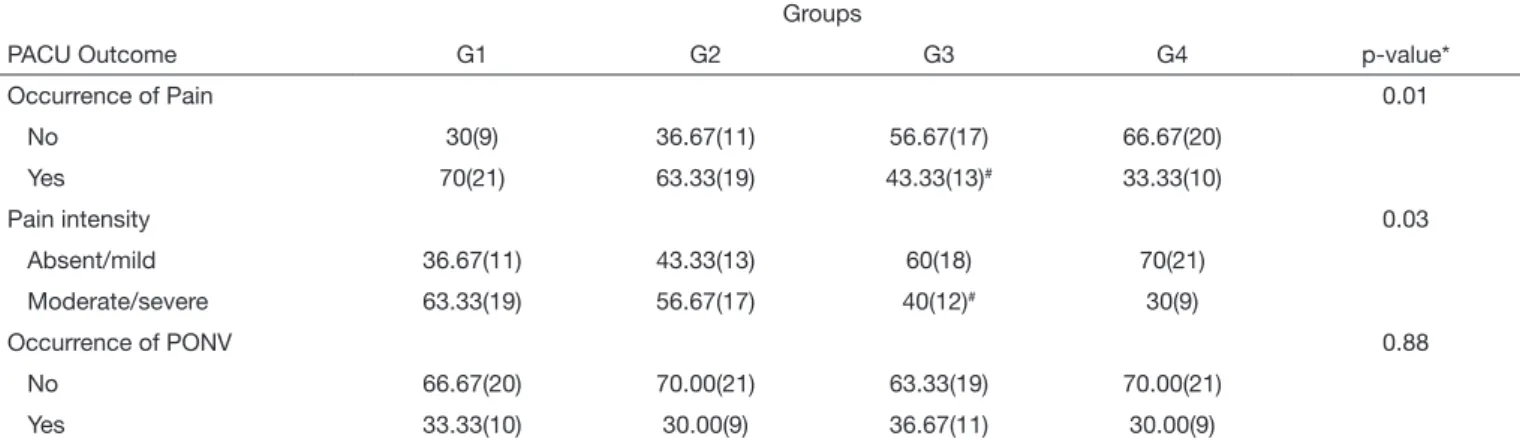
The incidence of pain on the PACU was 52.5% (n=63), and 36.11% of the patients who reported pain exhibited severe pain (defined as an 8 to 10 score on the numeric rating scale). The groups showed a statistically significant difference in relation to the incidence of pain in the PACU, which was lower among patients receiving a continuous infusion of dexmedetomidine (G3=43.33%; G4=33.33%) relative to those receiving remifent-anil infusion (G1=70%; G2=63.33%) (p<0.05). Sufentremifent-anil dos-age in anesthesia induction did not influence the incidence of pain (G1=G2>G3=G4). The incidence of PONV was 31.93%, and symptoms were intense in 15% of these cases. No statistically sig-nificant difference was found between the study groups regarding the occurrence of PONV (p>0.05) (Table 1). For patients pre-senting pain and PONV in the PACU, there was no statistically significant difference in relation to intensity scores between the study groups (p>0.05) (Table 2). Other possible factors were con-sidered as possibly being associated with the occurrence of pain in
the PACU apart from anesthesia technique, but no statistically sig-nificant association was observed with gender (p=0.34), age (years) (p=0.34), surgical technique (p=0.10), or surgery time (p=0.70). The occurrence of oxygen saturation less than 90% as deter-mined by pulse oximetry upon admission to the PACU and without supplemental oxygen occurred in 57% of the cases. Oxygen saturation between 85% and 90% with supplemental oxygen during the period in the PACU occurred in 28.33% of the cases. None of the cases had a recorded saturation less than 85% with supplemental oxygen or a need for positive pressure ventilation or reintubation due to hypoxia. Discharge from the PACU in a period greater than 90 minutes due to pain, PONV, or drowsiness occurred in 16.67% of the cases. No statistically significant difference between the study groups was found in re-lation to the occurrence of respiratory complications (Table 3). The frequency of delayed discharge from the PACU exceeding 90 minutes did not differ between the groups (p>0.05).
Table 1. Comparison between the groups regarding the incidence of pain in the post-anesthesia care unit after anesthesia for bariatric surgery
Groups
PACU Outcome G1 G2 G3 G4 p-value*
Occurrence of Pain 0.01
No 30(9) 36.67(11) 56.67(17) 66.67(20)
Yes 70(21) 63.33(19) 43.33(13)# 33.33(10)
Pain intensity 0.03
Absent/mild 36.67(11) 43.33(13) 60(18) 70(21)
Moderate/severe 63.33(19) 56.67(17) 40(12)# 30(9)
Occurrence of PONV 0.88
No 66.67(20) 70.00(21) 63.33(19) 70.00(21)
Yes 33.33(10) 30.00(9) 36.67(11) 30.00(9)
Values expressed in % (n). *Chi-square test. G1 = induction with 0.5 µg.kg-1 sufentanil associated with the continuous infusion of remifentanil; G2 = induction with 0.7 µg.kg-1 sufentanil associated with the continuous infusion of remifentanil; G3 = induction with 0.5 µg.kg-1 sufentanil associated with the continuous infusion of dexmedetomidine; G4 = induction with 0.7 µg.kg-1 sufentanil associated with the continuous infusion of dexmedetomidine. #Partition Chi-square test: incidence of pain: (G3=G4) < (G1=G2). PACU = post-anesthesia care unit; PONV = postoperative nausea and vomiting.
Table 2. Comparison between the groups in relation to the intensity of pain in the post-anesthesia care unit (numerical scale) and scale of pos-toperative nausea and vomiting symptom intensity after anesthesia for bariatric surgery
Groups
Scales G1 G2 G3 G4 p-value*
Pain (1-10) 6.5(6-7.75) 6(5-7) 7(5.5-8) 6(5-7) 0.45
PONV(1-4) 2(1-3) 3(1-4) 2(1-2) 2(1-3) 0.84
Values expressed as medians (25-75th percentiles). *Kruskal-Wallis analysis of variance: G1=G2=G3=G4. G1 = induction with 0.5 µg.kg-1 sufentanil associated with the continuous infusion of remifentanil; G2 = induction with 0.7 µg.kg-1 sufentanil associated with the continuous infusion of remifentanil; G3 = induction with 0.5 µg.kg-1 sufentanil associated with the continuous infusion of dexmedetomidine; G4 = induction with 0.7 µg.kg-1 sufentanil associated with the continuous infusion of dexmedetomidine. PACU = post-anesthesia care unit; PONV = postoperative nausea and vomiting.
Table 3. Comparison between the groups in relation to respiratory complications and delayed discharge from the post-anesthesia care unit after anesthesia for bariatric surgery
Groups
PACU outcome G1 G2 G3 G4 p-value*
SO2 less than 94% upon admission and without supplementary O2 33.33(10) 40(12) 60(18) 56.67(17) 0.11
SO2 between 85-90% in the PACU with supplemental O2 20(6) 36.67(11) 26.67(8) 30(9) 0.54
Discharge from the PACU after more than 90 minutes 23.33(7) 10(3) 13.33(4) 20(6) 0.49
DISCUSSION
The incidence of postoperative pain following bariatric surgery in patients undergoing general anesthesia is a factor to be consid-ered in the choice of anesthetics to be used intraoperatively. This study assessed the institution’s standard anesthesia technique and evaluated whether using dexmedetomidine as an adjuvant would benefit morbidly obese patients intraoperatively as well as post-operatively in terms of the most prevalent complications in the PACU. In this study, the continuous infusion of dexmedetomi-dine intraoperatively contributed to a reduced incidence of pain in the PACU, without any repercussions involving respiratory complications.
Developing an anesthesia and analgesia protocol in bariatric sur-gery is challenging due to the particular aspects of pain treatment in obese patients3. The polymorphism of the gene involved in the
pharmacokinetics and pharmacodynamics of opioids may be a factor to justify an individualized antalgic therapy and to explain the different pain scores in obese patients receiving the same an-algesic therapy. One study6 has identified 3 types of
polymor-phisms in the mu opioid receptor, with no difference between genders. Associating drugs with other mechanisms of action and analgesic potential guarantees multimodal and more effective analgesia with better outcomes in the recovery, as observed with the use of dexmedetomidine. However, there was still a high in-cidence of pain, regardless of the anesthetic technique. A sys-tematic and effective assessment in the PACU is essential due to the existence of this individualized response to anesthetics,. This allows for the early identification of patients who are more sensi-tive to pain and avoids an overdose of analgesics in those with a more effective response to the use of opioids.
The spinal cord has been suggested as the likely main site of anal-gesic action of α-2 adrenergic agonists such as dexmedetomidine. These drugs seem to have analgesic effects on the spinal cord and supraspinal areas. Dexmedetomidine can also provide antinoci-ception through non-spinal mechanisms7. Thus, anesthesia with
dexmedetomidine provides analgesia in places other than those reached by opioids alone and is, therefore, a potential adjuvant for analgesic control.
Dexmedetomidine has been used in general anesthesia to reduce the use of opioids and thus reduce the incidence of respirato-ry depression. One surgical center performed more than 2,000 bariatric procedures using a perioperative infusion of dexmede-tomidine. This drug was found to be cardioprotective and neuro-protective, presented good hemodynamic stability, and reduced the need for opioids and volatile agents8. When compared to
fentanyl, dexmedetomidine seemed to offer better postoperative analgesia and mitigated changes in blood pressure9.
In two groups of adolescent patients undergoing general an-esthesia for bariatric surgery (with and without an infusion of dexmedetomidine as an adjunct to the intraoperative anesthesia technique), pain scores were significantly lower in the group that received dexmedetomidine. The analgesic effects influenced the pain scores on the first postoperative day and reduced the need for rescue opioids in this period10. A published meta-analysis on
the effects of dexmedetomidine on the perioperative period in
obese patients showed a reduction in the need for postoperative analgesics and found it to be a safe and effective adjunct in obese patients11. In spite of a reduction in the incidence of PONV with
the use of dexmedetomidine determined in the meta-analysis, this effect was not observed in our study.
Remifentanil in continuous infusion is routinely used in an-esthesia for obese patients due to its short duration of action and good hemodynamic stability. Its pharmacokinetics does not seem to change in obese patients; therefore, to avoid excess, doses should be estimated based on ideal body weight12. In a study
comparing intraoperative remifentanil and dexmedetomidine, the dexmedetomidine group exhibited a greater need for rescue analgesia in the first 24h, a finding which differs from our re-sults. However, the methodology was also different, and patients received epidural for analgesia, which influenced the need for rescue analgesia. The study12 also observed that the continuous
intravenous administration of remifentanil offered 8 to 10 minu-tes of advantage over the infusion of dexmedetomidine at the moments of eye-opening, resumption of spontaneous breathing, and orotracheal extubation in morbidly obese patients under a standardized anesthetic technique. This reduction in awakening time was observed in our study, with a longer awakening time in patients undergoing anesthesia with dexmedetomidine and sufentanil at a dose of 0.7 µg.kg-1. Nevertheless, this advantage
shows no clinical relevance.
Postoperative hypoxia is one of the major complications of surgi-cal interventions in patients with morbid obesity. Dexmedetomi-dine can be used safely in patients with a high risk of complica-tions. Studies in animals have shown that it not only reduces the need for anesthetics but also has an intrinsic anesthetic property; it is therefore indicated for intraoperative maintenance of anes-thesia13,14. The current study found a low incidence of respiratory
complications, and no hypoxia-related events with a need for positive pressure ventilation were observed. This low incidence can be explained by the ability of the teams to perform the sur-gery in a reference center and with a shorter sursur-gery time, which leads to lower rates of morbidity. In this case series, surgery time was predominantly limited to 75 minutes, a variable which was not found to be associated with postoperative pain in the PACU. In bariatric surgery, deep relaxation has advantages for surgeon and patient. Compared to the moderate neuromuscular blockade, deep neuromuscular blockade produced stable and improved sur-gical conditions with less postoperative pain15. Deep
neuromus-cular blockade was used in all patients, and this may be a factor that contributed equally among groups to reduce pain score in the PACU. However, intraabdominal pressure (pneumoperitoneum) was maintained in 15mmHg, which limited the result of the deep neuromuscular blockade to decrease the incidence of pain15.
Although a previous study16 found reduced recovery times in the
PACU, the current study groups exhibited no differences when delayed discharge from the PACU and recovery time longer than 90 minutes were considered. Dexmedetomidine did not delay patient discharge since its sedative potential is greater than that of remifentanil.
when associated with dexmedetomidine. Analgesic medication quantities and rescue doses in the PACU were also not assessed, as only the first pain score reported by patients in the PACU was considered as an outcome.
CONCLUSION
The use of dexmedetomidine in anesthesia maintenance was compared to that of remifentanil. Regardless of the dose of sufen-tanil used in induction, dexmedetomidine exhibited an advan-tage to pain management in the PACU, which, in turn, reflected positively on postoperative progress. In addition, dexmedetomi-dine proved to be safe in terms of intraoperative cardiovascular stability and complications, and for respiratory complications in particular, in the PACU.
REFERENCES
1. Nguyen NT, Wolfe BM. The physiologic effects of pneumoperitoneum in the mor-bidly obese. Ann Surg. 2005;241(2):219-26.
2. Schumann R. Anaesthesia for bariatric surgery. Best Pract Res Clin Anaesthesiol. 2011;25(1):83-93.
3. Navarro Martínez MJ, Pindado Martínez ML, Paz Martín D, Caro Cascante M, Mariscal Flores M, Ruiz de Adana JC. [Perioperative anesthetic management of 300 morbidly obese patients undergoing laparoscopic bariatric surgery and a brief review of relevant pathophysiology]. Rev Esp Anestesiol Reanim. 2011;58(4):211-7. Spanish. 4. Silva LM, Kakuda CM, Abib AC, Fugiwara FY, Lima e Lara GF, Mazzotta RC, et al.
Factors associated to postoperative pain in the post-anesthetic care unit in patients submitted to laparoscopic gastroplasty. Rev Dor. 2013;14(4):239-44.
5. Piccinini Filho L, Mathias LA, Malheiros CA, Gregori WM, Guaratini AA, Vieira JE. [Dexmedetomidine in morbid patients undergoing gastroplasty: cardiovascular stability and consumption of intravenous anesthetics. A retrospective study]. Rev Bras Anestesiol. 2006;56(2):109-18. Portuguese.
6. Lloret Linares C, Hajj A, Poitou C, Simoneau G, Clement K, Laplanche JL, et al. Pilot study examining the frequency of several gene polymorphisms involved in morphine pharmacodynamics and pharmacokinetics in a morbidly obese population. Obes Surg. 2011;21(8):1257-64.
7. Al-Alipour M, Mowafi HA, Ismail SA, Siddiqui AK, Al-Ghamdi AM, Shafi MA, et al. Effect of intra-articular dexmedetomidine on postoperative analgesia after arthroscop-ic knee surgery. Br J Anaesth. 2008;101(3):395-9.
8. Ramsay MA, Saha D, Hebeler RF. Tracheal resection in the morbidly obese patient: the role of dexmedetomidine. J Clin Anesth. 2006;18(6):452-4.
9. Feld JM, Hoffman WE, Stechert MM, Hoffman IW, Ananda RC. Fentanyl or dexmedetomidine combined with desflurane for bariatric surgery. J Clin Anesth. 2006;18(1):24-8.
10. Vaughns JD, Martin C, Nelson J, Nadler E, Quezado ZM. Dexmedetomidine as an adjuvant for perioperative pain management in adolescents undergoing bariatric sur-gery: an observational cohort study. J Pediatr Surg. 2017;52(11):1787-90. 11. Singh PM, Panwar R, Borle A, Mulier JP, Sinha A, Goudra B. Perioperative analgesic
profile of dexmedetomidine infusions in morbidly obese undergoing bariatric surgery: a meta-analysis and trial sequential analysis. Surg Obes Relat Dis. 2017;13(8):1434-46. 12. Sudré EC, Salvador Mdo C, Bruno GE, Vasallo DV, Lauretti GR, Sudré Filho GN.
[Remifentanil versus dexmedetomidine as coadjutants of standardized anesthetic tech-nique in morbidly obese patients]. Rev Bras Anestesiol. 2004;54(2):178-89. Portuguese. 13. Segal IS, Vickery RG, Walton JK, Doze VA, Maze M. Dexmedetomidine diminishes
halothane anesthetic requirements in rats through a postsynaptic alpha 2 adrenergic receptor. Anesthesiology. 1988;69(6):818-23.
14. Doze VA, Chen BX, Maze M. Dexmedetomidine produces a hypnotic-anesthet-ic action in rats via activation of central alpha-2 adrenoceptors. Anesthesiology. 1989;71(1):75-9.
15. Warlé MC, Dahan A. Does deep neuromuscular block affect pain after laparoscopic surgery? Eur J Anaesthesiol. 2017;34(1):23-4.